Mostrando entradas con la etiqueta Photosynthesis. Mostrar todas las entradas

sábado, 23 de febrero de 2019

These Artificial Leaves Can Absorb 10 Times More CO2 From The Air Than Real Leaves

Plants possess a natural ability to purify the air and produce energy while doing so. The ability is called photosynthesis and it is the process whereby plants use water and carbon dioxide from the air to produce carbohydrates using energy from the sun. Scientists have found a way to make this happen artificially. The thing is, they hadn’t been able to get these artificial leaves to work outside the lab because the lab leaves use pure, pressurized carbon dioxide from tanks, which is different than getting it out of the air.

An artificial, bio-inspired leaf. Carbon dioxide (red and black balls) enter the leaf as water (white and red balls) evaporates from the bottom of the leaf. An artificial photosystem (purple circle at the center of the leaf) made of a light absorber coated with catalysts converts carbon dioxide to carbon monoxide and converts water to oxygen (shown as double red balls) using sunlight.” (Image: Meenesh Singh).
But now, researchers from the University of Illinois at Chicago have proposed a design solution that could change everything. Their idea just might be the leaves’ ticket out of the lab and into the environment. Their findings are reported in the journal ACS Sustainable Chemistry & Engineering .

Meenesh Singh, assistant professor of chemical engineering in the UIC College of Engineering and corresponding author on the paper, said:

“So far, all designs for artificial leaves that have been tested in the lab use carbon dioxide from pressurized tanks. In order to implement successfully in the real world, these devices need to be able to draw carbon dioxide from much more dilute sources, such as air and flue gas, which is the gas given off by coal-burning power plants.”

The only way that these artificial leaves will be able to collect and concentrate carbon dioxide (a potent greenhouse gas) from the air around us to drive their artificial photosynthetic reactions is if they are unhooked from the pressurized carbon dioxide supply.

Image: Meenesh Singh
Here’s how Singh and his colleague Aditya Prajapati, a graduate student in his lab, propose to solve this problem:
  • The traditional artificial leaf is placed inside a water-filled capsule constructed out of a semi-permeable membrane.
  • When the sunlight warms the water, it evaporates through the membrane – when that happens it gets the capsule to suck in carbon dioxide (co2).
  • The CO2 that’s been sucked in then gets converted into carbon monoxide (CO) and oxygen by the artificial leaf inside the capsule.
  • The carbon monoxide (CO) could be siphoned from the device and used to create synthetic fuels ranging from gasoline to methanol;
  • And the oxygen could be released back into the environment or collected.
In other words, all they have to do is envelope the artificial leaf technology (that has already been developed and works but only in the lab) within this specialized membrane and the whole unit will be able to function outside, like a natural leaf. Furthermore, according to their research, they believe that an artificial leaf built around their design would be 10 times more efficient at converting CO2 to fuel than natural leaves.

Their calculations reveal that 360 of their artificial leaves, each 1.7 meters long and 0.2 meters wide, would generate about half a ton of CO daily, which can be used as a basis for synthetic fuels. If those leaves were to be spread out over 500 square meters, then they could reduce the CO2 levels in the air within 100 meters of the space by 10 percent in just one day.

Singh concludes:

Our conceptual design uses readily available materials and technology, that when combined can produce an artificial leaf that is ready to be deployed outside the lab where it can play a significant role in reducing greenhouse gases in the atmosphere.

by Andrea D. Steffen
February 22, 2019

viernes, 16 de junio de 2017

Scientists Design Molecular System for Artificial Photosynthesis

System is designed to mimic key functions of the photosynthetic center in green plants to convert solar energy into chemical energy stored by hydrogen fuel

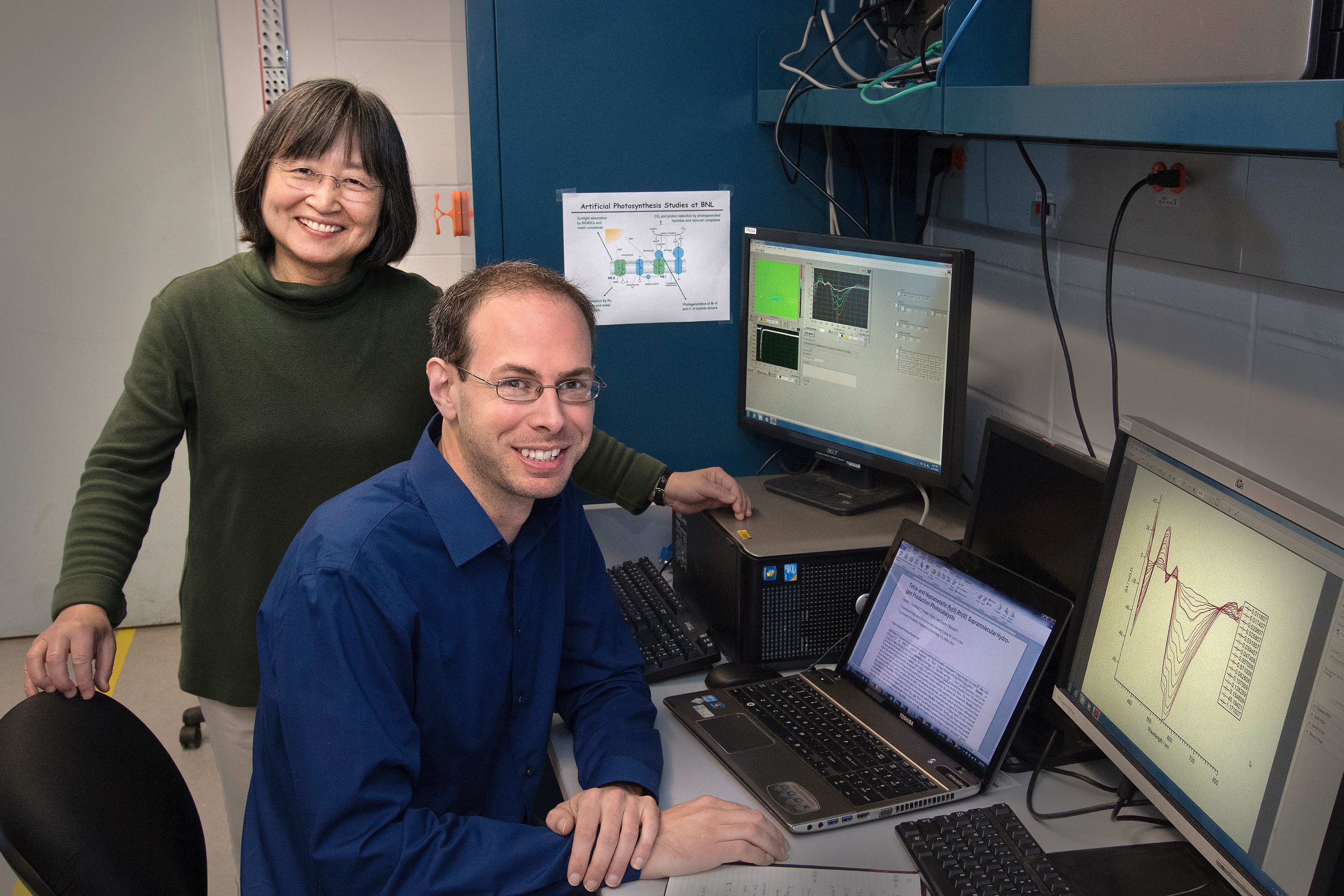
Etsuko Fujita and Gerald Manbeck of Brookhaven Lab's Chemistry Division carried out a series of experiments to understand why their molecular system with six light-absorbing centers (made of ruthenium metal ions bound to organic molecules) produced more hydrogen than the system with three such centers. This understanding is key to designing more efficient molecular complexes for converting solar energy into chemical energy—a conversion that green plants do naturally during photosynthesis.
Finding inspiration from nature
The leaves of green plants contain hundreds of pigment molecules (chlorophyll and others) that absorb light at particular wavelengths. When light of the proper wavelength strikes one of these molecules, the molecule enters an excited state. Energy from this excited state is shuttled along a chain of pigment molecules until it reaches a specific type of chlorophyll in the photosynthetic reaction center. Here, the energy is used to drive the charge-separation process required for photosynthesis to proceed. The electron “hole” left behind in the chlorophyll molecule is used for water-to-oxygen conversion. Hydrogen ions formed during the water-splitting process are eventually used for the reduction of carbon dioxide to glucose in the second stage of photosynthesis, known as the light-independent reaction.
UPTON, NY—Photosynthesis in green plants converts solar energy to stored chemical energy by transforming atmospheric carbon dioxide and water into sugar molecules that fuel plant growth. Scientists have been trying to artificially replicate this energy conversion process, with the objective of producing environmentally friendly and sustainable fuels, such as hydrogen and methanol. But mimicking key functions of the photosynthetic center, where specialized biomolecules carry out photosynthesis, has proven challenging. Artificial photosynthesis requires designing a molecular system that can absorb light, transport and separate electrical charge, and catalyze fuel-producing reactions—all complicated processes that must operate synchronously to achieve high energy-conversion efficiency.

Now, chemists from the U.S. Department of Energy’s (DOE) Brookhaven National Laboratory and Virginia Tech have designed two photocatalysts (materials that accelerate chemical reactions upon absorbing light) that incorporate individual components specialized for light absorption, charge separation, or catalysis into a single “supramolecule.” In both molecular systems, multiple light-harvesting centers made of ruthenium (Ru) metal ions are connected to a single catalytic center made of rhodium (Rh) metal ions through a bridging molecule that promotes electron transfer from the Ru centers to the Rh catalyst, where hydrogen is produced.
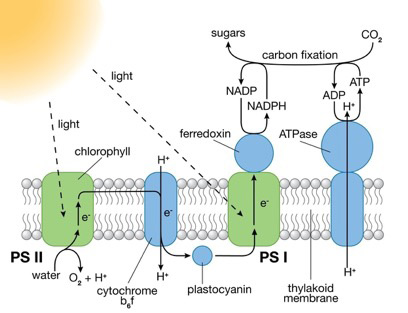
Photosystems (PS) I and II are large protein complexes that contain light-absorbing pigment molecules needed for photosynthesis. PS II captures energy from sunlight to extract electrons from water molecules, splitting water into oxygen and hydrogen ions (H+) and producing chemical energy in the form of ATP. PS I uses those electrons and H+ to reduce NADP+ (an electron-carrier molecule) to NADPH. The chemical energy contained in ATP and NADPH is then used in the light-independent reaction of photosynthesis to convert carbon dioxide to sugars.
They compared the hydrogen-production performance and analyzed the physical properties of the supramolecules, as described in a paper published in the June 1 online edition of Journal of the American Chemical Society, to understand why the photocatalyst with six as opposed to three Ru light absorbers produces more hydrogen and remains stable for a longer period of time. 

Developing efficient molecular systems for hydrogen production is difficult because processes are occurring at different rates,” said lead author Gerald Manbeck, a chemist in the artificial photosynthesis group at Brookhaven Lab. “Completing the catalytic turnover of hydrogen before the separated charges—the negatively charged light-excited electron and positive “hole” left behind after the excited molecule absorbs light energy—have a chance to recombine and wastefully produce heat is one of the major challenges.”

Another complication is that two electrons are needed to produce each hydrogen molecule. For catalysis to happen, the system must be able to hold the first electron long enough for the second to show up. “By building supramolecules with multiple light absorbers that may work independently, we are increasing the probability of using each electron productively and improving the molecules’ ability to function under low light conditions,” said Manbeck.

Manbeck began making the supramolecules at Virginia Tech in 2012 with the late Karen Brewer, coauthor and his postdoctoral advisor. He discovered that the four-metal (tetrametallic) system with three Ru light-absorbing centers and one Rh catalytic center yielded only 40 molecules of hydrogen for every catalyst molecule and ceased functioning after about four hours. In comparison, the seven-metal (heptametallic) system with six Ru centers and one Rh center was more than seven times more efficient, cycling 300 times to produce hydrogen for 10 hours. This great disparity in efficiency and stability was puzzling because the supramolecules contain very similar components.
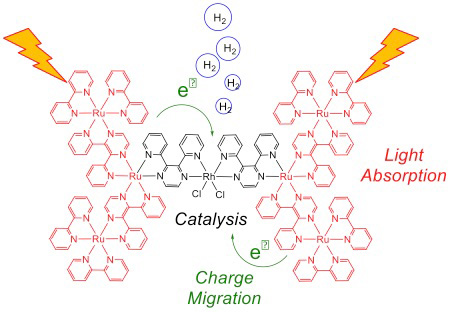
This depiction of the heptametallic system upon exposure to light shows light harvesting by the six Ru centers (red) and electron transfer to the Rh catalyst (black), where hydrogen is produced. Efficient electron transfer to Rh is essential for realizing high catalytic performance.

Manbeck joined Brookhaven in 2013 and has since carried out a series of experiments with coauthor Etsuko Fujita, leader of the artificial photosynthesis group, to understand the fundamental causes for the difference in performance.

The ability to form the charge-separated state is a partial indicator of whether a supramolecule will be a good photocatalyst, but realizing efficient charge separation requires fine-tuning the energetics of each component,” said Fujita. “To promote catalysis, the Rh catalyst must be low enough in energy to accept the electrons from the Ru light absorbers when the absorbers are exposed to light.

Through cyclic voltammetry, an electrochemical technique that shows the energy levels within a molecule, the scientists found that the Rh catalyst of the heptametallic system is slightly more electron-poor and thus more receptive to receiving electrons than its counterpart in the tetrametallic system. This result suggested that the charge transfer was favorable in the heptametallic but not the tetrametallic system.

They verified their hypothesis with a time-resolved technique called nanosecond transient absorption spectroscopy, in which a molecule is promoted to an excited state by an intense laser pulse and the decay of the excited state is measured over time. The resulting spectra revealed the presence of a Ru-to-Rh charge transfer in the heptametallic system only.

The data not only confirmed our hypothesis but also revealed that the excited-state charge separation occurs much more rapidly than we had imagined,” said Manbeck. “In fact, the charge migration happens faster than the time resolution of our instrument, and probably involves short-lived, high-energy excited states.” The researchers plan to seek a collaborator with faster instrumentation who can measure the exact rate of charge separation to help clarify the mechanism.

In a follow-up experiment, the scientists performed the transient absorption measurement under photocatalytic operating conditions, with a reagent used as the ultimate source of electrons to produce hydrogen (a scalable artificial photosynthesis of hydrogen fuel from water would require replacing the reagent with electrons released during water oxidation). The excited state generated by the laser pulse rapidly accepted an electron from the reagent. They discovered that the added electron resides on Rh in the heptametallic system only, further supporting the charge migration to Rh predicted by cyclic voltammetry.

The high photocatalytic turnover of the heptametallic system and the principles governing charge separation that were uncovered in this work encourage further studies using multiple light-harvesting units linked to single catalytic sites,” said Manbeck.

This research is supported by DOE’s Office of Science.
Brookhaven National Laboratory is supported by the Office of Science of the U.S. Department of Energy. The Office of Science is the single largest supporter of basic research in the physical sciences in the United States, and is working to address some of the most pressing challenges of our time. For more information, please visit science.energy.gov.

Related Links

ORIGIN: Brookhaven National Lab
June 2, 2017
Contact: Ariana Tantillo, (631) 344-2347, or Peter Genzer, (631) 344-3174

miércoles, 21 de diciembre de 2016

Artificial leaf as mini-factory for drugs (for Medicine)

(Nanowerk News) To produce drugs sustainably and cheaply, anywhere you want. Whether in the middle of the jungle or even on Mars. A 'mini-factory' whereby sunlight can be captured to make chemical products. Inspired by the art of nature where leaves are able to collect enough sunlight to produce food, chemical engineers at Eindhoven University of Technology (TU/e) have presented such a scenario.

They describe their prototype reactor - consciously shaped as a leaf -in today's journal Angewandte Chemie ("A leaf-inspired luminescent solar concentrator for energy efficient continuous-flow photochemistry").

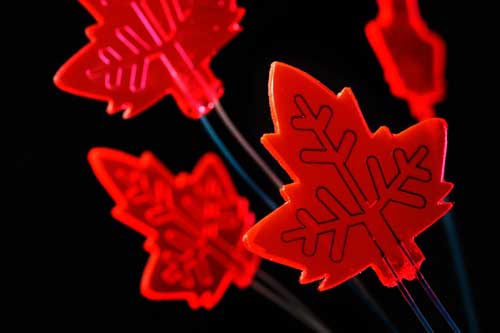
Even with the naked eye the amount of light captured by the 'mini-factories' is visible, lit up bright red. The 'veins' through the leaves are the thin channels through which liquid can be pumped. The start products enter the one channel, light causes the reactions and the end product comes out via the other channels. (Image: Bart van Overbeeke)
Using sunlight to make chemical products has long been a dream of many a chemical engineer. The problem is that the available sunlight generates too little energy to kick off reactions. However, nature is able to do this. Antenna molecules in leaves capture energy from sunlight and collect it in the reaction centers of the leaf where enough solar energy is present for the chemical reactions that give the plant its food (photosynthesis).

Light capture
The researchers came across relatively new materials, known as luminescent solar concentrators (LSC's), which are able to capture sunlight in a similar way. Special light-sensitive molecules in these materials capture a large amount of the incoming light that they then convert into a specific color that is conducted to the edges via light conductivity. These LSC's are often used in practice in combination with solar cells to boost the yield.

Thin channels
The researchers, led by Dr. Timothy Noël, combined the idea of an LSC with their knowledge of microchannels, incorporating very thin channels in a silicon rubber LSC through which a liquid can be pumped. In this way they were able to bring the incoming sunlight into contact with the molecules in the liquid with high enough intensity to generate chemical reactions.

Watch an animation of the artificial leaf.
Surpassed
While the reaction they chose serves as an initial example, the results surpassed all their expectations, and not only in the lab.
"Even an experiment on a cloudy day demonstrated that the chemical production was 40 percent higher than in a similar experiment without LSC material", says research leader Noël. "We still see plenty of possibilities for improvement. We now have a powerful tool at our disposal that enables the sustainable, sunlight-based production of valuable chemical products like drugs or crop protection agents."

Paracetamol on Mars
For the production of drugs there is certainly a lot of potential. The chemical reactions for producing drugs currently require toxic chemicals and a lot of energy in the form of fossil fuels. By using visible light the same reactions become sustainable, cheap and, in theory, countless times faster. But Noël believes it should not have to stop there.

"Using a reactor like this means you can make drugs anywhere, in principle, whether malaria drugs in the jungle or paracetamol on Mars. All you need is sunlight and this mini-factory."

Source: Eindhoven University of Technology


ORIGINAL: NanoWerk
Dec 21, 2016

jueves, 22 de septiembre de 2016

Fusing of Organic Molecules With Graphene Opens Up New Applications

 Photo: TUM A Model Molecule: Prof. Wilhelm Auwärter with a porphin-model.
 The hemoglobin-like molecule called porphyrin, which is responsible for making photosynthesis possible in plants and transporting oxygen in our blood, has been combined with graphene by researchers at the Technical University of Munich (TUM) in a new method that may make possible everything from molecular electronics to improved gas sensors.

While graphene’s properties—ranging from its electrical conductivity to its tensile strength—have made it desirable in a number of electronic applications, it still needs to be combined with so-called functional molecules to make it useful in applications such as photovoltaics and gas sensors. To date, the addition of these other functional molecules has been carried out through “wet chemistry,” which limits the amount of control possible over the properties of the resulting material.

However,  in a method described in the journal Nature Chemistry, the TUM researchers developed a highly controllable “dry” method based on exploiting the catalytic properties of a silver surface on which the graphene layer rested inside an ultra-high vacuum.

The benefit of this technique is that it preserves all the attractive properties of the porphyrins even after being combined with the graphene, most notably their intrinsic ability to have their electronic and magnetic properties tuned by the addition of different metal atoms. In terms of real-world devices, this means that these different metal atoms can bind with gas molecules to create effective gas sensors.

More generally, the method the TUM researchers have developed could be a breakthrough for how graphene is functionalized for a range of electronic applications.

The key to the importance of this research in terms of electronics is the complementary electronic structure in the graphene and the porphyrins,” said Wilhelm Auwärter, a professor at TUM who led the research, in an e-mail interview with IEEE Spectrum. “The porphyrins feature large electronic gaps, in contrast to graphene. The electronic, optical and magnetic properties of the porphyrins can be tuned by the choice of the metal center of the molecule.Electronic band gaps are critical to controlling how conductive a material is, and in turn, whether or not the material can be used in an electronic switch such as a transistor.

Auwärter further explains the electronic and magnetic properties of the porphyrins can also be modified by the attachment of gaseous ligands (like oxygen or nitric monoxide), This would allow, for example turning on and off the material’s mechanical response to a magnetic field. “Such functionalities are not inherent to the pristine graphene,” he added.

Auwärter also said that it should be possible to directly incorporate porphyrins into graphene nanoribbons. “In this way, one could achieve sequences of graphene ‘wires’ and porphyrin units. This should allow the engineering of an electronic gap in the hybrid structures,” he said.

While Auwärter believes that this manufacturing approach provides an avenue that could lead to new device designs for a range of electronic applications, he does concede that this is preliminary research that primarily serves as a starting off point.

We need to apply our protocol to well-defined graphene nanostructures, such as nanoribbons or nanographenes,” said Auwärter. “We need to place the hybrid structures on specific supports or to include them in layered materials and devices.”

In the future, to exploit this method for electronic applications, Auwärter points out that the hybrid material will need to be grown on insulating supports like hexagonal boron nitride.

While the electronic applications may still be somewhat far off, the novel protocol does offer an intriguing way forward for graphene-based electronics.
Learn More Technical University of Munichband gapgas sensorsgraphenegraphene nanoribbonsmolecular electronicsporphyrins

ORIGINAL: IEEE Spectrum
By Dexter Johnson
22 Sep 2016

martes, 6 de septiembre de 2016

Can we synthetically engineer C4 photosynthesis?

Photosynthesis as the engine for life on earth has high engineering potential, which has not yet been fully exploited…By step-wise identification of all the components needed for engineering, it will eventually become possible to employ this powerful machinery to increase yields for the future.

Schuler, ML, Mantegazza, O & Weber, APM, 2016, ‘Engineering C4 photosynthesis into C3 chassis in the synthetic biology age’. The Plant Journal, vol. 87, pp. 62

These lines from the conclusion of the review we write about here are indicative of why so much effort is being put into understanding the more productive C4 photosynthetic system and working to increase important crop yields with it.

Schuler, Mantegazza and Weber’s article in the special issue of The Plant Journal on plant synthetic biology provides an excellent overview of the current status, significant hurdles and possible solutions to those problems of the current research aimed at bolstering rice yield by converting it from the common C3 photosynthesis system to the more efficient C4 system. We’ve previously written about C4 photosynthesis here and here.

C4 photosynthesis
C4 photosynthesis has evolved independently at least 66 times and is likely linked to a sudden drop in atmospheric CO2 levels sometime in the past. It is characterised by the concentration of CO2 around Rubisco (ribulose 1,5-bisphosphate carboxylase/oxygenase), the carbon-assimilating enzyme, reducing the competition that CO2 has with O2 to interact with the enzyme. More CO2 means greater growth and reduced photorespiration, an energy requiring process that is used to remove the O2 reaction products.

The concentration of CO2 in C4 photosynthesis is usually caused by a two-celled (but one-celled is possible) distribution of the process of fixing carbon and the process of reducing it. The two-celled system combines mesophyll (M) cells, which take up the CO2 from the leaf air space, and the bundle sheath (BS) cells, where the Rubisco enzymes reside, the final destination of CO2 for fixation and entry into the Calvin-Benson cycle. These two cells are arranged in concentric layers (called ‘Kranz Anatomy’) around leaf veins, maximising the contact between the two types of cells and increasing the transport of the molecules between them.


M cells convert CO2 to bicarbonate and then into the 4 carbon compound oxaloacetate via an enzyme that doesn’t react with oxygen. The modified compound is then passed to the BS cells where it is reformed into CO2 and fixed by Rubisco to enter the Calvin-Benson cycle.

Basically, by assimilating CO2 away from Rubisco, the plant reduces the ability of Rubisco to interact with O2 and instead it is steadily fed with CO2 from the M cells.

Of course, this description of the process is simplified and although most of the process and main enzymes that carry out the process are known, there are still gaps in our knowledge.

Recent Advances
The gathering of increasing amounts of genomic, trascriptomic and metabolimic data continue to improve our knowledge of C4 photosynthesis, how it evolved and how we might transition C3 crops to use the more efficient carbon fixation method.

Important C4 crop species have had their genomes sequenced and quantitative analysis of transcriptomes have begun to unravel the mystery behind the genes upregulated and downregulated, and the stage of development that these regulatory differences occur, that lead the formation of the Kranz anatomy. What we are finding is that many of the genes involved in C4 photosynthesis exist in C3 plants but are differently regulated at early stages to differentiate the BS and M cells, enable high throughput of metabolites between the cells and to increase the size of vascular tissue to support the increased activity.

Engineering C4 photosynthesis
Our initial attempts to engineer C4 photosynthesis relied on over-expressing one or more enzymes in C3 plants. However, given the enzymes involved in the C4 system are used in the C3 system in multiple alternative pathways, the effects of over-expression were multiple, varied and didn’t have the desire result. The compartmentalisation of reactions, whether in the single or two-celled reactions that make up the distinctive photosystem, is complex.

The notion of being able to engineer C4 photosynthesis is comforted by a number of factors:
  1. The main enzymes are already present in C3 photosynthesis;
  2. Characteristics such as the passing of metabolites between cells is seen in C3 species such as tobacco plants; and
  3. Nature has done it herself in the past on multiple, independent occasions.
But the authors of the paper also note a number of engineering steps that need to be accomplished if we are re-enact evolution ourselves;
  1. Higher order veins need to be initiated in plants (it previously being shown that such physical properties were already evolved in plants that subsequently evolved the Kranz anatomy);
  2. The ratio of BS to M cells must be increased, ideally in a similar concentric organisation to Kranz anatomy;
  3. Enlarging and enriching BS cells with additional chloroplasts;
  4. Increasing the connection between M and BS cells;
  5. Engineering the different morphologies of the chloroplasts to mimic the morphologies of chloroplasts found in M and BS cells;
  6. Mirror the differing roles that M and BS cells take on in C4 photosynthesis so Rubisco reduction of CO2 occurs only in the BS cells with M cells feeding CO2 to the BS cells and excluding the oxidation of O2.
The tools we need
If we are to achieve success we still have some tools to develop and refine.

Chief among this list is a model plant that can be engineered and tested easily with speedy regeneration without requiring too much growing room. The authors point out that rice crops have some limitations in these criteria but identify Brachypodium distachyon as a model C3 plant with a small, annotated genome with quick flowering time, low growing space requirements and an efficient transformation protocol. A model such as this could hasten the engineering, testing and data gathering on conversion which can then be tested on important crop species.

A C4 model plant with similar characteristics is also required. Setaria viridis has previously been suggested as a possible model plant, as has the Fast Flowering Mini Maize.

The ability to drive and control expression of a transgene is also required. Cis-regulatory modules that promote gene expression are still under development in the wider plant synthetic biology area. This leaves a chasm between the tools we have to hand and the possibility that a large number of genes need to be differentially expressed in order to convert C3 photosynthesis to C4 photosynthesis.

Huge strides are being made with genetic manipulation, particularly with the discovery and modification of the CRISPR/Cas 9 system. But, according to the article, the maximum number of genes successfully introduced into a plant, at present, is 9. To induce C4 photosynthesis in a C3 plant, we may need the ability to stably transform a far larger number of genes plus regulatory elements, and do so without disrupting the remainder of the genome or the phenotype characteristics of our food crops.

Even when we do have these tools at the ready, we are still missing some vital information about the genes and regulatory elements that compose C4 photosynthesis. Increasing our knowledge of minutia of genetic composition and regulation of C4 systems compared to C3 systems is still a top priority. Identifying genera with the underlying predisposition that have allowed species within it to evolve from C3 to C4 for comparative analysis, particularly species displaying characteristics of a C3-C4 intermediate with sister taxa displaying C3 and C4 phenotypes, would be idyllic in assisting the study of the evolution. The authors highlight Morandia and Parthenium generas as possible true intermediates between C3 and C4 plants. Programs such as the Grass Phylogeny Working Group and the 1KP (1000 plants) project will greatly assist identifying and genotyping suitable candidates for understanding the genetics behind enhancing crop photosynthesis.

And some suggested means of pushing the research…
It is great to see that not only have the authors elucidated quite extensively the current knowledge and gaps within the field of C4 photosynthesis engineering, but have also suggested a couple of ways of advancing the research.

The first idea they suggested is synthetically replicating a simplified C4 photosynthetic system using known genetic components. The system replicates the targeting of specific enzymes to create a two-celled photosynthesis construct, limiting Rubisco to the BS cells using RNAi to interfere with its transcription in M cells. The article highlights specific transporters that can be used to transport the metabolites between the two cells.

A second suggested idea is using brute force to direct a speedy evolution of a C3 or C3-C4 intermediate species into a C4 plant. Identifying the minimum genetic requirements of a C4 plant in a candidate crop would then be followed by the repetitive growth under the selective pressure of a low CO2 atmosphere. By repeating genomic and transcription analysis of the evolving plant (if successful), a ‘mud-map’ of the road from C3 to C4 plants can be generated and be of enormous use to research seeking to synthetically install the same machinery.

Conclusion
Although its behind a pay-wall, get your hands on this article. Whether it be for a background in C4 photosynthesis or as a springboard for your own research, it is an area of immense potential that should be worthy of an X prize.

martes, 7 de junio de 2016

From Living Computers to Nano-Robots: How We’re Taking DNA Beyond Genetics


DNA is one of the most amazing molecules in nature, providing a way to carry the instructions needed to create almost any life form on Earth in a microscopic package. Now scientists are finding ways to push DNA even further, using it not just to store information but to create physical components in a range of biological machines.

Deoxyribonucleic acid or “DNA” carries the genetic information that we, and all living organisms, use to function. It typically comes in the form of the famous double-helix shape, made up of two single-stranded DNA molecules folded into a spiral. Each of these is made up of a series of four different types of molecular component: adenine (A), guanine (G), thymine (T), and cytosine (C).

Genes are made up from different sequences of these building block components, and the order in which they appear in a strand of DNA is what encodes genetic information. But by precisely designing different A, G, T and C sequences, scientists have recently been able to develop new ways of folding DNA into different origami shapes, beyond the conventional double helix.

This approach has opened up new possibilities of using DNA beyond its genetic and biological purpose, turning it into a Lego-like material for building objects that are just a few billionths of a meter in diameter (nanoscale). DNA-based materials are now being used for a variety of applications, ranging from templates for electronic nano-devices, to ways of precisely carrying drugs to diseased cells.

DNA-based nanothermometers
Designing electronic devices that are just nanometers in size opens up all sorts of possible applications but makes it harder to spot defects. As a way of dealing with this, researchers at the University of Montreal have used DNA to create ultrasensitive nanoscale thermometers that could help find minuscule hotspots in nanodevices (which would indicate a defect). They could also be used to monitor the temperature inside living cells.

The nanothermometers are made using loops of DNA that act as switches, folding or unfolding in response to temperature changes. This movement can be detected by attaching optical probes to the DNA. The researchers now want to build these nanothermometers into larger DNA devices that can work inside the human body.

Biological nanorobots
Researchers at Harvard Medical School have used DNA to design and build a nanosized robot that acts as a drug delivery vehicle to target specific cells. The nanorobot comes in the form of an open barrel made of DNA, whose two halves are connected by a hinge held shut by special DNA handles. These handles can recognize combinations of specific proteins present on the surface of cells, including ones associated with diseases.

When the robot comes into contact with the right cells, it opens the container and delivers its cargo. When applied to a mixture of healthy and cancerous human blood cells, these robots showed the ability to target and kill half of the cancer cells, while the healthy cells were left unharmed.
DNA barrel. Image credit: Campbell Strong, Shawn Douglas, and Gaël McGill.
Bio-computers in living animals
Because DNA structures can act as switches, moving from one position to another and back again, they can be used to perform the logical operations that make computer calculations possible. Researchers at Harvard and Bar-Ilan University in Israel have used this principle to build different nanoscale robots that can interact with each other, using their DNA switches to react to and produce different signals.

What’s more, the scientists implanted the robots into a living animal, in this instance a cockroach. This allowed them to develop a novel type of biological computer that can control the delivery of therapeutic molecules inside the cockroach by switching elements of their structure “on” or “off”. A trial of these DNA nanorobots is now scheduled to take place in humans.

Light-harvesting antennas
As well as creating minuscule machines, DNA can provide a way for us to copy natural processes at the nanoscale. For example, nature can capture energy from the sun using photosynthesis to convert light into chemical energy, which acts as fuel for plants and other organisms (and the animals that eat them). Researchers at Arizona State University and the University of British Columbia have now built a three-arm DNA structure that can capture and transfer light that mimics this process.

Photosynthesis occurs in living organisms thanks to tiny antennas made up of a large number of pigment molecules at specific orientations and distances from each other, which are able to absorb visible light. The artificial DNA-based structures act as similar antennas, controlling the position of specific dye molecules that absorb the light energy and channel it to a reaction centre where it is converted into chemical energy. This work could pave the way for devices capable of more efficiently using the most abundant source of energy we have at our disposal: sunlight.

So what’s next for DNA nanotechnology? It is hard to know but, with DNA, nature has given us a very versatile tool. It is now up to us to make the best use of it.

ORIGINAL: Singularity Hub

A Big Leap for an Artificial Leaf

A new system for making liquid fuel from sunlight, water, and air is a promising step for solar fuels.

The bionic leaf is one step closer to reality.
Daniel Nocera, a professor of energy science at Harvard who pioneered the use of artificial photosynthesis, says that he and his colleague Pamela Silver have devised a system that completes the process of making liquid fuel from sunlight, carbon dioxide, and water. And they’ve done it at an efficiency of 10 percent, using pure carbon dioxidein other words, one-tenth of the energy in sunlight is captured and turned into fuel. That is much higher than natural photosynthesis, which converts about 1 percent of solar energy into the carbohydrates used by plants, and it could be a milestone in the shift away from fossil fuels. The new system is described in a new paper in Science.

Bill Gates has said that to solve our energy problems, someday we need to do what photosynthesis does, and that someday we might be able to do it even more efficiently than plants,” says Nocera. “That someday has arrived.

In nature, plants use sunlight to make carbohydrates from carbon dioxide and water. Artificial photosynthesis seeks to use the same inputs—solar energy, water, and carbon dioxide—to produce energy-dense liquid fuels. Nocera and Silver’s system uses a pair of catalysts to split water into oxygen and hydrogen, and feeds the hydrogen to bacteria along with carbon dioxide. The bacteria, a microörganism that has been bioengineered to specific characteristics, converts the carbon dioxide and hydrogen into liquid fuels.

Several companies, including Joule Unlimited and LanzaTech, are working to produce biofuels from carbon dioxide and hydrogen, but they use bacteria that consume carbon monoxide or carbon dioxide, rather than hydrogen. Nocera’s system, he says, can operate at lower temperatures, higher efficiency, and lower costs.

Nocera’s latest work “is really quite amazing,” says Peidong Yang of the University of California, Berkeley. Yang has developed a similar system with much lower efficiency. “The high performance of this system is unparalleled” in any other artificial photosynthesis system reported to date, he says.

The new system can use pure carbon dioxide in gas form, or carbon dioxide captured from the air—which means it could be carbon-neutral, introducing no additional greenhouse gases into the atmosphere. “The 10 percent number, that’s using pure CO2,” says Nocera. Allowing the bacteria themselves to capture carbon dioxide from the air, he adds, results in an efficiency of 3 to 4 percent—still significantly higher than natural photosynthesis.That’s the power of biology: these bioörganisms have natural CO2 concentration mechanisms.

Nocera’s research is distinct from the work being carried out by the Joint Center for Artificial Photosynthesis, a U.S. its fusing of two usually separate fields:
  • inorganic chemistry (to split water) and 
  • biology (to convert hydrogen and carbon dioxide into fuel). 
What’s really exciting is the hybrid approach” to artificial photosynthesis, says Co. “It’s exciting to see chemists pairing with biologists to advance the field.

Commercializing the technology will likely take years. In any case, the prospect of turning sunlight into liquid fuel suddenly looks a lot closer.


ORIGINAL: Technology Review
by Richard Martin
June 7, 2016

lunes, 28 de diciembre de 2015

The Ideal Fuel

A nanomaterials chemist has figured out a good way to mimic leaves and turn water and carbon dioxide into things we need.
Peidong Yang
On a sunny day on the campus of the University of California, Berkeley, the peaceful rustling of eucalyptus trees belies the furious chemical activity happening inside every single leaf. Through photosynthesis, leaves use the energy in sunlight to turn water and carbon dioxide into substances that plants need, emitting only oxygen in the process. In a nearby lab, chemist Peidong Yang is building an artificial system that does the same, using arrays of nanowires coupled with engineered bacteria. If something like this is ever scaled up, it would churn out a better version of the fuels we use today—one that does not add to the total amount of carbon dioxide in the air.

Photosynthesis has been very difficult to imitate in the lab. In the 1970s, researchers at the University of Tokyo showed for the first time that a solar-powered device could do what plants do in the first step of photosynthesis: split water into hydrogen and oxygen. After an initial burst of activity, the field stalled. But it has been reborn in several labs thanks to a renewed focus on the energy problem and climate change—and because of the emergence of new technologies.

1. This small reactor filled with chemical precursors and water is heated in an oven to grow titanium dioxide nanowires.
2. Silicon ­nanowires are grown from gaseous ­precursors ­flowing through this ­reactor.
3. Silicon ­nanowires can also be grown on larger ­surfaces such as this wafer. It gets cut into pieces that serve as ­electrodes inside the device. 
4. Bacteria in this incubator will be seeded on an ­electrode to act as living catalysts.
Yang’s lab is improving on a basic design that was developed in the 1970s at the National Renewable Energy Laboratory. It has two light-sensitive electrodes coated with a catalyst—Yang is using nickel, which is inexpensive—that together split water into oxygen and hydrogen. In the original setup, the electrodes were flat, but Yang instead uses arrays of nanowires made from silicon and other semiconductors. Because the nanowires have 100 times the surface area of flat electrodes that could fit into the same space, they can hold more of the catalyst, greatly boosting the efficiency of the reaction.

However, splitting water is the easy half of photosynthesis. Plants go further, using the hydrogen from water in reactions that turn carbon from the air into complex molecules. Yang wants to do this too. After all, our planes and cars don’t run on hydrogen; they need gasoline and other chemically complex fuels.
5. Inside this device, light ­powers a reaction in which water and ­carbon dioxide are ­converted to fuel. Tubing allows the reaction’s side product—pure ­oxygen—to escape. 
6 and 7. Some bacteria in the system produce methane, which can be used directly as a fuel; others make acetate, which is fed to other genetically engineered bacteria to make fuels and plastics. Here, engineered E. colifeed on acetate.

8. Analytical tools including mass spectrometers are used to ­verify that the bacteria made the desired chemical. So far, the system is as efficient as natural photosynthesis.
To catalyze that part of the process, Yang relies on another technology that wasn’t around in the ’70s. He and colleagues have shown that genetically engineered bacteria nestled amid the nanowires function as “living catalysts.” They take up the hydrogen split from the water and combine it with carbon dioxide to make methane and other hydrocarbons that are needed for fuels or plastics. The bugs do this with natural enzymes that carry out a series of reactions chemists have not yet been able to master with synthetic catalysts.

Yang’s system currently matches the efficiency of photosynthesis, storing under 1 percent of the energy captured from sunlight in the form of chemical bonds. That’s not bad for a proof-of-concept demonstration, but making it more efficient and thus cost-effective will be essential.

Yang hopes to eventually switch to synthetic catalysts instead of bacteria, which are tricky to keep alive. But fully eliminating the bugs might not be necessary, given the urgent need for clean fuels. “If it has to be a hybrid approach, that’s okay,” he says.

ORIGINAL: MIT News
By Katherine Bourzac | Photographs by RC Rivera
December 22, 2015

jueves, 20 de agosto de 2015

'Artificial Leaf' Reaches Best Level Of Solar Energy Efficiency Yet

Photo credit: Green leaves. jajaladdawan/Shutterstock.

Humans have been struggling for years to create clean, renewable energy that doesn't decimate the planet. What's even more infuriating is that plants, waving gently in the breeze all the while, have been creating 'green' energy before mankind even existed. During plant photosynthesis, water and carbon dioxide is turned into glucose and oxygen. Recently, mankind has been trying to learn from plants to produce our own clean, green machines – in this case, artificial leaves.

The latest advancement in the artificial leaf comes from Monash University in Melbourne and brings us another step closer to a commercially viable method of turning water into fuel. Instead of creating glucose, the artificial leaf uses water and sunlight to produce hydrogen and oxygen. This process of "electrochemical splitting" is achieved by running an electric current through the water. The hydrogen can then be used for fuel production.

The make or break for any energy production technology is the all-important level of efficiency. If the energy output is too low, then artificial leaves will never stand a chance at replacing our current sources of energy, including things such as fossil fuels and nuclear power. In the past, the highest efficiency achieved in an artificial leaf was 18%. However, the scientists from Melbourne have increased this to an impressive 22%, the highest efficiency ever seen in artificial leaves. You can read about the details of this new device in Energy and Environmental Science.

While this level of efficiency is the best yet, it is still not quite good enough to make the process financially viable. However, the researchers note that they are aware of the parameters that need fine-tuning and which components need tweaking for the next generation of tests.

Electrochemical splitting of water could provide a cheap, clean and renewable source of hydrogen as the ultimately sustainable fuel. This latest breakthrough is significant in that it takes us one step further towards this becoming a reality,” Professor Leone Spiccia, the lead researcher, said in a statement. Creating energy without waste is one of the biggest issues the world is facing in the 21st century. Just recently, President Obama set an ambitious goal of reducing emissions by more than 80% by 2050, relative to 2005 levels. This target could be much more easily achieved with the assistance of something like the artificial leaf.

If the artificial leaf can be improved to a marketable level, then we could be seeing forests of them powering our houses, cars and maybe even entire cities. 

Hydrogen can be used to generate electricity directly in fuel cells. Cars driven by fuel cell electric engines are becoming available from a number of car manufacturers. Hydrogen could even be used as an inexpensive energy storage technology at the household level to store energy from roof-top solar cells,Professor Doug MacFarlane, co-author of the study, summarized.

ORIGINAL: IFLScience
by Caroline Reid
August 19, 2015

martes, 28 de abril de 2015

Artificial Photosynthesis Yields Valuable Chemicals


photo credit: Berkeley Lab. These nanowire superconductors don't look like much even under a scanning electron microscope, but in combination with bacteria, they could turn carbon dioxide into useful products
Tiny semiconductors and bacteria have been combined to create a system that uses sunlight to turn carbon dioxide into valuable chemicals.

Photosynthesis forms the basis of most life on Earth. However, it cannot draw carbon dioxide out of the atmosphere fast enough to match the rate at which we are releasing what was stored over millions of years. This has led to a quest to produce an artificial and more efficient version – ideally one that would turn the carbon into something we can easily use.

Recently, there has been a lot of work based around the idea of combining bacteria with manufactured materials. The Lawrence Berkeley National Laboratory has announced what team leader Professor Peidong Yang calls “a revolutionary leap forward” in this area.

"Our system has the potential to fundamentally change the chemical and oil industry in that we can produce chemicals and fuels in a totally renewable way, rather than extracting them from deep below the ground,” says Yang.

The work, described in Nano Letters, combines an array of semiconductor nanowires with Sporomusa ovata to turn carbon dioxide into acetate (C2H3O2−) using just sunlight and water.

The silicon and titanium dioxide wires use sunlight to produce a flow of electrons and have a large surface area for the bacteria to colonize. Using the electron's flow, the bacteria turn carbon dioxide to acetate. Genetically engineered E. coli exist that can turn the acetate into a variety of valuable products, including the fuel butanol, the pharmaceutical precursor amorphadiene and the biodegradable plastic PHB

"In natural photosynthesis, leaves harvest solar energy and carbon dioxide is reduced and combined with water for the synthesis of molecular products that form biomass," says co-author Chris Chang. "In our system, nanowires harvest solar energy and deliver electrons to bacteria, where carbon dioxide is reduced and combined with water for the synthesis of a variety of targeted, value-added chemical products."

Credit: Berkeley Lab. Schematic of the four-step process to turn waste carbon dioxide into useful products through artificial photosynthesis.

The carbon dioxide would be sourced from the exhaust of coal or gas-fired power stations. Unlike some plans for making use of power station waste, the wires offer protection to the normally oxygen-phobic bacteria, removing the need to separate the waste carbon dioxide from oxygen.

The water is slightly salty and contains trace vitamins for the bacteria, both of which are not in short supply. Likewise, the use of readily available raw materials for the wires indicates that the process should be able to be conducted very cheaply once mass production is under way. The authors add that by combining the two bacterial species, costs could be reduced further.

The conversion efficiency of the acetate to valuable chemicals is already between 25 and 52%, but the wires are currently only turning 0.38% of sunlight to electric charge, a 50th of good commercial solar cells.

"We are currently working on our second generation system which has a solar-to-chemical conversion efficiency of three-percent," Yang says. "Once we can reach a conversion efficiency of 10-percent in a cost effective manner, the technology should be commercially viable."


ORIGINAL: IFL Science
by Stephen Luntz
April 20, 2015

viernes, 16 de enero de 2015

Welcome to Plant-e

Do you want to use your lawn to charge your electric car? Use your green roof to power your house? Would you like to see each wetland and rice paddy field in the world turned into a power plant without harvesting the plants? Plant-e is a company that develops and produces products in which living plants generate electricity.

The company was founded on September 14, 2009 as a spin-off from the sub-department of Environmental Technology of Wageningen University by David Strik and Marjolein Helder. Since her PhD-graduation in November 2012 Marjolein is working full-time as CEO of Plant-e. David works as an assistant professor at Wageningen University, while supporting Plant-e’s R&D one day a week.


Technology

Plant-e develops products in which living plants generate electricity. These products are based on technology that was developed at Wageningen University, which was patented in 2007. The patent is now held by Plant-e. The technology enables us to produce electricity from living plants at practically every site where plants can grow. The technology is based on natural processes and is safe for both the plant, and its environment.

Via photosynthesis a plant produces organic matter. Part of this organic matter is used for plant-growth, but a large part can’t be used by the plant and is excreted into the soil via the roots. Around the roots naturally occurring micro-organisms break down the organic compounds to gain energy from. In this process, electrons are released as a waste product. By providing an electrode for the micro-organisms to donate their electrons to, the electrons can be harvested as electricity. Research has shown that plant-growth isn’t compromised by harvesting electricity, so plants keep on growing while electricity is concurrently produced.

Living plants in microbial fuel cells might be integrated in wetlands to create large-scale green powerplants.

How does that work?
Plants photosynthesize organic matter using solar energy. A significant part of this organic matter is released into the soil. There electrochemically active micro-organisms break down the organic matter producing electrons which are transported to the anode of the fuel cell. The energy rich electrons flow through a load to the cathode to generate 24 hours per day electricity.

The idea for this technology came from Dr. ir. Bert Hamelers. In 2008 the proof-of-principle of the technology was published (Strik et al. 2008; De Schamphelaire et al. 2008). From 2009 to 2012 an European consortium explored new areas of science to develop the plant-microbial fuel cell. This project resulted in spin-off company Plant-e that develops and produces products in which living plants generate electricity. Currently world-wide research groups investigate the technology.

For more information on the technology and recent publications see

www.plantpower.eu


ORIGINAL: Plant-e