Mostrando entradas con la etiqueta Fuel Cell. Mostrar todas las entradas

viernes, 16 de junio de 2017

Scientists Design Molecular System for Artificial Photosynthesis

System is designed to mimic key functions of the photosynthetic center in green plants to convert solar energy into chemical energy stored by hydrogen fuel
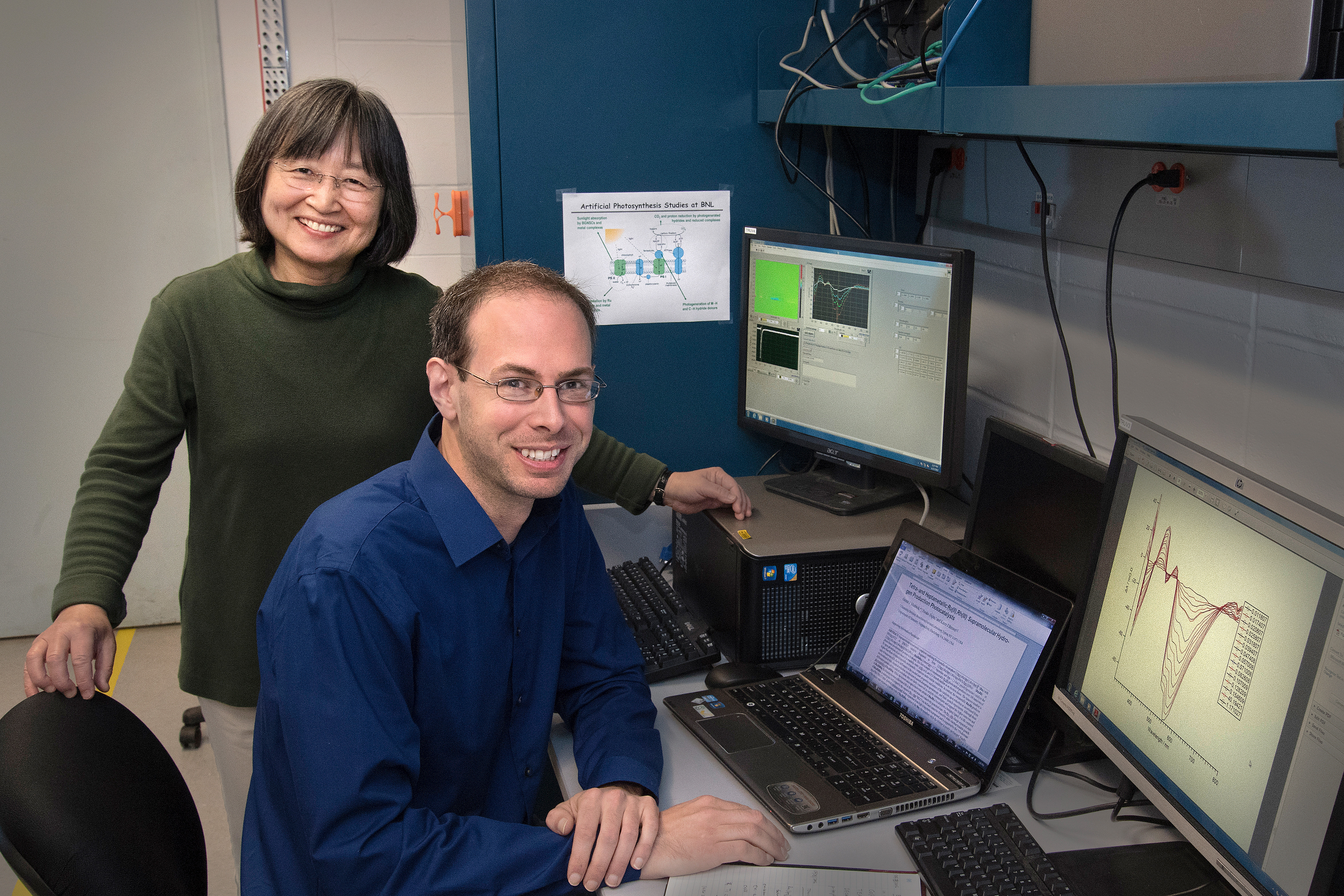
Etsuko Fujita and Gerald Manbeck of Brookhaven Lab's Chemistry Division carried out a series of experiments to understand why their molecular system with six light-absorbing centers (made of ruthenium metal ions bound to organic molecules) produced more hydrogen than the system with three such centers. This understanding is key to designing more efficient molecular complexes for converting solar energy into chemical energy—a conversion that green plants do naturally during photosynthesis.
Finding inspiration from nature
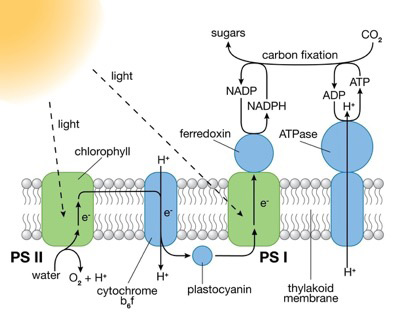
The leaves of green plants contain hundreds of pigment molecules (chlorophyll and others) that absorb light at particular wavelengths. When light of the proper wavelength strikes one of these molecules, the molecule enters an excited state. Energy from this excited state is shuttled along a chain of pigment molecules until it reaches a specific type of chlorophyll in the photosynthetic reaction center. Here, the energy is used to drive the charge-separation process required for photosynthesis to proceed. The electron “hole” left behind in the chlorophyll molecule is used for water-to-oxygen conversion. Hydrogen ions formed during the water-splitting process are eventually used for the reduction of carbon dioxide to glucose in the second stage of photosynthesis, known as the light-independent reaction.
UPTON, NY—Photosynthesis in green plants converts solar energy to stored chemical energy by transforming atmospheric carbon dioxide and water into sugar molecules that fuel plant growth. Scientists have been trying to artificially replicate this energy conversion process, with the objective of producing environmentally friendly and sustainable fuels, such as hydrogen and methanol. But mimicking key functions of the photosynthetic center, where specialized biomolecules carry out photosynthesis, has proven challenging. Artificial photosynthesis requires designing a molecular system that can absorb light, transport and separate electrical charge, and catalyze fuel-producing reactions—all complicated processes that must operate synchronously to achieve high energy-conversion efficiency.

Now, chemists from the U.S. Department of Energy’s (DOE) Brookhaven National Laboratory and Virginia Tech have designed two photocatalysts (materials that accelerate chemical reactions upon absorbing light) that incorporate individual components specialized for light absorption, charge separation, or catalysis into a single “supramolecule.” In both molecular systems, multiple light-harvesting centers made of ruthenium (Ru) metal ions are connected to a single catalytic center made of rhodium (Rh) metal ions through a bridging molecule that promotes electron transfer from the Ru centers to the Rh catalyst, where hydrogen is produced.
Photosystems (PS) I and II are large protein complexes that contain light-absorbing pigment molecules needed for photosynthesis. PS II captures energy from sunlight to extract electrons from water molecules, splitting water into oxygen and hydrogen ions (H+) and producing chemical energy in the form of ATP. PS I uses those electrons and H+ to reduce NADP+ (an electron-carrier molecule) to NADPH. The chemical energy contained in ATP and NADPH is then used in the light-independent reaction of photosynthesis to convert carbon dioxide to sugars.
They compared the hydrogen-production performance and analyzed the physical properties of the supramolecules, as described in a paper published in the June 1 online edition of Journal of the American Chemical Society, to understand why the photocatalyst with six as opposed to three Ru light absorbers produces more hydrogen and remains stable for a longer period of time. 
“Developing efficient molecular systems for hydrogen production is difficult because processes are occurring at different rates,” said lead author Gerald Manbeck, a chemist in the artificial photosynthesis group at Brookhaven Lab. “Completing the catalytic turnover of hydrogen before the separated charges—the negatively charged light-excited electron and positive “hole” left behind after the excited molecule absorbs light energy—have a chance to recombine and wastefully produce heat is one of the major challenges.”

Another complication is that two electrons are needed to produce each hydrogen molecule. For catalysis to happen, the system must be able to hold the first electron long enough for the second to show up. “By building supramolecules with multiple light absorbers that may work independently, we are increasing the probability of using each electron productively and improving the molecules’ ability to function under low light conditions,” said Manbeck.

Manbeck began making the supramolecules at Virginia Tech in 2012 with the late Karen Brewer, coauthor and his postdoctoral advisor. He discovered that the four-metal (tetrametallic) system with three Ru light-absorbing centers and one Rh catalytic center yielded only 40 molecules of hydrogen for every catalyst molecule and ceased functioning after about four hours. In comparison, the seven-metal (heptametallic) system with six Ru centers and one Rh center was more than seven times more efficient, cycling 300 times to produce hydrogen for 10 hours. This great disparity in efficiency and stability was puzzling because the supramolecules contain very similar components.
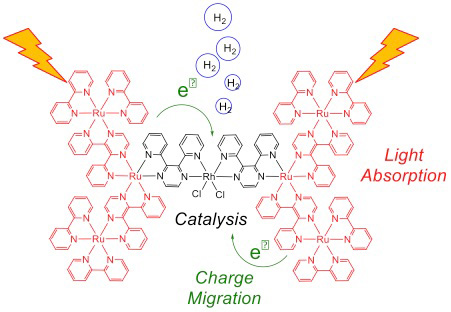
This depiction of the heptametallic system upon exposure to light shows light harvesting by the six Ru centers (red) and electron transfer to the Rh catalyst (black), where hydrogen is produced. Efficient electron transfer to Rh is essential for realizing high catalytic performance.

Manbeck joined Brookhaven in 2013 and has since carried out a series of experiments with coauthor Etsuko Fujita, leader of the artificial photosynthesis group, to understand the fundamental causes for the difference in performance.

“The ability to form the charge-separated state is a partial indicator of whether a supramolecule will be a good photocatalyst, but realizing efficient charge separation requires fine-tuning the energetics of each component,” said Fujita. “To promote catalysis, the Rh catalyst must be low enough in energy to accept the electrons from the Ru light absorbers when the absorbers are exposed to light.”

Through cyclic voltammetry, an electrochemical technique that shows the energy levels within a molecule, the scientists found that the Rh catalyst of the heptametallic system is slightly more electron-poor and thus more receptive to receiving electrons than its counterpart in the tetrametallic system. This result suggested that the charge transfer was favorable in the heptametallic but not the tetrametallic system.

They verified their hypothesis with a time-resolved technique called nanosecond transient absorption spectroscopy, in which a molecule is promoted to an excited state by an intense laser pulse and the decay of the excited state is measured over time. The resulting spectra revealed the presence of a Ru-to-Rh charge transfer in the heptametallic system only.

“The data not only confirmed our hypothesis but also revealed that the excited-state charge separation occurs much more rapidly than we had imagined,” said Manbeck. “In fact, the charge migration happens faster than the time resolution of our instrument, and probably involves short-lived, high-energy excited states.” The researchers plan to seek a collaborator with faster instrumentation who can measure the exact rate of charge separation to help clarify the mechanism.

In a follow-up experiment, the scientists performed the transient absorption measurement under photocatalytic operating conditions, with a reagent used as the ultimate source of electrons to produce hydrogen (a scalable artificial photosynthesis of hydrogen fuel from water would require replacing the reagent with electrons released during water oxidation). The excited state generated by the laser pulse rapidly accepted an electron from the reagent. They discovered that the added electron resides on Rh in the heptametallic system only, further supporting the charge migration to Rh predicted by cyclic voltammetry.

“The high photocatalytic turnover of the heptametallic system and the principles governing charge separation that were uncovered in this work encourage further studies using multiple light-harvesting units linked to single catalytic sites,” said Manbeck.

This research is supported by DOE’s Office of Science.
Brookhaven National Laboratory is supported by the Office of Science of the U.S. Department of Energy. The Office of Science is the single largest supporter of basic research in the physical sciences in the United States, and is working to address some of the most pressing challenges of our time. For more information, please visit science.energy.gov.

Related Links

ORIGIN: Brookhaven National Lab
June 2, 2017
Contact: Ariana Tantillo, (631) 344-2347, or Peter Genzer, (631) 344-3174

domingo, 1 de noviembre de 2015

Honda just unveiled its new hydrogen-powered car

Honda FCV Clarity. Photo: Honda
Emits nothing but water vapour.

Just when everyone’s getting all excited about electric cars usurping their fossil fuel-guzzling counterparts, Honda has announced that its hydrogen-powered cars will go on sale in Japan as early as March 2016, with launches in Europe and the US to follow.

The five-seated sedan, called the FCV Clarity, can travel 700 km (434 miles) on a single charge. It’s been priced at 7.66 million yen, or US$62,807, which puts it just in the affordability range for the average consumer, the Japanese automaker saying it expects to sell far more than the 72 units it sold of its previous-generation model, the FCX Clarity. "We want this car to be the trigger for the 'hydrogen society'," Honda operating officer, Toshihiro Mibe, told Reutersat the Tokyo Motor Show in Japan this week.

A Honda hydrogen-powered car is nothing new. Back in 2008, the FCX Clarity was leased to a handful of private buyers in California as part of a subsidised trial deal, but things didn’t go so well that time around. 

For one thing, the car cost 10 times more than it does now, and on top of that, it was 30 percent less powerful. The hydrogen fuel cell stack was also incredibly bulky, and the last thing you want to do is spend more than half a million dollars on a car you can barely fit into. "Until this point, fuel cells have been so large that they needed to be packaged elsewhere in the vehicle, like in Toyota's Mirai, which has its fuel cell stack in the centre of the vehicle, cutting into interior space," Nick Jaynes writes for Mashable. 

The FCV Clarity, on the other hand, features a fuel cell stack that's 33 percent smaller, now taking up the same amount of room under the hood as a typical V-6 engine. 

Hydrogen-powered cars work by having the fuel cell stack convert hydrogen into electricity, which powers an electric motor via a lithium-ion battery pack. "Essentially, think of it as an electric vehicle that can be refilled in 3 minutes and emits only water vapour out of its tailpipes," says Jaynes. 

And therein lies the biggest hurdle in convincing drivers to join the "hydrogen society" - you’re gonna need at least one hydrogen station in your local area to make buying one of these environmentally friendly vehicles in any way practical. Joann Muller reports at Forbes that companies like First Element and Air Liquide are installing some in Northeastern US and California, supported by government grants and loans from Toyota and Honda, but the rollout has so far been slow.

Not that Honda isn’t aware of the challenges its drivers could face in finding places to charge - it’s now developing a personal-use Smart Hydrogen Station, which is designed to be installed at home so you don’t have to go looking for a re-up. "There’s no word on when that might be available, but if it’s affordable, it could be a huge breakthrough in speeding the adoption of fuel cell vehicles,"says Muller.

It's exciting to see a car company go all-in on a vehicle that completely eliminates the need for toxic emissions. In a world where outdoor air pollution is killing more than 3 million people every year, with automobile exhaust being a significant part of the problem, alternatives like this are crucial. But only time will tell if there's truly a market for hydrogen cars out there.

"Compared to 10 years ago, I think fuel cell vehicles have developed significantly in terms of the technology," Honda president Takahiro Hachigo told Muller. "Ten years ago, we said fuel cells could not be driven in cold weather, for example, and that the hardware was too heavy. Today, fuel cells are equal to gasoline engine cars."

ORIGINAL: Science Alert
BEC CREW
28 OCT 2015

viernes, 23 de octubre de 2015

Robot With Tummy Full of Microbes Can Swim in Dirty Water Forever


Image: University of BristolRow-bot with mouth open (inset shows mouth closed).
Robots are better than animals in almost every way. Well, they’re better in some ways, I guess. I mean, robots are occasionally okay at some things. A few things. None of those things are energetic autonomy: the ability to operate continuously and indefinitely without dependence on humans for refueling. There certainly are robots that operate autonomously for long durations, and they’re either feeding off of radioactivity, or they’re relying on solar panels that don’t work half the time. A better option (at least in some situations) might be robots that forage for food like animals do, taking care of their own energy needs all by themselves.

This is only a slightly crazy idea (although at one point it was briefly the craziest idea ever), and fuel cells that are full of living microbes are a real thing. At the Bristol Robotics Laboratory, in the United Kingdom, they’ve been developing a robot called Row-bot that can swim around, harvesting energy directly from the water using a microbial fuel cell as an artificial stomach.

According to the researchers, Microbial Fuel Cells (MFCs) generate electricity by “electrons mobilised by the redox reaction that takes place in electrogenic bacterial anabolism.” More specifically, in the case of their device, they explain that “raw organic biomass is used as both an inoculant for the bacterial culture and the anolyte that fuels the reaction resulting in an environmentally biocompatible means of electricity generation.” In other words (simpler ones), microbes eat stuff in the water and poop out electrons, and as long as you’ve got enough water with stuff in it to keep the microbes fat and happy, they’ll keep giving you electrons that you can use to make your robot do things. MFCs work in all kinds of water, including fresh water in rivers and lakes, seawater, and even waste water, and they actually clean the water as they go, which is nice.

Microbes are kind of tiny, and each one doesn’t produce a lot of energy, so to do anything useful, you either need a whole bunch of them (multiple fuel cells) or a very efficient robot. Row-bot is very efficient, modeled on a water beetle. It has two side paddles to move, little floaty feeties to keep it from drowning, and a microbial fuel cell in its tummy:


It has a mouth, too, that it can open to ingest water for the fuel cell, and also a fuel outflow port on its posterior end that we’d call its butt if we were immature, which we’re not. Each time the robot opens its mouth, it swims forward, ingests fresh water into its MFC tummy, digests for 3 minutes, and then expels the water out the back as it swims forward again, making room for a fresh gulp. Row-bot stores the energy generated by the MFC in a capacitor, and over one cycle (opening its mouth, swimming 10 strokes forward at just under 1 stroke per second and then closing its mouth), it only uses 1.8 joules. That’s 20 centimeters of motion with about 1 joule of energy leftover that could potentially be used to power sensors or laser turrets or something. 

As long as Row-bot has water to swim through, the MFC makes it more or less energetically autonomous, although the current design is mostly a testbed for integration of the MFC with actuators to see how well it works. There’s a lot more optimization that needs to happen, like reducing body drag and finding the most efficient combination of materials to use for the paddles, as well as altering the “stride” of the robot to better mimic actual water beetles. Also, multiple MFCs could be configured in series if you need more power for those aforementioned laser turrets.

Eventually, the researchers suggest that Row-bot could be developed for applications such as remote sensing and environmental monitoring and clean-up, although space exploration isn’t out of the question either.

Also, it’s called “Row-bot.” Get it? Row-bot the robot. Heh.

“Row-bot: An Energetically Autonomous Artificial Water Boatman,” by Hemma Philamore, Jonathan Rossiter, Andrew Stinchcombe, and Ioannis Ieropoulos from the University of Bristol and University of the West of England, was presented at IROS 2015 in Hamburg, Germany.

Learn More fuel cell iros iros 201

ORIGINAL: IEEE Spectrum
By Evan Ackerman
Posted 22 Oct 2015

martes, 26 de mayo de 2015

Bloom Box: The Alternative Energy


What is an Energy Server?

Built with our patented solid oxide fuel cell technology, Bloom's Energy Server® is a new class of distributed power generator, producing clean, reliable, affordable electricity at the customer site.

Fuel cells are devices that convert fuel into electricity through a clean electro-chemical process rather than dirty combustion. They are like batteries except that they always run.

Our particular type of fuel cell technology is different than legacy "hydrogen" fuel cells in three main ways:
  1. Low cost materials – our cells use a common sand-like powder instead of precious metals like platinum or corrosive materials like acids.
  2. High electrical efficiency – we can convert fuel into electricity at nearly twice the rate of some legacy technologies
  3. Fuel flexibility – our systems are capable of using either renewable or fossil fuels
Each Bloom Energy Server provides 200kW of power, enough to meet the baseload needs of 160 average homes or an office building... day and night, in roughly the footprint of a standard parking space. For more power simply add more energy servers.


Energy Server Architecture
At the heart of every Energy Server® is Bloom's patented solid oxide fuel cell technology.

Each Energy Server consists of thousands of Bloom's fuel cells. Each cell is a flat solid ceramic square made from a common sand-like "powder."

Each Bloom Energy fuel cell is capable of producing about 25W... enough to power a light bulb. For more power, the cells are sandwiched, along with metal interconnect plates into a fuel cell "stack". A few stacks, together about the size of a loaf of bread, is enough to power an average home.

In an Energy Server, multiple stacks are aggregated together into a "power module", and then multiple power modules, along with a common fuel input and electrical output are assembled as a complete system.


For more power, multiple Energy Server systems can be deployed side by side.

In addition to Bloom's unmatched performance, this modular architecture offers...
  • easy and fast deployment
  • inherent redundancy for fault tolerance
  • high availability (one power module can be serviced while all others continue to operate)
  • mobility

Solid Oxide Fuel Cells
Fuel cells were invented over a century ago and have been used in practically every NASA mission since the 1960's, but until now, they have not gained widespread adoption because of their inherently high costs.

Legacy fuel cell technologies like

  • proton exchange membranes (PEMs), 
  • phosphoric acid fuel cells (PAFCs), and 
  • molten carbonate fuel cells (MCFCs), 

have all required expensive precious metals, corrosive acids, or hard to contain molten materials. Combined with performance that has been only marginally better than alternatives, they have not been able to deliver a strong enough economic value proposition to overcome the status quo.

Some makers of legacy fuel cell technologies have tried to overcome these limitations by offering combined heat and power (CHP) schemes to take advantage of their wasted heat. While CHP does improve the economic value proposition, it only really does so in environments with exactly the right ratios of heat and power requirements on a 24/7/365 basis. Everywhere else the cost, complexity, and customization of CHP tends to outweigh the benefits.

For decades, experts have agreed that solid oxide fuel cells (SOFCs) hold the greatest potential of any fuel cell technology. With low cost ceramic materials, and extremely high electrical efficiencies, SOFCs can deliver attractive economics without relying on CHP. But until now, there were significant technical challenges inhibiting the commercialization of this promising new technology. SOFCs operate at extremely high temperature (typically above 800°C). This high temperature gives them extremely high electrical efficiencies, and fuel flexibility, both of which contribute to better economics, but it also creates engineering challenges.

Bloom has solved these engineering challenges. With breakthroughs in materials science, and revolutionary new design, Bloom's SOFC technology is a cost effective, all-electric solution.

Over a century in the making, fuel cells are finally clean, reliable, and most importantly, affordable.


ORIGINAL: Bloom Energy

viernes, 2 de enero de 2015

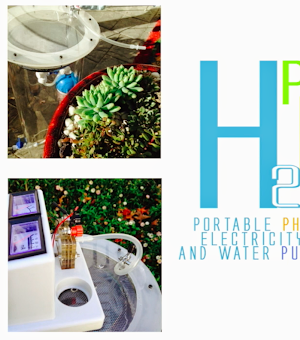
H2PRO - Portable Photocatalytic Electricity Generation and Water Purification Unit


Electricity and clean water -things that we easily have access to are unfortunately luxuries for those in underdeveloped countries.

In fact, not only is there a lack of resources in third-world countries, but also the whole world is facing energy crisis and water pollution. My objective is to find an eco-friendly and economical approach to solve both issues.

My device H2PRO relies on photocatalytic reactions to purify and sterilize wastewater and to generate electricity using hydrogen produced. This sustainable process only requires titania and light. What’s more is that organic pollutant doesn’t only get decomposed but will also enhance the reaction rate.


It is composed of 2 parts –the upper unit for photocatalytic water-purification and hydrogen-generation, which is connected to a fuel cell and the bottom unit for further water filtration.

H2PRO’s feasibility in the removal of organic pollutant was examined to be excellent-almost 90% of organic compound was decomposed after 2hours. However, its performance in electricity generation was quite unstable although theoretically and experimentally the photocatalytic hydrogen yield is proved to be satisfactory and even better in the presence of organic pollutant. I will keep improving this device until stable electricity generation is achieved.

In conclusion, I have successfully introduced a design for a portable electricity-generation and water-purification unit. Generally speaking, H2PRO has demonstrated its potential to feasibly provide clean water and sustainable energy to the needy ones. I will keep "practicalizing" the electricity-generation unit so that people can really benefit from my design one day.


ABOUT ME
Hello! My name is Cynthia Lam. I go to Balwyn High School in Melbourne, Australia. Besides Science, I love travelling, music and making crafts.

I am always fascinated by the how scientists put imaginations into practice to change the world. Rita Levi-Montalcini's perseverance in science is truly an inspiration to me. Yet, although there was always a spark of passion for science in my heart, I always thought that I was too young for researches and inventions - until last year.

In April 2013, out of curiosity and my love for Chemistry, I started my first research on Titania's Photocatalysis. I investigated the optimum conditions for photocatalytic hydrogen generation and it won the Major Bursary in Victoria's Science Talent Search. It was a very rewarding and exciting experience to complete a research, I was hence motivated to challenge myself and to create a helpful device that puts what I investigated into practice.

I would like to study Medicine or Environmental Science in the future because I want to be able to help those in need. By creating H2PRO, I introduced an eco-friendly alternative for providing people in underdeveloped countries clean water and electricity. There is still a long way to go, but I am glad I took my first step to make a difference. Winning would mean a motivation for me to keep improving my device and to bravely follow my dreams. Hopefully it would also raise the awareness of the importance of clean water and electricity in underdeveloped countries.

QUESTION / PROPOSAL
Is it possible to create a portable device that purifies wastewater while generating electricity sustainably and affordably?

This question is raised not only because of the lack of clean water and electricity in third-world countries, but also because we are all facing energy crisis and water pollution. My objective is to find an eco-friendly and economical approach to solve both issues.

Based on what I developed from investigating photocatalysis, I aim to create a device that can put the mechanisms into practice. In photocatalysis, not only water is purified and sterilized, but hydrogen is also produced through water-splitting, which can be used to generate electricity.

The entire sustainable process only needs titania and light-no additional power source is required. However, hydrogen production is generally low since photoexcited electrons tend to fall back to the hole(i.e.photoinduced electron-hole combination). Fortunately, it can be overcome by adding reductants, while some organic pollutants serve such purpose. Hence, I propose to combine the two mechanisms together to enhance the yield and lower the cost of hydrogen generation, meanwhile efficient water purification can also be achieved.

There are similar designs existing, but they require either an excessively complex use of technology or an external energy source, which means they are not sustainable, affordable and manageable for users in underdeveloped countries. Nonetheless, I hypothesize that photocatalysis can be applied in a manageable scale that allows water purification and electricity production to be economically and sustainably performed in a portable device as well as at a household level.

RESEARCH

EXISTING WORK
There is an existing design for mobile hydrogen energy and water supply, although feasible, that design needs an external solar power source to purify water and produce hydrogen through electrolyzer, which makes it costlier and less efficient. This inspires me to create a self-sustainable portable device that can purify wastewater and produce electricity through only photocatalysis (without any additional electricity source).

METHODOLOGY
I. Photocatalytic Redox Reactions
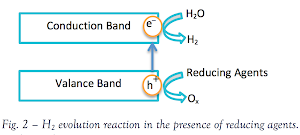
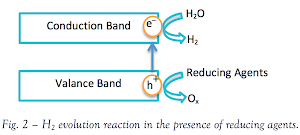
When titania absorbs ultraviolet energy, which is comparable to its band gap, photoexcitation of electron takes place and an electron-hole pair is produced.

Reduced by the excited electron, oxygen forms super oxide anion (•O2-). The hole reacts with water producing hydroxyl radicals (•OH).

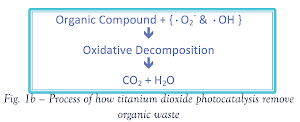
The radicals yielded in the process oxidize organic compound, resulting in water purification. Furthermore, organic compounds may also be oxidized by the hole. In either case, the organic compound decomposed to yield harmless CO2 and H2O.

I. Photocatalytic Water Splitting
The effect of water splitting using titania was first discovered by Akira Fujishima. The photoinduced electrons and holes cause redox reactions similarly to electrolysis, causing water molecules to be reduced by the electrons to form hydrogen and oxidized by the holes to form oxygen (most oxygen is consumed in side reactions so hydrogen is the major product).

III. Recombination of the photoinduced electron-hole pairs
Electrons tend to move to lower energies. When this transfer occurs from band to band, it is called recombination.
In this process, an electron (e–), which has been excited from the valence band to the conduction band of titania, falls back into an empty state in the valence band, which is the hole (h+).
This phenomenon hinders photocatalytic redox and water-splitting reactions. Hence, preventing the recombination reaction had long been the centerpiece of the field.

Different attempts to hinder the recombination of electron-hole pairs have been proposed; doping titania with noble metals for example. The addition of a sacrificial agent – a reducing agent or an oxidizing agent – is known as an excellent approach to overcome such limitation. When photocatalysis takes place in an aqueous solution including a reductant, a.k.a. electron donors/ hole scavengers, photoinduced holes irreversibly oxidize the reductant instead of water. Therefore, hydrogen production is enhanced.

Lots of common organic pollutants such as methanol, glycerol and EDTA can act as excellent reductants. As hole scavengers, they minimize the chance of recombination of the photoinduced electron-hole pairs, hence enhancing the rate of hydrogen generation. At the same time, they can be effectively decomposed.
III. Hydrogen Fuel Cell
There are various fuel cells, but generally they work similarly. Hydrogen fuel cell has an anode and a cathode separated by a membrane. Oxygen passes over cathode and hydrogen over anode.
H2 reacts to a catalyst on the anode that converts H2 into electrons and hydrogen ion.
The mobile electrons travel through a wire creating the electric current. The hydrogen ions move through the electrolyte membrane to the cathode where they react with oxygen and electrons to form water.