Mostrando entradas con la etiqueta Battery. Mostrar todas las entradas

miércoles, 27 de diciembre de 2017

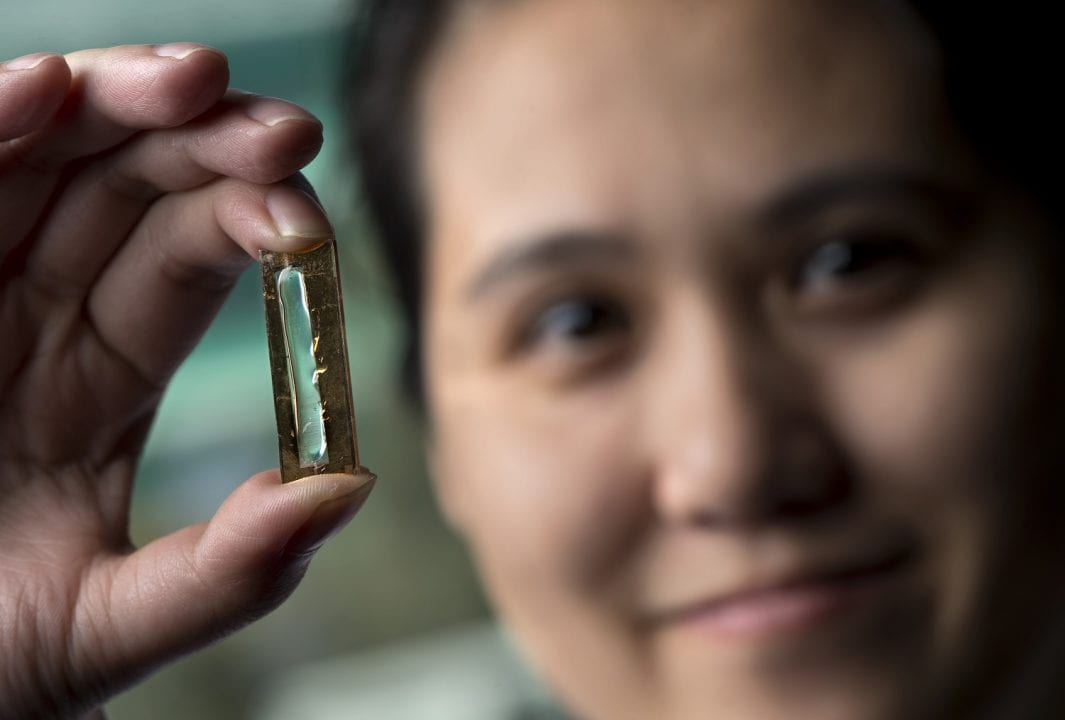
Scientists Develop A Battery That Can Run For More Than A Decade

Credit: Harvard University


Researchers from the Harvard John A. Paulson School of Engineering and Applied Sciences (SEAS) have developed a new flow battery that stores energy in organic molecules dissolved in neutral pH water. This new chemistry allows for a
  • non-toxic,
  • non-corrosive battery
  • with an exceptionally long lifetime and
  • offers the potential to significantly decrease the costs of production.
The research, published in ACS Energy Letters, was led by Michael Aziz, the Gene and Tracy Sykes Professor of Materials and Energy Technologies and Roy Gordon, the Thomas Dudley Cabot Professor of Chemistry and Professor of Materials Science.

A Neutral pH Aqueous Organic–Organometallic Redox Flow Battery with Extremely High Capacity Retention
Eugene S. Beh†‡ , Diana De Porcellinis†#, Rebecca L. Gracia∥, Kay T. Xia∥, Roy G. Gordon*†‡, and Michael J. Aziz*†
† John A. Paulson School of Engineering and Applied Sciences, Harvard University, Cambridge, Massachusetts 02138, United States
‡ Department of Chemistry and Chemical Biology, Harvard University, Cambridge, Massachusetts 02138, United States
# Department of Chemical Science and Technologies, University of Rome “Tor Vergata”, 00133 Rome, Italy
∥ Harvard College, Cambridge, Massachusetts 02138, United States
ACS Energy Lett., 2017, 2 (3), pp 639–644
DOI: 10.1021/acsenergylett.7b00019
Publication Date (Web): February 7, 2017
Copyright © 2017 American Chemical Society
*E-mail: gordon@chemistry.harvard.edu., *E-mail: maziz@harvard.edu.

Abstract
Abstract Image
We demonstrate an aqueous organic and organometallic redox flow battery utilizing reactants composed of only earth-abundant elements and operating at neutral pH. The positive electrolyte contains bis((3-trimethylammonio)propyl)ferrocene dichloride, and the negative electrolyte contains bis(3-trimethylammonio)propyl viologen tetrachloride; these are separated by an anion-conducting membrane passing chloride ions. Bis(trimethylammoniopropyl) functionalization leads to ∼2 M solubility for both reactants, suppresses higher-order chemical decomposition pathways, and reduces reactant crossover rates through the membrane. Unprecedented cycling stability was achieved with capacity retention of 99.9943%/cycle and 99.90%/day at a 1.3 M reactant concentration, increasing to 99.9989%/cycle and 99.967%/day at 0.75–1.00 M; these represent the highest capacity retention rates reported to date versus time and versus cycle number. We discuss opportunities for future performance improvement, including chemical modification of a ferrocene center and reducing the membrane resistance without unacceptable increases in reactant crossover. This approach may provide the decadal lifetimes that enable organic–organometallic redox flow batteries to be cost-effective for grid-scale electricity storage, thereby enabling massive penetration of intermittent renewable electricity.
Flow batteries store energy in liquid solutions in external tanks—the bigger the tanks, the more energy they store. Flow batteries are a promising storage solution for renewable, intermittent energy like wind and solar but today’s flow batteries often suffer degraded energy storage capacity after many charge-discharge cycles, requiring periodic maintenance of the electrolyte to restore the capacity.

By modifying the structures of molecules used in the positive and negative electrolyte solutions, and making them water soluble, the Harvard team was able to engineer a battery that loses only one percent of its capacity per 1000 cycles.

“Lithium ion batteries don’t even survive 1000 complete charge/discharge cycles,” said Aziz.

“Because we were able to dissolve the electrolytes in neutral water, this is a long-lasting battery that you could put in your basement,” said Gordon. “If it spilled on the floor, it wouldn’t eat the concrete and since the medium is noncorrosive, you can use cheaper materials to build the components of the batteries, like the tanks and pumps.”

This reduction of cost is important. The Department of Energy (DOE) has set a goal of building a battery that can store energy for less than $100 per kilowatt-hour, which would make stored wind and solar energy competitive to energy produced from traditional power plants.

“If you can get anywhere near this cost target then you change the world,” said Aziz. “It becomes cost effective to put batteries in so many places. This research puts us one step closer to reaching that target.”

“This work on aqueous soluble organic electrolytes is of high significance in pointing the way towards future batteries with vastly improved cycle life and considerably lower cost,” said Imre Gyuk, Director of Energy Storage Research at the Office of Electricity of the DOE. “I expect that efficient, long duration flow batteries will become standard as part of the infrastructure of the electric grid.”

The key to designing the battery was to first figure out why previous molecules were degrading so quickly in neutral solutions, said Eugene Beh, a postdoctoral fellow and first author of the paper. By first identifying how the molecule viologen in the negative electrolyte was decomposing, Beh was able to modify its molecular structure to make it more resilient.

Next, the team turned to ferrocene, a molecule well known for its electrochemical properties, for the positive electrolyte.

“Ferrocene is great for storing charge but is completely insoluble in water,” said Beh. “It has been used in other batteries with organic solvents, which are flammable and expensive.”

But by functionalizing ferrocene molecules in the same way as with the viologen, the team was able to turn an insoluble molecule into a highly soluble one that could also be cycled stably.

“Aqueous soluble ferrocenes represent a whole new class of molecules for flow batteries,” said Aziz.

The neutral pH should be especially helpful in lowering the cost of the ion-selective membrane that separates the two sides of the battery. Most flow batteries today use expensive polymers that can withstand the aggressive chemistry inside the battery. They can account for up to one third of the total cost of the device. With essentially salt water on both sides of the membrane, expensive polymers can be replaced by cheap hydrocarbons.

This research was coauthored by Diana De Porcellinis, Rebecca Gracia, and Kay Xia. It was supported by the Office of Electricity Delivery and Energy Reliability of the DOE and by the DOE’s Advanced Research Projects Agency-Energy.

With assistance from Harvard’s Office of Technology Development (OTD), the researchers are working with several companies to scale up the technology for industrial applications and to optimize the interactions between the membrane and the electrolyte. Harvard OTD has filed a portfolio of pending patents on innovations in flow battery technology.

ORIGINAL: Daily Accord
Credit: Harvard University
Feb 9, 2017 

sábado, 28 de mayo de 2016

UCI chemists create battery technology with off-the-charts charging capacity

UCI doctoral candidate Mya Le Thai has developed a nanowire-based technology that allows lithium-ion batteries to be recharged hundreds of thousands of times. Steve Zylius / UCI 
All powered up

Irvine, Calif., April 20, 2016 — University of California, Irvine researchers have invented nanowire-based battery material that can be recharged hundreds of thousands of times, moving us closer to a battery that would never require replacement. The breakthrough work could lead to commercial batteries with greatly lengthened lifespans for computers, smartphones, appliances, cars and spacecraft.

Scientists have long sought to use nanowires in batteries. Thousands of times thinner than a human hair, they’re highly conductive and feature a large surface area for the storage and transfer of electrons. However, these filaments are extremely fragile and don’t hold up well to repeated discharging and recharging, or cycling. In a typical lithium-ion battery, they expand and grow brittle, which leads to cracking.

UCI researchers have solved this problem by coating a gold nanowire in a manganese dioxide shell and encasing the assembly in an electrolyte made of a Plexiglas-like gel. The combination is reliable and resistant to failure.

The study leader, UCI doctoral candidate Mya Le Thai, cycled the testing electrode up to 200,000 times over three months without detecting any loss of capacity or power and without fracturing any nanowires. The findings were published today in the American Chemical Society’s Energy Letters.

Hard work combined with serendipity paid off in this case, according to senior author Reginald Penner.

“Mya was playing around, and she coated this whole thing with a very thin gel layer and started to cycle it,” said Penner, chair of UCI’s chemistry department. “She discovered that just by using this gel, she could cycle it hundreds of thousands of times without losing any capacity.”

“That was crazy,” he added, “because these things typically die in dramatic fashion after 5,000 or 6,000 or 7,000 cycles at most.”


The researchers think the goo plasticizes the metal oxide in the battery and gives it flexibility, preventing cracking.

“The coated electrode holds its shape much better, making it a more reliable option,” Thai said. “This research proves that a nanowire-based battery electrode can have a long lifetime and that we can make these kinds of batteries a reality.”

The study was conducted in coordination with the Nanostructures for Electrical Energy Storage Energy Frontier Research Center at the University of Maryland, with funding from the Basic Energy Sciences division of the U.S. Department of Energy.

About the University of California, Irvine: Currently celebrating its 50th anniversary, UCI is the youngest member of the prestigious Association of American Universities. The campus has produced three Nobel laureates and is known for its academic achievement, premier research, innovation and anteater mascot. Led by Chancellor Howard Gillman, UCI has more than 30,000 students and offers 192 degree programs. It’s located in one of the world’s safest and most economically vibrant communities and is Orange County’s second-largest employer, contributing $4.8 billion annually to the local economy. For more on UCI, visit www.uci.edu.

Media access: Radio programs/stations may, for a fee, use an on-campus ISDN line to interview UC Irvine faculty and experts, subject to availability and university approval. For more UC Irvine news, visit news.uci.edu. Additional resources for journalists may be found at communications.uci.edu/for-journalists.

ORIGINAL: UCI.edu
ON APRIL 20, 2016

martes, 22 de septiembre de 2015

Sensors You Can Swallow Could Be Made of Nutrients and Powered by Stomach Acid

Illustration: Bettinger Group/CMU
The future of ingestible sensors could be a cross between silicon-based circuitry and biodegradable materials, with batteries made of nutrients and running on stomach juices.

That, at least, is the vision of Christopher Bettinger, assistant professor of materials science and biomedical engineering at Carnegie Mellon University. His group is working on edible electronics and ways to power them. Ingestible sensors could provide a gut check for early signs on bacterial infection, look for symptoms of gastrointestinal disorders such as Crohn’s Disease, monitor uptake of medications, and even study the microbiome living inside people.“I think a lot of people hand-wave powering these devices through external RF, but bodies are a pretty good Faraday cage—Christopher Bettinger, Carnegie Mellon University

Some ingestible sensors, such as a clear pill containing a camera to examine the GI tracts up close, already exist, but they carry a risk of getting stuck and requiring surgery to remove. And researchers are working on devices made from biocompatible materials such as gelatin and indigo. Bettinger thinks the trick is to make the logic circuits out of silicon, taking advantage of the sophistication of that technology, but to encapsulate them in, say, a biodegradable hydrogel that can squeeze through tight openings. The other parts, such as antennas and batteries, would be made from organic and other bio-safe materials.

“If you really want to use these in a clinical setting, we think silicon is pretty good,” says Bettinger, who authored a review article on next-generation devices in the latest issue of Trends in Biotechnology.

One of the main issues is how to supply the sensors with power. “I think a lot of people hand-wave powering these devices through external RF,” he says, “but bodies are a pretty good Faraday cage,” which would prevent radio frequency energy from reaching the sensors. His team has built a battery with a cathode made of melanin—the pigment that colors hair and skin—and an anode made of manganese oxide, a form of a mineral that plays a role in nerve function. The battery has an open design, so that when it hits the stomach, gastrointestinal fluids act as the electrolyte and transport current, much the way the emergency lights of life vests light up when they’re dropped in ocean water. In lab tests, it provided 5 milliwatts of power for up to 20 hours. 

Various minerals, such as manganese, magnesium, and copper are considered essential nutrients, and could be used to build electronics in amounts smaller than the U.S. Food and Drug Administration “Recommended Daily Allowance”, which should help convince that agency of their safety, Bettinger says. “We think we can go to FDA and say, ‘here’s a battery compound of things that are already in our bodies, plus water,’” he explains. Even silicon, if it interacts with the body, can turn into silicic acid, which has some health benefits.

As for the melanin, Bettinger says, “there’s already more melanin in a serving of squid-ink pasta than will be in our batteries.”

The vision of edible electronics may not be far in the future. Proteus Digital Health, of Redwood Shores, Calif., already makes an ingestible sensor that sends data to a patch worn on the skin. Earlier this month they and Otsuka Pharmaceutical, of Tokyo, Japan, filed an application with the FDA for the first combination of a drug with a smart pill. Then hope to sell a pill of Abilify, a drug for mental disorders, with the Proteus sensor embedded within it to monitor drug uptake.

ORIGINAL: IEEE Spectrum
By Neil Savage
Posted 21 Sep 2015

jueves, 25 de junio de 2015

Chemical Battery Can Recharge Itself With Light


Image: Musthafa Ottakam Thotiyl/IISER Pune
Batteries, by definition, convert chemical energy into electricity. Once you’ve sucked them dry, you have to reverse the process to convert electricity into chemical energy, and for that, you need a source of electricity. It’s not like it’s hard to do this, but it is certainly a minor annoyance that could do with a fix.

Researchers at the Indian Institute of Science Education and Research (IISER) in Pune, India, have skipped the annoying step by developing a battery that charges directly from light. We’re not talking about a battery with a solar panel on it: it’s a “photo battery” where the anode itself is made of titanium nitride and ambient light.


Under artificial light, this prototype battery has a capacity of 77.8 mAh/g. It’ll quite happily power a small fan or LED light for about 30 seconds, and then if you give it a break for 30 seconds while shining a light on it, it’ll be all charged up and good to go again. Over 100 cycles, the battery retained a bit over 70 percent of its discharge capacity, which at least suggests some potential for longevity and usefulness.

In addition to being charged directly by light, which is pretty awesome, this battery design offers other benefits, including “ 
  • a sustainable and economical anode material which will not be consumed as a part of the discharge reactions, and 
  • an anode material that is free from loss of active materials, irreversible structural deformations, spontaneous deinsertion reactions, and safety concerns commonly encountered in the state of the art anode materials in [aqueous rechargeable batteries].”
Here we show a surrogate strategy for power production, wherein light is used to actuate a discharge chemistry in the cathode of an aqueous rechargeable battery (ARB). The proposed photo battery consists of a titanium nitride photoanode, promising cathode material iron(III) hexacyanoferrate(II) as the battery active species and Na2S2O8 as the chemical charging agent. The photo battery delivered negligible capacity in the dark and the capacity shot up to 77.8 mAh/g when artificially shined light, confirming that the battery chemistry is light driven. In the ambient light, the device retained 72% of its artificial light discharge capacity with a stable cycling for more than 100 cycles. Further, an unprecedented means for charging the battery rapidly is presented using Na2S2O8 and it revitalized the battery in 30 s without any external bias. This methodology of expending a photoanode extends to a battery that is free from dissolution of active materials, irreversible structural changes, spontaneous deinsertion reactions, and safety concerns commonly encountered in the state of the art anode materials in ARBs. Apart from bringing out a sustainable way for power production, this device opens up avenues for charging the battery in the likely events of electrical input unavailability, while solving the critcial issues of longer charging time and higher charging voltage. Source: http://pubs.acs.org/doi/full/10.1021/acs.jpcc.5b02871.
J. Phys. Chem. C, 2015, 119 (25), pp 14010–14016
DOI: 10.1021/acs.jpcc.5b02871
Publication Date (Web): May 27, 2015
Copyright © 2015 American Chemical Society

According to a press release from the American Chemical Society, “the researchers say their design is a promising first step toward a more sustainable and safer battery technology.” In other words, this is a thing that does cool stuff in a lab right now, but getting your hopes up for a light-powered battery in your cell phone might be premature by a decade or so. For now, the best you’ll be able to do is read the full paper here.

ORIGINAL: IEEE Spectrum
By Evan Ackerman
Posted 24 Jun 2015

lunes, 22 de junio de 2015

The story of the invention that could revolutionize batteries—and maybe American manufacturing as well

This black goop is what will be at the heart of the next generation of batteries.(Kieran Kesner for Quartz)
The world has been clamoring for a super-battery.
Since about 2010, a critical mass of national leaders, policy professionals, scientists, entrepreneurs, thinkers and writers have all but demanded a transformation of the humble lithium-ion cell. Only batteries that can store a lot more energy for a lower price, they have said, will allow for affordable electric cars, cheaper and more widely available electricity, and a reduction in greenhouse gas emissions. In the process, a lot of gazillionaires will be created.

But they have been vexed. Not only has nobody created a super-battery; a large number of researchers have lost faith in their powers to do so—perhaps ever. Entrepreneurs such as Tesla’s Elon Musk continue to tinker with off-the-shelf batteries for luxury electric cars and home power-storage systems, but industry hands seem generally to doubt that their cost will drop enough to attract a mass market any time soon. Increasingly, they are concluding that the primacy of fossil fuels will continue for decades to come, and probably into the next century.

This is where Yet-Ming Chiang enters the picture. A wiry, Taiwanese-American materials-science professor at the Massachusetts Institute of Technology (MIT), Chiang is best known for founding A123, a lithium-ion battery company that had the biggest IPO of 2009. The company ended up filing for bankruptcy in 2012 and selling itself in pieces at firesale prices to Japanese and Chinese rivals. Yet Chiang himself emerged untainted.

In 2010, having rounded up $12.5 million from Boston venture capital firms and federal funds, Chiang launched another company. Again, it was in batteries. And today, after five years in “stealth mode,” he is going public. There may be a way to revolutionize batteries, he says, but right now it is not in the laboratory. There may be a way to revolutionize batteries, but right now it is not in the laboratory. Instead, it’s on the factory floor. Instead, it’s on the factory floor. Ingenious manufacturing, rather than an ingenious leap in battery chemistry, might usher in the new electric age.

When it starts commercial sales in about two years, Chiang says, his company will slash the cost of an entry-level battery plant 10-fold, as well as cut around 30% off the price of the batteries themselves. That’s thanks to a new manufacturing process along with a powerful new cell that adds energy while stripping away cost. Together, he says, they will allow lithium-ion batteries to begin to compete with fossil fuels.

But Chiang’s concept is also about something more than just cheaper, greener power. It’s a model for a new kind of innovation, one that focuses not on new scientific invention, but on new ways of manufacturing. For countries like the US that have lost industries to Asia, this opens the possibility of reinventing the techniques of manufacture. Those that take this path could own that intellectual property—and thus the next manufacturing future.

This is the story of how that came about.
24M batteries.(Kieran Kesner for Quartz.)

Manufacturing, the new frontier of innovation
Traditionally, big innovations have happened at the lab bench. A discovery is made and patented, then is handed off to a commercial player who scales it up. With luck, it turns out a blockbuster product.

But, according to a report published in February by the Brookings Institution, researchers are increasingly skeptical of the delineation between innovation and production. Breakthrough-scale invention, they say, happens not only in the lab, but also in factories.

This is not a new idea. Until 1856, for instance, steel was an ultra-expensive niche product. It was far more robust than iron, but no one knew how to make it economically. Its use was confined to specialty hand tools and eating utensils for the rich. But then British inventor Henry Bessemer, stirred by French gripes about the fragility of cast-iron cannons, devised a process that reduced the cost of steel by more than 80%, roughly equivalent to iron. Steel—along with oil—went on to propel the latter part of the Industrial Revolution, along with the gargantuan 20th century economic boom.

If Bessemer had made his breakthrough today, it would be called “advanced manufacturing”—a label that has been broadly applied to next-generation fabrication methods such as
There is some hype around this term: The Brookings report identifies 50 industries in the US alone as “advanced,” and historic factory hubs such as the English city of Sheffield are renaming themselves as variants of “advanced manufacturing cluster.”
Nonetheless, entrepreneurs who develop genuinely novel manufacturing processes can enjoy the advantage of a patent and standing ahead of the crowd. While others will inevitably copy them, it will be a race to catch up. To the degree that such authentic advanced manufacturing moves forward, and can offer the US a chance to reinstate its prowess as a manufacturing hub, it’s led in part by a few clean energy companies like Yet-Ming Chiang’s.
Yet-Ming Chiang, 24M’s founder.(Kieran Kesner for Quartz)

The birth of an idea

At 57, Chiang has short-cropped, gray-flecked black hair, and almost always wears blue, long-sleeved check shirts. He speaks in a soft, even cadence, and is prone to finishing his sentences with a disarming, open-jawed grin.

But if unassuming, Chiang is also tremendously driven. His science-centered business sense has earned tens of millions of dollars for his investors. He and his family live on a farm on the affluent outskirts of Boston, where he raises bees and chickens, and hunts and fishes nearby.


domingo, 3 de mayo de 2015

Watch Elon Musk announce Tesla Energy in the best tech keynote I've ever seen


I've watched a lot of handsomely paid CEOs get on stages for keynote presentations over the past decade, and none were as good as the one I saw Elon Musk give Thursday night in California as he introduced Tesla's new battery system. I'm sure many people will disagree — I mean, how can you compete with Steve Jobs introducing the iPhone in 2007 — but ultimately Jobs was selling a better smartphone. Musk is selling a better future.

I'm not saying Musk is going to succeed, or that you should go buy Tesla's battery. There are lots of ways to save the world and cut down on fossil fuels, and Tesla's plan isn't the first. I'm just happy to see a presentation that was genuinely exciting and inspiring — a sales pitch for a tech product that's honest, and not treated like the second-coming of Jesus. It's really obvious why so many tech reporters become jaded. Too many tech visionaries pretend like every footprint they leave is going to radically change everything and make the world a better place to live in. We get it. You made a slightly thinner phone from last year's model. You made an app that sends the word "Yo" to someone. Enjoy it while it lasts.

DUDE'S SELLING A BATTERY AND HE STILL MANAGED TO BE INSPIRING
Here's what I loved about Musk's presentation. 

  • First of all, it was short, clocking in at about 20 minutes. Musk didn't waste anybody's time. He used that time to present a problem of critical importance (eliminating humanity's use of fossil fuels), explained how it can be addressed, and offered a plausible solution in the form of a new product — one that's priced within reach of a lot of people and available to order. Amazingly, all of those things are actually pretty rare to see in one show. Tesla's presentation was inspiring, and Musk wasn't selling some fancy sci-fi trinket that has the benefit of Star Trek nostalgia. Dude was selling a battery.
  • But aside from all the technical details I enjoyed, what I liked most was Musk's humble tenor. His ambitions often seem scattershot and sometimes ridiculous, and he probably spends too much time worrying about killer AI, but tonight he seemed confident and focused. Most importantly, he spoke to the audience with a frank tone that didn't feel manipulative or canned. There were no overdone theatrics here, just an honest conversation about how a new product might solve a major problem. The humility and ambition don't just seem to be a show; Tesla has already opened some of its patents to competitors, and announced tonight that it would even open its Gigafactory plans to others.
Take notes, suits of Silicon Valley. This is how you do it right.

ORIGINAL: The Verge
on May 1, 2015 01:51 am


ORIGINAL: TeslaEnergy.com

Energy Storage for a Sustainable Home
Powerwall is a home battery that charges using electricity generated from solar panels, or when utility rates are low, and powers your home in the evening. It also fortifies your home against power outages by providing a backup electricity supply. Automated, compact and simple to install, Powerwall offers independence from the utility grid and the security of an emergency backup.


MORNING DEMAND    PEAKSOLAR      EVENING DEMAND

Solar Powered Day and Night
The average home uses more electricity in the morning and evening than during the day when solar energy is plentiful. Without a home battery, excess solar energy is often sold to the power company and purchased back in the evening. This mismatch adds demand on power plants and increases carbon emissions. Powerwall bridges this gap between renewable energy supply and demand by making your home’s solar energy available to you when you need it.

Avoid Paying Peak RatesPower companies often charge a higher price for electricity during peak evening hours than overnight when demand is low. Powerwall can reduce your power bill by storing electricity when rates are low and powering your home when rates are high.


Energy SecurityPowerwall automatically switches to battery power in the event of an electric company outage, bringing peace of mind to those who live in areas prone to storms or unreliable utility grids.

Beautifully Functional
Current generation home batteries are bulky, expensive to install and expensive to maintain. In contrast, Powerwall’s lithium ion battery inherits Tesla’s proven automotive battery technology to power your home safely and economically. Completely automated, it installs easily and requires no maintenance.


Capacity
Powerwall comes in 10 kWh weekly cycle and 7 kWh daily cycle models. Both are guaranteed for ten years and are sufficient to power most homes during peak evening hours. Multiple batteries may be installed together for homes with greater energy need, up to 90 kWh total for the 10 kWh battery and 63 kWh total for the 7 kWh battery.
Multiple batteries may be installed together.

Specs

  • Technology
    Wall mounted, rechargeable lithium ion battery with liquid thermal control.
  • Models10 kWh $3,500
    For backup applications
    7 kWh $3,000
    For daily cycle applications
  • Warranty
    10 years
  • Efficiency
    92% round-trip DC efficiency
  • Power
    2.0 kW continuous, 3.3 kW peak
  • Voltage
    350 – 450 volts
  • Current
    5.8 amp nominal, 8.6 amp peak output
  • Compatibility
    Single phase and three phase utility grid compatible.
  • Operating Temperature
    -4°F to 110°F / -20°C to 43°C
  • Enclosure
    Rated for indoor and outdoor installation.
  • Installation
    Requires installation by a trained electrician. DC-AC inverter not included.
  • Weight
    220 lbs / 100 kg
  • Dimensions
    51.2" x 33.9" x 7.1"
    1300 mm x 860 mm x 180 mm
  • Certification
    NRTL listed to UL standards


    How much electricity does my home use?
    Common household electricity consumption.
  • Flat Screen TV0.1 kWh /hr
  • Lights Per Room0.1 kWh /hr
  • Laptop0.05 kWh /hr
  • Refrigerator4.8 kWh /day
  • Clothes Washer2.3 kWh each use