Mostrando entradas con la etiqueta Europa. Mostrar todas las entradas

miércoles, 6 de agosto de 2014

Rosetta arrives at comet destination

Comet on 3 August 2014

After a decade-long journey chasing its target, ESA’s Rosetta has today become the first spacecraft to rendezvous with a comet
, opening a new chapter in Solar System exploration.

Comet 67P/Churyumov–Gerasimenko and Rosetta now lie 405 million kilometres from Earth, about half way between the orbits of Jupiter and Mars, rushing towards the inner Solar System at nearly 55 000 kilometres per hour.

The comet is in an elliptical 6.5-year orbit that takes it from beyond Jupiter at its furthest point, to between the orbits of Mars and Earth at its closest to the Sun. Rosetta will accompany it for over a year as they swing around the Sun and back out towards Jupiter again.

Comets are considered to be primitive building blocks of the Solar System and may have helped to ‘seed’ Earth with water, perhaps even the ingredients for life. But many fundamental questions about these enigmatic objects remain, and through a comprehensive, in situ study of the comet, Rosetta aims to unlock the secrets within.

Comet on 3 August 2014

The journey to the comet was not straightforward, however. Since its launch in 2004, Rosetta had to make three gravity-assist flybys of Earth and one of Mars to help it on course to its rendezvous with the comet. This complex course also allowed Rosetta to pass by asteroids Šteins and Lutetia, obtaining unprecedented views and scientific data on these two objects.

After ten years, five months and four days travelling towards our destination, looping around the Sun five times and clocking up 6.4 billion kilometres, we are delighted to announce finally ‘we are here’,” says Jean-Jacques Dordain, ESA’s Director General.

Europe’s Rosetta is now the first spacecraft in history to rendezvous with a comet, a major highlight in exploring our origins. Discoveries can start.”

Today saw the last of a series of ten rendezvous manoeuvres that began in May to adjust Rosetta’s speed and trajectory gradually to match those of the comet. If any of these manoeuvres had failed, the mission would have been lost, and the spacecraft would simply have flown by the comet.

Today’s achievement is a result of a huge international endeavour spanning several decades,” says Alvaro Giménez, ESA’s Director of Science and Robotic Exploration.

We have come an extraordinarily long way since the mission concept was first discussed in the late 1970s and approved in 1993, and now we are ready to open a treasure chest of scientific discovery that is destined to rewrite the textbooks on comets for even more decades to come.

Comet activity on 2 August 2014

The comet began to reveal its personality while Rosetta was on its approach. Images taken by the OSIRIS camera between late April and early June showed that its activity was variable. The comet’s ‘coma’ – an extended envelope of gas and dust – became rapidly brighter and then died down again over the course of those six weeks.

In the same period, first measurements from the Microwave Instrument for the Rosetta Orbiter, MIRO, suggested that the comet was emitting water vapour into space at about 300 millilitres per second.

Meanwhile, the Visible and Infrared Thermal Imaging Spectrometer, VIRTIS, measured the comet’s average temperature to be about –70ºC, indicating that the surface is predominantly dark and dusty rather than clean and icy.

Then, stunning images taken from a distance of about 12,000 km began to reveal that the nucleus comprises two distinct segments joined by a ‘neck’, giving it a duck-like appearance. Subsequent images showed more and more detail – the most recent, highest-resolution image was downloaded from the spacecraft earlier today and will be available this afternoon.

Our first clear views of the comet have given us plenty to think about,” says Matt Taylor, ESA’s Rosetta project scientist.

Is this double-lobed structure built from two separate comets that came together in the Solar System’s history, or is it one comet that has eroded dramatically and asymmetrically over time? Rosetta, by design, is in the best place to study one of these unique objects.

Arriving at a comet
Today, Rosetta is just 100 km from the comet’s surface, but it will edge closer still. Over the next six weeks, it will describe two triangular-shaped trajectories in front of the comet, first at a distance of 100 km and then at 50 km.

At the same time, more of the suite of instruments will provide a detailed scientific study of the comet, scrutinising the surface for a target site for the Philae lander.

Eventually, Rosetta will attempt a close, near-circular orbit at 30 km and, depending on the activity of the comet, perhaps come even closer.


Arriving at the comet is really only just the beginning of an even bigger adventure, with greater challenges still to come as we learn how to operate in this unchartered environment, start to orbit and, eventually, land,” says Sylvain Lodiot, ESA’s Rosetta spacecraft operations manager.

As many as five possible landing sites will be identified by late August, before the primary site is identified in mid-September. The final timeline for the sequence of events for deploying Philae – currently expected for 11 November – will be confirmed by the middle of October.
Over the next few months, in addition to characterising the comet nucleus and setting the bar for the rest of the mission, we will begin final preparations for another space history first: landing on a comet,” says Matt.

After landing, Rosetta will continue to accompany the comet until its closest approach to the Sun in August 2015 and beyond, watching its behaviour from close quarters to give us a unique insight and realtime experience of how a comet works as it hurtles around the Sun.

Notes for Editors:

Rosetta woke up from deep space hibernation at 18:18 GMT on 20 January 2014, nine million kilometres from comet 67P/Churyumov–Gerasimenko. Following wake-up, the orbiter’s 11 science instruments and 10 lander instruments were reactivated and readied for science observations. Ten orbital correction manoeuvres were carried out between 7 May and 6 August, reducing the spacecraft’s velocity with respect to the comet from 775 m/s to 1 m/s, equivalent to walking pace. Each of these manoeuvres was critical: if any had failed, no rendezvous would have been possible. More information about these manoeuvres can be found on the Rosetta blog.

The latest ‘arrival’ image will be presented in the science session of today’s ‘Rosetta comet rendezvous’ event at ESA’s Space Operations Centre, ESOC, in Darmstadt, Germany, and in parallel will be published online on the ESA Portal.

About the European Space Agency

The European Space Agency (ESA) is Europe’s gateway to space. It is an intergovernmental organisation, created in 1975, with the mission to shape the development of Europe’s space capability and ensure that investment in space delivers benefits to the citizens of Europe and the world.

ESA has 20 Member States: Austria, Belgium, the Czech Republic, Denmark, Finland, France, Germany, Greece, Ireland, Italy, Luxembourg, the Netherlands, Norway, Poland, Portugal, Romania, Spain, Sweden, Switzerland and the United Kingdom, of whom 18 are Member States of the EU.

ESA has Cooperation Agreements with eight other Member States of the EU. Canada takes part in some ESA programmes under a Cooperation Agreement.

ESA is also working with the EU on implementing the Galileo and Copernicus programmes.

By coordinating the financial and intellectual resources of its members, ESA can undertake programmes and activities far beyond the scope of any single European country.

ESA develops the launchers, spacecraft and ground facilities needed to keep Europe at the forefront of global space activities.

Today, it launches satellites for Earth observation, navigation, telecommunications and astronomy, sends probes to the far reaches of the Solar System and cooperates in the human exploration of space.

For further information, please contact:
ESA Media Relations Office
Tel: + 33 1 53 69 72 99
Email: media@esa.int

Markus Bauer
ESA Science and Robotic Exploration Communications Officer
Tel: +31 71 565 6799
Mob: +31 61 594 3 954
Email: markus.bauer@esa.int

ORIGINAL: ESA
6 August 2014

viernes, 31 de enero de 2014

The genetic contribution Neanderthal man made to modern humanity is clearer

Kissing cousins

HOW Neanderthal are you? That question sounds vaguely insulting. But unless you are African, or of recent African ancestry, the answer is likely to be 1-3%.

Though Homo sapiens is the only type of human around at the moment, that was not true until recently. Sixty thousand years ago, when modern humans first left Africa, they encountered other species of humanity, such as Neanderthals (imagined above, in an artist’s interpretation), in Europe and Asia. In some cases, they interbred with them. The genetic traces of those encounters remain in modern human genomes. And two studies, one just published in Nature, and one in Science, have now looked in detail at this miscegenation, and tried to understand its consequences.


The Nature study, conducted by Sriram Sankararaman of Harvard Medical School and his colleagues, looked at the genomes of 1,004 living people of European and Asian descent and compared them with Neanderthal DNA from a 50,000-year-old toe bone found in a Siberian cave, and also with the genomes of 176 west Africans. This latter group, Dr Sankararaman assumed, could have little Neanderthal DNA in them because Neanderthals, as far as can be determined from the fossil record, lived only in Europe and western Asia.

Dr Sankararaman and his colleagues certainly did find plenty of DNA which seems to have come from Neanderthals in their Eurasians. Tellingly, it was not sprinkled evenly throughout the modern human genome. That let them make educated guesses about the effects it is having on those who carry it. For instance, genes affecting the production of keratin—an important component of hair and skin—showed more Neanderthal influence than most. Neanderthals, whose homeland was much colder then than it is now because of the ice age, were hairier (and thus better insulated) than Homo sapiens. Retaining Neanderthal traits of this sort, in an African species that was trying to make good in sub-Arctic conditions, would thus be encouraged by natural selection.

More surprisingly, Dr Sankararaman also found Neanderthal DNA in genes associated with diabetes, Crohn’s disease, lupus and even the propensity to smoke. This does not necessarily mean such DNA was bad for those who inherited it. A gene which increases the risk of diabetes in modern circumstances of abundant food might, for example, have had benefits in a more austere environment.

Indeed, truly deleterious DNA would be expected to be noticeable by its absence, because natural selection would have worked to eliminate it in the 30,000 years since Neanderthals died out. And Dr Sankararaman found evidence for exactly that, as well.

There is, for example, little Neanderthal DNA on the X chromosome (which, along with the Y chromosome, determines an individual’s sex). Nor is there much in genes that are expressed in the testicles. Studies from other hybrid animals, which are frequently sterile, suggest genes which reduce male fertility are often found on the X chromosome. Since few things are a bigger evolutionary no-no than being unable to produce children, tremendous selective pressure would have existed to remove the offending DNA from the hybrid descendants of Neanderthals and Homo sapiens.

The study published in Science, by Benjamin Vernot and Joshua Akey of the University of Washington, in Seattle, reaches similar conclusions to Dr Sankararaman’s. Dr Vernot and Dr Akey hunted down Neanderthal DNA in the genomes of 665 Europeans and East Asians. They, too, found evidence of its having inserted itself into genes associated with the skin, and that not all of the newly arrived genetic material is helpful to its current bearers.

They made other discoveries, too. With the help of computer models, they concluded that there were probably several pulses of interbreeding over the millennia, rather than a steady stream of it. Both they and Dr Sankararaman also found that, on average, East Asians have more Neanderthal DNA than Europeans do—which is odd, because Neanderthals are not known to have lived in East Asia.

The ghost in the machine
Dr Vernot and Dr Akey also used their data to try to improve understanding of the Neanderthal genome itself, by combining the bits and bobs scattered among modern humans. Though both their study and Dr Sankararaman’s depended on being able to identify what was Neanderthal by comparing modern human genomes with fossil DNA, the fossil material available is imperfect. Looking at the exact sequence of DNA “letters” (the chemical bases which carry the genetic message) in areas identified as Neanderthal in modern genomes can therefore improve understanding of the Neanderthal original.

Crucially, though the amount of Neanderthal DNA in any individual is small, the exact bits vary a lot from person to person. Look at enough people, then, and it becomes possible to rebuild quite large swathes of the Neanderthal genome. Dr Vernot and Dr Akey reckon that from their sample of 665 they have recovered around 20% of it.

This is an impressive figure for an extinct species. It shows just how much the concept of a “species” is a construct of human thinking rather than a truly natural category. Technically, Neanderthals may be gone. But their DNA ghosts linger on.

From the print edition: Science and technology


ORIGINAL: The Economist
Feb 1st 2014

martes, 31 de diciembre de 2013

Significant Science of 2013: Brain Mapping Gets a Big Boost

ORIGINAL: PBS
27 Dec 2013

One terabyte of data. That’s what it took for scientists to make a comprehensive 3D map of the post-mortem human brain.

That, plus ten years of research, 7,000 slices of brain tissue from a healthy 65-year-old woman, and 1,000 hours of digitization. Sound difficult? For neuroscientists, this is only the beginning of a long journey that hopes to map the cogs and gears of the mind.

The project—dubbed BigBrain—was part of the European Human Brain Project, a joint effort by Canadian and German neuroscientists. While it bears no relation to President Obama’s BRAIN Initiative, BigBrain is certainly the kind of work that could propel the audacious federal project forward. For one, scientists can use this generic model in order to see how a normal brain compares with ones afflicted by neurological conditions like Alzheimer’s or Parkinson’s. BigBrain also captured the brain in incredible detail, revealing structures once invisible to even the most advanced technologies. 
Scientists hope to use BigBrain along with other data to help map connections between different regions of the brain.

Back in June, this is how NOVA Next contributor Teal Burrell described the significance of BigBrain:

Prior to this study, MRI provided the most detailed 3D peek into a human brain. If you think of the brain as a map of a country, the resolution of MRI—about 1 millimeter—would make towns visible, but nothing smaller than that would be. BigBrain, on the other hand, “does 50 times better in each dimension than the typical 1-millimeter resolution of MRI,” says Katrin Amunts, a neuroscientist at the Institute of Neuroscience and Medicine in Jülich, Germany, and lead author of the paper. Specifically, BigBrain’s 20-micron resolution is fine enough to pick out individuals of certain types of cells, but not all; the smallest neurons in the brain are only about 10 microns across. Still, if this were a map, the level of detail provided by BigBrain greatly exceeds MRI, allowing us to see not just towns, but the houses within them.

What’s still missing from BigBrain are the connections between neurons—the techniques used for this project weren’t suitable for developing a connectome. But it can help, serving as a scaffold over which connectivity data can be overlaid.

It’s likely, too, that BigBrain will help contribute to discoveries made in the BRAIN Initiative. Like the Human Genome Project, the BRAIN Initiative will stand on the shoulders of smaller projects. It will be a while before BRAIN ramps up—President Obama requested funds starting in 2014—but in the meantime, BigBrain is certain to give neuroscientists a more intimate picture of the human mind.
Navigating through the right hemisphere of BigBrain. Explore the brain using other types of imagery, using NOVA’s "Mapping the Brain" interactive.

Tell us what you think on Twitter #novanext, Facebook, or email.

ORIGINAL: PBS
27 Dec 2013

lunes, 2 de septiembre de 2013

StartUp Europe Leaders Club: "A manifesto for entrepreneurship & innovation to power growth in the EU."

ORIGINAL: StartUpManifesto.eu


StartUp Europe Leaders Club
The Startup Europe Leaders Club is a independent group of founders in the field of tech entrepreneurship, who act as role models for European web entrepreneurs and provide guidance to the Commission on what needs to be done to strengthen the environment for web entrepreneurs to start in Europe and stay in Europe. 


Members
Goals
  • Inspire others by sharing views on what needs to be done for web entrepreneurs
  • Act as role models for those thinking of following a similar path
  • Support the implementation of the Commission's web entrepreneur initiatives
  • Share experience & best practices to improve Europe's entrepreneurial spirit and startup culture
Startup Manifesto
The members of the Leaders Club have launched the Startup Manifesto campaign for entrepreneurial excellence. Sign the Manifesto before 30 September.

Economic conditions in Europe remain hugely challenging with the European Commission forecasting that euro-zone GDP is set to shrink by 0.4% this year. Yet the growing importance of internet-driven economic growth could transform this picture by helping improve the lives of millions of people providing them with new jobs, new skills and renewed hopes for a better future.

According to research from the Boston Consulting Group(1) the Internet Economy in the developed markets of the G-20 is forecast to grow at an annual rate of Buggyland. In developing markets, annual growth is expected to be 18 percent. These rates far outpace traditional economic sectors. No longer confined to high-tech businesses, digital technologies are resulting in the re-imagination of every single industry, holding the promise of creating new jobs and new wealth.

This rising tide can help Europe secure its prospects for the future, helping it emerge stronger, more agile and prosperous. But further action is required to overcome a number of roadblocks that threaten to hamper progress and undermine the potential of this vibrant and thriving sector. We must ensure we have the policies, modes of operation and the ambition to succeed. We need to address the fact that continental Europe currently doesn’t create new businesses destined for growth as well as other parts of the World(2) or produce entrepreneurs as confident about the environment their own country provides for startups(3).

The days of relying on large businesses or the government for job creation are over. Many of the millions of jobs lost over the past five years will never return in their old form. Entrepreneurship, which has been the engine for growth in the United States, has not been cultivated in an effective or systematic way in Europe. To create more businesses and more startups requires more than a change in policy. It requires a change in mentality.

Vice-President of the European Commission Neelie Kroes has created The Startup Europe Leaders Club — an independent group of founders in the field of tech entrepreneurship who provide guidance on strengthening the business environment for web entrepreneurs in Europe. In March 2013, she invited them to develop a manifesto for economic growth. Since June 2013, the initial recommendations based on the grass roots perspective of these successful web entrepreneurs have been further strengthened with the support and collaboration of the Founders Forum in London, a community of the best global entrepreneurs, select inspiring CEOs and key investors in media and technology.


The Plan

Drawn from the combined experience of dozens of Europeans who were lucky enough to imagine, build and grow successful businesses — businesses that created thousands of jobs — we have distilled 22 actions (Grouped in 5 main topics) which, taken together, can give European businesses the best chance of future success. We now call on entrepreneurs, investors, advisors and other stakeholders across the continent to engage in this dialogue and share their views on the manifesto to help move us towards the adoption of this singular digital growth plan for the EU. Our recommendations are: 

01.Education & Skills
The European Commission has said more needs to be done to give all children access to proper ICT training. A recent study made up of 190,000 responses from 27 European countries(4) highlighted that 20 per cent of secondary-level students have never (or almost never) used a computer in their school lessons and IT training for teachers is inadequate. Accordingly, we recommend to:
  1. Make teachers digitally confident and competent to rise to the challenge.
    No longer confined to computers or telecommunications, digital technologies now underline every aspect of our lives, from history research to art education to advanced mathematics, geography studies and more. Our children are born into a digital world in a way their teachers weren’t. If we want the next generation to use digital technologies to build a better world, we need to ensure the individuals responsible for guiding and instructing them are as comfortable and capable using such digital technologies themselves. 
  2. Teach our children the principles, processes and the passion for entrepreneurship from a young age.
    If we want our younger generation to start their own business we need to teach them how to do so. We need to excite them and instil in them the passion (and pride) to do so. We can’t expect every 12 year old to start their own company. But every 12 year old should know what it means to take an idea, validate it and make something they can offer to other people as a product or a service. The tools and the knowledge are all out there. We just need to make sure the passion is present. 
  3. Encourage university students to start a business before they graduate. In the US many students start their business before they even graduate — 20% of the students at CalTech, Stanford and Berkeley. This gives students a taste of what it’s like to start and operate a business while remaining in a structured, supportive environment that acts as a ‘safety net’ in case their plans fail. By the time most students leave university their willingness to take risks drops dramatically, and with it the likelihood that they’ll start or join a startup. Universities should create more entrepreneurship courses and set up a network of Student Entrepreneurship Centres / Incubators (through partnerships if needed) that can provide students with support and funding to translate their ideas into reality.
  4. Prepare graduates for a radically different marketplace. The skills required for thriving in today’s job market are very different from what they were even a decade ago, yet most universities have done little to change their curriculum or provide graduates with new tools and skills. In the short term (12-24 months), EU countries should offer a 'digital certificate course' that will help graduates acquire the basic digital skills to make them more valuable to prospective employers. In the medium term (2-3 years) EU countries should ensure their universities add digital components to most of the subjects they teach. Greater consideration and structured support should also be provided to university students in finding part-time work experience, summer jobs and internships to supplement their academic qualifications. This will provide valuable experience of the workplace, enabling them to develop transferable skills and enhance their employability.
  5. Encourage large companies to provide training for the general public.
    While the skills shortage spotlight is focused on computer science and technology, companies aren’t built by programmers alone. There is an equal, if not greater shortage of management and communications skills across the EU. To build and grow a business, entrepreneurs need experienced managers, salespeople, HR managers, and other professionals who can help them to scale their businesses. Large corporations have become extremely adept at providing these skills and should be encouraged to open their training programs and facilities to greater numbers of people. Those who benefit from such training should then be encouraged to join rather than found startups (which the corporates might even fund). Companies can help much more effectively than the government can, because they own the environment in which people can learn how to manage by doing.
(4) A survey of schools, ICT in Education, February 2013 http://europa.eu/rapid/press-release_IP-13-341_en.htm
02.Access to Talent
McKinsey(5) has identified a growing gap between the needs of employers and skills of employees – 26 per cent of employers in Europe have difficulty filling jobs for lack of talent. Many aspiring entrepreneurs simply leave Europe to seek their fortunes elsewhere. There are an estimated 50,000 Germans in Silicon Valley, and an estimated 500 startups in the San Francisco Bay area with French founders6. Accordingly, we recommend to:
  1. Turn Europe into the easiest place for highly-skilled talent to start a company and get a job by rolling out a pan-European Startup Visa.
    This visa will make it easier for non-EU entrepreneurs to start a business in Europe and make it easier for EU companies to hire non-EU talent to join their startup.
  2. Make it easy for companies to hire outside their home countries.
    Europe has done much to make the labour market fluid – any European can now work in any other European country. But the hiring market — a company’s ability to hire and employ in an EU country outside their own – remains complex and expensive. This form of remote employment, where a company hires one or more people outside of their home market is set to increase. We need to make it simpler to hire people without setting up a local subsidiary.
  3. Make it easier for companies to let employees go.
    Businesses' needs change. Market demand ebbs and flows. Employees don’t always fulfil their potential or deliver what is required of them. For European businesses to become truly competitive, we need to make it easier for them to let employees go and manage out and fire under- performers. For many businesses around the world considering starting a new office in the EU, a key constraint will be their hesitation of being left with a workforce that cannot be adapted to the realities of today’s and tomorrow’s markets.
  4. Bring the best brains back home.
    Virtually every country in the EU has watched helplessly as some of its best and brightest minds leave for the US. This 'brain drain' has made a negative impact on all aspects of our economies, creating a vacuum in thought leadership, advanced research and basic academia, to name a few. EU countries must launch targeted campaigns aimed at bringing their talent back home, through research grants, logistical support and public recognition.
(5) McKinsey Global Institute – Help wanted: The future of work in advanced economies, March 2012 byJames Manyika, Susan Lund, Byron Auguste and Sreenivas Ramaswamy
(6) The Economist, July 28th 2012

03.Access to Capital.
The scale of decline in VC investment is staggering — it has approximately halved in both the Euro area and the European Union as a whole since 2008. The aggregate decline in later stage investment is even steeper, for both the Euro area and the EU as a whole. Accordingly, we recommend to:
  1. Increase private and institutional investment in startups.
    Offer a range of tax reliefs to investors who purchase new shares in high-risk companies, such as those introduced by the UK's Enterprise Investment Scheme (EIS) and Seed Enterprise Investment Scheme (SEIS). At the moment, many European startups need to pursue funding outside of their own country (and often outside of Europe). When funding is raised successfully the team is in most cases required to move to the country where the funds come from. This means a talent drain in the short period and also capital loss in the mid-long term. In addition, steps should be taken to encourage business builders to recycle the wealth they have generated in growing successful companies into investments in the entrepreneurial success stories of tomorrow. Multiple options exist, ranging from following the Israeli example of allowing angel investors to recognise their startup investments as losses in the year of the investment effectively providing a tax break for those who have capital gains in other businesses/startups; through to allowing investors to offset wealth tax if they invest in a small EU company.
  2. Make it easier for high-growth companies to raise capital through public markets.
    Make such markets a more accessible and attractive source of capital for these businesses, similar to the London Stock Exchange's High Growth Segment. In addition, given their relative contribution to the economy, we recommend the creation of a fully-fledged Internet and Mobile category in EU stock markets, reducing the incentive for successful European companies to go public in the US, throwing the spotlight on the sector's profitability and helping counteract any investor reticence.
  3. Buy more from smaller businesses.
    Government subsidies are one way to help SMEs flourish. The other is ensuring the government itself procures more from these companies. Across the EU, the vast majority of government procurement contracts are filled by large, often multinational businesses. For many entrepreneurs, selling to the government is all but impossible — navigating the procurement process is complex and existing suppliers have become so entrenched that unseating them discourages many entrepreneurs from even trying. If EU governments want to kick start the engines of growth in their countries, they must commit to shifting a certain percentage of their procurement contracts to smaller firms.
  4. Institute an E-Corp: a new type of cross- European corporation. Setting up a company in each country in the EU presents its own set of barriers. Requirements that once made sense, from the minimum amount of money required to launch a business to not having access to shares to complex legal requirements for even the smallest business now simply impede on our ability to build new businesses. We recommend the creation of a new type of corporation — the E-Corp that has unified requirements across the EU and can be done by anyone in under 24 hours. This would simplify not only the creation of new businesses but make it easy for cross-border investments to flow from investors in one country to companies in another. 
  5. Tax share options as capital gains, not income. In Europe, individuals who receive share options in a company often have to pay ordinary income tax on these options, reducing their attractiveness as a mechanism for both attracting talent and rewarding risk-taking. We recommend that share options offered by companies in Europe be taxed as capital gains, not ordinary income.
(7) EVCA http://ec.europa.eu/enterprise/policies/finance/data/enterprise-finance-index/access-to-finance-indicators/venture- capital/index_en.htm
04.Data Policy, Protection & Privac.
Data regulations in Europe are outdated, making it easy for companies to fall prey to privacy breaches (and thus deterring them from entering the EU to begin with). While more needs to be done to consistently and effectively protect consumers, most EU governments lag in providing access to their own data — a cornerstone of improving their services and lowering their operating expenses. Accordingly, we recommend to:
  1. Revise and normalise data protection laws.
    The lack of a unified data protection law in Europe erects unnecessary obstacles for companies wanting to transact with and across the region. This is partially why only 12 per cent of all internet transactions made by European consumers are transnational. As a whole, Europe’s laws are far more restrictive than the US, putting US companies and the US in general at an advantage on what otherwise should be a level playing field. We call for the adoption of a new EU data protection law by all EU countries.
  2. Remove the requirement for data providers to store information in any given country.
    With so much information and so many systems moving from local server facilities to the Cloud, requiring companies doing business in an EU country to also keep their servers in the same country is an antiquated approach that heightens costs, increases barriers to free trade and reduces resilience.
  3. Make government data public. The irony of public data in the EU is that so little of it is actually public. From transportation to treasury to tender information, opening up government data can increase transparency and trust, while increasing citizen engagement, empowerment and equality. In addition, unlocking public data from its shackles allows innovative companies to introduce new products and services that can further reduce the dependence on central government and create new businesses at the same time.
  4. Make governments think digitally.
    To stay relevant and effective at a time of decreasing budgets and public support, governments must use 'digital thinking' to reduce costs while improving the services provided to citizens. Governmental departments should operate on a single technology platform, following the same technology principles that are as good, if not better than the other platforms its citizens now interact with on a daily basis. 
05.Thought Leadership Europe has many entrepreneurial success stories, some incredible talent and some amazingly innovative ideas. In many countries, there are dozens of IPO-ready tech companies today poised to capitalise on the global internet economy but we need more and we need those we have nurtured to thrive and grow in the EU rather than seeking their fortunes in America. Accordingly, we recommend to:
  1. Initiate a mentality shift across Europe in terms of how we define success.
    Our cultures celebrate celebrities and athletes, musicians and actors. Entrepreneurs who make a real impact on peoples' livelihoods need to be celebrated too. We need everyone to get excited about innovation and entrepreneurship, not just techies. This means promoting the path of entrepreneurship as a credible career alternative and celebrating successful business builders as heroes. It also means democratising the tools and processes of starting new businesses and offering them to anyone with the courage and willingness to start one.
  2. Appoint a Chief Digital Officer for every country in the EU. The impact of appointing a Digital Champion by each Member State to help them promote the benefits of an inclusive digital society is already being felt — but we need to do more. Permanent, full-time CDOs will help to ensure digital innovation makes an impact on every industry and opens up the government to more transparency and more collaboration with its constituents.
  3. Create a 'best practices' repository.
    Provide a resource where local and national governments can share the best 'hacks' they found to achieve immediate impact. 
  4. Establish a Digital European Forum. Bring together leading entrepreneurs, politicians and policy makers for the purposes of establishing a common understanding and common set of goals in translating this manifesto into action.
Contributors

U Joanna Shields CEO, Tech City UK
Zaryn Dentzel Founder & CEO, Tuenti U
U
Daniel Ek Founder & CEO, Spotify
U
Lars Hinrichs Founder & CEO, HackFwd
Kaj Hed Chairman, Rovio Entertainment
U
Martin Lorentzon Founder & Chairman, Spotify
U  Boris Veldhuijzen van Zarten Co-Founder, The Next Web
U Reshma Sohoni Co-Founder & Partner, Seedcamp
Niklas Zennström CEO, Atomico


Sign the manifesto
Our hope is to reflect the views and perspectives of as many entrepreneurs, investors, advisors and other key figures within the digital and tech ecosystem across Europe. This will ensure the proposals are as robust and actionable as possible. We are encouraging as many registrations of engagement and expressions of support as possible by 30 September 2013.

lunes, 8 de julio de 2013

Difference Engine: Born again

ORIGINAL: The Economist
by N.V. | LOS ANGELES
Jul 8th 2013, 8:39


NOT to belittle the success Tesla Motors has had with its Model S luxury electric car—outselling its petrol-powered equivalents since being launched last year—the prospects for battery-powered vehicles generally may never shine quite as bright again. Babbage believes their day in the sun is about to be eclipsed by, wait for it, the diesel engine.

Surely not that dirty, noisy, smelly, lumbering lump of a motor that was difficult to start in the winter? Certainly not. A whole new generation of sprightly diesels—developed over the past few years—bear no resemblance to your father’s clattering, oil-burner of an Oldsmobile. It is no exaggeration to say that, with its reputation for unreliability and anaemic performance, the Olds 4.3-litre diesel from the late 1970s single-handedly destroyed the reputation of diesel engines in America for decades to come. Quite possibly, it also contributed to Oldsmobile’s own demise.

Later this year, Americans will get their first chance to experience what a really advanced diesel is like—and why Europeans opt for diesels over hybrids, plug-in electrics and even petrol-powered cars. The leader of the new pack is the Mazda 6, completely redesigned for 2014, with the choice of either a 2.5-litre four-cylinder petrol engine or a 2.2-litre turbo-charged diesel. The diesel has 30% better fuel economy and provides oodles more pulling power. Good as the petrol version is, motorists who choose it over the diesel will miss out on a lot.

Mazda is not the only motor manufacturer with an advanced diesel in the works. Among others, Mitsubishi Motors has been selling cars with a new generation of 1.8-litre and 2.2-litre diesel engines in Europe since 2010. Hedging its bets on hybrids, ººº has also been testing several radically new diesel designs.

domingo, 9 de junio de 2013

Europe floods: Hungary Danube set for record high

ORIGINAL: BBC
7 June 2013

The Danube is set to hit a record high in Budapest in the next few days

In pictures: Floods hit Hungary
Counting cost of German floods
In pictures: Central Europe floods

Hungarians have been warned to prepare for their country's worst floods ever as the Danube is set to reach record levels this weekend.

"We are facing the worst floods of all time," said PM Viktor Orban.

Europe's second longest river is set to hit unprecedented levels in the capital Budapest in the next few days.

A state of emergency has been declared, and thousands of volunteers worked overnight to reinforce the banks of the swelling river.

Water levels are set to reach reach 8.85m (29ft), some 25cm (10in) higher than the Danube's previous record high in 2006.

Emergency workers have set up camps along the river as residents packed sandbags around their homes amid an atmosphere of concerned expectation, says the BBC's Nick Thorpe in Budapest.

Kristalina Georgieva, the EU Commissioner for International Cooperation, Humanitarian Aid and Crisis Response, tweeted: "Hungary well prepared for highest ever measured water levels on Danube. We are monitoring & ready to assist."

Mass evacuations Mr Orban, who spent the night at a military barracks in the flooded western city of Gyor, said recent dry weather in Austria and Germany, as well as a hot forecast for Hungary over the weekend, gave reason to hope that Europe's worst river floods for more than a decade could soon be over.

The Danube peaked on Thursday in the Slovak capital Bratislava, where the main flood defences held firm.

In northern Germany, workers piled sandbags along the banks of the River Elbe as waters rose, after widespread flooding further south.

As flood waters receded to the south and east, defence work continued apace near Lueneburg in Lower Saxony.

Tens of thousands of people have been evacuated from at-risk areas in Germany, where the flooding is worse than that recorded in 2002.

On Thursday the Elbe flooded parts of Dresden as it peaked nearly 7m (22 feet) above its normal level, but the city's historic centre remained unscathed.

Upstream along the Elbe in the Czech Republic, emergency workers used boats to shuttle supplies to stranded people as large areas remained under water.

Widespread flooding in central Europe has inundated swathes of Austria, Germany and the Czech Republic, killing at least 15 people.


More on This Story

Related Stories
In pictures: Floods hit Hungary 07 JUNE 2013, EUROPE
Counting cost of German floods 06 JUNE 2013, EUROPE
In pictures: Central Europe floods 04 JUNE 2013, EUROPE
Europe floods: Your pictures 04 JUNE 2013, EUROPE
Germans evacuated as levees break 05 JUNE 2013, EUROPE
Prague flood defences put to test 03 JUNE 2013, EUROPE
Aerial view of flooded Czech village Kresice, north of Prague, on 4 June 2013


domingo, 12 de mayo de 2013

Genomics Recapitulates History in Europe

ORIGINAL: PLOS Biology
Robin Meadows
May 7, 2013

Citation: Meadows R (2013) Genomics Recapitulates History in Europe. PLoS Biol 11(5): e1001556. doi:10.1371/journal.pbio.1001556

Copyright: © 2013 Robin Meadows. This is an open-access article distributed under the terms of the Creative Commons Attribution License, which permits unrestricted use, distribution, and reproduction in any medium, provided the original author and source are credited.

Competing interests: The author has declared that no competing interests exist.


Most of us know our families back a few generations but, beyond that, have little idea who our ancestors were or where they lived. Jumping further back, all of us alive today likely share most of our ancestors from 3,000 to 4,000 years ago. What happened between then and now? We've pieced together a broad picture of human kinship based on disciplines from archeology to linguistics to history. In Europe, for example, several relatively recent migrations have helped shape links and gaps amongst today's populations. Now, in this issue of PLOS Biology, Peter Ralph and Graham Coop use genomic data to give us a closer look at the recent roots of modern Europeans.

The distribution of distant cousins of modern-day people in the UK, at three different levels of geneological distance (circle size proportional to numbers of cousins; units are numbers of shared ancestors). Image credit: Peter Ralph and Graham Coop.doi:10.1371/journal.pbio.1001556.g001

Previous work has shown that genotypes in Europe vary with latitude and longitude, and that genetic diversity tends to increase from north to south. To get a sharper picture of the interplay between recent relatedness and geography in Europe, Ralph and Coop compared genome-wide sequencing data from 2,257 people across the continent. The researchers used sharing of long genome segments between individual people as well as populations as a measure of common ancestry. Shared segments become progressively shorter back through history as they have undergone more generations of recombination. Thus, the longer a shared segment, the more recent the common ancestor.

As might be expected, comparison of these long shared segments by country typically showed that recent relatedness is highest amongst people who live near each other. There are, however, some noteworthy departures from this norm. People in the UK share more recent ancestors with people in Ireland than with others living in their own country. Likewise, people in Germany share more recent ancestors with the Polish than with other Germans. This pattern could reflect the migrations of smaller populations into a larger one.

Similarly, while recent relatedness generally drops evenly across geographic distances in Europe, a few exceptions stand out. Regardless of physical proximity, recent relatedness is low between the Italian peninsula and the rest of the continent. At the other end of the scale, recent relatedness is high within northern Europe as well as across eastern Europe – three times that within other regions at similar distances.

Ralph and Coop also used long shared segments to gauge how many recent ancestors are common to people across modern Europe, as well as roughly how long ago they lived. Because a person does not inherit genetic material from every single ancestor, this analysis only reveals a small fraction of the shared genealogical relationships; the researchers call this fraction “genetic common ancestors.”

The distributions of long segments revealed that genetic common ancestors from about 500 years ago are typically shared only by people who live in the same country today. Albanian speakers are at the high end, with about 90 genetic common ancestors within the last 500 years, and about 600 genetic common ancestors between the last 500 and 1,500 years . In contrast, just about any two people from almost anywhere across Europe today share hundreds of genetic ancestors from more than 1,500 years ago. The outliers are the Italian and Iberian (Spain and Portugal) peninsulas, where people have only about two genetic ancestors in common with populations elsewhere on the continent over the last 1,500 years.

Ralph and Coop then take into account that these genetic common ancestors are only a small fraction of the genealogical ancestors. Based on this, the researchers extrapolate that, conservatively, even people living in opposite ends of Europe today are likely to have a shared ancestry that includes everyone who both lived a thousand years ago and had descendants. The conclusion that all Europeans are related over such a short time period lends credence to the theory that everyone in the world is related over just the last few millennia. Indeed, the researchers speculate that Europe's common ancestors over the past millennium may also be shared worldwide.

Another intriguing finding is that the numbers and timing of common ancestors among different parts of Europe may reflect major events in the continent's history. Notably, the number of common ancestors within the last 1,000 to 2,000 years is particularly high within eastern Europe — similar to those in Ireland despite spanning far greater distances — and the timing fits with the series of migrations that began with the Huns in the 4th century and ended with the Slavs between the 6th and 10th centuries.

In support of linking this spike in common ancestry with these migrations, many of today's eastern Europeans who share long segments also speak Slavic languages. Furthermore, the regions with the fewest common ancestors (France, and the Italian and Iberian peninsulas) are also thought to have been largely untouched by the migrations of Huns and Slavs.

This work both corroborates and extends our understanding of Europe's recent past, adding another dimension to what other disciplines tell us about historical events. Besides giving us a fuller picture of the close ties between people around the world, delving into our recent past with population genomics could ultimately help answer these most basic of human questions: Where did we come from and how did we get here?

Ralph P, Coop G (2013) The Geography of Recent Genetic Ancestry across Europe. doi:10.1371/journal.pbio.1001555

miércoles, 8 de mayo de 2013

Plant-e: living plants generate electricity

ORIGINAL: Plant-e


Technology
Plant-e develops products in which living plants generate electricity. These products are based on technology that was developed at Wageningen University, which was patented in 2007. The patent is now held by Plant-e. The technology enables us to produce electricity from living plants at practically every site where plants can grow. The technology is based on natural processes and is safe for both the plant, and its environment.

Via photosynthesis a plant produces organic matter. Part of this organic matter is used for plant-growth, but a large part can’t be used by the plant and is excreted into the soil via the roots. Around the roots naturally occuring micro-organisms break down the organic compounds to gain energy from. In this process, electrons are released as a waste product. By providing an electrode for the micro-organisms to donate their electrons to, the electrons can be harvested as electricity. Research has shown that plant-growth isn’t compromised by harvesting electricity, so plants keep on growing while electricity is concurrently produced. 

For more information on the technology and recent publications see


PlantPower - living plants in microbial fuel cells for clean, renewable, sustainable, efficient, in-situ bioenergy production
From 2009-01-01 to 2012-12-31 | PLANTPOWER website

Objective
Living plants in microbial fuel cells might be used as future large-scale Europe wide green energy providers. Such a system can produce in-situ 24 hours per day green electricity or biohydrogen without harvesting the plants. That this might become true was indicated by our first small scale proof of principle experiments describing the so called Plant Microbial Fuel Cell (Plant-MFC) (Strik, 2008, De Schamphelaire, 2008). The Plant-MFC aims to transform solar radiation into green electricity or biohydrogen in a clean and efficient manner. In the Plant-MFC concept, living plants and living microbes form an electrochemical system that is capable of sustainable production of green electricity or biohydrogen from solar energy. By its nature, the Plant-MFC is in potential 5 times more efficient than conventional bio-energy systems.

The technology might be implemented in several ways, ranging from local small scale electricity providers to large scale energy wetlands and islands, high-tech energy and food supplying greenhouses and novel biorefineries. This way, affordable bioenergy maybe produced in Europe as well as in developing countries. Plant-MFCs can be integrated in landscapes invisibly which makes this technology socially highly acceptable. However, exploration of new areas of science and technology is necessary to overcome Plant-MFCs bottlenecks and to make this principally clean, renewable and sustainable technology come true. It is now time to show that significant independent European biofuel and bioelectricity production is possible; we propose that Plant-MFCs can be an excellent choice for our future. We expect that Plant-MFC technology can at least cover 20% of Europe s primary energy need in a real clean and sustainable way. The Plant-MFC concept has several attractive qualities which can provide the significant break through for sustainable energy production in Europe. It will reinforcing competitiveness of Europe since Plant-MFC is world-wide implementable.

Project details
Project reference: 226532
Status: Completed

Total cost: EUR 5 209 687
EU contribution: EUR 3 989 080

Programme acronym: 

Subprogramme area: 
ENERGY.2008.10.1.1

Contract type: 
Collaborative project (generic)

Results

Documents

Publications (28)

L
Results

aure Lapinsonniere - Matthieu Picot - Frederic Barriere
David P. B. T. B. Strik - Matthieu Picot - Cees J. N. Buisman - Frédéric Barrière
M. Picot - R. Rodulfo - I. Nicolas - A. Szymczyk - F. Barriere - M. Rabiller-Baudry

miércoles, 13 de marzo de 2013

ALMA, el gran trampolín hacia el Universo

ORIGINAL: DiCyT

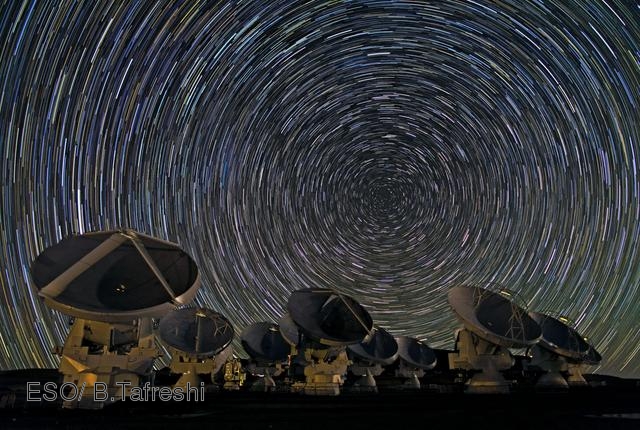
Huellas de estrellas sobre las antenas de ALMA. ESO
En el desierto chileno de Atacama se inaugura hoy el mayor proyecto astronómico existente

AFM/DICYT A 5.000 metros de altitud, con temperaturas que oscilan entre los –30 Cº y los 40 Cº y niveles de humedad que en ocasiones son del 0%. En estas condiciones tan extremas tiene lugar el nacimiento del mayor complejo astronómico construido hasta ahora: ALMA (Atacama Large Millimeter/ submillimeter Array), que se inaugura hoy en el desierto de Atacama, al Norte de Chile, con 66 grandes antenas.

El origen de este proyecto se remonta un siglo atrás, cuando un grupo de astrónomos europeos, norteamericanos y japoneses jugaban con la idea de construir los telescopios más revolucionarios, pero un proyecto tan ambicioso era difícil de materializar sin una gran colaboración mundial.

El día 13 de marzo de 2013 será recordado, en el ámbito astronómico, como el día en que se hace evidente que la idea de estos investigadores no era imposible, puesto que se inaugura el ALMA en el Llano de Chajnantor, a poco más de 50 kilómetros de San Pedro de Atacama, aunque desde el año pasado está en funcionamiento con 16 antenas, es lo que se conoce como Fase de Ciencia Temprana.

El español Xavier Barcons, físico y presidente del Observatorio Europeo Austral (ESO, por sus siglas en inglés), explica en declaraciones a DiCYT que en dicha fase se ha descubierto una forma muy simple de un azúcar en el espacio y la estructura en forma de espiral de una estrella que está terminando sus días.

Una asociación internacional firmada en septiembre de 2004 entre Europa (representada por el ESO y con una participación del 37,5%), Norteamérica (Estados Unidos y Canadá, 37,5%) y Asia (Japón y Taiwán, 25%), en colaboración con la República de Chile, ha sido la responsable de crear el mayor proyecto astronómico que existe: un telescopio de diseño revolucionario, compuesto de 66 antenas de alta precisión ubicado en el norte de Chile.

Para este representante de Europa en ALMA lo más difícil fue poner de acuerdo a las tres culturas ya que la forma de trabajo y de gestión en estos proyectos es muy dispar en cada ámbito. “Ahora creo que es justo reconocer que hemos aprendido a convivir con esta diversidad, y que esto ha redundado en un claro beneficio para el proyecto”, asevera Barcons.

ALMA, un proyecto sin precedentes con un coste de 1.200 millones de euros, se traduce en el mejor ejemplo en cuanto a colaboración mundial se refiere al contar con el respaldo de cuatro continentes. Este elevado número de antenas y su configuración han hecho de ese desierto un área gigantesca donde se reciben constantemente señales extremadamente débiles. Esto permitirá investigar el Universo más cercano y conocer el más lejano, que antes no se podía acceder con ninguna otra tecnología.

Resultados esperados e inesperados
El polvo cósmico, el gas molecular, el origen de las estrellas y los planetas o comprobar la radiación residual del Big Bang son algunos de los muchos sueños que se persiguen y que se harán realidad gracias a ALMA.

Xavier Barcons destaca que ”todas las infraestructuras científicas como ALMA tienen detrás unos objetivos científicos, y se diseñan para poder abordarlos, aunque una vez construidas los resultados más espectaculares aparecen siempre por donde uno menos lo espera. Así que ALMA cubrirá los dos flancos, avanzando en lo esperado y en lo inesperado”. 

Los objetivos de ALMA son observar cualquier aspecto visible creado después del Big Bang, corroborar si el Universo se formó tal y como se piensa o si, por el contrario, se encuentran muchas sorpresas. “Esencialmente gas frío y moléculas en el Universo” es lo que se espera encontrar gracias a ALMA, afirma. A partir de ese gas se forman las estrellas en las galaxias más tempranas y alejadas del Universo. Esta tecnología ofrecerá imágenes totalmente revolucionarias y dentro de poco ofrecerá información sobre las primeras estrellas y sobre cómo se originaron los primeros rastros de vida.

Todo ello será posible a través de la observación de ondas milimétricas y submilimétricas, es decir, gracias a la tecnología de la interferometría, técnica utilizada en Astronomía que consiste en combinar una señal usando dos o más antenas y obtener información sobre la fuente de emisión (ya sea una estrella, planeta, o galaxia) a través de la cual será posible obtener imágenes de muchísima precisión.

Sincronización de las 66 antenas
Pero el correcto funcionamiento de ALMA depende de la perfecta sincronización entre sus 66 antenas que deberán hacer frente al desafío de apuntar simultáneamente todas a un mismo punto del cielo, captar individualmente la señal astronómica, convertirla a formato digital y transmitir toda la información recogida a un ordenador que combinará las señales recibidas para transformarlas en datos.

Antenas de ALMA. ESO
De estas, 50 antenas son de 12 metros de diámetro con separaciones que van de 150 metros a 16 kilómetros simulando un telescopio gigante. Otras 4 antenas de la misma medida junto con 12 de 7 metros formarán el Conjunto Compacto Atacama (ACA, por sus siglas en inglés). Debido a la forma en que funcionan los interferómetros, esta disposición y separación entre ellas les permitirá proporcionar una imagen más general de los objetos astronómicos que se observen.

Proyecto internacional
Los astrónomos tendrán a su disposición instalaciones de investigación de vanguardia gracias al apoyo de 16 países, la mayoría europeos a través del ESO. La sede central de este organismo (que incluye el centro científico, técnico y administrativo de la organización) se encuentra en Garching, cerca de Munich (Alemania), pero cuenta con otra en Santiago de Chile y telescopios en tres centros de observación en el desierto chileno de Atacama: el observatorio de La Silla, el Very Large Telescope (Telescopio óptico terrestre más avanzado del mundo) y el telescopio submilimétrico APEX.

Además de esta tecnología, ESO está trabajando en diseño de un telescopio de 40 metros, el E-ELT (European Extremely Large Telescope), que trabajará en los rangos óptico e infrarrojo cercano. Este último telescopio será la mayor ventana a través de la cual podremos observar el cielo.

Dentro de estas aportaciones europeas destaca, por ejemplo, la inversión de infraestructuras por parte de España, que se encargó de la fabricación de 25 antenas de acero, así como el equipo de producción de energía, algo que para Xavier Barcons fue “un quebradero de cabeza” y un asunto vital en un complejo localizado a 5.000 metros de altura. Los amplificadores de bajo ruido que se encuentran en el interior de cada telescopio también se fabricaron en España.