Mostrando entradas con la etiqueta Exploración Espacial. Mostrar todas las entradas

martes, 11 de noviembre de 2014

Rosetta. Top 10 at 10Km

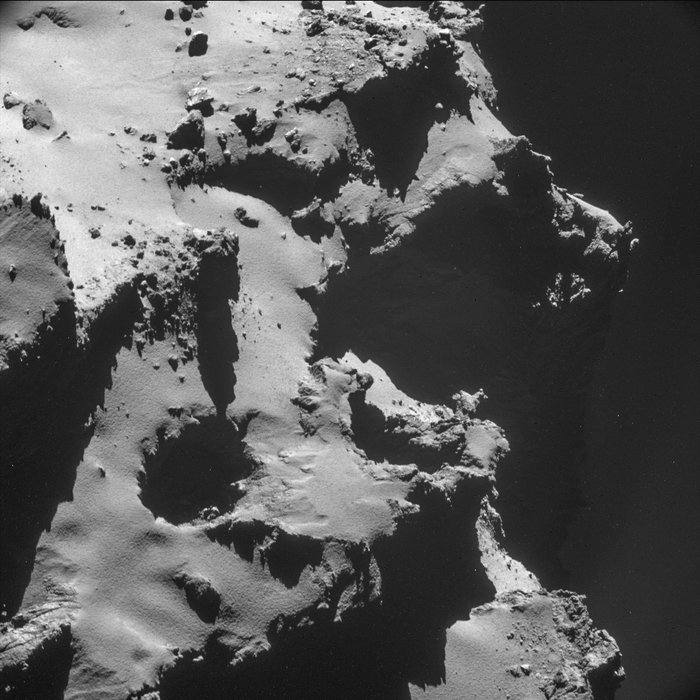
ESA’s comet-chasing Rosetta mission spent much of the second half of October orbiting Comet 67P/Churyumov–Gerasimenko at less than 10 km from its surface. This selection of previously unpublished ‘beauty shots’, taken by Rosetta’s navigation camera, presents the varied and dramatic terrain of this mysterious world from this close orbit phase of the mission.

Some light contrast enhancements have been made to emphasise certain features and to bring out features in the shadowed areas. In reality, the comet is extremely dark ­– blacker than coal. The images, taken in black-and-white, are grey-scaled according to the relative brightness of the features observed, which depends on local illumination conditions, surface characteristics and composition of the given area. Some slight vignetting can also be seen in the corners of some images.


Title NAVCAM top 10 at 10 km – 1
Released 11/11/2014 8:00 am
Copyright ESA/Rosetta/NAVCAM – CC BY-SA IGO 3.0

Description
This image showcases one of the many pits seen on the surface of 67P/Churyumov–Gerasimenko. Pits like these are thought to be where gas vents into space from the porous subsurface, carrying with it dusty grains of comet material. Scientists are keen to learn the role of this pit – and others – in the development of the comet’s activity, as it gets ever closer to the Sun.

This single-frame NAVCAM image measures 1024 x 1024 pixels. It was captured from a distance of 9.9 km from the centre of the comet (about 7.7 km from the surface) at 02:22 GMT on 15 October 2014. At this distance, the image resolution is 84.6 cm/pixel and the size of the image is 866 x 866 m.

This work is licenced under the Creative Commons Attribution-ShareAlike 3.0 IGO (CC BY-SA 3.0 IGO) licence. The user is allowed to reproduce, distribute, adapt, translate and publicly perform this publication, without explicit permission, provided that the content is accompanied by an acknowledgement that the source is credited as 'European Space Agency - ESA', a direct link to the licence text is provided and that it is clearly indicated if changes were made to the original content. Adaptation/translation/derivatives must be distributed under the same licence terms as this publication. To view a copy of this license, please visit http://creativecommons.org/licenses/by-sa/3.0/igo/
Id 326679


DETAILS
Title NAVCAM top 10 at 10 km – 2
Released 11/11/2014 8:00 am
Copyright ESA/Rosetta/NAVCAM – CC BY-SA IGO 3.0

miércoles, 24 de septiembre de 2014

India makes history with successful maiden voyage to Mars


Indian space agency's low-cost mission to Mars has successfully entered the red planet's orbit, crowning India as first country to execute such a project in its maiden attempt

India has triumphed in its first interplanetary attempt by successfully putting a satellite into orbit around Mars.

Scientists broke into wild cheers on Wednesday morning as the orbiter's engines completed 24 minutes of burn time and maneuvered into its designated place around the red planet.

The rocket launch (DD)

The success of India's Mars Orbiter Mission, affectionately nicknamed MOM, brings India into an elite club of Martian explorers that includes United States, the European Space Agency and the former Soviet Union.

The success of the Mars Orbiter Mission, lauded for its low price tag of $74 million, will boost India's five-decade-old space programme that newly-elected Prime Minister Narendra Modi aims to expand with better infrastructure and technology.


ORIGINAL:
Telegraph

miércoles, 6 de agosto de 2014

Rosetta arrives at comet destination

Comet on 3 August 2014

After a decade-long journey chasing its target, ESA’s Rosetta has today become the first spacecraft to rendezvous with a comet
, opening a new chapter in Solar System exploration.

Comet 67P/Churyumov–Gerasimenko and Rosetta now lie 405 million kilometres from Earth, about half way between the orbits of Jupiter and Mars, rushing towards the inner Solar System at nearly 55 000 kilometres per hour.

The comet is in an elliptical 6.5-year orbit that takes it from beyond Jupiter at its furthest point, to between the orbits of Mars and Earth at its closest to the Sun. Rosetta will accompany it for over a year as they swing around the Sun and back out towards Jupiter again.

Comets are considered to be primitive building blocks of the Solar System and may have helped to ‘seed’ Earth with water, perhaps even the ingredients for life. But many fundamental questions about these enigmatic objects remain, and through a comprehensive, in situ study of the comet, Rosetta aims to unlock the secrets within.

Comet on 3 August 2014

The journey to the comet was not straightforward, however. Since its launch in 2004, Rosetta had to make three gravity-assist flybys of Earth and one of Mars to help it on course to its rendezvous with the comet. This complex course also allowed Rosetta to pass by asteroids Šteins and Lutetia, obtaining unprecedented views and scientific data on these two objects.

“After ten years, five months and four days travelling towards our destination, looping around the Sun five times and clocking up 6.4 billion kilometres, we are delighted to announce finally ‘we are here’,” says Jean-Jacques Dordain, ESA’s Director General.

“Europe’s Rosetta is now the first spacecraft in history to rendezvous with a comet, a major highlight in exploring our origins. Discoveries can start.”

Today saw the last of a series of ten rendezvous manoeuvres that began in May to adjust Rosetta’s speed and trajectory gradually to match those of the comet. If any of these manoeuvres had failed, the mission would have been lost, and the spacecraft would simply have flown by the comet.

“Today’s achievement is a result of a huge international endeavour spanning several decades,” says Alvaro Giménez, ESA’s Director of Science and Robotic Exploration.

“We have come an extraordinarily long way since the mission concept was first discussed in the late 1970s and approved in 1993, and now we are ready to open a treasure chest of scientific discovery that is destined to rewrite the textbooks on comets for even more decades to come.”

Comet activity on 2 August 2014

The comet began to reveal its personality while Rosetta was on its approach. Images taken by the OSIRIS camera between late April and early June showed that its activity was variable. The comet’s ‘coma’ – an extended envelope of gas and dust – became rapidly brighter and then died down again over the course of those six weeks.

In the same period, first measurements from the Microwave Instrument for the Rosetta Orbiter, MIRO, suggested that the comet was emitting water vapour into space at about 300 millilitres per second.

Meanwhile, the Visible and Infrared Thermal Imaging Spectrometer, VIRTIS, measured the comet’s average temperature to be about –70ºC, indicating that the surface is predominantly dark and dusty rather than clean and icy.

Then, stunning images taken from a distance of about 12,000 km began to reveal that the nucleus comprises two distinct segments joined by a ‘neck’, giving it a duck-like appearance. Subsequent images showed more and more detail – the most recent, highest-resolution image was downloaded from the spacecraft earlier today and will be available this afternoon.

“Our first clear views of the comet have given us plenty to think about,” says Matt Taylor, ESA’s Rosetta project scientist.

“Is this double-lobed structure built from two separate comets that came together in the Solar System’s history, or is it one comet that has eroded dramatically and asymmetrically over time? Rosetta, by design, is in the best place to study one of these unique objects.”

Arriving at a comet
Today, Rosetta is just 100 km from the comet’s surface, but it will edge closer still. Over the next six weeks, it will describe two triangular-shaped trajectories in front of the comet, first at a distance of 100 km and then at 50 km.

At the same time, more of the suite of instruments will provide a detailed scientific study of the comet, scrutinising the surface for a target site for the Philae lander.

Eventually, Rosetta will attempt a close, near-circular orbit at 30 km and, depending on the activity of the comet, perhaps come even closer.


“Arriving at the comet is really only just the beginning of an even bigger adventure, with greater challenges still to come as we learn how to operate in this unchartered environment, start to orbit and, eventually, land,” says Sylvain Lodiot, ESA’s Rosetta spacecraft operations manager.

As many as five possible landing sites will be identified by late August, before the primary site is identified in mid-September. The final timeline for the sequence of events for deploying Philae – currently expected for 11 November – will be confirmed by the middle of October.
“Over the next few months, in addition to characterising the comet nucleus and setting the bar for the rest of the mission, we will begin final preparations for another space history first: landing on a comet,” says Matt.

“After landing, Rosetta will continue to accompany the comet until its closest approach to the Sun in August 2015 and beyond, watching its behaviour from close quarters to give us a unique insight and realtime experience of how a comet works as it hurtles around the Sun.”

Notes for Editors:

Rosetta woke up from deep space hibernation at 18:18 GMT on 20 January 2014, nine million kilometres from comet 67P/Churyumov–Gerasimenko. Following wake-up, the orbiter’s 11 science instruments and 10 lander instruments were reactivated and readied for science observations. Ten orbital correction manoeuvres were carried out between 7 May and 6 August, reducing the spacecraft’s velocity with respect to the comet from 775 m/s to 1 m/s, equivalent to walking pace. Each of these manoeuvres was critical: if any had failed, no rendezvous would have been possible. More information about these manoeuvres can be found on the Rosetta blog.

The latest ‘arrival’ image will be presented in the science session of today’s ‘Rosetta comet rendezvous’ event at ESA’s Space Operations Centre, ESOC, in Darmstadt, Germany, and in parallel will be published online on the ESA Portal.

About the European Space Agency

The European Space Agency (ESA) is Europe’s gateway to space. It is an intergovernmental organisation, created in 1975, with the mission to shape the development of Europe’s space capability and ensure that investment in space delivers benefits to the citizens of Europe and the world.

ESA has 20 Member States: Austria, Belgium, the Czech Republic, Denmark, Finland, France, Germany, Greece, Ireland, Italy, Luxembourg, the Netherlands, Norway, Poland, Portugal, Romania, Spain, Sweden, Switzerland and the United Kingdom, of whom 18 are Member States of the EU.

ESA has Cooperation Agreements with eight other Member States of the EU. Canada takes part in some ESA programmes under a Cooperation Agreement.

ESA is also working with the EU on implementing the Galileo and Copernicus programmes.

By coordinating the financial and intellectual resources of its members, ESA can undertake programmes and activities far beyond the scope of any single European country.

ESA develops the launchers, spacecraft and ground facilities needed to keep Europe at the forefront of global space activities.

Today, it launches satellites for Earth observation, navigation, telecommunications and astronomy, sends probes to the far reaches of the Solar System and cooperates in the human exploration of space.

For further information, please contact:
ESA Media Relations Office
Tel: + 33 1 53 69 72 99
Email: media@esa.int

Markus Bauer
ESA Science and Robotic Exploration Communications Officer
Tel: +31 71 565 6799
Mob: +31 61 594 3 954
Email: markus.bauer@esa.int

ORIGINAL: ESA
6 August 2014

miércoles, 11 de diciembre de 2013

First video in history to capture the Moon orbiting Earth

First video in history to capture the Moon orbiting Earth


According to NASA's Juno principal investigator Scott Bolton "if Captain Kirk of the USS Enterprise said, 'Take us home, Scotty,' this is what the crew would see." It's truly an incredible sequence—the first time ever that the Moon has been captured orbiting Earth.


Bolton describes the video: "In the movie, you ride aboard Juno as it approaches Earth and then soars off into the blackness of space. No previous view of our world has ever captured the heavenly waltz of Earth and moon."

The sequence was captured when Juno flew past Earth on October 9, 2013. In that pass, the ship accelerated to more than 8,800mph (7.3 kilometer per second), which put in en route to meet Jupiter on July 4, 2016. The scientists tested one of Juno's cameras, "optimized to track faint stars" by capturing this incredible view of the Earth and the Moon on their eternal dance.

As the designer of the star tracker—John Jørgensen of the Danish Technical University—put it: "Everything we humans are and everything we do is represented in that view."

Indeed. It may make you feel insignificant, but you should feel incredibly lucky to have materialized in this precious tiny planet of ours.

ORIGINAL: Sploid
Jesus Diaz on Sploid
Dec 10, 2013

martes, 23 de abril de 2013

A one-way ticket to Mars, apply now

ORIGINAL: CNN
By Ben Brumfield and Elizabeth Landau, CNN
April 22, 2013

Would you take a one-way trip to Mars? 
STORY HIGHLIGHTS 
  • Mars One wants to fly people to Mars and leave them there to live 
  • Every two years, a new crew would join them 
  • There is no return flight; you die there 
  • Some of it is media hype, but some is not, a source says 
(CNN) -- Step right up and prove why you should get a one-way ticket to Mars! Well, wait -- you might want to know a little more about the venture first. 

A Dutch company called Mars One began looking Monday for volunteer astronauts to fly to Mars. Departure for the Red Planet is scheduled for 2022, landing seven months later in 2023. 

The space travelers will return ... never. They will finish out their lives on Mars, representatives from the nonprofit said. 

"It's likely that there will be a crematorium," said CEO Bas Lansdorp. "It's up to the people on Mars to decide what to do with their dead." 

Still, the company said it has received more than 10,000 e-mails from interested would-be spacefarers. 

The one-way ticket makes the mission possible because it greatly reduces costs, and the technology for a return flight doesn't exist, according to Mars One's website. At a news conference, Lansdorp maintained that "no new inventions are needed to land humans on Mars." 


The biggest obstacles, he said, are financial. The company has revealed some of its sponsors and hopes to gain more via media coverage. It's not clear whether enough money will be collected in time. 

There are also practical issues: Can the kinks in having a sustainable system for people to survive in such a harsh environment be worked out by 2023? 

"Questions of reliability and robustness have to be answered before we leave Earth," said Grant Anderson of Paragon Space Development Corporation, which builds life-support systems and is joining the Mars One effort. 

Anyone may apply, for a fee 


The company announced a casting call for candidates at a news conference in New York City. 

Anyone 18 or older may apply via video but there is an application fee -- $38 for U.S. applicants. The money will fund the mission. 

Mars One wants to build a colony that will be able to grow with an ever-expanding crew. The group has a plan for testing the technology that would transport people and things. 

The group wants to launch a supply mission that will land on Mars as soon as October 2016. A "settlement rover" will land in 2018. 

The landing systems will be tested a total of eight times before they're used to transport humans, which Lansdorp says would make this "much safer than moon missions." 

The colony's budget comes in at "about $6 billion," Lansdorp said. "The $6 billion is for the first crew that goes there." 

By comparison, NASA's rover Curiosity, the most advanced and biggest robot to ever traverse Mars, is a $2.5 billion mission. 

Where exactly the $6 billion will go remains a mystery. Lansdorp said he didn't want to release an itemized budget because of competition. 

Mars One intends for a second crew to join the first one in 2025, and more will follow regularly. Each flight will carry two men and two women, so reproduction on Mars would be feasible but not intended. 

"We will certainly not send couples," Lansdorp said. 

At the news conference, Lansdorp said he'd like to go to Mars himself, but he isn't because his girlfriend won't come along. 

"I have a really nice girlfriend, and she doesn't want to come with me, so I'm staying right here." 


Are they for real? 
The idea of starting a colony on Mars in 10 years seems so out of this world that CNN contacted one of the mission's potential suppliers to check on Mars One's credibility. 

"I don't think they deserve to be dismissed," said a spokesman for an aerospace company that contracted for NASA's current Mars mission. 

The spokesman did not want his company named because he didn't want to damage the company's relationship with Mars One, but he felt he should talk to CNN to help put the Dutch start-up into perspective for a news audience, he said. 

With space opening up to the private sector, many companies large and small are trying to get in on the game, he said. Mars One's idea is one of the most audacious ones. 

Strange, dangerous mission 
As far as getting to Mars, Lansdorp said his organization is in discussions with SpaceX, the company that has now completed two commercial cargo missions to the International Space Station. The idea would be to use a slightly enlarged version of the Dragon capsule and land with retro-propulsion, not by parachute. 

If they get there, Mars astronauts will face a lonely life of danger, subsisting for extended periods on dried and canned food. They will get some of their water by recycling their urine. 

They will have to take care of sickness and injuries themselves. 

"There will be emergencies and deaths," Lansdorp said. "We need to make sure that crew members can continue without those people." 

Mars astronauts will have to be mentally fit to deal with the unusual stresses, he said. 

"Their psychological skills will be the main selection criteria we will use," he said. 

Once selected, a group of 40 astronauts will undergo seven years of training. 

The flight to Earth's neighbor, with its barren red desert landscape and thin carbon dioxide atmosphere, sounds almost worse than a lifetime on it. The crew of four will be cooped up on a rocket for seven months with a limited supply of food and water. 

It also might smell bad. 
"Showering with water will not be an option," according to Mars One's website. 

Mars, the greatest show on Earth 
Mars One plans to fund the mission partly from the sale of technology developed during the mission, Lansdorp said. It will share it with potential suppliers, which Mars One lists on its website. 

Media coverage will provide the main funding for the mission, Mars One said. Publicity is key, and the media event begins now with the casting of the astronauts. 

"Not unlike the televised events of the Olympic Games, Mars One intends to maintain an ongoing, global media event, from astronaut selection to training, from liftoff to landing," it says. 

How much money will that yield? It's tough to say, but the NCAA projects it will take in $700 million for television broadcast rights for its 2013 college sporting events. 

Lansdorp said that after consulting with media experts and ad agencies, he's confident life on Mars will remain a hit for decades on Earth and will be able to weather any financial crisis or war on Earth. 

"If humans land on Mars, everyone will want to watch," he said. "It will be bigger than the Olympic Games." 

If all goes well, Earthling television viewers can look forward to a decades-long reality show, though Lansdorp said the astronauts will be allowed to turn the cameras off at times. 

It's not just about the hype 
The spokesman for the aerospace company credits Mars One for creating a media spectacle and marrying it to technology. 

"They very aggressively seem to be pursuing the reality-TV angle," he said. 

It has gotten the small company to a stage that it can begin feasibility studies with aerospace companies, he said. It's also allowing scientists to work on ideas they otherwise might not have been able to pursue. 

"It may fund development that would otherwise not get funded," he said. 

The aerospace spokesman is hopeful Lansdorp and his team may one day say, "Mission accomplished." Even if they don't, though, they will likely reach other milestones. 

"We can't predict how far they'll get," he said. 

If the mission flops, Lansdorp has ideas about what the nonprofit would do with any leftover money: Donate it to organizations that support space travel, such as the Planetary Society. 

You might be thinking that $6 billion would be better spent on Earth, but Lansdorp says the money won't mean much on our planet. 

Besides, he said, "I don't have a business case to solve the problems on Earth. I have a really good business case to get humans to Mars."

jueves, 28 de marzo de 2013

La colombiana encargada de los "Ferrari" de la NASA

ORIGINAL: BBC
Thomas Sparrow BBC Mundo, Washington
26 de marzo de 2013


Utilizar un reproductor alternativo

Entre risas, Adriana Ocampo Uria dice que ella trabaja con los "Ferrari del Sistema Solar".

Nacida en Colombia pero criada en Argentina, Ocampo es responsable del programa Nuevas Fronteras en la agencia espacial estadounidense NASA, que coordina las sondas robóticas que viajan a toda velocidad hacia el gigante Júpiter y el enano Plutón.

Contenido relacionado

En fotos: el espectáculo de la conjunción de Venus y Júpiter
Más evidencia de agua en el sistema solar
Descubren un planeta de diamante

¿El objetivo? Acercarse lo más posible a estos cuerpos para resolver los misterios sobre su composición y sus características.

Además de trabajar en estas exploraciones planetarias, Ocampo tiene un rol mucho más terrenal: cuando no está pensando en los confines del Sistema Solar responde algunas de las cartas que los niños envían a la NASA con sus sueños.

BBC Mundo visitó a esta geóloga planetaria de 58 años en la sede central de la agencia espacial en Washington para conocer su trabajo.

clicEn fotos: Juno a la conquista de Júpiter
La nave espacial Juno tiene previsto su lanzamiento el próximo viernes 5 de agosto desde la base de Cabo Cañaveral en Florida. Juno partirá rumbo a Júpiter para explorar los misterios del planeta y comprender mejor el proceso de formación del Sistema Solar. "La historia de nuestro planeta reside en Júpiter", el sitio dedicado a la misión interplanetaria. Se espera que llegue a Júpiter en julio de 2016.

"Perspectiva desconocida"

El primer Ferrari que 'maneja' Adriana Ocampo se llama Juno, está impulsado por paneles solares y se mueve tan rápido que podría viajar de Los Ángeles a Nueva York en dos minutos.

Su recorrido total durante cinco años será de 2.800 millones de kilómetros hasta que llegue a Júpiter, un coloso de gas y una estrella fallida que ha fascinando a los astrónomos durante siglos, pero que todavía guarda el secreto sobre su formación.

Ocampo le explica a BBC Mundo que el Ferrari llegará al gigante en 2016, lo orbitará y penetrará su densa atmósfera, lo que les dará a los científicos "una perspectiva antes desconocida de lo que es ese planeta".

Y esa perspectiva es clave, en opinión de la NASA.

Así partió Juno a Júpiter en 2011


Utilizar un reproductor alternativo

Como la atmósfera de Júpiter tiene una composición similar a la del Sol, se cree que se formó temprano. Descubrir los detalles de su evolución les ayudaría a los científicos a entender el rol que han jugado titanes como Júpiter en la organización del Sistema Solar.

Ocampo explica que Júpiter también puede tener una de las claves sobre la formación de la vida.

Juno tratará de revelar la estructura interior del planeta para ver cómo influye en sus lunas, especialmente una de las más intrigantes, Europa.

Ésta, explica Ocampo, quizá contenga los tres ingredientes claves para la vida: agua líquida, material orgánico y una fuente de energía, que es la emitida por su planeta (ver video a la derecha).

Pero Ocampo no sólo está interesada en Júpiter y sus lunas.

No contenta con un Ferrari espacial, esta astrónoma colombiana también se encarga de otro: uno un poco más viejo que Juno, apenas del tamaño de un piano, pero que viajará incluso más lejos.

Se trata de la sonda Nuevos Horizontes, que se dirige hacia el mundo helado de Plutón.

Cuando fue lanzada en 2006, la NASA dijo que el conocimiento de ese planeta era tan limitado que podía caber "en la parte de atrás de una estampilla".

Los tiempos han cambiado. Plutón ya no es considerado un planeta y tiene varias lunas más de las que se creía.

El propósito de la misión, eso sí, sigue vigente: Nuevos Horizontes ya llegó a la mitad de su recorrido, cruzando en el proceso las lunas de Júpiter, y está previsto que pase por Plutón a mediados de 2015 para buscar estructuras geológicas, averiguar detalles sobre su atmósfera y analizar su superficie.

Mientras Juno y Nuevos Horizontes llegan a sus respectivos destinos y empiezan a emitir sus hallazgos, Adriana Ocampo se dedica también a una labor más terrenal: hablarles a los niños de su experiencia.

"Sueños rodantes por el Cosmos"
Cuando BBC Mundo le pregunta de dónde surgió su interés por las ciencias espaciales, Ocampo no duda en afirmar que fue "como un llamado de las estrellas".

Cuenta que cuando era una niña salía en las noches a la terraza de su casa, siempre acompañada de su perro Tauro, y se preguntaba por esos "puntitos de luz que veía en el cielo".

Intrigada por lo que podía estar más allá, decidió escribirle una carta a la NASA en español y ante su sorpresa, recibió una respuesta.

Sueños espaciales infantiles

"Fue extraordinario por el impacto que tuvo en mí que alguien escuchara mi llamado y mi interés", cuenta. "Es algo que te marca".

Por eso hoy, cuando ya cumplió su sueño, intenta fomentar el de otros.

Además de escribir un libro en español para niños sobre "la reina Gravedad y el rey Masa", también se encarga de responder algunas de las cartas infantiles que llegan a la NASA.

Uno de los proyectos en los que está involucrada se llama Huele a Sueños, creado por un grupo de niños de 11 y 12 años en Medellín, Colombia, que se apasionaron por la astronomía tras ver una película basada en la obra de Carl Sagan (ver galería a la derecha).

Ocampo no sólo les ha explicado a estos niños su trabajo vía teleconferencia, sino que además los invitó a la sede de la NASA en Cabo Cañaveral, en el estado de Florida.

Y ellos respondieron enviándole una promesa que ahora está enmarcada en su oficina: "Así seamos astrónomos, poetas o hasta las personas más ocupadas del mundo, siempre prestaremos atención a los sueños rodantes por el cosmos".

Quién sabe: tal vez entre esos niños de Medellín esté, como ya ocurrió con Ocampo, el próximo científico colombiano encargado de manejar un Ferrari espacial.