Mostrando entradas con la etiqueta Lingüística. Mostrar todas las entradas

martes, 18 de febrero de 2014

Why strange loops could be an argument for artificial intelligence


Strange loops can be many things, including musical tones, mathematical problems, and linguistic riddles. They also can be biological fact, and this fact might be translated into computer code or silicon chips. Here's why a philosophical theory might show true artificial intelligence is possible.

What Are Strange Loops?
When following a simple loop, you know you will go on a single trip that takes you back to where you started. There's one journey, and one destination. Strange loops are a bit more complicated — they form a kind of set of instructions, an ordered hierarchy, that brings you higher and higher, until you're back at the beginning where you started.

Strange Loops were the brainchild of Douglas Hofstadter, a philosopher and scientist who wrote I Am a Strange Loop. They can be simple or complex, but they depend on what Hofstadter called "tangled hierarchies." Instead of a linear progression, these hierarchies balance on each other. Together they encompass a set of instructions that set out two equally valid ways of looking at a situation. The situation cannot be resolved without elevating one view and one part of the set of instructions over the other, but there is no objective way to do that.

Examples of Strange Loops
Hofstadter proposes the Mona Lisa, or any painting, as an example of a strange loop. It's a group of pigments that are spackled onto a canvas, and it's a smiling woman. Obviously one is literally true and one is only figuratively true, but one would have to be deliberately obtuse to talk of the painting as only a grouping of colors under varnish. Examples of strange loops within paintings are the famous impossible object images of M. C. Escher and others — the endlessly descending stairs and rigid cages with bars that cross each other. If we could pin down which part of the object was real we could decide which part violated the laws of that painting's universe, but there's no objective basis to declare one part of the image real rather than any other part.

The Shepard Tones comprise a musical strange loop
. They are a group of tones that seem to continually rise (or fall) but never actually change. Our attention focuses on certain notes that seem to rise, but the lower notes never drop out. We keep waiting for an impossibly high dog whistle that never comes.


There are also linguistic strange loops that require us to make impossible distinctions. There's the famous two-sentence problem: "The following sentence is a lie. The previous sentence is true." And then there's the Berry Paradox, a famous mathematical definition that invalidates itself. It is meant to describe "the smallest positive integer not definable in under 1 words." Of course, whatever integer that is, it is now definable in under 11 words. Meaning there can't possibly be a smallest possible integer definable in under 11 words, except there has to be so that phrase can define it.

Strange Loops and Artificial Intelligence
What does any of this word play have to do artificial intelligence?
Hofstadter meant the title of his book literally. When he said, "I am a strange loop," what he meant was the idea of "I," the concept of the self, was a result of this weird duality of tangled hierarchies.

Ask people if their brains, the actual electrically lit-up matter that sits in their head cases, are what what make them themselves, and they'll probably say yes. We are our brains. Ask them if they are simply a mechanical thing, programmed to respond to stimulus, like a complex adding machine, and they would say no. We have a sense of self. To take the strictly literalist view that we do not have selves, that we are mechanical, would be as obtuse as saying the Mona Lisa is a group of colors or a difference engine is a proto-human. Our electrified protein has constructed a more numinous identity, and both the meat and the idea are valid.
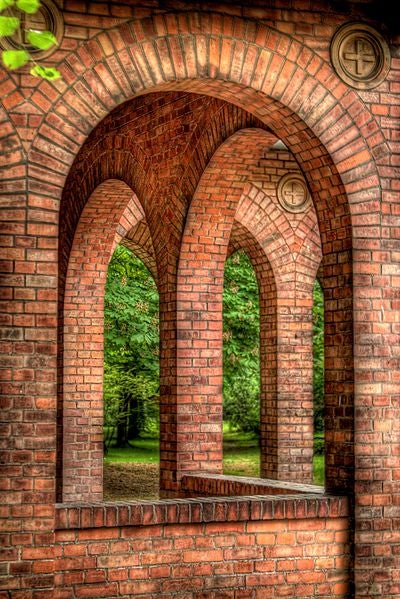
Impossible Arch Image: Till Krech.

So what? So that means that the sense of self will arise organically, from enough data input on sufficiently complex machinery. It doesn't matter if that machinery is made of flesh or anything else. Some people say that computers may imitate intelligent human life very well, but they'll never actually be the equivalent to humans. Others say that a calculator isn't much different from a human brain. The idea of strange loops, as they apply to life and machinery, asserts that calculators are not brains, because they do not construct an identity the way that brains do. However, they can become brains, or more accurately, they can become minds. Minds made of silicon, or anything else, are, when taken as strange loops, in no way distinguishable from human minds. "We" are both physical objects and incorporeal identities constructed from physical objects — and we are constructed so well that no one can say that the physical is more valid than the theoretical.

. [Via I Am a Strange Loop, Wolfram Math World, Philosophy Now, Strange Loops In Biology]

10 Hours of Infinite Fractal and Falling Shepard's Tone By
Daniel Repasky 
Video: Used with permission from the animated fractal's creator, Vladimir Bulatov. Check out his YouTube page here: http://bit.ly/13jdZ7e , and his DeviantArt page here: http://bit.ly/Yx2S78 .
The video is a fractal version of M.C. Escher's "Circle Limit III" (http://bit.ly/bbJ9P) created by Bulatov. Audio: Shepard's Tone (Shepard's Scale) consisting of rising tones set octaves apart, similar to how to barber's pole always seems to be rising: http://bit.ly/tlSj


ORIGINAL: Io9

domingo, 12 de mayo de 2013

Genomics Recapitulates History in Europe

ORIGINAL: PLOS Biology
Robin Meadows
May 7, 2013

Citation: Meadows R (2013) Genomics Recapitulates History in Europe. PLoS Biol 11(5): e1001556. doi:10.1371/journal.pbio.1001556

Copyright: © 2013 Robin Meadows. This is an open-access article distributed under the terms of the Creative Commons Attribution License, which permits unrestricted use, distribution, and reproduction in any medium, provided the original author and source are credited.

Competing interests: The author has declared that no competing interests exist.


Most of us know our families back a few generations but, beyond that, have little idea who our ancestors were or where they lived. Jumping further back, all of us alive today likely share most of our ancestors from 3,000 to 4,000 years ago. What happened between then and now? We've pieced together a broad picture of human kinship based on disciplines from archeology to linguistics to history. In Europe, for example, several relatively recent migrations have helped shape links and gaps amongst today's populations. Now, in this issue of PLOS Biology, Peter Ralph and Graham Coop use genomic data to give us a closer look at the recent roots of modern Europeans.

The distribution of distant cousins of modern-day people in the UK, at three different levels of geneological distance (circle size proportional to numbers of cousins; units are numbers of shared ancestors). Image credit: Peter Ralph and Graham Coop.doi:10.1371/journal.pbio.1001556.g001

Previous work has shown that genotypes in Europe vary with latitude and longitude, and that genetic diversity tends to increase from north to south. To get a sharper picture of the interplay between recent relatedness and geography in Europe, Ralph and Coop compared genome-wide sequencing data from 2,257 people across the continent. The researchers used sharing of long genome segments between individual people as well as populations as a measure of common ancestry. Shared segments become progressively shorter back through history as they have undergone more generations of recombination. Thus, the longer a shared segment, the more recent the common ancestor.

As might be expected, comparison of these long shared segments by country typically showed that recent relatedness is highest amongst people who live near each other. There are, however, some noteworthy departures from this norm. People in the UK share more recent ancestors with people in Ireland than with others living in their own country. Likewise, people in Germany share more recent ancestors with the Polish than with other Germans. This pattern could reflect the migrations of smaller populations into a larger one.

Similarly, while recent relatedness generally drops evenly across geographic distances in Europe, a few exceptions stand out. Regardless of physical proximity, recent relatedness is low between the Italian peninsula and the rest of the continent. At the other end of the scale, recent relatedness is high within northern Europe as well as across eastern Europe – three times that within other regions at similar distances.

Ralph and Coop also used long shared segments to gauge how many recent ancestors are common to people across modern Europe, as well as roughly how long ago they lived. Because a person does not inherit genetic material from every single ancestor, this analysis only reveals a small fraction of the shared genealogical relationships; the researchers call this fraction “genetic common ancestors.”

The distributions of long segments revealed that genetic common ancestors from about 500 years ago are typically shared only by people who live in the same country today. Albanian speakers are at the high end, with about 90 genetic common ancestors within the last 500 years, and about 600 genetic common ancestors between the last 500 and 1,500 years . In contrast, just about any two people from almost anywhere across Europe today share hundreds of genetic ancestors from more than 1,500 years ago. The outliers are the Italian and Iberian (Spain and Portugal) peninsulas, where people have only about two genetic ancestors in common with populations elsewhere on the continent over the last 1,500 years.

Ralph and Coop then take into account that these genetic common ancestors are only a small fraction of the genealogical ancestors. Based on this, the researchers extrapolate that, conservatively, even people living in opposite ends of Europe today are likely to have a shared ancestry that includes everyone who both lived a thousand years ago and had descendants. The conclusion that all Europeans are related over such a short time period lends credence to the theory that everyone in the world is related over just the last few millennia. Indeed, the researchers speculate that Europe's common ancestors over the past millennium may also be shared worldwide.

Another intriguing finding is that the numbers and timing of common ancestors among different parts of Europe may reflect major events in the continent's history. Notably, the number of common ancestors within the last 1,000 to 2,000 years is particularly high within eastern Europe — similar to those in Ireland despite spanning far greater distances — and the timing fits with the series of migrations that began with the Huns in the 4th century and ended with the Slavs between the 6th and 10th centuries.

In support of linking this spike in common ancestry with these migrations, many of today's eastern Europeans who share long segments also speak Slavic languages. Furthermore, the regions with the fewest common ancestors (France, and the Italian and Iberian peninsulas) are also thought to have been largely untouched by the migrations of Huns and Slavs.

This work both corroborates and extends our understanding of Europe's recent past, adding another dimension to what other disciplines tell us about historical events. Besides giving us a fuller picture of the close ties between people around the world, delving into our recent past with population genomics could ultimately help answer these most basic of human questions: Where did we come from and how did we get here?

Ralph P, Coop G (2013) The Geography of Recent Genetic Ancestry across Europe. doi:10.1371/journal.pbio.1001555