Mostrando entradas con la etiqueta ESA. Mostrar todas las entradas

jueves, 3 de noviembre de 2016

Kate Rubins’ Space Station Science Scrapbook

As a child, Kate Rubins dreamed of being an astronaut and a scientist. During the past four months aboard the International Space Station, that dream came full circle. She became the first person to sequence DNA in space, among other research during her recent mission, adding to her already impressive experience. She holds a doctorate in molecular biology, and previously led a lab of 14 researchers studying viruses, including Ebola.
Here’s a look back at Rubins in her element, conducting research aboard your orbiting laboratory.

Kate inside Destiny, the U.S. Laboratory Module

Destiny houses the Microgravity Science Glovebox (MSG), in which Kate worked on the Heart Cells experiment.
The U.S. national laboratory, called Destiny, is the primary research laboratory for U.S. payloads, supporting a wide range of experiments and studies contributing to health, safety, and quality of life for people all over the world. 

Swabbing for Surface Samples
Microbes that can cause illness could present problems for current and future long duration space missions. 
Understanding what microbe communities thrive in space habitats could help researchers design antimicrobial technology. Here, Kate is sampling various surfaces of the Kibo module for the Microbe-IV investigation.

Culturing Beating Heart Cells in Space
The Heart Cells investigation uses human skin cells that are induced to become stem cells, which can then differentiate into any type of cell.
Researchers forced the stem cells to grow into human heart cells, which Rubins cultured aboard the space station for one month.

Rubins described seeing the heart cells beat for the first time as “pretty amazing. First of all, there’s a few things that have made me gasp out loud up on board the [space] station. Seeing the planet was one of them, but I gotta say, getting these cells in focus and watching heart cells actually beat has been another pretty big one.”

Innovative Applied Research Experiment from Eli Lilly
The Hard to Wet Surfaces investigation from Eli Lilly, and sponsored by the Center for the Advancement of Science in Space (CASIS), looks at liquid-solid interactions and how certain pharmaceuticals dissolve, which may lead to more potent and effective medicines in space and on Earth. 
Rubins set up vials into which she injected buffer solutions and then set up photography to track how tablets dissolved in the solution in microgravity.

Capturing Dragon
Rubins assisted in the capture of the SpaceX Dragon cargo spacecraft in July. The ninth SpaceX resupply mission delivered more than two thousand pounds of science to the space station. 
Biological samples and additional research were returned on the Dragon spacecraft more than a month later. 

Sliding Science Outside the Station
Science doesn’t just happen inside the space station. External Earth and space science hardware platforms are located at various places along the outside of the orbiting laboratory. 

The Japanese Experiment Module airlock can be used to access the JEM Exposed Facility. Rubins installed the JEM ORU Transfer Interface (JOTI) on the JEM airlock sliding table used to install investigations on the exterior of the orbiting laboratory.

Installing Optical Diagnostic Instrument in the MSG
Rubins installed an optical diagnostic instrument in the Microgravity Science Glovebox (MSG) as part of the Selective Optical Diagnostics Instrument (SODI-DCMIX) investigation. Molecules in fluids and gases constantly move and collide. 

When temperature differences cause that movement, called the Soret effect, scientists can track it by measuring changes in the temperature and movement of mass in the absence of gravity. Because the Soret effect occurs in underground oil reservoirs, the results of this investigation could help us better understand such reservoirs.

The Sequencing of DNA in Space
When Rubins’ expedition began, DNA had never been sequenced in space. Within just a few weeks, she and the Biomolecule Sequencer team had sequenced their one billionth “base” – the unit of DNA - aboard the orbiting laboratory. 


The Biomolecule Sequencer investigation seeks to demonstrate that DNA sequencing in microgravity is possible, and adds to the suite of genomics capabilities aboard the space station.

The MinION™ DNA sequencer from Oxford Nanopore Technologies fits in the palm of a hand.
Credits: Oxford Nanopore Technologies

Studying Fluidic Dynamics with SPHERES
The SPHERES-Slosh investigation examines the way liquids move inside containers in a microgravity environment. The phenomena and mechanics associated with such liquid movement are still not well understood and are very different than our common experiences with a cup of coffee on Earth.


Rockets deliver satellites to space using liquid fuels as a power source, and this investigation plans to improve our understanding of how propellants within rockets behave in order to increase the safety and efficiency of future vehicle designs. Rubins conducted a series of SPHERES-Slosh runs during her mission.

Retrieving Science Samples for Their Return to Earth
Precious science samples like blood, urine and saliva are collected from crew members throughout their missions aboard the orbiting laboratory. 


They are stored in the Minus Eighty-Degree Laboratory Freezer for ISS (MELFI) until they are ready to return to Earth aboard a Soyuz or SpaceX Dragon vehicle.

Measuring Gene Expression of Biological Specimens in Space

Rubins ran several WetLab-2 RNA SmartCycler sessions during her mission.
Our WetLab-2 hardware system is bringing to the space station the technology to measure gene expression of biological specimens in space, and to transmit the results to researchers on Earth at the speed of light. 

Studying the First Expandable Habitat Module on the Space Station
The Bigelow Expandable Activity Module (BEAM) is the first expandable habitat to be installed on the space station. It was expanded on May 28, 2016. 


Expandable habitats are designed to take up less room on a spacecraft, but provide greater volume for living and working in space once expanded. Rubins conducted several evaluations inside BEAM, including air and surface sampling.

Better Breathing in Space and Back on Earth
Airway Monitoring, an investigation from ESA (the European Space Agency), uses the U.S. airlock as a hypobaric facility for performing science. Utilizing the U.S. airlock allows unique opportunities for the study of gravity, ambient pressure interactions, and their effect on the human body. 


This investigation studies the occurrence and indicators of airway inflammation in crew members, using ultra-sensitive gas analyzers to evaluate exhaled air. This could not only help in spaceflight diagnostics, but that also hold applications on earth within diagnostics of similar conditions, for example monitoring of asthma.

Hot Science with Cool Flames
Fire behaves differently in space, where buoyant forces are removed. Studying combustion in microgravity can increase scientists’ fundamental understanding of the process, which could lead to improvement of fire detection and suppression systems in space and on Earth. 

Many combustion experiments are performed in the Combustion Integration Rack (CIR) aboard the space station. Rubins replaced two Multi-user Droplet Combustion Apparatus (MDCA) Igniter Tips as part of the CIR igniter replacement operations.

Though Rubins is back on Earth, science aboard the space station continues, and innovative investigations that seek to benefit humans on Earth and further our exploration of the solar system are ongoing. Follow @ISS_Research to keep up with the science happening aboard your orbiting laboratory. 

Make sure to follow us on Tumblr for your regular dose of space: http://nasa.tumblr.com

lunes, 16 de mayo de 2016

NASA Animation Shows Mount Etna "Breathing"

Photo credit: NASA's Jet Propulsion Laboratory
A “breathing” volcano sounds like something out of an ancient myth, but this animation of Mount Etna is very much the real deal


The incredible visualization from NASA’s Jet Propulsion Laboratory shows how the ground surrounding the volcano pulses and morphs as a result of changes in the volume of a shallow chamber about 5 kilometers (3 miles) below sea level.

The data from the animation was picked up by radar interferometry on the European Space Agency's ERS-1 and ERS-2 satellites. This technique is so sensitive, it can detect ground deformation within 2.8 centimeters (1.1 inches)

Mount Etna, located on the island of Sicily, is one of Europe’s tallest active volcanoes at over 3,350 meters (10,990 feet). While on the whole its activity is fairly contained, it’s not without its temper tantrums. For example, in 1928 a particularly heavy flow of lava led to the near-total destruction of a town called Mascali.

The colored bar in the upper left corner of the video details how much the ground is falling in centimeters. Keep your eyes peeled for the red and yellow notches in the bottom right bar too. Each of these signify a volcanic eruption, with moderate eruption activity shown in yellow and strong ones shown in red.


ORIGINAL: IFLS
by Tom Hale
May 15, 2016

lunes, 17 de noviembre de 2014

OSIRIS spots Philae drifting across the comet

Title OSIRIS spots Philae drifting across the comet
Released 17/11/2014 3:00 pm
Copyright see below

Description
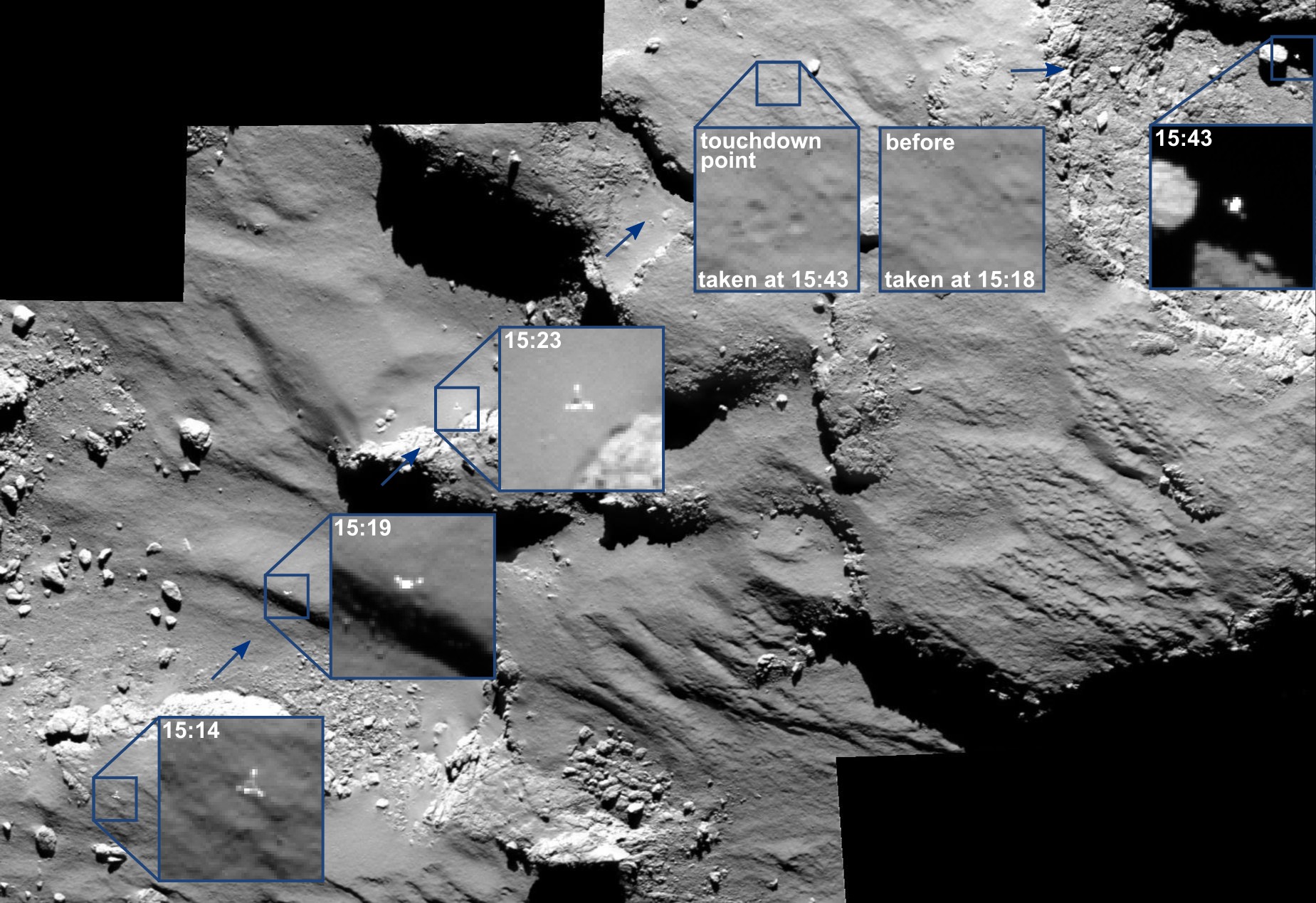
These incredible images show the breathtaking journey of Rosetta’s Philae lander as it approached and then rebounded from its first touchdown on Comet 67P/Churyumov–Gerasimenko on 12 November 2014.

The mosaic comprises a series of images captured by Rosetta’s OSIRIS camera over a 30 minute period spanning the first touchdown. The time of each of image is marked on the corresponding insets and is in GMT. A comparison of the touchdown area shortly before and after first contact with the surface is also provided.

The images were taken with Rosetta’s OSIRIS narrow-angle camera when the spacecraft was 17.5 km from the comet centre, or roughly 15.5 km from the surface. They have a resolution of 28 cm/pixel and the enlarged insets are 17 x 17 m.

From left to right, the images show Philae descending towards and across the comet before touchdown. The image taken after touchdown, at 15:43 GMT, confirms that the lander was moving east, as first suggested by the data returned by the CONSERT experiment, and at a speed of about 0.5 m/s.

The final location of Philae is still not known, but after touching down and bouncing again at 17:25 GMT, it reached there at 17:32 GMT. The imaging team is confident that combining the CONSERT ranging data with OSIRIS and navcam images from the orbiter and images from near the surface and on it from Philae’s ROLIS and CIVA cameras will soon reveal the lander’s whereabouts.

The insets are provided separately via the blog: OSIRIS spots Philae drifting across the comet

Credit: ESA/Rosetta/MPS for OSIRIS Team MPS/UPD/LAM/IAA/SSO/INTA/UPM/DASP/IDA

ORIGINAL: ESA

martes, 11 de noviembre de 2014

Rosetta. Top 10 at 10Km

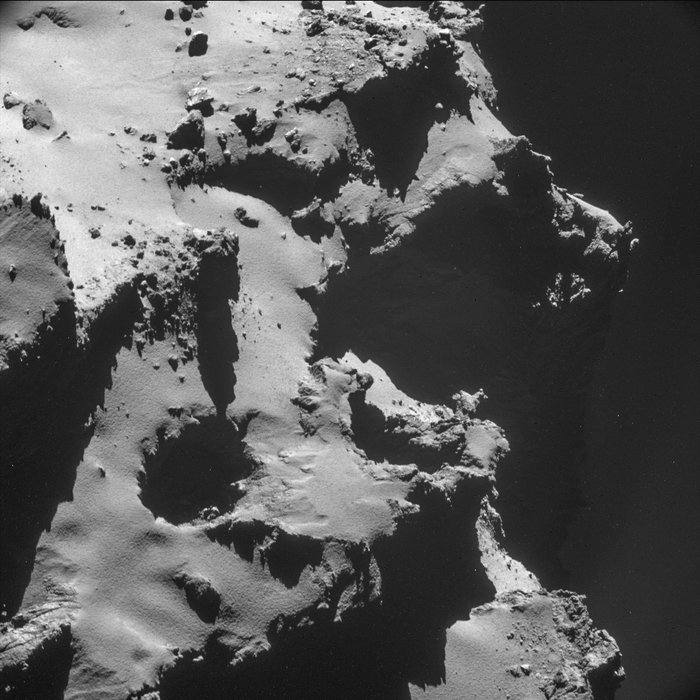
ESA’s comet-chasing Rosetta mission spent much of the second half of October orbiting Comet 67P/Churyumov–Gerasimenko at less than 10 km from its surface. This selection of previously unpublished ‘beauty shots’, taken by Rosetta’s navigation camera, presents the varied and dramatic terrain of this mysterious world from this close orbit phase of the mission.

Some light contrast enhancements have been made to emphasise certain features and to bring out features in the shadowed areas. In reality, the comet is extremely dark ­– blacker than coal. The images, taken in black-and-white, are grey-scaled according to the relative brightness of the features observed, which depends on local illumination conditions, surface characteristics and composition of the given area. Some slight vignetting can also be seen in the corners of some images.


Title NAVCAM top 10 at 10 km – 1
Released 11/11/2014 8:00 am
Copyright ESA/Rosetta/NAVCAM – CC BY-SA IGO 3.0

Description
This image showcases one of the many pits seen on the surface of 67P/Churyumov–Gerasimenko. Pits like these are thought to be where gas vents into space from the porous subsurface, carrying with it dusty grains of comet material. Scientists are keen to learn the role of this pit – and others – in the development of the comet’s activity, as it gets ever closer to the Sun.

This single-frame NAVCAM image measures 1024 x 1024 pixels. It was captured from a distance of 9.9 km from the centre of the comet (about 7.7 km from the surface) at 02:22 GMT on 15 October 2014. At this distance, the image resolution is 84.6 cm/pixel and the size of the image is 866 x 866 m.

This work is licenced under the Creative Commons Attribution-ShareAlike 3.0 IGO (CC BY-SA 3.0 IGO) licence. The user is allowed to reproduce, distribute, adapt, translate and publicly perform this publication, without explicit permission, provided that the content is accompanied by an acknowledgement that the source is credited as 'European Space Agency - ESA', a direct link to the licence text is provided and that it is clearly indicated if changes were made to the original content. Adaptation/translation/derivatives must be distributed under the same licence terms as this publication. To view a copy of this license, please visit http://creativecommons.org/licenses/by-sa/3.0/igo/
Id 326679


DETAILS
Title NAVCAM top 10 at 10 km – 2
Released 11/11/2014 8:00 am
Copyright ESA/Rosetta/NAVCAM – CC BY-SA IGO 3.0

lunes, 10 de noviembre de 2014

Rosetta's comet lander readies for its launch

Rosetta that was launched in 2004 is now preparing to enter its last phase of the mission. Ten years later, on August 6, the spacecraft began orbiting 67P, and its 11 instruments started scrutinizing myriad characteristics of the comet (SN: 9/6/14, p. 8). Those instruments, plus the cameras and sensors on the Philae lander, are designed to map 67P, determine what it’s made of and observe how its chemistry might change as it swings around the sun.

On November 12, Rosetta will sidle up to a comet, steady itself and drop a 100-kilogram robotic lander toward the hunk of rock, dust and ice. The lander, named Philae, will drift through space, tugged only slightly by the gravity of the comet, commonly called 67P. Mission scientists will be holding their breath for what could be several anxiety-filled hours to see if Philae lands where and how it’s supposed to.

The exercise — the first attempt to set a lander on a comet — is as nerve-racking as landing on Mars or the moon, with some added challenges. Comets and other small space rocks have much less gravity than planets or moons, which is why it will take Philae close to seven hours to float to comet 67P’s surface. Then there’s the comet’s speed: Rosetta will drop the lander toward 67P as the comet shoots through the solar system at 55,000 kilometers per hour.

Add to that a comet's unpredictable nature: At any moment and without warning, 67P might spew out jets of gas and dust. Such eruptions could blow the spacecraft off course or skew the lander’s trajectory so it hits a boulder or misses its mark.

Early in the mission, scientists estimated that Philae had a 70 to 75 percent chance of successfully touching down on the comet, officially known as 67P/Churyumov-Gerasimenko. They made that prediction when they thought the comet was shaped like a potato. In July, Rosetta began sending pictures of 67P, indicating it looks more like a rubber duck — two masses connected by a thin neck. The new shape adds a bit more uncertainty to Philae sticking its landing.

Video Transcript :
"The European Space Agency's Philae robot is preparing for an extraordinary landing on an ambitious target: comet 67P/Churyumov-Gerasimenko.

Out there in the cold depths of space, somewhere between Mars and Jupiter, a spacecraft called Rosetta is coyly playing with a comet. Scientists call this comet 67P/Churyumov-Gerasimenko. Since August, the spacecraft has been swooping in and around the 4-kilometer long comet, snapping selfies with it and taking close-ups of its craggy cliffs, crevices and boulders.

These striking images are the first to clearly show what the surface of comets can look like. They also helped scientists pinpoint just the right spot for a daring operation: To set a lander down on 67P’s surface.

After weeks of pouring over the images mission scientists finally selected a relatively flat spot on the head of the comet for their lander, Philaeto settle into. But getting down to the surface won’t be easy.

It will require a complex set of circles around the comet and a separation at just the right point in one of those orbits.

This separation is slated to take place on November 12. That day, Rosetta will swing to within 23 kilometers of the comet and drop Philae off its backside. The lander will then drift through space toward 67P. And, if all goes well, it will arrive on the comet roughly seven hours later.

Then the 10 instruments aboard the robot will probe the comet from the inside out. Each instrument is designed to look at specific features of the comet, such as its internal structure and the chemical elements and molecules that make up its dust. This data, along with Rosetta’s analysis of 67P, will help scientists really get a handle on what comets are and what happens to them as their orbits take them closer to the sun.

A close look at the comet could also take us back in time to the beginning of the solar system. That’s because comets appear to be time capsules that may have preserved some of the earliest materials found in the solar system. Looking at those pristine features may help scientists and astronomers answer fundamental questions about how the planets formed and possibly even how water and other life ingredients made their way to Earth.

But first we’ll have to wait for that long-sought signal saying yes, Philae has made its touchdown.


Images, graphics and animations courtesy of DLR German Aerospace Center and ESA; Narrated and produced by Ashley Yeager"


ORIGINAL: Science Dump
by Andreea
11/08/2014

miércoles, 6 de agosto de 2014

Rosetta arrives at comet destination

Comet on 3 August 2014

After a decade-long journey chasing its target, ESA’s Rosetta has today become the first spacecraft to rendezvous with a comet
, opening a new chapter in Solar System exploration.

Comet 67P/Churyumov–Gerasimenko and Rosetta now lie 405 million kilometres from Earth, about half way between the orbits of Jupiter and Mars, rushing towards the inner Solar System at nearly 55 000 kilometres per hour.

The comet is in an elliptical 6.5-year orbit that takes it from beyond Jupiter at its furthest point, to between the orbits of Mars and Earth at its closest to the Sun. Rosetta will accompany it for over a year as they swing around the Sun and back out towards Jupiter again.

Comets are considered to be primitive building blocks of the Solar System and may have helped to ‘seed’ Earth with water, perhaps even the ingredients for life. But many fundamental questions about these enigmatic objects remain, and through a comprehensive, in situ study of the comet, Rosetta aims to unlock the secrets within.

Comet on 3 August 2014

The journey to the comet was not straightforward, however. Since its launch in 2004, Rosetta had to make three gravity-assist flybys of Earth and one of Mars to help it on course to its rendezvous with the comet. This complex course also allowed Rosetta to pass by asteroids Šteins and Lutetia, obtaining unprecedented views and scientific data on these two objects.

After ten years, five months and four days travelling towards our destination, looping around the Sun five times and clocking up 6.4 billion kilometres, we are delighted to announce finally ‘we are here’,” says Jean-Jacques Dordain, ESA’s Director General.

Europe’s Rosetta is now the first spacecraft in history to rendezvous with a comet, a major highlight in exploring our origins. Discoveries can start.”

Today saw the last of a series of ten rendezvous manoeuvres that began in May to adjust Rosetta’s speed and trajectory gradually to match those of the comet. If any of these manoeuvres had failed, the mission would have been lost, and the spacecraft would simply have flown by the comet.

Today’s achievement is a result of a huge international endeavour spanning several decades,” says Alvaro Giménez, ESA’s Director of Science and Robotic Exploration.

We have come an extraordinarily long way since the mission concept was first discussed in the late 1970s and approved in 1993, and now we are ready to open a treasure chest of scientific discovery that is destined to rewrite the textbooks on comets for even more decades to come.

Comet activity on 2 August 2014

The comet began to reveal its personality while Rosetta was on its approach. Images taken by the OSIRIS camera between late April and early June showed that its activity was variable. The comet’s ‘coma’ – an extended envelope of gas and dust – became rapidly brighter and then died down again over the course of those six weeks.

In the same period, first measurements from the Microwave Instrument for the Rosetta Orbiter, MIRO, suggested that the comet was emitting water vapour into space at about 300 millilitres per second.

Meanwhile, the Visible and Infrared Thermal Imaging Spectrometer, VIRTIS, measured the comet’s average temperature to be about –70ºC, indicating that the surface is predominantly dark and dusty rather than clean and icy.

Then, stunning images taken from a distance of about 12,000 km began to reveal that the nucleus comprises two distinct segments joined by a ‘neck’, giving it a duck-like appearance. Subsequent images showed more and more detail – the most recent, highest-resolution image was downloaded from the spacecraft earlier today and will be available this afternoon.

Our first clear views of the comet have given us plenty to think about,” says Matt Taylor, ESA’s Rosetta project scientist.

Is this double-lobed structure built from two separate comets that came together in the Solar System’s history, or is it one comet that has eroded dramatically and asymmetrically over time? Rosetta, by design, is in the best place to study one of these unique objects.

Arriving at a comet
Today, Rosetta is just 100 km from the comet’s surface, but it will edge closer still. Over the next six weeks, it will describe two triangular-shaped trajectories in front of the comet, first at a distance of 100 km and then at 50 km.

At the same time, more of the suite of instruments will provide a detailed scientific study of the comet, scrutinising the surface for a target site for the Philae lander.

Eventually, Rosetta will attempt a close, near-circular orbit at 30 km and, depending on the activity of the comet, perhaps come even closer.


Arriving at the comet is really only just the beginning of an even bigger adventure, with greater challenges still to come as we learn how to operate in this unchartered environment, start to orbit and, eventually, land,” says Sylvain Lodiot, ESA’s Rosetta spacecraft operations manager.

As many as five possible landing sites will be identified by late August, before the primary site is identified in mid-September. The final timeline for the sequence of events for deploying Philae – currently expected for 11 November – will be confirmed by the middle of October.
Over the next few months, in addition to characterising the comet nucleus and setting the bar for the rest of the mission, we will begin final preparations for another space history first: landing on a comet,” says Matt.

After landing, Rosetta will continue to accompany the comet until its closest approach to the Sun in August 2015 and beyond, watching its behaviour from close quarters to give us a unique insight and realtime experience of how a comet works as it hurtles around the Sun.

Notes for Editors:

Rosetta woke up from deep space hibernation at 18:18 GMT on 20 January 2014, nine million kilometres from comet 67P/Churyumov–Gerasimenko. Following wake-up, the orbiter’s 11 science instruments and 10 lander instruments were reactivated and readied for science observations. Ten orbital correction manoeuvres were carried out between 7 May and 6 August, reducing the spacecraft’s velocity with respect to the comet from 775 m/s to 1 m/s, equivalent to walking pace. Each of these manoeuvres was critical: if any had failed, no rendezvous would have been possible. More information about these manoeuvres can be found on the Rosetta blog.

The latest ‘arrival’ image will be presented in the science session of today’s ‘Rosetta comet rendezvous’ event at ESA’s Space Operations Centre, ESOC, in Darmstadt, Germany, and in parallel will be published online on the ESA Portal.

About the European Space Agency

The European Space Agency (ESA) is Europe’s gateway to space. It is an intergovernmental organisation, created in 1975, with the mission to shape the development of Europe’s space capability and ensure that investment in space delivers benefits to the citizens of Europe and the world.

ESA has 20 Member States: Austria, Belgium, the Czech Republic, Denmark, Finland, France, Germany, Greece, Ireland, Italy, Luxembourg, the Netherlands, Norway, Poland, Portugal, Romania, Spain, Sweden, Switzerland and the United Kingdom, of whom 18 are Member States of the EU.

ESA has Cooperation Agreements with eight other Member States of the EU. Canada takes part in some ESA programmes under a Cooperation Agreement.

ESA is also working with the EU on implementing the Galileo and Copernicus programmes.

By coordinating the financial and intellectual resources of its members, ESA can undertake programmes and activities far beyond the scope of any single European country.

ESA develops the launchers, spacecraft and ground facilities needed to keep Europe at the forefront of global space activities.

Today, it launches satellites for Earth observation, navigation, telecommunications and astronomy, sends probes to the far reaches of the Solar System and cooperates in the human exploration of space.

For further information, please contact:
ESA Media Relations Office
Tel: + 33 1 53 69 72 99
Email: media@esa.int

Markus Bauer
ESA Science and Robotic Exploration Communications Officer
Tel: +31 71 565 6799
Mob: +31 61 594 3 954
Email: markus.bauer@esa.int

ORIGINAL: ESA
6 August 2014

martes, 21 de enero de 2014

ESA’s ‘sleeping beauty’ wakes up from deep space hibernation

Rosetta Wake-up signal

It was a fairy-tale ending to a tense chapter in the story of the Rosetta space mission this evening as ESA heard from its distant spacecraft for the first time in 31 months.

 
"Rosetta wakes up from deep space hibernation". Video from ESA

Video from ITN on Rosetta Mission

Rosetta is chasing down Comet 67P/Churyumov-Gerasimenko, where it will become the first space mission to rendezvous with a comet, the first to attempt a landing on a comet’s surface, and the first to follow a comet as it swings around the Sun.

Since its launch in 2004, Rosetta has made three flybys of Earth and one of Mars to help it on course to its rendezvous with 67P/Churyumov-Gerasimenko, encountering asteroids Steins and Lutetia along the way.

Operating on solar energy alone, Rosetta was placed into a deep space slumber in June 2011 as it cruised out to a distance of nearly 800 million km from the warmth of the Sun, beyond the orbit of Jupiter.

Now, as Rosetta’s orbit has brought it back to within ‘only’ 673 million km from the Sun, there is enough solar energy to power the spacecraft fully again.


Rosetta calls home

Thus today, still about 9 million km from the comet, Rosetta’s pre-programmed internal ‘alarm clock’ woke up the spacecraft. After warming up its key navigation instruments, coming out of a stabilising spin, and aiming its main radio antenna at Earth, Rosetta sent a signal to let mission operators know it had survived the most distant part of its journey.

The signal was received by both NASA’s Goldstone and Canberra ground stations at 18:18 GMT/ 19:18 CET, during the first window of opportunity the spacecraft had to communicate with Earth. It was immediately confirmed in ESA’s space operations centre in Darmstadt and the successful wake-up announced via the @ESA_Rosetta twitter account, which tweeted: “Hello, World!

We have our comet-chaser back,” says Alvaro Giménez, ESA’s Director of Science and Robotic Exploration. “With Rosetta, we will take comet exploration to a new level. This incredible mission continues our history of ‘firsts’ at comets, building on the technological and scientific achievements of our first deep space mission Giotto, which returned the first close-up images of a comet nucleus as it flew past Halley in 1986.

How Rosetta wakes up from deep space hibernation
Access the video

This was one alarm clock not to hit snooze on, and after a tense day we are absolutely delighted to have our spacecraft awake and back online,” adds Fred Jansen, ESA’s Rosetta mission manager.

Comets are considered the primitive building blocks of the Solar System and likely helped to ‘seed’ Earth with water, perhaps even the ingredients for life. But many fundamental questions about these enigmatic objects remain, and through its comprehensive, in situ study of Comet 67P/Churyumov-Gerasimenko, Rosetta aims to unlock the secrets contained within.

All other comet missions have been flybys, capturing fleeting moments in the life of these icy treasure chests,” says Matt Taylor, ESA’s Rosetta project scientist. “With Rosetta, we will track the evolution of a comet on a daily basis and for over a year, giving us a unique insight into a comet’s behaviour and ultimately helping us to decipher their role in the formation of the Solar System.

But first, essential health checks on the spacecraft must be completed. Then the eleven instruments on the orbiter and ten on the lander will be turned on and prepared for studying Comet 67P/Churyumov-Gerasimenko.

We have a busy few months ahead preparing the spacecraft and its instruments for the operational challenges demanded by a lengthy, close-up study of a comet that, until we get there, we know very little about,” says Andrea Accomazzo, ESA’s Rosetta operations manager.


Rosetta and Philae at comet

Rosetta’s first images of 67P/Churyumov-Gerasimenko are expected in May, when the spacecraft is still 2 million km from its target. Towards the end of May, the spacecraft will execute a major manoeuvre to line up for its critical rendezvous with the comet in August.

After rendezvous, Rosetta will start with two months of extensive mapping of the comet’s surface, and will also make important measurements of the comet’s gravity, mass and shape, and assess its gaseous, dust-laden atmosphere, or coma. The orbiter will also probe the plasma environment and analyse how it interacts with the Sun’s outer atmosphere, the solar wind.

Using these data, scientists will choose a landing site for the mission’s 100 kg Philae probe. The landing is currently scheduled for 11 November and will be the first time that a landing on a comet has ever been attempted.

In fact, given the almost negligible gravity of the comet’s 4 km-wide nucleus, Philae will have to use ice screws and harpoons to stop it from rebounding back into space after touchdown.

Among its wide range of scientific measurements, Philae will send back a panorama of its surroundings, as well as very high-resolution pictures of the surface. It will also perform an on-the-spot analysis of the composition of the ices and organic material, including drilling down to 23 cm below the surface and feeding samples to Philae’s on-board laboratory for analysis.

The focus of the mission will then move to the ‘escort’ phase, during which Rosetta will stay alongside the comet as it moves closer to the Sun, monitoring the ever-changing conditions on the surface as the comet warms up and its ices sublimate.

The comet will reach its closest distance to the Sun on 13 August 2015 at about 185 million km, roughly between the orbits of Earth and Mars. Rosetta will follow the comet throughout the remainder of 2015, as it heads away from the Sun and activity begins to subside.

We will face many challenges this year as we explore the unknown territory of comet 67P/Churyumov-Gerasimenko and I’m sure there will be plenty of surprises, but today we are just extremely happy to be back on speaking terms with our spacecraft,” adds Matt Taylor.

ORIGINAL: ESA
20 January 2014

jueves, 19 de diciembre de 2013

Orbiting ‘Magnetism to Light Converter’ Maps Earth’s Magnetic Field

Three identical satellites of ESA Swarm mission will move into separate polar orbits to blanket the planet with high-precision magnetic measurements. Illustrations: ESA
The European Space Agency’s Swarm expedition was launched from the Plesetsk Cosmodrome on 22 November, on a mission to study how the Earth’s magnetic field and ionosphere vary in time and space. It started sending back data four days later.

The mission consists of three identical satellites launched into separate polar orbits that will let them sheathe the Earth in a web of magnetic measurement.
Swarm will gauge the direction and strength of the planet’s magnetic field more precisely than ever before, using instruments up to five times as sensitive as those deployed on the Danish Øersted (launched 1999) and German CHAMP (2000) satellites. These measurements will return data on every part of the Earth, from the dynamo at the planet's core to the workings of the ionosphere and magnetosphere. It may even, perhaps, explain more about the magnetic “soft spot” that hovers over the South Atlantic (and might presage one of the periodic reversals in the Earth’s magnetic polarity).

Each Swarm spacecraft looks like an elongated horseshoe crab, with a solar-cell-covered carapace and a rapier of a tail. Once unfolded, the tail is a tubular, 4.3-meter-long, carbon-fiber-reinforced polymer boom. It’s manufactured without any magnetic components, because it is carries some of the most advanced magnetic-field-measurement instruments yet built.
Illustrations: ESA

About halfway down the boom is an optical bench that couples a three-axis star-tracking telescope with a Vector Field Magnetometer (VFM)a highly sensitive device for measuring the intensity and orientation of magnetic lines of flux. Overall, the assembly (devised by researchers at the Danish Technical University) is accurate to within about 0.5 nanotesla (0.5 x 10⁻⁹ T) in field strength and 0.1 degrees in satellite attitude. The VFM, which is the satellite’s primary instrument, will measure not only the direction and strength of the surrounding magnetic field, but also plot it against positions confirmed by the three-way star-sight.

At the end of the boom is a new design—the Absolute Scalar Magnetometer, (ASM) built by CEA-Leti (Grenoble, France), with scientific support from the Institut de Physique du Globe de Paris and financing and logistics from the Centre National d’Etudes Spatiales (CNES), the French national space agency.

The ASM’s nominal role is to understudy the VFM, helping to keep the vector instrument calibrated. What it actually offers, say the designers, goes a lot farther. (For a collection of papers on ASM’s design, see this CNES library.)

The device uses low-density helium as its sensor, and exploits the Zeeman effect—the splitting of the element’s emission-spectrum lines in a magnetic field.

To measure this spread, the ASM first applies radio frequency energy to lift electrons from their ground state to a metastable intermediate energy level (actually, one of three levels, since the Earth’s magnetic field splits this level into three levels, depending on the combined spins of the atom and its electrons).

Then a linearly polarized laser beam further pumps electrons to an even higher, though very short-lived, excited state. In one-tenth of a microsecond, the electrons drop back into one of the metastable levels, giving off photons and creating three closely grouped spectral lines (clustering at around 1083 nanometers wavelength in the infrared). The gap between the lines is proportional to the ambient magnetic field.

The instrument incorporates a number of refinements. To maintain accuracy, the designers had to maintain a constant relationship between the stimulating laser beam and the applied magnetic fields. By using a beam that’s polarized linearly rather than (as in previous designs) circularly, the designers were ab keep the system aligned by adjusting the direction of polarization rather than the direction of beam propagation—and it’s much easier to change polarization than to move the laser. In the ASM, non-magnetic piezoelectric motors control the orientations of the RF coils.

The net result is that the Absolute Scalar Magnetometer is about ten times as sensitive as the Vector Field Magnetometer, with a maximum error of less than 65 picotesla (65 x 10-12 T). By comparison, that’s about one millionth of the Earth’s surface magnetic field, which ranges from about 30 to 60 microtesla (30-60 x 10-6 T), and about one one-hundred-millionth the magnetic field strength of a common household refrigerator magnet (5 x 10⁻³ T). The precision should be better than 1 picotesla, and the noise levels are low, better than 1 pT / (Hz)1/2.

Also, the ASM uses three orthogonal sets of RF coils. The device is able to report how much of the scalar field is projected along each of these axes…so, voila, the scalar magnetometer can also function as a vector magnetometer, although at a lower sampling rate and with reduced accuracy. Among other experiments, the Swarm mission will test whether the understudy ASM might be ready to step out from backstage and take on the starring role of the VFM.


ORIGINAL: IEEE Spectrum
By Douglas McCormick
Posted 16 Dec 2013 
Modified 18 Dec. 2013 to include correct launch site at Plesetsk.