Mostrando entradas con la etiqueta Cometa. Mostrar todas las entradas

lunes, 17 de noviembre de 2014

OSIRIS spots Philae drifting across the comet

Title OSIRIS spots Philae drifting across the comet
Released 17/11/2014 3:00 pm
Copyright see below

Description
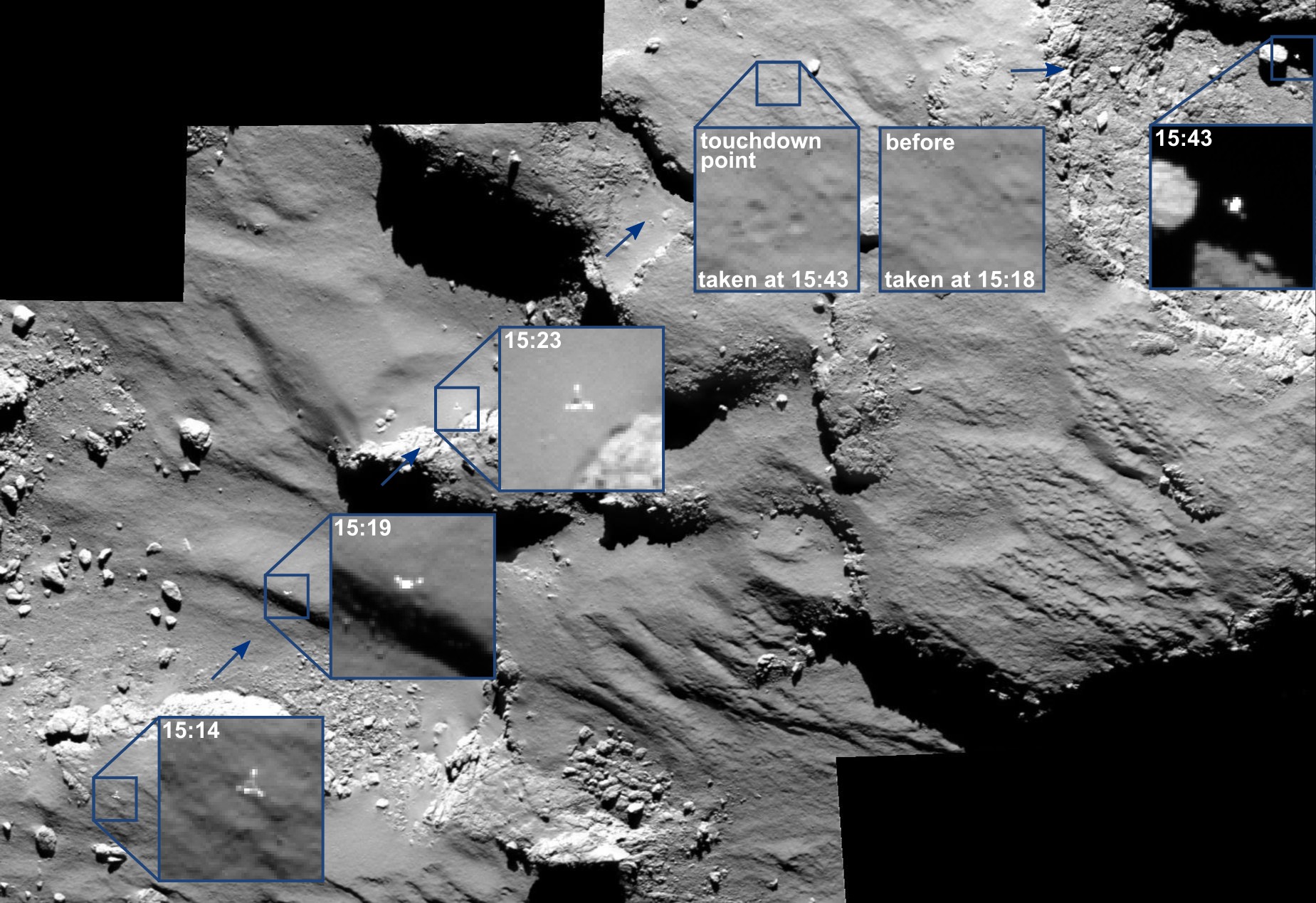
These incredible images show the breathtaking journey of Rosetta’s Philae lander as it approached and then rebounded from its first touchdown on Comet 67P/Churyumov–Gerasimenko on 12 November 2014.

The mosaic comprises a series of images captured by Rosetta’s OSIRIS camera over a 30 minute period spanning the first touchdown. The time of each of image is marked on the corresponding insets and is in GMT. A comparison of the touchdown area shortly before and after first contact with the surface is also provided.

The images were taken with Rosetta’s OSIRIS narrow-angle camera when the spacecraft was 17.5 km from the comet centre, or roughly 15.5 km from the surface. They have a resolution of 28 cm/pixel and the enlarged insets are 17 x 17 m.

From left to right, the images show Philae descending towards and across the comet before touchdown. The image taken after touchdown, at 15:43 GMT, confirms that the lander was moving east, as first suggested by the data returned by the CONSERT experiment, and at a speed of about 0.5 m/s.

The final location of Philae is still not known, but after touching down and bouncing again at 17:25 GMT, it reached there at 17:32 GMT. The imaging team is confident that combining the CONSERT ranging data with OSIRIS and navcam images from the orbiter and images from near the surface and on it from Philae’s ROLIS and CIVA cameras will soon reveal the lander’s whereabouts.

The insets are provided separately via the blog: OSIRIS spots Philae drifting across the comet

Credit: ESA/Rosetta/MPS for OSIRIS Team MPS/UPD/LAM/IAA/SSO/INTA/UPM/DASP/IDA

ORIGINAL: ESA

martes, 11 de noviembre de 2014

Rosetta. Top 10 at 10Km

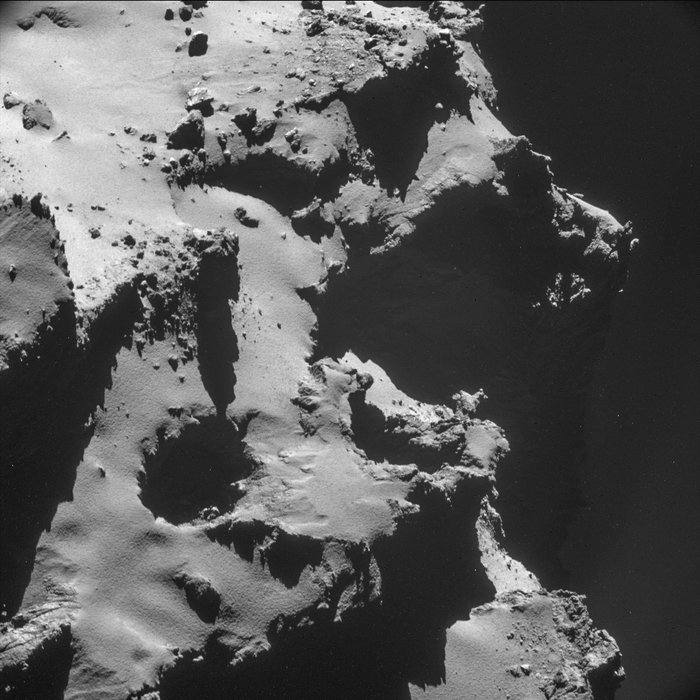
ESA’s comet-chasing Rosetta mission spent much of the second half of October orbiting Comet 67P/Churyumov–Gerasimenko at less than 10 km from its surface. This selection of previously unpublished ‘beauty shots’, taken by Rosetta’s navigation camera, presents the varied and dramatic terrain of this mysterious world from this close orbit phase of the mission.

Some light contrast enhancements have been made to emphasise certain features and to bring out features in the shadowed areas. In reality, the comet is extremely dark ­– blacker than coal. The images, taken in black-and-white, are grey-scaled according to the relative brightness of the features observed, which depends on local illumination conditions, surface characteristics and composition of the given area. Some slight vignetting can also be seen in the corners of some images.


Title NAVCAM top 10 at 10 km – 1
Released 11/11/2014 8:00 am
Copyright ESA/Rosetta/NAVCAM – CC BY-SA IGO 3.0

Description
This image showcases one of the many pits seen on the surface of 67P/Churyumov–Gerasimenko. Pits like these are thought to be where gas vents into space from the porous subsurface, carrying with it dusty grains of comet material. Scientists are keen to learn the role of this pit – and others – in the development of the comet’s activity, as it gets ever closer to the Sun.

This single-frame NAVCAM image measures 1024 x 1024 pixels. It was captured from a distance of 9.9 km from the centre of the comet (about 7.7 km from the surface) at 02:22 GMT on 15 October 2014. At this distance, the image resolution is 84.6 cm/pixel and the size of the image is 866 x 866 m.

This work is licenced under the Creative Commons Attribution-ShareAlike 3.0 IGO (CC BY-SA 3.0 IGO) licence. The user is allowed to reproduce, distribute, adapt, translate and publicly perform this publication, without explicit permission, provided that the content is accompanied by an acknowledgement that the source is credited as 'European Space Agency - ESA', a direct link to the licence text is provided and that it is clearly indicated if changes were made to the original content. Adaptation/translation/derivatives must be distributed under the same licence terms as this publication. To view a copy of this license, please visit http://creativecommons.org/licenses/by-sa/3.0/igo/
Id 326679


DETAILS
Title NAVCAM top 10 at 10 km – 2
Released 11/11/2014 8:00 am
Copyright ESA/Rosetta/NAVCAM – CC BY-SA IGO 3.0

miércoles, 6 de agosto de 2014

Rosetta arrives at comet destination

Comet on 3 August 2014

After a decade-long journey chasing its target, ESA’s Rosetta has today become the first spacecraft to rendezvous with a comet
, opening a new chapter in Solar System exploration.

Comet 67P/Churyumov–Gerasimenko and Rosetta now lie 405 million kilometres from Earth, about half way between the orbits of Jupiter and Mars, rushing towards the inner Solar System at nearly 55 000 kilometres per hour.

The comet is in an elliptical 6.5-year orbit that takes it from beyond Jupiter at its furthest point, to between the orbits of Mars and Earth at its closest to the Sun. Rosetta will accompany it for over a year as they swing around the Sun and back out towards Jupiter again.

Comets are considered to be primitive building blocks of the Solar System and may have helped to ‘seed’ Earth with water, perhaps even the ingredients for life. But many fundamental questions about these enigmatic objects remain, and through a comprehensive, in situ study of the comet, Rosetta aims to unlock the secrets within.

Comet on 3 August 2014

The journey to the comet was not straightforward, however. Since its launch in 2004, Rosetta had to make three gravity-assist flybys of Earth and one of Mars to help it on course to its rendezvous with the comet. This complex course also allowed Rosetta to pass by asteroids Šteins and Lutetia, obtaining unprecedented views and scientific data on these two objects.

“After ten years, five months and four days travelling towards our destination, looping around the Sun five times and clocking up 6.4 billion kilometres, we are delighted to announce finally ‘we are here’,” says Jean-Jacques Dordain, ESA’s Director General.

“Europe’s Rosetta is now the first spacecraft in history to rendezvous with a comet, a major highlight in exploring our origins. Discoveries can start.”

Today saw the last of a series of ten rendezvous manoeuvres that began in May to adjust Rosetta’s speed and trajectory gradually to match those of the comet. If any of these manoeuvres had failed, the mission would have been lost, and the spacecraft would simply have flown by the comet.

“Today’s achievement is a result of a huge international endeavour spanning several decades,” says Alvaro Giménez, ESA’s Director of Science and Robotic Exploration.

“We have come an extraordinarily long way since the mission concept was first discussed in the late 1970s and approved in 1993, and now we are ready to open a treasure chest of scientific discovery that is destined to rewrite the textbooks on comets for even more decades to come.”

Comet activity on 2 August 2014

The comet began to reveal its personality while Rosetta was on its approach. Images taken by the OSIRIS camera between late April and early June showed that its activity was variable. The comet’s ‘coma’ – an extended envelope of gas and dust – became rapidly brighter and then died down again over the course of those six weeks.

In the same period, first measurements from the Microwave Instrument for the Rosetta Orbiter, MIRO, suggested that the comet was emitting water vapour into space at about 300 millilitres per second.

Meanwhile, the Visible and Infrared Thermal Imaging Spectrometer, VIRTIS, measured the comet’s average temperature to be about –70ºC, indicating that the surface is predominantly dark and dusty rather than clean and icy.

Then, stunning images taken from a distance of about 12,000 km began to reveal that the nucleus comprises two distinct segments joined by a ‘neck’, giving it a duck-like appearance. Subsequent images showed more and more detail – the most recent, highest-resolution image was downloaded from the spacecraft earlier today and will be available this afternoon.

“Our first clear views of the comet have given us plenty to think about,” says Matt Taylor, ESA’s Rosetta project scientist.

“Is this double-lobed structure built from two separate comets that came together in the Solar System’s history, or is it one comet that has eroded dramatically and asymmetrically over time? Rosetta, by design, is in the best place to study one of these unique objects.”

Arriving at a comet
Today, Rosetta is just 100 km from the comet’s surface, but it will edge closer still. Over the next six weeks, it will describe two triangular-shaped trajectories in front of the comet, first at a distance of 100 km and then at 50 km.

At the same time, more of the suite of instruments will provide a detailed scientific study of the comet, scrutinising the surface for a target site for the Philae lander.

Eventually, Rosetta will attempt a close, near-circular orbit at 30 km and, depending on the activity of the comet, perhaps come even closer.


“Arriving at the comet is really only just the beginning of an even bigger adventure, with greater challenges still to come as we learn how to operate in this unchartered environment, start to orbit and, eventually, land,” says Sylvain Lodiot, ESA’s Rosetta spacecraft operations manager.

As many as five possible landing sites will be identified by late August, before the primary site is identified in mid-September. The final timeline for the sequence of events for deploying Philae – currently expected for 11 November – will be confirmed by the middle of October.
“Over the next few months, in addition to characterising the comet nucleus and setting the bar for the rest of the mission, we will begin final preparations for another space history first: landing on a comet,” says Matt.

“After landing, Rosetta will continue to accompany the comet until its closest approach to the Sun in August 2015 and beyond, watching its behaviour from close quarters to give us a unique insight and realtime experience of how a comet works as it hurtles around the Sun.”

Notes for Editors:

Rosetta woke up from deep space hibernation at 18:18 GMT on 20 January 2014, nine million kilometres from comet 67P/Churyumov–Gerasimenko. Following wake-up, the orbiter’s 11 science instruments and 10 lander instruments were reactivated and readied for science observations. Ten orbital correction manoeuvres were carried out between 7 May and 6 August, reducing the spacecraft’s velocity with respect to the comet from 775 m/s to 1 m/s, equivalent to walking pace. Each of these manoeuvres was critical: if any had failed, no rendezvous would have been possible. More information about these manoeuvres can be found on the Rosetta blog.

The latest ‘arrival’ image will be presented in the science session of today’s ‘Rosetta comet rendezvous’ event at ESA’s Space Operations Centre, ESOC, in Darmstadt, Germany, and in parallel will be published online on the ESA Portal.

About the European Space Agency

The European Space Agency (ESA) is Europe’s gateway to space. It is an intergovernmental organisation, created in 1975, with the mission to shape the development of Europe’s space capability and ensure that investment in space delivers benefits to the citizens of Europe and the world.

ESA has 20 Member States: Austria, Belgium, the Czech Republic, Denmark, Finland, France, Germany, Greece, Ireland, Italy, Luxembourg, the Netherlands, Norway, Poland, Portugal, Romania, Spain, Sweden, Switzerland and the United Kingdom, of whom 18 are Member States of the EU.

ESA has Cooperation Agreements with eight other Member States of the EU. Canada takes part in some ESA programmes under a Cooperation Agreement.

ESA is also working with the EU on implementing the Galileo and Copernicus programmes.

By coordinating the financial and intellectual resources of its members, ESA can undertake programmes and activities far beyond the scope of any single European country.

ESA develops the launchers, spacecraft and ground facilities needed to keep Europe at the forefront of global space activities.

Today, it launches satellites for Earth observation, navigation, telecommunications and astronomy, sends probes to the far reaches of the Solar System and cooperates in the human exploration of space.

For further information, please contact:
ESA Media Relations Office
Tel: + 33 1 53 69 72 99
Email: media@esa.int

Markus Bauer
ESA Science and Robotic Exploration Communications Officer
Tel: +31 71 565 6799
Mob: +31 61 594 3 954
Email: markus.bauer@esa.int

ORIGINAL: ESA
6 August 2014

miércoles, 18 de junio de 2014

Prepárate para la lluvia de estrellas

Pensarás que es imposible contar las estrellas que se ven en el cielo, pero no son tantas como parece. 

 En una noche despejada y sin Luna, una persona con buena vista y sin ayuda de instrumentos ópticos podría ver alrededor de 3.000 estrellas. En todo el cielo, el número máximo que podemos ver es del orden de 6.000.

Imagen: Quizás el más famoso cúmulo de estrellas en el cielo, las Pléyades se puede ver a ojo desnudo, incluso desde una ciudad contaminadada.

Para disfrutar de las dos lluvias de estrellas activas este fin de semana, del cometa PanSTARRS y del solsticio de verano ven al Planetario, contemos estrellas y exploremos juntos el universo.

Nuestra galaxia es muy grande, tiene alrededor de ¡200.000 millones de estrellas! Y es solo una entre cientos de miles de galaxias en el Universo.

Junio 11 a junio 21: Lluvia de estrellas las líridas
Junio 22 a julio 2: Lluvia de estrellas las bootidas
En este mes podremos disfrutar del cometa c/2012 k1 Panstarrs en la constelación de Leo menor.

¿Cuántas estrellas puedes ver en la noche?
El número de estrellas que puedes ver en una noche clara (sin luna) en un área oscura (lejos de las luces de la ciudad) es de alrededor de 2,000. Entre más oscuro esté el cielo, más estrellas puedes ver. La luz de la Luna brilla en el cielo nocturno y reduce el número de estrellas visibles. En una ciudad grande, con una gran cantidad de luces en la noche, probablemente seas capaz de ver las doce estrellas más brillantes. La contaminación lumínica es un problema mayor para los astrónomos que están en la Tierra.

¿Cuál es la estrella más cercana a nosotros?
La estrella más cercana a nosotros, además de nuestro Sol, por supuesto, es Próxima Centauri. Forma parte del sistema triple estelar Alpha Centauri. Está a unos 4.3 años-luz de distancia. Un año luz es la distancia que la luz viaja en un año, a la velocidad de 300,000 kilómetros por segundo.

El próximo sábado 21 de junio tendremos Solsticio de verano

Fotografía: Una imagen compuesta que sigue la trayectoria del Sol hacia el final del día del solsticio de junio de 2012.

Los solsticios en junio, cuando el sol sale y se pone más hacia el norte, marcan el comienzo del verano en el hemisferio norte y del invierno en el hemisferio sur. A la inversa, el solsticio de diciembre indica el momento en el que el sol sale y se pone más al sur y es el comienzo del verano austral y del invierno boreal. Los días en invierno son cortos y las noches largas; en verano es al revés. O sea que al sol lo vemos menos tiempo transitando por el cielo durante los días de invierno que el resto del año. El camino del sol es distinto en diferentes estaciones.

¡Inscríbete a la Fiesta de estrellas Antioquia 2014!

ORIGINAL: Parque Explora - Medellín
Redacción Planetario de Medellín planetariomedellin@parqueexplora.org @planetariomed
17 de Junio de 2014

martes, 21 de enero de 2014

ESA’s ‘sleeping beauty’ wakes up from deep space hibernation

Rosetta Wake-up signal

It was a fairy-tale ending to a tense chapter in the story of the Rosetta space mission this evening as ESA heard from its distant spacecraft for the first time in 31 months.

 
"Rosetta wakes up from deep space hibernation". Video from ESA

Video from ITN on Rosetta Mission

Rosetta is chasing down Comet 67P/Churyumov-Gerasimenko, where it will become the first space mission to rendezvous with a comet, the first to attempt a landing on a comet’s surface, and the first to follow a comet as it swings around the Sun.

Since its launch in 2004, Rosetta has made three flybys of Earth and one of Mars to help it on course to its rendezvous with 67P/Churyumov-Gerasimenko, encountering asteroids Steins and Lutetia along the way.

Operating on solar energy alone, Rosetta was placed into a deep space slumber in June 2011 as it cruised out to a distance of nearly 800 million km from the warmth of the Sun, beyond the orbit of Jupiter.

Now, as Rosetta’s orbit has brought it back to within ‘only’ 673 million km from the Sun, there is enough solar energy to power the spacecraft fully again.


Rosetta calls home

Thus today, still about 9 million km from the comet, Rosetta’s pre-programmed internal ‘alarm clock’ woke up the spacecraft. After warming up its key navigation instruments, coming out of a stabilising spin, and aiming its main radio antenna at Earth, Rosetta sent a signal to let mission operators know it had survived the most distant part of its journey.

The signal was received by both NASA’s Goldstone and Canberra ground stations at 18:18 GMT/ 19:18 CET, during the first window of opportunity the spacecraft had to communicate with Earth. It was immediately confirmed in ESA’s space operations centre in Darmstadt and the successful wake-up announced via the @ESA_Rosetta twitter account, which tweeted: “Hello, World!”

“We have our comet-chaser back,” says Alvaro Giménez, ESA’s Director of Science and Robotic Exploration. “With Rosetta, we will take comet exploration to a new level. This incredible mission continues our history of ‘firsts’ at comets, building on the technological and scientific achievements of our first deep space mission Giotto, which returned the first close-up images of a comet nucleus as it flew past Halley in 1986.”

How Rosetta wakes up from deep space hibernation
Access the video

“This was one alarm clock not to hit snooze on, and after a tense day we are absolutely delighted to have our spacecraft awake and back online,” adds Fred Jansen, ESA’s Rosetta mission manager.

Comets are considered the primitive building blocks of the Solar System and likely helped to ‘seed’ Earth with water, perhaps even the ingredients for life. But many fundamental questions about these enigmatic objects remain, and through its comprehensive, in situ study of Comet 67P/Churyumov-Gerasimenko, Rosetta aims to unlock the secrets contained within.

“All other comet missions have been flybys, capturing fleeting moments in the life of these icy treasure chests,” says Matt Taylor, ESA’s Rosetta project scientist. “With Rosetta, we will track the evolution of a comet on a daily basis and for over a year, giving us a unique insight into a comet’s behaviour and ultimately helping us to decipher their role in the formation of the Solar System.”

But first, essential health checks on the spacecraft must be completed. Then the eleven instruments on the orbiter and ten on the lander will be turned on and prepared for studying Comet 67P/Churyumov-Gerasimenko.

“We have a busy few months ahead preparing the spacecraft and its instruments for the operational challenges demanded by a lengthy, close-up study of a comet that, until we get there, we know very little about,” says Andrea Accomazzo, ESA’s Rosetta operations manager.


Rosetta and Philae at comet

Rosetta’s first images of 67P/Churyumov-Gerasimenko are expected in May, when the spacecraft is still 2 million km from its target. Towards the end of May, the spacecraft will execute a major manoeuvre to line up for its critical rendezvous with the comet in August.

After rendezvous, Rosetta will start with two months of extensive mapping of the comet’s surface, and will also make important measurements of the comet’s gravity, mass and shape, and assess its gaseous, dust-laden atmosphere, or coma. The orbiter will also probe the plasma environment and analyse how it interacts with the Sun’s outer atmosphere, the solar wind.

Using these data, scientists will choose a landing site for the mission’s 100 kg Philae probe. The landing is currently scheduled for 11 November and will be the first time that a landing on a comet has ever been attempted.

In fact, given the almost negligible gravity of the comet’s 4 km-wide nucleus, Philae will have to use ice screws and harpoons to stop it from rebounding back into space after touchdown.

Among its wide range of scientific measurements, Philae will send back a panorama of its surroundings, as well as very high-resolution pictures of the surface. It will also perform an on-the-spot analysis of the composition of the ices and organic material, including drilling down to 23 cm below the surface and feeding samples to Philae’s on-board laboratory for analysis.

The focus of the mission will then move to the ‘escort’ phase, during which Rosetta will stay alongside the comet as it moves closer to the Sun, monitoring the ever-changing conditions on the surface as the comet warms up and its ices sublimate.

The comet will reach its closest distance to the Sun on 13 August 2015 at about 185 million km, roughly between the orbits of Earth and Mars. Rosetta will follow the comet throughout the remainder of 2015, as it heads away from the Sun and activity begins to subside.

“We will face many challenges this year as we explore the unknown territory of comet 67P/Churyumov-Gerasimenko and I’m sure there will be plenty of surprises, but today we are just extremely happy to be back on speaking terms with our spacecraft,” adds Matt Taylor.

ORIGINAL: ESA
20 January 2014

domingo, 11 de agosto de 2013

¿Cómo disfrutar al máximo desde Colombia la lluvia de estrellas que caerá este domingo?

ORIGINAL: Caracol Radio
Caracol
Agosto 11 de 2013

Foto: ocio.uncomo.com

Caracol Radio habló con el geofísico Gonzalo Duque, profesor de astronomía de la Universidad Nacional, quien dio algunas instrucciones y explicó en qué consiste la lluvia de estrellas.
Expertos de la Universidad Nacional sede Manizales, recomendaron observar el fenómeno de lluvia de estrellas sin equipos especiales y desde zonas despejadas, en especial sectores rurales, procurando estar en áreas poco iluminadas.

El geofísico Gonzalo Duque, docente del centro educativo y profesor de astronomía, indicó que es un fenómeno que se extenderá hasta el 24 de agosto y que se observará en su plenitud y esplendor este domingo y lunes, por lo cual recomendó escoger las áreas de las ciudades y poblaciones en las que hay menos contaminación visual, en las que es reducido el número de edificios y se ve más despejado el firmamento.

Explicó el experto que desde el 16 de julio la tierra entró a un nube de polvo y de gas asociada a un cometa que tiene un periodo de retorno de unos 133 años, ese cometa pasa y deja el camino sucio, de ahí la lluvia de meteoritos o de estrellas que va hasta finales de agosto y que se puede observar sin gafas o binóculos al no implicar riesgo alguno.

Indicó que todo consiste en una línea similar a un cabello delgado con una señal luminosa que se desprende de un satélite en el cielo pero de manera muy rápida, una especie de estrella fugaz. Dijo que el paso de las estrellas genera entre 10 y 40 toneladas de polvo que caen totalmente incineradas en toda la atmósfera a 100 kilómetros por hora.

Desde Colombia se podrá ver la mayor lluvia de estrellas del año

lunes, 5 de agosto de 2013

ScienceCasts: Comet of the Century

ORIGINAL: NASA
Visit http://science.nasa.gov/ for breaking science news.
Jan. 18, 2013:

Out near the orbit of Jupiter, a faint speck of light is moving through the black of space.  At first glance it doesn't look like much, no brighter than a thousand distant stars speckling the velvet sky behind it; indeed, it takes a big telescope make out that it is a comet.

But what a comet it could turn out to be….

Later this year, “Comet ISON” could blossom into a striking naked eye object visible even in broad daylight.  
“Comet ISON is a sungrazer,” explains Karl Battams of the Naval Research Lab. “The orbit of the comet will bring it very close to the sun, which we know can be a spectacular thing.”

Comet ISON (splash)

A new ScienceCast video explores what could happen to Comet ISON as it approaches the sun in Nov. 2013. Possibilities range from "Comet of the Century" to "disintegrated dud." Play it

Russian astronomers Vitali Nevski and Artyom Novichonok found the comet in Sept. 2012. It bears the name of their night-sky survey program, the International Scientific Optical Network.

As 2013 unfolds, the comet is still very far away—near the orbit of Jupiter.   That’s why it looks like a speck.   “But for an object at such extreme distance, it is actually very bright," says Battams.  The comet’s glow suggests that is spewing gas and dust from a fairly large nucleus—“in the 1 to 10 km range,” estimates Matthew Knight of the Lowell Observatory. 

On Nov. 28, 2013, this “dirty snowball” will fly through the sun's atmosphere little more than a million km from the stellar surface. If the comet survives--a big IF--it could emerge glowing as brightly as the Moon, briefly visible near the sun in broad daylight. The comet's dusty tail stretching into the night sky could create a worldwide sensation. 

Some reporters have started calling ISON the "Comet of the Century," but Don Yeomans of NASA Near-Earth Object Program thinks that's premature.

"I'm old enough to remember the last 'Comet of the Century'," he says.  In 1973, a distant comet named Kohoutek looked like it would put on a great show, much like ISON.  The actual apparition was such a let-down that Johnny Carson made jokes about it on the Tonight Show. “It fizzled,” says Yeomans. “Comets are notoriously unpredictable.”

"Comet ISON has the potential to live up to the hype, but it also has the potential to do nothing," agrees Battams.

One hazard is the sun. Tidal forces and solar radiation have been known to destroy comets. A recent example is Comet Elenin, which broke apart and dissipated in 2011 as it approached the sun.  Elenin, however, was a much smaller comet.

Comet ISON (3D orbit, gif, 558px)

Click to view an interactive 3D orbit diagram of Comet ISON, courtesy of the JPL Near-Earth Object Program
A better comparison, perhaps, is Comet Lovejoy, which flew through the sun's atmosphere in 2011.  Lovejoy emerged intact and wowed observers with a garish tail for weeks.

"Comet ISON is probably at least twice as big as Comet Lovejoy and will pass a bit farther from the sun’s surface" notes Knight. “This would seem to favor Comet ISON surviving and ultimately putting on a good show.

One of the most exciting possibilities would be a partial break-up.  "If Comet ISON splits, it might appear as a 'string of pearls' when viewed through a telescope," speculates Battams.  “It might even resemble the famous Comet Shoemaker-Levy 9 that hit Jupiter in 1994.”

A break-up would pose no threat to Earth, assures Yeomans.  "Comet ISON is not on a collision course. If it breaks up, the fragments would continue along the same safe trajectory as the original comet."

Whatever happens, northern sky watchers will get a good view. For months after it swings by the sun, Comet ISON will be well placed for observers in the northern hemisphere.  It will pass almost directly over the North Pole, making it a circumpolar object visible all night long.

Will Comet ISON fizzle ... or sizzle?   Stay tuned to Science@NASA for updates.

Author: Dr. Tony Phillips |Production editor: Dr. Tony Phillips | Credit: Science@NASA

Astronomers are keeping a close eye on a newly-discovered Comet ISON, which could become visible in broad daylight later this year when it skims through the atmosphere of the sun.

martes, 2 de abril de 2013

Collision Course? A Comet Heads for Mars

ORIGINAL: NASA

March 27, 2013: Over the years, the spacefaring nations of Earth have sent dozens of probes and rovers to explore Mars. Today there are three active satellites circling the red planet while two rovers, Opportunity and Curiosity, wheel across the red sands below. Mars is dry, barren, and apparently lifeless.

Soon, those assets could find themselves exploring a very different kind of world.

"There is a small but non-negligible chance that Comet 2013 A1 will strike Mars next year in October of 2014," says Don Yeomans of NASA's Near-Earth Object Program at JPL. "Current solutions put the odds of impact at 1 in 2000."


Mars Comet (Splash)
In a new ScienceCast video, experts discuss what might happen if Comet 2013 A1 hits Mars. Play it

The nucleus of the comet is probably 1 to 3 km in diameter, and it is coming in fast, around 56 km/s (125,000 mph). "It if does hit Mars, it would deliver as much energy as 35 million megatons of TNT," estimates Yeomans.

For comparison, the asteroid strike that ended the dinosaurs on Earth 65 million years ago was about three times as powerful, 100 million megatons. Another point of comparison is the meteor that exploded over Chelyabinsk, Russia, in February of 2013, damaging buildings and knocking people down. The Mars comet is packing 80 million times more energy than that relatively puny asteroid.

An impact wouldn't necessarily mean the end of NASA's Mars program. But it would transform the program-- along with Mars itself.

"I think of it as a giant climate experiment," says Michael Meyer, lead scientist for the Mars Exploration Program at NASA headquarters. "An impact would loft a lot of stuff into the Martian atmosphere--dust, sand, water and other debris. The result could be a warmer, wetter Mars than we're accustomed to today."

Meyer worries that solar-powered Opportunity might have a hard time surviving if the atmosphere became opaque. Nuclear-powered Curiosity, though, would carry on just fine. He also notes that Mars orbiters might have trouble seeing the surface, for a while at least, until the debris begins to clear.
Opportunity might have trouble observing the aftermath of a comet impact if dust in the air cuts sunlight to the rover's solar panels. More
A direct impact remains unlikely. Paul Chodas of NASA's Near-Earth Object Program stresses that a 1 in 2000 chance of impact means there's a 1999 in 2000 chance of no impact. "A near-miss is far more likely," he points out.

Even a near miss is a potentially big event. The latest orbit solutions put the comet somewhere within 300,000 km of the red planet at closest approach. That means Mars could find itself inside the comet's gassy, dusty atmosphere or "coma." Visually, the comet would reach 0th magnitude, that is, a few times brighter than a 1st magnitude star, as seen from the Red Planet.

"Cameras on ALL of NASA's spacecraft currently operating at Mars should be able to take photographs of Comet 2013 A1," says Jim Bell, a planetary scientist and Mars imaging specialist at Arizona State University. "The issue with Mars Odyssey and the Mars Reconnaissance Orbiter will be the ability to point them in the right direction; they are used to looking down, not up. Mission designers will have to figure out if that is possible."

"The issue with the Opportunity and Curiosity rovers will be power for imaging at night," he continues. "Opportunity is solar powered and so would need to dip into reserve battery power to operate the cameras at night. Whether or not we will be able to do this will depend on how much power the rover is getting from dusty solar panels in the daytime. On the other hand, Curiosity is nuclear powered, so it could have better odds at night-time imaging."

Researchers will be keenly interested to see how the comet's atmosphere interacts with the atmosphere of Mars. For one thing, there could be a meteor shower. "Analyzing the spectrum of disintegrating meteors could tell us something interesting about the chemistry of the upper atmosphere," notes Meyer.
Click to view an interactive 3D orbit of Comet 2013 A1.
Another possibility is Martian auroras. Unlike Earth, which has a global magnetic field that wraps around our entire planet, Mars is only magnetized in patches. Here and there, magnetic umbrellas sprout out of the ground, creating a crazy-quilt of magnetic poles concentrated mainly in the southern hemisphere. Ionized gases hitting the top of the Martian atmosphere could spark auroras in the canopies of the magnetic umbrellas.

Even before the comet flyby was known, NASA had already decided to send a spacecraft to Mars to study the dynamics of the Martian atmosphere. If the probe, named MAVEN (short for "Mars Atmosphere and Volatile Evolution"), is launched on time in November 2013, it would reach Mars just a few weeks before the comet in 2014.

However, notes MAVEN's principal investigator Bruce Jakosky of the University of Colorado, the spacecraft won't be ready to observe the comet when it reaches Mars. "It takes a while to get into our science mapping orbit, deploy the booms, turn on and test the science instruments--and so on," he explains. "MAVEN won't be fully operational until perhaps two weeks after the comet passes. There are some effects that I would expect to linger for a relatively long period--especially if the comet hits Mars--and we will be able to observe those changes."

Astronomers around the world are monitoring 2013 A1. Every day, new data arrive to refine the comet's orbit. As the error bars shrink, Yeomans expects a direct hit to be ruled out. "The odds favor a flyby, not a collision," he says. 

Either way, this is going to be good. Stay tuned for updates as the comet approaches.


Author: Dr. Tony Phillips | Production editor: Dr. Tony Phillips | Credit: Science@NASA