Mostrando entradas con la etiqueta Rosetta. Mostrar todas las entradas

viernes, 28 de noviembre de 2014

DNA Survives Re-Entry Into Earth's Atmosphere

photo credit: Adrian Mettauer. When the TEXUS-49 sounding rocket launched it carried DNA coatings on the outside of its payload

Double-stranded DNA molecules applied to the outside of a rocket payload have survived being blasted into space: they briefly entered near total vacuum and returned through the atmosphere. At the end of this, the molecules could still transfer genetic information.

Contrary to some misunderstandings, the Rosetta mission did not find DNA on Comet Churyumov-Gerasimenko 67P. It did however find organic molecules. This revived discussion of the possibility, known as “panspermia” that life is distributed around the galaxy through molecules on comets or asteroids.

One of the challenges to this idea has been the question of whether something as complex as DNA could survive the extreme heat generated when entering the atmosphere. Exposure to cosmic rays or solar radiation while unprotected by the atmosphere represents another challenge to the theory.

However, the concept is looking more credible after a team from the University of Zurich pipetted DNA onto the outside of the TEXUS-49 sounding rocket, and collected it again after re-entry. They found the DNA could be inserted into bacteria and connective tissue cells and still function.

Dr. Cora Thiel came up with the idea of the experiment while planning to use TEXUS-49's payload to study how gene expression changes in human cells in zero gravity. She started thinking about the biosignatures, which she describes as “molecules that can prove the existence of past or present extraterrestrial life.”

The outside of the same rocket looked like a particularly tough test – DNA cocooned inside an asteroid might have a better chance of surviving than something on a rocket's metallic surface.

Reporting in PLOS ONE, Thiel used DNA carrying a green fluorescent protein and an antibiotic resistance cassette and applied the material both on the front surface of the payload and in more protected spots at the bottom and in grooves where screws were inserted.

Gas temperatures at the front of the craft reached over 1000° C. Even inside, it got to 130° C. Some of the DNA had burned off, but 53% was recovered from the payload bottom and as much as 35% was intact enough to produce both fluorescent proteins and antibiotic resistance when inserted into E. coli. Control areas had no detectable DNA, eliminating the possibility of contamination after the return to Earth. Mutation rates were low.

Thiel and her co-authors note that the findings are important for future missions to other planets or moons. “For these missions, it is essential to know whether the detected biomarkers definitely originate from the analysed site or if they could be potential contamination from “stowaways” which traveled as hitchhikers on the spacecraft or analytical equipment,” they argue. Knowing just what DNA can survive will help future projects decide what scrubbing needs to be done before launch.

The flight was only 13 minutes long, so there was no time to see how the DNA stood up to the radiation in space, but the capacity to survive the heat of re-entry could reshape thinking.

ORIGINAL: IFLScience
by Stephen Luntz
November 27, 2014

lunes, 17 de noviembre de 2014

OSIRIS spots Philae drifting across the comet

Title OSIRIS spots Philae drifting across the comet
Released 17/11/2014 3:00 pm
Copyright see below

Description
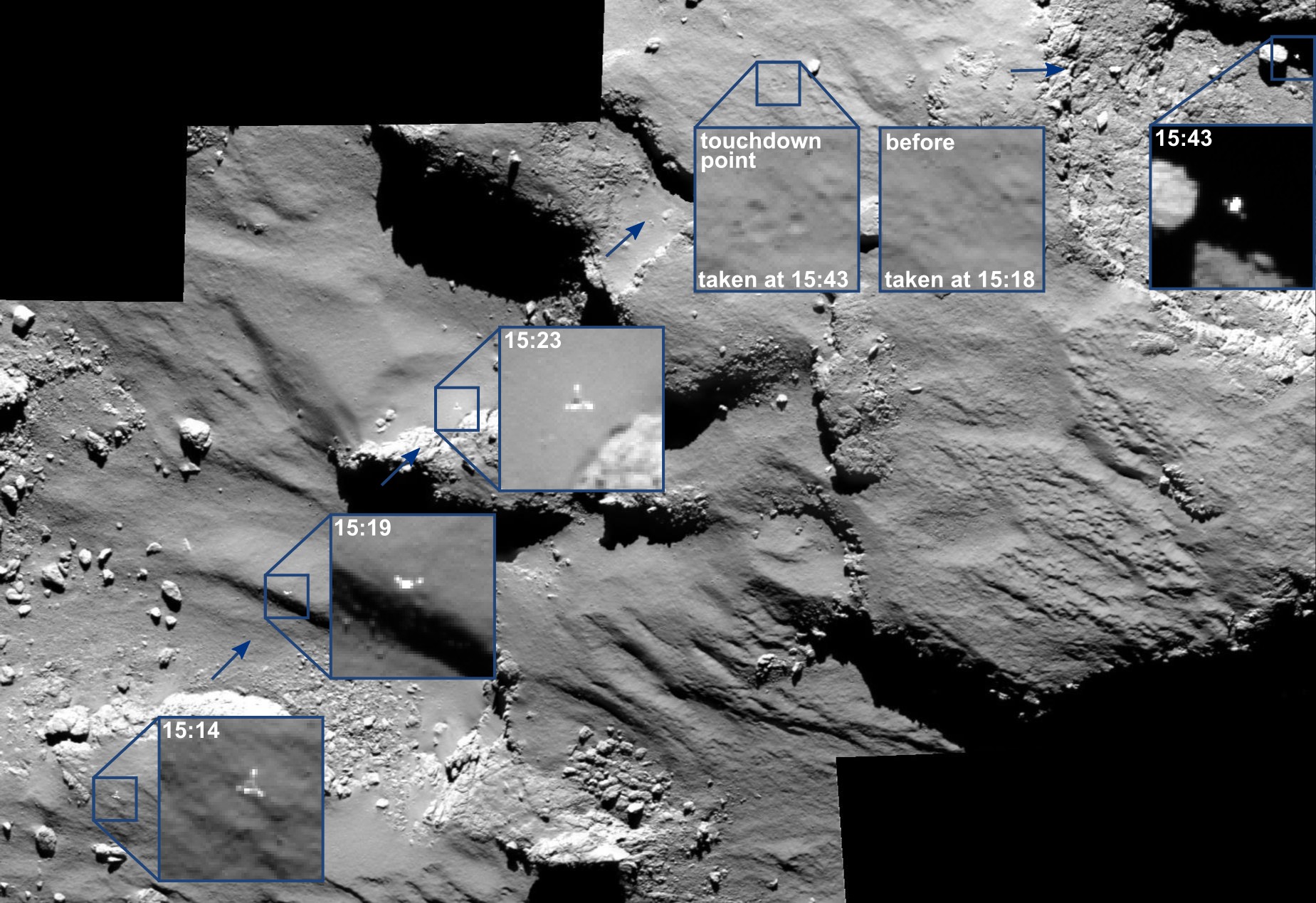
These incredible images show the breathtaking journey of Rosetta’s Philae lander as it approached and then rebounded from its first touchdown on Comet 67P/Churyumov–Gerasimenko on 12 November 2014.

The mosaic comprises a series of images captured by Rosetta’s OSIRIS camera over a 30 minute period spanning the first touchdown. The time of each of image is marked on the corresponding insets and is in GMT. A comparison of the touchdown area shortly before and after first contact with the surface is also provided.

The images were taken with Rosetta’s OSIRIS narrow-angle camera when the spacecraft was 17.5 km from the comet centre, or roughly 15.5 km from the surface. They have a resolution of 28 cm/pixel and the enlarged insets are 17 x 17 m.

From left to right, the images show Philae descending towards and across the comet before touchdown. The image taken after touchdown, at 15:43 GMT, confirms that the lander was moving east, as first suggested by the data returned by the CONSERT experiment, and at a speed of about 0.5 m/s.

The final location of Philae is still not known, but after touching down and bouncing again at 17:25 GMT, it reached there at 17:32 GMT. The imaging team is confident that combining the CONSERT ranging data with OSIRIS and navcam images from the orbiter and images from near the surface and on it from Philae’s ROLIS and CIVA cameras will soon reveal the lander’s whereabouts.

The insets are provided separately via the blog: OSIRIS spots Philae drifting across the comet

Credit: ESA/Rosetta/MPS for OSIRIS Team MPS/UPD/LAM/IAA/SSO/INTA/UPM/DASP/IDA

ORIGINAL: ESA

martes, 11 de noviembre de 2014

Rosetta. Top 10 at 10Km

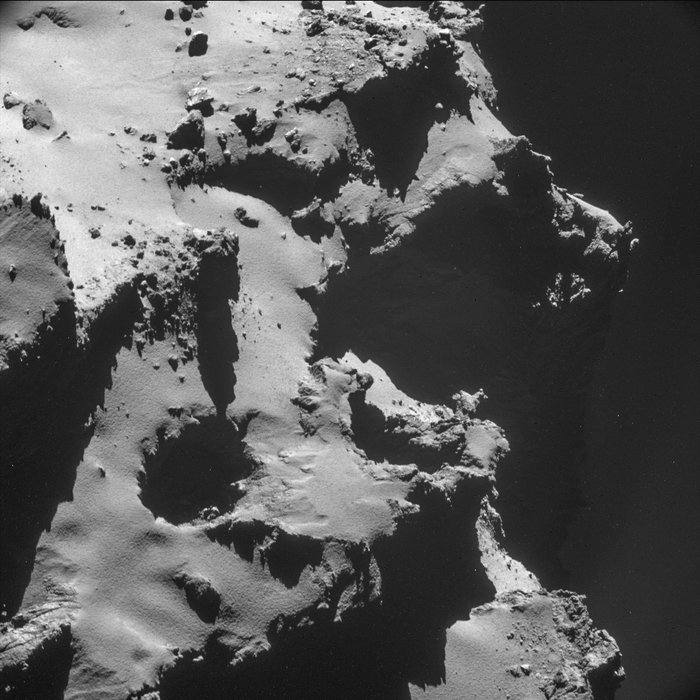
ESA’s comet-chasing Rosetta mission spent much of the second half of October orbiting Comet 67P/Churyumov–Gerasimenko at less than 10 km from its surface. This selection of previously unpublished ‘beauty shots’, taken by Rosetta’s navigation camera, presents the varied and dramatic terrain of this mysterious world from this close orbit phase of the mission.

Some light contrast enhancements have been made to emphasise certain features and to bring out features in the shadowed areas. In reality, the comet is extremely dark ­– blacker than coal. The images, taken in black-and-white, are grey-scaled according to the relative brightness of the features observed, which depends on local illumination conditions, surface characteristics and composition of the given area. Some slight vignetting can also be seen in the corners of some images.


Title NAVCAM top 10 at 10 km – 1
Released 11/11/2014 8:00 am
Copyright ESA/Rosetta/NAVCAM – CC BY-SA IGO 3.0

Description
This image showcases one of the many pits seen on the surface of 67P/Churyumov–Gerasimenko. Pits like these are thought to be where gas vents into space from the porous subsurface, carrying with it dusty grains of comet material. Scientists are keen to learn the role of this pit – and others – in the development of the comet’s activity, as it gets ever closer to the Sun.

This single-frame NAVCAM image measures 1024 x 1024 pixels. It was captured from a distance of 9.9 km from the centre of the comet (about 7.7 km from the surface) at 02:22 GMT on 15 October 2014. At this distance, the image resolution is 84.6 cm/pixel and the size of the image is 866 x 866 m.

This work is licenced under the Creative Commons Attribution-ShareAlike 3.0 IGO (CC BY-SA 3.0 IGO) licence. The user is allowed to reproduce, distribute, adapt, translate and publicly perform this publication, without explicit permission, provided that the content is accompanied by an acknowledgement that the source is credited as 'European Space Agency - ESA', a direct link to the licence text is provided and that it is clearly indicated if changes were made to the original content. Adaptation/translation/derivatives must be distributed under the same licence terms as this publication. To view a copy of this license, please visit http://creativecommons.org/licenses/by-sa/3.0/igo/
Id 326679


DETAILS
Title NAVCAM top 10 at 10 km – 2
Released 11/11/2014 8:00 am
Copyright ESA/Rosetta/NAVCAM – CC BY-SA IGO 3.0

lunes, 10 de noviembre de 2014

Rosetta's comet lander readies for its launch

Rosetta that was launched in 2004 is now preparing to enter its last phase of the mission. Ten years later, on August 6, the spacecraft began orbiting 67P, and its 11 instruments started scrutinizing myriad characteristics of the comet (SN: 9/6/14, p. 8). Those instruments, plus the cameras and sensors on the Philae lander, are designed to map 67P, determine what it’s made of and observe how its chemistry might change as it swings around the sun.

On November 12, Rosetta will sidle up to a comet, steady itself and drop a 100-kilogram robotic lander toward the hunk of rock, dust and ice. The lander, named Philae, will drift through space, tugged only slightly by the gravity of the comet, commonly called 67P. Mission scientists will be holding their breath for what could be several anxiety-filled hours to see if Philae lands where and how it’s supposed to.

The exercise — the first attempt to set a lander on a comet — is as nerve-racking as landing on Mars or the moon, with some added challenges. Comets and other small space rocks have much less gravity than planets or moons, which is why it will take Philae close to seven hours to float to comet 67P’s surface. Then there’s the comet’s speed: Rosetta will drop the lander toward 67P as the comet shoots through the solar system at 55,000 kilometers per hour.

Add to that a comet's unpredictable nature: At any moment and without warning, 67P might spew out jets of gas and dust. Such eruptions could blow the spacecraft off course or skew the lander’s trajectory so it hits a boulder or misses its mark.

Early in the mission, scientists estimated that Philae had a 70 to 75 percent chance of successfully touching down on the comet, officially known as 67P/Churyumov-Gerasimenko. They made that prediction when they thought the comet was shaped like a potato. In July, Rosetta began sending pictures of 67P, indicating it looks more like a rubber duck — two masses connected by a thin neck. The new shape adds a bit more uncertainty to Philae sticking its landing.

Video Transcript :
"The European Space Agency's Philae robot is preparing for an extraordinary landing on an ambitious target: comet 67P/Churyumov-Gerasimenko.

Out there in the cold depths of space, somewhere between Mars and Jupiter, a spacecraft called Rosetta is coyly playing with a comet. Scientists call this comet 67P/Churyumov-Gerasimenko. Since August, the spacecraft has been swooping in and around the 4-kilometer long comet, snapping selfies with it and taking close-ups of its craggy cliffs, crevices and boulders.

These striking images are the first to clearly show what the surface of comets can look like. They also helped scientists pinpoint just the right spot for a daring operation: To set a lander down on 67P’s surface.

After weeks of pouring over the images mission scientists finally selected a relatively flat spot on the head of the comet for their lander, Philaeto settle into. But getting down to the surface won’t be easy.

It will require a complex set of circles around the comet and a separation at just the right point in one of those orbits.

This separation is slated to take place on November 12. That day, Rosetta will swing to within 23 kilometers of the comet and drop Philae off its backside. The lander will then drift through space toward 67P. And, if all goes well, it will arrive on the comet roughly seven hours later.

Then the 10 instruments aboard the robot will probe the comet from the inside out. Each instrument is designed to look at specific features of the comet, such as its internal structure and the chemical elements and molecules that make up its dust. This data, along with Rosetta’s analysis of 67P, will help scientists really get a handle on what comets are and what happens to them as their orbits take them closer to the sun.

A close look at the comet could also take us back in time to the beginning of the solar system. That’s because comets appear to be time capsules that may have preserved some of the earliest materials found in the solar system. Looking at those pristine features may help scientists and astronomers answer fundamental questions about how the planets formed and possibly even how water and other life ingredients made their way to Earth.

But first we’ll have to wait for that long-sought signal saying yes, Philae has made its touchdown.


Images, graphics and animations courtesy of DLR German Aerospace Center and ESA; Narrated and produced by Ashley Yeager"


ORIGINAL: Science Dump
by Andreea
11/08/2014

miércoles, 6 de agosto de 2014

Rosetta arrives at comet destination

Comet on 3 August 2014

After a decade-long journey chasing its target, ESA’s Rosetta has today become the first spacecraft to rendezvous with a comet
, opening a new chapter in Solar System exploration.

Comet 67P/Churyumov–Gerasimenko and Rosetta now lie 405 million kilometres from Earth, about half way between the orbits of Jupiter and Mars, rushing towards the inner Solar System at nearly 55 000 kilometres per hour.

The comet is in an elliptical 6.5-year orbit that takes it from beyond Jupiter at its furthest point, to between the orbits of Mars and Earth at its closest to the Sun. Rosetta will accompany it for over a year as they swing around the Sun and back out towards Jupiter again.

Comets are considered to be primitive building blocks of the Solar System and may have helped to ‘seed’ Earth with water, perhaps even the ingredients for life. But many fundamental questions about these enigmatic objects remain, and through a comprehensive, in situ study of the comet, Rosetta aims to unlock the secrets within.

Comet on 3 August 2014

The journey to the comet was not straightforward, however. Since its launch in 2004, Rosetta had to make three gravity-assist flybys of Earth and one of Mars to help it on course to its rendezvous with the comet. This complex course also allowed Rosetta to pass by asteroids Šteins and Lutetia, obtaining unprecedented views and scientific data on these two objects.

“After ten years, five months and four days travelling towards our destination, looping around the Sun five times and clocking up 6.4 billion kilometres, we are delighted to announce finally ‘we are here’,” says Jean-Jacques Dordain, ESA’s Director General.

“Europe’s Rosetta is now the first spacecraft in history to rendezvous with a comet, a major highlight in exploring our origins. Discoveries can start.”

Today saw the last of a series of ten rendezvous manoeuvres that began in May to adjust Rosetta’s speed and trajectory gradually to match those of the comet. If any of these manoeuvres had failed, the mission would have been lost, and the spacecraft would simply have flown by the comet.

“Today’s achievement is a result of a huge international endeavour spanning several decades,” says Alvaro Giménez, ESA’s Director of Science and Robotic Exploration.

“We have come an extraordinarily long way since the mission concept was first discussed in the late 1970s and approved in 1993, and now we are ready to open a treasure chest of scientific discovery that is destined to rewrite the textbooks on comets for even more decades to come.”

Comet activity on 2 August 2014

The comet began to reveal its personality while Rosetta was on its approach. Images taken by the OSIRIS camera between late April and early June showed that its activity was variable. The comet’s ‘coma’ – an extended envelope of gas and dust – became rapidly brighter and then died down again over the course of those six weeks.

In the same period, first measurements from the Microwave Instrument for the Rosetta Orbiter, MIRO, suggested that the comet was emitting water vapour into space at about 300 millilitres per second.

Meanwhile, the Visible and Infrared Thermal Imaging Spectrometer, VIRTIS, measured the comet’s average temperature to be about –70ºC, indicating that the surface is predominantly dark and dusty rather than clean and icy.

Then, stunning images taken from a distance of about 12,000 km began to reveal that the nucleus comprises two distinct segments joined by a ‘neck’, giving it a duck-like appearance. Subsequent images showed more and more detail – the most recent, highest-resolution image was downloaded from the spacecraft earlier today and will be available this afternoon.

“Our first clear views of the comet have given us plenty to think about,” says Matt Taylor, ESA’s Rosetta project scientist.

“Is this double-lobed structure built from two separate comets that came together in the Solar System’s history, or is it one comet that has eroded dramatically and asymmetrically over time? Rosetta, by design, is in the best place to study one of these unique objects.”

Arriving at a comet
Today, Rosetta is just 100 km from the comet’s surface, but it will edge closer still. Over the next six weeks, it will describe two triangular-shaped trajectories in front of the comet, first at a distance of 100 km and then at 50 km.

At the same time, more of the suite of instruments will provide a detailed scientific study of the comet, scrutinising the surface for a target site for the Philae lander.

Eventually, Rosetta will attempt a close, near-circular orbit at 30 km and, depending on the activity of the comet, perhaps come even closer.


“Arriving at the comet is really only just the beginning of an even bigger adventure, with greater challenges still to come as we learn how to operate in this unchartered environment, start to orbit and, eventually, land,” says Sylvain Lodiot, ESA’s Rosetta spacecraft operations manager.

As many as five possible landing sites will be identified by late August, before the primary site is identified in mid-September. The final timeline for the sequence of events for deploying Philae – currently expected for 11 November – will be confirmed by the middle of October.
“Over the next few months, in addition to characterising the comet nucleus and setting the bar for the rest of the mission, we will begin final preparations for another space history first: landing on a comet,” says Matt.

“After landing, Rosetta will continue to accompany the comet until its closest approach to the Sun in August 2015 and beyond, watching its behaviour from close quarters to give us a unique insight and realtime experience of how a comet works as it hurtles around the Sun.”

Notes for Editors:

Rosetta woke up from deep space hibernation at 18:18 GMT on 20 January 2014, nine million kilometres from comet 67P/Churyumov–Gerasimenko. Following wake-up, the orbiter’s 11 science instruments and 10 lander instruments were reactivated and readied for science observations. Ten orbital correction manoeuvres were carried out between 7 May and 6 August, reducing the spacecraft’s velocity with respect to the comet from 775 m/s to 1 m/s, equivalent to walking pace. Each of these manoeuvres was critical: if any had failed, no rendezvous would have been possible. More information about these manoeuvres can be found on the Rosetta blog.

The latest ‘arrival’ image will be presented in the science session of today’s ‘Rosetta comet rendezvous’ event at ESA’s Space Operations Centre, ESOC, in Darmstadt, Germany, and in parallel will be published online on the ESA Portal.

About the European Space Agency

The European Space Agency (ESA) is Europe’s gateway to space. It is an intergovernmental organisation, created in 1975, with the mission to shape the development of Europe’s space capability and ensure that investment in space delivers benefits to the citizens of Europe and the world.

ESA has 20 Member States: Austria, Belgium, the Czech Republic, Denmark, Finland, France, Germany, Greece, Ireland, Italy, Luxembourg, the Netherlands, Norway, Poland, Portugal, Romania, Spain, Sweden, Switzerland and the United Kingdom, of whom 18 are Member States of the EU.

ESA has Cooperation Agreements with eight other Member States of the EU. Canada takes part in some ESA programmes under a Cooperation Agreement.

ESA is also working with the EU on implementing the Galileo and Copernicus programmes.

By coordinating the financial and intellectual resources of its members, ESA can undertake programmes and activities far beyond the scope of any single European country.

ESA develops the launchers, spacecraft and ground facilities needed to keep Europe at the forefront of global space activities.

Today, it launches satellites for Earth observation, navigation, telecommunications and astronomy, sends probes to the far reaches of the Solar System and cooperates in the human exploration of space.

For further information, please contact:
ESA Media Relations Office
Tel: + 33 1 53 69 72 99
Email: media@esa.int

Markus Bauer
ESA Science and Robotic Exploration Communications Officer
Tel: +31 71 565 6799
Mob: +31 61 594 3 954
Email: markus.bauer@esa.int

ORIGINAL: ESA
6 August 2014

martes, 21 de enero de 2014

ESA’s ‘sleeping beauty’ wakes up from deep space hibernation

Rosetta Wake-up signal

It was a fairy-tale ending to a tense chapter in the story of the Rosetta space mission this evening as ESA heard from its distant spacecraft for the first time in 31 months.

 
"Rosetta wakes up from deep space hibernation". Video from ESA

Video from ITN on Rosetta Mission

Rosetta is chasing down Comet 67P/Churyumov-Gerasimenko, where it will become the first space mission to rendezvous with a comet, the first to attempt a landing on a comet’s surface, and the first to follow a comet as it swings around the Sun.

Since its launch in 2004, Rosetta has made three flybys of Earth and one of Mars to help it on course to its rendezvous with 67P/Churyumov-Gerasimenko, encountering asteroids Steins and Lutetia along the way.

Operating on solar energy alone, Rosetta was placed into a deep space slumber in June 2011 as it cruised out to a distance of nearly 800 million km from the warmth of the Sun, beyond the orbit of Jupiter.

Now, as Rosetta’s orbit has brought it back to within ‘only’ 673 million km from the Sun, there is enough solar energy to power the spacecraft fully again.


Rosetta calls home

Thus today, still about 9 million km from the comet, Rosetta’s pre-programmed internal ‘alarm clock’ woke up the spacecraft. After warming up its key navigation instruments, coming out of a stabilising spin, and aiming its main radio antenna at Earth, Rosetta sent a signal to let mission operators know it had survived the most distant part of its journey.

The signal was received by both NASA’s Goldstone and Canberra ground stations at 18:18 GMT/ 19:18 CET, during the first window of opportunity the spacecraft had to communicate with Earth. It was immediately confirmed in ESA’s space operations centre in Darmstadt and the successful wake-up announced via the @ESA_Rosetta twitter account, which tweeted: “Hello, World!”

“We have our comet-chaser back,” says Alvaro Giménez, ESA’s Director of Science and Robotic Exploration. “With Rosetta, we will take comet exploration to a new level. This incredible mission continues our history of ‘firsts’ at comets, building on the technological and scientific achievements of our first deep space mission Giotto, which returned the first close-up images of a comet nucleus as it flew past Halley in 1986.”

How Rosetta wakes up from deep space hibernation
Access the video

“This was one alarm clock not to hit snooze on, and after a tense day we are absolutely delighted to have our spacecraft awake and back online,” adds Fred Jansen, ESA’s Rosetta mission manager.

Comets are considered the primitive building blocks of the Solar System and likely helped to ‘seed’ Earth with water, perhaps even the ingredients for life. But many fundamental questions about these enigmatic objects remain, and through its comprehensive, in situ study of Comet 67P/Churyumov-Gerasimenko, Rosetta aims to unlock the secrets contained within.

“All other comet missions have been flybys, capturing fleeting moments in the life of these icy treasure chests,” says Matt Taylor, ESA’s Rosetta project scientist. “With Rosetta, we will track the evolution of a comet on a daily basis and for over a year, giving us a unique insight into a comet’s behaviour and ultimately helping us to decipher their role in the formation of the Solar System.”

But first, essential health checks on the spacecraft must be completed. Then the eleven instruments on the orbiter and ten on the lander will be turned on and prepared for studying Comet 67P/Churyumov-Gerasimenko.

“We have a busy few months ahead preparing the spacecraft and its instruments for the operational challenges demanded by a lengthy, close-up study of a comet that, until we get there, we know very little about,” says Andrea Accomazzo, ESA’s Rosetta operations manager.


Rosetta and Philae at comet

Rosetta’s first images of 67P/Churyumov-Gerasimenko are expected in May, when the spacecraft is still 2 million km from its target. Towards the end of May, the spacecraft will execute a major manoeuvre to line up for its critical rendezvous with the comet in August.

After rendezvous, Rosetta will start with two months of extensive mapping of the comet’s surface, and will also make important measurements of the comet’s gravity, mass and shape, and assess its gaseous, dust-laden atmosphere, or coma. The orbiter will also probe the plasma environment and analyse how it interacts with the Sun’s outer atmosphere, the solar wind.

Using these data, scientists will choose a landing site for the mission’s 100 kg Philae probe. The landing is currently scheduled for 11 November and will be the first time that a landing on a comet has ever been attempted.

In fact, given the almost negligible gravity of the comet’s 4 km-wide nucleus, Philae will have to use ice screws and harpoons to stop it from rebounding back into space after touchdown.

Among its wide range of scientific measurements, Philae will send back a panorama of its surroundings, as well as very high-resolution pictures of the surface. It will also perform an on-the-spot analysis of the composition of the ices and organic material, including drilling down to 23 cm below the surface and feeding samples to Philae’s on-board laboratory for analysis.

The focus of the mission will then move to the ‘escort’ phase, during which Rosetta will stay alongside the comet as it moves closer to the Sun, monitoring the ever-changing conditions on the surface as the comet warms up and its ices sublimate.

The comet will reach its closest distance to the Sun on 13 August 2015 at about 185 million km, roughly between the orbits of Earth and Mars. Rosetta will follow the comet throughout the remainder of 2015, as it heads away from the Sun and activity begins to subside.

“We will face many challenges this year as we explore the unknown territory of comet 67P/Churyumov-Gerasimenko and I’m sure there will be plenty of surprises, but today we are just extremely happy to be back on speaking terms with our spacecraft,” adds Matt Taylor.

ORIGINAL: ESA
20 January 2014