Ciencia en Canoa, by Vanessa Restrepo Schild.

Páginas

  • INICIO
  • About
  • The author
  • Opinión colgante
  • Graphic Adventure
  • EcoSecretos
Mostrando entradas con la etiqueta Algae. Mostrar todas las entradas

martes, 28 de febrero de 2017

Nature’s water purifiers help clean up lakes

(Copyright: Floating Islands International)
More and more of our waterways are being starved of life through pollution. One simple, yet improbable, solution? Cover rafts in plants.

In the shallow waters of Gijon harbour, in northern Spain, swims scientists' latest weapon in the war against pollution.

Just five years ago, Fish Fry Lake was dying. The groundwater flowing into the lake situated 30 miles northeast of Billings, Montana, contained high levels of nitrogen and phosphorous, common ingredients in agricultural fertilisers and animal waste. The nitrogen and phosphorus had fostered an overgrowth of algae, which covered the lake and blocked sunlight from penetrating the surface. The deep water was a dead zone, devoid of oxygen and home to very little aquatic life.

The solution was as simple as it was improbable: cover rafts with plants, and set them afloat in the lake. Within a year-and-a-half, the algal blooms were gone. Water clarity improved. Oxygen levels rose. Today, the lake is home to a thriving community of fish, including black crappie, yellow perch and Yellowstone cutthroat trout.

The story of Fish Fry Lake demonstrates the power of mimicking wetlands to clean up dirty waterways. Wetlands are sometimes called nature’s own water purifiers: as dirty water moves through a sprawling marsh, the bacteria that cling to wetland plants, timber, rocks, and other debris consume and process some common water pollutants. Other contaminants get trapped in the mud and muck. As result of these and other processes, the water that eventually flows out of a wetland is much cleaner than the stream that came trickling in.

By creating floating treatment wetlands out of small, human-engineered rafts of vegetation, researchers and entrepreneurs hope to provide these same ecological services to small, polluted bodies of water that may be far from a natural marsh. “BioHaven floating islands are concentrated wetland systems that are essentially biomimicking nature’s wetland effect,” says Bruce Kania, the founder and research director of Floating Island International, the company behind the Fish Fry Lake rafts.
ORIGINAL: Floating Island International
Cleansing power
To construct a BioHaven island, the company starts with layers of mesh made from recycled plastic. They assemble this mesh into a floating raft – which can be as small as a home aquarium or nearly as large as a football field – and top it with soil and plants. They launch the island into a lake, pond, stream, or lagoon, anchoring it in place. Over time, the plants’ roots grow into and through the raft’s porous matrix, descending into the water below. At the same time, bacteria colonise the island, assembling into sticky, slimy sheets called biofilm that coat the floating matrix and the suspended plant roots.

This bacterial biofilm is the secret to a floating island’s cleansing power. Overgrowth of algae from nitrogen and phosphorus pollution can cause several problems, preventing sunlight from reaching subaquatic plants and starving a body of water of the oxygen needed to sustain fish populations and other animal life. A dead zone, like the one is Fish Fry Lake, is often the ultimate result. The biofilm bacteria consume nitrogen and phosphorous, however, and as polluted water flows through and around a floating island, the bacteria converts these contaminants into less harmful substances. Though the bacteria do the brunt of the work, the plant roots suspended from the floating island also play their part, absorbing some of the nitrogen and phosphorous through their roots.

In Fish Fry Lake, for instance, Floating Island International deployed several islands, which together covered almost 2% of the lake’s 6.5-acre (2.6-hectare) surface area. Over the course of four years, the islands helped reduce nitrogen concentrations by 95% and phosphorus concentrations by nearly 40%. Today, levels of dissolved oxygen are sixty times what they once were.

Clearer, cleaner, healthier
The system also mechanically filters out other pollutants, like metals and particulates. “The sticky biofilm essentially keeps the water clear because all the suspended solids tend to bond to it,” says Kania. Floating Island International, which has deployed more than 4,400 of their artificial wetland systems worldwide, has documented this effect in multiple case studies. For example, the concentrations of suspended solids, copper, lead, zinc, and oil and grease fell dramatically after a floating island was installed in a stormwater pond in Montana. Controlled laboratory studies and research by scientists not affiliated with the company have alsofound that floating treatment wetlands can reduce the levels of many common water pollutants.

Some scientists are now exploring how to optimise the design of floating islands – probing, for instance, which plants do the best job of removing pollutants. Gary Burtle, an aquaculture specialist at the University of Georgia, thinks we can get even more out of these artificial wetlands by seeding the rafts with plants that are of commercial value, such as lettuces and herbs. Burtle is screening a number of potential plant candidates – if he finds one that grows well on a floating island, we may soon see constructed wetland systems that “give us a little bit more return”, he says, producing saleable crops while purifying the water.

Meanwhile, the removal of contaminants not only improves the water itself, but also helps to foster a healthier ecosystem. Clearer water allows light to penetrate deeper, encouraging the growth of various aquatic plants, which produce oxygen and become part of the food chain, supporting larger populations of fish and other animals. “You end up with a waterway that can be abundant,” Kania says, “that can be verdant even at depth.” The organic debris that attaches itself to the underside of a floating island also becomes a source of food for fish and other aquatic organisms, and the island itself provides new habitat for birds.

“The concept of how to get back to a healthy waterway,” Kania says, “is very simple: nature’s wetland effect.” All we have to do is simulate it.

ORIGINAL: BBC
Emily Anthes
Posted by Unknown at 9:20 0 comments
Enviar por correo electrónicoEscribe un blogCompartir en XCompartir con FacebookCompartir en Pinterest
Etiquetas: Agricultural Fertilisers, Algae, Animal Waste, Bacteria, Biomimicry, Earth, Groundwater, Oxygen, Plants, Pollution, Purification, Sustainability, Urban Farming, water, Wetlands

jueves, 29 de septiembre de 2016

This Company Wants To Stop Our Algae Epidemic By Sucking It Up And Turning It Into Plastic

The combination of rising temperatures and industrial chemicals in our water is creating a lot of algae. Bloom thinks it has a solution to clean up our lakes—and make products in the process.

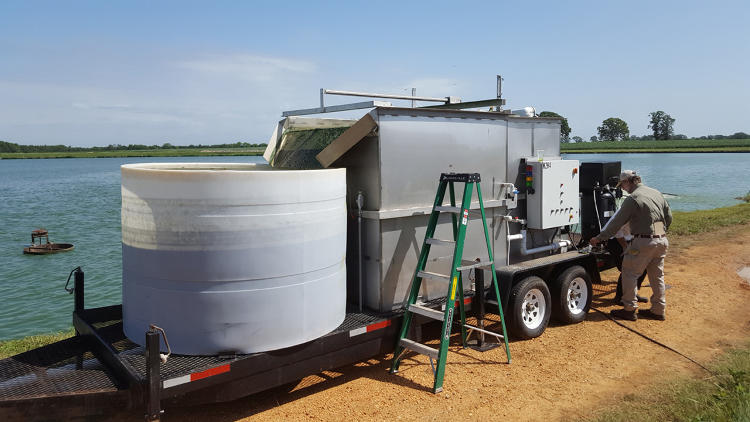
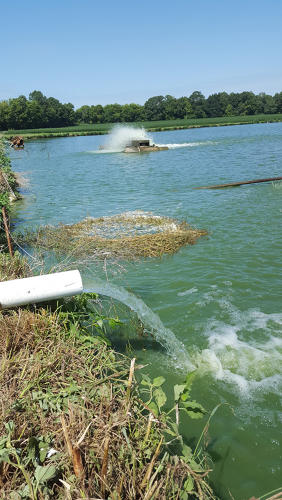
Bloom uses custom technology to carefully harvest wild algae from the water.

There, they collect algae from the top six inches or so of the water column.
The design, with screens and gentle suction, can't harm wildlife in the water.
Looking at the thick green layer of slime on some Florida beaches, most people see only the environmental crisis: out-of-control algae, fed by human activity and climate change, are killing fish, manatees, and other underwater life. Rob Falken sees a solvable problem and your next pair of shoes.


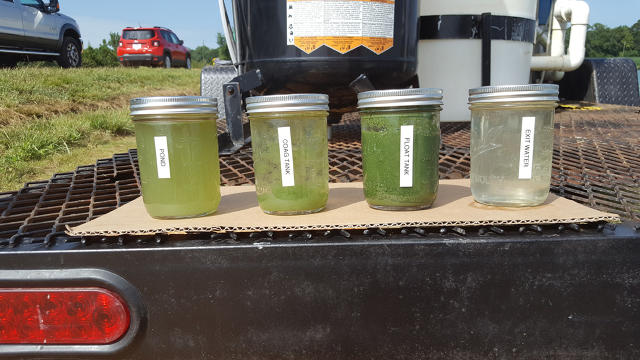
Along with the algae, the harvester also removes nitrogen and phosphorus.
Bloom, Falken's startup, uses custom technology to carefully harvest wild algae from the water, and then transforms it into a raw material to make plastics and foams for use in clothing, sneakers, car upholstery, and other products. The first product—a foam traction pad for surfboards, made with Kelly Slater—will hit shelves on October 1.

All of those products are typically made from petroleum formed into tiny pellets. Bloom makes pellets from algae instead, solar-drying the algae into flakes, pulverizing the flakes into a powder, and then turning that powder into pellets that can be melted down to merge with the petroleum-based ingredients. By partially replacing the pellets made from fossil fuels—and by sucking up carbon as it grows—the algae also helps lower carbon footprints.

"The end goal is to remove as much of the petroleum feedstock as possible," says Falken. "When you take a waste stream from nature—there naturally but there in such mass because of man made inputs—we can take that feedstock, that problem, and functionalize it into usable goods that are the exact same quality, indistinguishable, from the status quo that's out there today."

The company's small mobile harvesting units sit at the edge of a pond or lake, or float on a pontoon in the ocean, and collect algae from the top six inches or so of the water column.
The company's small mobile harvesting units sit at the edge of a pond or lake, or float on a pontoon in the ocean.
"The harvester works like a giant vacuum, basically," Falken says. The design, with screens and gentle suction, can't harm wildlife in the water; the technology was used first at catfish farms, where sucking up a fish with the algae would be an obvious problem.

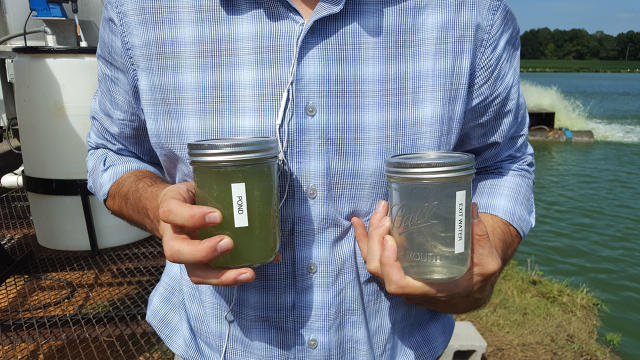
Along with the algae, the harvester also removes nitrogen and phosphorus—excess fertilizers that end up in the water from farming, sewage overflows, or lawns, and help cause the algae growth in the first place. Pure, filtered water is returned to the body of water.

In Florida, where officials declared a state of emergency in several counties because of algae blooms this summer, much of the problem comes from giant Lake Okeechobee, where runoff from sugar cane plantations and cattle farms fills the lake with algae-boosting fertilizer. Infrastructure and development in the area have made the problem worse. After heavy rains, the state flushes the algae-filled water out through canals, and it ends up also harming beaches at the coasts.

As the algae proliferate in the water, they can cut off oxygen. When the growth is out of control, and the algae die, they release toxins called microcystins that can last for weeks or months.


Bloom hopes to control the problem in Florida—and many other places struggling with algae—by regularly harvesting algae before it reaches a toxic state, and clearing out the fertilizers that cause future overgrowth. While the company can clean out toxic algae, only healthy algae is usable, so it's better to catch the problem before it escalates.

"When you have an algae crisis today, that's because of a lot of negligence, that's because nobody's doing anything to remove the inputs of nitrogen and phosphorus, and there's a massive influx of those inputs running rampant," says Falken. "You also couple that with an extremely high heat index and you've got a perfect storm."

The company has been operating in China at Lake Taihu—an even larger lake than Okeechobee that millions of people rely on for drinking water—for two years, where the company says they have removed millions of pounds of algae.

Now, they're in meetings with Florida officials, along with the infrastructure company AECOM, to make a plan for demonstrating the technology in the state. They hope to begin regularly working at Lake Okeechobee.

While other companies grow algae in tanks, wild harvesting has advantages—the process solves an environmental problem, and doesn't require the energy and cost used to grow algae in the dark. Algae grown in tanks is also genetically engineered, and Bloom argues that it could wipe out natural strains if it escaped into the wild.

The algae-based feedstock can be dropped into current manufacturing without any changes, and the cost is the same as petroleum-based feedstocks on the market today. "We can't convert industries worldwide if the price is higher," Falken says.
Then it transforms it into a raw material to make plastics and foams for use in clothing, sneakers, car upholstery, and other products.
There's also no shortage of wild algae, especially as warming waters make the problem worse. "We've already got more algae than we'll ever need," he says. "In China, Lake Taihu could produce enough algae for us to produce a pair of shoes for every man, woman, and child on this planet."

Even as some governments try to address the larger problems—Florida, for example, plans to spend more than $1 billion buying land to create storage ponds in the hope of naturally treating water—the process isn't guaranteed to work, and will take time.

"Those inputs are not going away," says Falken. "Agriculture's not going away, sugar cane plantations aren't going away, people are not going to en masse stop using fertilizers on their lawn. It's unfortunate. We can educate as much as possible, but the reality here is someone has got to be proactive. Because we can do something with it, and do a lot of good with it, we can ensure that algal bloom crisis is in time a thing of the past."

They hope to use the algae harvesters all over the country and world. "You look at Florida and say that's the epicenter, that's where the crisis is worst because all of the water policy issues and all the negligence," he says. "But if you look at the U.S. as a whole, all 50 states have algal bloom in some semi-crisis mode right now. You've got about 20 states that are really at peak crisis. The algae is everywhere, and the problems are global."

ORIGINAL: Fast Company
ADELE PETERS 
09.29.16
Posted by Unknown at 19:31 0 comments
Enviar por correo electrónicoEscribe un blogCompartir en XCompartir con FacebookCompartir en Pinterest
Etiquetas: Algae, Contamination, Fertilizers, Organic Waste, Plastic

sábado, 30 de julio de 2016

Smart bricks will transform how buildings work

ORIGINAL: UWE Bristol

Smart bricks capable of recycling wastewater and generating electricity from sunlight are being developed by a team of scientists from the University of the West of England (UWE Bristol). The bricks will be able to fit together and create 'bioreactor walls' which could then be incorporated in housing, public building and office spaces


The UWE Bristol team is working on the smart technologies that will be integrated into the bricks in this pan European 'Living Architecture' (LIAR) project led by Newcastle University. The LIAR project brings together living architecture, computing and engineering to find a new way to tackle global sustainability issues.

The smart living bricks will be made from bio-reactors filled with microbial cells and algae. Designed to self-adapt to changing environmental conditions the smart bricks will monitor and modify air in the building and recognise occupants.

Each brick will contain Microbial Fuel Cells (MFCs) containing a variety of micro-organisms specifically chosen to 

  • clean water, 
  • reclaim phosphate, 
  • generate electricity and 
  • facilitate the production of new detergents, 
as part of the same process.

The MFCs that will make up the living engine of the wall of smart bricks will be able to sense their surroundings and respond to them through a series of digitally coordinated mechanisms.

Professor Andrew Adamatzky, LIAR Project Director for UWE Bristol, is leading the UWE Bristol team, he said, “The technologies we are developing aim to transform the places where we live and work enabling us co-live with the building.

“A building made from bio-reactors will become a large-scale living organism that addresses all environmental and energy needs of the occupants. Walls in buildings comprised of smart bricks containing bioreactors will integrate massive-parallel computing processors where millions of living creatures sense the occupants in the building and the internal and external environmental conditions.

“Each smart brick is an electrical analogous computer. A building made of such bricks will be a massive-parallel computing processor.”

A photo-bioreactor is a device that can be programmed to utilize a variety of inputs such as 

  • grey water, 
  • microbial consortia (algae and bacteria), 
  • carbon dioxide from the atmosphere, and 
  • different types of nutrient to generate outputs.
These outputs include

  • 'polished' water, 
  • fertiliser, 
  • extractable products (recoverable phosphate), 
  • oxygen, 
  • next generation biodegradable detergents, 
  • electricity, 
  • recoverable biomass, 
  • bio-fluorescence and to a certain extent, 
  • heat.

Professor Ioannis Ieropoulos, Director of the Bristol Bioenergy Centre (BBiC), at the Bristol Robotics Laboratory at UWE Bristol, said, “Microbial Fuel Cells are energy transducers that exploit the metabolic activity of the constituent microbes to break down organic waste and generate electricity. This is a novel application for MFC modules to be made into actuating building blocks as part of wall structures. This will allow us to explore the possibility of treating household waste, generating useful levels of electricity, and have 'active programmable' walls within our living environments.”

Rachel Armstrong, Professor of Experimental Architecture at Newcastle University, UK, who is co-ordinating the project, said, “The LIAR project is incredibly exciting – it is bringing together living architecture, computing and engineering to find a new way to tackle global issues, like sustainability.”

The €3.2m LIAR (Living Architecture) project is co-ordinated by Newcastle University working with experts from the universities of

  • the West of England (UWE Bristol), 
  • Newcastle U
  • Trento and Florence, 
  • the Spanish National Research Council; 
  • LIQUIFER Systems Group (Austria) and 
  • EXPLORA.

The LIAR project has received funding from the European Union's Horizon 2020 research and innovation programme under grant agreement No. 686585
Posted by Unknown at 6:16 0 comments
Enviar por correo electrónicoEscribe un blogCompartir en XCompartir con FacebookCompartir en Pinterest
Etiquetas: 'Living Architecture' (LIAR), Algae, Computing, CSIC, Electricity, Engineering, Explora, Liquifier, MFC, Newcastle U, Oygen, SGAAVI, Smart Brick, Sustainable, Synthetic Ecosystem, U di Trento, UWE Bristol, water

viernes, 25 de diciembre de 2015

This Device Lets You Brew Your Own Drugs At Home

 www.fastcoexist.com
IN BRIEF
New concept technology sees a future that lets people brew their own drugs in their own home--posing numerous positive benefits and (of course) a few possible downsides.

PROTOTYPE
A machine prototype called Farma can let you manufacture your daily prescription of drugs right in your own home. Designed by MIT Media Lab graduate Will Patrick, the concept tech features a green cylinder and uses blue-green algae that’s genetically engineered to produce pharmaceutical drugs.

After the drugs are produced, the device then measures, filters, and dries it into a powder. Once in powder form, it can then be molded into pill form.
Image credit: Farma
“Part of my goal of the project is to demonstrate how easy it is to build an at-home system that could ferment microbes,” says Patrick, who designed the Farma gadget during a residency at Autodesk.

Currently, opiates can already be can be brewed in a lab and Artemisinin is made using genetically engineered yeast, which makes the possibility of using synthetic biology as a way to create other drugs feasible.

While still at the very early concept stage, the artist responsible for envisioning the machine believes the technology might be feasible for widespread use in five to ten years.

IMPLICATIONS
“The technical challenges lie in genetic engineering and biochemistry —engineering the organisms that can produce the drugs at useful quantities and processing and separating the drugs from the organism,” says Patrick in the release. And soon, the cost might make the tech feasible. As Patrick asserts, “The cost, tools, and knowledge required for genetically modifying organisms are all becoming more accessible. The hardware required for fermentation is fairly rudimentary in comparison.”

It’s hard to guarantee that a pill brewed in your own home might meet the same quality and production standards followed by a factory; but there are also implications that large pharmaceutical organizations might want to protect their intellectual property, which means that the biggest obstacles might not be making the technology work; rather, policy and business challenges are far bigger hurdles.

While the artist believes in the potential of the technology and its benefits, he expresses apprehension regarding the possibility of the machine enabling drug addiction.

However, the concept behind it is really meant to make people realize how well synthetic biology can be incorporated into lifestyles and how it could be used to assist individuals. “My main goal with Farma is to provoke the audience to consider how this new technology should be used,” he says.

Source: Co.Exist

ORIGINAL: Futurism
Posted by Unknown at 7:18 0 comments
Enviar por correo electrónicoEscribe un blogCompartir en XCompartir con FacebookCompartir en Pinterest
Etiquetas: Algae, art, Concept, Drugs, Farma, Genetic Engineering, Machine, Media Lab, MIT

DNA Manufacturing Enters the Age of Mass Production

Synthetic-biology startups adopt technologies from the computer industry

Illustration: Elias Stein

Emily Leproust, CEO and cofounder of the buzzy biotech startup Twist Bioscience, is an industrialist on the nanoscale. “I remind everyone at Twist, we are a manufacturing company,” she says. “We manufacture DNA.”
Photo: Twist Bioscience
DNA Factory: Twist Bioscience’s machine
builds DNA strands inside
600-nanometer wells on a silicon plate.
Twist is part of the young industry of synthetic biology, in which living organisms are the product and a biology lab is the factory floor. By manufacturing strands of DNA—assembling the genetic code of life from its basic components—scientists are creating organisms the likes of which the world has never seen. And these new life forms can be decidedly useful: Biologists have produced yeast cells that excrete pharmaceuticals and algae that brew jet fuel.

This burgeoning business sector has been hampered by the labor-intensive nature of DNA assembly, a painstaking process requiring trained personnel. Now, nimble startups are competing to fashion automated DNA assembly lines that would make Henry Ford proud, using techniques copied from the fabs that make computer chips. As their innovations bring down the cost of constructing DNA strands, these entrepreneurs are aiming for a low price point, which they say will cause a market boom. Twist Bioscience, which will begin commercial operations at its San Francisco headquarters in 2016, is a leading contender in that race to the bottom.

Genetic material is composed of molecules called nucleobases; the four types of bases in DNA are identified by the letters A, C, G, and T. The order of these letters serves as a code that instructs an organism how to build its cells and carry on the functions of life. In human beings, this code is about 3.2 billion letters long, while the yeast used in baking and beer brewing has a code of about 12 million letters. If you tweak the order of the letters, you tweak the organism’s instructions. Synthetic biologists have written new snippets of code and inserted them into yeast DNA, causing the microbe to churn out, for example, the omega-3 fatty acids found in fish oil supplements or the aromatic oils normally produced by roses.

Matter of Fact
Mycoplasma laboratorium: The name given to the first “synthetic organism,” a bacterium whose 1-million-base genome was assembled from scratch.

Constructing a strand of DNA isn’t complicated; in fact it’s a routine procedure performed in labs all over the world. But that procedure is typically carried out by hand, says Twist’s Leproust: “Microbiology is manual labor. You have a Ph.D. student moving liquid from one test tube to the next all day long.” So she and her cofounders invented a machine that automates the construction process.

The heart of the machine is a silicon plate pocked with 10,000 tiny wells, which are etched using the same photolithography techniques perfected by computer chip manufacturers. A different strand of DNA can be constructed in each 600-nanometerwide well. The machine does “the exact same chemistry” as a Ph.D. student would do, Leproust says, “only in a volume that’s 100 times smaller.”

Twist isn’t selling its machine but rather its DNA manufacturing services, which are aimed at researchers and startups seeking new genetic modifications that might prove useful. In 2015 the company began production runs for select customers; 2016 will see Twist’s full commercial launch. DNA assembly is priced on a cost-per-base model, and Leproust says her company’s 10-cents-per-base starting price is already the best in the industry. But she’s aiming for a 2-cent price point: “That’s the point at which researchers can significantly scale experiments and will no longer be limited by the cost of DNA,” she says. Today, customers typically order DNA strands of 300 to 1,800 bases in length, Leproust says.
1,600 Bases: Length of gene for insulin (INS)
81,000 Bases: Length of gene for breast cancer risk (BRCA1)
Another synthetic-biology startup in the San Francisco area, Zymergen ("ROBOTICS FOR HIGH THROUGHPUT BIOLOGY"), offers customers a broader set of services. The company not only 
  • constructs DNA snippets on the cheap, it also 
  • inserts that DNA into microbes and 
  • monitors the outcome. 
Chief science officer Zach Serber explains that the results can inform the next round of DNA design, letting customers iterate quickly as they look for their ideal organism. “You cast a wide net,” Serber says, “and when you find a variation that improves the microbe’s performance, then you double down.”

Such setups have led to excited talk of a synthetic-biology industry based on “organism fabs.” But the promise of mass-produced DNA doesn’t impress Rob Carlson, a biotech consultant and managing director of the BioEconomy Capital venture fund. “I don’t understand the business model,” he says.

Carlson is skeptical that cheap DNA assembly will lead to a proliferation of startups with ideas for profitable microbes. “So you can make and test a whole bunch more DNA—but that’s not the hard part,” he argues. “Going from test tube to bench scale to commercial scale, that’s 90 percent of cost.” For a startup to build a business around a yeast that cranks out a pharmaceutical, for example, it must manage massive tanks full of microbes. Reducing the cost of the initial DNA manufacturing would only give the company pocket money, Carlson says: “Hooray, they get to buy beer, or more pizza on Friday.”

ORIGINAL: IEEE Spectrum
By Eliza Strickland
23 Dec 2015
Posted by Unknown at 7:15 0 comments
Enviar por correo electrónicoEscribe un blogCompartir en XCompartir con FacebookCompartir en Pinterest
Etiquetas: Algae, Bioengineering, Biofuel, Business Model, DNA, Genome editing, Microelectrónica, Mycoplasma laboratorium, Nanofabrication, Photolithography, Synthetic Biology

jueves, 12 de noviembre de 2015

Genetically engineered algae kills 90% of cancer cells without harming healthy ones

Diatom algae genetically engineered to destroy cancer cells
Derek Keats/Flickr
Algae has been genetically engineered to kill cancer cells without harming healthy cells. The algae nanoparticles, created by scientists in Australia, were found to kill 90% of cancer cells in cultured human cells. The algae was also successful at killing cancer in mice with tumours.

Nico Voelcker, from the University of South Australia, worked with researchers from Dresden in Germany to engineer diatom algae and loaded it with chemotherapeutic drugs. Publishing their study in the journal Nature Communications, the team also found that when they injected the nanoparticles into mice, tumours regressed.

Diatom algae is a type of tiny, unicellular, photosynthesising algae. It measures just four to six micrometres in diameter and is enclosed within a porous skeleton made of silica. Because chemotherapeutic drugs are often toxic to healthy tissue, the researchers were able to hide the drugs inside the algae.

Researchers genetically engineered the algae to produce an antibody-binding protein on the surface of their shells. In turn, the antibody binds only to molecules found on cancer cells, meaning it could deliver drugs to the target cells.

Voelcker explained: "By genetically engineering diatom algae - tiny, unicellular, photosynthesising algae with a skeleton made of nanoporous silica, we are able to produce an antibody-binding protein on the surface of their shells. Anti-cancer chemotherapeutic drugs are often toxic to normal tissues.

"To minimise the off-target toxicity, the drugs can be hidden inside the antibody-coated nanoparticles. The antibody binds only to molecules found on cancer cells, thus delivering the toxic drug specifically to the target cells.

The report authors sate: "These data indicate that genetically engineered biosilica frustules may be used as versatile 'backpacks' for the targeted delivery of poorly water-soluble anticancer drugs to tumour sites."

As algae mostly only needs water and light to grow, the team believes the technique could reduce the cost and waste of nanoparticle manufacturing and has huge potential for future cancer treatments. "Although it is still early days, this novel drug delivery system based on a biotechnologically tailored, renewable material holds a lot of potential for the therapy of solid tumours including currently untreatable brain tumours," Voelcker said.Genetically engineered diatom biosilica (green) containing liposome-encapsulated drug molecules (yellow) can be targeted to lymphocyte cells in suspension (purple) by functionalizing the biosilica surface with cell specific antibodies. Liposome-encapsulated drug molecules are released from the biosilica carrier in the immediate vicinity of the target cells (inset).Marc Cirera.


ORIGINAL: International Business Times
By Hannah Osborne
November 10, 2015 
Posted by Unknown at 6:16 0 comments
Enviar por correo electrónicoEscribe un blogCompartir en XCompartir con FacebookCompartir en Pinterest
Etiquetas: Algae, antibody-binding protein, cancer, Diatom Algae, Genetic Engineering, Nanoparticles, Targeted Chemotherapy, U of South Australia

viernes, 2 de enero de 2015

This mushroom devours your plastic waste - and once it’s finished, you can eat it too.

Image: Paris Tsitsos, Livin Studio
WATCH: This new device turns plastic into edible mushrooms

Microbiologists in the Netherlands have teamed up with Austrian industrial designers to come up with an amazing solution to our plastic problem - now we can simply eat it, via an edible fungi.
It's been a good year for promising plastic breakthroughs, with scientists in November developing a plastic that breaks down fully in just three hours. Now the European team has developed a device called the Fungi Mutarium, which uses fungi to safely break down plastic, in turn growing an edible food source.
Fungi Mutarium - Julia Kaisinger and Katherina Unger

The prototype machine works on small bits of thin plastic - like the kind used in shopping bags - and first uses UV light to sterilise and kickstart their decomposition.

This UV-treated plastic is then placed in a small pod made from agar, which is an edible, algae-based type of gelatin.

These pods are then placed in the dome-like “growth sphere” and liquified fungi sprouts are poured over them.

In just a few weeks, fungi begins to grow out of the pods, using the plastic to feed its development. After several months, the plastic will be completely decomposed and you’re left with nothing but an agar cup filled with edible fluffy white mycelium - the soft, vegetative part of a fungus.

“We were both really inspired about the idea that something digests plastic but then still creates edible biomass,” Katharina Unger, one of the two industrial designers from the studio Livin, who worked on the project, told Kaleigh Rogers from Motherboard. They also wanted to find some new and innovative solutions to food shortages around the world.

“Farmers are increasingly dealing with extreme environmental conditions to produce food," Unger explained to Adele Peters from Co.Exist. "Fungi Mutarium is a projection of how new biotechnologies might be applied to grow edible material on so far harmful or even toxic waste material."

Amazingly, these mushrooms are, in theory, safe to eat, because although they can fully digest plastic, they do this without accumulating the toxic compounds - although the designers admit that more testing would need to be done on their safety before the mutarium could be commercialised. 

While it all sounds very cool, we know what you’re thinking - what do the mushrooms taste like? The microbiologists have so far used oyster mushroom and split gill mushrooms in the system, which are two of the most popular mushrooms in the world.

According to Unger, they’re pretty tasty, and can be eaten whole.

“It starts off being very neutral, but it can also get a bit nutty and spicy in taste. It really depends on the strain, actually,” Unger told Rogers.

The team also developed some recipes to flavour the agar cups that the mushroom is inside, which range from savoury to a sweet one with peaches and yoghurt.

As you can see in the video below, the whole set-up looks pretty futuristic.


Unfortunately however, there’s still a long way to go before this device can be used more widely.

Right now the fact that it takes months to break down tiny bits of plastic means that it’s not super appealing to the market. But the team are now looking into how they can improve the process and also scale it up for mass use.

“We know that there’s potential to speed up this process simply by optimising the processes around it: temperature, humidity, the perfect microclimate for this fungi to colonise the plastic material,” Unger told Rogers.

“Also, though it’s more controversial, there is genetic modification. What happens if you modify the organism so that it can process the materials more quickly?”

They also hope the prototype will make people think a little differently about plastic waste and the potential ways we can grow food.

While it’s still got a long way to go, the fact that scientists have now estimated there are 5.25 trillion bits of plastic polluting our oceans shows just how badly we need some new solutions to dealing with plastic waste. 

And if we can find a way to do that while also helping to feed the population sustainably, then that’s pretty awesome.

Source: Motherboard, Co.Exist

ORIGINAL: Science Alert

FIONA MACDONALD
 20 DEC 2014
Posted by Unknown at 12:28 0 comments
Enviar por correo electrónicoEscribe un blogCompartir en XCompartir con FacebookCompartir en Pinterest
Etiquetas: Agar, Algae, art, Biotechnology, Fungi, Plastic, Recycling, Waste

martes, 4 de noviembre de 2014

Urban Algae Farm Gobbles Up Highway Air Pollution


A French and Dutch design firm has come up with an elegantly simple way to harness the wonderful power of nature in order to clean up the environment: an algae farm suspended over a small stretch of highway in Geneva, Switzerland.


Gizmodo/Cloud Collective

Algae are a diverse group of organisms that, like plants, generate energy from photosynthesis using sunlight and carbon dioxide, churning out oxygen along the way. Since CO2 is a pollutant that’s produced by car engines, a busy highway riddled with environmentally damaging emissions is the perfect place to set up an urban algae farm.


Cloud Collective
The bioreactor consists of a closed system of transparent, algae-filled tubes that are hooked up to secondary equipment such as filters, pumps and solar panels. Thriving on the abundance of CO2 and sunlight, the algae will bloom and mature inside the tubes, filtering the air before being extracted and used for a variety of applications. According to the company that came up with the idea, Cloud Collective, the material could be used to create biodiesel, green electricity, medication, cosmetic products or even foods. That’s quite an impressive list.

“The functioning and the placement of this bioreactor signal practices of the future: food production in an urban environment, the conservation of green space and the reinterpretation of existing infrastructures,” the Cloud Collective writes on their website.

Cloud Collective

At the moment, the bioreactor is a proof of concept system that was built as part of a garden festival in Geneva, which “focuses on the co-habitation of the urban and the natural within the context of the urban expansion of Geneva.” However, it demonstrates how easy it could be to scale-up and install over larger areas.

Check out Cloud Collective’s video of the system here:


ORIGINAL: IFLScience
by Justine Alford
November 4, 2014

Posted by Unknown at 12:29 0 comments
Enviar por correo electrónicoEscribe un blogCompartir en XCompartir con FacebookCompartir en Pinterest
Etiquetas: Algae, Bioenergía, Biomasa, CO2, Contaminación, Energía, Granja, Suiza, Transporte, Vehículos

domingo, 2 de noviembre de 2014

This Algae Farm Eats Pollution From the Highway Below It


A highway overpass is the last place most of us would think to install a farm. But algae, that wonderful little ecological miracle, is different. Since it consumes sunlight and CO2 and spits out oxygen, places with high emissions are actually the perfect growing area. Which is why this overpass in Switzerland has its own algae farm.

Built this summer as part of a festival in Genève, the farm is actually fairly simple: It thrives on the emissions of cars that pass below it, augmented by sunlight. A series of pumps and filters regulate the system, and over time, the algae matures into what can be turned into any number of usable products. According to the designers behind it, the Dutch and French design firm Cloud Collective, those uses can range from combustable biomass to material for use in cosmetics and other consumer-facing products.

Of course, this is just a proof of concept—an installation to explain how easy it would be to do this on a larger scale. But that's just as important, at this point. Injecting an emerging system like algae into the public consciousness, bit by bit, shows how realistic a larger scale version could really be. [Cloud Collective; DesignBoom]

ORIGINAL: Gizmodo
By Kelsey Campbell-Dollaghan
Posted by Unknown at 8:41 0 comments
Enviar por correo electrónicoEscribe un blogCompartir en XCompartir con FacebookCompartir en Pinterest
Etiquetas: Algae, Bioenergía, Biomasa, CO2, Contaminación, Energía, Granja, Suiza, Transporte, Vehículos

martes, 11 de marzo de 2014

Flavours Orchard, China an ambitious eco-project

Flavours Orchard, 45 Plus-Energy (BEPOS) Villas In A Smart Grid
Kunming 2014
Yunnan Province, Southwest China


TYPE : Architectural & Engineering Commission
CLIENT : Private Developer, Kunming
PROGRAM : Construction of 45 Plus-Energy (BEPOS) Villas
PROJECT TITLE : Flavours Orchard
CONTRACT PERFORMANCE LOCATION : Dianchi Lake, Kunming, Southwest China City
SURFACE AREA : 90.000 m²
YEAR : 2014
VCA’S TEAM: Jiaoyang Huang, Benoit Patterlini, Maguy Delrieu, Olivier Sylvain, Vincent Callebaut


“THE FLAVOURS ORCHARD”
CONSTRUCTION OF 45 PLUS-ENERGY (BEPOS) VILLAS IN A SMART GRID
KUNMING 2014, YUNNAN PROVINCE, SOUTHWEST CHINA

1. CHINA’S ECO-HIGH-TECH CITIES : TOWARDS AN ENERGY EFFICIENT COMMUNITY IN KUNMING

Stepping out of your plus-energy house regulating the light and the temperature cleverly and automatically according to the sun’s path. Catch the vital energies of the nature by training ourselves Tai Chi Chuan or Qi Gong under a snow of cherry tree petals. Cultivate together with our neighbors the community vegetable garden. Harvest the organic vegetables for the family dinner. Wander between the marshes of rainwater harvesting and the recycling lagoons where the sky of koï carps is covered of lotus flowers. Swim in a naturally filtered swimming-pool. Admire the elegant and nagging axial wind turbines.

Listen the laughter of children of the eco-district who share with their grandparents the games of Mahjong, Go and Cuju in the wild field. Recycle our organic waste in compost wells producing natural fertilizer. Sort out the other waste via a silent and underground pneumatic collection system. Go to work by electric bicycle or driverless car (Electric Networked-Vehicle), both recharged directly by the photovoltaic roof of the house. Follow the road whose sensory LED lights match according to sounds and movements of the city-dwellers.

This is the Eco-High-Tech atmosphere of the “Flavours Orchard” project. It’s a pioneer project that fights for the conception of eco-responsible lifestyles along the Daguan river connecting the “Emerald”, the green lake of the city centre of Kunning, to the magnificent Dianchi Lake in the South. Capital of the Yunnan province, the city is located at 1894 meters high and benefits from a temperate climate all the year that gives to it the charming name of «The City of Eternal Spring ».

The site of several hectares is an old industrial wasteland devoted to be restored in a new eco-district whose exemplarity in terms of sustainable innovations is supposed to be reproducible everywhere in China. The leitmotiv is to produce more energy and biodiversity than we consume by recycling at the same time our waste in reusable natural resources endlessly towards a post-nuclear, post-fossil and zero carbon emission city. Through the creation of such projects, China is recovering its delay on the ecological debt reimbursement and tries to slow down the massive rural exodus it suffers by the creation of new urban prototypes mixing all the advantages of the city and the countryside.

2. 45 PLUS-ENERGY (BEPOS) VILLAS PLANTED IN THE SMART GRID OF A COMMUNITY ORCHARD

The building sector is a primary energy consumer particularly in China (40% of total consumed energy) in front of the transports (30%) and the industry (30%). It is responsible for more than 40% of total emissions of CO2. It’s obvious that the energy savings are thus the major economic and ecological challenge for this sector. Whereas the prices of the fuel and the non-renewable energy increase unavoidably, the objective is to divide by 10 the consumption of this construction sector for an equivalent service within the next ten years.

In this perspective, the concept of this new « Flavours Orchard » eco-district is to build 45 Plus-Energy Villas in a huge community orchard/food garden integrating a Smart Grid self-managed by the gardener-inhabitants and the participants of the project.

In the heart of this nourishing landscape, the goal is to associate a state-of-the-art for smart building automation systems and information integrated in each villa (leading to cost reduction and Increased functionality) with an intelligent energy network in order to redistribute the produced excess (electric, calorific, food) towards the nearest needs so as to prevent from the loss in lines or related to the storage systems. In addition to the fuel cells, the electric vehicles are also used as buffer storage of electricity excess produced by the solar roofs assuring thus the daily travels of the inhabitants for free.

The objective is also to repatriate the production of the organic agriculture in the heart of the city, center of its consumption. This bio-geographical integration of the master plan respects the natural qualities of the site and maintains the continuity of the endemic ecosystems (trees, hedges, streams, floras and fauna are preserved). Flavours Orchard is a genuine garden sharing its energies designed and cultivated collectively. Ideas are here more shared than the ground, the sun or the wind because it deals not only with producing what to eat, lighten and air conditions but also to meet on a common ground of ecological experimentations and collective projects. It’s an urban landscape open to everybody without fence between the villas, in favor of the neighborhood relationships and the intercultural and intergenerational social links. It’s an educational tool about the environment respect thanks to its ecological master plan, its organic agriculture technics, its smart home automation strategies and its integration of renewable energies.

The private garages for electric cars and the technical rooms for home automation are located underground. This basement distributes each villa under the central path to liberate completely the orchard dedicated only to pedestrians, cyclists or electric driverless cars.

The future families of these Plus-Energy villas will be able to live and work comfortably in their villa reinventing new eco-responsible lifestyles maximizing the normal living standards.

The 45 Plus-Energy Villas produce more energy from renewable energy sources, over the course of a year, than they consume from external sources. This is achieved by using large North and South facing window areas to allow sunlight to penetrate the structure, by reducing the need for energy use from air cooling units and light bulbs with triple-glazed windows, and by the addition of heavy insulation that means the structure is already warm in the evening and therefore needs less heating.

These passive buildings (BEPAS) that capture heat during the day in order to reduce the need to generate heat over night, exceed their energy needs through renewable energy production by the integration of solar photovoltaic and solar thermal panels, geothermal heat exchangers, and combined heat and power units (CHP). All grey water is recycled in lagoons for agricultural irrigation and toilet flushing. All waste water will be sent to bio-reactor facades (with panels filled with algae) for anaerobic digestion and the methane emitted during the digestion process will be used to produce energy and to cool the interiors.

The construction of positive energy constitutes a high technological and conceptual rupture. These villas are thermally insulated without discontinuity and without thermal bridges. They are airtight, present controlled ventilation and are also equipped with economical domestic appliances of A+++ class. They generalize the LED lighting with automatic detection of presence and needs. They have a total consumption of primary energy (heating, sanitary hot water, lighting, all appliances) estimated at less than 50 kWh/m2/year for an average production that can reach 100 kWh/m2/year via the sun or wind. According to the usage of inhabitants, the consumption of primary energy could even decrease under 35 kWh/m2/year.

The 45 villas building with a wood/steel structure are divided into three architectural typologies forming thus 3 eco-districts having their own identity:

2.1. THE “MOBIÜS” VILLA (15 units)
The Mobius Villa is organized around an endless ribbon drawing the symbol of infinity around two patios, one aquatic and the other planted. This ribbon with primary steel structure and secondary wood frame is built from the repetition of one trapezoidal module repeated 24 times in the space. This module, opened at 30 degrees forms thus a pedestrian sloping path of 720 degrees along its double revolution. It contains all the bedrooms, the bathrooms, the offices, the libraries and the game rooms. It is covered by a green roof, true suspended vegetable garden with high thermal inertia and with a zenithal photovoltaic glass roof. The curved geometry forms a snake in sustentation on top of a façade in “8” with supporting frames. Louvered shutters in translucent glass pivot automatically along this glass facade to regulate the solar inputs during the day.

The panoramic ground floor aims at immersing the diurnal life spaces in the heart of a clearing coiled in the orchard. The living room, the kitchens and reception rooms are located around the central vertical axis of the project. Actually at the intersection of the double loop, the vertical circulations distribute the 4 inhabited levels and the garden roof.

2.2. THE “MOUNTAIN” VILLA (15 units)

The Mountain Villa opens out at 180 degrees such as a huge Chinese fan built from east to west to ideally follow the sun’s path. It’s a double-skin architecture presenting a south facade very glazed and a very opaque north façade in wood presenting 20% of perforation. The 22 arches are linked together by cables. They are closed by solarized photovoltaic glass panels. Panels filled with algae are also integrated to the conception in the 7 central arches to produce bio-hydrogen. The second exterior skin develops a glued laminated timber frame and works as a huge windscreen shaped in wood lace. This trellis enables to assure the intimacy of the inhabitants and to regulate the inputs of heat by subduing the solar rays from east to west.

In the center of the villa, an atrium full of light raises on 4 levels. A spiral staircase coils around a panoramic glazed elevator to distribute all the night and relaxation spaces. The living rooms and reception spaces are opened towards the landscape by a big arch going through the North and South facades.

2.3. THE “SHELL” VILLA (15 units)

The Shell Villa liberates itself from the ground on its 6 stainless steel pillars to stretch towards the sky and to make its axial wind turbine higher than the top of the fruit trees. A circular deck takes the loads of a glued laminated timber carpentry that is plaited in diamonds such as a conical Chinese hat. It’s a cocoon villa drawn in double curves and organized around three patios in spiral that fit closely the membranes of the twisted wood beams.

These patios are isolated by the glass façades whereas three stainless steel petals put on insulating cushions coat the structure from outside. This radiant wood structure is divided into 36 standardized beams that are spaced out from each other by 10 degrees from their center. Thus, from the life spaces we obtain panoramic views on the whole orchard whereas an elevator goes through all the levels to the top of the mast of the axial wind turbine.

These three typologies of Plus-Energy Villas set up in the clearings of the great community orchard are the symbol that it is possible to invent new contemporary models of eco-responsible housing mixing the economical evolution in China and the worldwide respect of the environment. The precursory inhabitants are linked together by their citizen commitment for a new ecological ideal that is energetically efficient, collective and sustainable.

Through Architecture, the social life between city and countryside is first of all reinvented!

© Vincent Callebaut Architect
ORIGINAL:  Vincent Callebaut 


Could this ambitious project combine what's best about city and rural living? 

Could this ambitious project combine what's best about city and rural living?

The “Flavours Orchard” project, near the city of Kunming in southwest China, will be built on 22 acres of former industrial wasteland.

It’s a way for China to “slow down the massive rural exodus it suffers by the creation of new urban prototypes mixing all the advantages of the city and the countryside."

Each of the huge, light-filled houses in the design is energy-efficient, and intended to produce more power than it consumes, thanks to renewable energy sources.

The houses will be hooked into an on-site smart grid, so extra power can be stored in fuel cells.

Electric cars and bikes in underground garages can also store electricity.


Outside, the homes will be surrounded by a huge orchard and vegetable garden.

“The objective is to repatriate the production of the organic agriculture in the heart of the city, center of its consumption." The garden is also intended to help neighbors meet each other as they grow food.

The neighborhood will have three different types of homes. The "Mobius Villa," designed in a loop, combines a vegetable garden on the roof with photovoltaic glass. Shutters in glass walls pivot to regulate heat and light.

The "Mountain Villa" uses panels filled with algae to produce bio-hydrogen. The "Shell Villa" is built around a wind turbine.


The Flavours Orchard project combines the advantages of the city and country as a way to slow down China's rural exodus.

Over the next 12 years, the Chinese government plans to move 250 million people from farms and villages to newly built cities. At the same time, some city dwellers are starting to escape back to the countryside, fed up with certain aspects of city life, like air pollution in Beijing that some scientists are now comparing to nuclear winter. A new development in Kunming hopes to offer a little of both urban and rural life: Sustainable buildings are built in the middle of a functioning farm.

The “Flavours Orchard” project, designed by French architect Vincent Callebaut near the city of Kunming in southwest China, will be built on 22 acres of former industrial wasteland. It’s a way for China to “slow down the massive rural exodus it suffers by the creation of new urban prototypes mixing all the advantages of the city and the countryside,” Callebaut writes on his website.


Each of the huge, light-filled houses in the design is energy-efficient, and intended to produce more power than it consumes, thanks to renewable sources like solar panels and geothermal heat exchangers. The houses will be hooked into an on-site smart grid, so extra power can be stored in fuel cells. Electric cars and bikes in underground garages can also store electricity.

Outside, the homes will be surrounded by a huge orchard and vegetable garden. “The objective is to repatriate the production of the organic agriculture in the heart of the city, center of its consumption,” Callebaut writes. The garden is also intended to help neighbors meet each other as they grow food. "It’s an urban landscape open to everybody without fences between the villas, in favor of the neighborhood relationships and the intercultural and intergenerational social links," he writes.


The neighborhood will have three different types of homes, each with state-of-the-art sustainable features. The "Mobius Villa," designed in a loop, combines a vegetable garden on the roof with photovoltaic glass. Shutters in glass walls automatically pivot throughout the day to regulate heat and light. The "Mountain Villa" uses panels filled with algae to produce bio-hydrogen. The "Shell Villa" is built around a wind turbine.

We couldn't reach Callebaut to find out when, or even if, this development will break ground. But if it does get built, it could serve as a model for China's other new cities.

ORIGINALS:  Fast Company
Posted by Unknown at 14:30 0 comments
Enviar por correo electrónicoEscribe un blogCompartir en XCompartir con FacebookCompartir en Pinterest
Etiquetas: Agricultura urbana, Algae, Arquitectura Verde, Autosostenible, Biodiversidad, China, Construcción, Ecodiseño, Energía Eólica, Flavours Orchard, Granja, Industria, Smart Grid, Transporte, Vivienda
Entradas antiguas Inicio
Suscribirse a: Entradas (Atom)

VANESSA RESTREPO SCHILD

VANESSA RESTREPO SCHILD
Co-founder and editor of Ciencia en Canoa

Buscar en este blog

Small Acts...

Small Acts...
Small acts, when multiplied by millions of people, can transform the world.

PeerJ

Cargando...

Greentech Media: Headlines

Cargando...

Most Recent

Random Posts


TOTAL DE GASES DE EFECTO INVERNADERO EN LA ATMÓSFERA EN TONELADAS MÉTRICAS

www.know-the-number.com

Our Climate is Changing!
Please download Flash Player.

@cienenca

Tweets by @cienenca

Cuántas personas han visitado la Página

Translate


¿Qué es CIENCIA en CANOA?

Ciencia en Canoa es un blog que comparte acontecimientos ambientales de alto impacto.

EVOLUCIÓN DEL CONCEPTO


2010 - 2011 Ciencia en Canoa inspirado en Ciencia en Bicicleta.

La bicicleta va por los pueblos, por las calles, repartiendo el conocimiento, llega a una región a la que no puede acceder porque hay agua en el medio, entonces se baja de la bicicleta y sigue viajando en la canoa por el agua repartiendo conocimiento en las comunidades más abandonadas.

Se usa el Pirarucú (Arapaima gigas) -un animal endémico de Colombia que habita en la selva del Amazonas y es cazado indiscriminadamente- como el símbolo de la canoa. El reconocimiento de la naturaleza como medio de transporte.


2012 Ciencia en Canoa inspirado en la expresión indígena.

Las bicicletas son metálicas, simbolizan la perpetuación de la industrialización en nuestros tiempos. El crecimiento población y la desbordante demanda de productos es la mayor preocupación de éste siglo que se enfrenta al aparente irreversible cambio climático y de allí donde surge la búsqueda por la preservación. Surgen palabras como biodegradable, autosostenible y ecoamigable como pilares para el desarrollo.

En una relación endosimbiotica sin nuestra especie estar dentro de otra o viceversa se crea esa conexión, ese aprendizaje del otro como fuente de ideas aquella similitud que nos permite construir con la esencia de nuestros cuerpos, que para aquellos que son vida están hechos de los mismos materiales.


VANESSA RESTREPO SCHILD
30/12/2011


Add to iGoogle
Follow @CienEnCa


This Week in Science - The Kickass Science Podcast

Cargando...

Archivo del blog

  • ▼  2019 (7)
    • ▼  noviembre (1)
      • The scientists who are creating a bio-internet of ...
    • ►  septiembre (3)
    • ►  febrero (1)
    • ►  enero (2)
  • ►  2018 (15)
    • ►  noviembre (1)
    • ►  agosto (9)
    • ►  mayo (3)
    • ►  enero (2)
  • ►  2017 (50)
    • ►  diciembre (4)
    • ►  noviembre (2)
    • ►  octubre (3)
    • ►  septiembre (2)
    • ►  agosto (1)
    • ►  junio (5)
    • ►  mayo (1)
    • ►  abril (4)
    • ►  marzo (11)
    • ►  febrero (12)
    • ►  enero (5)
  • ►  2016 (139)
    • ►  diciembre (1)
    • ►  noviembre (6)
    • ►  octubre (10)
    • ►  septiembre (19)
    • ►  agosto (2)
    • ►  julio (7)
    • ►  junio (27)
    • ►  mayo (16)
    • ►  abril (13)
    • ►  marzo (16)
    • ►  febrero (6)
    • ►  enero (16)
  • ►  2015 (296)
    • ►  diciembre (30)
    • ►  noviembre (25)
    • ►  octubre (12)
    • ►  septiembre (27)
    • ►  agosto (9)
    • ►  julio (32)
    • ►  junio (29)
    • ►  mayo (32)
    • ►  abril (25)
    • ►  marzo (43)
    • ►  febrero (16)
    • ►  enero (16)
  • ►  2014 (500)
    • ►  diciembre (27)
    • ►  noviembre (51)
    • ►  octubre (3)
    • ►  septiembre (17)
    • ►  agosto (31)
    • ►  julio (21)
    • ►  junio (14)
    • ►  mayo (17)
    • ►  abril (42)
    • ►  marzo (97)
    • ►  febrero (95)
    • ►  enero (85)
  • ►  2013 (997)
    • ►  diciembre (98)
    • ►  noviembre (35)
    • ►  octubre (13)
    • ►  septiembre (97)
    • ►  agosto (97)
    • ►  julio (117)
    • ►  junio (78)
    • ►  mayo (82)
    • ►  abril (93)
    • ►  marzo (107)
    • ►  febrero (90)
    • ►  enero (90)
  • ►  2012 (1461)
    • ►  diciembre (64)
    • ►  noviembre (71)
    • ►  octubre (133)
    • ►  septiembre (148)
    • ►  agosto (148)
    • ►  julio (170)
    • ►  junio (156)
    • ►  mayo (197)
    • ►  abril (140)
    • ►  marzo (126)
    • ►  febrero (48)
    • ►  enero (60)
  • ►  2011 (147)
    • ►  diciembre (16)
    • ►  noviembre (17)
    • ►  octubre (19)
    • ►  septiembre (12)
    • ►  agosto (16)
    • ►  julio (14)
    • ►  junio (15)
    • ►  mayo (9)
    • ►  abril (7)
    • ►  marzo (7)
    • ►  febrero (7)
    • ►  enero (8)
  • ►  2010 (25)
    • ►  diciembre (5)
    • ►  noviembre (8)
    • ►  octubre (12)

Entradas populares

  • The scientists who are creating a bio-internet of things
  • How Fluorescence Works - The Science
  • 5 Ways to Make STEM More Exciting For Students
  • #BicisPorLaVida hoy 22 de septiembre
  • Only for Children
  • Scientists coax stem cells to form 3-D mini lungs
  • Amazonía perdió 1.206 kilómetros cuadrados de selva
  • Google’s Microcamera Contact Lens Is Coming to an Eyeball Near You
  • Smart Contact Lenses Will Give You Superhuman Vision
  • Beatrix Potter, Mushroom Expert

Etiquetas

Colombia (330) Biodiversidad (236) Agua (229) Medio Ambiente (157) Biomimicry (154) Contaminación (152) Cambio Climático (133) Ciencia (128) Educación (128) Estados Unidos (117) Innovación (113) Investigación (109) Minería (106) ecosistema (106) Evolución (105) Salud (103) Biología (102) Medellín (99) MIT (95) Video (94) Cultura (93) Energía (92) Google (92) Océano (92) ADN (90) NASA (85) Física (83) Computación (82) Genética (82) Amazonía (74) Combustible Fósil (72) Bacteria (67) Calentamiento Global (66) IBM (63) Deforestación (62) Japón (62) Economía (61) Comportamiento (60) Conservación (59) Nanotecnología (59) Biotecnología (58) Emisiones de Carbono (58) Materiales (57) Tecnología (56) Brasil (54) Gobierno (54) Descubrimiento (52) Antioquia (50) Arte (50) modelo (50) Astronomía (48) Protección (48) Transporte (48) China (47) Inundación (47) TED (47) Agricultura (45) Emergencia (45) Urbanismo (45) Desplazamiento Indígena (44) Geología (42) Nanomaterial (41) Colciencias (39) Especie en vía de Extinción (39) Matemáticas (39) Genómica (37) Aves (36) Jóvenes (36) Sequía (36) Australia (35) Abejas (34) Ambiente (34) Bioinformática (34) Exploración (34) Hidroelectricidad (34) Parques Naturales (34) Química (34) Bioenergía (33) Imagen (33) Naturaleza (33) Riesgo (33) Canadá (32) Política (32) biocomputación (32) Ecología (31) Sostenible (31) Vanessa Restrepo Schild (31) Ártico (30) Alemania (29) Bogotá (28) microscopía (28) Aire (27) Oro (27) Libro (26) Suiza (26) Efecto Invernadero (25) Entrevista (25) U de A (25) Arquitectura (24) Planeación (24) Chile (23) Ecuador (23) Recursos (23) 2012 (22) Bosques (22) Mujer (22) Reciclaje (22) Visualización (22) Bosque Húmedo Tropical (21) Desarrollo (21) Hongos (21) Imágenes (21) ONU (21) Clima (20) Premio (20) Tierra (20) Antropología (19) México (19) Reserva Natural (19) Smart Grid (19) Africa (18) Fauna (18) Fotografía (18) Hábitat (18) Satélite (18) Sociedad (18) Laboratorio (17) Solar (17) Alteración Antropogénica (16) Hidrología (16) Ilegal (16) Impacto Ambiental (16) Invención (16) Legislación (16) Ley (16) Mar (16) Medios (16) Música (16) Opinión (16) Pesticidas (16) Tailandia (16) Mercurio (15) Parque Explora (15) Alimento (14) Conferencia (14) Paleontología (14) Polinización (14) Seguridad (14) 2011 (13) Ambiental (13) Carbón (13) Deshielo (13) Especies (13) Flores (13) Pacífico (13) Tortuga (13) Bioluminiscencia (12) Financiación (12) Mutación (12) Nivel del Mar (12) Nuclear (12) Planta (12) Antártica (11) Bosque Tropical (11) Congreso (11) Corrupción (11) Global (11) Incendio Forestal (11) Jardín Botánico (11) Reforestación (11) Suelos (11) Botánica (10) EPFL (10) Lluvia (10) Renovable (10) BBC (9) El Carro del Futuro (9) Endangered Species (9) Espacio (9) Naciones Unidas (9) Población (9) Sir David Attenborough (9) Caza (8) Consumo (8) EPM (8) Gases (8) Gorila (8) ISS (8) La Niña (8) Nueva Zelandia (8) Orgánica (8) Patente (8) Reglamentación (8) Autonomía (7) Carro Eléctrico (7) Filipinas (7) Flora (7) Social (7) Trabajo (7) ACAC (6) Estadística (6) Evento (6) Inundaciones (6) Personajes (6) Políticas (6) Presupuesto (6) 2010 (5) Agua Subterránea (5) Andrés Hurtado García (5) CIENCIA EN CANOA (5) Charles Darwin (5) Comunidad (5) Congo (5) Control (5) Feria Científica (5) Fósiles (5) Galápagos (5) IPCC (5) Manizales (5) Radiación (5) Respeto (5) Temperatura (5) Tiempo (5) crecimiento (5) fósil (5) árbol (5) Alcaldía (4) Capital de Riesgo (4) Cuenca Hidrográfica (4) Entomología (4) Habitat (4) Huracán (4) Mercado de carbono (4) Mosca (4) Mujeres Jóvenes Talento (4) Negocios (4) Ocean (4) Parásitos (4) Resultados (4) USA (4) CAR (3) Cesar (3) Ciencia En Los Barrios (3) Concurso Mujeres Jóvenes Talento (3) Contaminación Genética (3) David Attenborough (3) Ecoturismo (3) Emergencias (3) Guayacán (3) IDEAM (3) IEA (3) Investigación Espacial (3) Mono (3) Mundial (3) Parque Tayrona (3) Partículas (3) Pesca Ilegal (3) Pingüino (3) Ser Humano (3) Tornados (3) Vías (3) acuerdo (3) Administración (2) Agrocombustibles (2) Aleta (2) Arctic (2) Bonobo (2) Carnívora (2) Cautiverio (2) Centro América (2) Ciudades (2) Convenio Diversidad Biológica (2) Deslizamientos (2) Disciplina (2) Energía Química (2) Estabilidad (2) Extremo (2) Historia Natural (2) Holograma (2) Humedales (2) Ilustración (2) Imágen (2) Incendio (2) Informe (2) Intervención (2) Irregularidades (2) Logros (2) Mapas (2) Mejoramiento Genético de Alimentos (2) Modelo de Negocio (2) Pequeño (2) Puerto Rico (2) Ranas (2) Relatividad (2) Secretaría de la Mujer (2) Sistema (2) Sur Äfrica (2) Tornado (2) Unicelular (2) Video Game 3D (2) Vía Láctea (2) fractales (2) ojo (2) Albinismo (1) Altura Marina (1) Alvaro Cogoyo (1) BST (1) Bio 2030 (1) Biofelicidad (1) Bosque Seco Tropical (1) Campaign (1) Construcción ilegal (1) Corporación (1) Cundinamarca (1) Célular (1) Efecto Lock-in (1) Estados Unidos de América (1) Expouniversidad (1) Fosil Fuel (1) Gasoducto (1) Gen Hox (1) Herramienta (1) Humberto Maturana (1) Iberoamérica (1) Industria acuícola (1) Interactiva (1) Invernal (1) Isabelinismo (1) LSU (1) Laboratorios de Investigación y Desarrollo (1) Malpelo (1) Mascota (1) Mayas (1) Muros Verdes (1) Naciones Unidad (1) Nativas (1) Neutrinos (1) Normas (1) Nueva Guinea (1) Observaciones (1) Periodista (1) Petición (1) Pisos (1) Pluricelular (1) Pol'iticas (1) Precámbrico (1) Propiedad (1) Proridades (1) Reflexiones (1) Rio de Janeiro (1) Suramerica (1) Tormentas Eléctricas (1) Vertebrado (1) Virtual Reality (1) Vocaloid (1) confocal (1) África Oriental (1) Économía (1)

EcoEarth.Info Environment

Cargando...

Seguidores

Business

Flickr Widget

Recent

Comments

Popular Posts

  • Electric Eels Found To Leap Out Of Water To Shock Predators
    Electric Eels Found To Leap Out Of Water To Shock Predators
    Main image credit:  Josh More/Flickr CC BY-NC-ND 2.0 ELECTRIC EELS HAVE BEEN FOUND TO SHOW SHOCKING LEAPING BEHAVIOR. As if growing...
  • The olm: the blind cave salamander that lives to 100
    ORIGINAL: Discover Magazine The olm is a blind, cave-dwelling salamander, also called the proteus and the “human fish”, for its pale, ...
  • Smart Contact Lenses Will Give You Superhuman Vision
    LAS VEGAS — Your future contact lenses could give you superhuman vision. Just one year after eyewear startup Innovega announced a pro...
  • How to Make Moss Graffiti
    ORIGINAL: WikiHow Edited by Teresa and 19 others Moss graffiti, also called eco-graffiti or green graffiti , replaces spray p...
  • Lego-like modular components make building 3-D 'labs-on-a-chip' a snap
    Modular fluidic and instrumentation components developed by researchers at the University of Southern California Viterbi School of Engi...
  • Physicists confirm (what biologists have already konwn for years)  there's a second layer of information hidden in our DNA
    Physicists confirm (what biologists have already konwn for years) there's a second layer of information hidden in our DNA
    Liya Graphics/Shutterstock.com Theoretical physicists have confirmed that it's not just the information coded into our DNA that sh...
  • The scientists who are creating a bio-internet of things
    The internet of things connects devices across the globe. Now researchers are considering how bacteria can join the network. by Emerging T...
  • Luke Bawazer on Genetically Evolving Technology
    Luke Bawazer on Genetically Evolving Technology
    ORIGINAL: 33rd Square April 1, 2013  Synthetic Biology    Luke Bawazer 's research in synthetic biology aims to ...
  • Colombia Magia Salvaje
    Colombia Magia Salvaje
    Sinopsis Colombia Magia Salvaje es una aventura que llevará a los colombianos por paisajes inexplorados y a conocer especies enca...
  • Absurd Creature of the Week: 10-Foot Bobbit Worm Is the Ocean’s Most Disturbing Predator
    ORIGINAL: Wired By Matt Simon 09.06.13 Image: Wikimedia If I could go back to my childhood I would have never waited for rain...

RSS

Entradas
Atom
Entradas
Comentarios
Atom
Comentarios

Contact

Vanessa Restrepo Schild
Research Scientist

cienciaencanoa@gmail.com

Research Interests
Biochemistry and Physiology

FB:
http://www.facebook.com/pages/Ciencia-en-canoa/168229513187101
Copyright © Ciencia en Canoa created by Vanessa Restrepo Schild & Hugo Angel. Imágenes del tema: Storman. Con la tecnología de Blogger.