Mostrando entradas con la etiqueta Sustainable. Mostrar todas las entradas

miércoles, 25 de septiembre de 2019

Carlo Ratti's orange squeezer serves juice in bioplastic cups made from the peel


Italian studio Carlo Ratti Associati has developed an orange juice bar that turns the waste fruit peel into 3D-printed bioplastic cups to drink the contents from, as an example of the circular economy in practice.

Created for global energy company Eni, Feel the Peel is a prototype orange-squeezing machine that aims to bring circular design into everyday life.

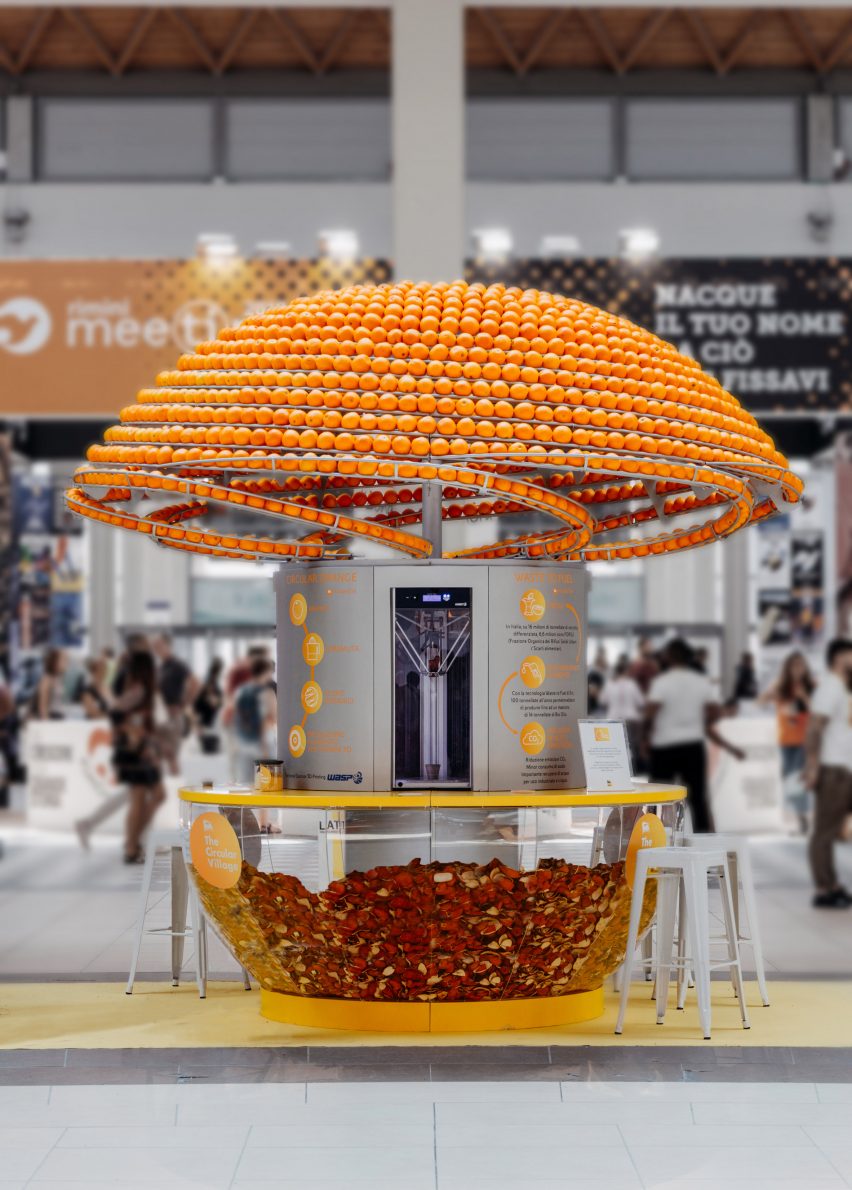
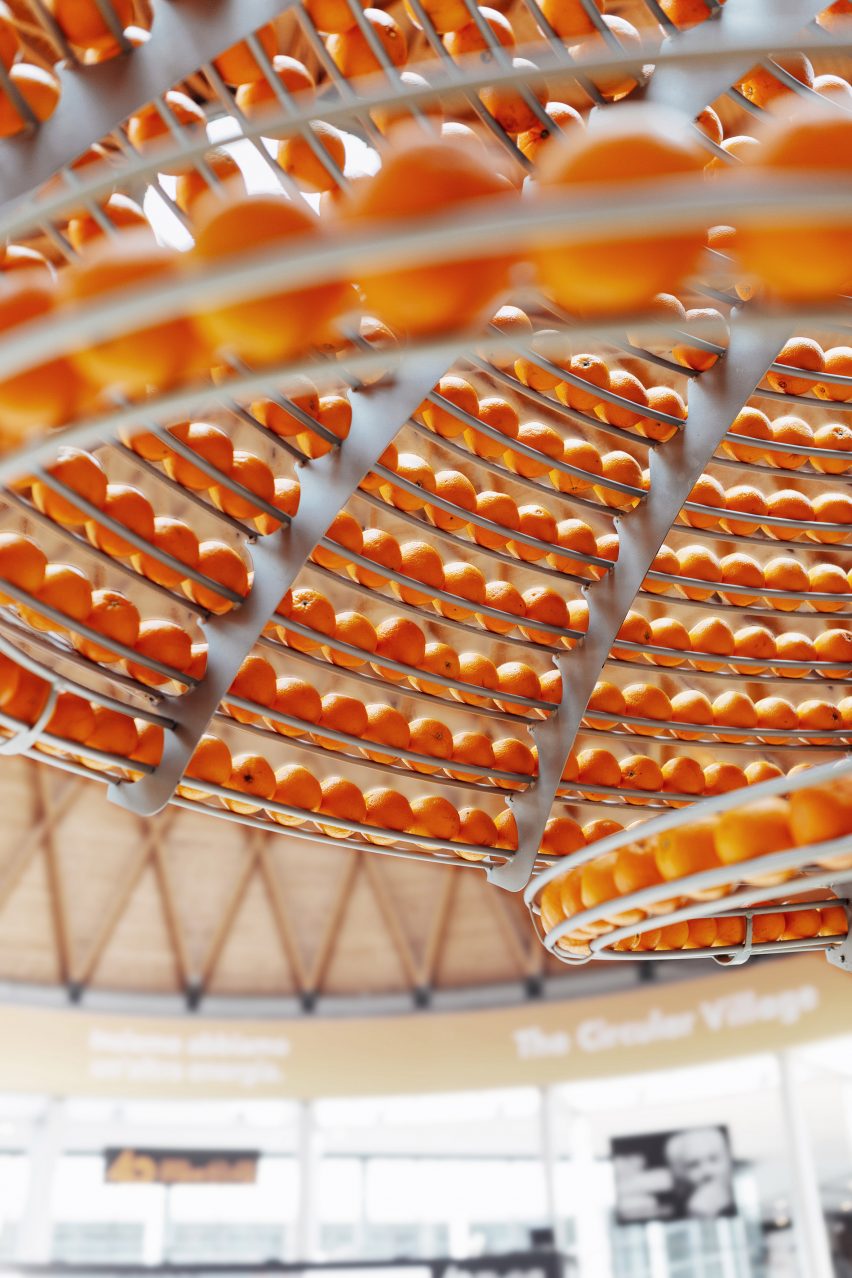
The 3.10-metre-tall experimental juice bar is topped by a circular dome filled with 1,500 oranges. When someone orders a juice, the oranges slide down into the squeezer where they are cut in half and juiced.
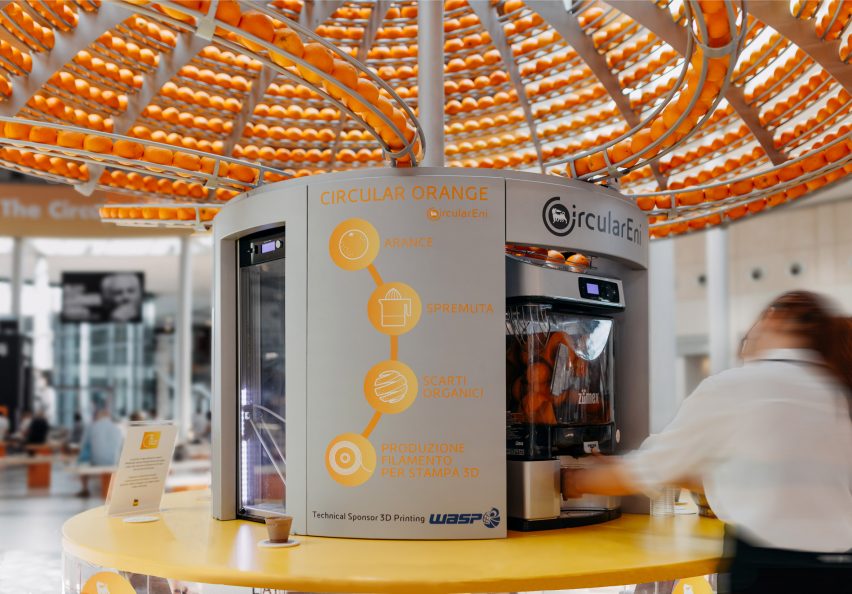
After being juiced, the leftover orange peel falls into a see-through compartment at the bottom of the machine. The collected rinds are then dried and milled to make "orange dust", which is mixed with polylactic acid (PLA) to form a bioplastic material.


Related story

Carlo Ratti grows Gaudí-inspired structures with a kilometre of mushroom mycelium

Grown from a fungus material, the structures were shredded and returned to the soil as compost after the design festival, in a fully circular fashion.


This material is then heated and melted to form a filament, which is fed through a 3D printer incorporated into the machine.

Visitors can watch the printing process as it builds up concentric layers of the filament, before using the finished product to drink the freshly-squeezed juice.

The cup can then be recycled after use, with the material continually broken down and remade into further cups in theory.

The move to a circular economy – which involves designing out waste and pollution from the production and consumption process, and regenerating natural systems – is being encouraged by the Ellen MacArthur Foundation and others.

Last month, MacArthur launched an initiative to persuade 20 million designers to shift from linear to circular principles in their work.
"The principle of circularity is a must for today's objects," said founder Carlo Ratti. "Working with Eni, we tried to show circularity in a very tangible way, by developing a machine that helps us to understand how oranges can be used well beyond their juice."


According to Ratti, the next iterations of Feel the Peel might include new functions, such as printing fabric for clothing from orange peel. 

The Circular Juice Bar will be installed at the Singularity University Summit in Milan from 8 to 9 October 2019, before touring around Italy in the following months in a bid to "demonstrate a new approach to environmental circularity in daily life".

Feel the Peel is not the first collaboration between Carlo Ratti Associati and Eni that explores circular design. The pair previously teamed up to present a series of arched architectural structures made from mushroom mycelium at Milan Design Week 2019.


Grown from a fungus material, the structures were shredded and returned to the soil as compost after the design festival, in a fully circular fashion.

sábado, 30 de julio de 2016

Smart bricks will transform how buildings work

ORIGINAL: UWE Bristol

Smart bricks capable of recycling wastewater and generating electricity from sunlight are being developed by a team of scientists from the University of the West of England (UWE Bristol). The bricks will be able to fit together and create 'bioreactor walls' which could then be incorporated in housing, public building and office spaces


The UWE Bristol team is working on the smart technologies that will be integrated into the bricks in this pan European 'Living Architecture' (LIAR) project led by Newcastle University. The LIAR project brings together living architecture, computing and engineering to find a new way to tackle global sustainability issues.

The smart living bricks will be made from bio-reactors filled with microbial cells and algae. Designed to self-adapt to changing environmental conditions the smart bricks will monitor and modify air in the building and recognise occupants.

Each brick will contain Microbial Fuel Cells (MFCs) containing a variety of micro-organisms specifically chosen to 

  • clean water, 
  • reclaim phosphate, 
  • generate electricity and 
  • facilitate the production of new detergents, 
as part of the same process.

The MFCs that will make up the living engine of the wall of smart bricks will be able to sense their surroundings and respond to them through a series of digitally coordinated mechanisms.

Professor Andrew Adamatzky, LIAR Project Director for UWE Bristol, is leading the UWE Bristol team, he said, “The technologies we are developing aim to transform the places where we live and work enabling us co-live with the building.

“A building made from bio-reactors will become a large-scale living organism that addresses all environmental and energy needs of the occupants. Walls in buildings comprised of smart bricks containing bioreactors will integrate massive-parallel computing processors where millions of living creatures sense the occupants in the building and the internal and external environmental conditions.

“Each smart brick is an electrical analogous computer. A building made of such bricks will be a massive-parallel computing processor.”

A photo-bioreactor is a device that can be programmed to utilize a variety of inputs such as 

  • grey water, 
  • microbial consortia (algae and bacteria), 
  • carbon dioxide from the atmosphere, and 
  • different types of nutrient to generate outputs.
These outputs include

  • 'polished' water, 
  • fertiliser, 
  • extractable products (recoverable phosphate), 
  • oxygen, 
  • next generation biodegradable detergents, 
  • electricity, 
  • recoverable biomass, 
  • bio-fluorescence and to a certain extent, 
  • heat.

Professor Ioannis Ieropoulos, Director of the Bristol Bioenergy Centre (BBiC), at the Bristol Robotics Laboratory at UWE Bristol, said, “Microbial Fuel Cells are energy transducers that exploit the metabolic activity of the constituent microbes to break down organic waste and generate electricity. This is a novel application for MFC modules to be made into actuating building blocks as part of wall structures. This will allow us to explore the possibility of treating household waste, generating useful levels of electricity, and have 'active programmable' walls within our living environments.”

Rachel Armstrong, Professor of Experimental Architecture at Newcastle University, UK, who is co-ordinating the project, said, “The LIAR project is incredibly exciting – it is bringing together living architecture, computing and engineering to find a new way to tackle global issues, like sustainability.”

The €3.2m LIAR (Living Architecture) project is co-ordinated by Newcastle University working with experts from the universities of


The LIAR project has received funding from the European Union's Horizon 2020 research and innovation programme under grant agreement No. 686585

viernes, 11 de marzo de 2016

China is building the largest waste-to-energy plant in the world

SHL Architects
It will turn a third of Shenzhen's trash into energy every single day.

The Chinese city of Shenzhen plans to tackle its serious waste problem by burning 5,000 tonnes of it a day in what will become the largest waste-to-energy plant in the world. 

The process, which is expected to turn at least a third of the trash into useable electricity, isn’t exactly the best thing for the environment on account of all the CO2 it’ll release, but it'll at least put a nice, big dent in the landfills and illegal dumps that have been building up in Shenzhen. One of these landfills actually killed dozens of people last year when it unexpectedly collapsed.

Expected to be up and running by 2020, the plant is less about generating electricity and more about finding a solution to the existing trash problem - the energy is just a handy bonus. 

According to Adele Peters at Fast Company, the new incinerator is one of 300 waste-to-energy plants that the Chinese government plans on building over the next three years. And while there’s been much debate over just how environmentally friendly (or not, as the case may be) burning all that trash is, many countries around the world have been using the process to essentially 'right the wrongs' of the past.

"Waste-to-energy plants are not an energy solution," Chris Hardie from Schmidt Hammer Lassen Architects, the Denmark-based firm that won a competition to design the plant, told Peters, adding that the amount of greenhouse gases emitted from decomposing landfills is around double the CO2 released by incineration. 

"They are a way of dealing with waste and using this process to generate electricity as a byproduct of the process. Cities have to move towards more recycling and reducing their waste for sure - and of course developing more sources of renewable energy. That is sort of the point we are making by proposing this be the first waste-to-energy plant that has a renewable component to it," he said.

What Hardie is referring to there is the fact that the roof of the massive plant - which will stretch about 1.6 km long (1 mile) - will be topped with around 44,000 square metres of solar panels. 

The idea is that the plant won’t just be about getting rid of trash, it will be providing clean and sustainable electricity to the surrounding city, and inviting members of the public to visit the facility and see it in action.

"The waste challenge is all about education - and experiencing the scale of the challenge is part of that education process," says Hardie. "Think of it like smoking in the 1950s and 1960s - everyone smoked. It was only until a civilisation became educated on how much it was polluting our own bodies did we dramatically stop. Waste is similar. If you don’t realise the damage it is doing, why stop creating waste?"

Ultimately, while burning trash is pretty much a necessary evil at this point, because there’s no point pretending it doesn’t exist, what China should also be focussing on is how to prevent similar build-ups in the future. 

Fast Company points out that by 2020 - the year the plant is expected to be operational - San Francisco plans on being a zero-waste city through some serious composting and recycling efforts. If burning waste is our reality today, let’s hope no waste at all will be our future.


ORIGINAL: Science Alert
BEC CREW
26 FEB 2016

jueves, 16 de julio de 2015

Denmark just generated 140% of its electricity demand from wind power


Image: Eugene Suslo/Shutterstock.com
And they’re sharing the excess with Norway, Germany, and Sweden.

On a particularly windy day last week, Denmark’s wind farms produced between 116 and 140 percent of the national electricity requirements, and they weren’t even operating at their full 4.8GW capacity at the time. Eighty percent of the excess was shared by Germany and Norway, and Sweden got 20 percent of the spoils, showing just redundant fossil fuels can be if governments make the commitment to renewable energy sources.

"It shows that a world powered 100 percent by renewable energy is no fantasy," Oliver Joy from the European Wind Energy Association said in a statement. "Wind energy and renewables can be a solution to decarbonisation - and also security of supply at times of high demand."

Denmark has long been an advocate for the benefits of wind power, and just last year managed to generate a record-breaking 39.1 percent of its national electricity needs from wind. Last week, it made an even greater achievement: a high of 140 percent of its national electricity needs, helped along by some unexpectedly severe weather.

"On an unusually windy day, Denmark found itself producing 116 percent of its national electricity needs from wind turbines yesterday evening," Arthur Nelson reports for The Guardian. "By 3am on Friday, when electricity demand dropped, that figure had risen to 140 percent."

The figures were verified by energinet.dk, a Denmark-based website that tracks the ratio of renewable versus fossil fuel-based energy being fed into the national grid. 

While the country can’t rely on wild and woolly weather to sustain it all the time (I’d imagine if it was hit with winds travelling at 93 km/h on a regular basis, it’d soon have no energy requirements at all on account of everyone jumping ship), it's been steadily increasing its wind farm output by 18 percent each year to take advantage the what wind it does get on a regular basis.

Right now, Denmark is getting a third of its overall electricity needs from off-shore wind farms, The Guardian reports, but it's well on its way to getting that share to 50 percent - and it expects to hit that well before its target date of 2020.

Denmark’s great success with wind is awesome news, but it also makes the recent announcement by the Australian government that the state-owned Clean Energy Finance Corporation (CEFC) would be ceasing all investments in wind and small-scale solar power projects look even more suspicious. Especially since it’s at complete odds with what the Australian public would actually prefer, as Peter Chan reports for the ABC:

"According to Essential Media polling conducted in May, 71 percent of Australians support more emphasis on solar power and 62 per cent support more emphasis on wind power. Only 4 percent and 6 percent, respectively, preferred less emphasis on these forms of energy."

I guess we’ll all just have to move to Europe.


ORIGINAL: Science Alert
BEC CREW
15 JUL 2015

domingo, 12 de abril de 2015

Wake Up Call

“ANYONE WHO BELIEVES IN INFINITE GROWTH ON A FINITE PLANET IS EITHER MAD OR AN ECONOMIST.” – D. ATTENBOROUGH


Have you ever felt like we're living through a nightmare of consumption? That you wish you could un-hook yourself and reconnect with a life that is somehow more real and vivid? Then perhaps you're ready to heed Earth's Wake Up Call.


Today we live in a time when there is little to no understanding of how the goods we consume and take for granted came into being. Without this we lack the knowledge to understand the true costs of our consumption, and the power to take action. As a result we have become disconnected from Earth - the origin of our health, wealth and all of the 'things' we depend on.

Wake Up Call takes us on a fast-paced, animated glimpse of the true costs behind some of our most prized possessions - our electronic gadgets. Joining the dots between the stages of extraction, production, consumption and disposal, it reveals that, although our gadgets appear sleek and shiny, their appearance is misleading.

From the mining that causes huge ecological and social destruction, to the mountains of e-waste shipped around the planet and dumped, the lifecycles of our technology are strewn with unacceptable devastation and toxicity.

It is time to Wake Up to this nightmarish destruction, broadly driven by our obsessive pursuit of economic growth at all costs. Things do not have to be this way, but it will take a critical mass of people willing to stand up and say ‘NO! We will not participate in these systems of violence against Earth and our fellow humans’ to make a change.

Wake Up Call invites us to do just that. To forge new paths into the future and join those who already are. We must reconnect with Earth, reduce our consumption, revalue what really makes us happy, and become part of the movement for an ecologically sane, and socially just economy that delivers fair technologies.

Wake Up Call expands on the story examined in “Short Circuit”, released by The Gaia Foundation in April 2013. It is a call to consciousness. Please watch, share, reflect and take action.

WITH A DONATION FROM YOU, WE CAN:
Continue to support communities affected by mining to raise their voices of resistance, to forge positive alliances and to secure legal expertise to challenge the companies involved.

Raise awareness of the true costs of our gadgets by sharing Wake Up Call around the world and developing materials about how we transition to a zero-waste, circular economy.
Join the conversation: #WakeUpCall. Find out more at
http://www.gaiafoundation.org/wakeupc...


ORIGINAL: Gaia Foundation

domingo, 15 de marzo de 2015

The Solar-Powered, Recycled House That Will Let Us Float in Style


1

If you've ever considered trading your house for a life on the water, but don't fancy the idea of cramped, below deck living quarters, then this floating, solar-powered home, designed by renowned Italian architect Giancarlo Zema, might be just the thing for you.

As our climate warms and sea levels continue rise, our coastlines will change irrevocably. EcoFloLife, the firm behind Zema's "Waternest 100," has spent years designing a new generation of energy-efficient homes to accommodate our changing planet and lives. The 1,000 square foot Waternest 100 is made from recycled timber and a recycled aluminum hull. The design includes skylights, balconies, and large windows that offer sweeping views of the natural surroundings. The roof is essentially a giant solar panel, and best of all, the home can be set to float atop any calm body of water.

Here are some sneak peeks the floating homes that may one day pepper our waterways:


2


3

Hey, even if our world gets swallowed by water, at least we'll be able to float away in style. [EcoFloLife vis Designboom]

All images courtesy of the Giancarlo Zema Design Group

ORIGINAL: Gizmodo
Maddie Stone