Mostrando entradas con la etiqueta CSIC. Mostrar todas las entradas

sábado, 30 de julio de 2016

Smart bricks will transform how buildings work

ORIGINAL: UWE Bristol

Smart bricks capable of recycling wastewater and generating electricity from sunlight are being developed by a team of scientists from the University of the West of England (UWE Bristol). The bricks will be able to fit together and create 'bioreactor walls' which could then be incorporated in housing, public building and office spaces


The UWE Bristol team is working on the smart technologies that will be integrated into the bricks in this pan European 'Living Architecture' (LIAR) project led by Newcastle University. The LIAR project brings together living architecture, computing and engineering to find a new way to tackle global sustainability issues.

The smart living bricks will be made from bio-reactors filled with microbial cells and algae. Designed to self-adapt to changing environmental conditions the smart bricks will monitor and modify air in the building and recognise occupants.

Each brick will contain Microbial Fuel Cells (MFCs) containing a variety of micro-organisms specifically chosen to 

  • clean water, 
  • reclaim phosphate, 
  • generate electricity and 
  • facilitate the production of new detergents, 
as part of the same process.

The MFCs that will make up the living engine of the wall of smart bricks will be able to sense their surroundings and respond to them through a series of digitally coordinated mechanisms.

Professor Andrew Adamatzky, LIAR Project Director for UWE Bristol, is leading the UWE Bristol team, he said, “The technologies we are developing aim to transform the places where we live and work enabling us co-live with the building.

“A building made from bio-reactors will become a large-scale living organism that addresses all environmental and energy needs of the occupants. Walls in buildings comprised of smart bricks containing bioreactors will integrate massive-parallel computing processors where millions of living creatures sense the occupants in the building and the internal and external environmental conditions.

“Each smart brick is an electrical analogous computer. A building made of such bricks will be a massive-parallel computing processor.”

A photo-bioreactor is a device that can be programmed to utilize a variety of inputs such as 

  • grey water, 
  • microbial consortia (algae and bacteria), 
  • carbon dioxide from the atmosphere, and 
  • different types of nutrient to generate outputs.
These outputs include

  • 'polished' water, 
  • fertiliser, 
  • extractable products (recoverable phosphate), 
  • oxygen, 
  • next generation biodegradable detergents, 
  • electricity, 
  • recoverable biomass, 
  • bio-fluorescence and to a certain extent, 
  • heat.

Professor Ioannis Ieropoulos, Director of the Bristol Bioenergy Centre (BBiC), at the Bristol Robotics Laboratory at UWE Bristol, said, “Microbial Fuel Cells are energy transducers that exploit the metabolic activity of the constituent microbes to break down organic waste and generate electricity. This is a novel application for MFC modules to be made into actuating building blocks as part of wall structures. This will allow us to explore the possibility of treating household waste, generating useful levels of electricity, and have 'active programmable' walls within our living environments.

Rachel Armstrong, Professor of Experimental Architecture at Newcastle University, UK, who is co-ordinating the project, said, “The LIAR project is incredibly exciting – it is bringing together living architecture, computing and engineering to find a new way to tackle global issues, like sustainability.

The €3.2m LIAR (Living Architecture) project is co-ordinated by Newcastle University working with experts from the universities of


The LIAR project has received funding from the European Union's Horizon 2020 research and innovation programme under grant agreement No. 686585

viernes, 18 de enero de 2013

Descrita una nueva ruta de señalización clave en la transferencia de genes virulentos entre bacterias

ORIGINAL: DCYT

El trabajo, publicado en la revista Molecular Cell, asigna a una enzima una nueva función señalizadora
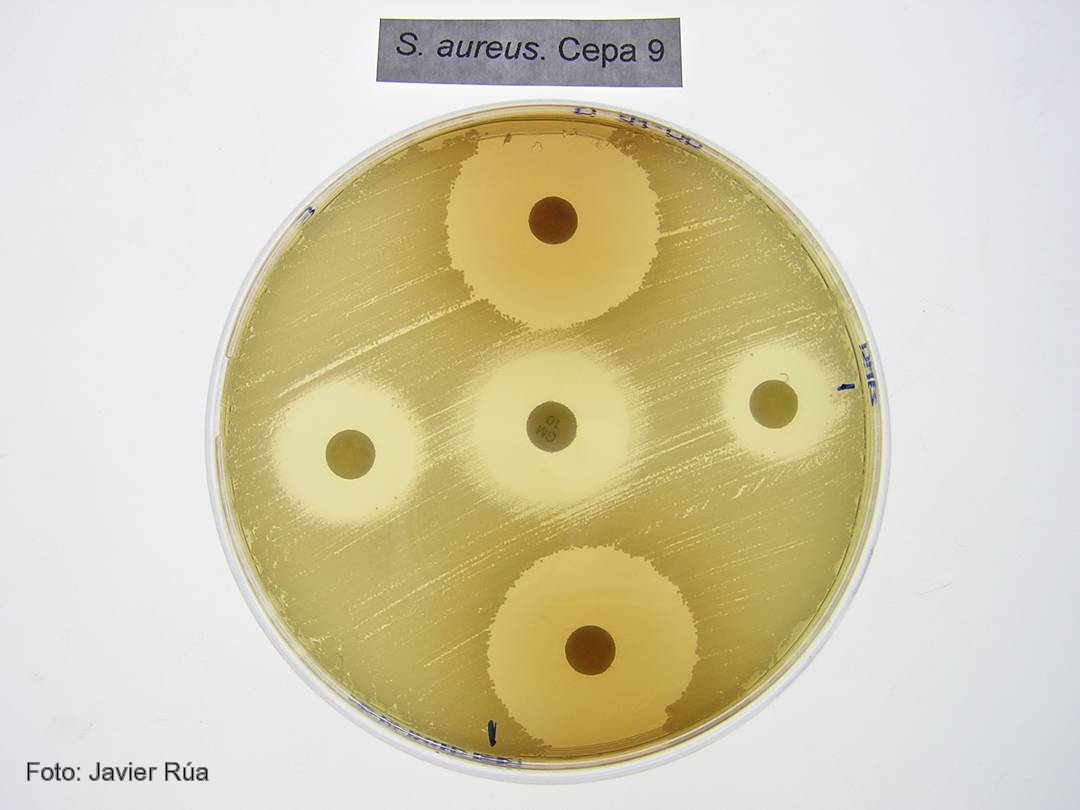
Cultivo de 'Staphylococcus aureus' tratado con los fenoles BHA (derecha) e hidroquinona (arriba).

CSIC/DICYT Un trabajo con participación del Consejo Superior de Investigaciones Científicas (CSIC) ha asignado a una enzima presente en todos los organismos vivos una nueva función en la transferencia de genes virulentos entre bacterias, un proceso que acaba provocando una infección. Los resultados, que aparecen publicados en el último número de Molecular Cell, y que han empleado como modelo la bacteria Staphylococcus aureus, la más frecuente en las infecciones adquiridas en hospitales, establecen el mecanismo de actuación de estas moléculas.

Las bacterias son capaces de transferir material genético entre sí mediante mecanismos de transferencia horizontal de genes. Cuando estos genes son virulentos, las bacterias que los reciben adquieren la capacidad de provocar enfermedades. “Algunos de los genes que codifican para toxinas y otros factores de virulencia están presentes en unas regiones denominadas islas de patogenicidad. Estas islas se transfieren de unas bacterias a otras utilizando virus que infectan bacterias, los llamados bacteriófagos”, explica el investigador del CSIC José Rafael Penadés, que trabaja en el Instituto de Biomedicina de Valencia.

El equipo de investigadores, formado también por científicos del Centro de Investigación y Tecnología Animal y la Universidad CEU Cardenal Herrera, en Valencia, han descubierto que las enzimas dUTPasas son capaces de despertar a las islas de patogenicidad para que detecten que la bacteria está siendo atacada por un virus. Antes de que la bacteria muera infectada, las islas inician su replicación y se transfieren a otras bacterias inocuas, a las que convierten en virulentas.

El proceso evolutivo ha hecho que las islas detecten que un virus está infectando a las bacterias, lo que producirá su muerte, y utilicen la presencia del bacteriófago para activarse e iniciar su ciclo. Esto ocurre porque algunas proteínas del fago se unen a un represor que bloquea la isla”, explica el investigador del CSIC.

Proteínas G protooncogénicas
Los resultados confirman que las dUTPasas son moléculas señalizadoras que emplean un mecanismo similar al descrito para una familia de proteínas presentes en células eucariotas: las proteínas G protooncogénicas. “Las dUTPasas son activas como señalizadoras cuando se unen a un nucleótido dUTP. Es entonces cuando cambian su conformación y, una vez cumplida su función, degradan el nucleótido y pasan a estar apagadas. Este mecanismo de encendido y apagado es el mismo que el empleado por los protooncogenes”, destaca Penadés.

Según el investigador del CSIC Alberto Marina, el estudio sugiere por primera vez que las dUTPasas cumplen una función señalizadora no sólo en la mayoría de los virus, sino además en organismos vivos complejos como los eucariotas superiores. “Nuestros resultados aportan una visión completamente nueva del mecanismo de actuación de estas enzimas, que depende de una serie de características presentes en las enzimas de los bacteriófagos de Staphylococcus aureus y que están también presentes en otras muchas dUTPasas de un gran número de organismos vivos. Todo ello sugiere que el mecanismo descrito es universal”, concluye el investigador del CSIC.

Referencia bibliográfica 
María Ángeles Tormo-Más, Jorge Donderis, María García-Caballer, Aaron Alt, Ignacio Mir-Sanchís, Alberto Marina y José R. Penadés. Phage dUTPases Control Transfer of Virulence Genes by a Proto-Oncogenic G Protein-like Mechanism. Molecular Cell. DOI: 10.1016.