Mostrando entradas con la etiqueta Nanofabrication. Mostrar todas las entradas

viernes, 25 de diciembre de 2015

DNA Manufacturing Enters the Age of Mass Production

Synthetic-biology startups adopt technologies from the computer industry

Illustration: Elias Stein

Emily Leproust, CEO and cofounder of the buzzy biotech startup Twist Bioscience, is an industrialist on the nanoscale. “I remind everyone at Twist, we are a manufacturing company,” she says. “We manufacture DNA.
Photo: Twist Bioscience
DNA Factory: Twist Bioscience’s machine
builds DNA strands inside
600-nanometer wells on a silicon plate.
Twist is part of the young industry of synthetic biology, in which living organisms are the product and a biology lab is the factory floor. By manufacturing strands of DNA—assembling the genetic code of life from its basic components—scientists are creating organisms the likes of which the world has never seen. And these new life forms can be decidedly useful: Biologists have produced yeast cells that excrete pharmaceuticals and algae that brew jet fuel.

This burgeoning business sector has been hampered by the labor-intensive nature of DNA assembly, a painstaking process requiring trained personnel. Now, nimble startups are competing to fashion automated DNA assembly lines that would make Henry Ford proud, using techniques copied from the fabs that make computer chips. As their innovations bring down the cost of constructing DNA strands, these entrepreneurs are aiming for a low price point, which they say will cause a market boom. Twist Bioscience, which will begin commercial operations at its San Francisco headquarters in 2016, is a leading contender in that race to the bottom.

Genetic material is composed of molecules called nucleobases; the four types of bases in DNA are identified by the letters A, C, G, and T. The order of these letters serves as a code that instructs an organism how to build its cells and carry on the functions of life. In human beings, this code is about 3.2 billion letters long, while the yeast used in baking and beer brewing has a code of about 12 million letters. If you tweak the order of the letters, you tweak the organism’s instructions. Synthetic biologists have written new snippets of code and inserted them into yeast DNA, causing the microbe to churn out, for example, the omega-3 fatty acids found in fish oil supplements or the aromatic oils normally produced by roses.

Matter of Fact
Mycoplasma laboratorium: The name given to the first “synthetic organism,” a bacterium whose 1-million-base genome was assembled from scratch.

Constructing a strand of DNA isn’t complicated; in fact it’s a routine procedure performed in labs all over the world. But that procedure is typically carried out by hand, says Twist’s Leproust: “Microbiology is manual labor. You have a Ph.D. student moving liquid from one test tube to the next all day long.” So she and her cofounders invented a machine that automates the construction process.

The heart of the machine is a silicon plate pocked with 10,000 tiny wells, which are etched using the same photolithography techniques perfected by computer chip manufacturers. A different strand of DNA can be constructed in each 600-nanometerwide well. The machine does “the exact same chemistry” as a Ph.D. student would do, Leproust says, “only in a volume that’s 100 times smaller.

Twist isn’t selling its machine but rather its DNA manufacturing services, which are aimed at researchers and startups seeking new genetic modifications that might prove useful. In 2015 the company began production runs for select customers; 2016 will see Twist’s full commercial launch. DNA assembly is priced on a cost-per-base model, and Leproust says her company’s 10-cents-per-base starting price is already the best in the industry. But she’s aiming for a 2-cent price point: “That’s the point at which researchers can significantly scale experiments and will no longer be limited by the cost of DNA,” she says. Today, customers typically order DNA strands of 300 to 1,800 bases in length, Leproust says.
1,600 Bases: Length of gene for insulin (INS)
81,000 Bases: Length of gene for breast cancer risk (BRCA1)
Another synthetic-biology startup in the San Francisco area, Zymergen ("ROBOTICS FOR HIGH THROUGHPUT BIOLOGY"), offers customers a broader set of services. The company not only 
  • constructs DNA snippets on the cheap, it also 
  • inserts that DNA into microbes and 
  • monitors the outcome. 
Chief science officer Zach Serber explains that the results can inform the next round of DNA design, letting customers iterate quickly as they look for their ideal organism. “You cast a wide net,” Serber says, “and when you find a variation that improves the microbe’s performance, then you double down.

Such setups have led to excited talk of a synthetic-biology industry based on “organism fabs.” But the promise of mass-produced DNA doesn’t impress Rob Carlson, a biotech consultant and managing director of the BioEconomy Capital venture fund. “I don’t understand the business model,” he says.

Carlson is skeptical that cheap DNA assembly will lead to a proliferation of startups with ideas for profitable microbes. “So you can make and test a whole bunch more DNA—but that’s not the hard part,” he argues. “Going from test tube to bench scale to commercial scale, that’s 90 percent of cost.” For a startup to build a business around a yeast that cranks out a pharmaceutical, for example, it must manage massive tanks full of microbes. Reducing the cost of the initial DNA manufacturing would only give the company pocket money, Carlson says: “Hooray, they get to buy beer, or more pizza on Friday.

ORIGINAL: IEEE Spectrum
23 Dec 2015

miércoles, 1 de julio de 2015

A 3D Printhead with Single Atom Precision? Enter the Nanobeacon

John Bashonger has tipped us off to a possible precursor for an “atomic precision” 3D printhead where the interaction of tailored light with a single atom and individual nanostructures combine to create remarkably accurate results.

At the Max Planck Institute for the Science of Light, this approach is utilized to couple light to a single atom, or for that matter, to individual nano-particles. The research demonstrates that light can be coupled to an ion trapped within a parabolic mirror, and the upshot is a high efficiency, optimized polarized beam.


Dr. Gerd Leuchs
The researchers, led by Dr. Gerd Leuchs, say that as individual atoms, ions and molecules form the basic building blocks of matter, our perception of the tangible materials formed from such building blocks through their interaction with light is key to our ability to manipulate them.

Complex objects such as nanostructures can be built and manipulated by understanding specific interactions they have with a light field. The manipulations may well prove to serve as the basis for potential applications in biophysics or quantum information processing, and the individual nanostructures themselves may serve as “building blocks” to create metamaterials.

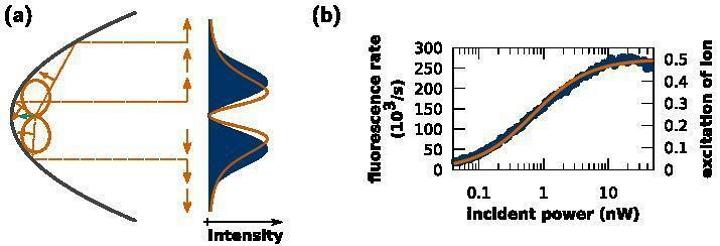
The process involves the creation of radially polarized light which is acutely focused. This incoming beam, which features a cylindrical symmetry, tracks across a path incident from right to left onto a lens. The focusing rotates the individual electric field vectors towards the optical axis, and they then interfere within the focal point to create an electric field component which oscillates along the optical axis.
The result is a tailored light where the precise shaping of the temporal and spatial distribution of the intensity of the light – and the polarization vector or direction of oscillation of the electric field – can then be concentrated to dimensions smaller than the wavelength of the light when focused onto a target object.

A radially polarized ring is focused with a parabolic mirror, and in this experiment, the researchers generated the tailored, radially polarized mode to an ideal field distribution down to 98%.

The work uses a “singly charged ytterbium ion” as the atom, and the ions can be accurately positioned, and even “trapped” for varying periods using an electrode arrangement and an applied AC voltage. An ion trap was developed to the parabolic mirror geometry which effectively shadows the ion from the focused light with minimal interference.

MPI says the methodology has been successfully applied to the investigation of numerous nanostructures and nanoscopic objects to create metamaterials of extraordinary properties
.

What it might mean is that, by “holding” a single atom with laser beams, it may well be possible to build a 3D printhead with singular atomic precision.

With the aid of artificial materials, light can be guided around objects and reflections can be suppressed to form a “nanobeacon.” The researchers say such light sources pave the way for high-precision control of light propagation in a range of optical networks.

Do you forsee a coming say when 3D printers which feature precision down to the level of a single atom could be created using this nanobeacon technology? Let us know in the Nanobeacon forum thread on 3DPB.com.


ORIGINAL: 3DPrint
July 1, 2015

sábado, 20 de julio de 2013

Desktop printing at the nano level

by Erin White
19 July 2013

Photo credit Wikimedia
Northwestern researchers create state-of-the-art desktop nanofabrication tool

EVANSTON, Ill. --- A new low-cost, high-resolution tool is primed to revolutionize how nanotechnology is produced from the desktop, according to a new study by Northwestern University researchers.

Currently, most nanofabrication is done in multibillion-dollar centralized facilities called foundries. This is similar to printing documents in centralized printing shops. Consider, however, how the desktop printer revolutionized the transfer of information by allowing individuals to inexpensively print documents as needed. This paradigm shift is why there has been community-wide ambition in the field of nanoscience to create a desktop nanofabrication tool.

With this breakthrough, we can construct very high-quality materials and devices, such as processing semiconductors over large areas, and we can do it with an instrument slightly larger than a printer,” said Chad A. Mirkin, senior author of the study and a world-renowned pioneer in the field of nanoscience.

Mirkin is the George B. Rathmann Professor of Chemistry in the Weinberg College of Arts and Sciences and a professor of medicine, chemical and biological engineering, biomedical engineering and materials science and engineering. He also is the director of Northwestern’s International Institute for Nanotechnology.

The study will be published July 19 in the journal Nature Communications.

The tool Mirkin’s team has created produces working devices and structures at the nanoscale level in a matter of hours, right at the point of use. It is the nanofabrication equivalent of a desktop printer.

Without requiring millions of dollars in instrumentation costs, the tool is poised to prototype a diverse range of functional structures, from gene chips to protein arrays to building patterns that control how stem cells differentiate to making electronic circuits.

Instead of needing to have access to millions of dollars, in some cases billions of dollars of instrumentation, you can begin to build devices that normally require that type of instrumentation right at the point of use,” Mirkin said.

The paper details the advances Mirkin’s team has made in desktop nanofabrication based upon easily fabricated beam-pen lithography (BPL) pen arrays, structures that consist of an array of polymeric pyramids, each coated with an opaque layer with a 100 nanometer aperture at the tip. Using a digital micromirror device, the functional component of a projector, a single beam of light is broken up into thousands of individual beams, each channeled down the back of different pyramidal pens within the array and through the apertures at the tip of each pen.

The nanofabrication tool allows one to rapidly process substrates coated with photosensitive materials called resists and generate structures that span the macro-, micro- and nanoscales, all in one experiment.

Key advances made by Mirkin’s team include developing the hardware, writing the software to coordinate the direction of light onto the pen array and constructing a system to make all of the pieces of this instrument work together in synchrony. This approach allows each pen to write a unique pattern and for these patterns to be stitched together into functional devices.

There is no need to create a mask or master plate every time you want to create a new structure,” Mirkin said. “You just assign the beams of light to go in different places and tell the pens what pattern you want generated.

Because the materials used to make the desktop nanofabrication tool are easily accessible, commercialization may be as little as two years away, Mirkin said. In the meantime, his team is working on building more devices and prototypes.

In the paper, Mirkin explains how his lab produced a map of the world, with nanoscale resolution that is large enough to see with the naked eye, a feat never before achieved with a scanning probe instrument. Not only that, but closer inspection with a microscope reveals that this image is actually a mosaic of individual chemical formulae made up of nanoscale points. Making this pattern showcases the instrument’s capability of simultaneously writing centimeter-scale patterns with nanoscale resolution.

The Nature Communications paper is titled “Desktop nanofabrication with massively multiplexed beam-pen lithography.” In addition to Mirkin, other authors are Xing Liao, Keith A. Brown, Abrin L. Schmucker, Guoliang Liu and Shu He, all of Northwestern University.

This study was supported by DARPA/MTO Award N66001-08-1-2044, AOARD Award FA2386-10-1-4065, AFOSR Awards FA9550-12-1-0280 and FA9550-12-1-0141, NSF Awards DBI-1152139 and DMB-1124131, DoD/NPS/NSSEF Fellowship Awards N00244-09-1-0012 and N00244-09-1-0071, the Chicago Biomedical Consortium with support from Searle Funds at The Chicago Community Trust and a CCNE initiative of NIH Award U54 CA151880. - See more at: http://www.northwestern.edu/newscenter/stories/2013/07/desktop-printing-at-the-nano-level.html#sthash.SqJb7VI3.dpuf
a, Schematic of the steps involved in fabricating a BPL tip array. b, SEM images of a BPL pen array in which the aperture (diameter, 50 ± 5 nm, inset) is fabricated by FIB. c, BPL pen array, where the aperture size is controlled by the amount of force made with an adhesive PMMA surface, as shown in a. Pen arrays as large as several square centimetres can be fabricated by this approach, where the size of the aperture can be controlled between 500 nm and 5 µm, simply by controlling the extent to which the beam pen array contacts the PMMA.
ORIGINAL: Nature Figure 1: Fabrication of a beam pen array.


martes, 20 de noviembre de 2012

More complex circuits for synthetic biology lead toward engineered cells


The protein–protein and protein–DNA interactions that can lead to crosstalk between gates are shown as red rectangles. (Credit: Tae Seok Moon et al./Nature)

One possible pathway from current technology to advanced nanotechnology that will comprise atomically precise manufacturing implemented by atomically precise machinery is through adaptation and extension of the complex molecular machine systems evolved by biology. Synthetic biology, which engineers new biological systems and function not evolved in nature, is an intermediate stage along this path. An article on KurzweilAI-net describes a recent achievement by MIT scientists in constructing a synthetic genetic circuit that responds to control signals from four molecules without any one molecule interfering with the responses to any other molecules. From “The most complex synthetic biology circuit yet“:

Christopher Voigt, an associate professor of biological engineering at MIT, and his students have developed circuit components that don’t interfere with one another, allowing them to produce the most complex synthetic circuit ever built.

The circuit integrates four sensors for different molecules. Such circuits could be used in cells to precisely monitor their environments and respond appropriately.

Using genes as interchangeable parts, synthetic biologists design cellular circuits that can perform new functions, such as sensing environmental conditions. However, the complexity that can be achieved in such circuits has been limited by a critical bottleneck: the difficulty in assembling genetic components that don’t interfere with each other.

Unlike electronic circuits on a silicon chip, biological circuits inside a cell cannot be physically isolated from one another. “The cell is sort of a burrito. It has everything mixed together,” says Voigt.

Because all the cellular machinery for reading genes and synthesizing proteins is jumbled together, researchers have to be careful that proteins that control one part of their synthetic circuit don’t hinder other parts of the circuit.

The pathway consists of three components: an activator, a promoter and a chaperone
A promoter is a region of DNA where proteins bind to initiate transcription of a gene. 
An activator is one such protein. 
Some activators also require a chaperone protein before they can bind to DNA to initiate transcription. …

To design synthetic circuits so they can be layered together, their inputs and outputs must mesh. With an electrical circuit, the inputs and outputs are always electricity. With these biological circuits, the inputs and outputs are proteins that control the next circuit (either activators or chaperones).

The research was published in Nature [abstract]. The authors conclude “This work demonstrates the successful layering of orthogonal logic gates, a design strategy that could enable the construction of large, integrated circuits in single cells.Certainly there are many steps between engineering cells to optimize their normal outputs to achieve engineered purposes, and engineering cells for entirely novel nanofabrication of materials not normally found in biology, but the more complex the tools that are available, the more opportunities there will be to advance along this path. Whether or not we can go all the way along this path from engineering biology to molecular manufacturing remains to be seen.
James Lewis, PhD

martes, 2 de octubre de 2012

IBM Research Creates Worlds Smallest 3D Map

22/04/2010

IBM scientists have created the smallest 3D map of the earth - so small that 1,000 maps could fit on a grain of salt*. The scientists accomplished this through a new, breakthrough technique that uses a tiny, silicon tip with a sharp apex -- one million times smaller than an ant -- to create patterns and structures as small as 15 nanometers at greatly reduced cost and complexity. This patterning technique opens new prospects for developing nanosized objects in fields such as electronics, future chip technology, medicine, life sciences, and opto-electronics.