Mostrando entradas con la etiqueta Fungi. Mostrar todas las entradas

viernes, 10 de noviembre de 2017

The Fungus That Turns Ants Into Zombies Is More Diabolical Than We Realized

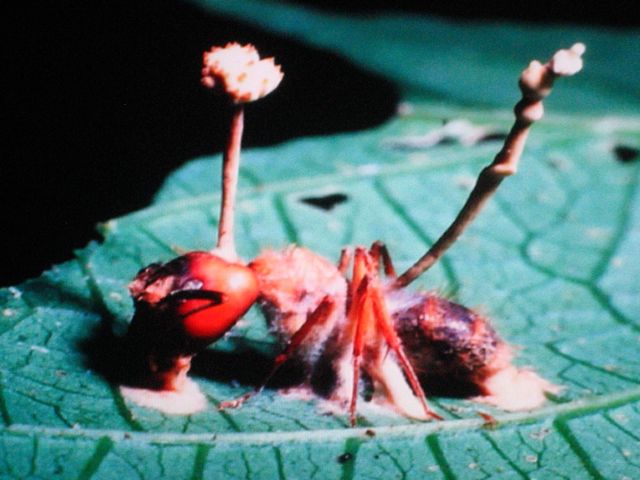
A dead spiny ant with fungal spores erupting out of its head. (Image: David Hughes/Penn State University)

Carpenter ants of the Brazilian rain forest have it rough. When one of these insects gets infected by a certain fungus, it turns into a so-called “zombie ant” and is no longer in control of its actions. Manipulated by the parasite, an infected ant will leave the cozy confines of its arboreal home and head to the forest floor—an area more suitable for fungal growth. After parking itself on the underside of a leaf, the zombified ant anchors itself into place by chomping down onto the foliage. This marks the victim’s final act. From here, the fungus continues to grow and fester inside the ant’s body, eventually piercing through the ant’s head and releasing its fungal spores. This entire process, from start to finish, can take upwards of ten agonizing days.“We found that a high percentage of the cells in a host were fungal cells,” said Hughes. “In essence, these manipulated animals were a fungus in ants’ clothing.”

We’ve known about zombie ants for quite some time, but scientists have struggled to understand how the parasitic fungus, O. unilateralis (pronounced yu-ni-lat-er-al-iss), performs its puppeteering duties. This fungus is often referred to as a “brain parasite,” but new research published this week in Proceedings of the National Academy of Sciences shows that the brains of these zombie ants are left intact by the parasite, and that O. unilateralis is able to control the actions of its host by infiltrating and surrounding muscle fibers throughout the ant’s body. In effect, it’s converting an infected ant into an externalized version of itself. Zombie ants thus become part insect, part fungus. Awful, right?

To make this discovery, the scientist who first uncovered the zombie ant fungus, David Hughes from Penn State, launched a multidisciplinary effort that involved an international team of entomologists, geneticists, computer scientists, and microbiologists. The point of the study was to look at the cellular interactions between O. unilateralis and the carpenter ant host Camponotus castaneus during a critical stage of the parasite’s life cycle—that phase when the ant anchors itself onto the bottom of leaf with its powerful mandibles.
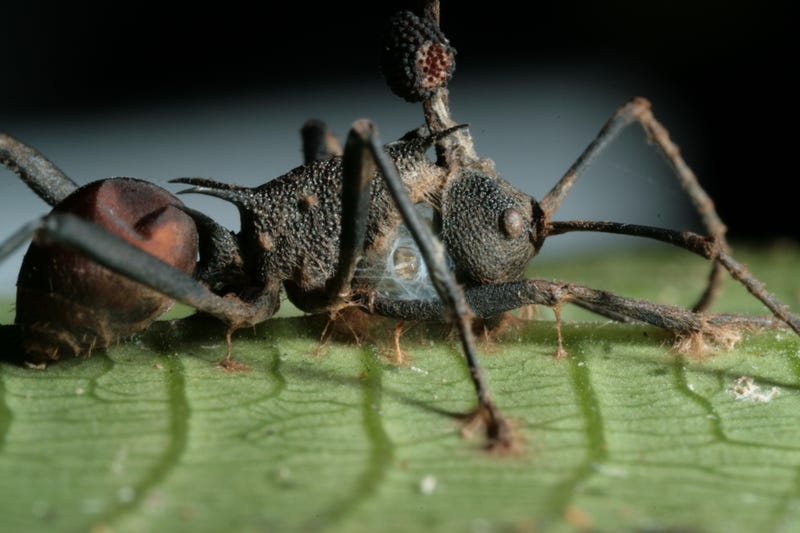
Ants infected with late stage O. unilateralis infection. (Image: David Hughes/PLOS ONE)

“The fungus is known to secrete tissue-specific metabolites and cause changes in host gene expression as well as atrophy in the mandible muscles of its ant host,” said lead author Maridel Fredericksen, a doctoral candidate at the University of Basel Zoological Institute, Switzerland, in a statement. “The altered host behavior is an extended phenotype of the microbial parasite’s genes being expressed through the body of its host. But it’s unknown how the fungus coordinates these effects to manipulate the host’s behavior.”

By referring to the parasite’s “extended phenotype,” Fredericksen is referring to the way that O. unilateralis is able to hijack an external entity, in this case the carpenter ant, and make it a literal extension of its physical self.

For the study, the researchers infected carpenter ants with either O. unilateralis or a less threatening, non-zombifying fungal pathogen known as Beauveria bassiana, which served as the control. By comparing the two different fungi, the researchers were able to discern the specific physiological effects of O. unilateralis on the ants.

Using electron microscopes, the researchers created 3D visualizations to determine location, abundance, and activity of the fungi inside the bodies of the ants. Slices of tissue were taken at a resolution of 50 nanometers, which were captured using a machine that could repeat the slicing and imaging process at a rate of 2,000 times over a 24-hour period. To parse this hideous amount of data, the researchers turned to artificial intelligence, whereby a machine-learning algorithm was taught to differentiate between fungal and ant cells. This allowed the researchers to determine how much of the insect was still ant, and how much of it was converted into the externalized fungus.
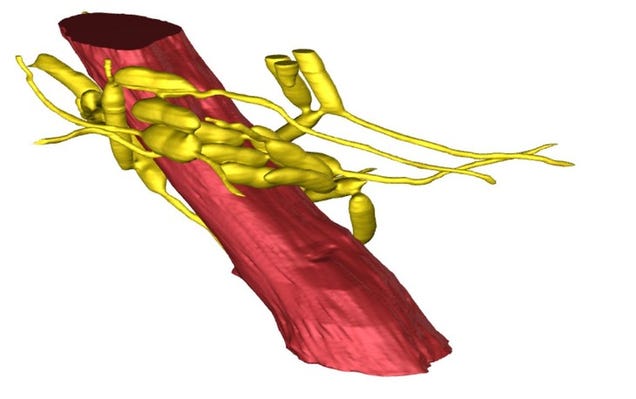
3D reconstruction of an ant mandible adductor muscle (red) surrounded by a network of fungal cells (yellow). (Image: Hughes Laboratory/Penn State)


The results were truly disturbing. Cells of O. unilateralis had proliferated throughout the entire ant’s body, from the head and thorax right down to the abdomen and legs. What’s more, these fungal cells were all interconnected, creating a kind of Borg-like, collective biological network that controlled the ants’ behavior.

“We found that a high percentage of the cells in a host were fungal cells,” said Hughes in a statement. “In essence, these manipulated animals were a fungus in ants’ clothing.”

But most surprising of all, the fungus hadn’t infiltrated the carpenter ants’ brains.

“Normally in animals, behavior is controlled by the brain sending signals to the muscles, but our results suggest that the parasite is controlling host behavior peripherally,” explained Hughes. “Almost like a puppeteer pulls the strings to make a marionette move, the fungus controls the ant’s muscles to manipulate the host’s legs and mandibles.”

As to how the fungus is able to navigate the ant towards the leaf, however, is still largely unknown. And in fact, that the fungus leaves the brain alone may provide a clue. Previous work showed that the fungus may be chemically altering the ants’ brains, leading Hughes’ team to speculate that the fungus needs to the ant to survive long enough to perform its final leaf-biting behavior. It’s also possible, however, that the fungus needs to leverage some of that existing ant brain power (and attendant sensorial capabilities) to “steer” the ant around the forest floor. Future research will be required to turn these theories into something more substantial.

“This is an excellent example of how interdisciplinary research can drive our knowledge forward,” Charissa de Bekker, an entomologist at the University of Central Florida not affiliated with the new study, told Gizmodo. “The researchers used cutting-edge techniques to finally confirm something that we thought to be true but weren’t sure about: that the fungus O. unilateralis does not invade or damage the brain.”

de Bekker says this work confirms that something much more intricate is going on, and that the fungus might be controlling the ant by secreting compounds that can work as neuromodulators. Data gleaned from the fungal genome points to this conclusion as well.

“This means the fungus might produce a wealth of bioactive compounds that could be of interest in terms of novel drug discovery,” said de Bekker. “I am, thus, very excited about this work!”

An authority on the zombie ant fungus herself, de Bekker also released new research this week. Her new study, published in PLOS One and co-authored with David Hughes and others, looked into the molecular clock of the Ophiocordyceps kimflemingiae fungus (a recently named species of the O. unilateralis complex) to see if the daily rhythms, and thus biological clocks, are an important aspect of the parasite-host interactions studied by biologists.

“In addition to confirming that the fungus indeed has a molecular clock, we found that this results in the daily oscillation of certain genes,” de Bekker told Gizmodo. “While some of them are active during the day-time, others are active during the night-time. Interestingly, we found that the fungus especially activates genes encoding for secreted proteins during the night-time. These are the compounds that possibly interact with the host’s brain! The fungus, therefore, does not just release bioactive compounds to manipulate behavior, but there seems to be a precise timing to it as well.”

There’s clearly still lots to learn about this insidious parasite and how it hijacks its insectoid hosts, but as these recent studies attest, we’re getting steadier closer to the answer—one that’s clearly disturbing in nature.

[Proceedings of the National Academy of Sciences, PLOS One] 
ORIGINAL: Gizmodo
By George Dvorsky

miércoles, 28 de septiembre de 2016

The Patent about an Organic Non Chemical pesticide that could change the World…


If there’s anything you read – or share – let this be it. The content of this article has potential to radically shift the world in a variety of positive ways. And as Monsanto would love for this article to not go viral, all we can ask is that you share, share, share the information being presented so that it can reach as many people as possible.

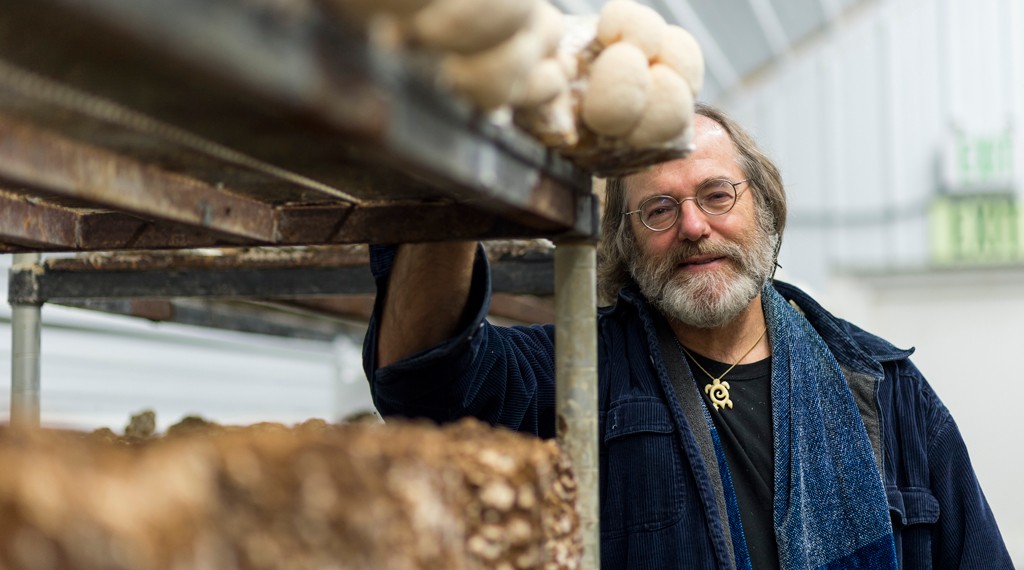
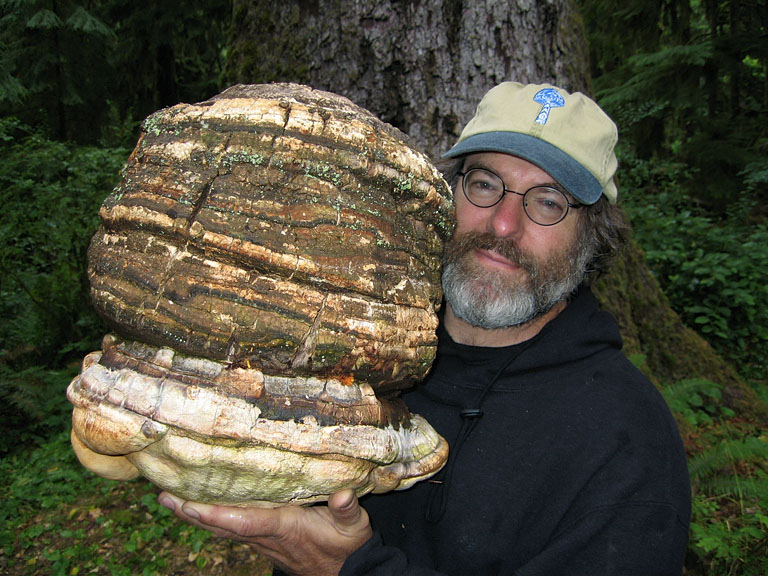
In 2006, a patent was granted to a man named Paul Stamets. Though Paul is the world’s leading mycologist, his patent has received very little attention and exposure. Why is that? Stated by executives in the pesticide industry, this patent represents “the most disruptive technology we have ever witnessed.” And when the executives say disruptive, they are referring to it being disruptive to the chemical pesticides industry.

What has Paul discovered? 
The mycologist has figured out how to use mother nature’s own creations to keep insects from destroying crops. It’s what is being called SMART pesticides. These pesticides provide safe & nearly permanent solution for controlling over 200,000 species of insects – and all thanks to the ‘magic’ of mushrooms.

Paul does this by taking entomopathogenic Fungi (fungi that destroys insects) and morphs it so it does not produce spores. In turn, this actually attracts the insects who then eat and turn into fungi from the inside out!


This patent has potential to revolutionize the way humans grow crops – if it can be allowed to reach mass exposure.

To tolerate the use of pesticides in modern agriculture is to deny evidence proving its detrimental effects against the environment. Such ignorance really can no longer be tolerated. For example, can you imagine a world without bees?

Monsanto’s chemical concoctions which are being sprayed all over farmers’ fields around the world are attributed to the large-scale bee die off. While a growing number of countries are banning Monsanto, it’s still being used in in nations who should be aware of its dangers. To say that new methods need to be implemented before it is too late is an understatement

How To Beat Monsanto At Their Own Game...
We don't need Monsanto's products. Learn how to make your own natural & effective pesticides at home to keep your garden organic. Subscribe to our free newsletter now & discover just how easy it really is with our organic gardening & self-sufficiency tips. Enter your details below & click the instant access button...

Monsanto presently generates $16 billion dollars per year (as reported in 2014), therefore you can be certain they do not want anything interrupting that flow of revenue. Such income gives them nearly limitless resources and abilities to suppress information that may be damaging their reputation.


But by becoming educated on the benefits of growing sustainable, organic, and bio-dynamic food, sharing articles like this, and boycotting GMO & herbicide-sprayed crops, the corporate demon may soon get the message.

Here are helpful links to understand more about the incredible patent discussed above:

Here is a link to the patent we are speaking of…
http://www.google.com/patents/US7122176

A list of all the patents Paul has applied for:
http://patents.justia.com/inventor/paul-edward-stamets

Plenty of information about Paul Stamets:
http://www.fungi.com/about-paul-stamets.html

Wikipedia page about Paul Stamets:
http://en.m.wikipedia.org/wiki/Paul_Stamets

And finally, here is a TedTalks video by Paul in 2008 called:
6 Ways Mushrooms Can Save The World…
ORIGINAL: Source: EWAO

If you like this idea, be sure to share it with your friends and inspire someone you know. Anything becomes possible with just a little inspiration…

sábado, 30 de julio de 2016

Fantastic Fungi: The Startling Visual Diversity of Mushrooms Photographed by Steve Axford (& New Photos9

Marasmius haematocephalus
To think any one of these lifeforms exists in our galaxy, let alone on our planet, simply boggles the mind. Photographer Steve Axford lives and works in the Northern Rivers area of New South Wales in Australia where he spends his time documenting the living world around him, often traveling to remote locations to seek out rare animals, plants, and even people. But it’s his work tracking down some of the world’s strangest and brilliantly diverse mushrooms and other fungi that has resulted in an audience of online followers who stalk his work on Flickr and SmugMug to see what he’s captured next.

Axford shares via email that most of the mushrooms seen here were photographed around his home and are sub-tropical fungi, but many were also taken in Victoria and Tasmania and are classified as temperate fungi. The temperate fungi are well-known and documented, but the tropical species are much less known and some may have never been photographed before. Mushrooms like the Hairy Mycena and the blue leratiomyces have most likely never been found on the Australian mainland before, and have certainly never been photographed in an artistic way as you’re seeing here.

It was painfully difficult not to include more of Axford’s photography here, so I urge you to explore further. All photos courtesy the photographer. (via Awkward Situationist)

Panus fasciatus

Leratiomyces sp. / Found in Booyong Reserve, Booyong, NSW

Mycena chlorophos


Cyptotrama aspratum or Gold tuft

Schizophyllum commune

Hairy mycena

White Mycena

Mauve splitting waxcap

Marasmius sp. / Marasmius haematocephalus

panus lecomtei

Photo by Steve Axford
Photo by Steve Axford

Photo by Steve Axford

Photo by Steve Axford

Photo by Steve Axford

Photo by Steve Axford

Photo by Steve Axford

Photo by Steve Axford

Photo by Steve Axford

Photo by Steve Axford

Photo by Steve Axford

Photo by Steve Axford

Photo by Steve Axford

Photo by Steve Axford

Photo by Steve Axford

Photo by Steve Axford

Photo by Steve Axford

Photo by Steve Axford
ORIGINAL: Colossal

New Photos of Extremely Unusual Mushrooms and Other Fungi by Steve Axfordby Christopher Jobson on July 29, 2016

lunes, 14 de marzo de 2016

IKEA To Use Mushroom-Based Packaging That Will Decompose In A Garden Within Weeks

The furniture retailer is looking at using biodegradable mycelium “fungi packaging” as part of its efforts to reduce waste and increase recycling.


It’s no secret polystyrene is devastating to the environment. But, do you know how exactly that is so? According to a fact-sheet provided by Harvard, polystyrene – which is made from petroleum, a non-sustainable, non-renewable, heavily polluting and fast-disappearing commodity – is not biodegradable, as it takes thousands of years to break down. In addition, it is detrimental to wildlife that ingests it.

Despite this well-known data, humans continue to toss more than 14 million tons of the stuff into landfills every year, according to the French ministry of ecology.

Sadly, until every individual decided to “be the change” and live consciously, styrofoam pollution will continue to be a problem. In fact, it’s already estimated that by 2050, 99% of birds on this planet will have plastic in their guts.

This is unacceptable. Thankfully, the Swedish company Ikea clearly agrees.

Aware of the environmental devastation polystyrene creates, the furniture retailer is looking to use the biodegradable mycelium “fungi packaging” as part of its efforts to reduce waste and increase recycling.
Credit: Ecovative
Mycelium is the part of a fungus that effectively acts as its roots, reports National Post. It grows in a mass of branched fibers, attaching itself to the soil or whatever surface it is growing on.

The American company Ecovative is responsible for developing the alternative styrofoam. Mushroom Packaging, as it’s called, is created by letting the mycelium grow around clean agricultural waste, such as corn stalks or husks. Over a few days, the fungus fibers bind the waste together, forming a solid shape. It is then dried to prevent it from growing any further.


Credit: Ecovative
The ingenious, eco-friendly packaging is truly a revolutionary invention, and it is one Ikea is intent on utilizing.

Joanna Yarrow, head of sustainability for Ikea in the U.K., relayed to the press that Ikea is looking to introduce the mycelium packaging because a lot of products that traditionally come in polystyrene cannot be recycled with ease or at all.

Mushroom Packaging, on the other hand, can be disposed of simply by throwing it in the garden where it will biodegrade within weeks.

Credit: Ecovative
“The great thing about mycelium is you can grow it into a mould that then fits exactly. You can create bespoke packaging,” said Yarrow.

The mushroom-based packaging was invented in 2006 and is manufactured in Troy, New York. Already, Ecovative is selling its product to large companies, including Dell – which uses the packaging to cushion large computer servers. In addition, it is working with a number of companies in Britain.

Credit: Ecovative
In the past, Ikea launched a vegetarian substitute for meatballs as a more eco-friendly alternative to the Swedish dish served in its cafes. The incentive to do so wasn’t purely to please more consumers but to reduce carbon emissions caused by supporting animal agriculture.

This article was written by: By Amanda Froelich and first appeared on True Activist. 

This article (Ikea To Use Mushroom-Based Packaging That Will Decompose In A Garden Within Weeks!) is free and open source. You have permission to republish this article under a Creative Commons license with attribution to the author and TrueActivist.com

2016/03/02

domingo, 6 de septiembre de 2015

Beatrix Potter, Mushroom Expert


IMAGE CREDIT: WIKIMEDIA COMMONS // PUBLIC DOMAIN // GETTY

You probably know that Beatrix Potter was the author of The Tale of Peter Rabbit. And you may even know that it’s been reported (by Roald Dahl, no less) that she wasn’t particularly fond of kids. But what you probably don’t know is that she was quite the expert on mushrooms.

Before stories like Peter Rabbit and The Tale of Benjamin Bunny made her famous, Potter had a passion for fungi. She studied and drew them in staggering detail, even making an important discovery about how they reproduced by spores, completely reclassifying them as lichens.

Unfortunately, Potter was an expert in the wrong era. When she attempted to submit her findings to the Linnean Society of London in 1897, they turned her down. If she wanted her research to be read, they told her, she would have to get a man to submit it, as women were not allowed to become members. It was their loss—years later, her theories were proven correct. The Linnean Society could have made that “discovery” much sooner had they just allowed Potter to speak.

Though she eventually turned her attention to writing (lucky for us), Potter kept all of her mycological work, willing it to the Armitt Museum upon her death. Her gorgeous watercolors—more than 450 of them—can still be seen there today. According to the Armitt, “These works have the almost unique distinction of being both scientifically accurate and beautiful works of art.” They’re so accurate and detailed that mycologists still refer to them to identify fungi today.

Armitt Museum
ORIGINAL: MentalFloss
July 21, 2015

lunes, 6 de abril de 2015

Fantastic Fungi - a film by Louie Schwartzberg


1,371backers
$109,387 pledged of $100,000 goal
This project will be funded on Sat, Apr 11 2015 1:59 AM EST.

Support our life-affirming, climate-changing, bee-saving film about mushrooms, featuring Paul Stamets and produced by Lyn Lear.
Los Angeles, CA Documentary

Share this project

Fantastic Fungi

fantasticfungi.com

See full bio


About this project
Help us reach our stretch goal of $125,000. The additional funding will give us the budget we need to film time-lapse of mycelium, giving the perspective of lifting up the forest floor to reveal the mysteries of this underground network.

An all-star team of artists, scientists, doctors and explorers are joining forces to create a life-affirming, mind-bending film about the mushroom and its mysterious root-like structure: mycelium. What they reveal will blow your mind, and possibly save the planet. Join us in this Year of Soils (as declared by the United Nations) to learn more about this critical solution for climate change.

Here's Louie Schwartzberg and Paul Stamets discussing the film:


Fantastic Fungi is an important scientific exploration and visual journey through the exotic, little-known realm of fungi, directed by Louie Schwartzberg, an award-winning master of nature imagery, special-effects cinematography and storytelling that is both informative and inspiring.


We begin with our cameras exploring a vast and startling realm. We discover fungi’s enormity; the largest organism on the planet is a 2,200+ acre mycelium fungal mat more than two thousand years old! We experience their beauty; our cameras capture jewel-like mushrooms in countless shapes and in brilliant colors, from pink and yellow to turquoise. And, ultimately, we realize fungi’s potential; the film takes us on a journey that reveals mycelium as the key to the regeneration of our living planet.

Mesmerizing time-lapse imagery reveals their remarkable toughness, as mushrooms power up through dead wood and stone-hard asphalt. As we watch fungi turn solid rock into soil, we grasp a key mechanism of life on Earth: fungi are not just decomposers, but composers continually producing the ingredients of new life, sustaining our ecosystem.

But these small, mighty miracles don’t stop there. The complex chemistry of mycelium produces antibiotics powerful enough to prevent many diseases and to stop pandemics, even an E.coli or smallpox attack by terrorists. Legendary researcher Paul Stamets explains, “Our strongest existing antibiotics come from fungi. They fight off the same microbes we do with defenses we can use.”

Paul goes on to explain that expanding fungi-generated soils around the world could absorb vast amounts of carbon dioxide and help control climate change. These organisms can be fantastic allies in our efforts to protect ourselves and to rejuvenate our entire ecosphere.

YES! An artistically-shot, scientifically-sound, life-affirming film about mycelium: the incredible, intelligent network under our feet that has the proven ability to restore our ecosystem, repair our health, and resurrect our symbiotic relationship to nature. Fantastic Fungi aspires to be an educational, inspirational, and ultimately critical film that explores the uses and benefits of fungi in three critical areas.

First, we uncover the research that shows mycelium as a viable alternative to western pharmacology, including treatment for breast cancer, Alzheimer's disease, and PTSD. Second, we reveal studies that point to mycelium as a solution to our gravest environmental challenges, such as toxic oil spills and colony collapse disorder. Finally, we marvel at mycelium's proven benefit on shifting consciousness and aiding in deep personal transformation. The research, discoveries, and anecdotal evidence we've gathered is astounding, particularly when shared through Louie’s visual storytelling.

Here's a sneak peak of our movie poster. Special thank you to Marianna Armata's photography. (Ooohhhh and aaaaahs are totally appropriate): 


You’re a filmmaker and you have a Hollywood producer? Why are you doing a Kickstarter campaign?
Simply put, big studios won’t make the film that needs to be made, can’t tell the story that needs to be told and aren't bold enough to create the change necessary to shift our climate and consciousness. Through Kickstarter, we can reach engaged citizens like you who are motivated to create meaningful change and who want to be a part of this revolution. When you vote with your dollar, you send a message about what you value. This is how we ignite meaningful change.

Mushrooms are mighty miracles that deserve a mighty film - a film that can only be told from the front lines, from the doctors, scientists, and artists who have learned the language of nature. Together we can create the shift in consciousness needed to restore our planet. 


Louie Schwartzberg (Director, Cinematographer), brought you Wings of Life, a Disneynature film about pollination narrated by Meryl Streep, the 3D IMAX Mysteries of the Unseen World currently playing worldwide in collaboration with National Geographic and narrated by Forest Whitaker, and the ground-breaking Ultra HD nature series, Moving Art, on Netflix. Louie is a master at making the invisible visible, unveiling the mysteries that are beyond human vision. He’s the recipient of two Clio Awards for Environmental PSA, an Emmy Nomination for Best Cinematography, The NAACP Pollinator Protector Award, the Jackson Hole Media Science Award for Best Immersive Cinema for Mysteries of the Unseen World, Best Theatrical Film for Wings of Life at the Jackson Hole Science Media Awards, Best Moving Picture Award from the Heartland Film Festival for America’s Heart & Soul, and Best Film Inspiration at the Ocean Film Festival for Gratitude. He was recognized as one of the "Top 70 Cinematographers" for the Kodak On Film Salute Series. He has wowed audiences on stages across the globe including TED, Bioneers, NASA and Oprah’s Super Soul Sunday. Louie directed and Lyn Lear produced What’s Possible to open the UN Climate Summit in New York, and A World of Solutions for the UN climate Summit in Lima. His three TED talks have been viewed over 45MM times worldwide.

Paul Stamets, the leading mycologist in his field, has discovered and coauthored several new species of mushrooms and pioneered countless techniques in the field of mushroom cultivation. Recipient of the Bioneers Award, the Founder of a New Northwest Award and National Geographic Adventure Magazine's Green-Novator and the Argosy Foundation's E-chievement Awards. He was also named one of Utne Reader's "50 Visionaries Who Are Changing Your World”. In 2014, Paul was chosen to be an "Invention Ambassador" by the American Association for the Advancement of Science (AAAS), the largest and most prestigious scientific organization in the world.

Here's Paul talking about his hat, made 100% from mushrooms:


ORIGINAL: Kickstarter