Mostrando entradas con la etiqueta Microelectrónica. Mostrar todas las entradas

viernes, 25 de diciembre de 2015

DNA Manufacturing Enters the Age of Mass Production

Synthetic-biology startups adopt technologies from the computer industry

Illustration: Elias Stein

Emily Leproust, CEO and cofounder of the buzzy biotech startup Twist Bioscience, is an industrialist on the nanoscale. “I remind everyone at Twist, we are a manufacturing company,” she says. “We manufacture DNA.
Photo: Twist Bioscience
DNA Factory: Twist Bioscience’s machine
builds DNA strands inside
600-nanometer wells on a silicon plate.
Twist is part of the young industry of synthetic biology, in which living organisms are the product and a biology lab is the factory floor. By manufacturing strands of DNA—assembling the genetic code of life from its basic components—scientists are creating organisms the likes of which the world has never seen. And these new life forms can be decidedly useful: Biologists have produced yeast cells that excrete pharmaceuticals and algae that brew jet fuel.

This burgeoning business sector has been hampered by the labor-intensive nature of DNA assembly, a painstaking process requiring trained personnel. Now, nimble startups are competing to fashion automated DNA assembly lines that would make Henry Ford proud, using techniques copied from the fabs that make computer chips. As their innovations bring down the cost of constructing DNA strands, these entrepreneurs are aiming for a low price point, which they say will cause a market boom. Twist Bioscience, which will begin commercial operations at its San Francisco headquarters in 2016, is a leading contender in that race to the bottom.

Genetic material is composed of molecules called nucleobases; the four types of bases in DNA are identified by the letters A, C, G, and T. The order of these letters serves as a code that instructs an organism how to build its cells and carry on the functions of life. In human beings, this code is about 3.2 billion letters long, while the yeast used in baking and beer brewing has a code of about 12 million letters. If you tweak the order of the letters, you tweak the organism’s instructions. Synthetic biologists have written new snippets of code and inserted them into yeast DNA, causing the microbe to churn out, for example, the omega-3 fatty acids found in fish oil supplements or the aromatic oils normally produced by roses.

Matter of Fact
Mycoplasma laboratorium: The name given to the first “synthetic organism,” a bacterium whose 1-million-base genome was assembled from scratch.

Constructing a strand of DNA isn’t complicated; in fact it’s a routine procedure performed in labs all over the world. But that procedure is typically carried out by hand, says Twist’s Leproust: “Microbiology is manual labor. You have a Ph.D. student moving liquid from one test tube to the next all day long.” So she and her cofounders invented a machine that automates the construction process.

The heart of the machine is a silicon plate pocked with 10,000 tiny wells, which are etched using the same photolithography techniques perfected by computer chip manufacturers. A different strand of DNA can be constructed in each 600-nanometerwide well. The machine does “the exact same chemistry” as a Ph.D. student would do, Leproust says, “only in a volume that’s 100 times smaller.

Twist isn’t selling its machine but rather its DNA manufacturing services, which are aimed at researchers and startups seeking new genetic modifications that might prove useful. In 2015 the company began production runs for select customers; 2016 will see Twist’s full commercial launch. DNA assembly is priced on a cost-per-base model, and Leproust says her company’s 10-cents-per-base starting price is already the best in the industry. But she’s aiming for a 2-cent price point: “That’s the point at which researchers can significantly scale experiments and will no longer be limited by the cost of DNA,” she says. Today, customers typically order DNA strands of 300 to 1,800 bases in length, Leproust says.
1,600 Bases: Length of gene for insulin (INS)
81,000 Bases: Length of gene for breast cancer risk (BRCA1)
Another synthetic-biology startup in the San Francisco area, Zymergen ("ROBOTICS FOR HIGH THROUGHPUT BIOLOGY"), offers customers a broader set of services. The company not only 
  • constructs DNA snippets on the cheap, it also 
  • inserts that DNA into microbes and 
  • monitors the outcome. 
Chief science officer Zach Serber explains that the results can inform the next round of DNA design, letting customers iterate quickly as they look for their ideal organism. “You cast a wide net,” Serber says, “and when you find a variation that improves the microbe’s performance, then you double down.

Such setups have led to excited talk of a synthetic-biology industry based on “organism fabs.” But the promise of mass-produced DNA doesn’t impress Rob Carlson, a biotech consultant and managing director of the BioEconomy Capital venture fund. “I don’t understand the business model,” he says.

Carlson is skeptical that cheap DNA assembly will lead to a proliferation of startups with ideas for profitable microbes. “So you can make and test a whole bunch more DNA—but that’s not the hard part,” he argues. “Going from test tube to bench scale to commercial scale, that’s 90 percent of cost.” For a startup to build a business around a yeast that cranks out a pharmaceutical, for example, it must manage massive tanks full of microbes. Reducing the cost of the initial DNA manufacturing would only give the company pocket money, Carlson says: “Hooray, they get to buy beer, or more pizza on Friday.

ORIGINAL: IEEE Spectrum
23 Dec 2015

martes, 18 de marzo de 2014

How Smart Dust Could Spy On Your Brain

Intelligent dust particles embedded in the brain could form an entirely new form of brain-machine interface, say engineers
The real time monitoring of brain function has advanced in leaps and bounds in recent years. That’s largely thanks to various new technologies that can monitor the collective behaviour of groups of neurons, such as functional magnetic resonance imaging, magnetoencephalopathy and positron emission tomography.

This work is revolutionising our understanding of the way the brain is structured and behaves. It has also lead to a new engineering discipline of brain-machine interfaces, which allows people to control machines by thought alone.

Impressive though these techniques are, they all suffer from inherent limitations such as limited spatial resolution, a lack of portability and extreme invasiveness.

Today, Dongjin Seo and pals at the University of California Berkeley reveal an entirely new way to study and interact with the brain. Their idea is to sprinkle electronic sensors the size of dust particles into the cortex and to interrogate them remotely using ultrasound. The ultrasound also powers this so-called neural dust.

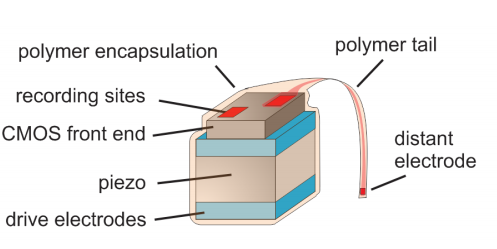
Each particle of neural dust consists of standard CMOS circuits and sensors that measure the electrical activity in neurons nearby. This is coupled to a piezoelectric material that converts ultra-high-frequency sound waves into electrical signals and vice versa.

The neural dust is interrogated by another component placed beneath the scale but powered from outside the body. This generates the ultrasound that powers the neural dust and sensors that listen out for their response, rather like an RFID system.

The system is also tetherless–the data is collected and stored outside the body for later analysis.

That gets around many of the limitations. The system
  • is lower power, 
  • can have a high spatial resolution, and 
  • it is easily portable. 
  • It is also rugged and 
  • can potentially provides a link over long periods of time. 
A major hurdle in brain-machine interfaces (BMI) is the lack of an implantable neural interface system that remains viable for a lifetime,” say Seo and co.

The difficulty is in designing and building such a system and today’s paper is a theoretical study of these challenges. First is the problem of designing and building neural dust particles on a scale of roughly 100 micrometres that can send and receive signals in the harsh, warm and noisy environment within the body.

That’s why Seo and co have chosen ultrasound to send and receive data. They calculate that the power required to use electromagnetic waves on the scale would generate a damaging amount of heat because of the amount of energy the body absorbs and the troubling signal-to-noise ratios at this scale.

By contrast, ultrasound is a much more efficient and should allow the transmission of at least 10 million times more power than electromagnetic waves at the same scale.

Next is the problem of linking the electronics to the piezoelectric system that converts ultrasound to electronic signals and vice versa. Ensuring that the system works efficiently will be tricky given that it has to be packaged in an inert polymer or insulator film (which must also expose the recording electrodes to nearby neurons).

Finally, there is the challenge of designing and building the interrogation system that generates the ultrasound to power the entire array but at a low enough power to avoid heating skull and the brain.

On top of all this is the additional challenge of implanting the neural dust particles in the cortex. Seo and co say this can probably be done by fabricating the dust particles on the tips of a fine wire array, held in place by surface tension, for example. This array would be dipped into the cortex where the dust particles become embedded.

That’s an ambitious vision that is littered with challenges beyond the state-of-the-art. However, the team has a strong background in nanoelectromechanical systems and in the interface between electronic systems and cells.

Indeed, one of the authors, Michel Maharbiz, developed the world’s first remotely controlled beetle a few years ago, a development that was named one of the top 10 emerging technologies of 2009 by Technology Review.

These guys are clearly not afraid to take on big challenges. It’ll be interesting to see how they fare.

Ref: arxiv.org/abs/1307.2196: Neural Dust: An Ultrasonic, Low Power Solution for Chronic Brain-Machine Interfaces


ORIGINAL: Technology Review
July 16, 2013

miércoles, 17 de julio de 2013

Rats Communicate Mind-to-Mind With Aid of Brain Implant

ORIGINAL: Health Line
by Rachel Barclay
July 12, 2013

A new brain-to-brain interface allows rats to directly share information and collaborate when making decisions, even from thousands of miles away.

In a groundbreaking study published earlier this year in Scientific Reports, a team of scientists has demonstrated that it's possible for a rat to transmit information directly into the brain of another rat.

In the past decade, increasingly sophisticated brain-machine interfaces have been developed to allow test animals—and more recently, human patients—to mentally control a robotic limb or move a cursor on a screen. The team, led by neurobiologist Dr. Miguel Nicolelis at the Duke University Medical Center, decided to take brain-machine interfaces to the next level.

"Our previous studies with brain-machine interfaces had convinced us that the brain was much more plastic than we had thought," Nicolelis said in a press release. "In those experiments, the brain was able to adapt easily to accept input from devices outside the body and even learn how to process invisible infrared light generated by an artificial sensor. So, the question we asked was, if the brain could assimilate signals from artificial sensors, could it also assimilate information input from sensors from a different body."

Two Bodies, One Mind

The researchers implanted pairs of rats with arrays of microelectrodes, devices a fraction of the width of a human hair, that lie directly on the surface of the brain. For each pair, one rat was dubbed the encoder; the other, the decoder. In a series of trials, the encoder rat was trained to perform a task in exchange for a sip of water, and the electrode array recorded its brain activity. Then that recorded activity was transmitted to the decoder rat’s brain, stimulating the electrodes in its brain in precisely the same pattern. By using its partner’s pattern, the decoder rat was able to make better decisions than it could on its own.

And learning went in both directions. The scientists designed the experiment so that when the decoder rat successfully performed its task, the encoder rat would receive an additional reward. Very quickly, the encoder rat learned to modify its brain activity, creating a smoother, stronger signal for its partner to read. The longer the two rats worked together, the more they altered their behavior to form a working team.

In one trial, the encoder rat was taught to pull a lever on the right or left of its cage when a light appeared over the lever, with about 95 percent accuracy. In the cage next to it, its partner, the decoder rat, was trained to pull the right or left lever, depending on a signal the scientists transmitted into its brain, with about 78 percent accuracy. Then, to test whether the encoder rat could teach the decoder rat which lever to pull, the scientists transmitted the encoder rat’s brainwaves to the decoder rat in real time.

Using the information received from the encoder rat, the decoder rat was able to pull the correct lever 70 percent of the time, far more accurately than chance would allow. When the decoder rat made a mistake, the encoder rat focused more and improved the quality of the signal it was sending to its friend. When the scientists switched the interface machine off, the decoder rat’s performance dropped back to no better than random chance.

To investigate the extent to which the two rats could align their senses, the team looked closely at the group of brain cells that processed information from the rats' whiskers. As in humans, the cells formed a “map” of the sensory input they were receiving. They found that after a period of transmitting the brain activity from the encoder rat into the decoder rat, the decoder rat's brain began to map out the encoder rat’s whiskers alongside its own.

This last finding is very promising for the advancement of prosthetics for people who have been paralyzed or suffered other nerve damage. It suggests that humans might able to not only learn to control a robotic limb, but also remap their brains to receive sensory information from the limb itself.

In the ultimate test of their technology, Nicolelis’s team decided to link together two rats in different countries. They partnered a rat in their lab in Durham, North Carolina, with a rat in a lab in Natal, Brazil. Despite thousands of miles over which the signal could degrade, the two rats were able to work together and cooperate in real time.

"So even though the animals were on different continents, with the resulting noisy transmission and signal delays, they could still communicate," said Miguel Pais-Vieira, a postdoctoral fellow and first author of the study, in a press release. "This tells us that we could create a workable network of animal brains distributed in many different locations."

Dawn of the Cyborg?

Right now, they’ve only linked two rats, but the researchers are working on building connections between groups of rats to see if they can collaborate on more complex tasks.

"We cannot even predict what kinds of emergent properties would appear when animals begin interacting as part of a brain-net,” Nicolelis said. “In theory, you could imagine that a combination of brains could provide solutions that individual brains cannot achieve by themselves."

Nicolelis’s discovery is on the vanguard of the expanding field of cybernetics. Crude structures like limbs aren’t the only robotic prostheses in development. A bionic eye was recently approved by the U.S. Food and Drug Administration (FDA).

Modern prosthetics even extend to the brain itself—a recent invention by Dr. Theodore Berger could allow one brain region to be replaced by a computer chip. In his study, Berger removed the hippocampus from rats, the brain region that allows all mammals to form new memories. Without a hippocampus, a rat cannot learn to run a maze.

In its place, he installed a chip that modeled the behavior of the hippocampus. Using the chip, the rat was able to learn to run the maze just fine; remove the chip, and the learning is gone. Whether another rat could then run the maze using the same chip remains untested, but Nicolelis’s research suggests it might be possible.

Computer-augmented and interconnectedminds have long had their place in science fiction and popular culture, but these discoveries might one day make the singularity a reality.