Mostrando entradas con la etiqueta Concept. Mostrar todas las entradas

viernes, 25 de diciembre de 2015

This Device Lets You Brew Your Own Drugs At Home

 www.fastcoexist.com
IN BRIEF
New concept technology sees a future that lets people brew their own drugs in their own home--posing numerous positive benefits and (of course) a few possible downsides.

PROTOTYPE
A machine prototype called Farma can let you manufacture your daily prescription of drugs right in your own home. Designed by MIT Media Lab graduate Will Patrick, the concept tech features a green cylinder and uses blue-green algae that’s genetically engineered to produce pharmaceutical drugs.

After the drugs are produced, the device then measures, filters, and dries it into a powder. Once in powder form, it can then be molded into pill form.
Image credit: Farma
Part of my goal of the project is to demonstrate how easy it is to build an at-home system that could ferment microbes,” says Patrick, who designed the Farma gadget during a residency at Autodesk.

Currently, opiates can already be can be brewed in a lab and Artemisinin is made using genetically engineered yeast, which makes the possibility of using synthetic biology as a way to create other drugs feasible.

While still at the very early concept stage, the artist responsible for envisioning the machine believes the technology might be feasible for widespread use in five to ten years.

IMPLICATIONS
The technical challenges lie in genetic engineering and biochemistry —engineering the organisms that can produce the drugs at useful quantities and processing and separating the drugs from the organism,” says Patrick in the release. And soon, the cost might make the tech feasible. As Patrick asserts, “The cost, tools, and knowledge required for genetically modifying organisms are all becoming more accessible. The hardware required for fermentation is fairly rudimentary in comparison.

It’s hard to guarantee that a pill brewed in your own home might meet the same quality and production standards followed by a factory; but there are also implications that large pharmaceutical organizations might want to protect their intellectual property, which means that the biggest obstacles might not be making the technology work; rather, policy and business challenges are far bigger hurdles.

While the artist believes in the potential of the technology and its benefits, he expresses apprehension regarding the possibility of the machine enabling drug addiction.

However, the concept behind it is really meant to make people realize how well synthetic biology can be incorporated into lifestyles and how it could be used to assist individuals. “My main goal with Farma is to provoke the audience to consider how this new technology should be used,” he says.


ORIGINAL: Futurism

viernes, 11 de diciembre de 2015

Computer Learns to Write Its ABCs

Photo-illustration: Danqing Wang
A new computer model can now mimic the human ability to learn new concepts from a single example instead of the hundreds or thousands of examples it takes other machine learning techniques, researchers say.

The new model learned how to write invented symbols from the animated show Futurama as well as dozens of alphabets from across the world. It also showed it could invent symbols of its own in the style of a given language
.

The researchers suggest their model could also learn other kinds of concepts, such as speech and gestures.

Although scientists have made great advances in .machine learning in recent years, people remain much better at learning new concepts than machines.

"People can learn new concepts extremely quickly, from very little data, often from only one or a few examples. You show even a young child a horse, a school bus, a skateboard, and they can get it from one example," says study co-author Joshua Tenenbaum at the Massachusetts Institute of Technology. In contrast, "standard algorithms in machine learning require tens, hundreds or even thousands of examples to perform similarly."

To shorten machine learning, researchers sought to develop a model that better mimicked human learning, which makes generalizations from very few examples of a concept. They focused on learning simple visual concepts — handwritten symbols from alphabets around the world.

"Our work has two goals: to better understand how people learn — to reverse engineer learning in the human mind — and to build machines that learn in more humanlike ways," Tenenbaum says.

Whereas standard pattern recognition algorithms represent symbols as collections of pixels or arrangements of features, the new model the researchers developed represented each symbol as a simple computer program. For instance, the letter "A" is represented by a program that generates examples of that letter stroke by stroke when the program is run. No programmer is needed during the learning process — the model generates these programs itself.

Moreover, each program is designed to generate variations of each symbol whenever the programs are run, helping it capture the way instances of such concepts might vary, such as the differences between how two people draw a letter.

"The idea for this algorithm came from a surprising finding we had while collecting a data set of handwritten characters from around the world. We found that if you ask a handful of people to draw a novel character, there is remarkable consistency in the way people draw," says study lead author Brenden Lake at New York University. "When people learn or use or interact with these novel concepts, they do not just see characters as static visual objects. Instead, people see richer structure — something like a causal model, or a sequence of pen strokes — that describe how to efficiently produce new examples of the concept."

The model also applies knowledge from previous concepts to speed learn new concepts. For instance, the model can use knowledge learned from the Latin alphabet to learn the Greek alphabet. They call their model the Bayesian program learning or BPL framework.

The researchers applied their model to more than 1,600 types of handwritten characters in 50 writing systems, including Sanskrit, Tibetan, Gujarati, Glagolitic, and even invented characters such as those from the animated series Futurama and the online game Dark Horizon. In a kind of .Turing test, scientists found that volunteers recruited via .Amazon's Mechanical Turk had difficulty distinguishing machine-written characters from human-written ones.

The scientists also had their model focus on creative tasks. They asked their system to create whole new concepts — for instance, creating a new Tibetan letter based on what it knew about letters in the Tibetan alphabet. The researchers found human volunteers rated machine-written characters on par with ones developed by humans recruited for the same task.

"We got human-level performance on this creative task," study co-author Ruslan Salakhutdinov at the University of Toronto.

Potential applications for this model could include 
  • handwriting recognition, 
  • speech recognition, 
  • gesture recognition and 
  • object recognition. 
"Ultimately we're trying to figure out how we can get systems that come closer to displaying human-like intelligence," Salakhutdinov says. "We're still very, very far from getting there, though."

The scientists detailed .their findings in the December 11 issue of the journal Science.

ORIGINAL: .IEEE Spectrum
By Charles Q. Choi
Posted 10 Dec 2015 | 20:00 GMT

jueves, 19 de marzo de 2015

Edible Growth: Healthy Snacking From Your 3D Printer

Bringing food and technology together in a nutritious alternative

 Photo: Chloé Rutzerveld
Living snack food! Imagine a healthy hors d’oeuvre, full of seeds and spores, which grows over time with a changing flavor profile. It’s nutritious, excitingly different… and freshly printed?

Dutch designer Chloé Rutzerveld has teamed up with research firm TNO to create the Edible Growth prototype.

The world of 3D printing is full of possibilities, but food printing has generally been focused on relatively simple items like burgers and pasta (not that there’s anything wrong with either of those), as well as less nutritious ingredients like sugar and dough, which can be turned into printable pastes.


Edible Growth is Rutzerveld’s healthier alternative to the pizza and chocolate snowflakes that are being printed by most other machines. Not only is it better for you, it’s also designed to be more sustainable, shortening the food production system by cutting out most packaging, minimizing storage and transportation, and removing all food waste.

Here's how it works:

  • You start with a shell. This can be printed from nuts, dried fruit or vegetables, or gelatinous agar-agar paste. For her original prototypes, Rutzerveld actually used insect flour!

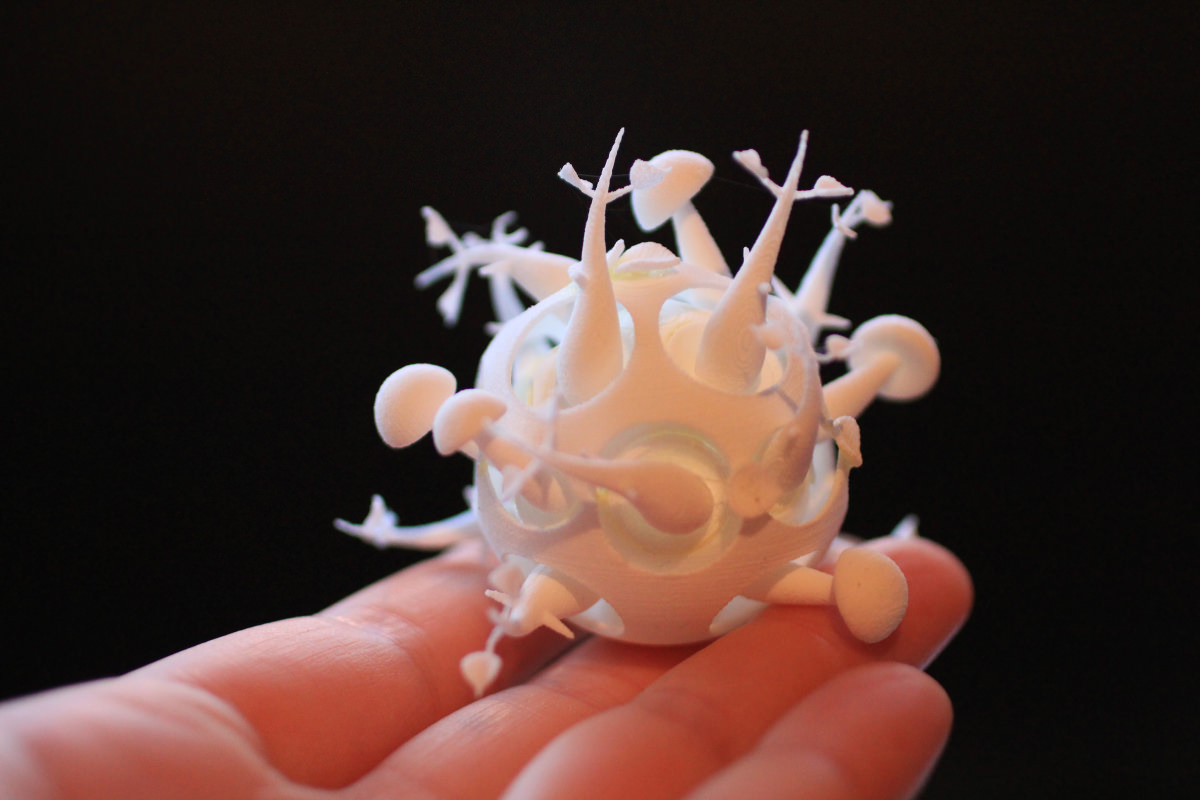
A printed nylon demo of the Edible Growth. Photo: Chloé Rutzerveld

  • This base is then infused with a variety of microorganisms: Yeast, bacteria, fungi, seeds, and spores are all available for development. These ingredients are all live cultures, in the same vein as what you’d find in good yogurt.
  • Finally, another layer of crust is added on top to create a unified structure
  • Holes are left in the upper lid to allow the internal components somewhere to grow. Theoretically, users would be able to alter the design to suit their (visual) tastes.
  • Now you just leave the snack to germinate for a few days, and 
  • then chow down once it smells good to you! The longer the spores and seeds are given to develop, the more pungent the treat will become, sort of like a plant and fungus version of maturing cheese.
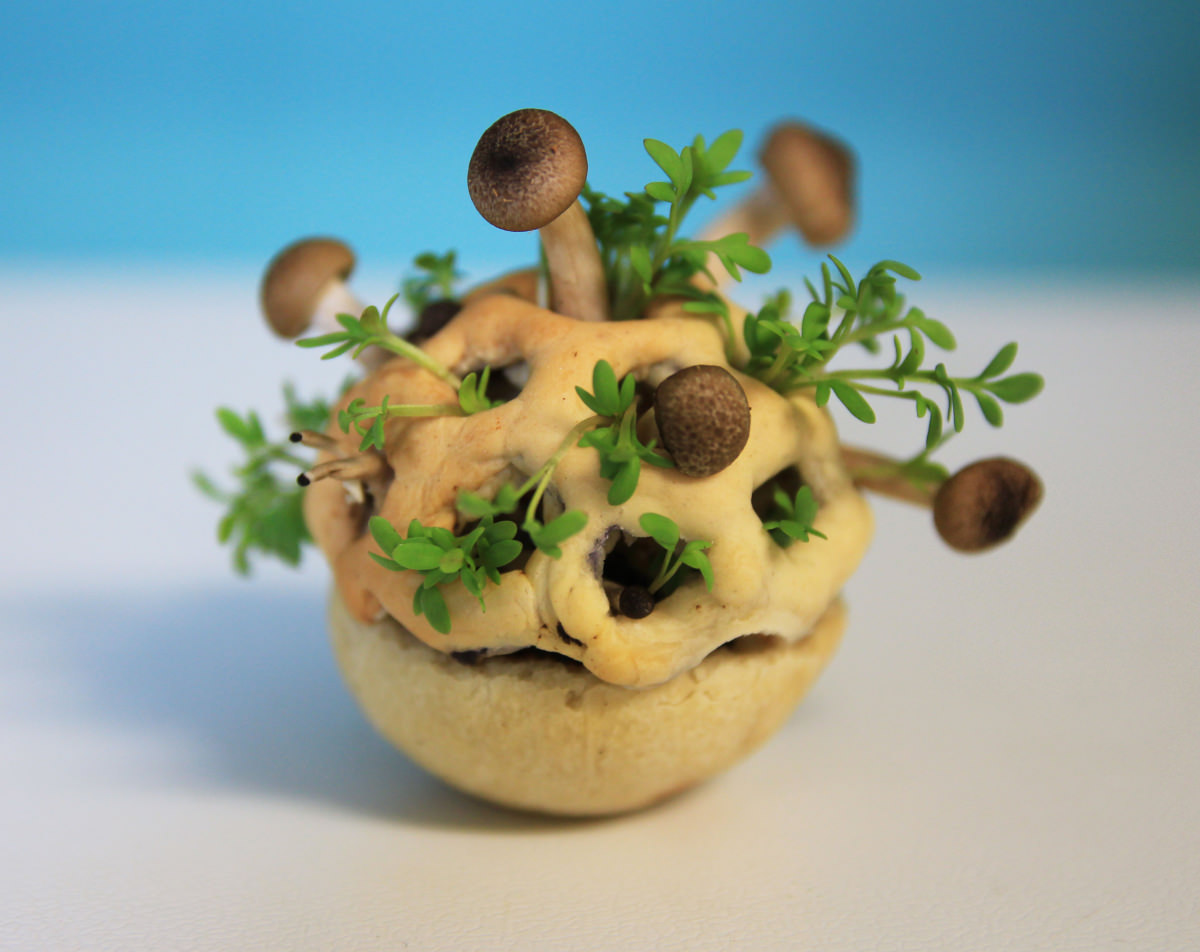
A test using sprouts that germinated in gel. Photo: Chloé Rutzerveld
A second growth test using sprouts embedded in gel. Photo: Chloé Rutzerveld
Without their caps, the Edible Growth looks like a really tiny planter pot. Photo: Chloé Rutzerveld

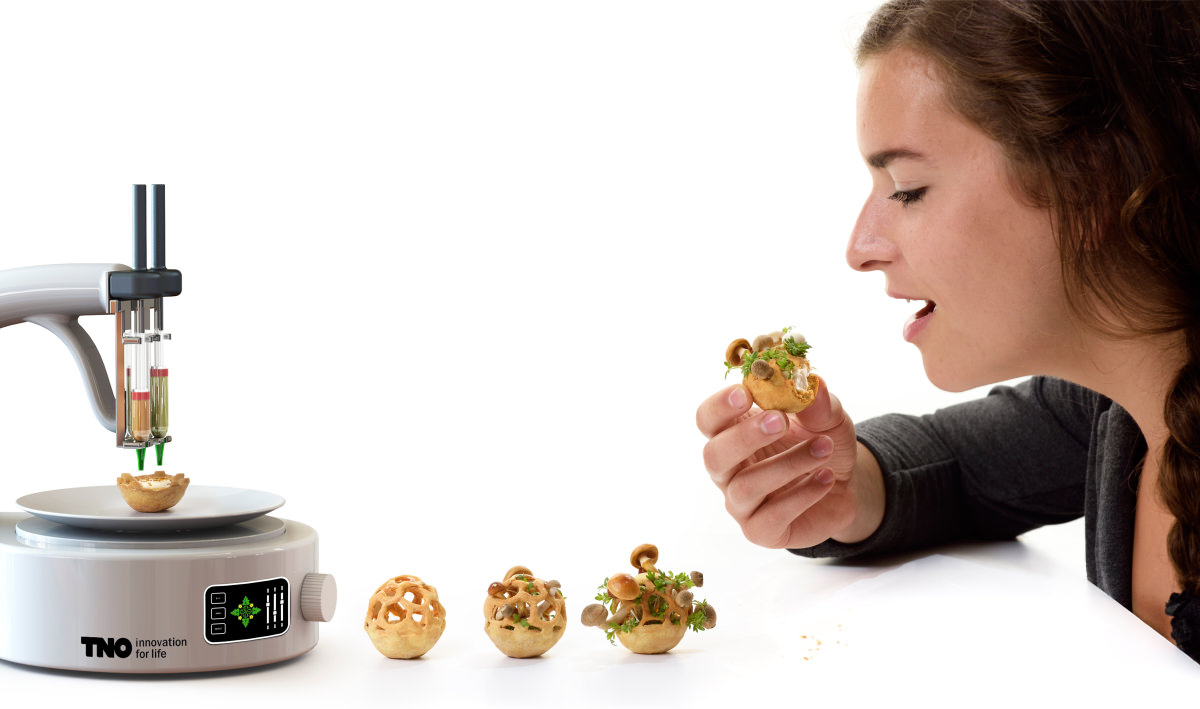
You can see the final product here in different lengths of incubation. Photo: Chloé Rutzerveld
For our more technically-oriented readers, Rutzerveld provided us with some more details: “The dough—which will not be dough in the final product—should be printed with a powder bed printer, otherwise the dome will collapse. The inside... can best be printed with FDM techniques. So a new type of printer should contain multiple printing techniques, and the software should be able to locate the organisms at very precise places so they don’t interfere with each other.

The Edible Growth in all its glory. Photo: Chloé Rutzerveld
Now, as great as this may sound, don’t start clearing cupboard space just yet. Edible Growth is still very much in the prototype phase. Rutzerveld explains that more time and money need to be invested to fine-tune the printing process, and to make the whole endeavor more practical for consumers.

Instead, she views this project as something designed to “inspire scientists, technologists, designers, and chefs... and it did! It’s an example of one possible way to create healthy food that is natural and sustainable.

There are many questions yet to answer about the Edible Growth, but one thing’s for certain: Like the world of 3D printing, the possibilities this little ball of deliciousness opens up are nigh endless.

From the printer to your mouth, here are the stages of Edible Growth. Photo: Chloé Rutzerveld

ORIGINAL: Reviewed
March 18, 2015