Mostrando entradas con la etiqueta Education. Mostrar todas las entradas

jueves, 15 de octubre de 2015

Why we need to talk about science


Image: Scientist prepares solutions for tests. REUTERS/Suzanne Plunkett
In this presidential election season, one thing is certain: candidates will rarely – if ever – be asked what they would do to keep the United States at the forefront of science and innovation.

That’s a shame.

The public dialogue about science is perhaps the most vital and most fraught national conversation not taking place in the US, and the ramifications are profound.

Ultimately, the way we address science and innovation will determine what our children learn in school, what college graduates bring to the larger world, how public lands and natural resources are cared for and whether people receive adequate health care. And the list goes on.

As the president of one of our country’s leading research university systems, I believe it is now incumbent on the academic community to ensure that the work and voices of researchers are front and center in the public square.

Calling all scientists
When the voices of scientists are not heard in the dialogue, there is a price to pay.

As Stanford University’s Charlotte DeCroes Jacobs made clear in her recent excellent biography, Jonas Salk, A Life, the fanfare brought Salk the everlasting disdain of some of his scientific colleagues, but it proved to serve the greater public good.

It is important that scientists be seen as regular people asking and answering important questions.

Our country needs more scientists who are willing and able to step out in the public arena and to weigh in, clearly and strongly – such as atmospheric physicist Veerabhadran Ramanathan of UC San Diego, who discovered the greenhouse effect of halocarbons in 1975.

Dr Ramanathan is a member of the Pontifical Academy of Sciences that influenced Pope Francis to speak out on global climate change.

We need more scientists who can explain what they are doing in language that is compelling and understandable to the public – for example, astrophysicist and Hayden Planetarium Director Neil deGrasse Tyson, whose use of television and social media earned him the US National Academy of Sciences Public Welfare medal this year for “exciting the public about the wonders of science.”

Those of us in the academic community who are not scientists should also be prepared to support public engagement by scientists, and to incorporate scientific knowledge into our public communications.

I know from conversations I have had with other higher education leaders that I am not the only one who believes this is important.

Understanding mysteries of research
Too many people in this country – and that includes some among our elected leadership – still do not understand how science works or why robust, long-range investments in research vitally matter.

The truth is in the numbers. In the 1960s, the United States devoted nearly 17% of discretionary spending to research and development, reaping decades of economic growth from this sustained investment. By 2008, the figure had fallen into the single digits. This occurs at a time when the private sector has cut back on its research investment and other nations have made significant gains in their own research capabilities.

China, for example, is projected to outspend the United States in research within the next decade. East Asia as a whole already does.

At the University of California, we pride ourselves not only on the quality of our research, but also on its contribution to improving aspects of the world we live in.

It is UC’s research, for example, that has made California among the most robust agricultural regions of the world.

To hasten the development of science from the lab bench to the market place, UC is investing our own money in our own good ideas.

This past summer, we launched the first primeUC competition, which will award US$300,000 to winning start-ups in the health sciences. And last year, our Board of Regents approved the creation of a new $250 million fund, designed to provide seed money for direct investment into student and faculty inventions.

It also is possible to have some fun in demonstrating the broad, societal significance of research.

Introducing Grad Slam
Last May, I had the opportunity to emcee the first-ever University of California system-wide Grad Slam.

The Grad Slam asked UC graduate students to take their years of academic toil and research, and present their work to an audience in just three minutes, free of jargon or technical lingo.

Think of these presentations as TED talks on steroids or the ultimate in elevator speeches. Each of our 10 campuses held a local competition, and the finals took place at our system-wide headquarters in Oakland. Several of those finalists are featured on The Conversation’s website.

While it was a fun event, the purpose was very serious.

Good, sound science depends on hypotheses, experiments and reasoned methodologies. It requires a willingness to ask new questions and try new approaches. It requires one to take risks and experience failures.

But good, sound science also requires 

  • clear explanation
  • succinct presentation and 
  • contextual understanding

Telling the story is half the battle, and Grad Slam is perfect practice.

‘An eternal guide to truth’
On the flip side, the US needs more politicians who understand science and recognize it as more than window dressing for photo ops at school science fairs or opportunities to come before the cameras in white lab coats.

Scientists, of course, should not lose their focus on conducting research in the lab or the field, sharing knowledge with their peers, and supervising the postdocs and graduate students who will serve as the scientists of tomorrow.

In today’s world, however, society will benefit from scientists who also are able to raise the profile of science in the public dialogue.

In the rim of the dome of the National Academy of Sciences, there is an inscription that reads:
To science, pilot of industry, conqueror of disease, multiplier of the harvest, explorer of the universe, revealer of nature’s laws, eternal guide to truth.

This is a fine, noble and trenchant statement of what science is all about. It is a statement that must be made to come alive in the nation’s public conscience, and in the public and political narrative.

For more than 200 years, science and research have been the source of our country’s greatest strengths, and the promise of its bright future.

Now more than ever, it is incumbent on scientists to put their knowledge on the table, and for others in the academic community to support them in that endeavor.

This article is published in collaboration with The Conversation. Publication does not imply endorsement of views by the World Economic Forum.

To keep up with the Agenda subscribe to our weekly newsletter.
Author: Janet Napolitano is the 20th president of the University of California.

Oct 14 2015

miércoles, 16 de septiembre de 2015

El juego de cartas “Mujeres de Ciencia”


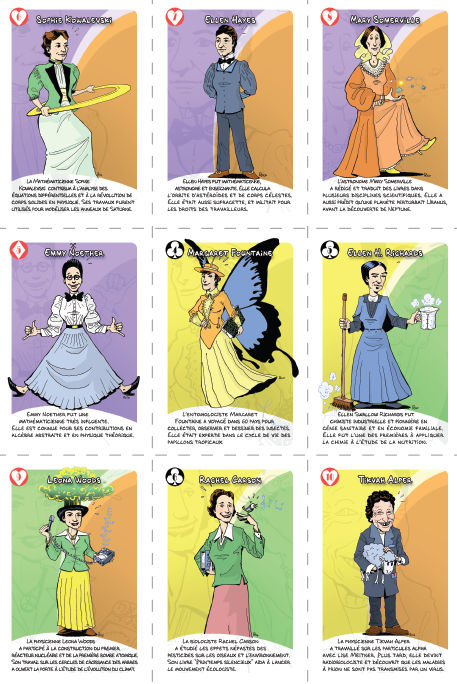
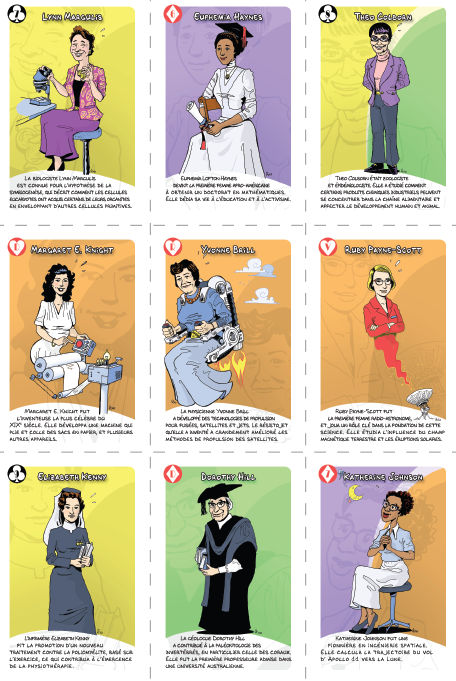
El juego de cartas Women in science presenta a 44 científicas de disciplinas variadas. La baraja –una idea de Anouk Charles y Benoît Fries– está compuesta por 52 cartas dibujadas por el artista Francis Collie.

Jugando con esta singular baraja, se puede aprender sobre las aportaciones de estas mujeres, algunas de ellas muy poco conocidas.

Además, este juego pretende ofrecer modelos tanto a chicas como a chicos, para que se animen a estudiar carreras de ciencias.

Reglas del juego
El objetivo del juego es reunir cuatro cartas del mismo color para formar un laboratorio. La primera persona que forma tres laboratorios, gana la partida. Cada jugador o jugadora recibe seis cartas. Se coloca el mazo (boca abajo) en el centro de la mesa y una primera carta boca arriba.

En cada turno, el jugador o jugadora decide coger la primera carta del mazo o la situada boca arriba, y se desprende de una carta, dejándola boca arriba en el montón de descarte.

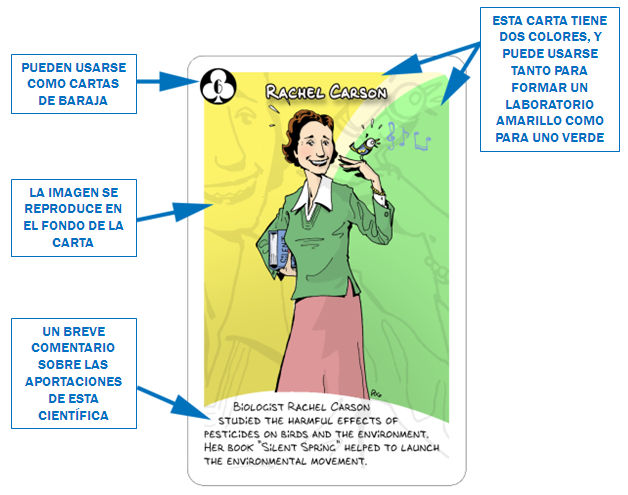
Algunas cartas tienen dos colores y pueden usarse para construir laboratorios de cualquiera de los dos colores. La carta reclutamiento permite a un jugador o jugadora coger cualquier personaje del montón de descarte. La carta prestigio permite robar dos personajes de un laboratorio adversario (se destruye el laboratorio y los personajes restantes se reenvian a la mano de su propietario). La cartaclon permite a un jugador o jugadora hacer una copia de un personaje que posee; se sitúa junto a la carta con el personaje calcado cuando se forma un laboratorio, y no pueden separarse hasta el final de la partida.

Al final de cada turno, cada jugador o jugadora sólo puede tener seis cartas en la mano, dejando las sobrantes en el montón de descarte.

Cuando se terminan las cartas del mazo en el turno de una persona, queda eliminada de la partida; sus cartas y sus laboratorios se barajan junto a las cartas del montón de descarte para formar un nuevo mazo, y el proceso vuelve a comenzar.
Imagen creada por Marta Macho Stadler a partir de ésta.

Además, las cartas pueden utilizarse para cualquier otro juego de baraja francesa (corazones, diamantes, tréboles y picas).

Los colores que permiten formar los laboratorios son cinco y representan a diferentes disciplinas de la ciencia –los laboratorios se forman con científicas que pueden colaborar entre ellas–: amarillo (enfermería, medicina, salud), fucsia (educación, psiquiatría, psicología), lila (informática, matemáticas), naranja (física, inventos) y verde (biología, geología, química).

Las científicas representadas –junto al color y el número y palo de la baraja que la identifica– son:


Corazones
1. Chien-Shiung Wu(naranja)
2. Cecilia Payne (naranja)
3. Lise Meitner (naranja)
4. Maria Telkes (verde-naranja)
5. Lillian Gilbreth (naranja-fucsia)
6. Sofia Kovalevskaya (lila-naranja)
7. Ellen Hayes (lila-naranja)
8. Mary Somerville (lila-naranja)
9. Leona Woods (verde-naranja)
10. Tikvah Alper (amarillo-naranja)
V. Ruby Payne-Scott(naranja)
D. Margaret E. Knight(naranja)
R. Yvonne Brill (naranja)

Diamantes
1. Rose Dieng-Kuntz (lila)
2. Grace Hopper (lila)
3. Dian Fossey (verde-lila)
5. Emmy Noether (lila)
6. Euphemia Haynes (lila)
7. Katherine Johnson (lila-naranja)
8. Sophie Germain (lila)
9. Ada Lovelace (lila)
10. Irène Joliot-Curie (naranja)
V. Hedy Lamarr (naranja)
D. Dorothy Hill (verde)
R. Margaret Mead (fucsia)

Tréboles
1. Tewhida Ben Sheikh(amarillo)
2. Françoise Dolto(amarillo-fucsia)
3. Rosalind Franklin(amarillo)
4. Margaret Fountaine(amarillo)
5. Ellen H. Richards(amarillo-verde)
6. Rachel Carson (amarillo-verde)
7. Lynn Margulis (amarillo-verde)
8. Theo Colborn (amarillo-verde)
9. Elizabeth Kenny(amarillo)
10. Dorothy Hodgkin(amarillo)
V. Marie Tharp (verde)
D. Inge Lehmann (verde)
R. Wangari Maathai(verde)

Picas
1 y 2. Carta ‘reclutamiento’ (Albert Einstein)
3 y 4. Carta ‘prestigio’
5, 6, 7 y 8. Carta ‘clon’
9. Karen Horney (fucsia)
10. Alice Miller (fucsia)
V. Melanie Klein (fucsia)
D. Maria Montessori (amarillo-fucsia)
R. Nettie Stevens (amarillo)

Esta baraja se puede adquirir en inglés –Women in science– y en francés –Femmes de science–.

Además, en este enlace (cartas en francés) o este enlace (cartas en inglés) se puede solicitar el envío –gratuito– de un fichero pdf para imprimir la baraja completa.


Sobre la autora
Marta Macho Stadler es doctora en matemáticas, profesora del Departamento de Matemáticas de la UPV/EHU y colaboradora en ::ZTFNews y la Cátedra de Cultura Científica de la UPV/EHU.


ORIGINAL: MujeresEnCiencia
9 septiembre, 2015

jueves, 11 de junio de 2015

Plastic to Oil, Fantastic


Blest Japan.

This video brief about the invention of a plastic-to-oil converting machine went viral and exceeded 3.7 million views on YouTube.

This is evidence that concern over “the plastic problem” is certainly not going away, despite encouraging bans on and decreases in the use of plastic shopping bags.

Here on Our World, on the video’s YouTube page and those of re-posters too, as well as on the hot Reddit Science link, the topic has generated much interest and debate amongst commenters.

Many think that this type of recycling is not a solution, but that instead the world should be seriously focused on the first “R” — which is reduce. We should shun single-use plastic (such as your average PET bottle or disposable container) altogether, they argue. The world’s oil resources are diminishing; does technology like this enable our denial of that fact, or is it a hopeful and constructive step in the right direction?

Others are doubtful of the conversion process and have concerns about pollution or toxic residue. But the machine actually
  • uses highly efficient but pretty straightforward pyrolysis
  • the plastic is fed into the pressurized oxygen-free oven and 
  • heated to 427° C (800°F), which liquefies it. 
  • The machine then converts the liquefied plastic to gas
which condenses to form a crude oil mixture of gasoline, diesel, kerosene and heavy oil.
Blest tells us that, if the proper materials are fed into the machine (i.e., polyethylene, polystyrene and polypropylene — PP, PE, PS plastics), there is no toxic substance produced and the small amount of inert char residue that may be leftover can be disposed of with regular garbage.

They also explain that while methane, ethane, propane and butane gasses are released in the process, the machine is equipped with an off-gas filter that disintegrates these gases into water and carbon.

Lastly, commentators from around the world are anxious to know if and where they can purchase a machine. Though the company still mainly produces larger, industrial-use machines, Blest Co. will be more than happy to hear from you. Please contact them directly at info@blest.co.jp.


Below is the original article, published on April 14, 2009

We are all well aware of plastic’s “rap-sheet”. It has been found guilty on many counts, including the way its production and disposal raises resource issues and lets loose extremely negative environmental impacts.

Typically made from petroleum, it is estimated that 7% of the world’s annual oil production is used to produce and manufacture plastic. That is more than the oil consumed by the entire African continent.

Plastic’s carbon footprint includes landfilling and incineration, since sadly, its recycle rate is dismally low around the globe.

Plastic trash is also polluting our oceans and washing up on beaches around the world. Tons of plastic from the US and Japan are floating in the Pacific Ocean, killing mammals and birds. Perhaps this tragedy is best captured in the TED presentation by Capt. Charles Moore of the Algalita Marine Research Foundation.

Using less, or use it better?

Thankfully, there are those who fully appreciate that plastic has a higher energy value than anything else commonly found in the waste stream. A Japanese company called Blest created a small, very safe and easy to use machine that can convert several types of plastic back into oil.

Though Japan has much improved its “effective utilization” rate over the years to 72% in 2006, that leaves 28% of plastic to be buried in landfills or burned. According to Plastic Waste Management Institute data, “effective utilization” includes not just the 20% that is actually recycled, but also 52% that is being incinerated for “energy recovery” purposes, i.e., generating heat or electric power.

If we burn the plastic, we generate toxins and a large amount of CO2. If we convert it into oil, we save CO2 and at the same time increase people’s awareness about the value of plastic garbage,” says Akinori Ito, CEO of Blest.

Blest’s conversion technology is very safe because it uses a temperature controlling electric heater rather than flame. The machines are able to process polyethylene, polystyrene and polypropylene but not PET bottles. The result is a crude gas that can fuel things like generators or stoves and, when refined, can even be pumped into a car, a boat or motorbike. One kilogram of plastic produces almost one liter of oil. To convert that amount takes about 1 kwh of electricity, which is approximately ¥20 or 20 cents’ worth.

The company makes the machines in various sizes and has 60 in place at farms, fisheries and small factories in Japan and several abroad.

Sources: Kohei Watanabe, “Waste and Sustainable Consumption” March 2005; Association of Regional Planners and Architects, Detailed Sorting and Measuring of Household Waste, Kyoto 1998.


To make a machine that anyone can use is my dream,” Ito says. “The home is the oil field of the future.

Perhaps that statement is not as crazy as it sounds, since the makeup of Japanese household waste has been found to contain over 30% plastic, most of it from packaging.

Continually honing their technology, the company is now able to sell the machines for less than before, and Ito hopes to achieve a product “that any one can buy.

Currently the smallest version, shown in the videobrief, costs ¥950,000 (US $9,500). [Note of 30 November 2010: Blest informs us that, since we visited them last year, improvements have been made to the machine and the price is now ¥1,060,000 (around US$12,700) without tax.]

Changing how we think

But it is the educational application of the small model of the machine that Ito is most passionate about. He’s taken it on planes on many occasions as part of a project that began some years ago in the Marshall Islands. There he worked with local government and schools to teach people about recycling culture and the value of discarded plastic, spreading the Japanese concept of mottainai, the idea that waste is sad and regrettable.

In such remote places, the machine also serves as a practical solution to the plastic problem, much of it left behind by tourists: the oil produced is used for tour buses or boats, Ito says.


Plastic’s carbon footprint includes landfilling and incineration, since sadly, its recycle rate is dismally low around the globe.

Teaching this at schools is the most important work that I do,” Ito reflects. In Japan too, he visits schools where he shows children, teachers and parents how to convert the packaging and drinking straws leftover from lunch.

If we were to use only the world’s plastic waste rather than oil from oil fields, CO2 emissions could be slashed dramatically, he says.

It’s a waste isn’t it?” Ito asks. “This plastic is every where in the world, and everyone throws it away.
Akinori Ito demonstrates the machine to school children, teaching them about the energy embodied in the plastics we too easily throw away.
A mountain to climb down 
The wonderful invention of plastics has spawned a huge problem that we are struggling to solve. With peak oil looming, things are set to change, but we find ourselves on top of an oil and plastic mountain, and the only way forward is down.

So while many solutions like this are not without hiccups or detractors, they are a step forward in coming to terms with our oil and plastics dependence and help raise awareness of the carbon footprint of its production and use. Somehow we all know that plastics is a habit we need to kick. But that doesn’t seem to make it any easier.

Perhaps the best thing you can do is to look more deeply into this issue. A good place to start is the 2008 Addicted to Plastic documentary from Cryptic Moth productions. You can watch the trailer online and maybe request it at your local video rental store.

According to the blurb, “the film details plastic’s path over the last 100 years and provides a wealth of expert interviews on practical and cutting edge solutions to recycling, toxicity and biodegradability.

Next it is just a matter of taking action to break our love affair with plastic.


Both the Plastic to Oil Fantastic article (by Carol Smith) and the video brief at top are licensed under a Creative Commons Attribution-NonCommercial-ShareAlike 4.0 Unported License.

PLEASE NOTE: The Plastic to Oil Fantastic video brief and any excerpt taken from it must make attribution to the source (United Nations University’s Our World Magazine) and state the conditions of the license under which it was published so that others may also share it. An example of such a note follows:

This work by United Nations University’s Our World Magazine is licensed under a Creative Commons Attribution-NonCommercial-ShareAlike 4.0 International License.

(Use the Creative Commons tool to generate appropriate variations.)


ORIGINAL:
United Nations University - Our World Magazine
Carol Smith United Nations University
2010•08•27 

jueves, 7 de mayo de 2015

A university in Sydney has just launched a game-changing ‘super lab’

Image: Andrew Worssam/UTS
Welcome to the future of science education.

The University of Technology Sydney’s (UTS) new science building has already made headlines for its green roof, six-star sustainability rating and colourful design, but down in the basement is something even more exciting - a super lab poised to revolutionise the way science is taught.

The lab is the first of its kind in Australia, and is capable of holding 220 students and 12 different classes all at once. It also looks totally different to the uni lab benches we’re used to - each work area features headphones and a computer screen, as well as a display area for demonstrators to work with students one-on-one.

The design was based on the Super Lab at the London Metropolitan University, which is touted as the most advanced science teaching facility in Europe.

According to UTS, being able to watch detailed demonstrations on screen, while students perform the experiments themselves, offers a better learning experience. And having several classes running in the lab at once also means that students can start thinking collaboratively and get an insight into the subjects they might want to take in the future.

In fact, the entire science building is set up with this collaborative approach in mind, after UTS:Science decided to get rid of its many separate schools and simply break down the faculty into the School of Life Sciences and the School of Mathematical and Physical Sciences, both of which are housed together in the new building. They hope this will help prepare their students for the real, cross-disciplinary world of science.

"Our research efforts focus on delivering impact – results that effectively tackle the problems we now face in health and the environment, and here also cross-disciplinary collaboration has a big role to play," UTS’s Dean of Science, Bruce Milthorpe, told the press. "Our two new science schools will break down old discipline silos, offering researchers and students alike the chance to broaden their experiences."


The building also features a cool-looking forensic crime scene simulation lab (complete with "dead body" mannequins) and a psychology clinic that services members of the community to give students hands-on experience. The green roof features a tree nursery and saltwater tank, where researchers can grow seagrass, algae, and saltmarsh plants, in order to understand how they store carbon dioxide.

Darren Bradley/UTS
By 2020, UTS is aiming to reduce its greenhouse gas emissions by 30 percent based on 2007 levels, while also doubling its floor space, and this building is an important first step.

Seeing as the same old lab layouts have dominated science education for the past century, we’re pretty excited that teaching is finally starting to catch up with today’s technology. And if it leads to more collaboration in science in the process, that’s a bonus.

Find out more about the new building and super lab in the video below, and check out the study options available at UTS:Science here.


ORIGINAL: Science Alert
FIONA MACDONALD
5 MAY 2015

miércoles, 6 de mayo de 2015

Andrew Ng: Why ‘Deep Learning’ Is a Mandate for Humans, Not Just Machines


If venture capital and research funding are any indication, artificial intelligence will play a leading role in shaping our future. And few tech innovators in the private or public sector have been as prominent in defining that role as Andrew Ng, chief scientist at China’s search giant Baidu. Ng has taught AI at Stanford, led the Google Brain project, founded online education pioneer Coursera, and just last year took his post at “China’s Google” in hopes of figuring out how to teach computers to see and hear, and to do that for the world’s most populous country. 

Small wonder why China represents such a huge opportunity for machine intelligence applications. 
  • Baidu is the world’s fifth most trafficked website. 
  • Shopping site Taobao
  • messaging app QQ
  • media company Sina, and 
  • microblogging platform Weibo
all Chinese properties, hold spots within the top 15. When Baidu designs an application, according to Ng, mobile comes first; cell phones are the primary channel of access for Chinese consumers

Ng is soft-spoken with an undercurrent of passion when discussing his research. Today he manages a growing team at Baidu’s U.S. campus in Sunnyvale, Calif. He does not believe all hype about the robot revolution, but says he does believe researchers are only scratching the surface of a machine’s potential. Killer robots are not his concern; he prefers to fret about a microprocessor’s run time or pushing voice recognition to a place where humans actually trust it. To him, there’s a lot of work to do. But Ng believes that there are enough good ideas and smart companies that someday soon we’ll be able to speak, rather than tap, when we want something on our smartphones. 

In a recent chat on Skype (edited for brevity and clarity), Ng outlined what he thinks is within reach—and what isn’t—for machine intelligence. 

What excites you most about the potential for AI and deep learning? 
A number of organizations, us and others, have just amazing computer vision technology, doing things that seemed impossible even a year ago. I think the struggle is figuring out the most compelling products. I don’t know that any of us have found the killer app yet. 

In Silicon Valley there are a lot of startups, using computer vision for agriculture or shopping—there are a lot for clothes shopping. At Baidu, for example, if you find a picture of a movie star, we actually use facial recognition to identify that movie star and then tell you things like their age and hobbies. If they are wearing clothing that we recognize, we can find related clothing you can buy, and we show that. That’s been pretty popular. 

Could advertisers eventually bid on the placement in relation to that image? 
We’re not doing that right now; we’re just finding related clothing. But there are a number of verticals like that—recognizing interesting people, recognizing a holiday destination and then showing other pictures of that same destination. There’s probably a potential for computer vision to do even bigger things, but I don’t think we’ve figured out what that is. 

What’s the most valid reason that we should be worried about destructive artificial intelligence? 
I think that hundreds of years from now if people invent a technology that we haven’t heard of yet, maybe a computer could turn evil. But the future is so uncertain. I don’t know what’s going to happen five years from now. The reason I say that I don’t worry about AI turning evil is the same reason I don’t worry about overpopulation on Mars. Hundreds of years from now I hope we’ve colonized Mars. But we’ve never set foot on the planet so how can we productively worry about this problem now? 

What’s it like working on AI every day? 
I think AI is akin to building a rocket ship. You need a huge engine and a lot of fuel. If you have a large engine and a tiny amount of fuel, you won’t make it to orbit. If you have a tiny engine and a ton of fuel, you can’t even lift off. To build a rocket you need a huge engine and a lot of fuel

The analogy to deep learning [one of the key processes in creating artificial intelligence] is that the rocket engine is the deep learning models and the fuel is the huge amounts of data we can feed to these algorithms

You spent time at Google—what’s your view on self-driving cars? 
I sat close to that team and I’m friends with a lot of them, so I have a sense of what they’re doing. But I was not contributing directly to them. 

I think self-driving cars are a little further out than most people think. There’s a debate about which one of two universes we’re in
  1. In the first universe it’s an incremental path to self-driving cars, meaning you have cruise control, adaptive cruise control, then self-driving cars only on the highways, and you keep adding stuff until 20 years from now you have a self-driving car. 
  2. In universe two you have one organization, maybe Carnegie Mellon or Google, that invents a self-driving car and bam! You have self-driving cars. It wasn’t available Tuesday but it’s on sale on Wednesday. 

I’m in universe one. I think there’s a lot of confusion about how easy it is to do self-driving cars. There’s a big difference between being able to drive a thousand miles, versus being able to drive anywhere. And it turns out that machine-learning technology is good at pushing performance from 90 to 99 percent accuracy. But it’s challenging to get to four nines (99.99 percent). I’ll give you this: we’re firmly on our way to being safer than a drunk driver. 

You founded Coursera and championed the value of online education programs. How do you think about the future of education? 
Our education system has succeeded so far in teaching generations to do different routine tasks. So when tractors displaced farming labor we taught the next generation to work in factories. But what we’ve never really been good at is teaching a huge number of people to do non-routine creative work. 

Do you buy the argument that the future of labor is less in peril because automation will lower the cost of goods so you will only need to work 10-20 hours a week? 

I would have said zero hours. I see a minimum living wage as a long-term solution, but I’m not sure that’s my favorite. I think society benefits if all the human race is empowered and aspiring to do great things. Giving people the skill sets to do great things will take work.

ORIGINAL: Wired
Author: Caleb Garling.

viernes, 17 de abril de 2015

5 Ways to Make STEM More Exciting For Students


Image via Flickr by Maryam
For many students, the list of subjects included in STEM – science, technology, engineering and math ­– doesn’t inspire the same level of passion and interest as other subjects. This is a shame, because many STEM careers are lucrative and the industries they’re in just keep growing.

Almost half of students expressed an interest in STEM majors and occupations, including a healthy number of female students (46%). But that expressed interest hasn’t yet translated into a diversification in who’s getting jobs in STEM. In engineering, computer, and math sciences professions women still seriously lag behind men. And racial minorities don’t fare much better.

Many people have ideas about ways STEM can be discussed and taught to interest more of the student population. For the students who see less appeal in numbers and facts than stories and ideas, STEM subjects don’t have to seem dry and lifeless. So much of how students feel about STEM depends on how they learn about it.

5 Tips for More Exciting STEM Lessons

1) Incorporate Pop Culture
Use Alice’s Adventures in Wonderland to talk about math and logic, or A Wrinkle in Time as a launching board to discuss physics. Or assign the popular podcast Star Talk, in which Neil Degrasse Tyson talks with (often famous) guests about the intersection between scientific inquiry and pop culture, taking on subjects like the science of superheroes and the zombie apocalypse.

Every year brings new big blockbusters that incorporate science and tech. What can students learn about space from Interstellar? (Google can help with that one.) Terminator can inspire a discussion about A.I., and Captain America can tie in to a lesson on the tech actually developed by the country during WWII.

Showing the role science and math play in stories and creativity can make all those students who think they only care about English and history realize that science actually has a lot going for it too.

2) Make it Relevant
For some students, the challenge of STEM is that it seems distant from the concerns of their everyday life. Brainstorm assignments that show them how they encounter STEM in their day-to-day. You could have students each research a tech advancement that saved lives or otherwise made the world better. The possibilities are seemingly endless:
  • The crops scientists developed to help us avoid world hunger.
  • The development of vaccines.
  • The invention of running water.
  • The rise in antibiotics.
  • The importance of satellites to help us see extreme weather coming.
That’s just a starter list. This site that celebrates scientist lifesavers can help you generate a few more ideas.

For a less lofty way to show science’s relevance, you could tell your students to each pick an object they encounter every day and research what goes into making it. Your iPhone doesn’t work on magic, and all sorts of everyday objects contain some kind of chemicals or minerals people never think about.

3) Get a Debate Going
Most students are taught about concepts like negative numbers as though they’re the truth, plain and simple. In fact, they were controversial and different mathematicians made impassioned arguments for and against them over many years before they became largely accepted.

How much more interesting are negative numbers to you now than they were five minutes ago?

Debate makes subjects more engaging — specially a debate that students can get riled up about on both sides.

STEM subjects bring up ample opportunities for heated debates, such as:
  • Should we fear A.I.?
  • Should animals be given human rights?
  • Was development of the nuclear bomb worth it?
  • Is technology changing how our brains work for better or worse?
  • Should money be spent going into space or helping people here on earth?
One way to get students really invested in researching a subject is to raise the stakes. Can your opinion (or the one you’re assigned to defend) stand up against someone else’s arguments?

4) Bring in Guest Experts
Whether you can get them to come into the classroom itself or instead set up a Skype call, people in STEM professions can clue students in to what those jobs look like day in and day out.

You get bonus points here for inviting successful people working in STEM fields that don’t look like the norm. Women and people of color making their mark on predominantly white and male professions will show your students that they don’t have to fit into a certain box to pursue those careers themselves. MIT has a series of videos on their website that show the experiences and insights of a diverse array of chemists. That’s the kind of thing that can help students of all types visualize themselves in a STEM career.

5) Let Student Passions Drive Their Assignments
No teacher needs to be told that every student is different. While it’s certainly not easy, working with individual students to come up with project ideas based on something they’re already passionate about can make for some real excitement.

A book lover could be assigned a seminal science fiction text and asked to do an assignment on the scientific issues explored in the book. A sports lover could be asked to analyze the math and physics behind the sport – how do angles, shapes, and distances play into creating the game they love? A photography enthusiast could be tasked with identifying and recording different plants and animals in her neighborhood.

A project that incorporates something they already love will feel more personal to each student than anything assigned to the whole class. It would give them an excuse to take ownership over their work and research in a way that will stick with them longer than many other assignments.

STEM doesn’t have to be a dry subject. Professionals and researchers are doing fascinating things in the STEM field every day. Students need a way to see that side of the story.

ORIGINAL: Edudemic
April 6, 2015 @atxcopywriter

viernes, 13 de marzo de 2015

BBC to give out one million 'Micro Bit' computers to get kids coding


It's the first year of a major new coding curriculum in the UK, and now the BBC wants to play its part in training the next generation of star programmers. The broadcaster is developing a spiritual successor to the BBC Micro, called the Micro Bit, which will give students a physical companion in their path to coding competence. It's going to be a small, standalone device with an LED display that children can carry around with them and plug into a computer to continue their work. The hardware will be basic, as the BBC calls it a "starting point" for "more complex" devices such as the Raspberry Pi and Kickstarter-funded Kano kits. The project is still in a prototype phase, but the BBC claims it'll be ready to give away one million of the new microcomputers to year 7 students this autumn.

The Micro Bit is just the tip of the BBC's new initiative, however. The organisation is developing classroom resources under its Bitesize and School Report brands, as well as a slate of events to inspire would-be coders. Under a new 'Make it Digital' campaign, the BBC is also pulling on some of its biggest TV shows, including Doctor Who, EastEnders and The One Show, to create new programming that will promote technology-fuelled creativity. BBC Three will be launching a talent show called 'Girls Can Code' and there will even be a drama about the making of Grand Theft Auto. Yes, you read that correctly. Grand Theft Auto. While some of this content will be available straight away, the BBC says it's working towards a "big audience moment" in September, when the kids go back to school.

The BBC has teamed up with a ton of companies to make all of this happen, including Google, Microsoft and Samsung, as well as Code Club, the British Computing Society and Tech City UK. At a time when the licence fee is being scrutinised yet again, such an ambitious project is a timely reminder of the BBC's public service contributions.
SOURCE: BBC
ORIGINAL: Engadget

lunes, 2 de febrero de 2015

AI Won’t End the World, But It Might Take Your Job

AI Won’t End the World, But It Might Take Your Job AI, Ethics, Jobs, Andrew NG, People2Watch, Baidu, Economy, Education,
Andrew Ng. Ariel Zambelich/WIRED

There’s been a lot of fear about the future of artificial intelligence.

Stephen Hawking
and Elon Musk worry that AI-powered computers might one day become uncontrollable super-intelligent demons. So does Bill Gates.


But Baidu chief scientist Andrew Ng—one of the world’s best-known AI researchers and a guy who’s building out what is likely one of the world’s largest applied AI projects—says we really ought to worry more about robot truck drivers than the Terminator.

In fact, he’s irritated by the discussion about scientists somehow building an apocalyptic super-intelligence. “I think it’s a distraction from the conversation about…serious issues,” Ng said at an AI conference in San Francisco last week.

Ng isn’t alone in thinking this way. A select group of AI luminaries met recently at a closed door retreat in Puerto Rico to discuss ethics and AI. WIRED interviewed some of them, and the consensus was that there are short-term and long-term AI issues to worry about. But it’s the long-term questions getting all the press.
Artificial intelligence is likely to start having an important effect on society over the next five to 10 years, according to Murray Shanahan, a professor of cognitive robotics with Imperial College, Professor of Cognitive Robotics. “It’s hard to predict exactly what’s going on,” he told WIRED a few weeks ago, “but we can be pretty sure that these technologies are going to impact and society quite a bit.

The way Ng sees it, it took the US about 200 years to switch from an agricultural economy where 90 percent of the country worked on farms, to our current economy, where the number is closer to 2 percent. The AI switchover promises to come must faster, and that could make it a bigger problem.

That’s an idea echoed in two MIT academics, Erik Brynjolfsson and Andrew McAfee, who argue that we’re entering a “second machine age,” where the accelerating rate of change brought on by digital technologies could leave millions of medium-and-low skilled workers behind.

Some AI technologies, such as the self-driving car, could be extremely disruptive, but over a much shorter period of time than the industrial revolution. There are three million truck drivers in the US, according to the American Trucking Association. What happens if self-driving vehicles put them all out of a job in a matter of years?

With recent advances in perception, the range of things that machines can do is getting a boost. Computers are better at understanding what we say and analyzing data in a way that used to be the exclusive domain of humans.

Last month, Audi’s self-driving car took WIRED’s Alex Davies for a 500 mile ride. In Cupertino, California’s Aloft Hotel a robot butler can deliver you a toothbrush. Paralegals are now finding their work performed by data-sifting computers. And just last year, Google told us about a group of workers who were doing mundane image recognition work for the search giant—jobs like figuring out the difference between telephone numbers and street addresses on building walls. Google figured out how to do this by machine, and so they’ve now moved onto other things.

Ng, who also co-founded the online learning company Coursera, says that if AI really starts taking jobs, retraining all of those workers could present a major challenge. When it comes to retraining workers, he said, “our education system has historically found it very difficult.

ORIGINAL: Wired
By Robert McMillan
02.02.15

viernes, 28 de noviembre de 2014

miniPCR: A DNA Discovery System for Everyone


 miniPCR: A DNA Discovery System for Everyone's video poster
DNA curious? Open up the world of DNA science and exploration with a portable, powerful, and affordable PCR-based DNA Discovery System

We live in a DNA world. DNA technology helps us diagnose disease, understand our ancestry and origins, establish guilt or innocence in our justice system, and test the water and food we consume every day. Yet DNA technology is still a black box for most of us.

We've created miniPCR to open the world of DNA science to everyone, everywhere.
This is the miniPCR DNA Discovery System:

Together we've reached our first Goal! Here are our Stretch Goals:

To prepare, amplify (copy), and visualize your DNA: With the DNA Family Tree kit, extract your own DNA and make so many million copies of it (in miniPCR) that you’ll see it shine before your eyes (with miniPCR visualizer).

Real-world biotech applications: Learn how DNA can be used to identify people, to detect bacteria in our food, to clone pieces of DNA from one organism into another, and more.

Learn more about the world around you: Engage in citizen science projects such as DNA barcoding, sushi-gate, detect food mislabeling, and (as you get more advanced) use PCR to characterize and discover new animals, plants, and fungi.

How DNA replication works (in our cells and in test tubes): PCR and our software will teach you how the chemistry of DNA allows our cells (and our miniPCR machines) to propagate genetic information.

The polymerase chain reaction (PCR) is at the heart of DNA analysis. PCR is a Nobel-winning technology that lets us make billions of copies of a specific piece of DNA that can be used for genetic analysis.


DNA testing and analysis kits everyone can use.

Get miniPCR for yourself, but don't forget to give one to a school.
More schools have asked for miniPCR, and we've added them!

Schools can now access a case full of DNA technology:

With the miniPCR DNA Discovery System:

  • YOU can take DNA science into your own hands, and share it with your kids.
  • OUR SCHOOLS can teach essential biotechnology and discovery.
  • EVERY LAB in the globe can have access to fundamental DNA analysis tools.

In the past few months, we have made and sold more than one hundred miniPCR machines that have been in use by scientists and students in four continents. See what miniPCR users are saying through these testimonials, and read:


You choice of:

  • The complete miniPCR DNA Discovery System (including a miniPCR Machine)
  • Or just the miniPCR machine (if you already own Pipetting Tools, Gel Electrophoresis, and Visualizer). PLUS you'll get the opportunity to donate cutting-edge DNA science to schools. 

Don't forget to add-on one or more DNA Testing Kits which contain all necessary reagents to do the labs!

The Amplyus team is led by Ezequiel (Zeke) Alvarez Saavedra and Sebastian Kraves. We met >15 years ago in college, where we shared the dream of becoming DNA scientists. Lacking access to lab tools, we learned DNA science mostly from lectures and textbooks. It wasn't ideal, but we fell in love with modern biology. After getting our PhDs at Harvard and MIT, we realized that we could create tools to give everyone access to the world of DNA science and discovery.

Amplyus is currently at the MassChallenge accelerator amidst other like-minded startups that strive to have a positive impact in our world.

Zeke Alvarez Saavedra, PhD, is a geneticist trained at MIT. His work has been cited thousands of times and profiled in The New York Times, National Public Radio and the BBC. Zeke is a patented and licensed inventor of gene-detection technologies.

Sebastian Kraves, PhD, is a molecular neurobiologist trained at Harvard. He has spent more than six years with the Boston Consulting Group addressing high-impact problems in healthcare, such as access to diagnostic technologies in Sub-Saharan Africa. Sebastian has also published on neural circuits, optogenetics, and the genetic regulation of behavior.


miniPCR comes out of the box and into the palm of your hand!

miniPCR will give you access to the full power and quality of a professional grade DNA lab instrument. If you're an experienced PCR user, you'll love its simplicity and convenience. If you're new to DNA analysis, miniPCR and its software will make it incredibly easy to learn.

  • Powerful. miniPCR delivers the same powerful genetic analysis as 10-times larger, $3,000-$10,000 instruments used by biomedical professionals. 
  • Portable. 2 x 5 x 4 inches, so you can take your science with you, or conveniently put miniPCR away when not in use.
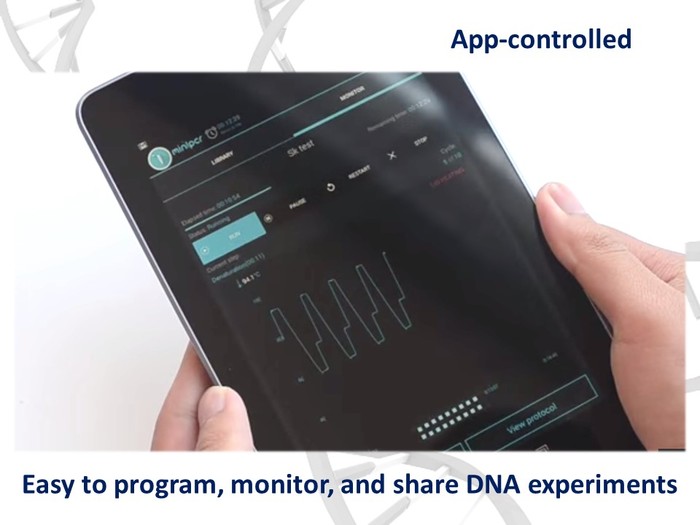
  • Simple. Easy to control directly from your Android device or Mac/Windows computer through the miniPCR app.
  • Ready to use. Requires no assembly. Simply plug into your computer, smartphone, or tablet. Or just flick it ON (miniPCR will store its program in memory).
  • Engaging. Through the app, visualize experiments and understand DNA science in real time. Through the clear case, see and understand how miniPCR works.
  • Affordable. At one-tenth the cost of commercial PCR machines, miniPCR is within the reach of homes, schools, and every lab budget.

The miniPCR software makes DNA science more intuitive. It's easy to program and monitor PCR conditions in real time, and export and share data for verification and analysis. It works on Android, MacOS, and Windows, and it's free with miniPCR.

Newcomers more easily grasp the underlying science 

Professional users enjoy the convenience of programming, storing, and monitoring experiments on their own phone or computer

To help you get up and running, we've created these DNA testing kits:

  • DNA Food Safety Lab
  • Forensic DNA Crime Lab
  • DNA Family Tree (see the schematic below)

miniPCR kits come with detailed instructions and have already been used by dozens of teachers and hundreds of students from middle school to college.

If the campaign meets our stretch goal, we will create a GMO detection lab to test whether your food has been genetically engineered.

It's 2014. More than 60 years since Watson and Crick's double helix, and more thanten since we've sequenced the human genome. Yet it's still hard to teach DNA science in our schools. Science is best learned by doing it, but biotech equipment available today is complex, expensive, and hardly education-friendly.

We're out to change that. We won't stop until every kid has access to the exciting world of biotech experimentation and the opportunities it creates.Download this brief document, and share it with your teacher, parent-teacher association, or principal to garner support to bring miniPCR to your classroom

Your pledge will help transform the landscape of science education through our technology, lesson plans, and teacher support.

Why? Just listen to Howard Goldsweig, MD, Biology teacher at The Codman Academy Public Charter School, a Boston inner city school:

PLAY


In PCR, small DNA sequences called primers search the millions or billions of letters in the genome for the target gene (or DNA region), in the same way that Google searches for a specific set of words in the World Wide Web. During PCR, that target DNA of interest is amplified or copied billions of times, in the same way that a small snippet of text can be broadcast widely using Twitter. To learn how PCR works watch the brief primer below.

PLAY

Our DNA Discovery System includes everything you'll need for steps 1, 2, and 3. We'll guide and support you if you've never done it before.

miniPCR will allow you to learn, discover, and explore in new ways:
Contribute to citizen science projects: DNA barcoding, sampling biodiversity, detecting food mislabeling, and more...

Make a billion copies of any gene from any organism

Understand more about yourself and the world around us

WHAT ELSE CAN SCIENTISTS DO WITH PCR? The range of DNA detection and modification experiments that doctors and scientists can do with PCR is virtually limitless. Copying DNA has countless applications; this wiki cites a few. PCR can be used to read genes, to detect infections (Ebola, HIV, malaria, many more), and to solve crimes. It can also just bring joy into the lives of biology nerds like us.

DISCLAIMER: We make miniPCR available to homes and schools for research and educational purposes only, and we offer it only with that intent. We believe that as more of us better understand DNA technology, society will be better equipped to make collective and individual decisions related to DNA analysis. We do not make/market/endorse miniPCR for use as a diagnostic or medical tool by laypersons, as we believe that people seeking to make medical decisions should be appropriately supported by medical professionals.

We are serious about science and education -- we love to experiment, but the last thing we’d do is experiment with you. miniPCR has gone through 10 prototypes, 3 beta versions, and one full year of validation of the final design in research labs and classrooms.
We've designed miniPCR from the ground up to make DNA science more accessible

Out of MIT, Zeke worked with a team at Templeman Automation. The team that undertook development and built the first prototype was formed by Zeke, Chris Templeman, Sean Jeffries, Cameron Dube, Dave Thomas, Randy Creasi, and Michael White. We open sourced the design. Early on the team received input from Josh Perfetto and Mac Cowell, who shared ideas and expertise. Thanks to you all!

Sebastian and Zeke decided to found Amplyus to further develop and validate the technology and bring it into manufacturing scale, making miniPCR machines available to everyone, everywhere.

We are now ready to bring miniPCR into full-scale production. Your pledge will help usset up our manufacturing operations locally in Massachusetts, creating jobs and helping lower production cost. It will also help us finalize development of our gel electrophoresis and visualization system.

The primary risk this campaign faces is the timely and efficient procurement of parts, components, and tools needed to manufacture at a larger scale. Luckily, we've spent the last year working with the same supply chain partners, getting to know them, and ensuring their quality and commitment meets ours. We are proud to be working with many local machine shops and suppliers that meet stringent specifications. That said, sourcing components can be a source of delays.

The second risk we'll face is the transition from small-batch production in our own hands to full-scale manufacturing. We've done a number of things to ensure a smooth hand-off. We have identified a local factory right here, in Massachusetts. This will allow us to work closely with our partners to get production rolling (while creating jobs!). Together, we have established standard processes, a quality control and testing plan, and we will soon run a production pilot.

The final challenge will be in working closely with our supporters to keep translating advanced concepts in DNA science into experiences accessible to a broad audience. This is the reason we started this company, and a challenge that we readily embrace.

Some may ask whether there are collateral risks with putting DNA technology into the hands of more people. Can miniPCR fall into the wrong hands and give birth to synthetic species that will colonize earth overnight? Extremely unlikely (sorry to disappoint). First off, it takes years of blood, sweat, and tears by entire teams of highly overtrained biologists to deliver any meaningful genetic transformation. Secondly, any evildoers lurking in the biosphere have access to laboratory tools already capable of doing the same genetic tricks as miniPCR (they are just much more expensive). All this said, we encourage everyone to explore biotechnology with the same spirit of exploration and curiosity that every scientist embodies. With great genetic power comes great responsibility. We believe that the greater risk lies in misinformation and ignorance, not in the dissemination of knowledge.

FAQ

ORIGINAL: Kickstarter