Mostrando entradas con la etiqueta Niños. Mostrar todas las entradas

lunes, 11 de agosto de 2014

How the Web Became Our ‘External Brain,’ and What It Means for Our Kids

Getty

Recently, my two-year-old nephew Benjamin came across a copy of Vanity Fair abandoned on the floor. His eyes scanned the glossy cover, which shone less fiercely than the iPad he is used to but had a faint luster of its own. I watched his pudgy thumb and index finger pinch together and spread apart on Bradley Cooper’s smiling mug. At last, Benjamin looked over at me, flummoxed and frustrated, as though to say, “This thing’s broken.”

Search YouTube for “baby” and “iPad” and you’ll find clips featuring one-year-olds attempting to manipulate magazine pages and television screens as though they were touch-sensitive displays. These children are one step away from assuming that such technology is a natural, spontaneous part of the material world. They’ll grow up thinking about the internet with the same nonchalance that I hold toward my toaster and teakettle. I can resist all I like, but for Benjamin’s generation resistance is moot. The revolution is already complete.

Technology Is Evolving Just Like Our DNA Does
With its theory of evolution, Charles Darwin’s The Origin of Species may have outlined, back in 1859, an idea that explains our children’s relationship with iPhones and Facebook. We are now witness to a new kind of evolution, one played out by our technologies.

Excerpted from The End of Absence: Reclaiming What We’ve Lost in a World of Constant Connection The “meme,” a term coined by evolutionary biologist Richard Dawkins in 1976, is an extension of Darwin’s Big Idea past the boundaries of genetics. A meme, put simply, is a cultural product that is copied. We humans are enamored of imitation and so become the ultimate “meme machines.” Memes—pieces of culture—copy themselves through history and enjoy a kind of evolution of their own, and they do so riding on the backs of successful genes: ours.

According to the memeticist Susan Blackmore, just as Darwinism submits that genes good at replicating will naturally become the most prevalent, technologies with a knack for replication rise to dominance. These “temes,” as she’s called these new replicators, could be copied, varied, and selected as digital information—thus establishing a new evolutionary process (and one far speedier than our genetic model). Blackmore’s work offers a fascinating explanation for why each generation seems less capable of managing solitude, and less likely to opt for technological disengagement.

YOUNG PEOPLE NOW COUNT ON THE INTERNET AS ‘THEIR EXTERNAL BRAIN’ AND HAVE BECOME SKILLFUL DECISION MAKERS—EVEN WHILE THEY ALSO ‘THIRST FOR INSTANT GRATIFICATION AND OFTEN MAKE QUICK, SHALLOW CHOICES.’

She suggests that temes are a different kind of replicator from the basic memes of everyday material culture. “Most memes . . . we forget how often we get them wrong,” Blackmore says. (Oral traditions of storytelling, for example, were characterized by constant twists in the tale.) “But with digital machines the fidelity is almost 100 percent. As it is, indeed, with our genes.” This is a startling thought: By delivering to the world technologies capable of replicating information with the same accuracy as DNA, we are playing a grand game indeed.

Old Ways of Thinking Are on the Verge of Extinction
The brains our children are born with are not substantively different from the brains our ancestors had 40,000 years ago. For all the wild variety of our cultures, personalities, and thought patterns, we’re all still operating with roughly the same three-pound lump of gray matter. But almost from day one, the allotment of neurons in those brains (and therefore the way they function) is different today from the way it was even one generation ago. Every second of your lived experience represents new connections among the roughly 86 billion neurons packed inside your brain. Children, then, can become literally incapable of thinking and feeling the way their grandparents did. A slower, less harried way of thinking may be on the verge of extinction.

In your brain, your billions of neurons are tied to each other by trillions of synapses, a portion of which are firing right now, forging (by still mysterious means) 

  • your memory of this sentence, 
  • your critique of this very notion, and 
  • your emotions as you reflect on this information. 
Our brains are so plastic that they will reengineer themselves to function optimally in whatever environment we give them. Repetition of stimuli produces a strengthening of responding neural circuits. Neglect of other stimuli will cause corresponding neural circuits to weaken. (Grannies who maintain their crossword puzzle regime knew that already.)

UCLA’s Gary Small is a pioneer of neuroplasticity research, and in 2008 he produced the first solid evidence showing that our brains are reorganized by our use of the internet. He placed a set of “internet naïve” people in MRI machines and made recordings of their brain activity while they took a stab at going online. Small then had each of them practice browsing the internet for an hour a day for a week. On returning to the MRI machine, those subjects now toted brains that lit up significantly in the frontal lobe, where there had been minimal neural activity beforehand. Neural pathways quickly develop when we give our brains new tasks, and Small had shown that this held true—over the course of just a few hours, in fact— following internet use.

WE CAN TELL THAT SOMETHING HAS CHANGED IN OUR MINDS, BUT WE STILL FEEL HELPLESS AGAINST IT, AND WE EVEN FEEL ADDICTED TO THE TECHNOLOGIES THAT ARE THAT CHANGE’S AGENTS.

“We know that technology is changing our lives. It’s also changing our brains,” he announced. On the one hand, neuroplasticity gives him great hope for the elderly. “It’s not just some linear trajectory with older brains getting weaker,” he told me. The flip side of all this, though, is that young brains may be more equipped to deal with digital reality than with the decidedly less flashy reality that makes up our dirty, sometimes boring, material world.

In The Shallows, Nicholas Carr describes how the internet fundamentally works on our plastic minds to make them more capable of shallow thinking and less capable of deep thinking. After enough time in front of our screens, we learn to absorb more information less effectively, skip the bottom half of paragraphs, shift focus constantly; “the brighter the software, the dimmer the user,” he suggests at one point.

Kids These Days Can Think Quickly—But Not Deeply
The most startling example of our brain’s malleability, though, comes from new research by neural engineers at Boston University who now suggest that our children will be able to “incept” a person “to acquire new learning, skills, or memory, or possibly restore skills or knowledge that has been damaged through accident, disease, or aging, without a person’s awareness of what is learned or memorized.” The team was able to use decoded functional magnetic resonance imaging (fMRI) to modify in highly specific ways the brain activity in the visual cortex of their human subjects.

The possibilities of such injections of “unearned” learning are as marvelous as they are quagmires for bioethical debate. Your grandchild’s brain could be trained in a certain direction while watching ads through digital contact lenses without his or her awareness (or, for that matter, acquiescence). For now, it’s easier to tell that something has changed in our minds, but we still feel helpless against it, and we even feel addicted to the technologies that are that change’s agents. But will our children feel the static?

SOME ARGUE THAT THE YOUNG ARE DEVELOPING NEW SKILLS BETTER SUITED TO THEIR OWN REALITY THAN TO AN OUTMODED PAST.

In 2012, Elon University worked with the Pew Internet and American Life Project to release a report that compiled the opinions of 1,021 critics, experts, and stakeholders, asking for their thoughts on digital natives. Their boiled-down message was that young people now count on the internet as “their external brain” and have become skillful decision makers—even while they also “thirst for instant gratification and often make quick, shallow choices.”

Some of those experts were optimistic about the future brains of the young. Susan Price, CEO and chief Web strategist at San Antonio’s Firecat Studio, suggested that “those who bemoan the perceived decline in deep thinking . . . fail to appreciate the need to evolve our processes and behaviors to suit the new realities and opportunities.” Price promises that the young are developing new skills and standards better suited to their own reality than to the outmoded reality of, say, 1992. Meanwhile, the report’s coauthor, Janna Anderson, noted that while many respondents were enthusiastic about the future of such minds, there was a clear dissenting voice: “Some said they are already witnessing deficiencies in young people’s abilities to focus their attention, be patient and think deeply. Some experts expressed concerns that trends are leading to a future in which most people become shallow consumers of information, endangering society.”

We may be on our way to becoming servants to the evolution of our own technologies. The power shifts very quickly from the spark of human intention to the absorption of human will by a technology that seems to have intentions of its own.

But we’ll likely find there was no robotic villain behind the curtain. Our own capitalist drive pushes these technologies to evolve. We push the technology down an evolutionary path that results in the most addictive possible outcome. Yet even as we do this, it doesn’t feel as though we have any control. It feels, instead, like a destined outcome—a fate.

Excerpted from The End of Absence: Reclaiming What We’ve Lost in a World of Constant Connection by Michael Harris, in agreement with Current, an imprint of Penguin Random House. Copyright (c) Michael Harris, 2014.

Editor: Samantha Oltman (@samoltman)

ORIGINAL: Wired
BY MICHAEL HARRIS 
08.06.14
Michael Harris
Michael Harris is a contributing editor at Western Living andVancouver magazine. His award-winning writing appears regularly in publications such as The Huffington Post and The Walrus. He is the author of The End of Absence and lives in Toronto, Canada.

lunes, 14 de julio de 2014

Todos Los Niños Nacen Genios, Pero Son Aplastados Por La Sociedad Y La Educación

ORIGINAL: UPSOCL
Por Francisco Lira

En esta entrevista el físico teórico Michio Kaku, cuenta una historia sobre una desgarradora pregunta que su hija le hizo. Según Michio, todos los niños nacen genios hasta que la sociedad aplasta el espíritu científico y presenta una simple hipótesis de por qué a los niños no les gusta la ciencia.¡Todos sabemos que la magia se perdió en algún momento de nuestra niñez!

martes, 8 de abril de 2014

Stress alters children's genomes

Poverty and unstable family environments shorten chromosome-protecting telomeres in nine-year-olds.

Pasieka/Science Photo Library Telomeres (shown in red) protect the ends of chromosomes from fraying over time.

Growing up in a stressful social environment leaves lasting marks on young chromosomes, a study of African American boys has revealed. Telomeres, repetitive DNA sequences that protect the ends of chromosomes from fraying over time, are shorter in children from poor and unstable homes than in children from more nurturing families.

When researchers examined the DNA of 40 boys from major US cities at age 9, they found that the telomeres of children from harsh home environments were 19% shorter than those of children from advantaged backgrounds. The length of telomeres is often considered to be a biomarker of chronic stress.

The study, published today in the Proceedings of the National Academy of Sciences1, brings researchers closer to understanding how social conditions in childhood can influence long-term health, says Elissa Epel, a health psychologist at the University of California, San Francisco, who was not involved in the research.

Participants’ DNA samples and socio-economic data were collected as part of the Fragile Families and Child Wellbeing Study, an effort funded by the US National Institutes of Health to track nearly 5,000 children, the majority of whom were born to unmarried parents in large US cities in 1998–2000. Children's environments were rated on the basis of their mother's level of education; the ratio of a family’s income to needs; harsh parenting; and whether family structure was stable, says lead author Daniel Notterman, a molecular biologist at Pennsylvania State University in Hershey.

The telomeres of boys whose mothers had a high-school diploma were 32% longer compared with those of boys whose mothers had not finished high school. Children who came from stable families had telomeres that were 40% longer than those of children who had experienced many changes in family structure, such as a parent with multiple partners.

Genetic links
The link between stressful home environments and telomere length is moderated by genetic variants in pathways that process two chemical transmitters in the brain, serotonin and dopamine, the study found. Previous studies have correlated variants in some of the genes studied, such as TPH2, with depression, bipolar disorder and other mental-health issues. Variants of another gene, 5-HTT, reduce the amount of the protein that recycles serotonin in nerve synapses. Some alleles of these genes are thought to increase the sensitivity of carriers to external risks.

Related stories


In the latest study, the researchers found that the 'sensitizing' variants of these genes protected telomeres in children from nurturing environments, and caused greater telomere damage in children from disadvantaged homes. Those who lacked these alleles had little difference in their telomeres, regardless of living conditions.

But boys with more than two sensitizing alleles were strongly influenced by their home environments. They had the shortest telomeres in stressful homes, and the longest telomeres in advantaged environments. Although these variants were known to influence chemical responses to stress in the brain, they were not previously linked to telomere length, says Notterman.

The team plans to expand its analysis to approximately 2,500 children and their mothers to see if these preliminary findings hold. However, because the effects of stress are tangible by the age of 9, Notterman suggests that early intervention practices may help to moderate the effects of adversity on children’s health.

“This was a small study testing a big theory,” says Epel. “It is a first but important step in understanding how social disparities get under the skin to affect lifelong health.”Nature doi:10.1038/nature.2014.14997

References
Mitchell, C. et al. Proc. Natl. Acad. Sci. USA http://dx.doi.org/10.1073/pnas.1404293111 (2014).
Show context

Related stories and links
From nature.com

From elsewhere

ORIGINAL: Nature
07 April 2014


lunes, 3 de febrero de 2014

Passion-Based Learning


There is lots of talk about the science, technology, engineering and math (STEM) pipeline and all of its leaks. My personal mission is to fill the STEM pipeline with so many children that it bursts. To do this, STEM must be taught in an inspiring way. To keep children engaged, we need to bring passion for learning back into the classroom.

Passion is hot. It is a force that sells movies and margarine and everything in between. It is a force the can move mountains, inspire art and make the weak strong. We need to bring passion back into learning, in teaching and all around.

Passion motivates. It makes a way out of no way. It allows students to overcome hardships to achieve a goal that is meaningful to them.

When writing my recent book for TED, Save Our Science, I learned about the alphabet soup of instructional strategies out there, with the common theme of enticing and engaging learning. Let's name a few of these pedagogies: there is
  • inquiry-based, 
  • project-based, 
  • design-based and 
  • problem-based learning, 
for example. Each of these methods has a central theme buried under all that jargon. If we were to compare the learning process to fishing, we want to draw students in (with the worm) and keep them engaged (with the hook). These pedagogies provide the motivation and the momentum using different approaches.

You can hook a student's attention if
  • they get their hands dirty (inquiry-based learning); 
  • have learning interactions with other students (project- and problem-based learning); or 
  • need to perform a specific task (problem- and design-based learning). 
All these methods are ways -- with their direct discovery, problem-solving, hands-on learning and collaborative methods -- used to keep the embers of passion for learning alive. A love of learning is a key skill for the 21st century. (See Figure 1)

The Power of Passion There are two ways to get a child passionate about something:
  • Find out what each child is innately passionate about.
  • Be an instructor that exudes passion for the topic, and infect your students with that excitement.
Only a few of us have benefited from the first option, but all of us can benefit from the second one. That is the power of passion.
Figure 1. Passion for learning is the key pedagogy to prepare for 21st century challenges. Credit: Ainissa Ramirez
I've witnessed this in my own journey. I met a graduate student working in a very esoteric (read: boring) scientific field that uses magnetism to determine the properties of atoms. It was a foreign technique that was equivalent to watching paint dry, but she gave an enthusiastic presentation. I later asked her how she got involved with this topic. She replied that she had a professor who loved this field, and his passion was contagious. His legacy was a group of students who loved this topic, too. That is the power of passion; it can make what was once dull now desirable.

Now, we must be careful when we talk about passion and making topics interesting. Lots of instructors and teachers feel that they are passionate about what they teach. They will launch into a lesson from the deep end of the pool. Too often professors, teachers and instructors who have been teaching a subject for some time cannot engage a beginner, because they have forgotten how life was before knowing what they know. In teaching, you must have a beginner's mind. And you must ask, "How does this look to someone if they are seeing this for the first time?" Help your students into the shallow end of the pool and bring them to the deeper end. Teach with passion and with patience.

Vulnerability and the Inner Geek

Show students why you love the topic. Be vulnerable and show them the human side of knowing this new thing. To teach well, teachers must go back to the stage of vulnerability and put themselves in the shoes of a student who is learning the material for the first time. Students respond to vulnerability. It shows that you are "with them."

Now, I must be clear: vulnerability does not mean a loss of power. We must decouple that in our minds -- being vulnerable can be a source of power. (I would suggest you read the work of Brené Brown for proof). We are all from an age where knowing is related to our self-worth. No one can know everything! So we've got to have a new posture with knowledge, especially in this age where the rate of information creation is exponential. In this age of Google, the human element still has a market on engagement; there isn't an algorithm for passion (yet).

Be a passion-based teacher. Take on a new learning posture with your students by presenting a story behind the topic you are teaching, or by showing its beauty, or by delighting in the topic. Get in touch with your inner geek. When you do that, you give students permission to do the same. Remember that the word pedagogy comes from the Greek root, which means "to lead the child."

Everyone is a geek for something; everyone has passion for something. Make that something learning. Infect your students with passion, and they'll never be able to contain it again. Release your passion!


ORIGINAL: Edutopia
April 2, 2013

sábado, 25 de enero de 2014

STRAWBEES - dream BIG, build BIGGER!


Strawbees, a fantastic prototyping toy for makers of all ages. Build huge mechanical objects from standard straws and cardboard!


Strawbees is a construction kit based on one simple unit that lets you connect straws to each other. You stick a Strawbee into the ends of a standard quarter inch (6mm) straw to make struts and then connect them with another Strawbee.

It's a wonderful system for trial and error construction and allows you to do a lot of things impossible with other systems.

With the Strawbees you can build everything from mathematical shapes like the platonic solids to mechanical birds, claws, or even huge animated snakes.

Just come up with an idea and start building, or simply start building and see where you end up. With the Strawbees you can always modify things as you go, add straws, cut straws, or add new connections to get a stronger, more flexible or bigger construction.

The claw above is made by searching for crabs claws on Youtube and image search on Google. That was enough to reverse engineer a claw with the strong muscle being a human hand and a rubber band for the weak opening action muscle.

Besides connecting straws the Strawbees can be used to connect cardboard. This means you can build large scale mechanical objects from cardboard with the same pieces you use for the straws.


These kickstarter kits are in an early stage and will not feature any instructions, instead we are going to post instruction videos on already available video sharing and instruction platforms. But the best part is that you don't really need any instructions to get started, just look at a mechanical object and try to reverse engineer it. We can't wait to see what you build!


The Strawbees act as a pivot point and as a connector to join straws. Take a quarter inch straw, add Strawbees to make a strut. Continue adding Strawbees to get as many legs as you want in the vertices.


Connecting cardboard is as easy as connecting straws, just make a hole with a regular pencil and then join them with Strawbees. If you run out of straws, you can always find some cardboard to build huge objects with. The standard Strawbees connects two normal layers of cardboard, but maybe you can figure out a way around this.
 
A lot of food chains seem to provide excellent Strawbees Construction Tubes!


We have let kids from the age of five play with the strawbees and have found it suitable not only for them but for makers, engineers and creatives of all ages and fields.

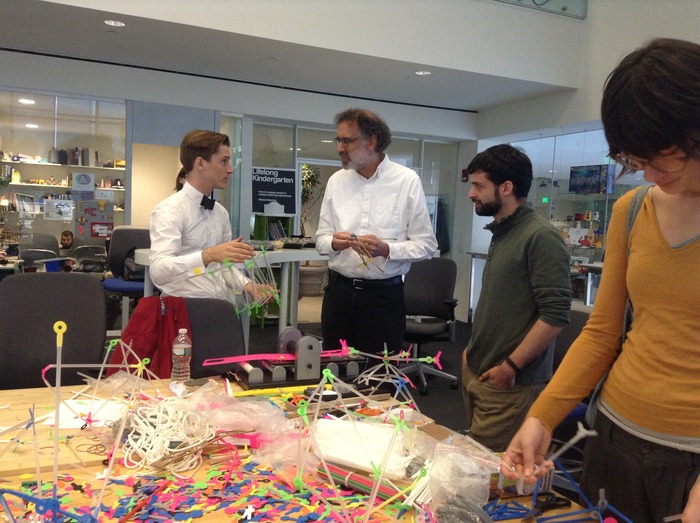
Actually it seems to appeal to anyone who wants to build big flexible structures, and who doesn't? We had a great time at M.I.T. where we had an afternoon workshop full of open ended construction play.

Strawbees are great for imaginative play, why not make a strange dog shaped thing? Or go high tech and construct a flex sensor controlled mechanical finger?

All pieces are connected with strawbees, even the servo and lever. There are always many different of ways of achieving the same thing and it's a truly open ended construction kit. It is also very hackable as you can modify the connector with a regular pair of scissors.

This combination of flexibility and iterative construction makes Strawbees perfect for fun and engaging STEM education activities at any level, from preschool to university engineering studies of both statics and dynamics. One feature for the higher studies is that the straws are weak enough that they bend under pressure, which makes it possible to visually inspect structures you have built to see how the applied load is distributed up until the breaking point. We think science education should be fun and believe this system really allows you to play your way to knowledge.

We are also co-founders of the global initiative www.kidshackday.com where we combine programming with construction activities and the Strawbees offer a great way to get things out of the computer into the real world in a large scale. The constructions are so light weight that a simple micro servo is enough to control even the biggest structures.


To help us get this out to more people, and let you get your hands on them before everyone else wee have devised the following fantastic pre-launch Strawbee kit rewards. The retail version of Strawbees will not be available until this fall, so be part of the beginning of this new toy and help us make it even better with your creations!

NOTE: WORLDWIDE SHIPPING INCLUDED IN KIT PRiCES!
(except for Infinite Kit and workshops)


When we designed the Strawbees, we didn’t really know exactly what we were doing. It was when our DIY clothespin was used as a construction toy by kids in India we figured that maybe we should try designing a real construction toy.

Our goal was to make a connector everyone could afford that could be made using commonly available scrap materials and preferably in one of our manual die cutting machines from Accucut.

One day at a public workshop at the Science Center Universeum in Gothenburg the organizers asked us if maybe we could come up with something smarter than the fragile connectors they had been using for some maths activities, a fully proprietary system with proprietary straws. That's when we started playing with regular straws, and found that the quarter inch straw is one of the most common dimensions.

All of a sudden this little thing appeared and after some tweaking we had developed what seemed to be the lowest common denominator for the joints of most polygon structures. We had to try building a geodesic dome.

Since then we have been trying it out inhouse, modifying it a couple of times and we have made four different tools and thousands of prototypes.

We have done test runs at five schools here in Sweden and more than five science centers around the world to make sure it works.
 
Built by a nine-year-old at Oslo maker fair. Note the visible stress in the lower pyramids!

We have also tried the Strawbees at public workshops and visited NY Maker Faire where we got a lot of positive reactions but most importantly young maker Chris Hodges came up with the brilliant name. A lot of people wanted to get their hands on them, but we weren't ready back then. Now we feel it's time to let it out into the world. We need your help!

To make this into the toy we want it to be, an open source construction kit available to all kids, we need your help.


First we need help to cover the costs of a large scale production, with big expensive tools, both for the Strawbees and also for a nice toy store worthy packaging.


The second and even more important reason is that we want to involve you in making and spreading construction ideas. We feel this is only possible if we keep a toy open. At the same time an open hardware project in the toy industry as simple as the Strawbee is much harder to finance so we figured why not team up with you from the beginning!


Our goal with the Strawbees is an online evolution of ideas and constructions where users build on or better each others ideas. Having this in mind, what better users to start with than the people on Kickstarter?


A stretch goal if the project gets successfully funded would be to have a part of the site featuring an evolution tree where we can post videos/instructions into a hierarchy so we can follow the development of ideas through time. If you know how to achieve a site such as this and feel inspired you are very welcome to contact us!


During the kickstarter we will develop the prototype packaging to suit the production sheets of Strawbees. Production tools will be ordered immediately after a finished kickstarter ends and we will get the production set up for when they arrive. We will pack & ship continuously during the production so shipping will be spread throughout April.


Risks and challenges Learn about accountability on Kickstarter

We have a couple of successful product launches behind us such as www.ass-savers.com but are still a struggling startup team and have never attempted to get into the very tricky business of making educational toys so we have some issues to address.

We are confident about reaching the march launch with a custom prototype packaging, but the big organization that is needed for instructions and a massive world wide launch is not there.

We have three years experience with production in PP sheets so we have most of the production chain sorted out already, the only challenge is to get as many pieces per sheet as possible but still have the machines cut trough cleanly. Worst case scenario is having to modify the tool to suit the machine we use which could delay us up to a week, but it would still allow shipping within the set schedule.

The second issue is to be able to pack & ship the product efficiently, which really is the biggest unknown and affects the total amount of pieces in a kit. Hopefully we have done our research and sorted this out, but it's the first time we are doing this many pieces per kit so we are on our toes ready for tweaking this process.

ORIGINAL: Kicstarter

martes, 16 de julio de 2013

Computer as Smart as a 4-Year-Old? Researchers IQ Test New Artificial Intelligence System

ORIGINAL: ScienceDaily

Artificial and natural knowledge researchers IQ-tested one of the best available artificial intelligence systems and learned that it's about as smart as the average 4-year-old. (Credit: © Spofi / Fotolia)

July 15, 2013 — Artificial and natural knowledge researchers at the University of Illinois at Chicago have IQ-tested one of the best available artificial intelligence systems to see how intelligent it really is.

Turns out it's about as smart as the average 4-year-old, they will report July 17 at the U.S. Artificial Intelligence Conference in Bellevue, Wash.

The UIC team put ConceptNet 4 (Currently ConceptNet5.1), an artificial intelligence system developed at M.I.T., through the verbal portions of the Weschsler Preschool and Primary Scale of Intelligence Test, a standard IQ assessment for young children.

They found ConceptNet 4 has the average IQ of a young child. But unlike most children, the machine's scores were very uneven across different portions of the test.

"If a child had scores that varied this much, it might be a symptom that something was wrong," said Robert Sloan, professor and head of computer science at UIC, and lead author on the study.

Sloan said ConceptNet 4 did very well on a test of vocabulary and on a test of its ability to recognize similarities.

"But ConceptNet 4 did dramatically worse than average on comprehension­the 'why' questions," he said.

One of the hardest problems in building an artificial intelligence, Sloan said, is devising a computer program that can make sound and prudent judgment based on a simple perception of the situation or facts-the dictionary definition of commonsense.

Commonsense has eluded AI engineers because it requires both a very large collection of facts and what Sloan calls implicit facts-things so obvious that we don't know we know them. A computer may know the temperature at which water freezes, but we know that ice is cold.

"All of us know a huge number of things," said Sloan. "As babies, we crawled around and yanked on things and learned that things fall. We yanked on other things and learned that dogs and cats don't appreciate having their tails pulled." Life is a rich learning environment.

"We're still very far from programs with commonsense-AI that can answer comprehension questions with the skill of a child of 8," said Sloan. He and his colleagues hope the study will help to focus attention on the "hard spots" in AI research.

Study coauthors are UIC professors Stellan Ohlsson of psychology and Gyorgy Turan of mathematics, statistics and computer science; and UIC mathematical computer science undergraduate student Aaron Urasky.

The study was supported by award N00014-09-1-0125 from the Office of Naval Research and grant CCF-0916708 from the National Science Foundation.

jueves, 28 de marzo de 2013

La colombiana encargada de los "Ferrari" de la NASA

ORIGINAL: BBC
Thomas Sparrow BBC Mundo, Washington
26 de marzo de 2013


Utilizar un reproductor alternativo

Entre risas, Adriana Ocampo Uria dice que ella trabaja con los "Ferrari del Sistema Solar".

Nacida en Colombia pero criada en Argentina, Ocampo es responsable del programa Nuevas Fronteras en la agencia espacial estadounidense NASA, que coordina las sondas robóticas que viajan a toda velocidad hacia el gigante Júpiter y el enano Plutón.

Contenido relacionado

En fotos: el espectáculo de la conjunción de Venus y Júpiter
Más evidencia de agua en el sistema solar
Descubren un planeta de diamante

¿El objetivo? Acercarse lo más posible a estos cuerpos para resolver los misterios sobre su composición y sus características.

Además de trabajar en estas exploraciones planetarias, Ocampo tiene un rol mucho más terrenal: cuando no está pensando en los confines del Sistema Solar responde algunas de las cartas que los niños envían a la NASA con sus sueños.

BBC Mundo visitó a esta geóloga planetaria de 58 años en la sede central de la agencia espacial en Washington para conocer su trabajo.

clicEn fotos: Juno a la conquista de Júpiter
La nave espacial Juno tiene previsto su lanzamiento el próximo viernes 5 de agosto desde la base de Cabo Cañaveral en Florida. Juno partirá rumbo a Júpiter para explorar los misterios del planeta y comprender mejor el proceso de formación del Sistema Solar. "La historia de nuestro planeta reside en Júpiter", el sitio dedicado a la misión interplanetaria. Se espera que llegue a Júpiter en julio de 2016.

"Perspectiva desconocida"

El primer Ferrari que 'maneja' Adriana Ocampo se llama Juno, está impulsado por paneles solares y se mueve tan rápido que podría viajar de Los Ángeles a Nueva York en dos minutos.

Su recorrido total durante cinco años será de 2.800 millones de kilómetros hasta que llegue a Júpiter, un coloso de gas y una estrella fallida que ha fascinando a los astrónomos durante siglos, pero que todavía guarda el secreto sobre su formación.

Ocampo le explica a BBC Mundo que el Ferrari llegará al gigante en 2016, lo orbitará y penetrará su densa atmósfera, lo que les dará a los científicos "una perspectiva antes desconocida de lo que es ese planeta".

Y esa perspectiva es clave, en opinión de la NASA.

Así partió Juno a Júpiter en 2011


Utilizar un reproductor alternativo

Como la atmósfera de Júpiter tiene una composición similar a la del Sol, se cree que se formó temprano. Descubrir los detalles de su evolución les ayudaría a los científicos a entender el rol que han jugado titanes como Júpiter en la organización del Sistema Solar.

Ocampo explica que Júpiter también puede tener una de las claves sobre la formación de la vida.

Juno tratará de revelar la estructura interior del planeta para ver cómo influye en sus lunas, especialmente una de las más intrigantes, Europa.

Ésta, explica Ocampo, quizá contenga los tres ingredientes claves para la vida: agua líquida, material orgánico y una fuente de energía, que es la emitida por su planeta (ver video a la derecha).

Pero Ocampo no sólo está interesada en Júpiter y sus lunas.

No contenta con un Ferrari espacial, esta astrónoma colombiana también se encarga de otro: uno un poco más viejo que Juno, apenas del tamaño de un piano, pero que viajará incluso más lejos.

Se trata de la sonda Nuevos Horizontes, que se dirige hacia el mundo helado de Plutón.

Cuando fue lanzada en 2006, la NASA dijo que el conocimiento de ese planeta era tan limitado que podía caber "en la parte de atrás de una estampilla".

Los tiempos han cambiado. Plutón ya no es considerado un planeta y tiene varias lunas más de las que se creía.

El propósito de la misión, eso sí, sigue vigente: Nuevos Horizontes ya llegó a la mitad de su recorrido, cruzando en el proceso las lunas de Júpiter, y está previsto que pase por Plutón a mediados de 2015 para buscar estructuras geológicas, averiguar detalles sobre su atmósfera y analizar su superficie.

Mientras Juno y Nuevos Horizontes llegan a sus respectivos destinos y empiezan a emitir sus hallazgos, Adriana Ocampo se dedica también a una labor más terrenal: hablarles a los niños de su experiencia.

"Sueños rodantes por el Cosmos"
Cuando BBC Mundo le pregunta de dónde surgió su interés por las ciencias espaciales, Ocampo no duda en afirmar que fue "como un llamado de las estrellas".

Cuenta que cuando era una niña salía en las noches a la terraza de su casa, siempre acompañada de su perro Tauro, y se preguntaba por esos "puntitos de luz que veía en el cielo".

Intrigada por lo que podía estar más allá, decidió escribirle una carta a la NASA en español y ante su sorpresa, recibió una respuesta.

Sueños espaciales infantiles

"Fue extraordinario por el impacto que tuvo en mí que alguien escuchara mi llamado y mi interés", cuenta. "Es algo que te marca".

Por eso hoy, cuando ya cumplió su sueño, intenta fomentar el de otros.

Además de escribir un libro en español para niños sobre "la reina Gravedad y el rey Masa", también se encarga de responder algunas de las cartas infantiles que llegan a la NASA.

Uno de los proyectos en los que está involucrada se llama Huele a Sueños, creado por un grupo de niños de 11 y 12 años en Medellín, Colombia, que se apasionaron por la astronomía tras ver una película basada en la obra de Carl Sagan (ver galería a la derecha).

Ocampo no sólo les ha explicado a estos niños su trabajo vía teleconferencia, sino que además los invitó a la sede de la NASA en Cabo Cañaveral, en el estado de Florida.

Y ellos respondieron enviándole una promesa que ahora está enmarcada en su oficina: "Así seamos astrónomos, poetas o hasta las personas más ocupadas del mundo, siempre prestaremos atención a los sueños rodantes por el cosmos".

Quién sabe: tal vez entre esos niños de Medellín esté, como ya ocurrió con Ocampo, el próximo científico colombiano encargado de manejar un Ferrari espacial.

lunes, 7 de enero de 2013

Girls Outpace Boys Mostly Due to Classroom Behavior

ORIGINAL: Education News

Education experts have long been asking themselves why girls often receive better grades than boys, especially in kindergarten and elementary schools — and a new study offers an answer to the question. After looking at data for nearly 5,800 students, researchers have concluded that a large portion of the grade gap could be attributed to [...]

Education experts have long been asking themselves why girls often receive better grades than boys, especially in kindergarten and elementary schools — and a new study offers an answer to the question.

After looking at data for nearly 5,800 students, researchers have concluded that a large portion of the grade gap could be attributed to differences in behavior. In short, when it comes to report card time, girls are being rewarded less for their knowledge and more for how quietly they can sit and pay attention in class.

The academic gender gap has been a growing concern in Britain, where girls are already outperforming their male peers in academics by the time they reach primary schools with the gap growing all through students’ academic careers. According to Graeme Paton, the Education Editor for The Daily Telegraph, nearly two-thirds of female students gained five decent GCSE grades last year, while only slightly more than half of male students did likewise.

The gap is now becoming evident even in subjects that have been traditionally dominated by boys – like math and science. The above statistic holds for GCSEs in those subjects as well.

Girls are now more likely to go on to university and graduate with a first-class honours degree, it was revealed.

Prof Christopher Cornwell, of the University of Georgia, who led the study, said: “The skill that matters the most in regards to how teachers graded their students is what we refer to as ‘approaches toward learning’.

“You can think of ‘approaches to learning’ as a rough measure of what a child’s attitude toward school is: It includes six items that rate the child’s 

  • attentiveness, 
  • task persistence, 
  • eagerness to learn, 
  • learning independence, 
  • flexibility and 
  • organisation.
The study followed students from first grade through to the sixth, and researchers found that even early on boys began to receive overall grades that were at odds with their actual level of achievement. Boys who were able to meet the behavior standard set by their female classmates didn’t have the same grade-achievement disparity in their overall marks.

To derive their conclusions, Cornwell and her co-authors looked at raw grading data in all subject areas, including reading mathematics and science, and compared it to how teachers assessed student performance.

Prof Cornwell said: “The trajectory at which kids move through school is often influenced by a teacher’s assessment of their performance.

“This affects their ability to enter into advanced classes and other kinds of academic opportunities, even post-secondary opportunities.

viernes, 13 de julio de 2012

Neuroscience Revolution: How Parents Can Help Develop Their Child’s Brain

ORIGINAL: Our Kids

Interested in some new ways to engage your children this summer? You can develop their interests and life skills by doing simple every day activities! Michelle Eisen highlights five ways to help develop your children’s brains that translate to real life experiences throughout their lives.

Glen Bernard Camp – Photograph by Mike Pochwat
The great thing about being a parent is that you have the power and opportunity to help a child grow into the best he can be from the moment he enters this world. 
The great thing about being a child, is that you have the opportunity to learn quickly, and take in a great deal of information. At birth, a child is born with 100 billion neurons, and each neuron sends information to thousands of other neurons through connections called synapses.

As children develop, learn, and take part in new experiences, the number of synapses (connections) greatly increase. Connections which are never or rarely used are eliminated. Because of this rapid synaptic growth and destruction during the early years, such emphasis is placed onto early learning in the school system, and teaching pre-literacy skills at home. Whether you love to bake, build, garden, or paint, you have the power to use what you know to increase your child’s cognitive ability. Taking advantage of the teachable moments these activities allow can actually increase your child’s competency in math and literacy later on in life.

Looking for meaningful and productive activities for your kids to do this summer? Here are top five ways you can use what you know to help develop your child’s brain:

Baking Buddies—Baking is a great way to increase your child’s self-efficacy in working with different foods in the kitchen, increasing the likelihood that (s)he will cook healthy meals for him or herself later on in life. Through baking, children can learn measurement using fractions—a subject most students have trouble grasping. All of a sudden, fractions become tangible. With these experiences under their belts, in grade 8, when those students are asked for 1/3 of ¾, they can recall placing three quarter cups of flour in the cake, which would mean that 1/3 of that would be ¼! As your child becomes more experienced with baking, they will learn to double recipes (double fractions), and halve recipes (divide fractions). Not only will these children be able to follow the standard procedure for multiplying fractions, they will conceptually understand the math, and be able to apply these skills in real-world settings. What about Science? Baking allows children to understand scientific concepts such as viscosity, melting and boiling points, changes of state (solid-liquid), and chemical reactions (using yeast to make bread or desserts).Vocabulary opportunities: measuring cup, egg beater, food processor, temperature, mixing bowl, spatula, rubber bowl scraper, blade, greasing the pan, and teaspoon.

Are you someone who likes to build? Involving your child in (safe) building, is another great way to give him/her the math advantage and encourage the development of other cognitive skills such as mental rotation and planning. Through building activities, children will have tangible experiences to refer back to when learning about measurement and conversions (ex: meter to centimeter)—another area students struggle with in school.Vocabulary opportunities: tape measure, level, saw, goggles, blueprint, drywall, wrench, screwdriver, hammer, draft, brackets, sand paper, and drill.

Digging up the dirt—Gardening can involve planning and spatial reasoning when figuring out where each type of flower should be planted. Perhaps you would like the early and late bloomers spread out evenly throughout the garden, allowing for a full summer of colour, or perhaps you have to account for required plant conditions such as amount of sunlight, or soil drainage. Having to keep all of these factors in mind when planning a garden is great mental exercise, especially for the growing brain. Additionally, taking into account the height each plant will grow to when planning your garden will allow your child the ability to later conceptualize standardized and non-standardized units of measurement—a concept introduced as early as Kindergarten with non-standardized units, until grade two, when standardized units such as centimeters are introduced.Vocabulary opportunities: shovel, rake, roots, loam, moss, lilies, orchids, cultivate, annual, perennial, drainage, sprout, larvae, cocoon, trowel, and wheelbarrow.

Parenting with Paint—Whether you love to paint pictures, furniture, or your home, involving your children in the process can teach them about colour (Science), volume (Math), and texture (Art). Have your child think about and suggest how much paint you would need to buy to repaint the entire kitchen, for example. Would one can be enough, or would another one be required? Ask your child to estimate the total cost before you arrive at the cash: “If one can of paint costs $10.00, and we are buying two cans of paint, how much do you think the total will be when we cash out?” If painting a picture together, only offer red, blue, and yellow, and ask how you could create the colour orange to paint a pumpkin, or the colour green to paint grass in a landscape.Vocabulary opportunities: cyan, maroon, mixing, smudge, lighter, darker, blend, even, texture, glaze, trim, baseboards, pigment, hue, palette, prime, matte, and saturation.

Collaboration is Key—The goal of promoting early brain development in children can be accomplished by providing children with as many different exposures to the same concept, allowing for an increase in synapses (connections) in the brain. An increase in synapses allows for deeper understanding and effective application to new and real world circumstances. Enrolling your child in a camp or private schoolcan be an effective way of providing him/her with opportunities to extend his/her learning, thus increasing the number of neural synapses.Some camps which are sure to extend your child’s learning experience are:
  • The Chef Upstairs- A one-week summer cooking camp located in Toronto, which will teach your children through experience, the skills of cooking and baking, along with healthy eating habits.
  • Toronto Waldorf School Camp- The Adventure/Creative camp offered by Waldorf for ages 10-14, is an adventure camp taking place at Camp Kettleby and Albion Hills Conservation Area. Campers will not only have the opportunity for biking, hiking, and orienteering, but they will be able to extend their skills in building through creating and carving wood.
  • Camp Otterdale- This camp in Lombardy, Ontario offers campers an opportunity to practice their woodworking and glass etching skills, along with golf, drama, mountain biking, tennis, hiking, and more.
  • Centauri Summer Arts Camp- This camp offers children summer programs in painting, drawing, design, photography, stop-motion animation, and comic creation. This is a great opportunity for your child to take what she has learned through painting at home, and use these skills in a new context, furthering her connections and understanding.
  • Glen Bernard Summer Camp- This all-girls camp is devoted to teaching environmental sustainability through the use of solar energy, composting toilets, a solar boat, and more. They run an earth education program, allowing campers to interact and learn about sustainable technologies. Throughout the year, they also offer Outdoor Education Centres for co-ed school groups.
  • Keep in mind that the more opportunities children have to expand their knowledge through real-life experiences, the less trouble they will have learning new concepts later on in school. When children can use prior knowledge to help them make sense of a new concept, the learning process becomes easier and more enjoyable. Whether it is baking, building, gardening, or choosing a new colour to paint your living room, involving your children in everyday activities will prove to be not only a rewarding learning experience, but one in which you form an even stronger and invaluable bond.
If you are looking for some enriching activities to do with your child, please feel free to contact me for ideas at: FeedingTheNeedToSucceed@gmail.com

* * * * *

Have you tried some of these activities with your kids already to help develop their interests and skills? How else do you engage your children? Share your thoughts in the Comments section below.


Related:


Michelle Eisen founded the Feeding the Need to Succeed initiative in 2011, providing parents with accessible tools to help their children reach their full potential. Through her education, teaching experience, consultant roles, and research in music, literacy and nutrition, she has become an expert in child development, devoting her time to bringing research to practice. You can contact her at FeedingTheNeedToSucceed@gmail.com or Twitter: @Feed2Succeed

martes, 1 de mayo de 2012

Clean Drinking Water for Everyone

ORIGINAL: MTU
April 30, 2012
By Marcia Goodrich
Leaving bottles of water in the sun kills pathogens--but only if the water is transparent. Michigan Tech's Joshua Pearce has devised a simple way to clarify water, so even muddy water could be made safe for drinking. SODIS Eawag photo

Nearly 80 percent of disease in developing countries is linked to bad water and sanitation. Now a scientist at Michigan Technological University has developed a simple, cheap way to make water safe to drink, even if it’s muddy.

It’s easy enough to purify clear water. The solar water disinfection method, or SODIS, calls for leaving a transparent plastic bottle of clear water out in the sun for six hours. That allows heat and ultraviolet radiation to wipe out most pathogens that cause diarrhea, a malady that kills 4,000 children a day in Africa.

It’s a different story if the water is murky, as it often is where people must fetch water from rivers, streams and boreholes. “In the developing world, many people don’t have access to clear water, and it’s very hard to get rid of the suspended clay particles,” says Joshua Pearce, an associate professor of materials science and engineering. “But if you don’t, SODIS doesn’t work. The microorganisms hide under the clay and avoid the UV.”

Thus, to purify your water, you first have to get the clay to settle out, a process called flocculation. Working with student Brittney Dawney of Queen’s University in Ontario, Pearce discovered that one of the most abundant minerals on Earth does this job very well: sodium chloride, or simple table salt.

Salt is inexpensive and available almost everywhere. And it doesn’t take very much to make muddy water clear again.

“The water has a lower sodium concentration than Gatorade,” Pearce says. This would still be too much salt to pass muster as American tap water, but American tap water is not the alternative.

“I’ve drunk this water myself. If I were somewhere with no clean water and had kids with diarrhea, and this could save their lives, I’d use this, no question,” he says.

Salt works best when the suspended particles are a type of clay called bentonite. The technique doesn’t work as well with other kinds of clay. However, by adding a little bentonite with the salt to water containing these different clays, most of the particles glom together and settle out, creating water clear enough for SODIS treatment.

Pearce and Dawney are running more tests on water containing various types of clays, and they are also investigating different soil types across Africa to see where their methods might work the best.

Their paper “Optimizing the Solar Water Disinfection (SODIS) Method by Decreasing Turbidity with NaCl” has been accepted for publication in the Journal of Water, Sanitation, and Hygiene for Development and will appear in June. A preprint of the paper is available here.

Michigan Technological University (www.mtu.edu) is a leading public research university developing new technologies and preparing students to create the future for a prosperous and sustainable world. Michigan Tech offers more than 130 undergraduate and graduate degree programs in engineering; forest resources; computing; technology; business; economics; natural, physical and environmental sciences; arts; humanities; and social sciences.

miércoles, 11 de abril de 2012

UNICEF recauda fondos para prestar asistencia y salvar a más de 1 millón de niños cuya vida corre peligro en el Sahel

ORIGINAL: UNICEF
Por Chris Niles
NUEVA YORK, USA, 2 de abril de 2012. Conforme inicia la temporada de hambruna en la región africana del Sahel, UNICEF lanza una gigantesca campaña de recaudación de fondos para ayudar a más de un millón de niños que corren el riesgo de morir de desnutrición grave aguda.


VÍDEO: Vea el anuncio de interés público de UNICEF que insta a los donantes a prestar asistencia para los niños afectados por la crisis en la región africana del Sahel. Véalo en RealPlayer La campaña coincide con la visita de Anthony Lake, Director Ejecutivo de UNICEF, a Chad, uno de los ocho países del Sahel que encajan el triple golpe de la sequía, el alto precio de los alimentos y la inestabilidad.

"Lo que queremos es llamar la atención del mundo sobre el calvario que sufren los niños del Sahel. Queremos asegurarnos de que la gente es consciente de lo que sucede antes de que sea demasiado tarde", afirmó Louis-Georges Arsenault, Director de Programas de emergencia de UNICEF.

Millones de personas afectadas
Más de 15 millones de personas en Burkina Faso, Camerún, Chad, Malí, Mauritania, Níger, Nigeria y Senegal son víctimas directas de la crisis. Pese a que la población del Sahel se sobrepone, las continuas situaciones de emergencia la han debilitado. La región sufrió el azote de las sequías en 2005 y 2010, y muchas familias se vieron obligadas a vender su ganado, sacar a sus niños de la escuela, pedir dinero prestado y sobrevivir con menos alimentos.

Imagen del UNICEF
© UNICEF Chad/2012/Tidey
Una mujer sostiene a su hijo desnutrido en Chad. UNICEF corre a contrarreloj para asistir a más de un millón de niños que hacen frente a la desnutrición aguda grave en la región del Sahel.

UNICEF estima en 120 millones de dólares las necesidades para alimentar al millón de niños menores de cinco años, que precisarán un tratamiento salvavidas contra la desnutrición aguda grave. Hasta ahora sólo se ha cubierto el 32% de esa cantidad.

"Queremos asegurarnos de que la crisis en el Sahel sea de dominio público pues necesitamos más recursos para aumentar de verdad nuestra respuesta, antes de que sea demasiado tarde y se pierdan demasiadas vidas", expuso Arsenault.

UNICEF se ha preparado durante los últimos siete meses para satisfacer las necesidades extremas en el Sahel, mediante la adquisición y envío de alimentos y suministros alimenticios, además de la contratación de personal adicional. Se trata de un esfuerzo titánico que implica a ocho gobiernos nacionales, muchos aliados de las Naciones Unidas y ONG.

"Si no somos capaces de organizar la respuesta apropiada la cifra de niños gravemente desnutridos podría ascender a 1,4 millones, es decir, que está en juego la vida de muchas personas", manifestó Arsenault.

A contrarreloj para cubrir las necesidades de los niños

A la crisis se añade la inseguridad que se desata vertiginosamente en Malí, donde una rebelión interna ha desplazado a más de 200.000 personas. UNICEF también trabaja para satisfacer las necesidades de aquellos que se han visto forzados a huir de sus hogares.

Mientras UNICEF corre contrarreloj para cubrir las necesidades inmediatas, también se refuerza la capacidad de la infancia en el Sahel para sobreponerse a largo plazo.

"Estamos hablando de una grave crisis de nutrición para los niños y de una crisis que requiere un planteamiento más integrado, porque sin el acceso al agua, el saneamiento y la inmunización resultará muy difícil provocar el efecto necesario", agregó Arsenault.