Mostrando entradas con la etiqueta Energía Solar. Mostrar todas las entradas

lunes, 13 de enero de 2014

A Young Clean-Tech Entrepreneur Learns Even Simple Design Ideas Face Challenges

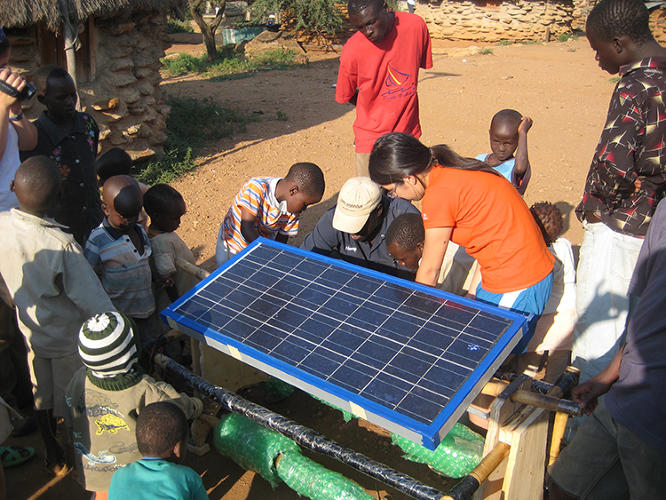
SunSaluter is a simple idea with a big pay-off. The harder part is getting it to those who need it.

By rotating solar panels with the movement of the sun, the device can improve electricity generation by up to 40%. All that's really involved is a bamboo stand to hold the panel, and a few plastic bottles.


"A lot of it depends on the eagerness of customers," says 21-year-old inventor Eden Full. "Our core focus is now on India."
Once in the spotlight for "dropping out" of college under the tutelage of billionaire Peter Thiel, Eden Full, 21, is now a junior at Princeton University who is still busy refining her big idea for end users.

Eden Full's SunSaluter is a simple idea with a big pay-off. By rotating solar panels with the movement of the sun, the device can improve electricity generation by up to 40%, according to its 21-year-old inventor. All that's really involved is a bamboo stand to hold the panel, and a few plastic bottles. As water drains out during the day, the panel starts to tilt.

The harder part is getting SunSaluter to the people who need it--off-grid villagers in developing countries--and making sure it works properly in their setting. And that's something that Full, currently a junior at Princeton University, is still working out. Like many simple design and technology ideas, it's the practicalities that remain challenging.


"The original design didn't consider the needs of the end-user, which isn't surprising as I was in high school at the time," Full says. "It was too complicated, technical, and difficult to fix."

Over the last year, Full has sent 35 units to six countries, working with "beta" customers. The design, which costs $50, now uses local materials and is simpler to set up and maintain. She's now concentrating on India and Malawi, in southeast Africa, where partners have shown greatest willingness to test the product.

"A lot of it depends on the eagerness of customers," she says. "Our core focus is now on India. That's where we have most of our resources and where we've established connections with people who want to work with us and move quickly." In the first half of 2014, Full hopes to deliver up 100 units, collaborating with up to 10 local groups. 


Two years ago, Full received a lot of media coverage, both for her idea and for the fact that she left her college plans aside to join Peter Thiel's anti-college fellowship program. Several stories talked about her "dropping out" to pursue the SunSaluter idea.

But Full says that was never the case. She only ever planned to take a year two years out and she resists the idea of being a poster-child for the college-is-dead movement. She thinks she can learn a lot of Princeton, and, in fact, a year on the Thiel program has showed her how much she has to learn. It should all be useful as she looks to roll SunSaluter more widely in 2014.

ORIGINAL: FastCo Exist

martes, 20 de agosto de 2013

Artificial Photosynthesis for Splitting Water Reaches One-Volt Milestone

ORIGINAL: IEEE Spectrum
By Dexter Johnson
Posted 21 Aug 2013 | 0:53 GMT
Image: HyperSolar

Almost 18 months ago, HyperSolar, Inc., a company based in Santa Barbara, CA, unveiled its ambitious plans for artificial photosynthesis. The announcement promised “the world’s first nanotechnology-based, zero-carbon process for the production of renewable hydrogen and natural gas.” The company was so confident that, two months later, it promised to publicly chronicle its progress toward the lofty goal.

Other companies have tried—and failed—to find an artificial photosynthesis process that can split water into hydrogen and oxygen and do it economically. Around the same time that HyperSolar promised to chronicle their efforts, Sun Catalytix determined that its process for splitting water just didn’t make economic sense when they crunched the numbers.

In the journal Nature, the maker of Sun Catalytix’s prototype explained the dreary economics:

“Hydrogen from a solar panel and electrolysis unit can currently be made for about US$7 per kilogram, the firm estimates; the artificial leaf would come in at US$6.50. (It costs just $1-2 to make a kilogram of hydrogen from fossil fuels.) With the prices of solar cells dropping all the time, the firm is not going to make a heavy investment that's unlikely to pay off. Instead, it is looking at cheaper designs—but these require yet-to-be-invented semiconductor materials.”

When I didn’t hear any updates from HyperSolar on how its grand project was progressing this year, I began to suspect that they had encountered these same numbers and had a second thought. I guess I was wrong—the company just sent out a press release detailing its success in achieving the 1-volt milestone. To date inexpensive silicon solar cells are the most inexpensive and abundant, but their 0.7 volt per cell is not enough to split water.

HyperSolar's 1 volt per cell is still short of the 1.5 volts realistically needed to split water into hydrogen and oxygen, but the 1 volt number does represent a steady progression, according to the company. HyperSolar managed to increase the voltage from 0.2 volts eight months ago to .75 volts three months ago. At that rate of increase, one could expect that the company could achieve the 1.5 volts in another six months.

“Our cutting-edge research program at the University of California Santa Barbara led by Dr. Syed Mubeen Hussaini continues to make impressive progress,” stated Tim Young, CEO of HyperSolar, in the press release. “The 1.0 volt milestone is very exciting in that it provides us with a clear and encouraging roadmap to reach the 1.5 volts needed for water splitting. The semi-conductor materials used are very inexpensive, which gives us confidence that a low cost system is possible. The process to make this novel solar cell is equally exciting in that it is a simple solutions-based chemistry process. It does not require conventional expensive semiconductor processes and facilities. It was literally made in a beaker.”

The key to HyperSolar’s proposed technology will be a nanoparticle made from low-cost semiconductor materials. In the company’s original roadmap for milestones, they were supposed to design this nanoparticle within the first year. It’s not clear from this press release whether that design has been settled upon, except to explain that each nanoparticle: “is a complete hydrogen generator that contains a novel high voltage solar cell bonded to chemical catalysts by a proprietary encapsulation coating.”

It is interesting that the company is providing key metrics for determining whether the system will work, but it would be good to have a better sense of where they are in developing the nanoparticle that forms the basis of this technology.

lunes, 29 de abril de 2013

MIT's 2013 Top 10 Breakthrough Technologies - 2: Ultra-Efficient Solar Power

ORIGINAL: Tech Review
April 23, 2013

Doubling the efficiency of solar devices would completely change the economics of renewable energy. Here is a design that just might make it possible.

Harry Atwater thinks his lab can make an affordable device that produces more than twice the solar power generated by today’s panels. The feat is possible, says the Caltech professor of materials science and applied physics, because of recent advances in the ability to manipulate light at a very small scale.

Solar panels on the market today consist of cells made from a single semiconducting material, usually silicon. Since the material absorbs only a narrow band of the solar spectrum, much of sunlight’s energy is lost as heat: these panels typically convert less than 20 percent of that energy into electricity. But the device that ­Atwater and his colleagues have in mind would have an efficiency of at least 50 percent. It would use a design that efficiently splits sunlight, as a prism does, into six to eight component wavelengths—each one of which produces a different color of light. Each color would then be dispersed to a cell made of a semiconductor that can absorb it.


Atwater’s team is working on three designs. In one (see illustration), for which the group has made a prototype, sunlight is collected by a reflective metal trough and directed at a specific angle into a structure made of a transparent insulating material. Coating the outside of the transparent structure are multiple solar cells, each made from one of six to eight different semiconductors. Once light enters the material, it encounters a series of thin optical filters. Each one allows a single color to pass through to illuminate a cell that can absorb it; the remaining colors are reflected toward other filters designed to let them through.

Another design would employ nanoscale optical filters that could filter light coming from all angles. And a third would use a hologram instead of filters to split the spectrum. While the designs are different, the basic idea is the same: combine conventionally designed cells with optical techniques to efficiently harness sunlight’s broad spectrum and waste much less of its energy.

It’s not yet clear which design will offer the best performance, says Atwater. But the devices envisioned would be less complex than many electronics on the market today, he says, which makes him confident that once a compelling prototype is fabricated and optimized, it could be commercialized in a practical way.

Achieving ultrahigh efficiency in solar designs should be a primary goal of the industry, argues Atwater, since it’s now “the best lever we have” for reducing the cost of solar power. That’s because prices for solar panels have plummeted over the past few years, so continuing to focus on making them less expensive would have little impact on the overall cost of a solar power system; expenses related to things like wiring, land, permitting, and labor now make up the vast majority of that cost. Making modules more efficient would mean that fewer panels would be needed to produce the same amount of power, so the costs of hardware and installation could be greatly reduced. “Within a few years,” Atwater says, “there won’t be any point to working on technology that has efficiency that’s less than 20 percent.”

lunes, 22 de abril de 2013

Primavera, el primer vehículo solar colombiano

ORIGINAL: EAFIT
16 de abril de 2013


El Proyecto Primavera conjuga investigación y desarrollo en un espacio de interdisciplinariedad. Es el resultado de la alianza entre EPM y EAFIT.
Con el apoyo de EPM un grupo interdisciplinario de EAFIT construye, con ingeniería propia, el primer vehículo solar del país. Una apuesta a la movilidad sostenible.

En octubre participará en World Solar Challenge, competencia de 3.000 kilómetros por el desierto australiano en la que estarán las mejores universidades del mundo.

El bloque 19 y los talleres de EAFIT son, por estos días, los lugares donde se combinan el ingenio y el entusiasmo. Allí, en el espacio donde se reúnen gran parte de las ingenierías de la Institución, se diseña y construye Primavera, el primer vehículo solar de competición colombiano.
Add caption
Este desarrollo, que competirá en los 3.000 kilómetros que componen el World Solar Challenge en Australia, es el resultado de una iniciativa que mueve, no solo a quienes construyen y modelan cada una de las piezas del carro, sino también a la Universidad y a EPM, que le apostaron a un proyecto que se encuentra alineado con el programa de movilidad sostenible y de tecnologías energéticas eficientes.

“Se trata de producir, almacenar y hacer un uso eficiente de la energía en su expresión más limpia: la energía solar. Sabemos que a partir de esta experiencia, en un país que cree en su futuro, seguiremos sumando esfuerzos para alcanzar la meta y entregar al mundo este aporte que refleja las capacidades de los colombianos”, dice Juan Esteban Calle Restrepo, gerente general de EPM.

El Proyecto Primavera es otra muestra de por qué Medellín fue elegida como la ciudad más innovadora del mundo, un lugar donde se piensan soluciones para mejorar el entorno, en este caso, la búsqueda de energías alternativas en beneficio de un planeta que así lo requiere.

La interdisciplinariedad es la característica principal del grupo que le da vida a Primavera. Son más de 40 estudiantes vinculados al proyecto, guiados por profesores de la Escuela de Ingeniería y por profesionales de la Subdirección de Investigación y Desarrollo de Negocios de Energía de EPM, quienes han puesto sus conocimientos en diseño, producción, procesos, mecánica y electrónica, al servicio de una innovación de Medellín para el mundo.
Add caption
“Integración de saberes, de conocimientos y de ideas. En esos tres puntos se resume esta labor entre EAFIT y EPM. Una colaboración en la que la experiencia obtenida en el proceso, así como los resultados que puedan verse en un futuro próximo, será la mayor ganancia para todos los que han contribuido al florecimiento del Proyecto Primavera” expresa Juan Luis Mejía Arango, rector de EAFIT.

La carrera
El vehículo tendrá su prueba de fuego en la edición 12 del World Solar Challenge, una carrera de 3.000 kilómetros que atraviesa a Australia de norte a sur, entre las ciudades de Darwin y Adelaida.

La carrera de carros solares más larga del mundo se originó en la aventura del danés Hans Tholstrup, quien en 1984 recorrió el continente australiano en un vehículo solar de desarrollo propio y se demoró 20 días. En 1987 se oficializó la primera carrera y en 2013 participará el primer vehículo colombiano.

Serán 40 equipos participantes entre los que se destacan los de las universidades de Stanford y Michigan de Estados Unidos, Cambridge de Inglaterra, TU Delft de Holanda, y Tokai de Japón.

Jorge Barrera Velásquez, coordinador técnico del proyecto y quien fue miembro del equipo solar MIT que participó en 1999 en la competición, señala que “los más afortunados logran terminar en cinco o seis días, si lo logran, pues terminar la carrera es toda una hazaña de resistencia, estrategia y logística”.

Y es que los vehículos están expuestos a las altas temperaturas del desierto y al frío de la noche. También hay que tener en cuenta que se corre con tráfico vehicular normal, que hay animales en la vía y el ocasional Willy Willy, pequeño tornado australiano.

Pero el equipo eafitense está a la altura del reto y trabaja en la preparación de cada uno de los detalles, pues en el carro se integran componentes estándar de alto nivel competitivo y las piezas son hechas con tecnología propia.

Además de los desarrollos en innovación y el conocimiento que se crea alrededor del proyecto, Barrera Velásquez destaca la pasión de los estudiantes que integran Primavera, quienes desde ya le preguntan qué harán apenas concluya la carrera.

“Este es un proyecto de desarrollo tecnológico que hace parte de la estrategia de Ciencia, Tecnología e Innovación del Grupo EPM, enfocada en desarrollos de alta tecnología en soluciones de energía y movilidad limpias y sostenibles, de alto impacto en la competitividad de la empresa, y la región”, anota Sergio Adolfo Montoya Mejía, subdirector de Investigación y Desarrollo del negocio Energía.

El cambio de mentalidad es uno de los mayores valores agregados del proceso, encontrar la solución a un obstáculo es la única alternativa y todo es susceptible de ser inventado. Por eso, la Universidad y EPM empiezan a pensar en la continuidad del proyecto, bien sea para participar en otras competiciones o incluso para formar un semillero de investigación. La iniciativa se encuentra abierta a la participación de la empresa privada.

Mayores informes para periodistas
Gilberto Osorio Gómez
Docente de la Escuela de Ingeniería
Teléfono: 574 2619500 Ext. 9086
Correo electrónico: gosoriog@eafit.edu.co

Unidad de Comunicaciones de EPM
Teléfonos: 574 3804418 y 574 3804404

Ricardo Mejía Gutiérrez
Docente de la Escuela de Ingeniería
Teléfono: 574 2619500 Ext. 9712
Correo electrónico: rmejiag@eafit.edu.co

Jorge Barrera Velásquez
Proyecto EPM – EAFIT Solar Car Team
Teléfono: 320 6771487
Correo electrónico: jbarre13@eafit.edu.co

lunes, 18 de marzo de 2013

India is building Solar Canals to Produce Energy while Slowing Water Loss

ORIGINAL: ArtsElectronic
Add caption
An experimental project in India is combining solar photovoltaic panels with an irrigation system in an attempt to save water while generating electricity. A 1 MW array has been built over nearly half a mile of the Narmada Canal in the state of Gujarat.

The combination will not only produce electricity but also conserve land and water, according to officials of the state government . The project is meant to show an efficient use of land in an agricultural region by putting solar panels over a waterway rather than over fertile ground. It also should reduce evaporation of the canal water by an estimated 237,750 gallons of water each year. The Gujarat State Electricity Corporation developed the project and hired U.S. based SunEdison to build it.

This is not the first time someone has thought of putting solar panels over water to save space and preserve scarce water supplies. It is still relatively uncommon, however. A New York Times story last year outlined several projects – including two at California vineyards – that have installed solar panels over ponds. The story also talked about the idea of covering the California Aqueduct with solar panels, but an official from the state agency overseeing the aqueduct expressed concerns over the stability of solar panels and the ability of repair workers to fix leaks and other problems at the 400-mile canal if they have to contend with massive structures of solar panels and their mounting systems.

Gujarat has seen many solar arrays installed in recent years. The state encourages solar panels by guaranteeing premium prices for the solar electricity, boasts at least 600 MW of solar and 2,580 MW of wind energy generation, which makes it one of the largest renewable energy producing states in the country.

The 1 MW project only covers a small section of the canal, the main waterway of which runs for nearly 285 miles. If all the side channels are included, then the overall length is about 11,806 miles. So there is potentially still plenty of space to put more solar panels over them.


Close on heels of commencing use of wastelands in northern districts and rooftops in towns and cities, Gujarat is set to potentially use the existing 19,000 km-long network of Narmada canals across the State for setting up solar panels to generate power.

The Chief Minister, Mr Narendra Modi, will inaugurate the first of a series of this project, known as Canal Solar Power Project, when he launches a 1 megawatt (mw) pilot project, which is already commissioned, on Narmada branch canal near Chandrasan village of Kadi taluka in Mehsana district on Tuesday.

According to Business Line, last week, he inaugurated a 600-MW solar power project spread across 11 districts. This included a 214MW Solar Power Park, the largest such generation centre at a single location in Asia. Also, Azure Power, leading independent power producer in solar sector, announced a 2.5 MW rooftops project in Gandhinagar.

Gujarat, which invests nearly Rs 2,000 crore an year on renewable energy, has attracted investments of Rs 9,000 crore so far on solar energy projects.

The pilot project has been developed on a 750-m stretch of the canal by Gujarat State Electricity Corporation (GSECL) with support from Sardar Sarovar Narmada Nigam Ltd (SSNNL), which owns and maintains the canal network.


The pilot project will generate 16 lakh units of clean energy per annum and also prevent evaporation of 90 lakh litres of water annually from the canal, an official told Business Line here on Monday. The concept will, therefore, tackle two of the challenges simultaneously by providing energy and water security.

The cost of per megawatt of solar power, in this case, is likely to be much less than the estimated Rs 10-11 crore, as the two banks of the canal will be used to cover the canal by installing solar power panel and the government will not have to spend much on creating basic infrastructure, including land acquisition .

Today, Gujarat has about 458 km of open Main Canal, while the total canal length, including sub-branches, is about 19,000 km at present. When completed, the SSNNL’s canal network will be about 85,000 km long. Assuming a utilisation of only 10 per cent of the existing canal network of 19,000 km, it is estimated that 2,200 MW of solar power generating capacity can be installed by covering the canals with solar panels. This also implies that 11,000 acres of land can be potentially conserved along with about 2,000 crore litres of water saved per annum.


domingo, 25 de noviembre de 2012

While Germany Is Headed for 80% Renewable Energy, We (US)'re Getting Left in the Dust

ORIGINAL: AlterNet
November 21, 2012 |

Osha Gray Davidson discusses his new book "Clean Break," about the keys to Germany's success with renewables and why the U.S. is getting its butt kicked.
Photo Credit: © manfredxy/ Shutterstock.com
This article was published in partnership with GlobalPossibilities.org.

When you think of places with great potential for solar energy, what comes to mind? Maybe the American Southwest, perhaps the Middle East. What probably doesn’t come to mind is Germany — and yet Germany is leading a global revolution in renewable energy, with solar playing a key part.

In the U.S., we now get 6 percent of our energy from renewables, which is exactly where Germany was in 2000. And then it passed the Renewable Energy Act and jumpstarted a movement known as Energiewende. Twelve years later, Germany gets over 25 percent of its energy from renewables and it is surpassing all of its benchmarks to be 80 percent renewable-powered by 2050.

In his new book, Clean Break: The Story of Germany’s Energy Transformation and What Americans Can Learn From It, Osha Gray Davidson explains how Germany made such a significant leap. Here are some shocking numbers he breaks down in the book:
  • 25 percent of Germany’s electricity now comes from solar, wind and biomass. 
  • A third of the world’s installed solar capacity is found in Germany, a nation that gets roughly the same amount of sunlight as Alaska. 
  • A whopping 65 percent of the country’s total renewable power capacity is now owned by individuals, cooperatives and communities, leaving Germany’s once all-powerful utilities with just a sliver (6.5 percent) of this burgeoning sector.
AlterNet interviewed Davidson about his new book, and got his take on whether or not the U.S. can catch up to the green energy revolution.

Tara Lohan: You went to Germany interested in its clean energy revolution. Despite the research you’d done, were you surprised by what you found there?

Osha Gray Davidson: No matter how much I read about it beforehand, it couldn’t prepare me for what I saw. I write in the book about traveling by train from Hamburg in the north down to Freiburg in the very south. It was something like a five-hour train ride but there wasn’t more than 15 minutes that went by without seeing either wind turbines on the hills or farm fields or solar panels on roofs of houses, barns, anything that had a south-facing roof. Even knowing how much energy they get — now it is 26 percent — from renewables, it doesn’t prepare you for what’s it’s like to live or visit a society that is moving in a big way to renewable energy.

TL: Does hitting their goal of 80 percent renewable power by 2050 seem realistic?

OGD: The reason it does seem realistic to me is they started out in the year 2000 with 6 percent renewable power and they’ve had a series of targets and so far they’ve been surpassing the targets. In the year 2020 their target was 30 percent, they are so far along now that they’ve moved that target to 35 percent. Everyone I’ve talked to there across the political spectrum says that 35 percent renewable energy by 2030 is completely doable.

When you look at how much money they’re putting into this and how it’s designed, and it’s not universal support, but there is overwhelming support for this transformation throughout Germany. Knowing all that, yes, I can see them getting to 80 percent by 2050.

TL: What has been the key to their success so far?

OGD: A couple of things. One, they made a decision to do this and I think when a government and a population make a decision to do something and it’s widespread that changes a whole lot because it’s always a matter of political will, not technological will, that makes the difference. The support is key and the way that they got that support is they designed policies that would give everybody — all residents of Germany — a way to have skin in the game. Sixty-five percent of all renewable energy in Germany is owned by individuals and cooperatives and groups of small investors.

Germany gets unfairly tarred as doing this as a command-and-control program — the energy transformation — according to its critics, mostly in the United States, say it’s a socialist program, and nothing could be further from the truth. It is incredibly market-based, far more than our energy policies, to the extent that we actually have any.

Everybody in Germany has a chance to participate; they can become a utility essentially. If you want to put solar panels on your roof, or if you’re a renter and want to get together with a group of friends and invest in solar panels or a windmill or a windfarm or chuches ... I saw many churches in Germany covered in solar panels and found out they’ve lowered their electricity bills by a huge extent by taking part in this. Giving everyone the financial incentive in making this work is really key.

TL: It seems like such a big transformation in 12 years to go from big power corporations to so much smaller, more distributed, community-run energy sources.

OGD: Yeah and that is key, that it’s distributed rather than centralized. It’s disappointing in the United States that we don’t really have that conversation at all. It’s just assumed here that energy, whether it’s fossil fuel, nuclear or renewable, is going to be produced by a large utility.

In Germany, the large utilities — the Big Four, they’re called — they have about 6 percent renewable energy capacity. But that is by design. When the Renewable Energy Act was written and then passed in 2000, one of the keys was understanding that you have to give everybody an incentive. Even though Germans, to a greater extent than Americans, know that global warming is a huge problem and that it needs to be solved, that isn’t enough to make an energy transformation.

A lot of people here who understand it and know that climate change is a problem can’t really do much about it because even if they put solar panels up — what is that going to do — it’s one tiny piece of something. In Germany they know that they’re plugging into a much larger movement that is going to have an effect and beside from that, you do get a financial benefit; you earn money by putting solar panels on the roof.

To install a similar sized array on a rooftop in Germany costs half as much as it does in the States even though the hardware costs are all the same. It’s the process of putting it up that’s much cheaper — the soft costs. And then you earn money. As opposed to here, where the best you can do with net metering is lower your utility bill to zero. But there, beyond that, you can actually make some coin off of it. Anybody can.

TL: It must help if you’re making investments of tens of thousands of dollars that the overall political will is there and it’s not going to shift every time there is an election.

OGD: Exactly. And that’s another part of the policy design from the Renewable Energy Act that you’re guaranteed a certain price for the power you produce for 20 years. So businesses, including individuals, know exactly how long it will take them to recoup the costs and start earning money on it — and how much they’ll make for the next 20 years. A lot of small businesses are doing this because there is policy certainty. In the U.S. we’ve just seen here with the Wind Production Tax Credit, the fact that it’s going to expire here on December 31st unless Congress extends it, wind manufacturers have already laid off several hundred people in the United States because of that policy uncertainty.

TL: Do you think it’s possible in the United States, considering the strength of our energy lobby, to move toward more sources of distributed power?

OGD: I do, and it’s because when you talk to people in Germany and read about the history of this you realize the problems were not the same but were equivalent — people said "you’re crazy, you’re not going to achieve any of these goals." But this was really a bottom-up movement that forced politicians to get behind it, politicians from across the spectrum. So the center-right governing party now, Angel Merkel’s party, they are for the Energiewende. They are not doing it very effectively, they’re mismanaging it. But it’s fascinating, I just got used to in the United States if you see someone who has solar or wind you generally know politically where they’re going to be on the spectrum in the United States. In Germany you have absolutely no idea from someone’s involvement in renewable energy, where they are on the political spectrum.

TL: And they are making all these leaps with renewable energy while at the same time shutting down their nuclear facilities.

OGD: The whole anti-nuclear aspect is a big one in Germany because like Japan, they lived through a nuclear crisis with Chernobyl in 1986. In Germany there are still parts where you can’t harvest mushrooms because of the radioactive contamination from Chernobyl.

It was a big deal in Germany. The kids had to stay inside for days at a time and they didn’t know what was going to happen. As it turned out, the radioactivity was less in Germany than it was in some of the Scandinavian countries because of the wind patterns. And German farmers remember having to destroy a lot of crops because of contamination. So for them, moving to renewables made sense just as farmers wanting to protect their land and their crops and their way of life.

TL: What was the pushback in Germany when decisions were made to shut down the nuclear plants?

OGD: A little after 2000 there was an amendment to the Renewable Energy Act that was worked out in agreement with the nuclear power plant owners to phase out nuclear. It was going to be done in an orderly way that they could count on as these plants aged they would have to shut them down anyway. They were part of that — they weren’t just forced out until the Merkel government came in. This is what I mean by the mismanagement of it.

Her government extended the licenses of nuclear plants and there were huge demonstrations throughout Germany against that and then six months or so later was when Fukushima happened and lo and behold Angela Merkel turned anti-nuclear. So she went from extending the licenses and abrogating that plan they had with nuclear power companies to then all of a sudden essentially closing them down.

That’s caused a lot of problems in Germany and I think the critics of closing them down immediately have a really good point that she took offline low-carbon energy producers that were going to be phased out anyway.

TL: I’m wondering about the kinds of infrastructure that needs to be built or upgraded when you’re talking about generating energy from renewables. You wrote in the book about how they need $25 billion more for new power lines — where does that money come from? Who’s footing the bill?

OGD: Well, that’s the question. They’re still debating that and there is no easy answer. I certainly don’t want to give the impression that this transition is an easy one and a cost-free one — it’s just that not doing anything is far costlier. As several people there have pointed out, everyone is going to move to a renewable energy economy eventually, because they’re dependent on non-renewable fuels. Germany has a headstart by doing it early, but there are costs related to doing it early. Germans were paying more to install solar panels at the very beginning before the price got cut by mass production.

But Germany is way ahead in other ways including their export economy, and not just the solar panels which have been a problem in trying to keep up with China on that now. China’s manufacturing plants that make solar panels — those were bought from Germany — the plants themselves, all of that technology came from Germany. So they’re still reaping rewards.

And the extra cost that they’re paying, you have to look at where it is going and mostly it is to citizens of Germany — it’s creating jobs, over 300,000 jobs in renewable energy there. So the costs were higher but the money stayed within Germany and stayed within small towns. It’s being spent wisely and it’s helping the German economy. It’s not just a cost, it’s also a benefit.

TL: What did you think of their use of biomass? I know that can be a mixed bag when it comes to environmental impacts.

OGD: Yes, and there is debate on it in Germany. It is like most other forms of energy in that you can do it wrong or you can do it right. One big objection is using corn — growing corn, a food crop, and then burning it, using it for energy production. It drives up food costs and it’s probably not a good use of land. So that’s one example of using biomass in an unsustainable fashion.

But I saw some biomass projects that were using sustainably harvested wood from woodlots and just trimmings. I watched them trimming trees on the side of the road and the wood chips would be taken by this farmer to a community heating unit in this tiny town in the Black Forest, St. Peter, where they have this community heating project using sustainably harvested wood chips to heat over 200 houses and businesses and they’re cutting back on C02 emissions because it’s replacing oil burning furnaces. And it’s a cooperative, so all of the people who live there — the 200 homes — not only is the heat cheaper but they get any financial returns.

So biomass can be done in a sustainable way or it can not be.

TL: Was it frustrating at all for you to see all this progress in Germany and to think about where the conversation is at right now in the U.S. — where we barely speak about climate change and if we do we still have people insisting that we debate its existence?

OGD: I went back and forth on this when I was in Germany. I’d see all of this stuff — in Hamburg, the public transportation system, the whole built environment, which is a big part of the energy change. Ninety-nine percent of residents in Hamburg live within 300 meters of public transport. Germans own cars to a far lesser extent because they have such a great transportation system. The built environment is created for mass transportation and bikes and walking.

And yes, I was alternately frustrated that we didn’t have that and hopeful because I saw what was possible. In the States a lot of the discussion is about theory — what can we get — but it doesn’t have to be a theoretical conversation and that was what I took away from Germany. They are actually doing it and I do think that if they can do that then yes, we can do that here.

The main driver in Germany was citizens' groups who wanted out of nuclear power, that was one of the very first issues. Ursula Sladek was a school teacher and her husband was a village doctor when Chernobyl blew and all the radioactive fallout fell on their area, they were in one of the most heavily contaminated areas. Ursula didn’t want to be part of a nuclear society anymore and went to the utility which was a monopoly back then and said "we don’t want you to use nuclear anymore" — she had gotten a group of friends and neighbors together. And the utility said, "ha, we don’t care what you want."

From that, Ursula and this group in town now run the largest green cooperative in Germany and they have 180,000 households and business members of their little company in this tiny town in the Black Forest.

I always ask "What lessons can Americans learn?" And the overwhelming theme was, "just start going it, that’s what we did." And Ursula is such a great example of that. It took them 10 years in this David and Goliath battle with their utility. As she’s pointed out, “we didn’t shut down a single nuke plant, and that was all we were trying to do. But we’ve helped start a renewable energy revolution."

When I asked her about what we Americans could learn, she didn’t answer at first and she looked around at this office she was in, the headquarters with solar panels on the roof and she said, "This is something that is very American isn’t it? You Americans are people who say we can do it — we can do it ourselves."

She in fact was inspired by Jimmy Carter, a lot of the people who started the Energiewende in Germany, including Hans-Josef Fell who was the main author of the Renewable Energy Act, he was inspired by Jimmy Carter and the renewable energy revolution that he tried to start here in the U.S. by putting solar panels on the roof of the White House and funding solar projects throughout the country and wind projects. Fell said he looked around and saw pictures of all of that and wondered why they couldn’t have that in Germany. And now the situation is simply reversed.

We did start down that road, and when Reagan came in a decision was made to scuttle that and to go back to dependence on fossil fuels.

I think that if Americans now take a look at Germany and see what they’ve done and start doing that now here, yes, I think we can get to where Germany is and in fact the National Renewable Energy Laboratories in Colorado, the main government technology center for renewable energies, came out with a report this past year that said by the year 2050 the U.S. could be getting 80 percent of our power from renewables; by coincidence, that’s exactly what Germany’s goal is.

We obviously have the resources to do it. So I think it’s a matter of political will and also empowerment. A lot of Americans feel there is nothing they can do because of all these big companies — well, I don’t have much patience for that. The Germans could have said the same thing, but they rolled up their sleeves and started taking action at a local level and eventually that forced political leaders to respond.

So, we shouldn’t whine about it — we should get busy and do it.

Osha Gray Davidson's new book Clean Break: The Story of Germany’s Energy Transformation and What Americans Can Learn From It (InsideClimate News, 2012), is available as an e-book here.
Tara Lohan is a senior editor at AlterNet and editor of the new book Water Matters: Why We Need to Act Now to Save Our Most Critical Resource. You can follow her on Twitter @TaraLohan.

miércoles, 21 de noviembre de 2012

Desarrollan paneles solares utilizando alas de mariposas (VIDEO)

ORIGINAL: Ecoosfera
Nov 21, 2012


El profesor de la Universidad de Pennsylvania, Shu Yang, descubrió la manera de utilizar mariposas como fuentes de energía renovable. Utilizado la técnica de litografía holográfica desarrollo un material que imita las cualidades iridiscentes y resistentes al agua de las alas de la mariposa.

El proyecto de Yang atrajo la atención suficiente para conseguir fondos y poder desarrollar un prototipo de panel solar, creando recubrimientos hidrófobos más secos, más limpios y por lo tanto más eficientes para captar la luz solar.

Cómo funciona:

Yang utilizó la técnica de litografía holográfica para recrear las propiedades reflectantes de las alas, utilizando un láser para hacer un 3D reticulada, un patrón en un tipo de material llamado fotorresistente. Un disolvente luego lava todos los fotorresistente, tocado por el láser, creando la estructura 3D que afecta a la luz para crear los efectos de color. A continuación, un disolvente pobre pone áspera la superficie, creando la textura que hace que las alas de mariposa resistentes al agua.

Los paneles solares pasan mucho tiempo expuestos directamente a los elementos, cuando la suciedad y la humedad se acumulan en la superficie, la eficiencia disminuye drásticamente, explicó Yang.

Así que el recubrimiento especial de Yang podría ayudar a preservar la eficiencia solar, manteniendo los paneles limpios y secos, sin mucho esfuerzo extra.


domingo, 30 de septiembre de 2012

Elon Musk, the 21st Century Industrialist

ORIGINAL: BusinessWeek
September 13, 2012

On Fridays, Elon Musk gathers his engineers in an old hangar in Los Angeles. The building, next to a municipal airport a couple miles south of the Hollywood Park race track and casino, is now a research and development facility for Musk’s electric car company, Tesla Motors (TSLA). Musk uses these meetings to check the team’s progress and give straightforward, often withering, design critiques. During one such session in July, versions of the Model S sedan and the skeletal frame of a forthcoming sport-utility vehicle, the Model X, sit in a corner. Drivetrain prototypes lay on the concrete floor next to interior cabin mock-ups.

Musk’s staff huddles around him as he zeroes in on a sun visor. He hates it. He examines the seam and, noticing how it pushes up the fabric, declares it “fish-lipped.” The screws on the hinges feel like knives stabbing him in the eye. He announces he wants to find the best sun visor in the world, and then make a better one.


llustration by R. Kikuo Johnson
The session continues in the parking lot, where a number of competitors’ vehicles—some hybrids, some conventional—await judgment. Musk squeezes his six-foot-two, broad-shouldered frame into the back seat of a luxury sedan from Hyundai and then into an Acura SUV. He scoffs at the cramped third-row seats in the Acura. “That’s like a midget cave,” he says, and the group chuckles on cue. “It’s good to get a sense for just how bad the other cars are.”

Last year alone, Acura’s parent company, Honda Motor (HMC), sold 200,000 hybrids. Toyota Motor (TM) sold 629,000. In nine years, Tesla has built a total of 2,450 vehicles. The auto industry may have had a rough time of late, but Tesla has had buckets of delays, quality issues, and near-death financial crises. That Musk feels no shame dismissing the efforts of vastly larger competitors would not surprise his friends and colleagues, who describe him as Steve Jobs, John D. Rockefeller, and Howard Hughes rolled into one. “He’s a throwback to when people were doing less incrementalist things,” says Peter Thiel, the tech investor who co-founded PayPal with Musk. “The companies he’s started are executing against a vision measured not in years but in decades.” Bruce Leak, a veteran Silicon Valley entrepreneur who once worked with Musk at a video game company, says, “He has that Bill Gates energy where his foot bounces and he’s wiggling just because he’s so smart.” Jon Favreau, a friend and the director of the Iron Man movies, has called Musk the basis for his version of comic book hero Tony Stark, the playboy inventor who builds a flying weaponized suit.

Musk has been having a year good enough for another movie. In May, his Space Exploration Technologies, better known as SpaceX, successfully launched a 227-foot-tall rocket from a platform in Cape Canaveral, docking one of its Dragon capsules with the International Space Station, orbiting 220 miles above the earth—a feat NASA called “absolutely incredible.” Tesla, which went public in 2010, started shipping the all-electric Model S luxury sedan in June and will soon unveil a nationwide network of charging stations. SolarCity, where Musk is chairman of the board, is a player in the residential and commercial solar markets, with more than 28,000 customers, and is expected to go public imminently at a value of about $1.5 billion. Musk is chief executive officer of Tesla and SpaceX, and is the largest shareholder in all three companies. Following the SolarCity IPO, his net worth could be well north of $3 billion.