Mostrando entradas con la etiqueta Peter Thiel. Mostrar todas las entradas

viernes, 11 de diciembre de 2015

Elon Musk And Sam Altman Launch OpenAI, A Nonprofit That Will Use AI To 'Benefit Humanity'


.
Led by an all-star team of Silicon Valley's best and brightest, OpenAI already has $1 billion in funding.
.
Silicon Valley is in the midst of an .artificial intelligence war, as giants like Facebook and Google attempt to outdo each other by deploying machine learning and AI to automate services. But a brand-new organization called .OpenAI—helmed by Elon Musk and a posse of prominent techies—aims to use AI to "benefit humanity," without worrying about profit.
Musk, the CEO of SpaceX and Tesla, .took to Twitter to announce OpenAI on Friday afternoon.

The organization, the formation of which has been in discussions for quite a while, came together in earnest over the last couple of months, co-chair and Y Combinator CEO Sam Altman told Fast Company. It is launching with $1 billion in funding from the likes of Altman, Musk, LinkedIn founder Reid Hoffman, and Palantir chairman Peter Thiel. In an .introductory blog post, the OpenAI team said "we expect to only spend a tiny fraction of this in the next few years."

Noting that it's not yet clear on what it will accomplish, OpenAI explains that its nonprofit status should afford it more flexibility. "Since our research is free from financial obligations, we can better focus on a positive human impact," the blog post reads. "We believe AI should be an extension of individual human wills and, in the spirit of liberty, as broadly and evenly distributed as is possible safely." We're just trying to create new knowledge and give it to the world.

The organization features an all-star group of leaders: Musk and Altman are co-chairs, while Google research scientist Ilya Sutskever is research director and Greg Brockman is CTO, a role he formerly held at payments company Stripe.

For nearly everyone involved in OpenAI, the project will be full-time work, Altman explained. For his part, it will be a "major commitment," while Musk is expected to "come in every week, every other week, something like that."

Altman explained that everything OpenAI works on—including any intellectual property it creates—will be made public. The one exception, he said, is if it could pose a risk. "Generally speaking," Altman told Fast Company, "we'll make all our patents available to the world."

Companies like Facebook and Google are working fast to use AI. Just yesterday, .Facebook announced it is open-sourcing new computing hardware, known as "Big Sur," that doubles the power and efficiency of computers currently available for AI research. Facebook has also recently talked about using AI to help its blind users, as well as to make broad tasks easier on the giant social networking service. Google, .according to Recode, has also put significant efforts into AI research and development, but has been somewhat less willing to give away the fruits of its labor.

Altman said he imagines that OpenAI will work with both of those companies, as well as any others interested in AI. "One of the nice things about our structure is that because there is no fiduciary duty," he said, "we can collaborate with anyone."

For now, there are no specific collaborations in the works, Altman added, though he expects that to change quickly now that OpenAI has been announced.

Ultimately, while many companies are working on artificial intelligence as part of for-profit projects, Altman said he thinks OpenAI's mission—and funding—shouldn't threaten anyone. "I would be very concerned if they didn't like our mission," he said. "We're just trying to create new knowledge and give it to the world."

ORIGINAL: .FastCompany
By .Daniel Terdiman.

OpenAI's research director is Ilya Sutskever, one of the world experts in machine learning. Our CTO is Greg Brockman, formerly the CTO of Stripe. The group's other founding members are world-class research engineers and scientists: Trevor Blackwell, Vicki Cheung, Andrej Karpathy, Durk Kingma, John Schulman, Pamela Vagata, and Wojciech Zaremba. Pieter Abbeel, Yoshua Bengio, Alan Kay, Sergey Levine, and Vishal Sikka are advisors to the group. OpenAI's co-chairs are Sam Altman and Elon Musk.

Sam, Greg, Elon, Reid Hoffman, Jessica Livingston, Peter Thiel, Amazon Web Services (AWS), Infosys, and YC Research are donating to support OpenAI. In total, these funders have committed $1 billion, although we expect to only spend a tiny fraction of this in the next few years.

You can follow us on Twitter at @open_ai or email us at info@openai.com.

lunes, 13 de enero de 2014

A Young Clean-Tech Entrepreneur Learns Even Simple Design Ideas Face Challenges

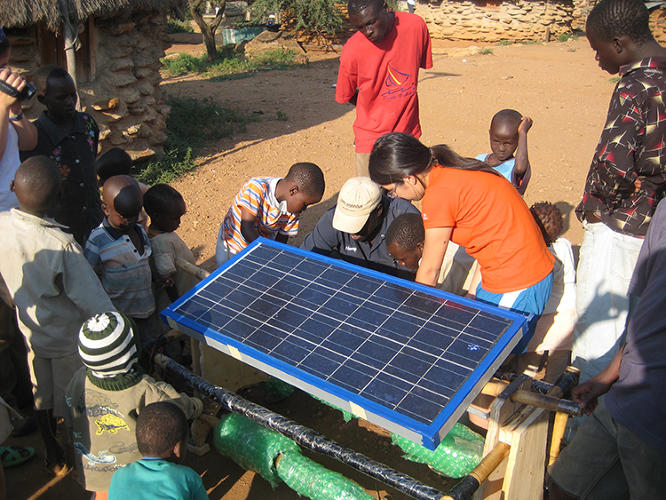
SunSaluter is a simple idea with a big pay-off. The harder part is getting it to those who need it.

By rotating solar panels with the movement of the sun, the device can improve electricity generation by up to 40%. All that's really involved is a bamboo stand to hold the panel, and a few plastic bottles.


"A lot of it depends on the eagerness of customers," says 21-year-old inventor Eden Full. "Our core focus is now on India."
Once in the spotlight for "dropping out" of college under the tutelage of billionaire Peter Thiel, Eden Full, 21, is now a junior at Princeton University who is still busy refining her big idea for end users.

Eden Full's SunSaluter is a simple idea with a big pay-off. By rotating solar panels with the movement of the sun, the device can improve electricity generation by up to 40%, according to its 21-year-old inventor. All that's really involved is a bamboo stand to hold the panel, and a few plastic bottles. As water drains out during the day, the panel starts to tilt.

The harder part is getting SunSaluter to the people who need it--off-grid villagers in developing countries--and making sure it works properly in their setting. And that's something that Full, currently a junior at Princeton University, is still working out. Like many simple design and technology ideas, it's the practicalities that remain challenging.


"The original design didn't consider the needs of the end-user, which isn't surprising as I was in high school at the time," Full says. "It was too complicated, technical, and difficult to fix."

Over the last year, Full has sent 35 units to six countries, working with "beta" customers. The design, which costs $50, now uses local materials and is simpler to set up and maintain. She's now concentrating on India and Malawi, in southeast Africa, where partners have shown greatest willingness to test the product.

"A lot of it depends on the eagerness of customers," she says. "Our core focus is now on India. That's where we have most of our resources and where we've established connections with people who want to work with us and move quickly." In the first half of 2014, Full hopes to deliver up 100 units, collaborating with up to 10 local groups. 


Two years ago, Full received a lot of media coverage, both for her idea and for the fact that she left her college plans aside to join Peter Thiel's anti-college fellowship program. Several stories talked about her "dropping out" to pursue the SunSaluter idea.

But Full says that was never the case. She only ever planned to take a year two years out and she resists the idea of being a poster-child for the college-is-dead movement. She thinks she can learn a lot of Princeton, and, in fact, a year on the Thiel program has showed her how much she has to learn. It should all be useful as she looks to roll SunSaluter more widely in 2014.

ORIGINAL: FastCo Exist

domingo, 7 de abril de 2013

Laura Deming: “Mi meta es extender la esperanza de vida”

ORIGINAL: Prensa Libre
POR ROBERTO VILLALOBOS VIATOD REVISTA D
07/04/13

Es una chica sonriente y espontánea. Delgada y alta. Conversadora. Muy inteligente. Laura Deming nació hace 18 años en Nueva Zelanda, un país insular de Oceanía localizado en el suroeste del océano Pacífico, formado por dos grandes islas y muchas otras más pequeñas.

Laura Deming. Una fundación le dio US$100 mil para que abandonara sus estudios y se dedicara a la investigación. La joven lo hizo y le va bastante bien. Esta es su historia.
Laura, aún bastante joven, ya es una destacada bióloga. Apenas tenía 12 años cuando, con su familia, se mudó a San Francisco, Estados Unidos, para trabajar con Cynthia Kenyon, una prestigiosa bióloga molecular que estudia el proceso del envejecimiento. A los 14 se mudó a Boston para ingresar en el Instituto Tecnológico de Massachusetts (MIT, en inglés), una auténtica “fábrica de cerebros”.

A los 17, la Fundación Thiel puso en sus manos US$100 mil a cambio de que abandonara sus estudios —eso fue en el 2011—. Claro, el trato no era “así por así”. La brillante Laura, además, debía implementar tecnologías de punta con teorías innovadoras en el campo en el que se desenvolvía. En su caso, se enfoca en crear una terapia para incrementar la esperanza de vida del ser humano; es decir, obtener una fórmula para detener el envejecimiento. Fue así que cofundó la compañía Floreat Capital, con la cual lucha para alcanzar esa meta.

La joven Deming estuvo hace unos días en Guatemala, invitada por la Universidad Francisco Marroquín, donde impartió varias conferencias, todas en inglés, donde expuso las investigaciones y resultados que ha efectuado en su ya vasta y fructífera carrera científica.

¿Cómo te vino la idea de que el envejecimiento puede ser tratado?
Sucedió cuando tenía 8 años. Mi mamá me habló acerca de la muerte y no podía parar de llorar. Eso me parecía una tragedia. La vida es increíble, pero la muerte es inevitable. Para entonces ya me había gustado la biología. Desde entonces, mi concepción de ciencia cambió, pues la empecé a ver como un factor que puede salvar vidas.

Pese a esa corta edad, decidiste ponerte manos a la obra.
(Ríe). Sí. Cuando tenía 12 años —vivía en Nueva Zelanda— le escribí un correo electrónico a Cinthia Kenyon —biogerontóloga y bióloga molecular—, quien para mí es la mejor científica que estudia el envejecimiento en Estados Unidos. No tenía nada qué perder. Ella, sorprendentemente, me contestó y me invitó a trabajar en su laboratorio en la Universidad de California, en San Francisco (UCSF). Tomó el riesgo de permitir que yo, entonces una niña, empezara a investigar sobre ese tema. Fue así que Kenyon se convirtió en mi mentora.

Siendo tan pequeña, ¿entendías lo que ella te enseñaba?
Kenyon tenía una manera adecuada para describir las cosas. Por ejemplo, me decía que los científicos son como detectives, que tratan de resolver misterios y descubrir a los “culpables” genéticos del envejecimiento.

¿Qué fue lo que hiciste en la UCSF?
Juguetear con pequeños gusanos —C. elegans— en el laboratorio de biología, tratando de que estos vivieran más de lo esperado, lo cual logré. También tomé clases de genética y bioquímica, entre otras materias.

Luego vinieron tus estudios en el prestigioso Instituto Tecnológico de Massachusetts (MIT, en inglés).
Sí. Ingresé cuando tenía 14 años.

***

En el laboratorio Guarente, del MIT, Deming investigó el potencial terapéutico de la enzima SIRT1 en la osteoporosis y en el envejecimiento de mamíferos. Efectuó, asimismo, ensayos bioquímicos para estudiar la función proteica y trabajó con factores mutantes en ratones para establecer ensayos sobre osteoporosis. También efectuó estudios en el iGEM (International Genetically Engineered Machine Competition) y el Laboratorio Weiss, ambos del MIT.

***

Luego te ofrecieron US$100 mil para que dejaras tus estudios.
(Ríe). Así es. Es la Beca 20 under 20 proporcionada por la Fundación Thiel.

***

Dicha beca es facilitada por el magnate Peter Thiel, cofundador de la empresa de pagos en línea PayPal y uno de los primeros que apostó por Facebook.

Thiel incentiva con US$100 mil a jóvenes con mentes brillantes por debajo de los 20 años para que abandonen sus estudios y pasen los próximos dos años en Silicon Valley, San Francisco, para desarrollar proyectos innovadores.

Este empresario, quien tiene dos títulos por la Universidad de Stanford, considera que la educación superior actual está en una “burbuja loca”, como la ha denominado, pues hay miles de estudiantes que se endeudan para pagar una cuantiosa matrícula, la cual deben pagar al graduarse, consiguiendo, además, un trabajo que solo produce un pequeño retorno a la inversión.

Jim O’Neill, director de la Fundación Thiel, expresó en una entrevista con la BBC de Londres: “Hay obsesión por los títulos y las credenciales y no se presta suficiente atención a las habilidades y el talento (...) Hay muchos ejemplos de empresarios exitosos que crean un negocio rentable y no vuelven a la universidad, tales como Bill Gates, de Microsoft, o Steve Jobs, de Apple”.

Jim Danielson, otro de los becarios, también expresó en esa ocasión: “A veces el sistema universitario frena la innovación”. De momento, Danielson desarrolla un motor eléctrico para un automóvil Porsche 924S con energía electrónica que él mismo inventó.

Para Deming, el objetivo es diferente.

***

¿Cuál es tu meta con esa beca?
Conseguir la primera terapia que permita incrementar la esperanza de vida del ser humano. Hasta ahora hemos tenido resultados alentadores. Con ratones de laboratorio, con la misma edad y características, pero algunos con modificaciones respecto de otros, se ha logrado incrementar su esperanza de vida. ¿Funcionará en humanos? Es posible, pero se necesitan más estudios. Para eso, quizás hagan falta otros 20 años.

¿Qué causa el envejecimiento?
Es causado por una complicada mezcla de factores genéticos y estocásticos.

¿Por qué para ti es tan importante vivir más?
Porque si no se encuentra algo para vivir más, el ser humano seguirá muriendo en torno a los cien años. Además, en el camino, es posible que se encuentren formas para detener o curar enfermedades propias del envejecimiento, como el alzhéimer, párkinson o Huntington.

Aparte de las enfermedades que me mencionaste, ¿crees posible curar el cáncer?
Quizás en unos 20 años se pueda conseguir una cura para el alzhéimer, pero el cáncer es muy complicado, ya que es muy diferente a otras enfermedades.

¿Temes envejecer?
No, no le temo a ese proceso, pero sí creo que es necesario encontrar una terapia que lo retrase.

Me has hablado de crear una terapia antienvejecimiento. ¿Consideras que tal proceso es una enfermedad?
La Administración de Alimentos y Medicamentos (FDA, en inglés) no lo cataloga como tal.

Entonces, ¿cómo es que has podido crear un negocio alrededor de eso?

No es una hazaña. Mi compañía —Floreat Capital, de la cual es cofundadora y en la que trabaja con Corey Goodman, una destacada biotecnóloga—, procuramos crear una estructura rentable y autosostenible que permita tener varios proyectos antienvejecimiento, y luego comercializar las investigaciones. Es importante, además, que los científicos tengan fuentes estables para financiar proyectos de este tipo.

La Iglesia Católica no tiene una postura oficial en cuanto a la investigación genética. Ahora se ha elegido a un nuevo papa —Francisco—. ¿Esperas que esa institución se pronuncie al respecto?
Ese es un punto interesante. En realidad no sé qué decir. No soy católica, pero lo que esperaría es que la Iglesia esté abierta a la ciencia, pues las investigaciones que se llevan a cabo son para mejorar la salud y la calidad de vida en general. Sería terrible si hubiera algo que detuviera el desarrollo de este tipo de estudios.

¿Cuando termine tu beca —al final de este año—, planeas regresar a la Universidad?
Extraño estudiar para los exámenes, pero creo que podría aprender mucho más acerca de biotecnología —tanto en el aspecto científico como en lo empresarial— sumergiéndome en ella.

Al hablarte se nota tu entusiasmo por lo que haces. ¿Cómo pueden los jóvenes encontrar su aptitud?
Es una pregunta bastante difícil, pero creo que todo se dirige a encontrar aquello que a cada quien le apasiona. ¿Cómo se halla? Pues hay que hacer muchas cosas; experimentar. En ese proceso, esa persona se dará cuenta de cuáles son las cosas que le gustan hacer.

¿Es posible que todos logremos nuestros sueños?
Es posible que no sea posible lograr todo lo que quieras, pero si no lo intentas nunca lo sabrás. Los sueños grandes, lógicamente, son los más difíciles de alcanzar. Son realmente duros. Pero vale la pena intentarlo. No importa la edad. El solo hecho de estar vivo quiere decir que tienes la oportunidad de luchar por eso que quieres.

PERFIL
Laura Deming, neozelandesa de 18 años, estudió con la bióloga molecular Cinthia Kenyon, de junio del 2006 a mayo del 2009.

Del 2009 al 2011 ingresó en el Instituto Tecnológico de Massachusetts (MIT, en inglés), para estudiar Física y Biología.

En el 2011 fue seleccionada para la Beca Thiel, que proporciona US$100 mil como incentivo para dejar los estudios, a cambio de desarrollar negocios y tecnologíasinnovadoras. Laura Deming se enfoca en crear una terapia efectiva para incrementar la esperanza de vida del ser humano.

viernes, 11 de enero de 2013

Billionaire Peter Thiel donates to 3D meat bioprinting lab

ORIGINAL: Wired
16 August 12

Image credit: Shutterstock
Related features

The Thiel Foundation has made a six-figure grant to a series of biotechnology startups, including a company that wants to 3D print meat.

Modern Meadow is a Missouri-based startup that believes 3D printing could help to take some of the environmental cost out of producing a hamburger. He said: "If you look at the resource intensity of everything that goes into a hamburger, it is an environmental train wreck."

The company claims that by carefully layering mixtures of cells of different types in a specific structure, in-vitro meat production becomes feasible. It's set a short-term goal of printing a sliver of meat around two centimetres by one centimetre, and less than half a millimetre thick, which is edible.

The company explains in a submission to the United States Department of Agriculture: "The technology has several advantages in comparison to earlier attempts to engineer meat in vitro. The bio-ink particles can be reproducibly prepared with mixtures of cells of different type. Printing ensures consistent shape, while post-printing structure formation and maturation in the bioreactor facilitates conditioning."

However, it admits that the road ahead is strewn with difficulties. "The consumer acceptance of such products may not be without challenges. We expect it will first appeal to culinary early-adopter consumers and the segment of the vegetarian community that rejects meat for ethical reasons. With reduction in price, it can reach the masses with religious restrictions on meat consumption (people restricted to Hindu, Kosher, Halal diets) and finally populations with limited access to safe meat production."

To help the company achieve this aim, Billionaire Peter Thiel has given it a grant of between £160,000 and £220,000, through the Thiel Foundation's "Breakout Labs". Other recipients of grants include Bell Biosystems and Entopsis, both medical startups.


miércoles, 9 de enero de 2013

DON’T Drop Out to Do a Startup


christian. Co-founder ReelSurfer (Y Combinator S12), Microsoft and Google alum, Stanford '08. Avid eater. View Full Profile →
Steve Jobs did it in 1972. Bill Gates did it in 1974. More recently, so did Mark Zuckerberg and Jack Dorsey. I’m not talking about some illicit drug in vogue with the Silicon Valley elite (well,except for Jobs) – I’m talking about dropping out of college.

In recent years, dropping out to pursue a tech startup has become the new American Dream. With films like The Social Network, even mainstream Hollywood has bought into the mystique, painting romantic notions of bucking traditional education to change the world, all while making billions. Perhaps the most controversial manifestation of this trend is legendary entrepreneur and VC Peter Thiel’s Thiel Fellowship, formerly known as the “20 under 20″. This fellowship offers $100k each year to students under 20 on the condition that they drop out of school to pursue an idea. In the CNBC documentary trailer about the “20 under 20″, Sean Parker of Napster fame gives his take: “If your goal is to become an entrepreneur, it would seem that college has become a very bad place to do that” (watch the actual highlight here).

Well, I’m here to say *don’t* do it – do NOT drop out of school. Let’s start with some numbers.

The Numbers
It’s pretty easy to come up with success stories, but what proportion of the whole do they actually make up? If we use wealth as a measure of success, Forbes’ January 2012 edition reveals that about 85% of America’s 400 Richest People (shown left) do, in fact, have a college degree. The top 400 is already an elite minority, and only an even smaller minority decided to forego traditional education.

“But that’s the old guard,” you say. “We’re the new generation with new, innovative ways of doing things”. If you go younger, the trend is the same. I looked through this year’s Forbes 30 under 30 in theTech category and an overwhelming 92.5% stuck to school. Even in a fuzzy category like Art & Style, 87% had undergraduate degrees or better. You can see my compiled results here.

But what if you don’t buy this numerical argument? Innovation is about going against the odds and taking risks, after all. I still argue, though, that we need a foundation to build from, and that foundation is school.

A Skills Foundation
From a practical perspective, a tech startup needs a sufficient pool of technical skills in software, hardware, the sciences, or even finance. This is especially true for the technical founder, who on top of writing code will need to architect designs, allocate resources, and otherwise set the tone for the entire engineering team as the company grows1. More often than not, this level of skill is fostered in some sort of formal education.

But why do you need college to develop these skills? There’s an old saying that sums up my view: “You don’t know what you don’t know”. To throw in some personal experience, I started out my programming career, like many others, by learning by doing. Through trial and error and the occasional book, I freelanced enough websites and apps that I almost considered myself a proficient developer. It wasn’t until I took courses in formal principles like design patterns, programming paradigms, or architecture that I realized how much I didn’t know. It wasn’t until I worked on team projects that I realized how many practical project management skills I didn’t have. At the time, I “didn’t know what I didn’t know”. In hindsight, embarking on my own startup before building a skills foundation would have been disastrous. As another example, James Proud, the first of the aforementioned “20 under 20″ fellows to have sold his company, actually remarks in the New York Times that “he knows he is missing out on the deep computer science knowledge that he could learn in college”.

And even if you don’t actually have to go to college to learn the things I described above, a college degree provides a baseline measurement for both yourself and others to calibrate against.

Say you’re presiding over a loved one in critical condition after an accident. Suddenly a man pushes through the crowd and declares he is going to do emergency surgery. “Are you a doctor?” you ask. I’m pretty sure “No, I’m self-taught,” wouldn’t be your preferred reply.

That was a contrived example, but there are legitimate cases where a college degree serves as a proxy for qualifications: when you’re looking through resumes, when an investor is deciding whether to make a bet on your team. Like all proxies, it’s not perfect, but in a world with finite resources, it’s an unavoidable shortcut.

A Life Foundation
In addition to technical skills, college also teaches the life skills needed to succeed. Don’t worry – I’m not getting philosophical on you. As an engineer, I find unquantifiable “life skills” like “networking” a bit hokey. But as long as we’re talking about networking, where do you think most startups hire from? Or find their cofounders?

I met my co-founder Neil Joglekar in the dorms playing poker. After we were able to take each other’s money without wanting to kill each other (mostly), I knew we could get along as friends. And after working on class projects together, I knew we could function as a team. The same advice is reiterated on Hacker News time and time again: college is one of the best resources for starting your company and career. The population at large agrees – according to Forbes and Pew Research Center,

  • 74% of respondents say college helped them grow intellectually, 
  • 69% say it helped them mature as a person, and 
  • 55% say it helped them prepare for a job or career.
But even if you believe the best school is the school of hard knocks, college as a skills proxy applies to life skills as well. For the outside observer, the fact that you completed college shows you can finish what you start.

For example, one of the biggest lessons I’ve learned as a founder is to persevere through the inevitable low points. Paul Graham calls this getting through the Trough of Sorrow. Seth Godin calls it getting past “The Dip” in the eponymous The Dip: A Little Book That Teaches You When to Quit. However you want to describe it, there will come a time that will test you and your team’s conviction. You’ll have to scrap your shiny new interface after usability testing reveals it’s not so shiny after all and start over from scratch. You’ll pour countless hours into creating single-use, throwaway presentations. And before you’ve actually performed these trials by fire, your past accomplishments are the only pseudo-guarantee your investors, co-founder, and team have that you won’t cut and run as soon as the next shiny thing comes along. For those of you deciding whether to drop out of school, your main accomplishment probably *is* school.

Stay in School
In closing, hopefully I’ve made the case for NOT dropping out of school to pursue a startup. I’d love to hear your perspective on the topic – please don’t hesitate to leave a comment below or contact me at yang.christian [at] gmail [dot] com. In the immortal words of Arthur Fonzarelli (am I showing my age?): “Staying in school… is cool.”

If you’re a technical founder, check out John Allspaw’s great essay On Being A Senior Engineer ↩