Mostrando entradas con la etiqueta Física de partículas. Mostrar todas las entradas

domingo, 13 de abril de 2014

Scientists Discover Evidence of a New Type of Matter: the Tetraquark

In this Sept. 10, 2008 file photo, European Center for Nuclear Research (CERN) scientists control computer screens showing traces on Atlas experiment of the first protons injected in the Large Hadron Collider (LHC) during its switch on operation in CERN's control room, near Geneva, Switzerland.

The recent identification of a long-theorized particle provides strong evidence of a new form of matter.

Scientists working on the Large Hadron Collider, the most powerful particle collider in the world, verified the existence of a particle called Z(4430) last week, according to New Scientist. Previously, physicists had reasoned that the particle could exist but had yet to observe it.


Discovery of any new particle is an important step for scientists, but Z(4430) is viewed with particular importance — it is evidence of a new type of matter called a tetraquark.

Quarks are among the most basic building blocks of matter. Combinations of different types of quarks produce protons and neutrons. Although quarks typically bind together in groups of two or three, scientists had theorized that four quarks could be combined to form a different type of matter: the tetraquark.

The discovery has particular importance for our understanding of neutron stars, according to space-news site Universe Today, which wrote:

"With the existence of tetraquarks, it is possible for neutrons within the core to interact strongly enough to create tetraquarks. This could even lead to the production of pentaquarks and hexaquarks, or even that quarks could interact individually without being bound into color neutral particles. This would produce a hypothetical object known as a quark star."

ORIGINAL: Mashable
April 14th, 2014

jueves, 23 de enero de 2014

Journey Into the Dark Realm

After nearly a century of observations, astronomers have concluded that the type of matter that makes up you and me amounts to just a scant 5% of the recipe of the universe. A ghostly form of matter called dark matter is five times more common than our familiar atoms. True to its name, dark matter emits no light; we “see” it only indirectly, by measuring its gravitational pull on ordinary atoms. So how do we know it’s really there? To be sure, we need to detect dark matter directly.

Photomultiplier tubes in the LUX dark matter experiment. 
Credit: Flickr/luxdarkmatter, under a creative commons license.

Physicists have been searching for dark matter particles for decades now. Some experiments seem to have caught them while other, equally powerful experiments have failed to find any evidence for dark matter. Most recently, the ultra sensitive LUX detector, a vat of liquid xenon buried in a mile-deep underground lab, found no evidence for dark matter and ruled out earlier measurements that had reported hints of a signal. Does this mean one or more of these results is wrong? Not necessarily. There are ways for both the LUX measurement and earlier measurements to be true, but this requires that dark matter and ordinary matter interact with each other in very specific, unexpected ways. Scientists are exploring these possibilities.

At the same time, physicists are beginning to think a bit more creatively. Until now, scientists looking for dark matter have imagined that dark matter is very simple. Specifically they imagine that there is just single type of dark matter particle: electrically neutral, experiencing only the weak and gravitational forces and with a mass 10-1000 times that of a proton. This model is popular because it is simple. On the other hand, the universe is not obliged to honor our definition of simplicity.

Suppose someone was studying the behavior of ordinary matter using only gravity as a probe. They’d no doubt construct a simple model of matter as a particle that was something like a neutron. However, we know that our world is very complex, that the neutron is just one member of the particle zoo and that these particles can come together in all sorts of interesting ways. Scientists are beginning to wonder if maybe dark matter might be similar.

Perhaps dark matter isn’t just one particle but a diverse realm of dark matter particles that experience forces that don’t affect ordinary matter. These dark matter particles might interact fairly strongly with each other, but only weakly with ordinary matter. With little experimental evidence to guide them, theoretical physicists are allowed to speculate fairly freely, although there are some constraints imposed by astronomical observations.

One idea postulates a dark equivalent to electrical charge called “dark charge.” Just as ordinary electrons and positrons (antimatter electrons) can interact with each other and emit photons, it is possible that particles carrying dark charge can interact and produce dark photons.

It is crucial to remember that dark charge, if it exists, does not interact with ordinary matter except by way of gravity and maybe the familiar weak force. A dark matter particle carrying dark charge and a familiar particle carrying electrical charge would pass by one another without so much as a “how do you do?”

If a complicated dark sector exists, we can see it only if there is a particle that interacts with both ordinary matter and dark matter. If we could create such a messenger particle and allow it to interact with astronomical dark matter or (more likely) decay into dark matter particles, we might be able to detect it at particle accelerators like the LHC. But there’s a catch: The experimental signature would be “missing” energy in some collisions as the energy flowed into what physicists call the dark sector, the enigmatic realm of dark matter and dark energy. Given that disappearing energy is a fairly common feature of particle collisions (e.g. when neutrinos are created), it would be tricky to pin it on the creation of dark matter messenger particles. But by measuring the distribution of “missing” energy in LHC collisions and comparing it to the predictions of known physics and theoretical models of dark matter particles, it might be possible to catch a glimpse of the dark sector.

Of course, missing energy is just one possible signature of a complicated dark sector. Another possibility invokes the principle of supersymmetry, which postulates that every known fundamental subatomic particle has a (so far undiscovered) cousin with a different quantum spin. Were the LHC to create these theoretical supersymmetric particles in a collision, they would decay into low-mass supersymmetric particles capable of interacting with the complex dark matter sector. After another cascade of decays, a dark matter particle could emit a messenger particle that “sees” both dark matter and ordinary matter and then decay in turn into a matter-antimatter particle pair that could be picked out in the collider data. Because this scenario postulates both supersymmetry and complex dark matter, it is even more of a jump into the unknown. But given that we don’t understand a lot of the universe, sometimes wild ideas are required. As Niels Bohr once quipped to Wolfgang Pauli, “We are all agreed that your theory is crazy. The question which divides us is whether it is crazy enough.”

So far, physicists have not found evidence for a complex dark sector, but the search has just begun. Ordinary matter is complex, so it seems very reasonable that the dark sector should be, too. Over the next several years, theorists will begin to flesh out a myriad of dark possibilities, including possibly even dark atoms, just in time for the LHC to turn back on and see if the data supports these interesting ideas.

Go Deeper

Author's suggestions for further reading

arXiv: Dark Sectors and New, Light, Weakly-Coupled Particles
A technical paper summarizing the motivation for and possible tests of dark sector theory.

Preposterous Universe: More Messy Dark Matter
Astrophysicist Sean Carroll blogs about the possibility that dark matter is more "interesting" than we thought.

Sanford Underground Research Facility: First results from LUX experiment in South Dakota
A press release outlining the results of the LUX experiment's first, three-month-long search for dark matter.


ORIGINAL: PBS
January 22, 2014

jueves, 26 de septiembre de 2013

Google Street View Lets You Take a Virtual Tour of CERN

ORIGINAL: FastCo

Now CERN has graciously opened its doors to Google's Street View.
GOOGLE NOW OFFERS YOU A PEEP INTO THE MACHINE THAT'S PROBING THE SECRETS OF THE BIG BANG AND HOW THE UNIVERSE WORKS. IT'S COLORFUL!

You may think Google's engineers are smart, but they're rather outclassed by the small town's worth of physicists, engineers, and mathematicians who populate CERN, Europe's amazing research facility that's home to the Large Hadron Collider. Now CERN has graciously opened its doors to Google's Street View. This means that you, too can take a walk around the rooms and structures where scientists are trying to unravel the secrets of everything.

CERN-Atlas - Photo: Google
CERN is enormous, so it took the Street View team about two weeks to image the whole thing back in 2011. The image archives are extensive as a result, letting you walk around the curving tunnels that contain the particle accelerator at the heart of the LHC and even to peep at the various experiments inserted in its beam, including the ones used to find the Higgs boson.

CERN - Large Hadron Collider tunnel. Photo: Google

It's the sort of facility that you will find fascinating--your writer has long dreamed of visiting, having been lucky enough to spend hundreds of hours strolling around a mere 100-meter synchrotron, a small toy compared to the LHC. Once you've enjoyed peeping at CERN, why don't you do a little reading about what goes on there?

[Images: Google]

lunes, 23 de septiembre de 2013

A Jewel at the Heart of Quantum Physics

By: Natalie Wolchover
September 17, 2013

Artist’s rendering of the amplituhedron, a newly discovered mathematical object resembling a multifaceted jewel in higher dimensions. Encoded in its volume are the most basic features of reality that can be calculated — the probabilities of outcomes of particle interactions. . Illustration by Andy Gilmore
Physicists have discovered a jewel-like geometric object that dramatically simplifies calculations of particle interactions and challenges the notion that space and time are fundamental components of reality.

“This is completely new and very much simpler than anything that has been done before,” said Andrew Hodges, a mathematical physicist at Oxford University who has been following the work.

The revelation that particle interactions, the most basic events in nature, may be consequences of geometry significantly advances a decades-long effort to reformulate quantum field theory, the body of laws describing elementary particles and their interactions. Interactions that were previously calculated with mathematical formulas thousands of terms long can now be described by computing the volume of the corresponding jewel-like “amplituhedron,” which yields an equivalent one-term expression.

“The degree of efficiency is mind-boggling,” said Jacob Bourjaily, a theoretical physicist at Harvard University and one of the researchers who developed the new idea. “You can easily do, on paper, computations that were infeasible even with a computer before.”

The new geometric version of quantum field theory could also facilitate the search for a theory of quantum gravity that would seamlessly connect the large- and small-scale pictures of the universe. Attempts thus far to incorporate gravity into the laws of physics at the quantum scale have run up against nonsensical infinities and deep paradoxes. The amplituhedron, or a similar geometric object, could help by removing two deeply rooted principles of physics: locality and unitarity.

“Both are hard-wired in the usual way we think about things,” said Nima Arkani-Hamed, a professor of physics at the Institute for Advanced Study in Princeton, N.J., and the lead author of the new work, which he is presenting in talks and in a forthcoming paper. “Both are suspect.”

Locality is the notion that particles can interact only from adjoining positions in space and time. And unitarity holds that the probabilities of all possible outcomes of a quantum mechanical interaction must add up to one. The concepts are the central pillars of quantum field theory in its original form, but in certain situations involving gravity, both break down, suggesting neither is a fundamental aspect of nature.

In keeping with this idea, the new geometric approach to particle interactions removes locality and unitarity from its starting assumptions. The amplituhedron is not built out of space-time and probabilities; these properties merely arise as consequences of the jewel’s geometry. The usual picture of space and time, and particles moving around in them, is a construct.

“It’s a better formulation that makes you think about everything in a completely different way,” said David Skinner, a theoretical physicist at Cambridge University.

The amplituhedron itself does not describe gravity. But Arkani-Hamed and his collaborators think there might be a related geometric object that does. Its properties would make it clear why particles appear to exist, and why they appear to move in three dimensions of space and to change over time.

Because “we know that ultimately, we need to find a theory that doesn’t have” unitarity and locality, Bourjaily said, “it’s a starting point to ultimately describing a quantum theory of gravity.”

Clunky Machinery

The amplituhedron looks like an intricate, multifaceted jewel in higher dimensions. Encoded in its volume are the most basic features of reality that can be calculated, “scattering amplitudes,” which represent the likelihood that a certain set of particles will turn into certain other particles upon colliding. These numbers are what particle physicists calculate and test to high precision at particle accelerators like the Large Hadron Collider in Switzerland.

United States Postal Service


The iconic 20th century physicist Richard Feynman invented a method for calculating probabilities of particle interactions using depictions of all the different ways an interaction could occur. Examples of “Feynman diagrams” were included on a 2005 postage stamp honoring Feynman.

The 60-year-old method for calculating scattering amplitudes — a major innovation at the time — was pioneered by the Nobel Prize-winning physicist Richard Feynman. He sketched line drawings of all the ways a scattering process could occur and then summed the likelihoods of the different drawings. The simplest Feynman diagrams look like trees: The particles involved in a collision come together like roots, and the particles that result shoot out like branches. More complicated diagrams have loops, where colliding particles turn into unobservable “virtual particles” that interact with each other before branching out as real final products. There are diagrams with one loop, two loops, three loops and so on — increasingly baroque iterations of the scattering process that contribute progressively less to its total amplitude. Virtual particles are never observed in nature, but they were considered mathematically necessary for unitarity — the requirement that probabilities sum to one.

lunes, 8 de julio de 2013

Quantum computing: The next information revolution

ORIGINAL: AAAS
Author: Freelance Writer Brad Hooker
November 16, 2012

An artist's conception of an array of spin qubits based on subatomic nuclear memory. (Illustration by Peter Allen, courtesy of David Awschalom, UCSB)
Curiosity drives humanity. When confronted with a new phenomenon, we are compelled to search for understanding. We can then control the science with new technologies, making life easier. This, says AAAS fellow Raymond Laflamme, grants us time to be curious.

In the rapidly evolving field of quantum computing, curiosity over the last hundred years has driven scientists to the brink of controlling this once exotic world.

Quantum computers, with the capacity to complete in an instant calculations that a classical computer with all the time and energy in the universe could never solve, will propel the next information revolution. Yet the concept of quantum computing is young and, so far, no scientist can predict with certainty when that revolution will occur.

For one AAAS fellow and his team of researchers, the missing tool to jump-start this revolution may be found in diamonds.

The subatomic ocean

Observations and theories in quantum mechanics have led to stories of subatomic particles breaking all known laws of classical physics, essentially walking through walls, teleporting across vast distances and traveling back in time.

Quantum particles can occupy two states at the same time. Incredibly sensitive, their characteristics change in the simple process of observing them. Yet in measuring the interactions of particles with higher mass, experimenters can calculate minute energy fluctuations, allowing a better understanding of this quantum soup.

“Quantum mechanics tells you that the quantum [computing] bit or the quantum coin can be both tails and heads at the same time. And this is really changing how the world works,” says Laflamme, the executive director of the University of Waterloo’s Institute for Quantum Computing.

An early scientist to envision a computing system to harness the nature of quantum physics, Richard Feynman, a renowned physicist and mathematician, suggested in 1982 that the strange ability of quantum particles to occupy multiple states—known as superposition—would theoretically allow for parallel calculations. The idea presented a method far more efficient for solving certain problems than the linear factoring system of classical computing that is based on 1s and 0s.

“We already have the technology to harness a small part of the quantum world. That’s what lasers are and that’s what magnetic resonance imaging is,” says Laflamme. “We want to go further than this and there’s quite a big ocean. So now that we have dipped our big toe in the water of the ocean of the quantum world, we try to go deeper.”

Yet this pursuit has been obstructed by defects found in the nanostructures of traditional computers – imperfections magnified exponentially on the quantum scale. This led physicists in the field to scoff at the idea of being able to contain and control these particles.

In five years – a comparative leap in the long history of quantum research – that thinking changed.

“So all of the work culminated in roughly the year 2000 in what is called the accuracy threshold theory,” says Laflamme. “In other words, it says that in principal imprecision and imperfection of a realistic device can be controlled.”

And with control came new technologies.

One in a sea of particles

Every two years the number of transistors on a computer chip doubles, according to the famous observation known as Moore’s Law. In shrinking the size of transistors, processor manufacturers can fit more computing power into a smaller space, enabling new technologies like smart phones and ultralight laptops. Yet these electron transistors can only be so small before fans can no longer cool them. The end result is overheating and melting.

“Most of the world of technology has really focused on making very clean and perfect types of material of nanostructures,” says University of California, Santa Barbara physicist and AAAS Fellow David Awschalom. “Oddly enough it’s the defects in certain materials that can very strongly attract one electron and hold it there in a very convenient way.”

One such material is diamonds.

Rather than being plucked from the earth, this type of diamond is synthesized in a lab: chemical vapors deposit single crystal fillings to make a strand large enough to be applied in experiments.

The defects in the diamonds – the missing atoms – trap the electrons, allowing Awschalom and his team to study these particles and the interference on their spins that is created by other particles, by other spins, by molecules and a number of other interactions. The scientists can also manipulate the spin of the particle using ultra high frequency circuits.

The spin direction, in this way, counts as a point of memory. Through superposition, multiple points of memory can be recorded. Each of these particles represents a single quantum bit, or qubit. By lining up about 20 to 50 qubits, scientists can perform searching and sorting algorithms – the equivalent of matching a single phone number in a New York City phone book.

“What’s been interesting about systems like diamonds is that all of these physics and dynamics work on the desktop,” says Awschalom in explaining how this material eliminates the need for supercooling. “So it’s made very accessible to a lot of scientists, including ourselves.”

Beyond the information horizon

In 1994, Laflamme faced a growing concern in the field he studied then, quantum cosmology. How could you factor in the distribution of the universe when so much quantum noise is interfering with every interaction of every particle? Quantum computing, as it turned out, was dealing with the same hurdle. To better understand this issue, Laflamme’s mentor sent him to a conference that year on quantum computing. As it turns out, this became the catalyst for Laflamme’s sudden emergence into this growing field.

The speaker, a professor at the Massachusetts Institute of Technology, was Peter Shor.

“This is a mathematician who proved that in principle a computer based on the laws of quantum physics could factor large numbers, which is the basis of all our cryptography,” says AAAS Fellow Steve Rolston, co-director of the University of Maryland’s Joint Quantum Institute.

Shor’s algorithm predicted that a quantum computer could find all the prime factors of a given integer and it could do it far faster than a classical computer ever could. Over night the encryption method for banking systems, online shopping and myriad other code-based networks, became immensely vulnerable. The fact that it was impossible to factor large numbers in this way now stood in doubt.

“Suddenly the attention came to the NSA (National Security Agency),” recalls LaFlamme. “And then they started to say, ‘Is that really true? Is that guy Peter Shor a crank or is he a real scientist?’” If all the encryption the intelligence agency has been using will now be in jeopardy, he says, they want to know when it will happen – when a functioning quantum computer will be built.

With the subsequent boon in funding for quantum research, scientists from an assortment of fields grew fascinated with this emerging science.

“You always hear people talk about interdisciplinary things all the time and sometimes it’s just a buzz word,” says Rolston. “But here it’s really true – physicists of varying types, computer scientists and mathematicians. It’s intellectually stimulating.”

The field is now redefining what information is and how it will be delivered.

“The information revolution was really a quantum revolution because all our electronics are based on the laws of quantum mechanics, the semiconductors, the transistors, etc.,” says Rolston. “So now what we’re trying to do is see if we can’t do that again, but using those other aspects of quantum mechanics that haven’t been exploited so far. The sky’s the limit in some sense.”

The first likely technology to result from the manipulation of sensitive quantum states will be sensors. In fields like chemistry and biology this could lead to extraordinary advances in imaging the nuclear structure of proteins, changing the way pharmaceuticals are designed.

In time, a machine to capture the immense information capacities of the mysterious quantum frontier may one day fit inside a shirt pocket and will enable humanity to build technologies that top scientists in the field have yet to dream up.

“Once we have quantum computers we’ll have harnessed the quantum world,” says Laflamme. “We’ll be swimming in it in kind of a backstroke. Anything we want to do we’ll be able to do it. It’s our holy grail, quantum computing.”

Related Links:
Raymond Laflamme and the potential of quantum computers


martes, 2 de octubre de 2012

A major step forward for open-access publishing (at CERN)

ORIGINAL: CERN

Photo: CERN
Representatives from the science-funding agencies and library communities of 29 countries are meeting at CERN today to launch the Sponsoring Consortium for Open Access Publishing in Particle Physics (SCOAP3) initiative.

At a meeting last week the CERN Finance Committee officially approved the award of contracts for the provision of peer-review, open access and other publication services for the benefit of SCOAP3. The consortium aims to provide unrestricted access to high-energy-physics (HEP) research literature in its final, peer-reviewed form, by sharing the cost of the peer-review service between funding agencies, research institutions, libraries and library consortia, while publishers make electronic versions of their journals open access.

"The Finance Committee's approval is a watershed, with a large exclamation mark!" says CERN librarian Jens Vigen. "After years of design and consensus building, we can now move on to the implementation phase of the project. This is the first time ever that an entire field is concretely moving towards open-access publishing."

The goal of open access is to grant anyone free access to the results of scientific research. But the current model of scientific publishing – where journal access is restricted to paying customers and reuse of material is hindered by copyright restrictions – is at odds with this idea. Traditionally libraries have paid, on behalf of their readers, for access to content. However, the service needed by the community is the peer-review and quality-assurance service, as in the field of high-energy physics community preprints of articles are generally made available online long before they appear in journals. SCOAP3 is putting this service at the centre, remunerating the publishing industry for it, while content will be open access.

"The issue is that people in our field don't tend to read the journals, they read the arXiv," says Vigen. "This said, peer-reviewed journals add an indispensable quality stamp. The new system enshrines the role of the journals in providing the peer-review service rather than repositories of content."

In the SCOAP3 model, HEP funding agencies, research institutions, libraries and library consortia, which today buy journal subscriptions to implicitly support the peer-review service, instead pool their resources explicitly to cover the cost of this service, while publishers make the electronic versions of their journals open access. SCOAP3 partners recover their contributions by redirecting the funds they currently use for journal subscriptions. 

With a projected SCOAP3 budget of 36 million Swiss francs over three years, 12 journals from 7 publishers are now on the list for a possible contract for the provision of peer-review, open access and other publication services. Over 6600 articles relevant to the field were published in these journals in 2011; this represents the vast majority of the literature.

"It has taken an amazing team effort to get here, with volunteers from the library community, research institutions and funding agencies working hard together to steer the initiative, alongside constructive discussions with the publishers of the field," says Salvatore Mele, head of Open Access at CERN, who convened the SCOAP3 Steering Committee over a year and a half. "This bodes well for the next crucial steps as SCOAP3 moves forward."

"I think neighbouring fields like nuclear physics and astrophysics might be inspired by this model in some way," says Vigen. "When we initiated the process six years ago, open access publishing was in its infancy – today it has become mainstream. We have entered into an era that will accelerate science."
FIND OUT MORE:

martes, 25 de septiembre de 2012

Open-access deal for particle physics

ORIGINAL: Nature
24 September 2012

Consortium brokers agreement with 12 journals.


Freeview: experimental results from high-energy physics, such as this fireball of quarks and gluons, should soon be published in open-access papers. CERN


The entire field of particle physics is set to switch to open-access publishing, a milestone in the push to make research results freely available to readers.

Particle physics is already a paragon of openness, with most papers posted on the preprint server arXiv. But peer-reviewed versions are still published in subscription journals, and publishers and research consortia at facilities such as the Large Hadron Collider (LHC) have previously had to strike piecemeal deals to free up a few hundred articles.

Related stories


After six years of negotiation, the Sponsoring Consortium for Open Access Publishing in Particle Physics (SCOAP3) is now close to ensuring that nearly all particle-physics articles — about 7,000 publications last year — are made immediately free on journal websites. Upfront payments from libraries will fund the access.

So that individual research groups do not need to arrange open publication of their work, the consortium has negotiated contracts with 12 journals (see ‘Particles on tap’) that would make 90% of high-energy-physics papers published from 2014 onwards free to read, says Salvatore Mele, who leads the project from CERN, Europe’s high-energy physics laboratory near Geneva, Switzerland, and home of the LHC. According to details announced on 21 September, six of the journals will switch their business models entirely from subscription to open access. It is “the most systematic attempt to convert all the journals in a given field to open access”, says Peter Suber, a philosopher at Earlham College in Richmond, Indiana, and a proponent of open access.


Publisher
JournalNo. of high-energy-physics articles in 2011Charge per article
American Physical SocietyPhysical Review C107US$1,900
American Physical SocietyPhysical Review D2,989US$1,900
ElsevierPhysics Letters B1,010US$1,800
ElsevierNuclear Physics B284US$2,000
HindawiAdvances in High Energy Physics28US$1,000
Institute of Physics/Chinese Academy of SciencesChinese Physics C16£1,000 (US$1,600)
Institute of Physics/DPGNew Journal of Physics20£1,200 (US$1,950)
Institute of Physics/SISSAJournal of Cosmology and Astroparticle Physics138£1,400 (US$2,270)
Jagiellonian UniversityActa Physica Polonica B23€500 (US$650)
Oxford University Press/Physical Society of JapanProgress of Theoretical Physics46£1,000 (US$1,600)
Springer/Società Italiana di FisicaEuropean Physical Journal C326€1,500 (US$1,940)
Springer/SISSAJournal of High Energy Physics1,652€1,200 (US$1,550)
Table


miércoles, 4 de julio de 2012

Higgs within reach. Our understanding of the universe is about to change…

ORIGINAL: CERN


The ATLAS and CMS experiments at CERN today presented their latest results in the search for the long-sought Higgs boson. Both experiments see strong indications for the presence of a new particle, which could be the Higgs boson, in the mass region around 126 gigaelectronvolts (GeV).

The experiments found hints of the new particle by analysing trillions of proton-proton collisions from the Large Hadron Collider (LHC) in 2011 and 2012. The Standard Model of particle physics predicts that a Higgs boson would decay into different particles – which the LHC experiments then detect.
A proton-proton collision event in the CMS experiment producing two high-energy photons (red towers). This is what we would expect to see from the decay of a Higgs boson but it is also consistent with background Standard Model physics processes. © CERN 2012
Both ATLAS and CMS gave the level of significance of the result as 5 sigma on the scale that particle physicists use to describe the certainty of a discovery. One sigma means the results could be random fluctuations in the data, 3 sigma counts as an observation and a 5-sigma result is a discovery. The results presented today are preliminary, as the data from 2012 is still under analysis. The complete analysis is expected to be published around the end of July.

PR17.12
04.07.2012


CERN experiments observe particle consistent with long-sought Higgs boson


Geneva, 4 July 2012. At a seminar held at CERN1 today as a curtain raiser to the year’s major particle physics conference, ICHEP2012 in Melbourne, the ATLAS and CMS experiments presented their latest preliminary results in the search for the long sought Higgs particle. Both experiments observe a new particle in the mass region around 125-126 GeV.

“We observe in our data clear signs of a new particle, at the level of 5 sigma, in the mass region around 126 GeV. The outstanding performance of the LHC and ATLAS and the huge efforts of many people have brought us to this exciting stage,” said ATLAS experiment spokesperson Fabiola Gianotti, “but a little more time is needed to prepare these results for publication.”


"The results are preliminary but the 5 sigma signal at around 125 GeV we’re seeing is dramatic. This is indeed a new particle. We know it must be a boson and it’s the heaviest boson ever found,” said CMS experiment spokesperson Joe Incandela. “The implications are very significant and it is precisely for this reason that we must be extremely diligent in all of our studies and cross-checks."

“It’s hard not to get excited by these results,” said CERN Research Director Sergio Bertolucci. “ We stated last year that in 2012 we would either find a new Higgs-like particle or exclude the existence of the Standard Model Higgs. With all the necessary caution, it looks to me that we are at a branching point: the observation of this new particle indicates the path for the future towards a more detailed understanding of what we’re seeing in the data.”

The results presented today are labelled preliminary. They are based on data collected in 2011 and 2012, with the 2012 data still under analysis. Publication of the analyses shown today is expected around the end of July. A more complete picture of today’s observations will emerge later this year after the LHC provides the experiments with more data.

The next step will be to determine the precise nature of the particle and its significance for our understanding of the universe. Are its properties as expected for the long-sought Higgs boson, the final missing ingredient in the Standard Model of particle physics? Or is it something more exotic? The Standard Model describes the fundamental particles from which we, and every visible thing in the universe, are made, and the forces acting between them. All the matter that we can see, however, appears to be no more than about 4% of the total. A more exotic version of the Higgs particle could be a bridge to understanding the 96% of the universe that remains obscure.

“We have reached a milestone in our understanding of nature,” said CERN Director General Rolf Heuer. “The discovery of a particle consistent with the Higgs boson opens the way to more detailed studies, requiring larger statistics, which will pin down the new particle’s properties, and is likely to shed light on other mysteries of our universe.”

Positive identification of the new particle’s characteristics will take considerable time and data. But whatever form the Higgs particle takes, our knowledge of the fundamental structure of matter is about to take a major step forward.

Contact:
CERN press office, press.office@cern.ch
+41 22 767 34 32
+41 22 767 21 41

Further information:
Follow CERN at:

1. CERN, the European Organization for Nuclear Research, is the world's leading laboratory for particle physics. It has its headquarters in Geneva. At present, its Member States are Austria, Belgium, Bulgaria, the Czech Republic, Denmark, Finland, France, Germany, Greece, Hungary, Italy, the Netherlands, Norway, Poland, Portugal, Slovakia, Spain, Sweden, Switzerland and the United Kingdom. Romania is a candidate for accession. Israel and Serbia are Associate Members in the pre-stage to Membership. India, Japan, the Russian Federation, the United States of America, Turkey, the European Commission and UNESCO have Observer status.

lunes, 2 de julio de 2012

Physicists find new particle, but is it the Higgs?

ORIGINAL: Nature
02 July 2012

LHC data confirm discovery, but not identity, of Higgs-like entity.

The ATLAS detector (above) and its rival CMS have both seen a clear signal of a new, Higgs-like particle. CLAUDIA MARCELLONI/CERN


Physicists in Europe will present evidence of an entirely new particle on Wednesday, Nature has learned. But more data will be needed to officially confirm whether it is indeed the long-awaited Higgs boson — the particle thought to be behind the mass of all the others.

Even as rumours fly in the popular media, physicists have begun quietly cheering at CERN, the European particle-physics lab near Geneva in Switzerland. “Without a doubt, we have a discovery,” says one member of the team working on the ATLAS experiment, who wished to remain anonymous. “It is pure elation!”

For nearly half a century, physicists have predicted the existence of a particle that helps to endow others with mass. Named after theoretical physicist Peter Higgs, the boson is the upshot of a mathematical trick that unites the electromagnetic and weak nuclear forces into a single ‘electroweak’ interaction. It is considered the final, crucial piece of the standard model of particle physics.

Physicists working on ATLAS saw hints of a Higgs particle last year (see: 'Detectors home in on Higgs boson' ), but the first solid results from the full 2012 data set arrived last week. The signal was seen in the decay of a Higgs-like particle into two high-energy photons — one of the cleanest ways to glimpse a Higgs among the hundreds of trillions proton–proton collisions recorded in the Large Hadron Collider (LHC). The data contained “a significant excess" of collision events at a mass of around 125 gigaelectronvolts, the ATLAS researcher told Nature, which is the same value suggested by last year's data. The same signal is present in other Higgs decay channels, too, such as those in which the new Higgs-like particle decays into four leptons.

ATLAS's chief rival, the CMS experiment, also sees significant Higgs evidence in its 2012 data, according to a physicist there, who asked not to be named because both ATLAS and CMS have strict embargoes in place. “In practice you would have to be monstrously sceptical not to be convinced by what we have now,” the source says. "But the final decisions on what to say on Wednesday are still being made."

Weighing in
Physicists have maintained that they will not announce the discovery of the Higgs until the signal surpasses 5 sigma, meaning that it has just a 0.00006% chance of being wrong. The ATLAS and CMS experiments are each seeing signals between 4.5 and 5 sigma, just a whisker away from a solid discovery claim. The results are also consistent with an analysis from the mothballed Tevatron collider, which was presented today at Fermilab in Batavia, Illinois.

CERN's head of communications, James Gillies, confirmed that four of the theorists who dreamt up the Higgs mechanism in the 1960s — François Englert, Carl Hagen, Peter Higgs and Gerald Guralnik — will be present at Wednesday's seminar, but he declined to be drawn on what will be announced. "Things are still evolving here," he says. "Until the spokespersons of the ATLAS and CMS collaborations stand up in front of the audience, it's premature to speculate."

Physicists will now turn their attention to understanding the new particle. Crucially, they will want to know whether it behaves like a mass-giving Higgs, and more specifically whether it behaves like the Higgs predicted in the standard model. One important task will be to carefully measure the different ways that the particle is produced and decays inside the LHC detectors. The rates could be altered by the existence of exotic new particles not predicted by the standard model that would interfere with the underlying quantum mechanical behaviour.

“Fine, there is something there — a resonance," says Martinus Veltman, emeritus professor at the University of Michigan in Ann Arbor, who shared the 1999 Nobel Prize in Physics for his work on the standard model. “Now we have to find out if it has all the properties that the Higgs is supposed to have.”Nature doi:10.1038/nature.2012.10932


martes, 26 de junio de 2012

El CERN se prepara para revelar los resultados de su búsqueda del Bosón de Higgs

ORIGINAL: MadrI+D
FUENTE | Agencia EFE 26/06/2012

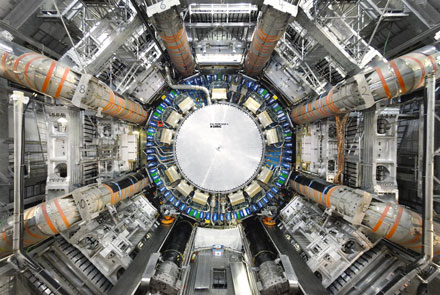
Detector ATLAS. Foto CERN
El Centro Europeo de Física de Partículas (CERN) ha reunido en sólo tres meses más del doble de datos experimentales que todo el pasado año, lo que le acerca a un resultado definitivo sobre la existencia o no del Bosón de Higgs, la última partícula a descubrir en el modelo estándar de física.

Así lo reveló el CERN al anunciar que la próxima semana celebrará un seminario científico para aportar "la última actualización en la búsqueda del Bosón de Higgs".

El director de Aceleradores y Tecnología del CERN, Steve Myers, indicó que terminó la toma de datos para presentar los resultados preliminares en la mayor conferencia internacional de física de partículas del año, la ICHEP, que se celebra julio en Melburne (Australia).

El calendario de funcionamiento del acelerador LHC se diseñó especialmente para obtener "la mayor cantidad posible de datos de los experimentos" antes de ese gran evento científico, de forma que entre abril y junio de 2012 se consiguieron más informaciones que en todo 2011.

En ese periodo se incrementó la energía a la que circulaban los haces de protones hasta llegar a una intensidad jamás alcanzada por otra máquina y se mejoraron las técnicas de análisis para seleccionar datos que podrían probar la existencia del Bosón.

La información reunida "debería ser suficiente para ver si las tendencias que observamos en 2011 todavía están allí o si por el contrario han desaparecido", sostuvo el director de investigación e informática del CERN, Sergio Bertolucci.

A finales del pasado año, científicos del CERN aseguraron que el análisis de los primeros resultados arrojaba indicios "intrigantes" de la eventual existencia del Bosón de Higgs, pero explicaron que con el nivel de datos reunidos hasta entonces no era posible dar una confirmación científica de la partícula más buscada de la física moderna.