Mostrando entradas con la etiqueta Cianobacteria. Mostrar todas las entradas

domingo, 5 de mayo de 2013

Purdue professor identifies proton pathway in photosynthesis

ORIGINAL: Purdue BioNews
Posted on April 22, 2013 

A Purdue University-led team has revealed the proton transfer pathway responsible for a majority of energy storage in photosynthesis.
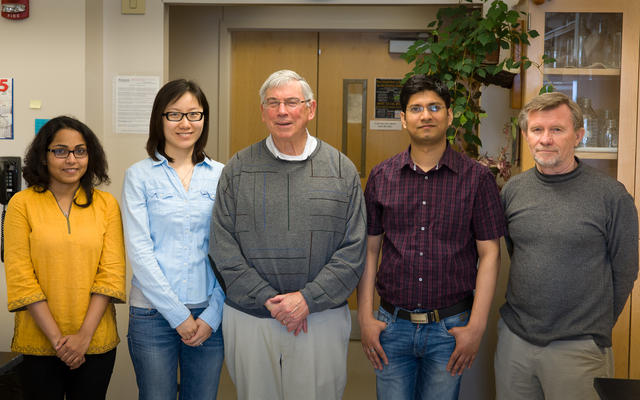
From left to right: Danas Baniulus, Jason Stofleth, William Cramer, Stanislav Zakharov and S.Saif Hasan. Not pictured in photo: E.Yamashita and Mariya V. Zhainina
Through photosynthesis, plants, algae and bacteria convert sunlight, carbon dioxide and water into chemical energy stored in the membrane of special cells, a process similar to charging a battery, said William A. Cramer, the Henry Koffler Distinguished Professor of Biological Sciences and research team leader.

The key to photosynthesis is the movement of electrical charge from a positive to a negative pole, just as in a battery,” Cramer said. “In this case, the electrical charge is in the form of electrons and protons passed along by amino acids and water molecules in a ‘bucket brigade’ through the cellular membrane. We identified and found the structure and orientation of the individual bucket carriers.

His team looked at the pathway through the cytochrome complex, a group of eight proteins responsible for transporting two-thirds of the protons that energize the plant cell “battery.” The proteins are made up of different sequences of amino acids, including those that participate in the “bucket brigade” of proton transfer.

Cramer credits S. Saif Hasan, a graduate student in his research group who will receive his doctoral degree in May, with leading the project.

The team used X-ray crystallography to describe the molecular structure of the cytochrome complex isolated from cyanobacteria, the most primitive photosynthetic organism.

A paper detailing the National Institutes of Health-funded work was published in the Proceedings of the National Academy of Sciences.

Although a mechanism for energy storage involving transfer of protons across biological membranes was the subject of the 1978 Nobel Prize in chemistry and advances had been made in its understanding, the amino acids involved and how they are connected for proton transfer in the photosynthetic protein complex was unknown, Cramer said.

In addition to Cramer and Hasan, team members include E. Yamashita of the Institute for Protein Chemistry in Osaka, Japan, and D. Baniulis of the Lithuanian Research Institute for Agriculture and Forestry.

Understanding details of the process of photosynthesis aids work toward the development of artificial photosynthesis, which could allow for the conversion of solar energy into alternative environmentally friendly sources of biofuels.

The findings also contribute to the understanding of membrane proteins, which regulate all traffic into and out of the cell and are important for drug delivery and structural biology.

Membrane proteins are fat-soluble, which makes them especially difficult to isolate and crystallize for examination, Cramer said.

Membrane proteins dissolve only in fat, not water, and if you pull them out of the cell membrane they tend to congeal like grease on a frying pan dipped in cold water,” he said. “Scientists have only been able to determine the structure of relatively few of this group of proteins, and we have much more to learn.

Writer: Elizabeth Gardner, 765-494-2081, ekgardner@purdue.edu

Source: William Cramer, 765-494-4956, waclab@purdue.edu

Related website:


ABSTRACT

Quinone-Dependent Proton Transfer Pathways in the 
Photosynthetic Cytochrome b6f Complex

S. Saif Hasan, Eiki Yamashita, Danas Baniulis, and William A. Cramer

As much as two-thirds of the proton gradient used for transmembrane free energy storage in oxygenic photosynthesis is generated by the cytochrome b6f complex. The proton uptake pathway from the electrochemically negative (n) aqueous phase to the n-side quinone binding site of the complex, and a probable route for proton exit to the positive phase resulting from quinol oxidation, are defined in a 2.70-Å crystal structure and in structures with quinone analog inhibitors at 3.07 Å (tridecyl-stigmatellin) and 3.25 Å (2-nonyl-4-hydroxyquinoline N-oxide) resolution. The simplest n-side proton pathway extends from the aqueous phase via Asp20 and Arg207 (cytochrome b6 subunit) to quinone bound axially to heme cn. On the positive side, the heme-proximal Glu78 (subunit IV), which accepts protons from pastosemiquinone, defines a route for H+ transfer to the aqueous phase. These pathways provide a structure-based description of the quinone-mediated proton transfer responsible for generation of the transmembrane electrochemical potential gradient in oxygenic photosynthesis.

This work was funded in part by National Institutes of Health Grant GM-038323.
This article originally appeared in Purdue Today on April 22, 2013


martes, 29 de enero de 2013

Algae in Paris Revisited

JANUARY 25, 2013

On occasion we publish letters on Green Building Elements. In this case, Kstor, writing from France, is critical of the energy promises made by Ennesys and Origin Oil in a Jan. 11 post about growing algae on buildings using wastewater to then generate energy. In spite of real optimism to generate renewable energy using a sustainable infrastructure, the criticism here is articulate and should be carefully considered by those intrigued by the promise of algae.

Photo: Algae floating from Shutterstock
Kstor writes:

The idea of growing algae on buildings using wastewater is not new. As a matter of fact, it originates from the French architect studio X-TU back in 2008 (and they have a patent on it), which will soon deliver the first prototypes of their biofacade concept in cooperation with a world-class French public laboratory on microalgae controlled cultures (see recent press releases and articles in French about it).

The problem here is more what Ennesys tries to achieve, when they promise to cover 80% of the building’s energy needs thanks to microalgae productivities of 150T/ha (see many other articles and their press releases).

Those figures are just not correct, as any microalgae specialist will immediately notice. These kinds of productivity are theorical, and can only be achieved in lab conditions with a 12 h direct flow of photons and constant temperature, pH, nutriments, carbon inputs, etc… In outdoor conditions, the maximum productivity in Paris would be around 30 T/ha with the most advanced intensified PBRs – which they do not have – as a scientific article clearly demonstrate: “Theoretical Investigation of Biomass Productivities Achievable in Solar Rectangular Photobioreactors for the Cyanobacterium Arthrospira platensis”.

It would be wise for Ennesys, and especially for their partners and investors, to “land on earth” and announce more realistic figures- unless they want to nourrish a greentech bubble…

Thanks for the letter. We invite Origin Oil and Ennesys to respond.

Thanks to Jean-Louis Kindler at Ennesys for this answer:

There is abundant scientific – both private and public – literature confirming the figures demonstrated a few decades ago by NREL / DOE in the US showing average yields in the range of 30 dry g/m2/day in outdoor facilities, not even using advanced intensified PBR’s (just type “microalgae yield per acre” in any search engine).

Your assertions are based on theories and furthermore on assumptions on our system’s configuration. Our system’s performance is being measured with our real size, outdoor demonstrator.


ORIGINAL ARTICLE Source of discussion

Origin Oil & Ennesys Use Paris Building Wastewater to Grow Algae for Energy
BY GLENN MEYERS
JANUARY 11, 2013

This post provides an interesting glimpse at a recently opened Paris building that generates energy from wastewater. The companies involved in this venture: Ennesys and Origin Oil.


Photo: Ennesys
OriginOil and its energy systems partner Ennesys unveiled this pilot project at the high-rise La Défense area in Paris, which has 37.7 million sq ft of office space, where they are fusing two essential functions of the smart buildings of the future: energy generation and wastewater clean-up. They have developed a solution that converts wastewater from commercial buildings into energy.

Here’s a short video

Jerry Schranz, part of the public relations team, informed me this system takes wastewater from the building (that is derived from bathroom waste water, kitchen water, etc.). This water is then used to grow algae, which is nourished by wastewater. The Algae Appliance invented by OriginOil scientists, processes the water and algae to produce methane, which is then used to power the building. Importantly, the flat panel bioreactors (where the algae grows) can be used on vertical surfaces, so skyscrapers are a huge area of opportunity for this type of energy production.

Algae Appliance invented by OriginOil
Photo: Ennesys
While the French government has mandated that new commercial buildings must produce more clean energy than they consume and purify or recycle water, OriginOil views these conditions as laying favorable ground for its technologies to be broadly adopted.

Congratulations to Ennesys and Riggs Eckelberry, Origin Oil’s CEO, on this demonstration of sustainable energy.


martes, 2 de octubre de 2012

Bloom - Microbial Bebop

ORIGINAL: YouTube

This musical composition was created from data of microbes (bacteria, algae and other microorganisms) sampled in the English Channel. Argonne National Laboratory biologist Peter Larsen created the songs as a unique way to present and comprehend large datasets. 

This composition highlights seasonal patterns in marine physical parameters at the L4 Station. The chords are generated from seasonal changes in photosynthetically active radiation. The melody of each measure is comprised of eight notes, each mapped to a physical environmental parameter, in the following order: 
  • temperature, 
  • soluble reactive phosphate, 
  • nitrate, 
  • nitrite, 
  • saline, 
  • silicate and c
  • hlorophyll A concentrations. 

Photo of cyanobacteria colonies is courtesy Specious Reasons
Creative Commons.

jueves, 17 de mayo de 2012

Lawrence Berkeley National Lab: Oil from Tobacco Leaves

ORIGINAL: UC ARPA-E


FOLIUM is a collaborative project between LBNL, UC Berkeley, JGI and The Kentucky Tobacco Research & Development Center (KTRDC) at Univ. of Kentucky and is funded by ARPA-E. The FOLIUM team, which consists of a bunch of unusually attractive people, can be viewed on the here

Other FOLIUM team members are:
  • Ling Meng, Postdoc in the Jansson lab
  • Hanwool Park, Research Assistant in the Jansson lab
  • Hsu-Ching Winz, Molecualr Biology Specialist in the Melis lab
  • Tamara Miller Lab assistant in the Lemaux lab
  • Judith Adhiambo-Otwi, Postdoc in the Lemaux lab
  • Lauriebeth Leonelli, Postdoc in theNiyogi lab
  • Fei Cai, Postdoc in the Kerfeld lab
  • Barunava Patra, Postdoc in the Chamber/ Yuan lab
  • Yongmei Wu, Visiting Scholar in the Chamber/Yuan lab
The FOLIUM concept is to develop tobacco as a platform for foliar production of advanced hydrocarbon fuels. This involves: 
  1. Installing pathways for alkane and isoprenoid biosynthesis and accumulation in tobacco leaves via chloroplast and nuclear transformation
  2. Optimize carbon flux toward hydrocarbon biosynthesis
  3. Enhance photosynthetic light efficiency and CO2 uptake
  4. Improve planting, cultivation and harvesting practices of tobacco. 
In the context of foliar production of oil and oil-based biofuels, tobacco (Nicotiana tabacum) emerges as a system of great potential: 
  1. Tobacco is an outstanding industrial biomass crop with large leaf surface area, and a high leaf-to-stem ratio
  2. It can be coppiced to generate multiple harvests per year
  3. Large-scale agricultural infrastructure for planting, growing, harvesting and handling tobacco leaves is in place. 
  4. The tobacco farmers would benefit by using tobacco as a biofuel crop plant. 
  5. Tobacco is already cultivated in large land tracts of the US and many countries overseas. It is grown in over 100 countries worldwide, can be cultivated on marginal land unsuitable for food crops, and has a wider geographic geographic range than either corn or sugar cane. 
  6. Tobacco is not part of the food supply chain. Thus biosynthesis of oil-based biofuels in tobacco leaves, as opposed to oil seeds in soybean or canola, avoids the potential problem of competition with the food/feed sector
  7. Tobacco is highly amenable to genetic and molecular manipulations of both the nuclear and plastid genomes. With 500 to 10,000 copies of the plastome per cell in tobacco leaves, the possibility exist for very high overexpression of selected genes. 
  8. Sequencing and annotation of the tobacco nuclear genome is currently in progress. The work in my group has a dual focus: 
    1. Introduce the alkane biosynthesis pathway from cyanobacteria into tobacco chloroplasts (Fig. 1). 
    2. Enhance CO2 uptake in tobacco by introduction of bicarbonate transporters from cyanobacteria into tobacco chloroplasts.

Scientists at UC Berkeley and Lawrence Berkeley National Laboratory's FOLIUM Project, funded by ARPA-E, use light to convert the carbon in tobacco leaves into biofuels.

LAWRENCE BERKELEY NATIONAL LAB: OIL FROM TOBACCO LEAVES

CRITICAL NEED
Traditional biofuels production is limited by the small amount of solar energy plants convert by photosynthesis into plant material that is readily processed into fuels and by inefficient fuel conversion techniques. New robust, farm-ready crops are needed that produce more easily convertible fuel precursors per acre at dramatically lower costs. If successful, advanced biofuels would offer a renewable alternative to petroleum-based fuels that produces nearly zero net greenhouse gas emissions. Biofuels must be produced at close to half their current cost to make them cost-competitive with petroleum-based fuels.

PROJECT INNOVATION + ADVANTAGES
LBNL is modifying tobacco to enable it to directly produce fuel molecules in its leaves for use as a biofuel. 
Tobacco is a good crop for biofuels production because it is an outstanding biomass crop, has a long history of cultivation, does not compete with the national food supply, and is highly responsive to genetic manipulation. LBNL will incorporate traits for hydrocarbon biosynthesis from cyanobacteria and algae, and enhance light utilization and carbon uptake in tobacco, improving the efficiency of photosynthesis so more fuel can be produced in the leaves. The tobacco-generated biofuels can be processed for gasoline, jet fuel or diesel alternatives. LBNL is also working to optimize methods for planting, cultivating and harvesting tobacco to increase biomass production several-fold over the level of traditional growing techniques.

IMPACT
If successful, LBNL’s project would genetically engineer tobacco to enable it to produce oil directly from its leaves. This could enable large scale production of oils, which could eventually begin to replace petroleum-based fuels.

SECURITY: The transportation sector accounts for nearly all of our petroleum imports. Providing an advanced biofuels alternative to petroleum will allow the U.S. to reduce these imports, improving our energy independence.
ENVIRONMENT: More than 25% of all greenhouse gas emissions in the U.S. come from the transportation sector. Because plants naturally absorb carbon dioxide as they grow, the level of greenhouse gas emissions from biofuels is less than half that of petroleum fuels.
ECONOMY: The U.S. imports nearly $1 billion in petroleum each day, accounting for the single largest factor in our trade balance with the rest of the world. Biofuels can be produced domestically, allowing us to keep more dollars at home.
JOBS: A self-sustaining biofuels industry that is cost-competitive with oil is well-positioned to see job growth in the agricultural, engineering, and research sectors.

CONTACTS
ARPA-E Program Director:
Dr. Jonathan Burbaum,
jonathan.burbaum@hq.doe.gov
Project Contact:
Dr. Christer Jansson,
cgjansson@lbl.gov