Mostrando entradas con la etiqueta Research. Mostrar todas las entradas

domingo, 27 de enero de 2019

Chemical Computing, the Future of Artificial Intelligence

In 1951, the Russian chemist Boris Belousov sent to a scientific journal a study in which he described an astonishing discovery: while trying to simulate a metabolic process in the laboratory, he had discovered a chemical reaction that occurred and then reversed itself on its own, alternating between a yellow colour and a colourless state. Belousov couldn’t find any journal willing to publish his results, since they appeared to violate a fundamental law of nature.

However, his work—which only came to light in 1959 through a brief presentation at a symposium—has become, half a century later, the foundation stone of a new discipline: chemical computing. This technological path is an alternative to quantum computing and conventional computing, capable of processing in parallel based on the same operating principles as our brain, promising futuristic applications, such as integrating in our body in the form of intelligent biosensors.

Portrait of Boris Belousov. Source: Wikimedia
Computing is based on the use of logic gates, which process a data input—usually in binary code—to produce a result or output. In the chips of our current computers, this function is carried out thanks to semiconductors, materials with a binary response capacity operating through the movement of electrons. However, this is not the only possible system; quantum computing, currently in the experimental phase, uses properties of subatomic particles that can also take alternative values, with greater versatility than semiconductors.

Until the discovery of Belousov, no one would have suspected that chemical reactions could act as logic gates. According to the second law of thermodynamics, these processes are linear, spontaneously moving towards equilibrium through an increase in entropy, a measure of the energy of chaos; what is done cannot be undone, at least on its own. For this reason, Belousov’s work was rejected and ignored, until a decade later it was recovered, extended and made known by the biophysicist Anatol Zhabotinsky.

THE FIRST CHEMICAL OSCILLATOR

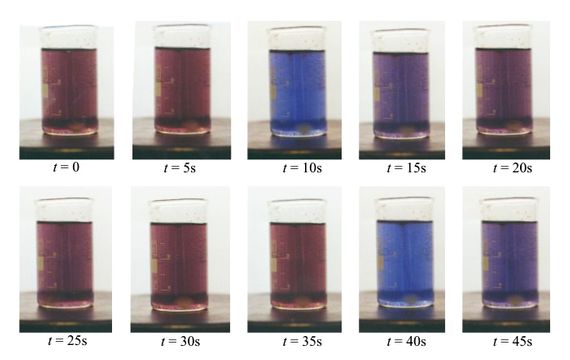
The Belousov-Zhabotinsky reaction was the first chemical oscillator, a non-linear reaction that moves alternately in one direction and then the opposite as the process itself modifies the concentrations of the ions present, and which only stops when the reagents are consumed. In a Petri dish, these reactions produce waves of colours that diffuse from different points and act as inputs; the interaction between these input data can produce as an output a new wave—a 1, in binary code.

But this ability of chemical systems to compute by acting as logic gates is not something invented by humans, but was discovered, since it exists in nature. “We are already using chemical computers, because our brains and bodies employ communication via the diffusion of mediators, neuromodulators, hormones, etc.,” says computer scientist Andrew Adamatzky, director of the International Center of Unconventional Computing at the University of the West of England in Bristol. “We are chemical computers,” he summarises.

The Belousov-Zhabotinsky reaction is a non-linear reaction that moves alternately in one direction and then the opposite. Credit: Jkrieger
For decades it was believed that the brain’s computational capacity lay in the neuron as a minimal unit, and that its subcellular parts were limited to acting as simple transmitters of the decisions made by the cell in terms of the inputs received. Today it is known that this is not the case, and that discrete parts of the neuron, such as
  • the dendrites (the branches that receive the signals), 
  • the axon (which sends the impulse to other neurons), and 
  • the synapse (the space that communicates between them) 
are independently modulable, and therefore capable of computing by themselves. As this modulation is exerted through chemical agents, the brain is not an electrical computer, but an electrochemical one.

THE BRAIN, A PARALLEL COMPUTER

The great versatility of each neuron confers on the brain a valuable quality. “The brain and chemical computers are parallel computers,” explains biophysicist Vladimir Vanag, from the Centre for Nonlinear Chemistry at the Immanuel Kant Baltic Federal University (Russia). Parallel computing is not within the reach of conventional microprocessors (though it is for quantum ones). In practice, this advantage that chemical computing possesses overcomes one of its drawbacks—its slower speed.

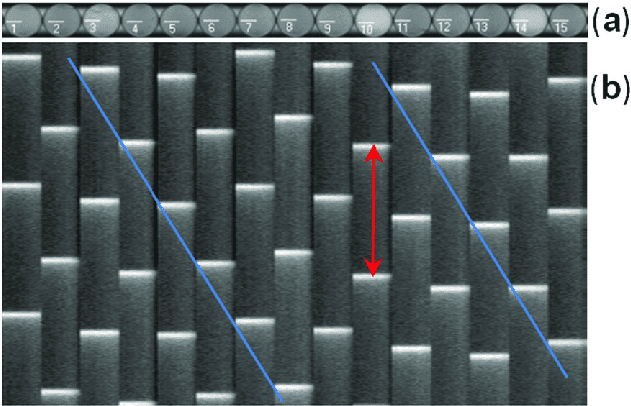
(a) The array of the BZ microdroplets in a 1D capillary. (b) Spacetime plot for the dynamics of the BZ MDs at GNF with coefficient g e = 0.11. The total size of the space-time plot is equal to 1875 mm  424 s. Short horizontal bars depict spikes for each of the 15 BZ MDs. The averaged diameter d of a single MD equals 125 mm. The red arrow depicts the averaged period of oscillations, T 0 = 159 s. The slope of the blue line characterizes the ''velocity'' spike propagation, 1.68 mm s À1. Some droplets in snapshot (a) look lighter since they are in the oxidized state of the catalyst, the others look darker since they correspond to the reduced state of the catalyst. White dashes in droplets with index numbers (from 1 to 15) display the image reading area to record the ox-red state of the droplets. Compared with the great speed of electronic chips, chemical computing is limited by the speed of the diffusion of reactions in the medium. Researchers like Adamaztky are working on breaking this barrier: “Systems can be scaled down to the nano-scale and then everything will be fast,” he says. However, he notes that certain applications will not require higher speeds: “When reaction-diffusion computers are embedded in the human body, their speed of processing information will perfectly match natural processes.”

But in any case, Vanag explains with an example how parallel computing compensates for any speed limit: if a micro-oscillator—equivalent to a processor—occupies a cubic volume of 100 microns on each side, a single cubic centimetre could contain a million of them, all working in parallel. Thus, “we can increase the number of micro-oscillators by many orders of magnitude and overcome the speed of conventional computers,” he says. Say goodbye to Moore’s law; with chemical computing, a small increase in volume is enough to multiply the processing capacity. This is the secret of the human brain, slower than any computer, but more powerful than all of them.

The brain is slower than any computer, but much more powerful. Credit: Pixbay
A NEW ARTIFICIAL-INTELLIGENCE
In addition, chemical computing brings other crucial advantages. “It should work without electricity,” says Vanag. “No viruses, autonomous regime of working, and extremely high efficiency.” And all this while using just a few cheap chemical reagents. Thanks to these qualities, chemical computing is emerging as a promising alternative to simulate the human brain. By building bottom-up systems, starting with small oscillator networks and adding more and more layers of complexity, scientists are learning how cognitive functions such as image recognition or decision making appear.

Of course, a consequence of this chemical recreation of the brain would be the possibility of obtaining new artificial-intelligence systems, but radically different from what we usually envision: imagine robots made of gel, without a defined shape, capable of dividing themselves into smaller ones so that each one of them works independently. Perhaps they’ll even be embedded in our own bodies, analysing our biological parameters, curing our diseases. “But this is a fantasy,” concludes Vanag. “At the moment.


Javier Yanes


ORIGINAL: OpenMind

domingo, 16 de abril de 2017

With this new system, scientists never have to write a grant application again

Johan Bollen (left) and Marten Scheffer (right) say scientists should give each other money instead of writing and reviewing grants. Ingrid van de Leemput
AMSTERDAM—Almost every scientist agrees: Applying for research funding is a drag. Writing a good proposal can take months, and the chances of getting funded are often slim. Funding agencies, meanwhile, spend more and more time and money reviewing growing stacks of applications.

That’s why two researchers are proposing a radically different system that would do away with applications and reviews; instead scientists would just give each other money. “Self-organized fund allocation(SOFA), as it’s called, was developed by computer scientist Johan Bollen at Indiana University in Bloomington. When he first published about the idea in 2014, many people were skeptical. But interest appears to be growing, and thanks to the work of an enthusiastic advocate, ecologist Marten Scheffer of Wageningen University in the Netherlands, the Dutch parliament adopted a motion last year asking the country’s main funding agency, the Netherlands Organization for Scientific Research (NWO), to set up a SOFA pilot project.

Competition for funding has become too intense, especially for young scientists, Scheffer and Bollen say, and the current peer-review system is inefficient. It’s also unfair, they argue, because a few scientists get lots of grants—Scheffer is one of them—whereas many others get few or nothing. But when Scheffer explained his idea at an NWO workshop about “application pressure” here last week, the agency didn’t appear sold yet.

The duo says the numbers speak for themselves. At the U.S. National Institutes of Health, the overall success rate for grants applications has dropped from 30% in 2003 to 19.1% in 2016. In the latest round of European Research Council Starting Grants, the rate was a paltry 11.3%. At NWO, the success rate for grants for young scientists has dropped to 14%. A 2013 study estimated that writing and reviewing applications for €40 million worth of these grants costs €9.5 million annually.

In Bollen’s system, scientists no longer have to apply; instead, they all receive an equal share of the funding budget annually—some €30,000 in the Netherlands, and $100,000 in the United States—but they have to donate a fixed percentage to other scientists whose work they respect and find important. “Our system is not based on committees’ judgments, but on the wisdom of the crowd,” Scheffer told the meeting.

Bollen and his colleagues have tested their idea in computer simulations. If scientists allocated 50% of their money to colleagues they cite in their papers, research funds would roughly be distributed the way funding agencies currently do, they showed in a paper last year—but at much lower overhead costs.

Not everybody is convinced. At the meeting, some worried that scientists might give money mostly to their friends. Scheffer said an algorithm would prevent that, for instance by banning donations to people you have published with, but he acknowledged it would be a challenge in small research communities. SOFA might also result in a mismatch between what scientists need and what their colleagues donate, and a competition for donations could lead to a time-consuming and costly circus, comparable to an election campaign.

The way to find out, Scheffer and Bollen say, is a real-world test, and they say the Netherlands, a small country with short lines of communication between scientists, politicians, and funding agencies, is a good place for one. Last year, Scheffer convinced Eppo Bruins, a member of the Dutch House of Representatives, to submit a motion calling for a pilot program at NWO, which the parliament approved in June 2016. The money could be taken from a €150 million NWO pot currently distributed among consortia of innovative Dutch scientists, Bruins suggested.

But NWO is not obliged to carry out the proposal, and so far has shown little enthusiasm. “NWO is willing to explore together with scientists and other stakeholders how to improve allocation rates, but is still considering practicality and support” for SOFA, a spokesperson tells ScienceInsider. At last week’s meeting, NWO President Stan Gielen said the funds Bruins has in mind are distributed by NWO but are earmarked by the Ministry of Education, Culture and Science, which would have to give permission. Gielen added that any experiment should not come at the expense of existing funding.

Scheffer says he’s not giving up. It’s not a risky experiment, he says: “The money would not be wasted, after all, but just be given to other scientists.But he says he understands why NWO is not thrilled: If applied universally, the novel system would make the agency redundant. Perhaps it’s telling, Scheffer says, that he has not been invited to an international conference on applications and peer review that NWO is organizing in June.
DOI: 10.1126/science.aal1055

ORIGINAL: Science Magazine
Apr. 13, 2017 , 3:00 PM

jueves, 3 de noviembre de 2016

Kate Rubins’ Space Station Science Scrapbook

As a child, Kate Rubins dreamed of being an astronaut and a scientist. During the past four months aboard the International Space Station, that dream came full circle. She became the first person to sequence DNA in space, among other research during her recent mission, adding to her already impressive experience. She holds a doctorate in molecular biology, and previously led a lab of 14 researchers studying viruses, including Ebola.
Here’s a look back at Rubins in her element, conducting research aboard your orbiting laboratory.

Kate inside Destiny, the U.S. Laboratory Module

Destiny houses the Microgravity Science Glovebox (MSG), in which Kate worked on the Heart Cells experiment.
The U.S. national laboratory, called Destiny, is the primary research laboratory for U.S. payloads, supporting a wide range of experiments and studies contributing to health, safety, and quality of life for people all over the world. 

Swabbing for Surface Samples
Microbes that can cause illness could present problems for current and future long duration space missions. 
Understanding what microbe communities thrive in space habitats could help researchers design antimicrobial technology. Here, Kate is sampling various surfaces of the Kibo module for the Microbe-IV investigation.

Culturing Beating Heart Cells in Space
The Heart Cells investigation uses human skin cells that are induced to become stem cells, which can then differentiate into any type of cell.
Researchers forced the stem cells to grow into human heart cells, which Rubins cultured aboard the space station for one month.

Rubins described seeing the heart cells beat for the first time as “pretty amazing. First of all, there’s a few things that have made me gasp out loud up on board the [space] station. Seeing the planet was one of them, but I gotta say, getting these cells in focus and watching heart cells actually beat has been another pretty big one.”

Innovative Applied Research Experiment from Eli Lilly
The Hard to Wet Surfaces investigation from Eli Lilly, and sponsored by the Center for the Advancement of Science in Space (CASIS), looks at liquid-solid interactions and how certain pharmaceuticals dissolve, which may lead to more potent and effective medicines in space and on Earth. 
Rubins set up vials into which she injected buffer solutions and then set up photography to track how tablets dissolved in the solution in microgravity.

Capturing Dragon
Rubins assisted in the capture of the SpaceX Dragon cargo spacecraft in July. The ninth SpaceX resupply mission delivered more than two thousand pounds of science to the space station. 
Biological samples and additional research were returned on the Dragon spacecraft more than a month later. 

Sliding Science Outside the Station
Science doesn’t just happen inside the space station. External Earth and space science hardware platforms are located at various places along the outside of the orbiting laboratory. 

The Japanese Experiment Module airlock can be used to access the JEM Exposed Facility. Rubins installed the JEM ORU Transfer Interface (JOTI) on the JEM airlock sliding table used to install investigations on the exterior of the orbiting laboratory.

Installing Optical Diagnostic Instrument in the MSG
Rubins installed an optical diagnostic instrument in the Microgravity Science Glovebox (MSG) as part of the Selective Optical Diagnostics Instrument (SODI-DCMIX) investigation. Molecules in fluids and gases constantly move and collide. 

When temperature differences cause that movement, called the Soret effect, scientists can track it by measuring changes in the temperature and movement of mass in the absence of gravity. Because the Soret effect occurs in underground oil reservoirs, the results of this investigation could help us better understand such reservoirs.

The Sequencing of DNA in Space
When Rubins’ expedition began, DNA had never been sequenced in space. Within just a few weeks, she and the Biomolecule Sequencer team had sequenced their one billionth “base” – the unit of DNA - aboard the orbiting laboratory. 


The Biomolecule Sequencer investigation seeks to demonstrate that DNA sequencing in microgravity is possible, and adds to the suite of genomics capabilities aboard the space station.

The MinION™ DNA sequencer from Oxford Nanopore Technologies fits in the palm of a hand.
Credits: Oxford Nanopore Technologies

Studying Fluidic Dynamics with SPHERES
The SPHERES-Slosh investigation examines the way liquids move inside containers in a microgravity environment. The phenomena and mechanics associated with such liquid movement are still not well understood and are very different than our common experiences with a cup of coffee on Earth.


Rockets deliver satellites to space using liquid fuels as a power source, and this investigation plans to improve our understanding of how propellants within rockets behave in order to increase the safety and efficiency of future vehicle designs. Rubins conducted a series of SPHERES-Slosh runs during her mission.

Retrieving Science Samples for Their Return to Earth
Precious science samples like blood, urine and saliva are collected from crew members throughout their missions aboard the orbiting laboratory. 


They are stored in the Minus Eighty-Degree Laboratory Freezer for ISS (MELFI) until they are ready to return to Earth aboard a Soyuz or SpaceX Dragon vehicle.

Measuring Gene Expression of Biological Specimens in Space

Rubins ran several WetLab-2 RNA SmartCycler sessions during her mission.
Our WetLab-2 hardware system is bringing to the space station the technology to measure gene expression of biological specimens in space, and to transmit the results to researchers on Earth at the speed of light. 

Studying the First Expandable Habitat Module on the Space Station
The Bigelow Expandable Activity Module (BEAM) is the first expandable habitat to be installed on the space station. It was expanded on May 28, 2016. 


Expandable habitats are designed to take up less room on a spacecraft, but provide greater volume for living and working in space once expanded. Rubins conducted several evaluations inside BEAM, including air and surface sampling.

Better Breathing in Space and Back on Earth
Airway Monitoring, an investigation from ESA (the European Space Agency), uses the U.S. airlock as a hypobaric facility for performing science. Utilizing the U.S. airlock allows unique opportunities for the study of gravity, ambient pressure interactions, and their effect on the human body. 


This investigation studies the occurrence and indicators of airway inflammation in crew members, using ultra-sensitive gas analyzers to evaluate exhaled air. This could not only help in spaceflight diagnostics, but that also hold applications on earth within diagnostics of similar conditions, for example monitoring of asthma.

Hot Science with Cool Flames
Fire behaves differently in space, where buoyant forces are removed. Studying combustion in microgravity can increase scientists’ fundamental understanding of the process, which could lead to improvement of fire detection and suppression systems in space and on Earth. 

Many combustion experiments are performed in the Combustion Integration Rack (CIR) aboard the space station. Rubins replaced two Multi-user Droplet Combustion Apparatus (MDCA) Igniter Tips as part of the CIR igniter replacement operations.

Though Rubins is back on Earth, science aboard the space station continues, and innovative investigations that seek to benefit humans on Earth and further our exploration of the solar system are ongoing. Follow @ISS_Research to keep up with the science happening aboard your orbiting laboratory. 

Make sure to follow us on Tumblr for your regular dose of space: http://nasa.tumblr.com

miércoles, 7 de septiembre de 2016

Quantum Computers Explained – Limits of Human Technology

Where are the limits of human technology? And can we somehow avoid them? This is where quantum computers become very interesting. 

Check out THE NOVA PROJECT to learn more about dark energy: www.nova.org.au 


ORIGINAL: YouTube


martes, 17 de mayo de 2016

The Rise of Artificial Intelligence and the End of Code

EDWARD C. MONAGHAN
Soon We Won’t Program Computers. We’ll Train Them Like Dogs

Before the invention of the computer, most experimental psychologists thought the brain was an unknowable black box. You could analyze a subject’s behavior—ring bell, dog salivates—but thoughts, memories, emotions? That stuff was obscure and inscrutable, beyond the reach of science. So these behaviorists, as they called themselves, confined their work to the study of stimulus and response, feedback and reinforcement, bells and saliva. They gave up trying to understand the inner workings of the mind. They ruled their field for four decades. 
Then, in the mid-1950s, a group of rebellious psychologists, linguists, information theorists, and early artificial-intelligence researchers came up with a different conception of the mind. People, they argued, were not just collections of conditioned responses. They absorbed information, processed it, and then acted upon it. They had systems for writing, storing, and recalling memories. They operated via a logical, formal syntax. The brain wasn’t a black box at all. It was more like a computer. 

The so-called cognitive revolution started small, but as computers became standard equipment in psychology labs across the country, it gained broader acceptance. By the late 1970s, cognitive psychology had overthrown behaviorism, and with the new regime came a whole new language for talking about mental life. Psychologists began describing thoughts as programs, ordinary people talked about storing facts away in their memory banks, and business gurus fretted about the limits of mental bandwidth and processing power in the modern workplace. 

This story has repeated itself again and again. As the digital revolution wormed its way into every part of our lives, it also seeped into our language and our deep, basic theories about how things work. Technology always does this. During the Enlightenment, Newton and Descartes inspired people to think of the universe as an elaborate clock. In the industrial age, it was a machine with pistons. (Freud’s idea of psychodynamics borrowed from the thermodynamics of steam engines.) Now it’s a computer. Which is, when you think about it, a fundamentally empowering idea. Because if the world is a computer, then the world can be coded. 

Code is logical. Code is hackable. Code is destiny. These are the central tenets (and self-fulfilling prophecies) of life in the digital age. As software has eaten the world, to paraphrase venture capitalist Marc Andreessen, we have surrounded ourselves with machines that convert our actions, thoughts, and emotions into data—raw material for armies of code-wielding engineers to manipulate. We have come to see life itself as something ruled by a series of instructions that can be discovered, exploited, optimized, maybe even rewritten. Companies use code to understand our most intimate ties; Facebook’s Mark Zuckerberg has gone so far as to suggest there might be a “fundamental mathematical law underlying human relationships that governs the balance of who and what we all care about.In 2013, Craig Venter announced that, a decade after the decoding of the human genome, he had begun to write code that would allow him to create synthetic organisms. “It is becoming clear,” he said, “that all living cells that we know of on this planet are DNA-software-driven biological machines.” Even self-help literature insists that you can hack your own source code, reprogramming your love life, your sleep routine, and your spending habits.


In this world, the ability to write code has become not just a desirable skill but a language that grants insider status to those who speak it. They have access to what in a more mechanical age would have been called the levers of power. “If you control the code, you control the world,” wrote futurist Marc Goodman. (In Bloomberg Businessweek, Paul Ford was slightly more circumspect: “If coders don’t run the world, they run the things that run the world.” Tomato, tomahto.) 

But whether you like this state of affairs or hate it—whether you’re a member of the coding elite or someone who barely feels competent to futz with the settings on your phone—don’t get used to it. Our machines are starting to speak a different language now, one that even the best coders can’t fully understand. 

Over the past several years, the biggest tech companies in Silicon Valley have aggressively pursued an approach to computing called machine learning. In traditional programming, an engineer writes explicit, step-by-step instructions for the computer to follow. With machine learning, programmers don’t encode computers with instructions. They train them. If you want to teach a neural network to recognize a cat, for instance, you don’t tell it to look for whiskers, ears, fur, and eyes. You simply show it thousands and thousands of photos of cats, and eventually it works things out. If it keeps misclassifying foxes as cats, you don’t rewrite the code. You just keep coaching it. 

This approach is not new—it’s been around for decades—but it has recently become immensely more powerful, thanks in part to the rise of deep neural networks, massively distributed computational systems that mimic the multilayered connections of neurons in the brain. And already, whether you realize it or not, machine learning powers large swaths of our online activity. Facebook uses it to determine which stories show up in your News Feed, and Google Photos uses it to identify faces. Machine learning runs Microsoft’s Skype Translator, which converts speech to different languages in real time. Self-driving cars use machine learning to avoid accidents. Even Google’s search engine—for so many years a towering edifice of human-written rules—has begun to rely on these deep neural networks. In February the company replaced its longtime head of search with machine-learning expert John Giannandrea, and it has initiated a major program to retrain its engineers in these new techniques. “By building learning systems,” Giannandrea told reporters this fall, “we don’t have to write these rules anymore.” 

Our machines speak a different language now, one that even the best coders can’t fully understand. 

But here’s the thing: With machine learning, the engineer never knows precisely how the computer accomplishes its tasks. The neural network’s operations are largely opaque and inscrutable. It is, in other words, a black box. And as these black boxes assume responsibility for more and more of our daily digital tasks, they are not only going to change our relationship to technology—they are going to change how we think about ourselves, our world, and our place within it. 

If in the old view programmers were like gods, authoring the laws that govern computer systems, now they’re like parents or dog trainers. And as any parent or dog owner can tell you, that is a much more mysterious relationship to find yourself in. 

Andy Rubin is an inveterate tinkerer and coder. The cocreator of the Android operating system, Rubin is notorious in Silicon Valley for filling his workplaces and home with robots. He programs them himself. “I got into computer science when I was very young, and I loved it because I could disappear in the world of the computer. It was a clean slate, a blank canvas, and I could create something from scratch,” he says. “It gave me full control of a world that I played in for many, many years.” 

Now, he says, that world is coming to an end. Rubin is excited about the rise of machine learning—his new company, Playground Global, invests in machine-learning startups and is positioning itself to lead the spread of intelligent devices—but it saddens him a little too. Because machine learning changes what it means to be an engineer. 

People don’t linearly write the programs,” Rubin says. “After a neural network learns how to do speech recognition, a programmer can’t go in and look at it and see how that happened. It’s just like your brain. You can’t cut your head off and see what you’re thinking.When engineers do peer into a deep neural network, what they see is an ocean of math: a massive, multilayer set of calculus problems that—by constantly deriving the relationship between billions of data points—generate guesses about the world. 

Artificial intelligence wasn’t supposed to work this way. Until a few years ago, mainstream AI researchers assumed that to create intelligence, we just had to imbue a machine with the right logic. Write enough rules and eventually we’d create a system sophisticated enough to understand the world. They largely ignored, even vilified, early proponents of machine learning, who argued in favor of plying machines with data until they reached their own conclusions. For years computers weren’t powerful enough to really prove the merits of either approach, so the argument became a philosophical one. “Most of these debates were based on fixed beliefs about how the world had to be organized and how the brain worked,” says Sebastian Thrun, the former Stanford AI professor who created Google’s self-driving car. “Neural nets had no symbols or rules, just numbers. That alienated a lot of people.” 

The implications of an unparsable machine language aren’t just philosophical. For the past two decades, learning to code has been one of the surest routes to reliable employment—a fact not lost on all those parents enrolling their kids in after-school code academies. But a world run by neurally networked deep-learning machines requires a different workforce. Analysts have already started worrying about the impact of AI on the job market, as machines render old skills irrelevant. Programmers might soon get a taste of what that feels like themselves. 

Just as Newtonian physics wasn’t obviated by quantum mechanics, code will remain a powerful tool set to explore the world. 

I was just having a conversation about that this morning,” says tech guru Tim O’Reilly when I ask him about this shift. “I was pointing out how different programming jobs would be by the time all these STEM-educated kids grow up.” Traditional coding won’t disappear completely—indeed, O’Reilly predicts that we’ll still need coders for a long time yet—but there will likely be less of it, and it will become a meta skill, a way of creating what Oren Etzioni, CEO of the Allen Institute for Artificial Intelligence, calls the “scaffolding” within which machine learning can operate. Just as Newtonian physics wasn’t obviated by the discovery of quantum mechanics, code will remain a powerful, if incomplete, tool set to explore the world. But when it comes to powering specific functions, machine learning will do the bulk of the work for us. 

Of course, humans still have to train these systems. But for now, at least, that’s a rarefied skill. The job requires both a high-level grasp of mathematics and an intuition for pedagogical give-and-take. “It’s almost like an art form to get the best out of these systems,” says Demis Hassabis, who leads Google’s DeepMind AI team. “There’s only a few hundred people in the world that can do that really well.” But even that tiny number has been enough to transform the tech industry in just a couple of years. 

Whatever the professional implications of this shift, the cultural consequences will be even bigger. If the rise of human-written software led to the cult of the engineer, and to the notion that human experience can ultimately be reduced to a series of comprehensible instructions, machine learning kicks the pendulum in the opposite direction. The code that runs the universe may defy human analysis. Right now Google, for example, is facing an antitrust investigation in Europe that accuses the company of exerting undue influence over its search results. Such a charge will be difficult to prove when even the company’s own engineers can’t say exactly how its search algorithms work in the first place. 

This explosion of indeterminacy has been a long time coming. It’s not news that even simple algorithms can create unpredictable emergent behavior—an insight that goes back to chaos theory and random number generators. Over the past few years, as networks have grown more intertwined and their functions more complex, code has come to seem more like an alien force, the ghosts in the machine ever more elusive and ungovernable. Planes grounded for no reason. Seemingly unpreventable flash crashes in the stock market. Rolling blackouts. 

These forces have led technologist Danny Hillis to declare the end of the age of Enlightenment, our centuries-long faith in logic, determinism, and control over nature. Hillis says we’re shifting to what he calls the age of Entanglement. “As our technological and institutional creations have become more complex, our relationship to them has changed,” he wrote in the Journal of Design and Science. “Instead of being masters of our creations, we have learned to bargain with them, cajoling and guiding them in the general direction of our goals. We have built our own jungle, and it has a life of its own.The rise of machine learning is the latest—and perhaps the last—step in this journey. 

This can all be pretty frightening. After all, coding was at least the kind of thing that a regular person could imagine picking up at a boot camp. Coders were at least human. Now the technological elite is even smaller, and their command over their creations has waned and become indirect. Already the companies that build this stuff find it behaving in ways that are hard to govern. Last summer, Google rushed to apologize when its photo recognition engine started tagging images of black people as gorillas. The company’s blunt first fix was to keep the system from labeling anything as a gorilla. 

To nerds of a certain bent, this all suggests a coming era in which we forfeit authority over our machines. “One can imagine such technology 

  • outsmarting financial markets, 
  • out-inventing human researchers, 
  • out-manipulating human leaders, and 
  • developing weapons we cannot even understand,” 
wrote Stephen Hawking—sentiments echoed by Elon Musk and Bill Gates, among others. “Whereas the short-term impact of AI depends on who controls it, the long-term impact depends on whether it can be controlled at all.” 

But don’t be too scared; this isn’t the dawn of Skynet. We’re just learning the rules of engagement with a new technology. Already, engineers are working out ways to visualize what’s going on under the hood of a deep-learning system. But even if we never fully understand how these new machines think, that doesn’t mean we’ll be powerless before them. In the future, we won’t concern ourselves as much with the underlying sources of their behavior; we’ll learn to focus on the behavior itself. The code will become less important than the data we use to train it. 

This isn’t the dawn of Skynet. We’re just learning the rules of engagement with a new technology. 

If all this seems a little familiar, that’s because it looks a lot like good old 20th-century behaviorism. In fact, the process of training a machine-learning algorithm is often compared to the great behaviorist experiments of the early 1900s. Pavlov triggered his dog’s salivation not through a deep understanding of hunger but simply by repeating a sequence of events over and over. He provided data, again and again, until the code rewrote itself. And say what you will about the behaviorists, they did know how to control their subjects. 

In the long run, Thrun says, machine learning will have a democratizing influence. In the same way that you don’t need to know HTML to build a website these days, you eventually won’t need a PhD to tap into the insane power of deep learning. Programming won’t be the sole domain of trained coders who have learned a series of arcane languages. It’ll be accessible to anyone who has ever taught a dog to roll over. “For me, it’s the coolest thing ever in programming,” Thrun says, “because now anyone can program.” 

For much of computing history, we have taken an inside-out view of how machines work. First we write the code, then the machine expresses it. This worldview implied plasticity, but it also suggested a kind of rules-based determinism, a sense that things are the product of their underlying instructions. Machine learning suggests the opposite, an outside-in view in which code doesn’t just determine behavior, behavior also determines code. Machines are products of the world. 

Ultimately we will come to appreciate both the power of handwritten linear code and the power of machine-learning algorithms to adjust it—the give-and-take of design and emergence. It’s possible that biologists have already started figuring this out. Gene-editing techniques like Crispr give them the kind of code-manipulating power that traditional software programmers have wielded. But discoveries in the field of epigenetics suggest that genetic material is not in fact an immutable set of instructions but rather a dynamic set of switches that adjusts depending on the environment and experiences of its host. Our code does not exist separate from the physical world; it is deeply influenced and transmogrified by it. Venter may believe cells are DNA-software-driven machines, but epigeneticist Steve Cole suggests a different formulation: “A cell is a machine for turning experience into biology.” 
A cell is a machine for turning experience into biology.” 
Steve Cole

And now, 80 years after Alan Turing first sketched his designs for a problem-solving machine, computers are becoming devices for turning experience into technology. For decades we have sought the secret code that could explain and, with some adjustments, optimize our experience of the world. But our machines won’t work that way for much longer—and our world never really did. We’re about to have a more complicated but ultimately more rewarding relationship with technology. We will go from commanding our devices to parenting them


What the AI Behind AlphaGo Teaches Us About Humanity. Watch this on The Scene.

Editor at large Jason Tanz (@jasontanz) wrote about Andy Rubin’s new company, Playground, in issue 24.03. 

This article appears in the June issue. Go Back to Top. Skip To: Start of Article. 

ORIGINAL: Wired