Mostrando entradas con la etiqueta señalización. Mostrar todas las entradas

lunes, 16 de diciembre de 2013

SOFS Take to Water. Researchers at Berkeley Lab’s Molecular Foundry Create First Soluble 2D Supramolecular Organic Frameworks

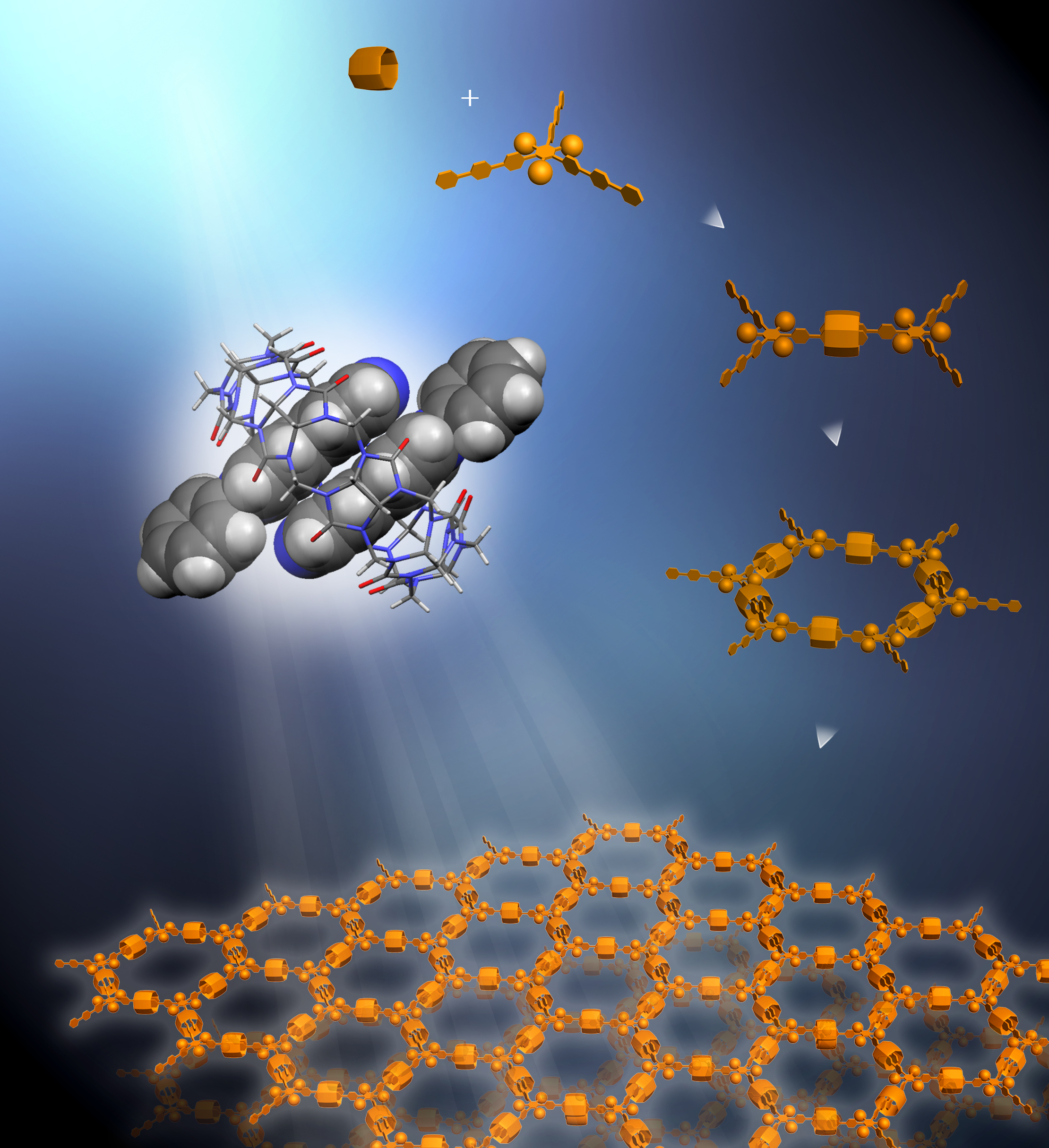
Rigid triangular struts self-assemble in combination with macrocycle rings in solution to create a supramolecular organic framework (SOF). Each strut contains functional units that resist stacking to maintain the 2D framework in a single layer.

Supramolecular chemistry, aka chemistry beyond the molecule, in which molecules and molecular complexes are held together by non-covalent bonds, is just beginning to come into its own with the emergence of nanotechnology. Metal-organic frameworks (MOFs) are commanding much of the attention because of their appetite for greenhouse gases, but a new player has joined the field – supramolecular organic frameworks (SOFs). Researchers with the U.S. Department of Energy (DOE)’s Lawrence Berkeley National Laboratory (Berkeley Lab) have unveiled the first two-dimensional SOFs that self-assemble in solution, an important breakthrough that holds implications for sensing and separation technologies, energy sciences, and, perhaps most importantly, biomimetics.

“We’ve demonstrated the first soluble single-layer 2D honeycomb SOF that combines the ordering and porous features of MOFs with the solubility of supramolecular polymers,” says Yi Liu, a chemist with Berkeley Lab’s Materials Sciences Division. “The results prove that we can exercise precise control of dimensionality within structures through a solution-based supramolecular approach, which paves the way for the assembly of more advanced architectures that can be processed in solution.”

Liu, who oversees the supramolecular electronics research group at Berkeley Lab’s Molecular Foundry, a DOE national nanoscience user facility, is one of three corresponding authors of a paper describing this research in the Journal of the American Chemical Society (JACS). The paper is titled “Toward a Single-Layer Two-Dimensional Honeycomb Supramolecular Organic Framework in Water.” The other corresponding authors are Xin Zhao and Zhan-Ting Li, of China’s Shanghai Institute of Organic Chemistry and Fudan University.


Yi Liu at the Molecular Foundry. (Photo by Roy Kaltschmidt)
Traditional molecular chemistry involves the strong covalent bonds formed by the sharing or exchange of electrons between the atoms that make up a molecular system. Supramolecular chemistry involves systems that are held together by a multitude of weaker, non-covalent connections, such as hydrogen bonds and electrostatic and Van der Waals forces. Nature uses supramolecular chemistry to form the double-helix of DNA or to fold proteins. For nanotechnology, single-layers of 2D structurally ordered materials – along the lines of graphene – could fill a great many needs but the key is to process them in solution.

“Solution-based processing allows for mass production and reduced manufacturing costs, and is an important step for transferring materials to a dry state without losing their structural integrity,” Yi says. “Solution-based processing also allows for bio-related applications such as biomimetic sensing, where the framework structure is advantageous for the capturing of guest molecules and the amplification of chemical signals.”
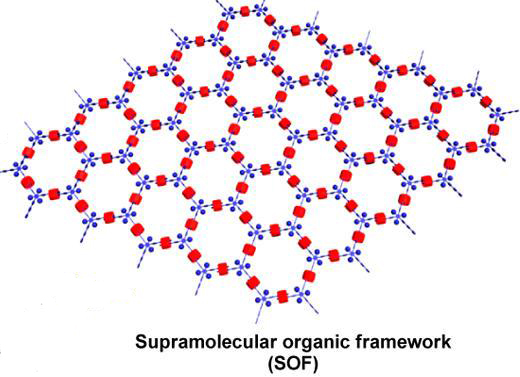

SOFs feature a porous framework with honeycomb periodicity similar to a MOF.

However, the self-assembly of well-defined 2D supramolecular systems polymers in solution has been a challenge because such polymers tend to precipitate out of solution, making them difficult to manipulate and characterize. To meet this challenge, Yi and his collaborators used a combination of self-assembling tripods and macrocycle rings to form a porous framework with honeycomb periodicity, similar to that of a MOF, but which remains rigid in solution. Equipping the tripods with bulky hydrophilic groups that resist stacking preserved the solubility and single-layer 2D architecture of the framework.

“That our framework is held together by reversible, non-covalent supramolecular interactions ensures good solubility in water,” Li says. “The precise dimensional control of our solution-based processing facilitates the structural and chemical customization of our frameworks.”

The tripods of these SOFs were made from aromatic bipyridine molecules whose trio of struts or arms were interlocked with the struts of their neighboring molecules through the macrocycles, which were made from cucurbituril molecules. The molecules used in this study were proof-of-principle starters. Other molecules for the struts could be employed in the future for the design of similar or more complex architectures. The 2D single-layer structures of these first SOFs were characterized at Berkeley Lab’s Advanced Light Source, another DOE national user facility, using small angle X-ray scattering (SAXS) technologies at beamlines 12.3.1 and 7.3.3.

Yi and his collaborators at the Molecular Foundry and in Shanghai are now working to create soluble SOFs in 3D. In addition to the corresponding authors, other authors of the JACS paper were Kang-Da Zhang, Jia Tian, David Hanifi, Yuebiao Zhang, Andrew Chi-Hau Sue, Tian-You Zhou and Lei Zhang.

This research was supported by the DOE Office of Science.

Additional Information

For more about the research of Yi Liu go here
For more about the Molecular Foundry go here
For more about the Advanced Light Source go here

# # #

Lawrence Berkeley National Laboratory addresses the world’s most urgent scientific challenges by advancing sustainable energy, protecting human health, creating new materials, and revealing the origin and fate of the universe. Founded in 1931, Berkeley Lab’s scientific expertise has been recognized with 13 Nobel prizes. The University of California manages Berkeley Lab for the U.S. Department of Energy’s Office of Science. For more, visit www.lbl.gov.

DOE’s Office of Science is the single largest supporter of basic research in the physical sciences in the United States, and is working to address some of the most pressing challenges of our time. For more information, please visit the Office of Science website at science.energy.gov/.
TAGS: energy, material science, Materials Sciences Division, Molecular Foundry, nanoscience, nanotechnology


ORIGINAL: Berkeley Labs
Lynn Yarris (510) 486-5375 lcyarris@lbl.gov 
December 16, 2013

lunes, 20 de agosto de 2012

Study unlocks link between sex and female brain

ORIGINAL: Physorg.com

These are crystals of pure OIF used at Canadian Light Source protein crystallography beam line. Credit: Yvonne Leduc, U of S

An international team of scientists led by Gregg Adams at the University of Saskatchewan has discovered that a protein in semen acts on the female brain to prompt ovulation, and is the same molecule that regulates the growth, maintenance, and survival of nerve cells. 

Male mammals have accessory sex glands that contribute seminal fluid to semen, but the role of this fluid and the glands that produce it are not well understood.

"From the results of our research, we now know that these glands produce large amounts of a protein that has a direct effect on the female," says Adams, a professor of veterinary biomedical sciences at the Western College of Veterinary Medicine at the U of S.

The work, which appears in the August 20, 2012 issue of the Proceedings of the National Academy of Sciences (PNAS), raises intriguing questions about fertility in mammals, including humans.

The team characterized the protein, dubbed ovulation-inducing factor (OIF), that they have found in the semen of all species of mammal they have looked at so far. In the process of discovering its identity, the team compared OIF to thousands of other proteins, including nerve growth factor (NGF) which is found primarily in nerve cells throughout the body.

"To our surprise, it turns out they are the same molecule," Adams says. "Even more surprising is that the effects of NGF in the female were not recognized earlier, since it's so abundant in seminal plasma."
Gregg Adams with a University of Saskatchewan llama east of Saskatoon, Saskatchewan, Canada. Credit: Liam Richards for the University of Saskatchewan
While OIF/NGF may function differently from animal to animal, it is present in all mammals studied so far, from llamas, cattle and koalas to pigs, rabbits, mice, and humans. This implies an important role in reproduction in all mammals. Just how it works, its role in various species, and its clinical relevance to human infertility are a few of the questions that remain to be answered.

OIF/NGF in the semen acts as a hormonal signal, working through the hypothalamus of the female brain and the pituitary gland. This triggers the release of other hormones that signal the ovaries to release an egg (or eggs, depending on the species). 

For this latest study, the team looked at two species: llamas and cattle. Llamas are "induced ovulators," that is, they ovulate only when they have been inseminated. Cows – and humans – are "spontaneous ovulators," meaning that a regular buildup of hormones stimulates the release of an egg. 

Using a variety of techniques, the researchers compared OIF and NGF and found them to have the same size and to cause the same effects across species. Work at the Canadian Light Source synchrotron at the U of S confirmed the structure of the molecule. 

"The idea that a substance in mammalian semen has a direct effect on the female brain is a new one," Adams explains. "This latest finding broadens our understanding of the mechanisms that regulate ovulation and raises some intriguing questions about fertility." 

viernes, 27 de abril de 2012

A shiny new tool for imaging biomolecules

ORIGINAL: EurekAlert
Berkeley Lab researchers embed artificial membranes with billions of nanoantennas for enhanced optical studies
Gold triangle nanoparticles paired tip-to-tip in a bow-tie formation, serve as optical antennas. When a protein (green) bound to a fluorescently labeled SOS-catalyst passes through the the gaps between opposing tips of the triangles (plasmonic hot spots) fluorescence is amplified. Credit: (Image by Groves, et. al., Berkeley Lab) Usage Restrictions: courtesy of Jay Groves, Berkeley Lab, UC Berkeley, HHMI
At the heart of the immune system that protects our bodies from disease and foreign invaders is a vast and complex communications network involving millions of cells, sending and receiving chemical signals that can mean life or death. At the heart of this vast cellular signaling network are interactions between billions of proteins and other biomolecules. These interactions, in turn, are greatly influenced by the spatial patterning of signaling and receptor molecules. The ability to observe signaling spatial patterns in the immune and other cellular systems as they evolve, and to study the impact on molecular interactions and, ultimately, cellular communication, would be a critical tool in the fight against immunological and other disorders that lead to a broad range of health problems including cancer. Such a tool is now at hand.
An array of gold nanoparticles in the shape of triangles that are paired in a tip-to-tip formation, like a bow-tie, can serve as optical antennas, capturing and concentrating light waves into well-defined hot spots, where the plasmonic effect is greatly amplified. Credit: (Image by Groves, et. al., Berkeley Lab). Usage Restrictions: courtesy of Jay Groves, Berkeley Lab, UC Berkeley, HHMI. 
Researchers with the U.S. Department of Energy (DOE)'s Lawrence Berkeley National Laboratory (Berkeley Lab) and the University of California (UC) Berkeley, have developed the first practical application of optical nanoantennas in cell membrane biology. A scientific team led by chemist Jay Groves has developed a technique for lacing artificial lipid membranes with billions of gold "bowtie" nanoantennas. Through the phenomenon known as "plasmonics," these nanoantennas can boost the intensity of a fluorescent or Raman optical signal from a protein passing through a plasmonic "hot-spot" tens of thousands of times without the protein ever being touched.
"Our technique is minimally invasive since enhancement of optical signals is achieved without requiring the molecules to directly interact with the nanoantenna," Groves says. "This is an important improvement over methods that rely on adsorption of molecules directly onto antennas where their structure, orientation, and behavior can all be altered."
Groves holds joint appointments with Berkeley Lab's Physical Biosciences Division and UC Berkeley's Chemistry Department, and is also a Howard Hughes Medical Institute investigator. He is the corresponding author of a paper that reports these results in the journal NanoLetters. The paper is titled "Single Molecule Tracking on Supported Membranes with Arrays of Optical Nanoantennas." Co-authoring the paper were Theo Lohmuller, Lars Iversen, Mark Schmidt, Christopher Rhodes, Hsiung-Lin Tu and Wan-Chen Lin.
Jay Groves is a chemist who holds appointments with Berkeley Lab, UC Berkeley and HHMI. Credit: (Photo by Roy Kaltschmidt, Berkeley Lab).