Mostrando entradas con la etiqueta Computación Cuántica. Mostrar todas las entradas

sábado, 12 de julio de 2014

How D-Wave Built Quantum Computing Hardware for the Next Generation


Photo: D-Wave Systems

One second is here and gone before most of us can think about it. But a delay of one second can seem like an eternity in a quantum computer capable of running calculations in millionths of a second. That's why engineers at D-Wave Systems worked hard to eliminate the one-second computing delay that existed in the D-Wave One—the first-generation version of what the company describes as the world's first commercial quantum computer.

Such lessons learned from operating D-Wave One helped shape the hardware design of D-Wave Two, a second-generation machine that has already been leased by customers such as Google, NASA, and Lockheed Martin. Such machines have not yet proven that they can definitely outperform classical computers in a way that would support D-Wave's particular approach to building quantum computers. But the hardware design philosophy behind D-Wave's quantum computing architecture points to how researchers could build increasingly more powerful quantum computers in the future.

"We have room for increasing the complexity of the D-Wave chip," says Jeremy Hilton, vice president of processor development at D-Wave Systems. "If we can fix the number of control lines per processor regardless of size, we can call it truly scalable quantum computing technology."

D-Wave recently explained the hardware design choices it made in going from D-Wave One to D-Wave Two in the June 2014 issue of the journal IEEE Transactions on Applied Superconductivity. Such details illustrate the engineering challenges that researchers still face in building a practical quantum computer capable of surpassing classical computers. (See IEEE Spectrum's overview of the D-Wave machines' performance from the December 2013 issue.)
  
Photo: D-Wave SystemsD-Wave's Year of Computing Dangerously

Quantum computing holds the promise of speedily solving tough problems that ordinary computers would take practically forever to crack. Unlike classical computing that represents information as bits of either a 1 or 0, quantum computers take advantage of quantum bits (qubits) that can exist as both a 1 and 0 at the same time, enabling them to perform many simultaneous calculations.

Classical computer hardware has relied upon silicon transistors that can switch between "on" and "off" to represent the 1 or 0 in digital information. By comparison, D-Wave's quantum computing hardware relies on metal loops of niobium that have tiny electrical currents running through them. A current running counterclockwise through the loop creates a tiny magnetic field pointing up, whereas a clockwise current leads to a magnetic field pointing down. Those two magnetic field states represent the equivalent of 1 or 0.

The niobium loops become superconductors when chilled to frigid temperatures of 20 millikelvin (-273 degrees C). At such low temperatures, the currents and magnetic fields can enter the strange quantum state known as "superposition" that allows them to represent both 1 and 0 states simultaneously. That allows D-Wave to use these "superconducting qubits" as the building blocks for making a quantum computing machine. Each loop also contains a number of Josephson junctions—two layers of superconductor separated by a thin insulating layer—that act as a framework of switches for routing magnetic pulses to the correct locations.

But a bunch of superconducting qubits and their connecting couplers—separate superconducting loops that allow qubits to exchange information—won't do any computing all by themselves. D-Wave initially thought it would rely on analog control lines that could apply a magnetic field to the superconducting qubits and control their quantum states in that manner. However, the company realized early on in development that it would need at least six or seven control lines per qubit, for a programmable computer. The dream of eventually building more powerful machines with thousands of qubits would become an "impossible engineering challenge" with such design requirements, Hilton says.

The solution came in the form of digital-to-analog flux converters (DAC)—each about the size of a human red blood cell at 10 micrometers in width— that act as control devices and sit directly on the quantum computer chip. Such devices can replace control lines by acting as a form of programmable magnetic memory that produces a static magnetic field to affect nearby qubits. D-Wave can reprogram the DACs digitally to change the "bias" of their magnetic fields, which in turn affects the quantum computing operations.

Most researchers have focused on building quantum computers using the traditional logic-gate model of computing. But D-Wave has focused on a more specialized approach known as "quantum annealing" —a method of tackling optimization problems. Solving optimization problems means finding the lowest "valley" that represents the best solution in a problem "landscape" with peaks and valleys. In practical terms, D-Wave starts a group of qubits in their lowest energy state and then gradually turns on interactions between the qubits, which encodes a quantum algorithm. When the qubits settle back down in their new lowest-energy state, D-Wave can read out the qubits to get the results.

Both the D-Wave One (128 qubits) and D-Wave Two (512 qubits) processors have DACs. But the circuitry setup of D-Wave One created some problems between the programming DAC phase and the quantum annealing operations phase. Specifically, the D-Wave One programming phase temporarily raised the temperature to as much as 500 millikelvin, which only dropped back down to the 20 millikelvin temperature necessary for quantum annealing after one second. That's a significant delay for a machine that can perform quantum annealing in just 20 microseconds (20 millionths of a second).

By simplifying the hardware architecture and adding some more control lines, D-Wave managed to largely eliminate the temperature rise. That in turn reduced the post-programming delay to about 10 milliseconds (10 thousandths of a second)— a "factor of 100 improvement achieved within one processor generation," Hilton says. D-Wave also managed to reduce the physical size of the DAC "footprint" by about 50 percent in D-Wave Two.

Building ever-larger arrays of qubits continues to challenge D-Wave's engineers. They must always be aware of how their hardware design—packed with many classical computing components—can affect the fragile quantum states and lead to errors or noise that overwhelms the quantum annealing operations.

"We were nervous about going down this path," Hilton says. "This architecture requires the qubits and the quantum devices to be intermingled with all these big classical objects. The threat you worry about is noise and impact of all this stuff hanging around the qubits. Traditional experiments in quantum computing have qubits in almost perfect isolation. But if you want quantum computing to be scalable, it will have to be immersed in a sea of computing complexity."

Still, D-Wave's current hardware architecture, code-named "Chimera," should be capable of building quantum computing machines of up to 8000 qubits, Hilton says. The company is also working on building a larger processor containing 1000 qubits.

"The architecture isn’t necessarily going to stay the same, because we're constantly learning about performance and other factors," Hilton says. "But each time we implement a generation, we try to give it some legs so we know it’s extendable."

ORIGINAL: IEEE Spectrum
By Jeremy Hsu
11 Jul 2014

lunes, 13 de enero de 2014

Computer science: The learning machines

Using massive amounts of data to recognize photos and speech, deep-learning computers are taking a big step towards true artificial intelligence.

Article tools
PDF
Rights & Permissions

BRUCE ROLFF/SHUTTERSTOCK

Three years ago, researchers at the secretive Google X lab in Mountain View, California, extracted some 10 million still images from YouTube videos and fed them into Google Brain — a network of 1,000 computers programmed to soak up the world much as a human toddler does. After three days looking for recurring patterns, Google Brain decided, all on its own, that there were certain repeating categories it could identify: human faces, human bodies and … cats1.

Google Brain's discovery that the Internet is full of cat videos provoked a flurry of jokes from journalists. But it was also a landmark in the resurgence of deep learning: a three-decade-old technique in which massive amounts of data and processing power help computers to crack messy problems that humans solve almost intuitively, from recognizing faces to understanding language.

Deep learning itself is a revival of an even older idea for computing: neural networks. These systems, loosely inspired by the densely interconnected neurons of the brain, mimic human learning by changing the strength of simulated neural connections on the basis of experience. Google Brain, with about 1 million simulated neurons and 1 billion simulated connections, was ten times larger than any deep neural network before it. Project founder Andrew Ng, now director of the Artificial Intelligence Laboratory at Stanford University in California, has gone on to make deep-learning systems ten times larger again.

Such advances make for exciting times in artificial intelligence (AI) — the often-frustrating attempt to get computers to think like humans. In the past few years, companies such as Google, Apple and IBM have been aggressively snapping up start-up companies and researchers with deep-learning expertise. For everyday consumers, the results include software better able to sort through photos, understand spoken commands and translate text from foreign languages. For scientists and industry, deep-learning computers can search for potential drug candidates, map real neural networks in the brain or predict the functions of proteins.

“AI has gone from failure to failure, with bits of progress. This could be another leapfrog,” says Yann LeCun, director of the Center for Data Science at New York University and a deep-learning pioneer.

“Over the next few years we'll see a feeding frenzy. Lots of people will jump on the deep-learning bandwagon,” agrees Jitendra Malik, who studies computer image recognition at the University of California, Berkeley. But in the long term, deep learning may not win the day; some researchers are pursuing other techniques that show promise. “I'm agnostic,” says Malik. “Over time people will decide what works best in different domains.”

Inspired by the brain

Back in the 1950s, when computers were new, the first generation of AI researchers eagerly predicted that fully fledged AI was right around the corner. But that optimism faded as researchers began to grasp the vast complexity of real-world knowledge — particularly when it came to perceptual problems such as what makes a face a human face, rather than a mask or a monkey face. Hundreds of researchers and graduate students spent decades hand-coding rules about all the different features that computers needed to identify objects. “Coming up with features is difficult, time consuming and requires expert knowledge,” says Ng. “You have to ask if there's a better way.”

IMAGES: ANDREW NG

 In the 1980s, one better way seemed to be deep learning in neural networks. These systems promised to learn their own rules from scratch, and offered the pleasing symmetry of using brain-inspired mechanics to achieve brain-like function. The strategy called for simulated neurons to be organized into several layers. Give such a system a picture and
  • the first layer of learning will simply notice all the dark and light pixels. 
  • The next layer might realize that some of these pixels form edges; 
  • the next might distinguish between horizontal and vertical lines. 
  • Eventually, a layer might recognize eyes, and might realize that two eyes are usually present in a human face (see 'Facial recognition').

The first deep-learning programs did not perform any better than simpler systems, says Malik. Plus, they were tricky to work with. “Neural nets were always a delicate art to manage. There is some black magic involved,” he says. The networks needed a rich stream of examples to learn from — like a baby gathering information about the world. In the 1980s and 1990s, there was not much digital information available, and it took too long for computers to crunch through what did exist. Applications were rare. One of the few was a technique — developed by LeCun — that is now used by banks to read handwritten cheques.

By the 2000s, however, advocates such as LeCun and his former supervisor, computer scientist Geoffrey Hinton of the University of Toronto in Canada, were convinced that increases in computing power and an explosion of digital data meant that it was time for a renewed push. “We wanted to show the world that these deep neural networks were really useful and could really help,” says George Dahl, a current student of Hinton's.

As a start, Hinton, Dahl and several others tackled the difficult but commercially important task of speech recognition. In 2009, the researchers reported2 that after training on a classic data set — three hours of taped and transcribed speech — their deep-learning neural network had broken the record for accuracy in turning the spoken word into typed text, a record that had not shifted much in a decade with the standard, rules-based approach. The achievement caught the attention of major players in the smartphone market, says Dahl, who took the technique to Microsoft during an internship. “In a couple of years they all switched to deep learning.” For example, the iPhone's voice-activated digital assistant, Siri, relies on deep learning.

Giant leap
When Google adopted deep-learning-based speech recognition in its Android smartphone operating system, it achieved a 25% reduction in word errors. “That's the kind of drop you expect to take ten years to achieve,” says Hinton — a reflection of just how difficult it has been to make progress in this area. “That's like ten breakthroughs all together.”

Meanwhile, Ng had convinced Google to let him use its data and computers on what became Google Brain. The project's ability to spot cats was a compelling (but not, on its own, commercially viable) demonstration of unsupervised learning — the most difficult learning task, because the input comes without any explanatory information such as names, titles or categories. But Ng soon became troubled that few researchers outside Google had the tools to work on deep learning. “After many of my talks,” he says, “depressed graduate students would come up to me and say: 'I don't have 1,000 computers lying around, can I even research this?'”

So back at Stanford, Ng started developing bigger, cheaper deep-learning networks using graphics processing units (GPUs) — the super-fast chips developed for home-computer gaming3. Others were doing the same. “For about US$100,000 in hardware, we can build an 11-billion-connection network, with 64 GPUs,” says Ng.

Victorious machine

But winning over computer-vision scientists would take more: they wanted to see gains on standardized tests. Malik remembers that Hinton asked him: “You're a sceptic. What would convince you?” Malik replied that a victory in the internationally renowned ImageNet competition might do the trick.

In that competition, teams train computer programs on a data set of about 1 million images that have each been manually labelled with a category. After training, the programs are tested by getting them to suggest labels for similar images that they have never seen before. They are given five guesses for each test image; if the right answer is not one of those five, the test counts as an error. Past winners had typically erred about 25% of the time. In 2012, Hinton's lab entered the first ever competitor to use deep learning. It had an error rate of just 15% (ref. 4).

“Deep learning stomped on everything else,” says LeCun, who was not part of that team. The win landed Hinton a part-time job at Google, and the company used the program to update its Google+ photo-search software in May 2013.

Malik was won over. “In science you have to be swayed by empirical evidence, and this was clear evidence,” he says. Since then, he has adapted the technique to beat the record in another visual-recognition competition5. Many others have followed: in 2013, all entrants to the ImageNet competition used deep learning.


“Over the next few years we'll see a feeding frenzy. Lots of people will jump on the deep-learning bandwagon.”

With triumphs in hand for image and speech recognition, there is now increasing interest in applying deep learning to natural-language understanding — comprehending human discourse well enough to rephrase or answer questions, for example — and to translation from one language to another. Again, these are currently done using hand-coded rules and statistical analysis of known text. The state-of-the-art of such techniques can be seen in software such as Google Translate, which can produce results that are comprehensible (if sometimes comical) but nowhere near as good as a smooth human translation. “Deep learning will have a chance to do something much better than the current practice here,” says crowd-sourcing expert Luis von Ahn, whose company Duolingo, based in Pittsburgh, Pennsylvania, relies on humans, not computers, to translate text. “The one thing everyone agrees on is that it's time to try something different.”

Deep science

In the meantime, deep learning has been proving useful for a variety of scientific tasks. “Deep nets are really good at finding patterns in data sets,” says Hinton. In 2012, the pharmaceutical company Merck offered a prize to whoever could beat its best programs for helping to predict useful drug candidates. The task was to trawl through database entries on more than 30,000 small molecules, each of which had thousands of numerical chemical-property descriptors, and to try to predict how each one acted on 15 different target molecules. Dahl and his colleagues won $22,000 with a deep-learning system. “We improved on Merck's baseline by about 15%,” he says.

Biologists and computational researchers including Sebastian Seung of the Massachusetts Institute of Technology in Cambridge are using deep learning to help them to analyse three-dimensional images of brain slices. Such images contain a tangle of lines that represent the connections between neurons; these need to be identified so they can be mapped and counted. In the past, undergraduates have been enlisted to trace out the lines, but automating the process is the only way to deal with the billions of connections that are expected to turn up as such projects continue. Deep learning seems to be the best way to automate. Seung is currently using a deep-learning program to map neurons in a large chunk of the retina, then forwarding the results to be proofread by volunteers in a crowd-sourced online game called EyeWire.

“Deep learning has the property that if you feed it more data, it gets better and better.”

William Stafford Noble, a computer scientist at the University of Washington in Seattle, has used deep learning to teach a program to look at a string of amino acids and predict the structure of the resulting protein — whether various portions will form a helix or a loop, for example, or how easy it will be for a solvent to sneak into gaps in the structure. Noble has so far trained his program on one small data set, and over the coming months he will move on to the Protein Data Bank: a global repository that currently contains nearly 100,000 structures.

For computer scientists, deep learning could earn big profits: Dahl is thinking about start-up opportunities, and LeCun was hired last month to head a new AI department at Facebook. The technique holds the promise of practical success for AI. “Deep learning happens to have the property that if you feed it more data it gets better and better,” notes Ng. “Deep-learning algorithms aren't the only ones like that, but they're arguably the best — certainly the easiest. That's why it has huge promise for the future.”

Not all researchers are so committed to the idea. Oren Etzioni, director of the Allen Institute for Artificial Intelligence in Seattle, which launched last September with the aim of developing AI, says he will not be using the brain for inspiration. “It's like when we invented flight,” he says; the most successful designs for aeroplanes were not modelled on bird biology. Etzioni's specific goal is to invent a computer that, when given a stack of scanned textbooks, can pass standardized elementary-school science tests (ramping up eventually to pre-university exams). To pass the tests, a computer must be able to read and understand diagrams and text. How the Allen Institute will make that happen is undecided as yet — but for Etzioni, neural networks and deep learning are not at the top of the list.

One competing idea is to rely on a computer that can reason on the basis of inputted facts, rather than trying to learn its own facts from scratch. So it might be programmed with assertions such as 'all girls are people'. Then, when it is presented with a text that mentions a girl, the computer could deduce that the girl in question is a person. Thousands, if not millions, of such facts are required to cover even ordinary, common-sense knowledge about the world. But it is roughly what went into IBM's Watson computer, which famously won a match of the television game show Jeopardy against top human competitors in 2011. Even so, IBM's Watson Solutions has an experimental interest in deep learning for improving pattern recognition, says Rob High, chief technology officer for the company, which is based in Austin, Texas.

Google, too, is hedging its bets. Although its latest advances in picture tagging are based on Hinton's deep-learning networks, it has other departments with a wider remit. In December 2012, it hired futurist Ray Kurzweil to pursue various ways for computers to learn from experience — using techniques including but not limited to deep learning. Last May, Google acquired a quantum computer made by D-Wave in Burnaby, Canada (see Nature 498, 286–288; 2013). This computer holds promise for non-AI tasks such as difficult mathematical computations — although it could, theoretically, be applied to deep learning.

Despite its successes, deep learning is still in its infancy. “It's part of the future,” says Dahl. “In a way it's amazing we've done so much with so little.” And, he adds, “we've barely begun”. Nature505,146–148(09 January 2014)doi:10.1038/505146a
References Le, Q. V. et al. Preprint at http://arxiv.org/abs/1112.6209 (2011). Show context
Mohamed, A. et al. 2011 IEEE Int. Conf. Acoustics Speech Signal Process. http://dx.doi.org/10.1109/ICASSP.2011.5947494 (2011). Show context
Coates, A. et al. J. Machine Learn. Res. Workshop Conf. Proc. 28, 1337–1345 (2013). Show context
Krizhevsky, A., Sutskever, I. & Hinton, G. E. In Advances in Neural Information Processing Systems 25; available at http://go.nature.com/ibace6 Show context
Girshick, R., Donahue, J., Darrell, T. & Malik, J. Preprint at http://arxiv.org/abs/1311.2524 (2013).

viernes, 27 de diciembre de 2013

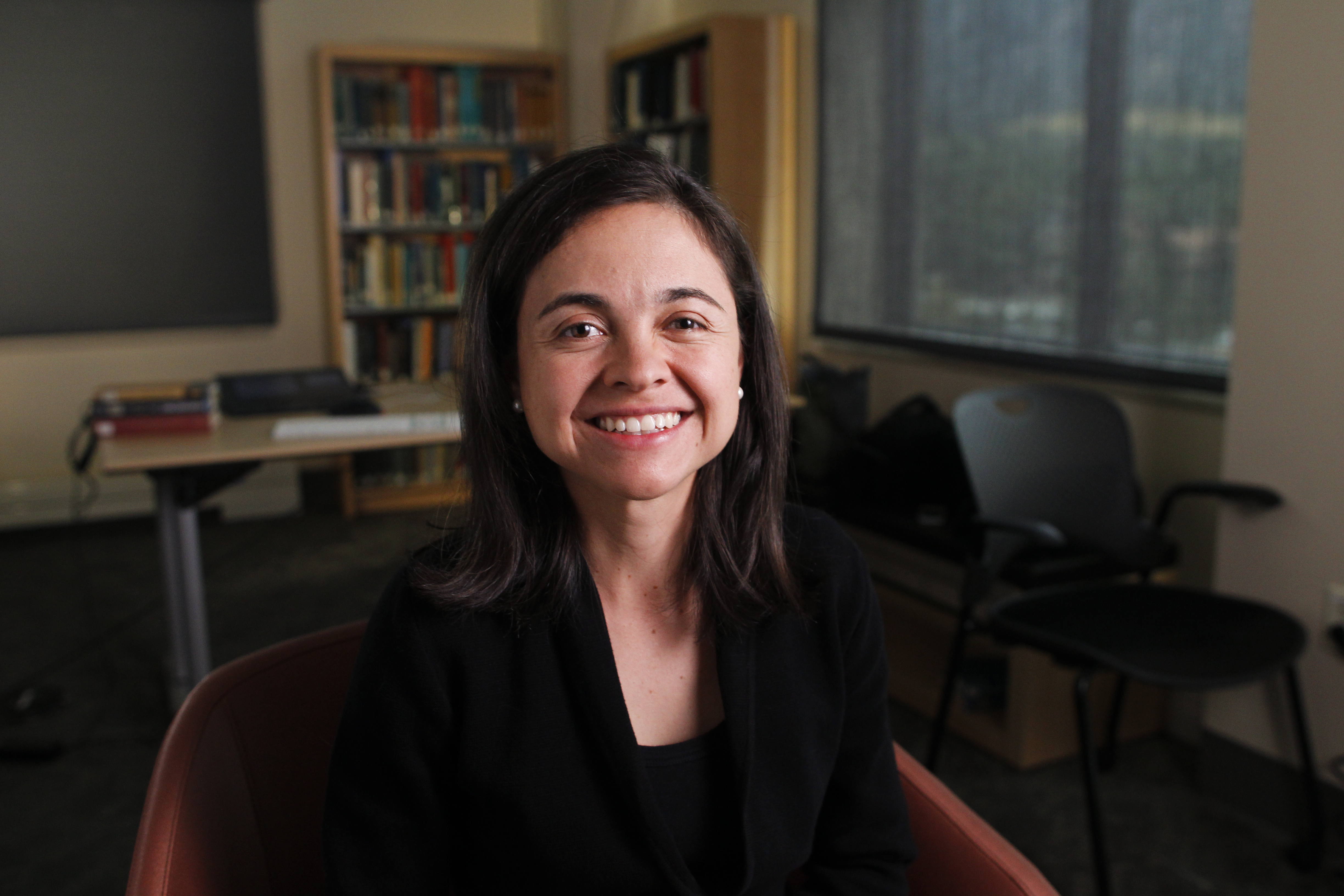
Ana Maria Rey, Atomic Physicist. MacArthur Fellow Class of 2013

MacArthur Fellows / Meet the Class of 2013

Ana Maria Rey. Atomic Physicist. Fellow of JILA. University of Colorado. Boulder, CO. Age: 36

Ana Maria Rey is a theoretical physicist working across the interfaces of atomic, molecular, optical, and condensed matter physics with the goal of using mathematical models to describe the complex behavior of nature. Rey is tackling this challenge through her research on ultracold optical-lattice systems, which will facilitate progress in areas such as quantum simulation and quantum information and enable the preparation of large-scale entanglement between atoms.

Through her ability and willingness to forge close collaborations across the physics community, Rey’s fundamental conceptual research in optical lattices is being leveraged by experimentalists to simulate, manipulate, and control novel states of matter, including quantum magnets, superfluids, and insulators that are important for understanding quantum phenomena like superconductivity. With colleagues, Rey is developing a comprehensive theoretical framework for an optical-lattice quantum computer based on alkaline earth metals. This effort has already proposed solutions for the key problems of storing, addressing, and transporting qubits (the quantum version of a classical bit in computing).

She is now working to resolve long-standing impediments to large-scale entanglement between atoms. A quantum computer requires entangled states—which occurs when the quantum states of two or more atoms become linked or connected—for both communication and computation. Rey’s theory offers a novel solution for maintaining coherence (or stability) in a quantum computer using unique properties of alkaline earth atoms, such as their large number of internal degrees of freedom. Rey’s collaborations with experimentalists have also enabled advances in the development of an optical atomic clock and quantum simulations with polar molecules and trapped ions, which in turn have opened up new theoretical explorations of quantum many-body effects and entanglement. Rey has started her independent career in research with significant contributions to condensed matter physics that harken a promising trajectory for novel theoretical approaches to quantum phenomena.


Ana Maria Rey received a B.S. (1999) from the Universidad de los Andes in Bogotá and a Ph.D. (2004) from the University of Maryland. She was a postdoctoral researcher (2004–2005) with the National Institute of Standards and Technology and a postdoctoral fellow (2005–2008) at the Institute for Theoretical Atomic, Molecular and Optical Physics at the Harvard-Smithsonian Center for Astrophysics, prior to joining the University of Colorado at Boulder, where she is currently a fellow at JILA and a research assistant professor in the Department of Physics.

ORIGINAL: MacArthur Foundation
September 25, 2013 

JILA
Education
University of MarylandCollege Park, Maryland, USA
Ph.D., Physics
August 2004
Dissertation Title: "Ultracold bosonic atoms in optical lattices"
Advisors: Charles W. Clark and Theodore R. Kirkpatrick
Universidad de los AndesBogota, Colombia
B.S., Physics
March 1999
Dissertation Title: "Propagation of electromagnetic radiation in Kerr's metric"
Advisors: Rafael Bautista
Academic Experience
Fellow of JILA
Assistant Professor Adjoint, Department of Physics
January 2012- Present

Associate Fellow of JILA
Assistant Professor Adjoint, Department of Physics
August 2008- 2011t

Institute of theoretical, Molecular, and optical Physics (ITAMP)
At the Harvard- Smithsonian Center for Astrophysics, Cambridge, Massachusetts, USA.
Postdoctoral fellowSeptember, 2005 - 2008

National Institute of Standards and Technology (NIST)Gaithersburg, Maryland, USA.
Postdoctoral researcher
September 2004 - September 2005

University of MarylandCollege Park, Maryland, USA.
Research Assistant
September 2000 - September 2004

Honors & Awards
Great Minds in STEM - Hispanic Engineer National Achievement Award, Award year: 2013

Related News: Ana Maria Rey Wins “Great Minds in STEM” Most Promising Scientist Award

APS Woman Physicist of the Month - APS, Award year: 2012
Related News: Ana Maria Rey selected as APS Woman Physicist of the Month

Physical and Natural Sciences Prize - Fundacion Alejandro Angel Escobar, Award year: 2007

Postdoctoral fellowship, 2005 - 2008 - ITAMP, Award year: 2005

Atomic, Molecular, and Optical Physics Outstanding Doctoral Thesis Award (DAMOP thesis prize) - American Physical Society, Award year: 2005

Cooperative Fellowship NIST/Chemical Physics, 2002 - 2004 - University of Maryland, Award year: 2002

Departmental Fellowship, 2000 - 2002 - University of Maryland, Award year: 2000

Magna cum laude B.S. Physics degree - Universidad de los Andes, Award year: 1999

Best GPA award - Universidad de los Andes, Award year: 1998

Best GPA Award - Universidad de los Andes, Award year: 1997

"Beca 40 años" Fellowship, 1994 - 1998 - Universidad de los Andes, Award year: 1994

domingo, 17 de noviembre de 2013


In May, Google launched the Quantum Artificial Intelligence Lab with hardware from the Canadian quantum computing company D-Wave and technical expertise from NASA. It was an ambitious open research project aimed at exploring both the capabilities of quantum computer architecture and the mysteries of space exploration — but in the months since, they've stayed quiet about exactly what kind of work they've been doing there.

Operated at near-absolute-zero temperatures
Tomorrow, they're breaking the silence with a brief short film, set to debut at the Imagine Science Films Festival at Google New York. The film takes a look at various researchers working on the project, as well as the computer itself, which has to be operated at near-absolute-zero temperatures. Researchers hope the quantum architecture will eventually be used to optimize solutions across complex and interconnected sets of variables currently outside the capabilities of conventional computing. That could allow for new solutions in computational medicine or help NASA to construct a more comprehensive picture of the known universe. "We don't know what the best questions are to ask that computer," says NASA's Eleanor Rieffel in the video. "That's exactly what we're trying to understand."


Video provided by Google

We don't know what the best questions are to ask that computer."

Beyond the film, Google says it's made great leaps in recent experiments with the quantum chips, determining which algorithms work better in a quantum setup and providing further evidence that the D-Wave processor uses quantum entanglement, a behavior that links particles with no apparent physical connection between them. D-Wave has always claimed that its chips involved entanglement, but it had been difficult to conclusively demonstrate before now.

The first practical application has been on Google Glass, as engineers put the quantum chips to work on Glass's blink detector, helping it to better distinguish between intentional winks and involuntary blinks. For engineering reasons, the quantum processor can never be installed in Glass, but together with Google's conventional server centers, it can point the way to a better blink-detecting algorithm. That would allow the Glass processor to detect blinks with better accuracy and using significantly less power. If successful, it could be an important breakthrough for wink-triggered apps, which have struggled with the task so far.


ORIGINAL: The Verge
By Russell Brandom 
October 10, 2013

Google and NASA's Quantum Artificial Intelligence Lab


Announced in May, Google and NASA's Quantum Artificial Intelligence Lab has now been introduced in a film takes a look at various researchers working on the project, as well as the computer itself. 

Google has produced a video introducing some of the people involved with the newly founded Quantum Artificial Intelligence Lab. In May, in partnership with NASA, Google announced the Quantum A.I. Lab, a place where researchers from around the world can experiment with the incredible powers and possibilities of quantum computing. The facility, located in a NASA research center uses D-Wave's quantum computers. It is still early days, but Google thinks quantum computing can help solve some of the world's most challenging computer science problems. The company is particularly interested in how quantum computing can advance machine learning, which can then be applied to virtually any field: from finding the cure for a disease to understanding changes in our climate. 


Related articles 

D-Wave's Geordie Rose, who is featured in the video commented on his blog, 

There are some great memes in the video. One of my favorites was raised by Sergio Boixo. He says at 4:25, '... [this machine] teaches us that we shouldn't be naive about the world, and we shouldn't think about the world as a simple machine. It forces us to consider more sophisticated notions of how the reality around us is actually shaped.'

In the video, Rose comments that the ultimate problem for quantum computers to work on are optimization problems. Speaking non-technically he also offers, 

How amazing is it that we, with our monkey heritage and monkey brains and monkey fingers, have lucked into a brain that allows us to ask legitimate questions about the nature of physical reality. That's so cool.

The film also features commentator Jason Silva ruminating on the possibilities of the technology. Silva also gets the poetic last words: 


It's that human risk to go forth into that unknown frontier, whether it's space exploration or quantum exploration. We do it because we must. We do it because that what it means to be human.

ORIGINAL: 33rdSquare

miércoles, 18 de septiembre de 2013

On the Road to Fault-Tolerant Quantum Computing:

ORIGINAL: Lawrence Berkeley National Laboratory
Lynn Yarris
September 16, 2013
Collaboration at Berkeley Lab’s Advanced Light Source Induces High Temperature Superconductivity in a Toplogical Insulator
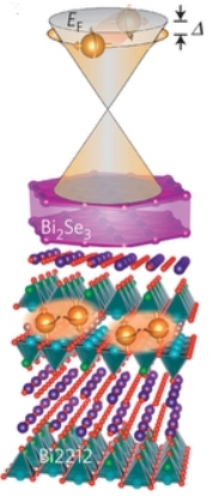
This schematic of a bismuth selenide/BSCCO cuprate (Bi2212)
heterostructure shows a proximity-induced high-temperature superconducting gap on the surface states of the bismuth selenide topological insulator.

Reliable quantum computing would make it possible to solve certain types of extremely complex technological problems millions of times faster than today’s most powerful supercomputers. Other types of problems that quantum computing could tackle would not even be feasible with today’s fastest machines. The key word is “reliable.” If the enormous potential of quantum computing is to be fully realized, scientists must learn to create “fault-tolerant” quantum computers. A small but important step toward this goal has been achieved by an international collaboration of researchers from China’s Tsinghua University and the U.S. Department of Energy (DOE)’s Lawrence Berkeley National Laboratory (Berkeley Lab) working at the Advanced Light Source (ALS).

Using premier beams of ultraviolet light at the ALS, a DOE national user facility for synchrotron radiation, the collaboration has reported the first demonstration of high-temperature superconductivity in the surface of a topological insulator – a unique class of advanced materials that are electrically insulating on the inside but conducting on the surface. Inducing high-temperature superconductivity on the surface of a topological insulator opens the door to the creation of a pre-requisite for fault-tolerant quantum computing, a mysterious quasiparticle known as the “Majorana zero mode.”

“We have shown that by interfacing a topological insulator, bismuth selenide, with a high temperature superconductor, BSCCO (bismuth strontium calcium copper oxide), it is possible to induce superconductivity in the topological surface state,” says Alexei Fedorov, a staff scientist for ALS beamline 12.0.1, where the induced high temperature superconductivity of the topological insulator heterostructure was confirmed. “This is the first reported demonstration of induced high temperature superconductivity in a topological surface state.”

The results of this research are presented in the journal Nature Physics in a paper titled “Fully gapped topological surface states in Bi2Se3 induced by a d-wave high temperature superconductor.” The corresponding authors are Shuyun Zhou and Xi Chen of Tsinghua University in Beijing, China. The lead authors are Eryin Wang and Hao Ding, also with Tsinghua University. Wang is currently an ALS Doctoral fellow in residence.

For all of its boundless potential, quantum computing faces a serious flaw. The quantum data bit or “qubit” used to process and store information is fragile and easily perturbed by electrons and other elements in its surrounding environment. Utilizing topological insulators is considered one promising approach for solving this “decoherence” problem because qubits in a topological quantum computer would be made from Majorana zero modes, which are naturally immune from decoherence. Information processed and stored in such topological qubits would always be preserved. While the ALS collaboration has not yet identified a Majorana zero mode in their bismuth selenide/BSCCO heterostructures, they believe their material is fertile ground for doing so.

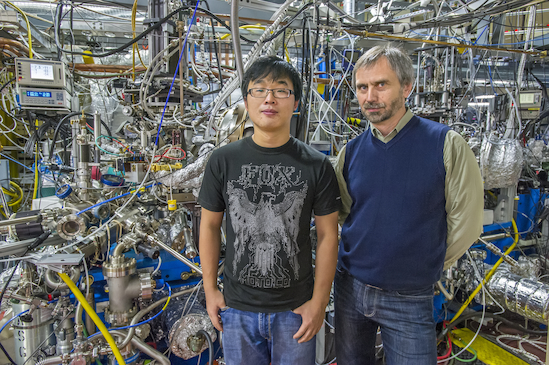
Eryin Wang (left)and Alexei Fedorov at ALS Beamline 12.0.1 where the induced high temperature superconductivity in a topological insulator was confirmed. (Photo by Roy Kaltschmidt)


“Our studies reveal a large superconducting pairing gap on the topological surface states of thin films of the bismuth selenide topological insulator when grown on BSCCO,” Fedorov says. “This suggests that Majorana zero modes are likely to exist, bound to magnetic vortices in this material, but we will have to do other types of measurements to find it.”

The high quality bismuth selenide/BSCCO topological thin film heterostructure was made at Tsinghua University in the laboratory of Xi Chen and Qi-Kun Xue using molecular beam epitaxy.

“Our study was made possible by the high quality topological insulator film heterostructure that the Chen and Xue groups managed to grow,” says Zhou, who did much of her research at the ALS before returning to China. “Bismuth selenide and the BSSCO ceramic have very different crystal structures and symmetries, which made the growth of such a heterostructure particularly challenging.”

Says Chen, “By controlling the growth kinetics carefully using molecular beam epitaxy, we managed to grow a topological insulator film with controlled thickness on a freshly cleaved BSCCO surface. This provided a cleaner and better-controlled interface, and also opened up opportunities for surface sensitive measurements.”

The bismuth selenide/BSCCO material was brought to the ALS to study the electronic states on its surface using a technique known as ARPES, for angle-resolved photoemission spectroscopy. In ARPES, a beam of X-ray photons striking the material’s surface causes the photoemission of electrons. The kinetic energy of these photoelectrons and the angles at which they are ejected are then measured to obtain an electronic spectrum.

“Previous work on topological insulators revealed superconductivity at only a few Kelvin with a gap of about one milli-electron volt,” Fedorov says. “Such a small energy scale and ultra-low temperature makes it particularly challenging to realize Majorana zero modes experimentally, and to distinguish these modes from other states. Using ARPES, we show evidence of a superconducting gap persisting in the surfaces of our material up to the transition temperature of BSCCO. As the gap and transition temperature in our heterostructure reflect almost an order of magnitude increase over previous work, we believe ours is a better system to search for Majorana zero modes.”

This research was primarily supported by the National Natural Science Foundation of China.

# # #

Lawrence Berkeley National Laboratory addresses the world’s most urgent scientific challenges by advancing sustainable energy, protecting human health, creating new materials, and revealing the origin and fate of the universe. Founded in 1931, Berkeley Lab’s scientific expertise has been recognized with 13 Nobel prizes. The University of California manages Berkeley Lab for the U.S. Department of Energy’s Office of Science. For more, visit www.lbl.gov.

The Advanced Light Source is a third-generation synchrotron light source producing light in the x-ray region of the spectrum that is a billion times brighter than the sun. A DOE national user facility, the ALS attracts scientists from around the world and supports its users in doing outstanding science in a safe environment. For more information visit www-als.lbl.gov/.The Advanced Light Source is a third-generation synchrotron light source producing light in the x-ray region of the spectrum that is a billion times brighter than the sun. A DOE national user facility, the ALS attracts scientists from around the world and supports its users in doing outstanding science in a safe environment. For more information visit http://www.als.lbl.gov/. TAGS: Advanced Light Source, computational research, computing, materials, quantum computing, superconductors

sábado, 14 de septiembre de 2013

A world first! Success at complete quantum teleportation

ORIGINAL: DigInfo TV
The University of Tokyo
11/9/2013
Furusawa group at the University of Tokyo has succeeded in demonstrating complete quantum teleportation of photonic quantum bits by a hybrid technique for the first time worldwide. In 1997, quantum teleportation of photonic quantum bits was achieved by a research team at Innsbruck University in Austria. However, such quantum teleportation couldn't be used for information processing, because measurement was reqI think we can definitely say that quantum computers have come closer to reality. Teleportation can be thought of as a quantum gate where input and output are the same. So, it's known that, if we improve this a little, the input and output could be produced in different forms. If changing the form of input and output like that is considered as a program, you have a programmable quantum gate. So, I think a quantum computer could be achieved by combining lots of those.uired after transport, and the transport efficiency was low. So, quantum teleportation was still a long way from practical use in quantum communication and quantum computing. The demonstration of quantum teleportation of photonic quantum bits by Furusawa group shows that transport efficiency can be over 100 times higher than before. Also, because no measurement is needed after transport, this result constitutes a major advance toward quantum information processing technology.

"In 1997, quantum bit teleportation was successfully achieved, but as I said just now, it was only achieved in a probabilistic sense. In 1998, we used a slightly different method to succeed at unconditional, complete teleportation. But at that time, the state sent wasn't a quantum bit, but something different. Now, we've used our experimental technology, which was successful in 1998, to achieve teleportation with quantum bits. The title of our paper is "Hybrid Technique," and developing that technique is where we've been successful."

The hybrid technique was developed by combining technology for transporting light waves with a broad frequency range, and technology for reducing the frequency range of photonic quantum bits. This has made it possible to incorporate photonic quantum bit information into light waves without disruption by noise. This research result has been published in Nature, and is attracting attention worldwide, as a step toward quantum information processing technology.

"I think we can definitely say that quantum computers have come closer to reality. Teleportation can be thought of as a quantum gate where input and output are the same. So, it's known that, if we improve this a little, the input and output could be produced in different forms. If changing the form of input and output like that is considered as a program, you have a programmable quantum gate. So, I think a quantum computer could be achieved by combining lots of those."

Looking ahead, Furusawa group aims to increase the transport efficiency and make the device smaller by using photonic chips. In this way, the researchers plan to achieve further advances toward quantum computing.