Mostrando entradas con la etiqueta StartUps. Mostrar todas las entradas

martes, 14 de marzo de 2017

What Happened When We Took the SCiO Food Analyzer Grocery Shopping

Scanning tomatoes at Whole Foods with the handheld SCiO spectrum analyzer--the system pronounces the quality
Photo: Tekla Perry
I’m at a Whole Foods in Palo Alto with Dror Sharon, cofounder and CEO of Consumer Physics, based in San Francisco and Israel. Sharon is holding his smartphone and a tiny handheld device he calls SCiO, which is about the size of a TicTac box. We are browsing around the produce department, checking out the Brix level of various items. The Brix number represents the sugar content of a solution and, for fruits, is an indicator of whether or not a particular fruit has much flavor. The tomatoes, according to the SCiO’s accompanying smartphone app, are horrible; not a big surprise in March. The apples are mixed, there is only one variety Sharon would buy right now. The mangos, he proclaims, are just perfect, and contemplates filling a bag before we go.

Scanning cheeses at Whole Foods using the tiny SCiO spectrum analyzer, screen shows fat, protein, and calories
Photo: Tekla PerryTesting the SCiO portable analyzer at the Whole Foods dairy case
We move onto the dairy case, where the labels of cellophane-wrapped cheeses provided only price and name. Sharon’s smartphone app popped up all sorts of additional information as he pointed the SCiO gadget at different chunks (still in their wrapping), including fat content, calories per gram, and protein content.


On the way to Whole Foods, we stopped outside a restaurant where two women were having brunch, and asked them if we could scan their food before they ate it. Sharon told them the strawberries would be excellent (they women agreed they were), but the whipped cream would be abnormally sweet, there was so much sugar in it wasn’t recognizable as dairy (it was).

It was all pretty magical, pointing a gadget at food and getting an instant analysis. To be fair, I can’t verify the accuracy of what I was seeing on the screen; I didn’t take the fruits and cheeses back to a laboratory to confirm the analysis using more traditional technology. But it certainly seemed real, real enough that I would be pretty excited to have this kind of technology built into my smart phone, given I have my phone out anyway when I’m grocery shopping to scan shelf tags in order to download coupons. And Sharon promises it is indeed coming into phones—as soon as the third quarter of this year in China, fourth quarter in the United States.

Here’s how SCiO works—and why it exists.
Using the SCiO food analyzer to determine the carb, water, and calorie content of an apple
Photo: Tekla PerryThese apples should be pretty good
The gadget uses standard infrared spectroscopy; it measures the absorption of infrared light. It may not be as accurate as a benchtop spectrometer used in a laboratory environment, but Sharon says it makes up for this with its algorithms. The user starts out by simplifying the problem a bit by identifying the category of the item to be examined—it’s not “What fruit is this,” but, “This is an apple, is it any good?” Consumer Physics’ cloud-based software then taps into its knowledge base, for an apple, it defines “good” as “sweet” (hence the Brix measurement), and considers an apple’s typical range of sweetness based on thousands of scans. A graphic on the phone then places the apple on a quality range.

Besides having data on most fruits and vegetables, the system also knows about dairy products; for those, it provides information on calories and fat content. And it knows about the cocoa content of chocolate, the amount of alcohol in drinks, and the protein, fat, and calories in raw fish, poultry, beef, and pork. And while, to date, the focus has been on food, Sharon stresses that the technology works with all sorts of materials. The company has started holding workshops for people who want to develop their own databases.

Sharon had been wanting this kind of gadget for a long time before he finally set out to build one. He grew up on a farm in Israel; he was used to eating produce that hadn’t been shipped further than across the property. So, when he moved to Massachusetts for business school at MIT (his bachelor’s degree is in electrical engineering), he was surprised by just how tasteless he found the produce at local groceries. “The food just didn’t taste the same. And when I saw that I was buying grapes from Chile, I was sure something was not right about them.

He decided that he should get himself something to determine whether or not the food in the stores was any good before he bought it, so he logged onto Amazon and searched for such a gadget. He didn’t find one. Disappointed, he resigned himself to occasionally buying tasteless produce or traveling 30 miles to a grocer he discovered that he could trust.

But about five years later, in 2010, after a few years working in the U.S. and then moving back to Israel, he came back to the idea. There ought to be a scanner that could give you useful information about the food you are about to buy, he insisted. He teamed up with Damian Goldring, a friend from his undergraduate days with a PhD in silicon photonics, and the two started investigating sensing technologies that, potentially, could be built into a phone. They landed on infrared spectrometry, and, in 2011, started Consumer Physics. In mid-2012, they rented one of those expensive, luggable, commercial spectrometers for a day and demonstrated to a large cellular service provider that the technology could be used to analyze food, doing a demo on chocolate mixtures that looked the same, but had different substances mixed in, like regular butter and peanut butter. “We’re going to put this into a phone,” Sharon said. (The company didn’t fund them.)

Testing the SCiO handheld spectrum analyzer on tomatoes
Photo: Tekla PerryDon’t buy these tomatoes
Sharon and Goldring may not have convinced that company, but they had convinced themselves, and began working on the technology, first on their own dime, and then with a little money from angel investors and crowd-sourced funding from OurCrowd. In early 2014, they were convinced enough that they could deliver the technology as a small Bluetooth peripheral—not inside a phone quite yet, but pretty close—to launch a Kickstarter campaign, pitching a $200 portable infrared spectrometer. Some 13,000 people signed up, ponying up about $2.7 million.

Things from Kickstarter funding to shipped product were not exactly smooth sailing. Come September of 2016, we reported that only 5000 of the Kickstarter backers had received products, far later than originally estimated, and many of the remaining backers were angry. To make things worse, the backers could no longer communicate with the company via Kickstarter, the page had been taken down in a trademark dispute over the name “SCiO”.

What happened? Sharon says the delays were due to manufacturing challenges, as well as a redesign to improve sensitivity, resistance to ambient light, and penetration depth. And the company has now fulfilled almost all of its Kickstarter orders, with the exception of customers who haven’t yet provided shipping addresses, have unique shipping requirements, or are choosing to wait for a Special Edition version of the gadget—that’s fewer than 10 percent of the backers, Sharon says.

But while the Kickstarter rollout was more than normally bumpy, the company’s efforts to get venture funding have born, well, fruit. After picking up some funding from angel investors and people using crowdfunding platform OurCrowd, Consumer Physics closed a round of venture investment led by Khosla Ventures. To date, Sharon said, funding totals over $25 million.

Photo: Tekla PerryThanks to Analog Devices, the SCiO technology can now fit inside a smart phone
The company also lined up some critical partnerships: with Analog Devices, which worked with the company to reduce the size of the sensor package into something that will easily fit into smartphones and is manufacturing this version of the device; and with Chinese phone manufacturer Changhong, which will be incorporating the technology in the Changhong H2 smartphone starting in China in the third quarter of this year and in the U.S. towards the end of 2017. Consumers in China, Sharon points out, are particularly interested in checking food safety, given the history of problems with the food supply. Sharon hopes other smartphone manufacturers will follow, turning using a phone to scan food as common a practice as using one to photograph food.

Consumer Physics now has about 100 employees, with corporate offices in San Francisco, a sales team based in the Midwestern United States, and a development team in Israel. Dozens of people are scanning food 24/7, Sharon said, to increase the kinds of food that can be analyzed as well as the accuracy of the analysis.

While the initial applications surround food, Sharon says that the technology is not just for checking out food freshness and nutritional information; it’s good at analyzing body fat, and distinguishing real pharmaceuticals from their fake counterparts. “We’ve done a demo that distinguishes real Viagra from fake Viagra,” says Sharon. “That’s the most commonly counterfeited drug.”

Consumer Physics has, to date, shipped more than 3000 developer kits, and is hoping some interesting consumer applications will emerge. One such in the works by French company Terallion, Sharon said, is a kitchen scale, intended for diabetics, that can use SCiO’s analysis to allow it to give users accurate information about protein and carbohydrate content of the food they are about to eat. The company is also working directly with industrial partners, in particular, with those working to develop tools for digital agriculture.

ORIGINAL: IEEE Spectrum
14 Mar 2017

martes, 24 de enero de 2017

Artificial Intelligence in the UK: Landscape and learnings from 226 startups

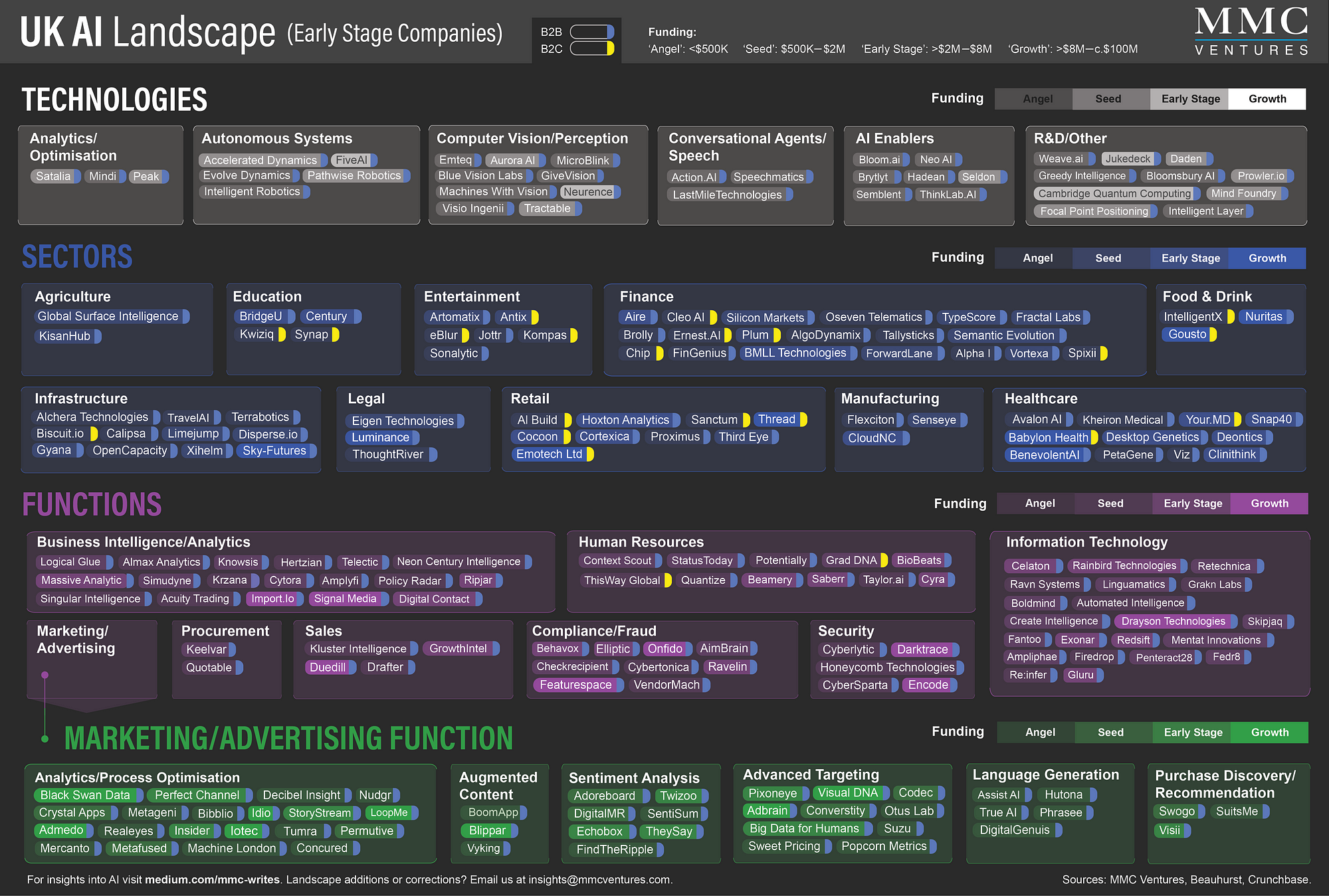
Figure 1 (above): The landscape of early stage UK AI companies.
With every paradigm shift in technology, waves of innovation follow as companies improve and then reimagine processes. Today we are in the early stages of the global artificial intelligence (AI) revolution. Machine learning algorithms, whose results improve with experience, enable us to find patterns in large data sets and make predictions more effectively — about people, equipment, systems and processes. (For an accessible introduction to AI, read our Primer.) But what are the dynamics of AI entrepreneurship in the UK?

We’ve mapped 226 independent, early stage AI software companies based in the UK and met with over 40 of these companies in recent weeks. Below, we share six powerful dynamics we see that are shaping the UK AI market— from changing activity levels and areas of focus, to trends in monetisation and the size and staging of investment.
Interested in more venture capital insights? Sign up for our blog posts.
AI entrepreneur? Get in touch.
The UK AI landscape: 226 companies and counting
Over time, we expect the distinction between ‘AI’ companies and other software providers to blur and then disappear, as machine learning is employed to tackle a wide variety of business processes and sectors. Today, however, it is possible to point to a sub-set of early stage software companies defined by their focus on AI.

We’ve researched 226 early stage AI companies in the UK and met with 40 of them. We’ve developed a map (Figure 1, above) to place the 226 according to their:

  • Purpose: Is the company focused on improving a business function (for example, marketing or human resources) or a sector (healthcare, education, agriculture)? Or does the company develop an AI technology with cross-domain application?
  • Customer Type: Does the company predominantly sell to other businesses (‘B2B’) or to consumers (‘B2C’)?
  • Funding: How much funding has the company received to date? We bracket this from ‘angel’ investment (under $500,000) through to ‘growth’ capital ($8m to ~$100m).
We’ll update our map regularly. We apologise if we’ve omitted or mis-classified your company; we’re aware that many early stage companies may be using, but not presenting, extensive AI. Please get in touch with additions or corrections.

After analysing the market and meeting with 40 companies in recent weeks, we highlight the following six dynamics in the market:

1. A focus on AI for business functions
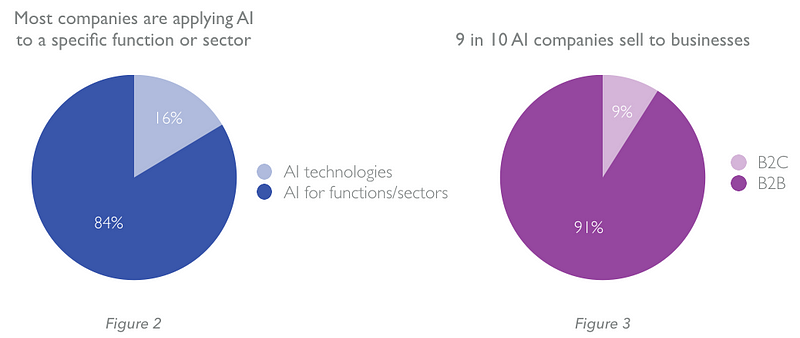
Most early stage UK AI companies — five in every six — are applying machine learning to challenges in specific business functions or sectors (Figure 2, below). Reflecting the nascent stage of the field, however, one in six is developing an AI technology — a capability, platform or set of algorithms — applicable across multiple domains. These companies’ activities range from the development of computer vision solutions to the creation of algorithms for autonomous decision-making.

To whom are AI companies selling? Nine out of 10 AI companies are predominantly ‘B2B’, developing and selling solutions to other businesses (Figure 3, below). Just one in 10 sells directly to consumers (‘B2C’).

Add caption

A ‘cold start’ challenge around data is inhibiting the number of new B2C AI companies. Training machine learning algorithms usually requires large volumes of data. While B2B companies can analyse the varied and extensive data sets of the businesses they serve, in the absence of public or permissioned (e.g. Facebook profile) data, customer-facing companies usually begin without large volumes of consumer data to analyse. Typically, therefore, they deploy machine learning over time as their user bases and data sets grow. Gousto, for example, is an MMC portfolio company that delivers recipes and associated ingredients to consumers for them to cook at home. Today, Gousto’s team of machine learning PhDs, data analysts and engineers leverage AI for warehouse automation and menu design. Since its inception Gousto has had a vision for the use of AI, but the Company has achieved its vision over time.

Given the ‘cold start’ challenge, the reality is that most consumers will first experience machine learning via the world’s most popular consumer applications — Facebook, Google, Amazon, Netflix, Pinterest and others — that leverage vast data sets and machine learning teams to deliver facial recognition, search and entertainment recommendations, translation capabilities and more.

2. AI entrepreneurship is unevenly spread
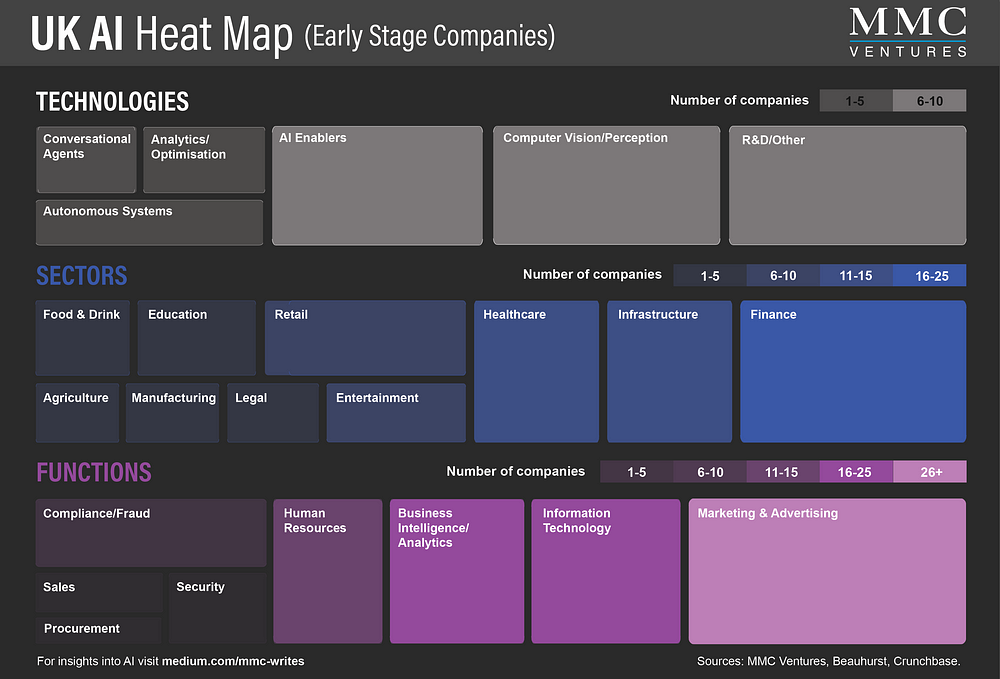
A heat map highlights areas of early stage activity, as measured by the number of companies in each segment (Figure 4, below).

Figure 4: A heat map of early stage AI companies in the UK
Activity is greatest within:
  • The Marketing & Advertising, 
  • Information Technology, and 
  • Business Intelligence & Analytics functions; and
  • The Finance sector.
Activity is extensive within:
  • The Human Resources function; and
  • The Infrastructure, 
  • Healthcare and 
  • Retail sectors.
The sectors above are well suited to the application of AI, explaining the concentration of AI activity within them. The opportunity for value creation within each segment is demonstrable as well as significant. In marketing and in finance, for example, improvements in campaign conversion and financial performance against a benchmark are readily quantifiable. All offer numerous prediction and optimisation challenges well suited to the application of machine learning. All offer large data sets for training and deployment. A path to better-than-human performance is technically achievable. The alternatives are impractical or expensive. And all are specialised verticals, distant from the competitive threat posed by the consumer- and horizontal focus of the AI platform providers Google, Amazon, Microsoft and IBM — with the exception of healthcare where Google and IBM both enable and challenge.

As attractive market fundamentals catalyse activity, the strongest AI companies can develop a competitive moat by:
  • bringing deep domain expertise to bear in a complex domain; 
  • developing proprietary algorithms
  • creating a network effect around data by leveraging non-public data sets; and 
  • by securing adequate capital to build a high quality machine learning team and go-to-market resources.
Activity in Marketing & Advertising dominates; one in five early stage UK AI companies target this function. The fundamentals of modern marketing and advertising represent a sweet-spot for AI. Consumers have billions of touch points with websites and apps, providing a rich seam of available, but complex, data. Further, almost every stage of the marketing and advertising value chain is ripe for optimisation and automation — including
  • content processing, 
  • consumer segmentation, 
  • consumer targeting, 
  • programmatic advertising optimisation, 
  • purchase discovery for consumers and 
  • analysis of consumer sentiment.
Areas of lower activity
In a number of areas, activity appears modest relative to market opportunities. In the Manufacturing sector, for example, there are few startups to address a substantial need.
  • Machine learning has the potential to unlock 20% more production capacity through predictive, optimised maintenance of machines
  • Raw material costs and re-working can be reduced through improved analysis of product quality data
  • Further, ‘buffering’ — storing raw materials and part-developed products to compensate for unforeseen inefficiencies during production — can be reduced by up to 30% given more predictable production capacity. 
  • The proliferation of sensors in the manufacturing industry, including sensor data from the production line, machine tool parameters and environmental data, has also increased significantly the data available for machine learning.
Within the Compliance & Fraud function, there appear few startups capitalising on banks’ ballooning expenditure on compliance.
  • 30,000 people in Citi — 12% of the Bank’s workforce — now work in compliance. In its 1Q15 conference call, Citi highlighted that over 50% of the $3.4B it saved through efficiency initiatives was being consumed by additional investments in regulation and compliance. The dynamics are similar among Citi’s peers. 
  • JP Morgan increased compliance spend 50% between 2011 and 2015, to $9B, while 
  • Goldman Sachs highlighted that its 11% increase in headcount in the last four years has largely been to meet regulatory compliance needs. 
Our discussions with banks highlight particular focus on ‘Know Your Customer’ (KYC) and Anti- Money Laundering (AML) initiatives. Beyond presenting an extensive need, the sector offers large data sets for training, expensive human alternatives and, in some areas at least, an evident ability for machine learning to deliver better-than-human performance given the pragmatic impossibility of humans monitoring the data deluge. There may be few UK compliance companies given in-house efforts by the banks, concern regarding potential client concentration, or competition from US startups — but opportunities appear considerable.

3. AI entrepreneurship has doubled
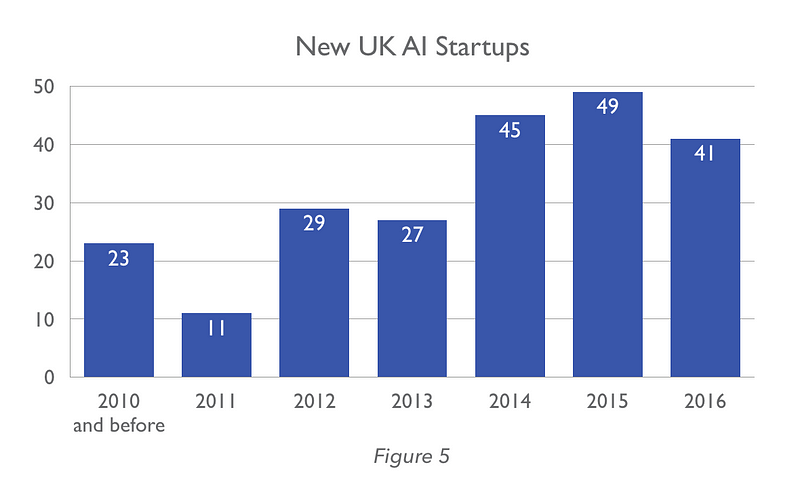
The number of AI companies founded annually in the UK (Figure 5, below) has doubled in recent years (2014–2016) compared with the prior period (2011–2013). Over 60% of all UK AI companies were founded in the last 36 months. During this period, a new AI company has been founded in the UK on almost a weekly basis.
Entrepreneurship in AI is being fuelled by the broader coming of age of AI as well as factors specific to early stage entrepreneurship.

Regarding AI activity generally,
  • seeds planted during the last 20 years of AI research are bearing fruit today. 
  • New algorithms, particularly convolutional and recurrent neural networks, are delivering more effective results. 
  • A logarithmic increase in the availability of training data has made it possible to tune machine learning algorithms to deliver accurate predictions
  • Development of graphical processing units (GPUs) has decreased the time required to train a neural network by 5x-10x. And 
  • a six-fold increase in public awareness of AI during the last five years has increased buyers’ interest in the technology.
Additional factors are fuelling an increase in new AI startups.

  • Venture capital funding of AI companies has increased seven-fold in five years as investors see promise in the sector. 
  • The provision of AI infrastructure and services from industry cloud providers (Google, Amazon, Microsoft and IBM) is reducing the difficulty and cost of deploying machine learning solutions. And 
  • the growth of open source AI software — particularly TensorFlow, a library of components for machine learning — has reduced barriers to involvement
Subject to continued venture capital funding, we expect high levels of AI entrepreneurship in the UK to continue.

Where are new AI companies focusing? 
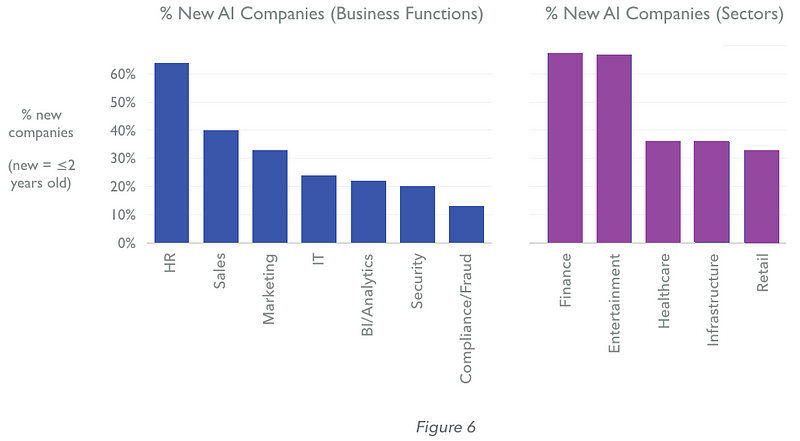
The HR business function and Finance sector have the highest proportion of new AI companies (Figure 6, below). Two thirds of AI HR and Finance companies are less than two years old.


Recent activity in HR stems from a paradigm shift taking place within the function. HR is evolving from an administrative system of record to a predictive driver of growth and efficiency. Business owners are seeking to leverage previously under-utilised data sets to drive utility — ranging from competency-based recruitment to predictive modelling of employee churn.

It is unsurprising that in the business intelligence, security and compliance functions, and in the retail and infrastructure sectors, the proportion of new AI companies is lower. With large data sets ripe for machine learning, these sectors were the first to attract AI entrepreneurs.

4. A nascent sector relative to global peers
The UK AI sector is at a nascent stage in its development relative to global peers, presenting both opportunities and challenges.

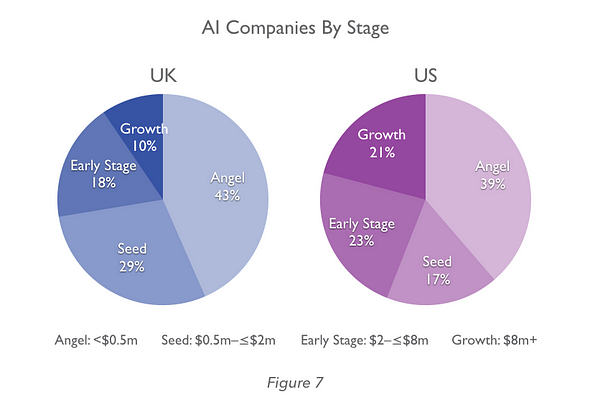
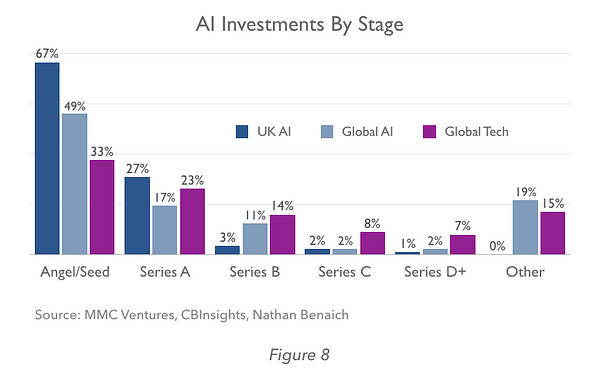
Today, three quarters of UK AI companies are at the earliest stages of their journey, with ‘seed’ or ‘angel’ funding, compared with half of US peers (Figure 7, below). At the other end of the spectrum, just one in 10 UK AI companies is in the late, ‘growth capital’ stage compared with one in five in the US. In 2015, the last full year for which data are available, almost all capital infusions into UK AI companies were at the angel, seed or Series A stage — while among global AI peers a third received later-stage funding (Figure 8, below).


This dynamic presents both opportunities and risks. A vibrant startup scene presents unrivalled opportunities for entrepreneurs, employees and investors in early stage companies. At the same time, more developed and richly funded overseas competitors may increase competitive pressures on UK companies. This effect may be exacerbated by the high proportion of AI companies that sell to enterprises, many of which source providers globally. The UK maintains valuable assets for AI research, including a quarter of the world’s top 25 universities and a growing ecosystem of AI executives and investors following the acquisitions of
5. The journey to monetisation can be longer
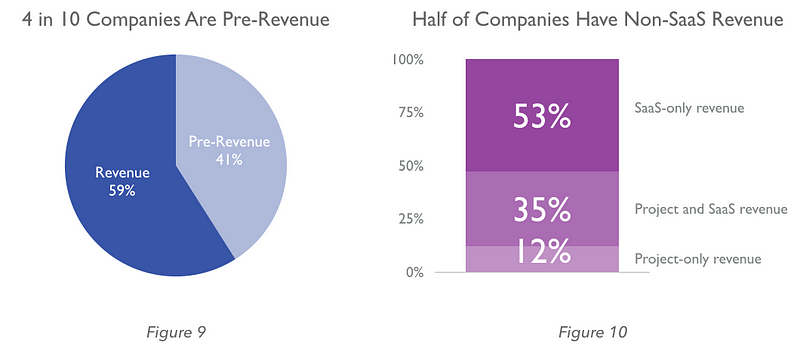
Over 40% of the AI companies we meet are yet to generate revenue (Figure 9, below). This is not an artefact of us meeting ‘early stage’ companies; the median profile of a company we meet is one 
  • founded 2–3 years ago that has 
  • raised £1.3m, has 
  • a team of nine and is 
  • spending £76,000 per month.


The idea that most AI companies — applied AI companies, at least — plan to be acquired pre-revenue instead of selling software and services is a myth. All the companies we met were implementing or developing monetisation plans. Why, then, are some AI companies taking longer to monetise or scale than is usual for early stage companies? We see four reasons:
  • The bar to a minimum viable product (MVP) in this technically challenging field can be higher, requiring longer development periods. 90% of AI companies are B2B. The long sales cycles typical in B2B sales are exacerbated by many AI companies’ focus on sectors, such as finance, with sprawling and sensitive data sets.
  • Deployment periods can be lengthy given
    * extensive per-client data integration,
    * data cleansing and
    * customisation requirements.
    Half the AI companies we meet have a pure software-as-a-service model; as many monetise significant client integration and customisation work in the form of project revenue (Figure 10, above).
  • The limited number of personnel available for implementation in early stage companies is inhibiting many AI companies’ growth. In a sentiment echoed by several companies, one told us “we couldn’t implement more sales even if we had them.” One third of many teams are engaged in deployment support.
  • Exacerbated by cash burn rates increased by the high cost of machine learning talent, a longer path to monetisation can pose a challenge to AI companies. 
We recommend that AI companies raise sufficient capital to last them through this period of risk, to go-to-market and beyond.
6. Investments are larger and staging is atypical
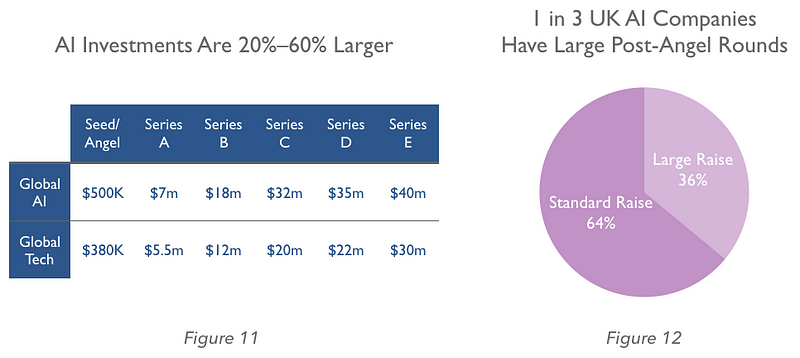
Globally at least, investments into AI firms are typically 20% to 60% larger than average capital infusions (Figure 11, below, shows 2015 data). This reflects company fundamentals and dynamics in the supply and demand of capital. AI companies’ capital requirements can be higher given
  • longer development periods prior to product viability, 
  • the high cost of machine learning talent and 
  • the larger teams required for complex deployments. 
Beyond these fundamentals, however, capital infusions are being inflated by
  • extensive supply (many venture capitalists seek opportunities to invest in artificial intelligence companies) and 
  • limited demand (there are relatively few AI companies in which to invest). 
Venture capital investment in early stage AI companies has increased seven-fold in five years, while the number of investable prospects remains limited.

Further, in the UK a sizeable minority of companies jump from a seed rounds to a much larger raise than is typical for a subsequent round (Figure 12, below). 1 in 3 UK AI companies that raised more than $8m in a funding round raised less than $1m previously. As above, this dynamic is driven in part by AI companies’ capital requirements, but as much by the limited number of attractive investment opportunities in AI. Companies’ valuation expectations, meanwhile, are being supported by ‘acquihire’ offers for nascent teams.


Conclusion: An inflection point in UK AI
The last 36 months have marked an inflection point in early stage UK AI. Entrepreneurship has doubled, as AI technology comes of age and investment has increased. Yet, companies are early in their development relative to global peers, offering entrepreneurs and employees unprecedented opportunity and challenge. Three quarters of UK AI companies are at the earliest stages of their journey and activity remains uneven. Startups have concentrated on readily addressable business functions, where data sets are plentiful and optimisation challenges are pronounced. Today, business processes are being optimised. In the future, they will be re-imagined. Within the last 24 months, additional functions and sectors are starting to be tackled by AI entrepreneurs. The path to monetisation for today’s AI companies can be longer, but effective entrepreneurs are taking advantage of attractive capital dynamics to raise sufficient sums of money earlier in their journey.

As the AI revolution continues, the distinction between ‘AI companies’ and other software providers will further blur. Today, however, we are pleased to highlight the dynamics of a group of companies delivering remarkable benefits. Together, they are shaping the ‘fourth industrial revolution’.

ORIGINAL: Medium
By David Kelnar. Investment Director & Head of Research at MMC Ventures. 2x CEO/CFO. Love tech, venture capital, trends and triathlon. 
Dec 21, 2016

jueves, 10 de noviembre de 2016

The Competitive Landscape for Machine Intelligence


Three years ago, our venture capital firm began studying startups in artificial intelligence. AI felt misunderstood, burdened by expectations from science fiction, and so for the last two years we’ve tried to capture the most-important startups in the space in a one-page landscape. (We prefer the more neutral term “machine intelligence” over “AI.”)


In past years, we heard mostly from startup founders and academics — people who pay attention to early, far-reaching trends in technology. But this year was different. This year we’ve heard more from Fortune 500 executives with questions about machine intelligence than from startup founders.

These executives are asking themselves what to do. Over the past year, machine intelligence has exploded, with $5 billion in venture investment, a few big acquisitions, and hundreds of thousands of people reading our earlier research. As with the internet in the 1990s, executives are realizing that this new technology could change everything, but nobody knows exactly how or when.

If this year’s landscape shows anything, it’s that the impact of machine intelligence is already here. Almost every industry is already being affected, from agriculture to transportation. Every employee can use machine intelligence to become more productive with tools that exist today. Companies have at their disposal, for the first time, the full set of building blocks to begin embedding machine intelligence in their businesses.

And unlike with the internet, where latecomers often bested those who were first to market, the companies that get started immediately with machine intelligence could enjoy a lasting advantage.

So what should the Fortune 500 and other companies be doing to get started?

Make Talent More Productive
One way to immediately begin getting the value of machine intelligence is to support your talent with readily available machine intelligence productivity tools. Some of the earliest wins have been productivity tools tuned to specific areas of knowledge work — what we call “Enterprise Functions” in our landscape. With these tools, every employee can get some of the powers previously available only to CEOs.

These tools can aid with monitoring and predicting (e.g., companies like Clari forecasting client-by-client sales to help prioritize deals) and with coaching and training (Textio’s* predictive text-editing platform to help employees write more-effective documents).

Find Entirely New Sources of Data
The next step is to use machine intelligence to realize value from new sources of data, which we highlight in the “Enterprise Intelligence” section of the landscape. These new sources are now accessible because machine intelligence software can rapidly review enormous amounts of data in a way that would have been too difficult and expensive for people to do.

Imagine if you could afford to have someone listen to every audio recording of your salespeople and predict their performance, or have a team look at every satellite image taken from space and determine what macroeconomic indicators could be gleaned from them. These data sources might already be owned by your company (e.g., transcripts of customer service conversations or sensor data predicting outages and required maintenance), or they might be newly available in the outside world (data on the open web providing competitive information).


Rethink How You Build Software
Let’s say you’ve tried some new productivity tools and started to mine new sources of data for insight. The next frontier in capturing machine intelligence’s value is building a lasting competitive advantage based on this new kind of software.

But machine intelligence is not just about better software; it requires entirely new processes and a different mindset. Machine intelligence is a new discipline for managers to learn, one that demands a new class of software talent and a new organizational structure.

Most IT groups think in terms of applications and data. New machine intelligence IT groups will think about applications, data, and models. Think of software as the combination of code, data, and a model. “Model” here means business rules, like rules for approving loans or adjusting power consumption in data centers. In traditional software, programmers created these rules by hand. Today machine intelligence can use data and new algorithms to generate a model too complex for any human programmer to write.

With traditional software, the model changes only when programmers explicitly rewrite it. With machine intelligence, companies can create models that evolve much more regularly, allowing you to build a lasting advantage that strengthens over time as the model “learns.”

Think of these models as narrowly focused employees with great memories and not-so-great social skills — idiot savants. They can predict how best to grow the business, make customers happier, or cut costs. But they’ll often fail miserably if you try to apply them to something new, or, worse, they may degrade invisibly as your business and data change.

All of this means that the discipline of creating machine intelligence software differs from traditional software, and companies need to staff accordingly. Luckily, though finding the right talent may be hard, the tools that developers need to build this software is readily available.

How robotics and machine learning are changing business.
For the first time, there is a maturing “Stack” (see our landscape) of building blocks that companies can use to practice the new discipline of machine intelligence. Many of these tools are available as free, open-source libraries from technology companies such as

  • Google (TensorFlow), 
  • Microsoft (CNTK), or 
  • Amazon (DSSTNE). 
Others make it easier for data scientists to collaborate(see “Data Science”) and manage machine intelligence models (“Machine Learning”).

If your CEO is struggling to answer the question of how machine intelligence will change your industry, take a look at the range of markets in our landscape. The startups in these sections give a sense of how different industries may be altered. Machine intelligence’s first useful applications in an industry tend to use data that previously had lain dormant. Health care is a prime example: We’re seeing predictive models that run on patient data and computer vision that diagnoses disease from medical images and gleans lifesaving insights from genomic data. Next up will be finance, transportation, and agriculture because of the volume of data available and their sheer economic value.

Your company will still need to decide how much to trust these models and how much power to grant them in making business decisions. In some cases the risk of an error will be too great to justify the speed and new capabilities. Your company will also need to decide how often and with how much oversight to revise your models. But the companies that decide to invest in the right models and successfully embed machine intelligence in their organization will improve by default as their models learn from experience.

Economists have long wondered why the so-called computing revolution has failed to deliver productivity gains. Machine intelligence will finally realize computing’s promise. The C-suites and boardrooms that recognize that fact first — and transform their ways of working accordingly — will outrun and outlast their competitors.

*The authors’ fund has invested in this company.


Shivon Zilis is a partner and founding member of Bloomberg Beta, which invests heavily in the future of work. She focuses on early-stage data and machine intelligence investments.

James Cham is a Partner at Bloomberg Beta where he invests in data-centric and machine learning-related companies.


viernes, 24 de junio de 2016

How Brexit will impact the science and technology industry

Policy, regulation, trade, and science funding will all be hit by the UK's decision to leave the EU

Credit Getty Images / Saeed Khan 
The United Kingdom has voted to leave the European Union.
Prime minister David Cameron has stated his intention to step-down from the role in three months, but said Article 50, which would legally invoke leaving Europe, would not be enacted immediately.

The responsibility for invoking the Article will fall with the new prime minister and it is expected that negotiations on the exact terms of the UK leaving will take two years. The vote has prompted stock market declines around the world and a drop in the value of Sterling as investors react to the position of the UK.

Many in the science and technology community predicted that a vote to leave would have a significant impact on the industries. This is how they have responded to the result.

Startups and technology industry
None of the UK's private companies valued at more than $1 billion supported leaving the EU, The Guardian report in May. The 14 unicorns, of which five explicitly said they would be supporting remain, were concerned that leaving the Union would affect trade and business.

The International Monetary Fund (IMF) said the UK leaving the EU "could do severe regional and global damage" to trade relationships.

TechUK, a trade body representing more than 900 UK companies in the technology sector, has responded to the vote saying that it "opens up many uncertainties about the future". The group said it had starting to plan how it should respond to policy and regulatory changes that will be caused by leaving the EU.

"Tech companies will need to come together and speak with one voice to ensure their needs are understood and acted upon," TechUK said in a statement.

Whether the UK is able to stay in the single market will be a key point that will impact businesses. London Mayor Sadiq Khan has said he will push for the country to stay within the trading agreement as part of the forthcoming negotiations between EU and the UK.

Science funding
Academic researchers at UK universities benefit from European Union funded grants. Approximately 18.3 per cent of the UK's funding from the EU goes to scientific research and development, a House of Lords committee has said. A reduction on this funding would have a significant impact on UK universities.

Following the referendum result, Dame Julia Goodfellow, the president of Universities UK – a collection 133 universities – said the body would look to "secure opportunities" for students and researchers to be able to access "vital pan-European programmes".

"Our first priority will be to convince the UK government to takes steps to ensure that staff and students from EU countries can continue to work and study at British universities," Goodfellow said in a statement.
Universities UK statement on the outcome of the EU referendum
24 June 2016
Source. Universities UK
Dame Julia Goodfellow, President of Universities UK said:

'Leaving the EU will create significant challenges for universities. Although this is not an outcome that we wished or campaigned for, we respect the decision of the UK electorate. We should remember that leaving the EU will not happen overnight – there will be a gradual exit process with significant opportunities to seek assurances and influence future policy.

'Throughout the transition period our focus will be on securing support that allows our universities to continue to be global in their outlook, internationally networked and an attractive destination for talented people from across Europe. These features are central to ensuring that British universities continue to be the best in the world.

'Our first priority will be to convince the UK Government to take steps to ensure that staff and students from EU countries can continue to work and study at British universities in the long term, and to promote the UK as a welcoming destination for the brightest and best minds. They make a powerful contribution to university research and teaching and have a positive impact on the British economy and society. We will also prioritise securing opportunities for our researchers and students to access vital pan-European programmes and build new global networks.

Notes
Universities UK is the representative organisation for the UK's universities. Founded in 1918, its mission is to be the definitive voice for all universities in the UK, providing high quality leadership and support to its members to promote a successful and diverse higher education sector. With 133 members and offices in London, Cardiff (Universities Wales) and Edinburgh (Universities Scotland), it promotes the strength and success of UK universities nationally and internationally. Visit: www.universitiesuk.ac.uk

Policy and regulation
Many UK laws and regulations are derived from EU legislation. The UK's position in relation to these will be negotiated once Article 50 has been invoked.

The Institute of Environmental Management and Assessment (IEMA), a membership body of environmentalists and those working in the industry said "environment and climate policy risked being watered down" as a result of Brexit.

"It is therefore essential that the government gives a commitment that, in negotiating the terms of the UK’s exit from the EU, an equivalent or enhanced level of environmental protection and climate policy will be implemented here in the UK," the group said in a statement.

Data protection is another EU-prescribed area. A new European Data Protection Regulation (GDPR) was passed in April after more than four years of negotiation. The regulations, which will outline how citizen's data is processed, is set to be implemented across the EU in 2018.

ORIGINAL: Wired
Friday 24 June 2016 

sábado, 10 de mayo de 2014

Google Ventures: Your Design Team Needs A War Room. Here's How To Set One Up


WANT TO FOSTER CREATIVITY? SKIP THE FOOSBALL TABLE AND OPT FOR A WAR ROOM INSTEAD. GOOGLE VENTURES'S JAKE KNAPP SHOWS YOU HOW. PLUS: A PEEK INSIDE GOOGLE VENTURES'S OWN WAR ROOM

In the last two years at Google Ventures, I’ve done design sprints with more than 80 startups. One of the simplest tricks I’ve learned is that a dedicated space with walls--a war room--always helps us do better work. The walls of a war room can
  • extend a team’s memory, 
  • provide a canvas for shared note-taking, and 
  • act as long-term storage for works in progress.
Unfortunately, war rooms are few and far between. I’m surprised by how many tech companies make space for a foosball table (fun but seldom used), yet don't dedicate a room to their most important project.

If your team doesn’t have a war room, don’t worry. In this post, I’ll explain how to put one together on almost any budget. Spoiler: while a dedicated physical space is great to have, it’s not an absolute necessity. But first, here’s a bit more on why war rooms work so well.

The Innovation by Design Awardscelebrates the controversial ideas, new products, business ventures, and wild ideas highlighted every day on Co.Design. Winners and finalists are featured in a special design issue of Fast Companymagazine. Enter today.
SPATIAL MEMORY > SHORT-TERM MEMORY

To solve a complex design problem, you need to track lots of moving parts. As humans, our short-term memory is not all that good--but our spatial memory is awesome. Plaster a room with notes and you take advantage of that spatial memory. You begin to know where information is, which extends your ability to remember things.

PHYSICAL IDEAS ARE EASIER TO MANIPULATE
We all know it’s better to re-order a prioritized list of sticky notes or re-draw a diagram than to make the same decisions verbally. That’s why there are whiteboards in meeting rooms and why people love agile trackers with sticky notes. War rooms take those tools to the next level.

WAR ROOMS BUILD SHARED UNDERSTANDING
War rooms help your team work better together. When you capture every decision and put it on the wall, you don’t have to wonder if everyone is on the same page. The room is the page. The more you put on the walls, the more shared understanding you build. As a bonus, you spend less time revisiting already-discussed issues. A war room works great for long-term projects of a few days or a few weeks--and it also works great for one-off meetings.

INGREDIENTS OF A GREAT WAR ROOM

LOTS OF SURFACE AREA
In a Google Ventures design sprint, it’s common to have many things on the walls at once: user story diagrams, research notes, printouts of the existing UI, sketches of possible solutions, a detailed storyboard, and sometimes more. To accommodate all that stuff, you need a lot of space. That means whiteboards, windows, and empty walls where you can stick stuff.

Every bit of window, wall, and whiteboard is useful.

DEDICATED TO PROJECTS (NOT MEETINGS)
You don’t want your war room turning into just another conference room. For best results, remove your war room from your company’s room-scheduling calendar.

AS MANY WHITEBOARDS AS YOU CAN FIT
Whiteboards come in a lot of styles, so choose wisely.

  • Floor-to-ceiling wall-mounted--The best. I like to use every square inch of available space, and with these babies, that’s a lot of space.
  • IdeaPaint--Great stuff (unless your walls have a funky texture). And for goodness sake, paint all the walls, otherwise, get ready to have somebody write “Not a whiteboard!” in whiteboard marker on the unpainted walls.
  • Normal wall-mounted--These are okay if you get more than one.
  • D.I.Y. shower board whiteboards--Much cheaper than real whiteboards, these require more elbow grease to install (you may spill Liquid Nails on your designer-y plaid shirt). The surface isn’t quite as good, so expect to clean it more often.
  • Rolling--These come in small and giant sizes. The small ones have a lot of unusable space down by the floor, and they shake when you draw on them. The giant ones cost a lot more, but they’re actually usable.
FLEXIBLE FURNITURE
In our design sprints, we go through a lot of different work modes. Sometimes we need to talk a lot, and we want chairs and open space. Other times, we’re drawing on paper and we want desks. The ideal war room has furniture that’s lightweight or on wheels, so it’s easy to move.
Everything is lightweight, on wheels, or both.

You should always have at least one person wearing plaid--three or more if possible.

THREE WAR ROOM RECIPES

1. GOOGLE VENTURES DESIGN WAR ROOM
We took over a conference room and removed the big table in the middle. Next, we installed as many whiteboards as we could. We couldn’t do floor-to-ceiling, but we got close.

Finally we ordered a bunch of flexible furniture--some of it fancy-pants (like Modernica chairs) and some utilitarian (like clipboards and a coat hanger). Here’s the complete shopping list hand-picked by Google Ventures’ Daniel Burka. Some highlights:


2. RECONFIGURABLE CONFERENCE ROOM
It may be impossible to completely take over a room. If you have to share your war room, get some portable wall space that you can assemble and disassemble quickly. Your options:

  • Sticky flip charts--Blank sheets of this stuff make a reusable, moveable backdrop for sticky notes and printouts.
  • Giant foam core--Foam core comes in 96”x48” but it’s expensive and tricky to find, not to mention cumbersome. Which is why I prefer...
  • Rolling whiteboards--see above for our favorite.

3. NO-ROOM WAR ROOM
Sometimes you don’t even have a conference room to commandeer. I’ve seen this challenge at startups in incubators or shared offices. Don’t freak out. You can still make a war room by hacking the space around your desk. Use rolling whiteboards as partitions. It’s just like you’re a kid again, building a fort out of chairs and blankets! But don’t actually use blankets, because your co-workers might get creeped out.

TELL ME ABOUT YOUR WORKSPACE
We’re still experimenting and learning with our own war room, as well as those at our companies. How have you set up project spaces for your team?


ORIGINAL: FastCo Design
By Jake Knapp
May 1, 2014