Mostrando entradas con la etiqueta Bioeconomía. Mostrar todas las entradas

domingo, 8 de diciembre de 2013

The BIOLATAM 2013 program:


PROGRAM
BIOLATAM 2013 will feature a program of conferences addressing the following topics:

Conferences, December 9th

“VENTURE CAPITAL SEMINAR”

Monday, December 9th – 9h00-15h00
Room 1
  • Success stories in public-private funding
  • Opportunities for cross participation between Europe, USA and LATAM
  • How to attract private wealth & business angels to the biotech industry

Chairwoman:

  • Cristina Garmendia, Former Spanish Minister of Science and Innovation (Spain)
Part 1 (9h00-10h30): Public policies to support biotech Venture Capital


Moderator:

  • MatTeo Grazzi, Specialist in the Competitiveness and Innovation Division, Inter-American Development Bank, (USA-DC)
Confirmed Speakers:

  • Catalina Ortiz, General Manager, INNPULSA COLOMBIA (Colombia)
  • Elisa Robles, General Director, CDTI (Spanish Center for the Development of Industrial Technology)- Innvierte Program (Spain). "Venture Capital Initiatives for Technology Companies"
  • Consuelo Valverde, Founder, SV LATAM FUND (USA-CA)
  • Felipe Camposano, General Partner, AUSTRAL CAPITAL & President, ASEMBIO - Chilean Association of Biotechnology Companies (Chile) "What we need to build a Biotech Industry in Latin America"
Part 2 (10h30-12h00): Biotech Venture Capital: the experience of international investors


Moderator:

  • Joël Jean-Mairet, Managing Partners, YSIOS CAPITAL PARTNERS (Spain)
Confirmed Speakers:
  • Gilles Nobercourt , Partner, EDMOND DE ROTHSCHILD (France)
  • Sander Slootweg, Managing Partner, FORBION CAPITAL PARTNERS (Netherlands)
  • Arun R. Jayadev, Principal, WELLINGTON PARTNERS (United Kingdom)
Part 3 (13h30-15h00): What investors seek in the latinamerican biotechnology

Moderator:

  • Ángel Santos, Director of Business Development, CRB INVERBÍO SGECR (Spain)
Confirmed Speakers:
  • João Paulo Poiares Baptista, Managing Director, BURRILL BRASIL GESTÃO DE RECURSOS S.A. (Brazil)
  • Santiago de Torres, President, INVEREADY BIOTECH II SCR (Spain). "Venture capital as a lever of growth for biotech companies. Risks and strengths"
  • Susanna Mesa, Senior Associate, THE TROUT GROUP LLC (USA-NY). "What makes biotechnology companies attractive to US investors"
 “BIOSIMILARS”

Monday, December 9th – 10h30-12h00
Room 2
  • Regulatory environment
  • Experiences in manufacturing
  • Situation and outlook in Latin America
Moderator

  • Katherine Garzón, Manager, BIOTECHNOVA SAS (Colombia)
Confirmed Speakers:

  • Oriol Argemi, Responsible of Business Development, GRIFOLS ENGINEERING S.A. (Spain). "Design of Protein Manufacturing Plant"
  • Erick Sabido Ruiz, Biotechnology Division Manager, SARTORIUS DE MÉXICO S.A. (Mexico). "Efficient and Flexible Facilities for the production of Vaccines and mAb's"
  • Sundar Ramanan, R&D Policy AMGEN INC (USA-CA). "Realizing the Full Potential of Biosimilars"
  • Edita Mistiniene, Scientific Director, 3P BIOPHARMACEUTICALS S.L. (Spain)
“PERSONALIZED MEDICINE BASED ON BIOMARKERS AGAINST CANCER”

Monday, December 9th – 13h30-15h00
Room 2
  • Assessment of the results of the study "Cancer Control Planning in Latin America and the Caribbean" published by Lancet Oncology
  • Population screening strategies
  • Early & Cost effective diagnostic & pronostic systems
Moderator:
  • Juan Carlos Alvarez, Social Policies Department Adviser, Spanish Government Presidency Cabinet (Spain)
Confirmed Speakers:

  • Gabriela Cezar, Senior Director and Head, External R&D Innovation, Brazil, Latin America & South Africa, PFIZER (Brazil). "A key role for Latin America in global Precision Medicine R&D"
  • Patricio Manque, Dean of the Faculty of Sciences& Director of the Center for Genomics and Bioinformatics, Universidad Mayor (Chile). "miRNAs as biomarkers for disease"
  • María del Carmen Álvarez-Buylla Roces, Liaison and Institutional Development Manager, INMEGEN-Instituto Nacional de Medicina Genómica (Mexico)
  • Augusto G. Silva, R & D Director, ALTHIA HEALTH (Spain). "New Predictor Models Under Personalized Medicine Scope"
“TOWARDS A SUSTAINABLE BIOECONOMY FOR LATIN AMERICA”

Monday, December 9th – 15h00-16h30
Room 2
  • Bioeconomy Strategy of the European Union: Opportunities for Latin America in the framework of Horizon 2020. What is there for Latin America?
  • Market trends in Biofuels
  • Bioplastics: Opportunities in a growing market 
Moderator:
  •  Carlos Eduardo Calmanovici, President, ANPEI - Associação Nacional de Pesquisa e Desenvolvimento das Empresas Innovadoras (Brazil)
Confirmed Speakers:
  • Javier Velasco, CEO, NEOL BIOSOLUTIONS S.A. (Spain)
  • Roberto Horcajada, Project Dept. Sub-Director & International Projects Manager, INKEMIA IUCT GROUP S.A. (Spain). "Renewable feedstocks, one of the bases of industrial biotechnology for biorefineries, biofuels and high added value products"
  • Aleck Santamaría de la Cruz, General Manager, BIOENERGY S.A. (Colombia). "Biofuels: an alternative in the transport sector"
  • Antonio José Vallespir, Executive Vice President - Institutional Affairs Europe, ABENGOA BIOENERGY (Spain)
“ADVANCED THERAPIES”
Monday, December 9th – 15h00-16h30
Room 2
  • The role of organ donation and transplantation systems in the light of the challenge presented by regenerative medicine
  • Map of scientific excellence in Latin America
  • Opportunities in the field of private health providers
 Moderator:
  • Bernardo Camacho, Scientific Director, Distrital Health Secretariat of Bogotá (Colombia)
Confirmed Speakers:
  • Gabriel Márquez, Technologies Manager, GENETRIX S.L. (Spain). "Regenerative Strategies for Myocardial Regeneration"
  • José Terencio, COO, GRI-CEL (Spain). "Recent Advances in Gene Therapy"
  • Matías Vial Valdés, General Manager, CELLS FOR CELLS S.A. (Chile)
“AGROBIOTECHNOLOGY”

Monday, December 9th – 16h30-18h00
Room 1
  • Situation in Europe & in the U.S.A
  • Is there room for Biotech SMEs?
  • Crops of interest in Latin America
 Moderator
  • Albert Sasson, President, BIOEUROLATINA (France)
 Confirmed Speakers:
  • Marianela García-Siverio, Business Development Executive, CIGB - Cuban Center for Genetic Engineering and Biotechnology (Cuba). "Agribiotechnology in Cuba. Practical experience at CIGB."
  • Alexander Grobman, President, ETHANO PERU LLC (Peru)
  • Adriana Gutiérrez, Secretary for Science, Technology & Innovation, Secretariat for Science, Technology and Innovation of the Cundinamarca Governance (Colombia)
  • Carlos Simancas, District Secretary for Economic Development, Bogota Economic Development Secretariat (Colombia) 
"BIOBASED MEDICAL DEVICES"

Monday, December 9th – 16h30–18h30
Room 2
  • Biomedical innovation and entrepreneurship
  • Future of medical devices based on biotechnology
  • In vitro diagnostics for infectious diseases
Moderator
  • Hugo Fernando Villegas, President for Latam Area, COVIDIEN (USA -MA)
Confirmed Speakers

Diagnostics:
  • Juan Carlos Briceño, Director, Biomedical Engineering Department of Los Andes University (Colombia). "Innovation and Entrepreneurship in Biomedical Engineering at Uniandes"
  • Walter García, Deputy Chief Medical Officer, Biotechnology Research, LABORATORIOS SILANES SA de CV (Mexico). "Molecular Diagnosis and Pharmacogenomics in Mexico"
  • Maria Tuominen, Key Account Manager, International Sales, BIOHIT HEALTHCARE (Finland). "GastroPanel test for the primary diagnostics of stomach health"
  • Eduardo Giacomazzi, Deputy Coordinator, COMITÊ DA CADEIA PRODUTIVA DE BIOTECNOLOGIA - COMBIO at FIESP (Brazil). "Brazilian LIfe Science and Medical Devices Map. Convergency and Challenges for the future." 
Medical Technologies:

  • Xavier Abad Lloret, Product Manager, BTI BIOTECHNOLOGY INSTITUTE (Spain). "Regenerative and personalized medicine: therapeutic solutions"
  • Mauricio Orozco-Levi, Head of Pneumology Service, FUNDACIÓN CARDIOVASCULAR DE COLOMBIA (Colombia). "Two New Medical Devices for Respiratory Therapy of Adults and Pediatric Patients: Oxygen Fraction Control (Controlizer) and Airflow Vibration (BURTER)"
  • Mauricio Alberto Lizarazo, General Manager, OSTEOPHOENIX (Spain). "Design and production of customized osteosynthesis devices and reconstructive medicine. Future or history?"
Conferences, December 10th   

“BIOTECHNOLOGY FOR COSMETICS”

Tuesday, December 10th – 8h00-9h30
Room 1
  • Strategies for finding new natural extracts
  • In vitro assay technologies
  • Nanotech Solutions 
Moderator:

  • Jaime Mauricio Concha, Managing Director, ANDI, National Business Association of Colombia (Colombia)
Confirmed Speakers:

  • Carlos Moro, Presidente, ABROBIOTEC S.L. (Matarromera Group) (Spain)
  • Alba Lucía Valenzuela, Head of Efficacy & Safety in Vitro Laboratory, BELCORP (Colombia)
  • Oscar Expósito, CSO, PHYTURE BIOTECH S.L. (Spain). "Plant Stem Cell Technology: an eco -sustainable tool for obtaining a new generation of plant extracts with high added value for its application in dermocosmetics"
 "NEGLECTED DISEASES"

Tuesday, December 10th – 8h00-9h30
Room 2
  • Treatment of neglected diseases: an opportunity for biotech companies
  • Excellence research in the field of neglected diseases
  • Main challenges and advances in research and innovation in this area
Moderator:

  • Elkin Osorio, Promotion & Prevention Manager, COLOMBIAN MINISTRY OF HEALTH AND SOCIAL PROTECTION (Colombia)
Confirmed Speakers:

  • Isabel Amat, RUTI Vaccine Co-Inventor, ARCHIVEL FARMA S.L. (Spain)
  • Walter García, Medical Director, INSTITUTO BIOCLON (Mexico). "Anascorp, the successful development of an antivenom for the treatment of an orphan disease"
  • Silvio Wandalsen, Technical Director, BIOCLIN (Brazil)
  • Sofía Duque Beltrá, Parasitology Group Coordinator, Branch of Scientific and Technological Research, Direction of Public Health Research, COLOMBIAN MINISTRY OF HEALTH AND SOCIAL PROTECTION (Colombia). "Onchocerciasis Elimination in Colombia"
  • Águeda Cabello, General Manager of Health Surveillance, Paraguay's Ministry of Public Health and Social Wellbeing (Paraguay)

"LATIN DIASPORA: SUCCESSFUL LATINAMERICAN BIOENTREPRENEURS AROUND THE WORLD"

Tuesday, December 10th – 9h30-11h00
Room 1

Moderator:

  • Joseph Fernández, CEO, ACTIVE MOTIF (USA -CA)
Confirmed Speakers:

  • Willy A. Valdivia-Granda, Founder & CEO, ORION INTEGRATED BIOSCIENCES INC (USA -NJ). "Developing an Innovation Environment to Integrate Diagnostics, Prophylactics and Therapeutics"
  • Carlos Encinas, CFO & VP for Business Development, AMERSTEM INC (USA-CA)
  • Julio Castro, CEO, PALO BIOFARMA S.L. (Spain). "Coffee and Caffeine: Opportunities for the development of new medicines"
  • Esteban Pombo Villar, COO, OXFORD BIOTHERAPEUTICS LTD (United Kingdom)

“FOOD BIOTECHNOLOGY, THE BIG BET”

Tuesday, December 10th – 9h30-11h00
Room 2
  • Tools for quality control and traceability
  • Latest developments in fermentation & probiotics
  • Functional ingredients and nutrigenomics
Moderator:
  • Sandra Rodríguez, Technology Intelligence Manager, CLARKE, MODET & Co (Spain)
Confirmed Speakers:

  • Daniel Ramón, Consejero Delegado, BIOPOLIS S.L. (Spain)
  • Gianfranco Grompone , Director Científico, DANONE RESEARCH (France). "New models for probiotic screening: a synergic study case between Europe and Latin America"
  • Pablo Ortiz, Market Strategy Manager, OWL METABOLOMICS (Spain)
  • Bernadette Klotz, General Manager,  ALPINA CORPORATIVO (Colombia)
  • Surendra Surejdeo-Maharaj, Plant Pathologist, COCOA RESEARCH CENTRE (Trinidad and Tobago). "Understanding the Potential of Cocoa Through Innovation and Commercialization"
“BIOPROSPECTING AND BIODIVERSITY”

Tuesday, December 10th – 13h30-15h00
Room 1
  • Regulatory Status
  • Opportunities in marine and terrestrial prospection
  • Success stories in the sustainable management of biodiversity
 Moderator:
  • Óscar Manuel Cobar Pinto, Dean of the Faculty of Chemical & Pharmaceutical Sciences, Universidad de San Carlos de Guatemala (Guatemala)
 Confirmed Speakers:
  • María Mercedes Zambrano, Scientific Director, Corporación CORPOGEN (Colombia)
  • Laura Charry, Business Development for South America, MAGELLAN BIOSCIENCE GROUP INC (USA-FL). "Development of sustainable technologies through marine microorganisms"
  • Olga Genilloud, Scientific Director, FUNDACIÓN MEDINA (Spain). "Prospection and valorization of microbial biodiversity at Fundacion MEDINA"
  • Jorge Huete-Pérez, President, NICARAGUAN ACADEMY OF SCIENCES (Nicaragua)
“THE IMPACT OF BIOTECHNOLOGY IN ANIMAL HEALTH AND AQUACULTURE”

Tuesday, December 10th – 13h30-15h00
Room 2
  • New vaccines
  • Diagnostic Systems
  • Genomic technology applied to the sector
  • New sources of supply
 Moderator:
  • Belén Barreiro, Marketing Manager, IMMUNOLOGY AND APPLIED GENETICS S.A. - INGENASA (Spain)
 Confirmed Speakers:
  • Pedro Bustamante–Gallardo, IBPG LTDA (Biotechnology & Genomic Platform) (Chile)
  • Alfredo Sánchez, Sales Manager, VECOL S.A. (Colombia)
  • Mirko Zimic Head Bioinformatics Group, FARVET S.A.C. (Peru).). "New technologies for the development of safer and more efficient avian vaccines"
  • Geraldine Mlynarz, Gerente, ACTIVAQ S.A. (Chile)
  “GOOD MARKET ACCESS PRACTICES IN LATAM”
Tuesday, December 10th – 13h30-15h00
Room 1
  • The regulatory diversity in LATAM
  • The critical role of distributors
  • Success stories
Moderator:

  • Christian López-Silva, Head of Pharmaceuticals & Life Sciences, Baker & McKenzie (Mexico)
 Confirmed Speakers:
  • Antonio Vila-Coro, Head of Business Development, VIVOTECNIA RESEARCH S.L. (Spain). "GLP Drug Development as a requirement to access EU and USA markets"
  • Mario Alanis Garza, International Affairs Manager, COFEPRIS- Federal Commission for the Protection against Sanitary Risk (Mexico)
  • Claudia Patricia Vaca, Adviser, Colombian Ministry of Health and Social Protection (Colombia)
  • Henrique Kruger Frizzo, Attorney at Law, TRENCH, ROSSI E WATANABE ADVOGADOS (Brazil). "Brazilian Market and the Government as a Relevant Stakeholder".
"BIOENTREPRENEURIAL COLOMBIA"

Tuesday, December 10th – 14h00-16h00
Room 2

The Main Character in Biolatam, Know 8 from the hottest Biotech Companies in Colombia


Moderator:

  • Carlos Estévez, Biohacker, LABORATORIO DE INVESTIGACIÓN EN SISTEMAS INTELIGENTES BIOLISI (Colombia)
 Speakers:
  • Jorge Soto, CEO, KERADERM (Colombia)
  • Jorge Mario Giraldo, CEO, INBIOTECH (Colombia) o Germán Castaño, CEO, SOLAR CIENCIA AGRÍCOLA (Colombia)
  • Camila Lecaros, GP- Investor, NAZCA VENTURES (Colombia)
  • Patricia del Portillo, Executive Director, Corporación CORPOGEN (Colombia)
  • Gloria Niño, CEO, SATECH (Colombia)
  • Susana Fiorentino, CEO, PHAIRILAB (Colombia)
  • Xavier Fargetton, CEO, ARCANATURA (Colombia)

“BIOTECH CLUSTER POLICIES IN LATIN AMERICA”
Tuesday, December 10th – 15h30-17h30
Room 1
  • The role of industry associations
  • Bioparks & Bioincubators
  • International networks
Chairwoman:
  • Elisa Robles, General Manager, CDTI-Spanish Center for the Development of Industrial Technology (Spain)
Moderator:
  • Cristina Rechy, Section of Competitiveness, Innovation and Technology, OAS-Organization of American States (USA-DC)
Confirmed Speakers:
  • Gabriela Couto, Founder & Director, MARKETPLAZA COSTA RICA (Costa Rica). "LatinAmerican Biotech: our potential in the world´s biotech industry"
  • Vanessa Silva da Silva, Executive Coordinator, AMBIOTEC, Associação Mineira de Empresas de Biotecnologia e Ciéncias da Vida (Brazil)
  • Nuno Arantes-Oliveira, President, P-BIO (Associaçao Portuguesa de Bioindústria) (Portugal). "Clustering in Portugal: finding critical mass in a small country"
  • Victor Fuentes Tassara, Regional Manager, CORFO - Chilean Economic Development Agency (Chile)
  • Óscar Manuel Cobar Pinto, Dean of the Faculty of Chemical & Pharmaceutical Sciences, Universidad de San Carlos de Guatemala (Guatemala)
  • Cecilia Pérez, Sectorial Coordinator, URUGUAY XXI (Uruguay). "Biotechnology Sectorial Council- Uruguayan Experience"
  • Lisa Melton, News editor, Nature Biotechnology (United Kingdom)
  • Jorge Andrés Muñoz Guerrero, Adviser, Sustainable Rural Developmente Directorate, National Planning Department (DNP) (Colombia)
The BIOLATAM 2013 program:

MONDAY, 9 DECEMBER 2013
TIME
CONFERENCES
PARTNERING 
Room 1
Room 2
7:00 AM 7:30 AM
DOOR OPENING & REGISTRATION
7:30 AM 8:00 AM
8:00 AM 8:30 AM
BIOLATAM 2013 OPENING CEREMONY
8:30 AM 9:00 AM
9:00 AM 9:30 AM
VENTURE CAPITAL SEMINAR
Part 1: Public policies to support biotech Venture Capital


ONE-TO-ONE MEETINGS 
9:30 AM 10:00 AM
10:00 AM 10:30 AM
10:30 AM 11:00 AM
VENTURE CAPITAL SEMINAR
Part 2: Biotech Venture Capital, the experience of international investors

BIOSIMILARS
11:00 AM 11:30 AM
11:30 AM 12:00 PM
12:00 PM 12:30 PM
LUNCH
(will not be provided by the event)
12:30 PM 1:00 PM
1:00 PM 1:30 PM
1:30 PM 2:00 PM
VENTURE CAPITAL SEMINAR
Part 3: What investors seek in the latinamerican biotechnology
PERSONALIZED MEDICINE BASED ON BIOMARKERS AGAINST CANCER
2:00 PM 2:30 PM
2:30 PM 3:00 PM
3:00 PM 3:30 PM
TOWARDS A SUSTAINABLE BIOECONOMY FOR LATIN AMERICA
ADVANCED THERAPIES
3:30 PM 4:00 PM
4:00 PM 4:30 PM
4:30 PM 5:00 PM
AGROBIOTECHNOLOGY
BIOBASED MEDICAL DEVICES
5:00 PM 5:30 PM
5:30 PM 6:00 PM
6:00 PM 6:30 PM

TUESDAY, 10 DECEMBER 2013
TIME
CONFERENCES
PARTNERING 
Room 1
Room 2
7:30 AM 8:00 AM
DOOR OPENING & REGISTRATION
8:00 AM 8:30 AM
BIOTECHNOLOGY FOR COSMETICS
NEGLECTED DISEASES
ONE-TO-ONE MEETINGS 
8:30 AM 9:00 AM
9:00 AM 9:30 AM
9:30 AM 10:00 AM
LATIN DIASPORA: SUCCESSFUL LATINAMERICAN BIOENTREPRENEURS AROUND THE WORLD
FOOD BIOTECHNOLOGY, THE BIG BET
10:00 AM 10:30 AM
10:30 AM 11:00 AM
11:00 AM 11:30 AM
BIOPROSPECTING AND BIODIVERSITY
THE IMPACT OF BIOTECHNOLOGY IN ANIMAL HEALTH AND AQUACULTURE
11:30 AM 12:00 PM
12:00 PM 12:30 PM
12:30 PM 1:00 PM
LUNCH
(will not be provided by the event)
1:00 PM 1:30 PM
1:30 PM 2:00 PM
2:00 PM 2:30 PM
GOOD MARKET ACCESS PRACTICES IN LATAM
BIOENTREPENEURIAL
IN COLOMBIA
2:30 PM 3:00 PM
3:00 PM 3:30 PM
3:30 PM 4:00 PM
BIOTECH CLUSTER POLICIES IN LATIN AMERICA
4:00 PM 4:30 PM
4:30 PM 5:00 PM
5:00 PM 5:30 PM
5:30 PM 6:00 PM


An Asebio / Biospain event
Hosted by: Invest in Bogotá
Follow us on:  Twitter       Facebook      LinkedIn
Institutional sponsors:


Innpulsa Colombia
Cámara de Comercio de Bogotá
Secretaría de Desarrollo de Bogotá
Ministerio de Comercio de Colombia Bancoldex Prosperidad para todos
Cundinarmarca
ICEXEspaña, Technology for Life
CDTI

ORIGINAL: BioLatAm 2013

miércoles, 18 de septiembre de 2013

JBEI Technoeconomic Model: The Sequels

ORIGINAL: Berkeley Lab
Lynn Yarris
September 09, 2013
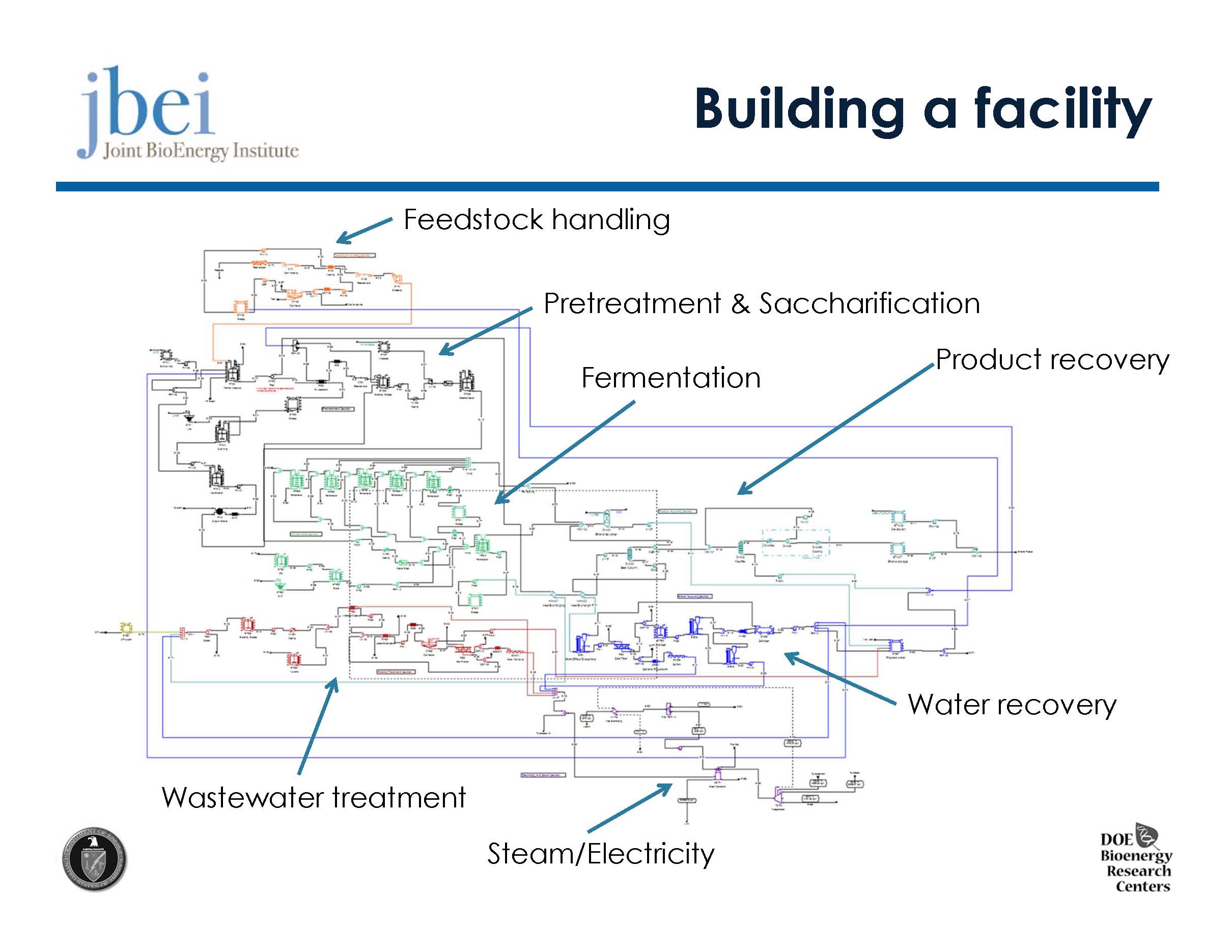
Using JBEI’s technoeconomic models, researchers can provide fuel production input factors to calculate fuel, energy and greenhouse gas output and derive production costs based on different processing strategies.

Now available on-line from the Joint BioEnergy Institute (JBEI) are two new, improved versions of a technoeconomic model created in 2010 to accelerate the development of next generation biofuels that are economically competitive with petroleum-based fuels. Incorporating the latest state-of-the-art technologies relevant to bioethanol production, these new wiki-based models simulate critical factors in the biorefinery process, such as production costs and energy balances, under different scenarios. This enables researchers to concentrate their efforts on the most promising strategies for cost-efficient biorefinery operations. Both new models correspond to refinery process configuration and performance scenarios, with one reflecting the best current technologies and the other reflecting projected technological developments.

“Two aspects were improved in the new models, configuration and performance, configuration, which encompasses the chemical engineering steps in the biorefinery process, and performance, which looks at how well each of those steps accomplish their intended purpose,” says Daniel Klein-Marcuschamer, a researcher with JBEI’s Deconstruction Division and one of the creators of both the original and the latest versions of the technoeconomic models. “The configuration is the same for both models, but the models differ in key process performance parameters, such as pretreatment, saccharification, and fermentation.”

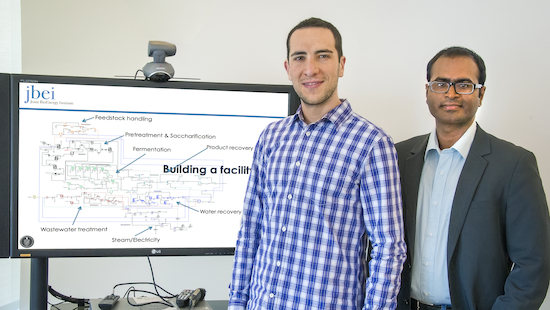
Daniel Klein-Marcuschamer (left) and Murthy Konda at the Joint BioEnergy Institute (JBEI) are developing technoeconomic models for optimizing biorefinery operations. (Photo by Roy Kaltschmidt)

Like their predecessor, the new models are formulated to simulate a lignocellulosic ethanol biorefinery that uses corn stover feedstock. From a comprehensive set of fuel production input factors, users can calculate the resulting ethanol, energy and greenhouse gas output, and can derive production costs, then vary the input values to test the effectiveness of different processing strategies. Murthy Konda, also with JBEI’s Deconstruction Division, working with Klein-Marcuschamer, updated the original technoeconomic model on the basis of research and analytical studies published since 2010.

“Over the last few years, there has been a significant research effort globally within the field of biofuels,” Konda says. “Subsequently, there is a need to ensure that the model-based tools such as our techno-economic models are up-to-date. Addressing this need is our current release of updated models. As before, we expect these new models will continue to be useful to biofuel research community. Eventually, we will be modeling scenarios for other types of biofuels using other types of feedstocks. Already we have started modeling biorefineries based on JBEI’s in-house ionic liquid pretreatment of biomass technologies.”

The new models have been released in the same wiki as the original along with accompanying notes. The 2010 model is still accessible so that current users can transition to the new models as needed. First-time users are encouraged to use the new models to take advantage of the updated research results and software.

Development of the JBEI technoeconomic models has been supported by Blake Simmons, who heads JBEI’s Deconstruction Division, and Harvey Blanch, JBEI’s Chief Science and Technology Officer. Both hold appointments with Berkeley Lab’s Physical Biosciences Division as do Konda and Klein-Marcuschamer.

JBEI is one of three Bioenergy Research Centers funded by the U.S. Department of Energy to advance the development of the next generation of biofuels. It is a scientific partnership led by Berkeley Lab and including the Sandia National Laboratories, the University of California (UC) campuses of Berkeley and Davis, the Pacific Northwest National Laboratory, the Carnegie Institution for Science, and the Lawrence Livermore National Laboratory.

Additional Information

The JBEI technoeconomic models for biorefinery operations is free and available for downloading here

viernes, 19 de octubre de 2012

What is the "Green Economy"?

ORIGINAL: UNEP

For the purposes of the Green Economy Initiative, UNEP has developed a working definition of a green economy as one that results in improved human well-being and social equity, while significantly reducing environmental risks and ecological scarcities. In its simplest expression, a green economy can be thought of as one which is low carbon, resource efficient and socially inclusive.


Practically speaking, a green economy is one whose growth in income and employment is driven by public and private investments that reduce carbon emissions and pollution, enhance energy and resource efficiency, and prevent the loss of biodiversity and ecosystem services. These investments need to be catalyzed and supported by targeted public expenditure, policy reforms and regulation changes. This development path should maintain, enhance and, where necessary, rebuild natural capital as a critical economic asset and source of public benefits, especially for poor people whose livelihoods and security depend strongly on nature.

What is the "Green Economy Initiative"?

The UNEP-led Green Economy Initiative, launched in late 2008, consists of several components whose collective overall objective is to provide the analysis and policy support for investing in green sectors and in greening environmental unfriendly sectors.

Within UNEP, the Green Economy Initiative includes three sets of activities:

  • Producing a Green Economy Report and related research materials, which will analyse the macroeconomic, sustainability, and poverty reduction implications of green investment in a range of sectors from renewable energy to sustainable agriculture and providing guidance on policies that can catalyze increased investment in these sectors. 
  • Providing advisory services on ways to move towards a green economy in specific countries.
  • Engaging a wide range of research, non-governmental organizations, business and UN partners in implementing the Green Economy Initiative.
Beyond UNEP, the Green Economy Initiative is one of the nine UN-wide Joint Crisis Initiatives (JCI) launched by the UN System's Chief Executives Board in early 2009. In this context, the Initiative includes a wide range of research activities and capacity building events from more than 20 UN agencies including the Bretton Woods Institutions, as well as an Issue Management Group (IMG) on Green Economy, launched in Washington, DC, in March 2010.

WISH20: End Ecocide by 2020


Imagine it’s 2020 and we’ve achieved the Green Economy.

Is it still possible that Ecocide, the extensive destruction of ecosystems, is still legal and profitable?

So what changed?

Could it be that the extensive destruction of ecosystems itself became illegal and provided an incentive for all the other changes that were necessary to enable the Green Economy?

In March 2010 international barrister and award winning author Polly Higgins proposed to the United Nations that Ecocide be made the fifth Crime Against Peace.

Ecocide is the extensive damage to, destruction of or loss of ecosystem(s) of a given territory, whether by human agency or by other causes, to such an extent that peaceful enjoyment by the inhabitants of that territory has been or will be severely diminished.

The law of Ecocide will enable sustainable development and the United Nations Environmental Program’s vision for a Green Economy. It is an innovative approach that will create a paradigm shift in the global economy and offers the promise that significant change is possible. The law of Ecocide is a new method for achieving a prosperous future for all people because it goes to the core of the environmental issues that are proving so difficult to tackle:

  • It is not a small idea that will have incremental benefits;
  • It does not treat the symptoms.
  • The Law of Ecocide addresses the causes of many environmental issues directly;
  • It will end the most extreme forms of environmental destruction;
  • It can be realistically achieved because no country has a veto and it initially requires support from only 81 countries.
  • It is the missing fifth Crime Against Peace.
The law of Ecocide will work because it will eliminate from most global supply chains the products and services that cause the greatest environmental destruction and so make companies that promote truly renewable solutions significantly more profitable. These companies will experience growth and so will create millions of jobs around the world. This will be good for people, societies, governments and shareholders everywhere. What is needed is an end to Ecocide.

If the world is going to achieve the Green Economy, where all humanity’s needs are delivered within the renewable capacity of the Earth, something significant has to happen to stop major environmental destruction taking place. That significant change, which many have predicted, is the law of Ecocide.

Polly and her legal team are determined to end this era of Ecocide. Find out how you can help. 

Read about Ecocide
Read about what happened at Rio+20


sábado, 13 de octubre de 2012

Nos toca iniciar una nueva revolución industrial: gurú economía verde

ORIGINAL: El Tiempo


Foto: Carlos Ortega
Paul Ekins dice que Colombia tiene gran potencial para diseñar un modelo de desarrollo sostenible.

Paul Ekins dice que si una gran parte de la humanidad viviera como él lo hace, el mundo sería diferente. A lo mejor no habría tantos enigmas climáticos o dilemas ambientales por resolver. No tiene carro y prefiere moverse en bicicleta por Londres (Inglaterra), su ciudad desde hace más de 40 años. No es vegetariano recalcitrante, pero dice que come la menor cantidad de carne posible.

Estuvo en Colombia esta semana como una excepción a la regla, porque a menos de tener una gran justificación, no hace viajes muy largos en avión. Prefiere ir a donde alcance a llevarlo un tren. Usa la tecnología básica y calienta el agua de su casa con paneles solares. "Llevo una vida sencilla -dice este experto en energía y política ambiental-, aunque me gusta mucho la música y el teatro, tal vez en exceso, pero no creo que consumir mucho arte signifique una amenaza".

Ekins, profesor del University College de Londres (UCL) y director del Centro Británico de Investigación en Energía, participó en el V Congreso Internacional de Medioambiente que terminó esta semana en Bogotá, organizado por el Centro de Estudios Internacionales para el Desarrollo Sostenible (Ceid), con el apoyo de EL TIEMPO.

Él es uno de los seres humanos que más sabe de economía verde, una nueva estrategia que busca que las naciones impongan un modelo de crecimiento que genere riqueza, pero al tiempo reduzca los impactos ecológicos sobre los ecosistemas. Tanta fe le tiene Ekins a esta nueva vía, que considera que puede "y debe" dividir en dos el futuro del siglo XXI.

Usted dice que la economía verde es la próxima revolución industrial. ¿Por qué?

La revolución industrial cambió las bases de la economía, cambió las formas de producción, de consumo y de inversión. De una humanidad muy agrícola se pasó a una manufacturera; surgieron los combustibles fósiles y nació el carro, por ejemplo. La economía verde busca que se dejen de mirar los recursos naturales como activos infinitos. Ahora tenemos que comenzar una nueva revolución industrial que nos ponga a movernos de forma diferente, a usar nuevos recursos para cambiar la manera de hacer energía. Necesitamos pasar de una economía marrón o contaminante a una verde y que se mueve con el viento, el sol o las olas del mar.

¿La economía verde es una moda medioambiental pasajera o ya maduró?

No es una moda ni puede serlo; aquí las cosas no dependen de si es o no una tendencia, debe ser el modelo del futuro. No podemos esperar que los 7.000 millones de ciudadanos vivan como los californianos, sin restringir lujos o consumo. Toca cambiar. El énfasis debe ser la no destrucción del medio ambiente.

¿No cree que es un modelo excluyente, solo para países ricos?

Hoy, por el uso incorrecto de los recursos y la destrucción de los ecosistemas, los pobres no pueden acceder a energía, a comida adecuada, al agua potable. Precisamente lo que logra la economía verde es sostener los recursos de los cuales dependen las comunidades de escasos recursos y reducir sus carencias. Un ejemplo: a corto plazo, crear un botadero a cielo abierto es más barato que construir un relleno con tecnología de punta que maneje las basuras adecuadamente. Pero a largo plazo, sale más caro el botadero, que generará daños impagables al suelo, al agua y a la salud de la gente. Es todo lo contrario a un modelo excluyente.

Para pasar de la teoría a la realidad, ¿qué países se destacan, así sea parcialmente, como económicamente verdes?

En Alemania, el 20 por ciento de su energía es limpia; la hacen con turbinas eólicas. En Austria, esa misma producción de energía renovable llega al 40 por ciento. En Holanda, más del 85 por ciento de los residuos industriales son reciclados. En Taiwán, la industria recicla el 50 por ciento. En estos sitios se está pasando del modelo producir-usar-botar a uno que cierre el ciclo y sea producir-usar-botar y reusar.

¿Cuál debe ser la estrategia gubernamental para aplicar este modelo sostenible?

Impuestos ambientales para quienes contaminen y oportunidades para sectores que intenten ser limpios. Aplicar restricciones: obligar a que cada complejo de viviendas que se construya sea energéticamente eficiente, por ejemplo. E impulsar las innovaciones, la investigación y el desarrollo de nuevas tecnologías.

La Administración de Información Energética dice que el consumo de carbón y otros combustibles fósiles aumentará hasta 2030. 

¿Cuál es el futuro de las energías renovables si esa economía basada en contaminantes no frena por ahora?

Todo depende. Esos son los cálculos de hoy, hechos con el modelo actual. No sabemos si en 20 años haya tanta inversión en formas de producción sostenibles que el modelo comience a variar, al punto de que el carbón o el petróleo dejen de ser tan atractivos comercialmente. Dependemos de las decisiones políticas.

Uno de los beneficios teóricos de la economía verde es que crea millones de puestos de trabajo. ¿Cómo se produce este milagro?

En el momento en que se inventen nuevas tecnologías, se necesitarán más personas que manejen esas nuevas propuestas. Incluso habrá gente que deje de trabajar en actividades contaminantes y se pase a cubrir el nuevo modelo. La transición hacia una economía más verde podría generar entre 15 y 60 millones de empleos adicionales en el mundo en las próximas dos décadas, y sacar a millones de la pobreza.

¿Cuál es ese sector que se debe 'enverdecer' primero?

La agricultura, que debe ser mucho más orgánica, como lo está logrando Europa. Pero en general, todos los sectores deben incluir procesos menos impactantes, porque igual vamos a necesitar hierro, agua o madera.

¿Cuál energía renovable se podría desarrollar primero: eólica, solar, térmica o marina?

La energía de biomasa, que usa materia orgánica. Le seguiría la solar, que transforma la energía en electricidad. Detrás estaría la que se produce con las olas del mar.

¿Se podría vivir solo del sol?

Por supuesto. Solo el sol, en un día, nos aporta la energía que los humanos usamos y producimos de múltiples formas durante un año. Impensable todo lo que estamos desperdiciando; por eso, las tecnologías que la captan deben ser cada vez más eficientes, sobre todo para los países ubicados sobre el Ecuador, donde la energía solar está presente todos los días.

Estamos sacrificando la salud del planeta y la nuestra, por un consumo desaforado. ¿Cuál es el camino para cambiar ese enfoque tan impactante?

Logrando que las formas de consumo irresponsable sean gravadas o penalizadas. El consumo propio no es un problema hasta tanto no perjudiques a tu vecino. El uso excesivo u ofensivo de los recursos debe ser castigado con dinero.

Colombia debate si debe ser un país minero, pero es biodiverso y genera más del 70 por ciento de la energía eléctrica con agua. ¿Qué análisis le merece?

Colombia debe pensar en buscar alternativas energéticas. La energía hidráulica, aunque no produce emisiones de CO2, no se puede considerar limpia por el impacto ecológico que tiene. No pueden descuidar el Amazonas, y si se piensa hacer minería allí, deben obligarse a que esta cumpla exigencias ambientales muy altas. Creo que es uno de los países del mundo con mayor potencial para revolucionar su actual modelo.

JAVIER SILVA HERRERA
Redacción Vida de hoy

domingo, 15 de julio de 2012

Contravía-La locomotora minera en Colombia.


CAPÍTULO 258: Joan Martínez Alier es un catalán historiador, investigador y catedrático en economía ambiental, visitó nuestro país en el marco de una gira que él programó por América Latina con el ánimo de recoger información para sus investigaciones y para visibilidad a los gobiernos locales y a las comunidades de las graves consecuencias que deja la explotación de tierra para obtener minerales.

La explotación de oro a cielo abierto con cianuro, el desmedido incremento de terrenos de las mineras de carbón, el "boom" de las compañías multinacionales que hacen presencia en Colombia gracias a las comodidades que el gobierno les ofrece, son parte de los trascendentales anuncios que se revelan en esta entrega de Contravía.

El 35% del territorio Colombiano está en la mira de la explotación, ya sea para metales, hidrocarburos o carbón; esto pone en riesgo la vida de miles de especies animales y vegetales y la generación de agua en los páramos, puesto que una empresa como EcoOro podría explotar el oro en el páramo de Santurbán en Santander afectando de manera DIRECTA el 60% de la zona "protegida".

lunes, 9 de julio de 2012

Gobierno 'congeló' zonas para títulos mineros

ORIGINAL: El Tiempo

Una buena noticia. Felicitaciones #GobiernoColombiano

En Antioquia hay exploraciones en la Cordillera Occidental en busca de oro, cobre y molibdeno. Foto Archivo

El presidente Santos anunció que congelará 17,6 millones de hectáreas en regiones del país.

Al terminar su intervención en la cumbre ambiental de Río+20, en la que Colombia propuso que expertos definan los objetivos de desarrollo sostenible, el presidente Juan Manuel Santos anunció el congelamiento de 17,6 millones de hectáreas en distintas regiones del país para la entrega de títulos mineros.

La medida, según explicó, está dirigida a impedir que en regiones muy sensibles se sigan entregando licencias de explotación minera "a dedo".

"Hemos venido desarrollando nuestra política ambiental, fortaleciéndola, tomando decisiones como las que anunciamos hoy: 17,6 millones de hectáreas que declaramos reserva estratégica minera, sobre todo en las zonas donde hay una gran riqueza en materia de biodiversidad. Son zonas que quedan en Amazonas, Vaupés, Vichada, Guainía, y Chocó", dijo Santos.

Destacó que estas son "señales del compromiso nuestro con el medio ambiente, donde estamos permanentemente en búsqueda de lo que hemos considerado que podría llamarse estado del arte en lograr un equilibrio entre el desarrollo normal, inclusive minero, porque somos un país con una gran riqueza minera, pero sobre todo con el desarrollo sostenible y ambiental".

En la cumbre, la propuesta de Colombia para el desarrollo sostenible del mundo se convirtió en la fórmula que permitiría que esta conferencia no sea un fracaso. La idea es que 30 representantes, expertos, de todos los países, de todas las regiones, inicien el estudio precisamente de identificar estos objetivos.

"No solamente identificarlos, sino ponerles sustancia; es decir, metas específicas y avanzar en la mayor medida posible para que en la Asamblea General de Naciones Unidas, el año entrante, en septiembre del 2013, ese grupo intergubernamental pueda dar sus recomendaciones y sus resultados", dijo el Presidente.

ONU propone cambiar el PIB

El Programa de Naciones Unidas para el Desarrollo (PNUD) propuso la creación de un índice de desarrollo sostenible humano que sustituya el Producto Interno Bruto (PIB).

La nueva medición, presentada en la conferencia de Río+20, se basa en el Índice de Desarrollo Humano (IDH), un indicador que incluye variables de salud, educación y nivel de renta, y que, desde hace dos décadas, es usado por la ONU para evaluar el progreso social y económico de los países.

La administradora del PNUD, Helen Clark, dijo que el PIB no incluye elementos "fundamentales en nuestras vidas" como la equidad, la dignidad, la felicidad y la sostenibilidad, según un comunicado.

Luis Guillermo Forero C.
Enviado especial EL TIEMPO
Río de Janeiro.

lunes, 2 de julio de 2012

After Rio+20, developing countries must take the lead

ORIGINAL: SciDev
David Dickson
29 June 2012

Shutterstock
Leadership from developing countries will be key to global sustainable development

Last week's summit has confirmed that sustainable development will only be achieved through the political leadership of developing countries.

Two and a half years ago, the Copenhagen climate change conference (COP15) ended in rancorous and highly public disagreement between developed and developing nations on what was needed to prevent further global warming .

The outcome proved an intense embarrassment to the host nation, Denmark.

From the beginning of negotiations over the UN Conference on Sustainable Development (dubbed Rio+20 ), which took place in Rio de Janeiro, Brazil, last week, it was widely reported that the Brazilian government was desperate to avoid the same fate.

This article is part of our coverage of Rio+20 — the UN Conference on Sustainable Development — which took place on 20-22 June 2012. For other articles, go to Science at Rio+20

Although Brazil's determination was only one contributory factor, the result was the agreement, by all 188 participating nations, on an outcome document that was filled with aspirations and exhortations about the need for the world to move to a more sustainable path of economic and social development, but lacking any firm commitment to the more painful steps needed to achieve this goal.

Inevitably, this outcome has satisfied virtually no-one engaged in the process (apart from the host country).

But the increased focus that it provided on the political realities on which the Copenhagen meeting foundered — and which Rio+20 ducked — has itself been a significant step forward.


Taking the lead

What became clearer than ever at Rio was that the key to global sustainable development does not lie in the logical arguments coming from proponents in the developed world, including its scientific communities, however passionately they are delivered.

Rather, it now lies in the combination of political muscle and imaginative thinking in the developing world, particularly the so-called "emerging economies" of countries such as Brazil, China and India.

In Rio, these countries insisted, quite legitimately, that a global commitment to making the transition to "green economies" is only valid if it includes atransfer of significant financial and technical resources from the North to the South.

Their argument was that such a transfer would compensate for the fact that this transition is necessary because of the consumption patterns of the North.

Furthermore, the emerging economies — and China in particular — are coming to realise that sustainable development is in their own interest.

Their own internal environmental problems, from air pollution to an increase in flooding related to climate change , need to be addressed urgently as the unacceptable by-products of economic growth.

At the same time, a combination of technical ingenuity and low labour costs makes them well placed to become the leading producers of sustainable technologies for the rest of the world­ — as China has already shown in exporting solar energy technologies to Africa, for example.

Galvanising the grassroots

The organisers of Rio+20 were keen to emphasise that even as the formal proceedings turned out to be disappointing, this had been partially compensated for by the enormous networking opportunities the meeting provided for sustainable development stakeholders .

In particular, by the end of the meeting, more than 700 pledges — valued at over US$500 billion — had been registered for concrete actions through, for example, individual institutional commitments or partnership agreements.

Each of these was required to commit to quantifiable outcomes within a fixed timeframe. Together they show that a massive global commitment to sustainable development already exists, even without promises of resource transfers from political leaders.

Indeed, this outcome appears to confirm what many have been arguing: that truly sustainable economies can only be built from the grassroots, and with the full inclusion of community groups and other interested stakeholders.

Reigning in corporate power

But even if grassroots or voluntary initiatives are a necessary condition for sustainable development, they are not sufficient.

In particular, it ignores the extent to which the key directions and components of economic growth — such as a continued reliance on non-renewable energy sources supported by generous subsidies — are inevitably set at the top, rather than the bottom, of the political pyramid.

Furthermore, without an all-embracing political framework to ensure coherence between individual actions, each stakeholder remains — equally inevitably — motivated primarily by their own self-interest (or that of their stakeholders or shareholders), rather than a commitment to a common good. 

For example, many of the 700 individual pledges registered at Rio involved individual commitments from corporations keen to be seen to be "going green".

Ironically, however, former Norwegian Prime Minister Gro Harlem Brundlandt, head of the Brundlandt Commission, which first coined the phrase "sustainable development" in the 1980s, accused corporate lobbyists of being partly responsible for the disappointing outcome of the formal negotiations. [1]


Paving the future

The scientific meetings held in the run-up to Rio+20 — including both the Planet Under Pressure meeting in London in April, and the International Council for Science and UN Educational, Scientific and Cultural Organization's Forum on Science, Technology and Innovation for Sustainable Development , held two weeks ago in Rio itself — both underlined the urgency of taking action on many fronts.

Rio+20 opened the door for action on some of these, such as protecting the marine environment or mountain ecosystems . It also endorsed closer interaction between scientific communities and policymakers — another essential element of any future strategy.

But the meeting also highlighted the political challenge of changing the course of a global economy still wedded largely to fossil fuels and non-sustainable patterns of consumption.

It also showed that the developed world lacks the commitment to make the necessary changes and accept the painful consequences, pursuing the familiar maxim that "turkeys don't vote for Christmas".

It is now up to the developing world and its emerging economies to show that they can do better — for example, by taking on a key role in defining the forthcoming Sustainable Development Goals — and providing the political muscle to make this happen.

Concerns about embarrassment over possible failure should not stop them from taking the necessary political risks.

David Dickson 
Editor, SciDev.Net

This article is part of our coverage on Science at Rio+20 . Read more in our blog .

REFERENCES