Mostrando entradas con la etiqueta Biología Evolucionaria. Mostrar todas las entradas

jueves, 11 de septiembre de 2014

I Contain Multitudes

Our bodies are a genetic patchwork, possessing variation from cell to cell. Is that a good thing?

Olena Shmahalo for Quanta Magazine

Even healthy brains harbor genetic diversity, though scientists disagree over the extent.

Your DNA is supposed to be your blueprint, your unique master code, identical in every one of your tens of trillions of cells. It is why you are you, indivisible and whole, consistent from tip to toe.

But that’s really just a biological fairy tale. In reality, you are an assemblage of genetically distinctive cells, some of which have radically different operating instructions. This fact has only become clear in the last decade. Even though each of your cells supposedly contains a replica of the DNA in the fertilized egg that began your life, mutations, copying errors and editing mistakes began modifying that code as soon as your zygote self began to divide. In your adult body, your DNA is peppered by pinpoint mutations, riddled with repeated or rearranged or missing information, even lacking huge chromosome-sized chunks. Your data is hopelessly corrupt.

Most genome scientists assume that this DNA diversity, called “somatic mutation” or “structural variation,” is bad. Mutations and other genetic changes can alter the function of the cell, usually for the worse. Disorderly DNA is a hallmark of cancers, and genomic variation can cause a suite of brain disorders and malformations. It makes sense: Cells working off garbled information probably don’t function very well.

Most research to date has focused on how aberrant DNA drives disease, but even healthy bodies harbor genetic disorder. In the last few years, some researchers report that anywhere from 10 to 40 percent of brain cells and between 30 and 90 percent of human liver cells are aneuploid, meaning that one entire chromosome is either missing or duplicated. Copy number variations, in which chunks of DNA between 100 and a few million letters in length are multiplied or eliminated, also seem to be widespread in healthy people.

jueves, 6 de febrero de 2014

Written all over your face: humans express four basic emotions rather than six, says new study


Happiness, sadness, fear, anger, surprise, and disgust might no longer be the simplest six.

Human beings are emotional creatures whose state of mind can usually be observed through their facial expressions.

A commonly-held belief, first proposed by Dr Paul Ekman, posits there are six basic emotions which are universally recognised and easily interpreted through specific facial expressions, regardless of language or culture. These are:
  • happiness, 
  • sadness, 
  • fear, 
  • anger, 
  • surprise and 
  • disgust.

New research published in the journal Current Biology by scientists at the University of Glasgow has challenged this view, and suggested that there are only four basic emotions.

In the news: BBC News Online

Their conclusion was reached by studying the range of different muscles within the face – or Action Units as researchers refer to them – involved in signalling different emotions, as well as the time-frame over which each muscle was activated.

This is the first such study to objectively examine the ‘temporal dynamics’ of facial expressions, made possible by using a unique Generative Face Grammar platform developed at the University of Glasgow.

The team from the Institute of Neuroscience and Psychology claim that while the facial expression signals of happiness and sadness are clearly distinct across time, fear and surprise share a common signal – the wide open eyes – early in the signalling dynamics.
 
Disgust and anger, surprise and fear
Similarly, anger and disgust share the wrinkled nose. It is these early signals that could represent more basic danger signals. Later in the signalling dynamics, facial expressions transmit signals that distinguish all six ‘classic’ facial expressions of emotion.

Lead researcher Dr Rachael Jack said: “Our results are consistent with evolutionary predictions, where signals are designed by both biological and social evolutionary pressures to optimise their function.

“First, early danger signals confer the best advantages to others by enabling the fastest escape. Secondly, physiological advantages for the expresser – the wrinkled nose prevents inspiration of potentially harmful particles, whereas widened eyes increases intake of visual information useful for escape – are enhanced when the face movements are made early.

“What our research shows is that not all facial muscles appear simultaneously during facial expressions, but rather develop over time supporting a hierarchical biologically-basic to socially-specific information over time.”

In compiling their research the team used special techniques and software developed at the University of Glasgow to synthesise all facial expressions.

The Generative Face Grammar – developed by Professor Philippe Schyns, Dr Oliver Garrod and Dr Hui Yu – uses cameras to capture a three-dimensional image of faces of individuals specially trained to be able to activate all 42 individual facial muscles independently.

From this a computer can then generate specific or random facial expressions on a 3D model based on the activation of different Actions Units or groups of units to mimic all facial expressions.

By asking volunteers to observe the realistic model as it pulled various expressions – thereby providing a true four-dimensional experience – and state which emotion was being expressed the researchers are able to see which specific Action Units observers associate with particular emotions.

It was through this method they found that the signals for fear/surprise and anger/disgust were confused at the early stage of transmission and only became clearer later when other Action Units were activated.

Dr Jack said: “Our research questions the notion that human emotion communication comprises six basic, psychologically irreducible categories. Instead we suggest there are four basic expressions of emotion.

“We show that ‘basic’ facial expression signals are perceptually segmented across time and follow an evolving hierarchy of signals over time – from the biologically-rooted basic signals to more complex socially-specific signals.

“Over time, and as humans migrated across the globe, socioecological diversity probably further specialised once-common facial expressions, altering the number, variety and form of signals across cultures.”

The researchers intend to develop their study by looking at facial expressions of different cultures, including East Asian populations whom they have already ascertained interpret some of the six classical emotions differently – placing more emphasis on eye signals than mouth movements compared to Westerners.


Related links

Find out more

Further information: Stuart.Forsyth@glasgow.ac.uk / 0141 330 4831
ORIGINAL: U of Glasgow

domingo, 21 de julio de 2013

Evolution not as unpredictable as thought, study says

ORIGINAL: LA Times
By Melissa Pandika
July 18, 2013


A study published Thursday in Science found that the ecology of an area can predict the traits a species will evolve millions of years from now, despite all the chance events that could influence the outcome. Researchers examined the evolution of anole lizards, such as this Anolis garmani from Blue Mountain, Jamaica. (Luke Mahler / July 10, 2008)

Say you could hop into a DeLorean and travel back to when life on Earth began. Would fish migrate from water to land? Would the dinosaurs go extinct? At the end of our trip, would we still encounter life as we now know it?

Some scientists don’t think so. They argue that any number of chance events — storms and earthquakes, for example — would steer evolution down another course, making it impossible to predict.

But a study published Tuesday in Science has found that if we know the ecology of an area, we can predict the traits a species will evolve millions of years from now, despite all the chance events that could influence the outcome.

While most biologists agree that the natural environment can predict evolutionary changes over a few generations, whether it can do so over millions of years has remained “contentious,” said UC Davis population biologist and study leader Luke Mahler. Longer time spans mean more opportunities for chance events to occur.

But since “we can’t rewind the tape of life and replay it again” Mahler said, settling the controversy has been difficult. But Mahler approximated this time travel by studying evolution in anole lizards in the Greater Antilles islands -- Cuba, Hispaniola (which comprises the Dominican Republic and Haiti), Jamaica, and Puerto Rico -- which was like screening the tape at “four different theaters all at the same time,” he said. The islands are also ecologically similar.

Mahler and his colleagues found that nearly 90% of the time, anoles on different islands had evolved highly similar traits — a phenomenon called convergent evolution — and that their similar environments, not chance alone, can account for this similarity. That allowed them to conclude that, despite all the chance events that occurred over each species’ history, comparable ecological pressures had led them to comparable evolutionary outcomes.

Mahler decided to study the tiny, color-changing anoles because they’ve been evolving on the Greater Antilles for 40 million years, allowing him to examine their evolution over a long time scale. In addition, biologists had already constructed detailed anole evolutionary trees, making it easy to identify different species.

Scientists have observed convergent evolution in a few anole species in the Greater Antilles, but no one had done an analysis that considered every anole species, including those unique to different islands.

Strained diplomatic relations between the U.S. and Cuba made traveling to the island “ a hurdle” for scientists, Mahler said. In Haiti, safety concerns, especially after the 2010 earthquake, similarly stymied fieldwork there.

But eventually, Mahler was able to spend two years measuring an array of physical attributes in 100 out of 119 known anole species in the Greater Antilles, relying on both preserved museum specimens and animals in the wild. He used calipers to measure the lengths of their bodies, legs and tails, and counted the number of sticky pads on their toes.

Anoles are known to have adapted these physical traits specifically to survive in different ecological “niches.” For example, field anoles have long tails that help them cling to swaying grass blades, while treetop-dwelling anoles have a high number of sticky toe pads well-suited for climbing.

Mahler and his colleagues then developed several statistical models of evolution, testing to each to see which one best explained the physical characteristics they had observed. The best fit was one that relied on the idea of “adaptive peaks,” or particular combinations of features that natural selection would favor.

By that token, similar evnironments should have similar adaptive peaks -- collectively known as an “adaptive landscape” — but no one had tested the idea, until now.

The adaptive peak model “blows all those other models out of the water,” Mahler said. “It leaves them smoking.”

His analysis also revealed that the convergence he and his colleagues had observed wasn’t due just to chance. “You expect some convergence by chance,” he said. But in models with a high degree of chance, “you don’t get anything resembling the convergence that we see.”

Although the anoles inhabited different islands, the islands’ ecological similarity meant they faced the same adaptive landscape with the same niches to exploit. As the lizards diversified, their traits converged on the same peaks — ones that make them twig or leaf specialists, for example.

The only places where the anole species diverged from the handful of adaptive peaks were Cuba and Hispaniola — larger islands where anoles are more likely to find and exploit unique niches not found on the other islands.

Mahler’s findings are consistent with studies that have found similarities among cichlid fish species in different lakes in the African Rift. But the current study is “the first to show in a quantifiable way just how this [convergence] happened,” said Rosemary Gillespie, an evolutionary biologist at UC Berkeley who was not part of the study.

But Gillespie noted that, although the paper shows that ecology can predict evolution on small islands, “whether the same kind of thing happens on a continental scale we don’t know exactly.” Still, the paper shows this prediction is possible, she said.

Others have already begun testing Mahler’s ideas by unwittingly introducing anoles to Hawaii, a region ecologically similar to the Caribbean. (The anoles often hitch rides on ships carrying plants or produce.) If his conclusions hold up, the lizards should eventually resemble their Caribbean counterparts.

“I think it’s going to be an amazing experiment to come back in 3 million years and see how they turn out,” he said. “That’ll be the real test of our ideas.”

viernes, 10 de agosto de 2012

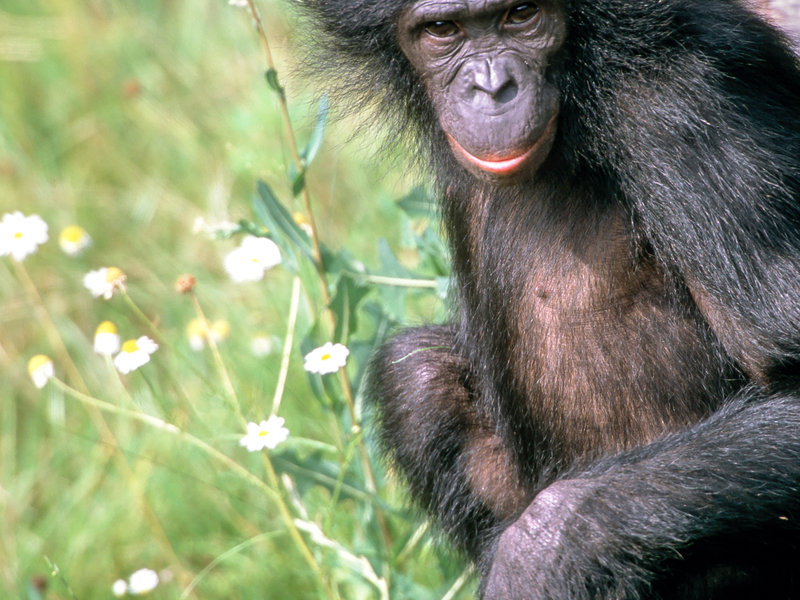
Bonobo Genome Completed: The Final Great Ape to Be Sequenced

June 13, 2012

Max Planck scientists have completed the genome of the bonobo - the final great ape to be sequenced

In a project led by the Max Planck Institute for Evolutionary Anthropology in Leipzig, an international team of scientists has completed the sequencing and analysis of the genome of the last great ape, the bonobo. 

Bonobos, which together with chimpanzees are the closest living relatives of humans, are known for their peaceful, playful and sexual behaviour that contrasts with the more aggressive behaviour of chimpanzees. 

The genome sequence provides insights into the evolutionary relationships between the great apes and may help us to understand the genetic basis of these traits.

The female Bonobo Ulindi in the Zoo Leipzig. © Michael Seres 
The genome was sequenced from Ulindi, a female bonobo who lives in the Zoo Leipzig. Genome sequences have also been generated from all other great apes – chimpanzee, orang-utan and gorilla - making this the final genome of a great ape to be sequenced and providing insights into their relationships with one another and with humans.

The comparison of the genome sequences of bonobo, chimpanzee, and human show that humans differ by approximately 1.3% from both bonobo and chimpanzee. Chimpanzees and bonobos are more closely related, differing by only 0.4%.

Bonobo and chimpanzee territories in central Africa are close to one another and separated only by the Congo River. It has been hypothesized that the formation of the Congo River separated the ancestors of chimpanzees and bonobos, leading to these distinct apes. Examination of the relationship between bonobos and chimpanzees showed that there appears to have been a clean split and no subsequent interbreeding, which supports this hypothesis.

Despite the fact that on average the genomes of bonobos and chimpanzees are equally distant from human, analysis of the genome sequence of the bonobo revealed that for some particular parts of the genome, humans are closer to bonobos than to chimpanzees, while in other regions the human genome is closer to chimpanzees. Further research will determine whether these regions contribute in any way to the behavioural differences and similarities between humans, chimpanzees, and bonobos.

domingo, 1 de julio de 2012

The Male Praying Mantis — Dying to Mate?

ORIGINAL:  Biozine

A female mantis chews off the head of a male.
Females of the praying mantis and Chinese mantis species are infamous for their habit of devouring male mantises before, during, or after mating with them. For years scientists have been arguing over how and why this gruesome relationship could have evolved. The female certainly benefits from having a large meal that essentially delivers itself to her spiny embrace. What can account for this suicidal form of insect chivalry on the part of the male?

In the evolutionary scheme of things, any organism that reproduces and passes on its genes is considered successful, even if it involves personal sacrifice. Have male mantises not evolved a way to avoid being eaten by females because their main objective — passing on genes — is achieved? Have females evolved in a way that leads to selecting males who cooperate in their own death? Do males who fight for their lives never get a chance to mate and pass on their genes? If you're a female mantis, especially a hungry one, why choose a mate who's going to put up a fuss when you try to bite his head off?

Some point out that the nutrition offered to females in the form of a male probably improves the odds that the sperm deposited in a female will end up resulting in a new generation of offspring. If a male simply mated with a female and walked away, as is the case in many animal species, then the female would have to fend for herself and the few hundred eggs she carries. A well-fed female should fare much better than a hungry female.

Despite these compelling, logical arguments, some scientists insist that a male who could mate with a female but also live to mate another day would be more successful in reproductive and evolutionary terms. So why hasn't evolution lead to male mantises adapted to the female's aggression? Is there no way to mate without losing your life?

William Brown of the State University of New York, Fredonia, decided to study Chinese mantises to see if males demonstrated any ability to avoid death at the hands of their mates. Brown and one of his undergraduate students, Jonathan Lelito, experimented with introducing male and female mantises to each other under different conditions.

"We predicted that if the male is complicit, he's just going to march into her jaws," Brown said. "But if the male does not want to become her meal, then he should avoid the risk of being eaten." They placed some males in containers with females who had not eaten recently, and placed others with females who had already feasted on crickets. They also experimented with how the males approached the females. Did males fare better if they approached from behind?

The results of Brown's experiments showed that males are quicker to approach females that are full. When presented with hungry females, males will jump onto them from a greater distance, possibly to avoid being grabbed and killed before getting a chance to mate. Males also tend to stay on hungry females for longer, perhaps to wait for the female's hunger to pass. Males who approach females from behind are also less likely to be eaten.

"It's clearly a case of sexual conflict," Dr. Brown said. "Males are not willing partners." While the work of Brown and Lelito shows that male mantises are not gung-ho about being cannibalized during sex, the fact that as much as 63% of a female mantis's diet is composed of male mantises suggests that the urge to mate is stronger than the urge to live.