Mostrando entradas con la etiqueta Matemática. Mostrar todas las entradas

viernes, 13 de junio de 2014

Mathematical Model Of Consciousness Proves Human Experience Cannot Be Modelled On A Computer


A new mathematical model of consciousness implies that your PC will never be conscious in the way you are

One of the most profound advances in science in recent years is the way researchers from a variety of fields are beginning to think about consciousness. Until now, the c-word was been taboo for most scientists. Any suggestion that a researchers was interested in this area would be tantamount to professional suicide.

That has begun to change thanks to a new theory of consciousness developed in the last ten years or so by Giulio Tononi, a neuroscientist at the University of Wisconsin in Madison, and others. Tononi’s key idea is that consciousness is phenomenon in which information is integrated in the brain in a way that cannot be broken down.

So each instant of consciousness integrates the smells, sounds and sights of that moment of experience. And consciousness is simply the feeling of this integrated information experience.

What makes Tononi’s ideas different from other theories of consciousness is that it can be modelled mathematically using ideas from physics and information theory. That doesn’t mean this theory is correct. But it does mean that, for the first time, neuroscientists, biologists physicists and anybody else can all reason about consciousness using the universal language of science: mathematics.

This has led to an extraordinary blossoming of ideas about consciousness. A few months ago, for example, we looked at how physicists are beginning to formulate the problem consciousness in terms of quantum mechanics and information theory.

Today, Phil Maguire at the National University of Ireland and a few pals take this mathematical description even further. These guys make some reasonable assumptions about the way information can leak out of a consciousness system and show that this implies that consciousness is not computable. In other words, consciousness cannot be modelled on a computer.

Maguire and co begin with a couple of thought experiments that demonstrate the nature of integrated information in Tononi’s theory. They start by imagining the process of identifying chocolate by its smell. For a human, the conscious experience of smelling chocolate is unified with everything else that a person has smelled (or indeed seen, touched, heard and so on).

This is entirely different from the process of automatically identifying chocolate using an electronic nose, which measures many different smells and senses chocolate when it picks out the ones that match some predefined signature.

A key point here is that it would be straightforward to access the memory in an electronic nose and edit the information about its chocolate experience. You could delete this with the press of a button.

But ask a neuroscientist to do the same for your own experience of the smell of chocolate—to somehow delete this—and he or she would be faced with an impossible task since the experience is correlated with many different parts of the brain.

Indeed, the experience will be integrated with all kinds of other experiences. “According to Tononi, the information generated by such [an electronic nose] differs from that generated by a human insofar as it is not integrated,” say Maguire and co.

This process of integration is then crucial and Maguire and co focus on the mathematical properties it must have. For instance, they point out that the process of integrating information, of combining it with many other aspects of experience, can be thought of as a kind of information compression.

This compression allows the original experience to be constructed but does not keep all of the information it originally contained.

To better understand this, they give as an analogy the sequence of numbers: 4, 6, 8, 12, 14, 18, 20, 24…. This is an infinite series defined as: odd primes plus 1. This definition does not contain all the infinite numbers but it does allow it be reproduced. It is clearly a compression of the information in the original series.

The brain, say Maguire and co, must work like this when integrating information from a conscious experience. It must allow the reconstruction of the original experience but without storing all the parts.

That leads to a problem. This kind of compression inevitably discards information. And as more information is compressed, the loss becomes greater.

But if our memories were like that cannot be like that, they would be continually haemorrhaging meaningful content. “Memory functions must be vastly non-lossy, otherwise retrieving them repeatedly would cause them to gradually decay,” say Maguire and co.

The central part of their new work is to describe the mathematical properties of a system that can store integrated information in this way but without it leaking away. And this leads them to their central proof. “The implications of this proof are that we have to abandon either the idea that people enjoy genuinely [integrated] consciousness or that brain processes can be modelled computationally,” say Maguire and co.

Since Tononi’s main assumption is that consciousness is the experience of integrated information, it is the second idea that must be abandoned: brain processes cannot be modelled computationally.

They go on to discuss this in more detail. If a person’s behaviour cannot be analysed independently from the rest of their conscious experience, it implies that something is going on in their brain that is so complex it cannot feasibly be reversed, they say.

In other words, the difference between cognition and computation is that computation is reversible whereas cognition is not. And they say that is reflected in the inability of a neuroscientist to operate and remove a particular memory of the small of chocolate.

That’s an interesting approach but it is one that is likely to be controversial. The laws of physics are computable, as far as we know. So critics might ask how the process of consciousness can take place at all if it is non-computable. Critics might even say this is akin to saying that consciousness is in some way supernatural, like magic.

But Maguire and go counter this by saying that their theory doesn’t imply that consciousness is objectively non-computable only subjectively so. In other words, a God-like observer with perfect knowledge of the brain would not consider it non-computable. But for humans, with their imperfect knowledge of the universe, it is effectively non-computable.

There is something of a card trick about this argument. In mathematics, the idea of non-computability is not observer-dependent so it seems something of a stretch to introduce it as an explanation.

What’s more, critics might point to other weaknesses in the formulation of this problem. For example, the proof that conscious experience is non-computable depends critically on the assumption that our memories are non-lossy.

But everyday experience is surely the opposite—our brains lose most of the information that we experience consciously. And the process of repeatedly accessing memories can cause them to change and degrade. Isn’t the experience of forgetting a face of a known person well documented?

Then again, critics of Maguire and co’s formulation of the problem of consciousness must not lose sight of the bigger picture—that the debate about consciousness can occur on a mathematical footing at all. That’s indicative of a sea change in this most controversial of fields.

Of course, there are important steps ahead. Perhaps the most critical is that the process of mathematical modelling must lead to hypotheses that can be experimentally tested. That’s the process by which science distinguishes between one theory and another. Without a testable hypothesis, a mathematical model is not very useful.

For example, Maguire and co could use their model to make predictions about the limits in the way information can leak from a conscious system. These limits might be testable in experiments focusing on the nature of working memory or long-term memory in humans.

That’s the next challenge for this brave new field of consciousness.

Ref: arxiv.org/abs/1405.0126 : Is Consciousness Computable? Quantifying Integrated Information Using Algorithmic Information Theory


Follow the Physics arXiv Blog on Twitter at @arxivblog, on Facebook and by hitting the Follow button below.

ORIGINAL: Medium

martes, 18 de febrero de 2014

Why strange loops could be an argument for artificial intelligence


Strange loops can be many things, including musical tones, mathematical problems, and linguistic riddles. They also can be biological fact, and this fact might be translated into computer code or silicon chips. Here's why a philosophical theory might show true artificial intelligence is possible.

What Are Strange Loops?
When following a simple loop, you know you will go on a single trip that takes you back to where you started. There's one journey, and one destination. Strange loops are a bit more complicated — they form a kind of set of instructions, an ordered hierarchy, that brings you higher and higher, until you're back at the beginning where you started.

Strange Loops were the brainchild of Douglas Hofstadter, a philosopher and scientist who wrote I Am a Strange Loop. They can be simple or complex, but they depend on what Hofstadter called "tangled hierarchies." Instead of a linear progression, these hierarchies balance on each other. Together they encompass a set of instructions that set out two equally valid ways of looking at a situation. The situation cannot be resolved without elevating one view and one part of the set of instructions over the other, but there is no objective way to do that.

Examples of Strange Loops
Hofstadter proposes the Mona Lisa, or any painting, as an example of a strange loop. It's a group of pigments that are spackled onto a canvas, and it's a smiling woman. Obviously one is literally true and one is only figuratively true, but one would have to be deliberately obtuse to talk of the painting as only a grouping of colors under varnish. Examples of strange loops within paintings are the famous impossible object images of M. C. Escher and others — the endlessly descending stairs and rigid cages with bars that cross each other. If we could pin down which part of the object was real we could decide which part violated the laws of that painting's universe, but there's no objective basis to declare one part of the image real rather than any other part.

The Shepard Tones comprise a musical strange loop
. They are a group of tones that seem to continually rise (or fall) but never actually change. Our attention focuses on certain notes that seem to rise, but the lower notes never drop out. We keep waiting for an impossibly high dog whistle that never comes.


There are also linguistic strange loops that require us to make impossible distinctions. There's the famous two-sentence problem: "The following sentence is a lie. The previous sentence is true." And then there's the Berry Paradox, a famous mathematical definition that invalidates itself. It is meant to describe "the smallest positive integer not definable in under 1 words." Of course, whatever integer that is, it is now definable in under 11 words. Meaning there can't possibly be a smallest possible integer definable in under 11 words, except there has to be so that phrase can define it.

Strange Loops and Artificial Intelligence
What does any of this word play have to do artificial intelligence?
Hofstadter meant the title of his book literally. When he said, "I am a strange loop," what he meant was the idea of "I," the concept of the self, was a result of this weird duality of tangled hierarchies.

Ask people if their brains, the actual electrically lit-up matter that sits in their head cases, are what what make them themselves, and they'll probably say yes. We are our brains. Ask them if they are simply a mechanical thing, programmed to respond to stimulus, like a complex adding machine, and they would say no. We have a sense of self. To take the strictly literalist view that we do not have selves, that we are mechanical, would be as obtuse as saying the Mona Lisa is a group of colors or a difference engine is a proto-human. Our electrified protein has constructed a more numinous identity, and both the meat and the idea are valid.
Impossible Arch Image: Till Krech.

So what? So that means that the sense of self will arise organically, from enough data input on sufficiently complex machinery. It doesn't matter if that machinery is made of flesh or anything else. Some people say that computers may imitate intelligent human life very well, but they'll never actually be the equivalent to humans. Others say that a calculator isn't much different from a human brain. The idea of strange loops, as they apply to life and machinery, asserts that calculators are not brains, because they do not construct an identity the way that brains do. However, they can become brains, or more accurately, they can become minds. Minds made of silicon, or anything else, are, when taken as strange loops, in no way distinguishable from human minds. "We" are both physical objects and incorporeal identities constructed from physical objects — and we are constructed so well that no one can say that the physical is more valid than the theoretical.

. [Via I Am a Strange Loop, Wolfram Math World, Philosophy Now, Strange Loops In Biology]

10 Hours of Infinite Fractal and Falling Shepard's Tone By
Daniel Repasky 
Video: Used with permission from the animated fractal's creator, Vladimir Bulatov. Check out his YouTube page here: http://bit.ly/13jdZ7e , and his DeviantArt page here: http://bit.ly/Yx2S78 .
The video is a fractal version of M.C. Escher's "Circle Limit III" (http://bit.ly/bbJ9P) created by Bulatov. Audio: Shepard's Tone (Shepard's Scale) consisting of rising tones set octaves apart, similar to how to barber's pole always seems to be rising: http://bit.ly/tlSj


ORIGINAL: Io9

viernes, 27 de diciembre de 2013

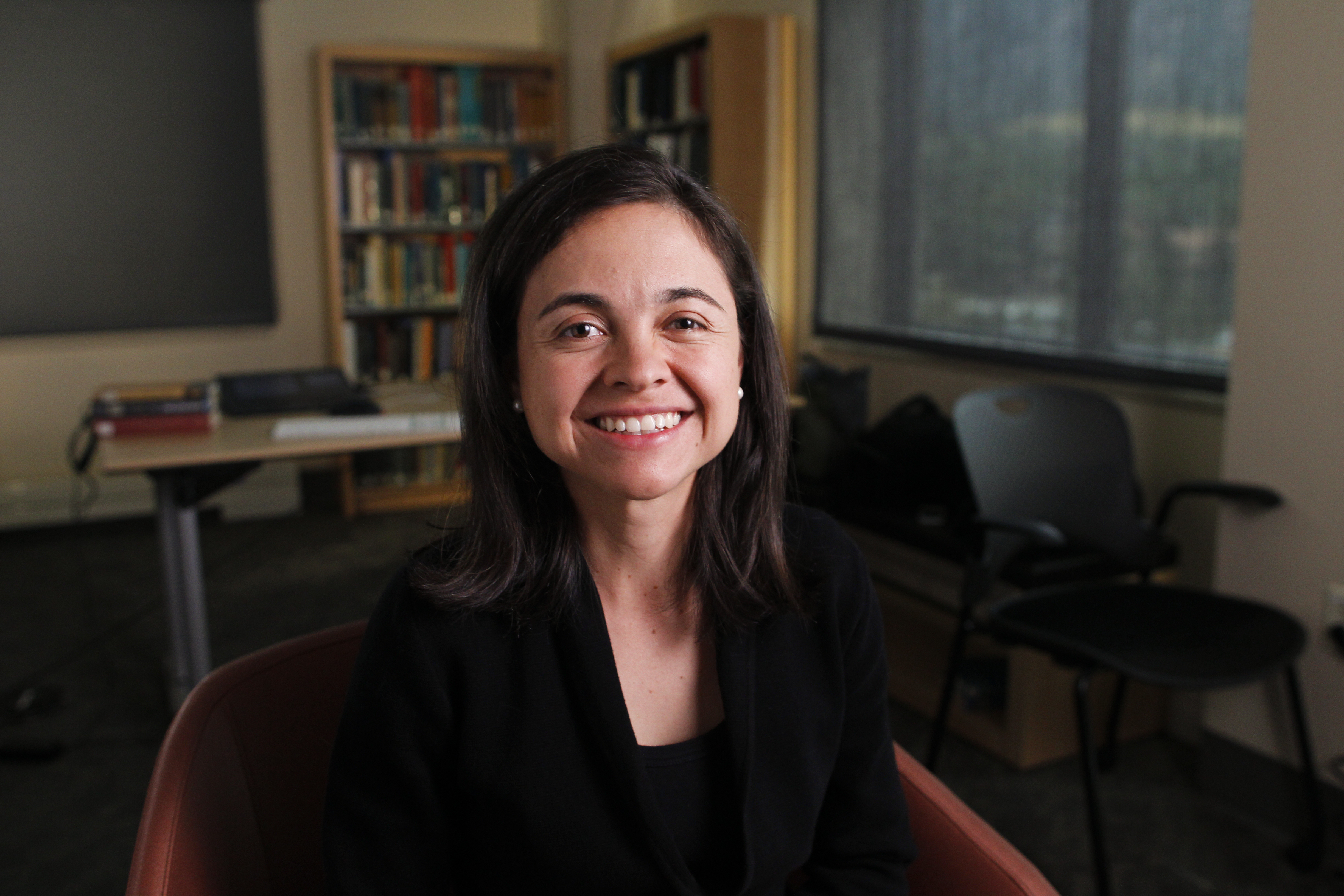
Ana Maria Rey, Atomic Physicist. MacArthur Fellow Class of 2013

MacArthur Fellows / Meet the Class of 2013

Ana Maria Rey. Atomic Physicist. Fellow of JILA. University of Colorado. Boulder, CO. Age: 36

Ana Maria Rey is a theoretical physicist working across the interfaces of atomic, molecular, optical, and condensed matter physics with the goal of using mathematical models to describe the complex behavior of nature. Rey is tackling this challenge through her research on ultracold optical-lattice systems, which will facilitate progress in areas such as quantum simulation and quantum information and enable the preparation of large-scale entanglement between atoms.

Through her ability and willingness to forge close collaborations across the physics community, Rey’s fundamental conceptual research in optical lattices is being leveraged by experimentalists to simulate, manipulate, and control novel states of matter, including quantum magnets, superfluids, and insulators that are important for understanding quantum phenomena like superconductivity. With colleagues, Rey is developing a comprehensive theoretical framework for an optical-lattice quantum computer based on alkaline earth metals. This effort has already proposed solutions for the key problems of storing, addressing, and transporting qubits (the quantum version of a classical bit in computing).

She is now working to resolve long-standing impediments to large-scale entanglement between atoms. A quantum computer requires entangled states—which occurs when the quantum states of two or more atoms become linked or connected—for both communication and computation. Rey’s theory offers a novel solution for maintaining coherence (or stability) in a quantum computer using unique properties of alkaline earth atoms, such as their large number of internal degrees of freedom. Rey’s collaborations with experimentalists have also enabled advances in the development of an optical atomic clock and quantum simulations with polar molecules and trapped ions, which in turn have opened up new theoretical explorations of quantum many-body effects and entanglement. Rey has started her independent career in research with significant contributions to condensed matter physics that harken a promising trajectory for novel theoretical approaches to quantum phenomena.


Ana Maria Rey received a B.S. (1999) from the Universidad de los Andes in Bogotá and a Ph.D. (2004) from the University of Maryland. She was a postdoctoral researcher (2004–2005) with the National Institute of Standards and Technology and a postdoctoral fellow (2005–2008) at the Institute for Theoretical Atomic, Molecular and Optical Physics at the Harvard-Smithsonian Center for Astrophysics, prior to joining the University of Colorado at Boulder, where she is currently a fellow at JILA and a research assistant professor in the Department of Physics.

ORIGINAL: MacArthur Foundation
September 25, 2013 

JILA
Education
University of MarylandCollege Park, Maryland, USA
Ph.D., Physics
August 2004
Dissertation Title: "Ultracold bosonic atoms in optical lattices"
Advisors: Charles W. Clark and Theodore R. Kirkpatrick
Universidad de los AndesBogota, Colombia
B.S., Physics
March 1999
Dissertation Title: "Propagation of electromagnetic radiation in Kerr's metric"
Advisors: Rafael Bautista
Academic Experience
Fellow of JILA
Assistant Professor Adjoint, Department of Physics
January 2012- Present

Associate Fellow of JILA
Assistant Professor Adjoint, Department of Physics
August 2008- 2011t

Institute of theoretical, Molecular, and optical Physics (ITAMP)
At the Harvard- Smithsonian Center for Astrophysics, Cambridge, Massachusetts, USA.
Postdoctoral fellowSeptember, 2005 - 2008

National Institute of Standards and Technology (NIST)Gaithersburg, Maryland, USA.
Postdoctoral researcher
September 2004 - September 2005

University of MarylandCollege Park, Maryland, USA.
Research Assistant
September 2000 - September 2004

Honors & Awards
Great Minds in STEM - Hispanic Engineer National Achievement Award, Award year: 2013

Related News: Ana Maria Rey Wins “Great Minds in STEM” Most Promising Scientist Award

APS Woman Physicist of the Month - APS, Award year: 2012
Related News: Ana Maria Rey selected as APS Woman Physicist of the Month

Physical and Natural Sciences Prize - Fundacion Alejandro Angel Escobar, Award year: 2007

Postdoctoral fellowship, 2005 - 2008 - ITAMP, Award year: 2005

Atomic, Molecular, and Optical Physics Outstanding Doctoral Thesis Award (DAMOP thesis prize) - American Physical Society, Award year: 2005

Cooperative Fellowship NIST/Chemical Physics, 2002 - 2004 - University of Maryland, Award year: 2002

Departmental Fellowship, 2000 - 2002 - University of Maryland, Award year: 2000

Magna cum laude B.S. Physics degree - Universidad de los Andes, Award year: 1999

Best GPA award - Universidad de los Andes, Award year: 1998

Best GPA Award - Universidad de los Andes, Award year: 1997

"Beca 40 años" Fellowship, 1994 - 1998 - Universidad de los Andes, Award year: 1994

viernes, 24 de mayo de 2013

How Girls Should Serve Raspberry Pi: Tom Dubick at TEDxCharlotteED

ORIGINAL: TEDxCharlotteED
Mar 16, 2013

Imagine a classroom as a sandbox in which middle school girls can play with ideas and be creative. Does that sound like an engineering course? It is at Charlotte Latin School, where students are using the affordable Raspberry Pi open-source computer to explore programming, design, and technology concepts without fear of damaging expensive equipment.

martes, 30 de abril de 2013

Talking about the Computational Future at SXSW 2013

March 19, 2013

Last week I gave a talk at SXSW 2013 in Austin about some of the things I’m thinking about these days—including quite a few that I’ve never talked publicly about before. Here’s a video, and a slightly edited transcript:


Well, this is a pretty exciting time for me. Because it turns out that a whole bunch of things that I’ve been working on for more than 30 years are all finally converging, in a very nice way. And what I’d like to do here today is tell you a bit about that, and about some things I’ve figured out recently—and about what it all means for our future.

This is going to be a bit of a wild talk in some ways. It’s going to go from pretty intellectual stuff about basic science and so on, to some really practical technology developments, with a few sneak peeks at things I’ve never shown before.

Let’s start from some science. And you know, a lot of what I’ll say today connects back to what I thought at first was a small discovery that I made about 30 years ago. Let me tell you the story.

I started out at a pretty young age as a physicist. Diligently doing physics pretty much the way it had been done for 300 years. Starting from this-or-that equation, and then doing the math to figure out predictions from it. That worked pretty well in some cases. But there were too many cases where it just didn’t work. So I got to wondering whether there might be some alternative; a different approach.

At the time I’d been using computers as practical tools for quite a while—and I’d even created a big software system that was a forerunner of Mathematica. And what I gradually began to think was that actually computers—and computation—weren’t just useful tools; they were actually the main event. And that one could use them to generalize how one does science: to think not just in terms of math and equations, but in terms of arbitrary computations and programs.

So, OK, what kind of programs might nature use? Given how complicated the things we see in nature are, we might think the programs it’s running must be really complicated. Maybe thousands or millions of lines of code. Like programs we write to do things.

But I thought: let’s start simple. Let’s find out what happens with tiny programs—maybe a line or two of code long. And let’s find out what those do. So I decided to do an experiment. Just set up programs like that, and run them. Here’s one of the ones I started with. It’s called a cellular automaton. It consists of a line of cells, each one either black or not. And it runs down the page computing the new color of each cell using the little rule at the bottom there.


OK, so there’s a simple program, and it does something simple. But let’s point our computational telescope out into the computational universe and just look at all simple programs that work like the one here.


Well, we see a bunch of things going on. Often pretty simple. A repeating pattern. Sometimes a fractal. But you don’t have to go far before you see much stranger stuff.

This is a program I call “rule 30“. What’s it doing? Let’s run it a little longer.


That’s pretty complicated. And if we just saw this somewhere out there, we’d probably figure it was pretty hard to make. But actually, it all comes just from that tiny program at the bottom. That’s it. And when I first saw this, it was my sort of little modern “Galileo moment”. I’d seen something through my computational telescope that eventually made me change my whole world view. And made me realize that computation—even as done by a tiny program like the one here—is vastly more powerful and important than I’d ever imagined.


Well, I’ve spent the past few decades working through the consequences of this. And it’s led me to build a new kind of science, to create all sorts of practical technology, and to make me think about almost everything in a different way. I published a big book about the science about ten years ago. And at the time when the book came out, there was a quite a bit of “paradigm shift turbulence“. But looking back it’s really nice to see how well the science has taken root.


And for example there are models based on my kinds of simple programs showing up everywhere. After 300 years of being dominated by Newton-style equations and math, the frontiers are definitely now going to simple programs and the new kind of science.

But there’s still one ultimate app out there to be done: to figure out the fundamental theory of physics—to figure out how our whole universe works. It’s kind of tantalizing. We see these very simple programs, with very complex behavior.


It makes one think that maybe there’s a simple program for our whole universe. And that even though physics seems to involve more and more complicated equations, that somewhere underneath it all there might just be a tiny little program. We don’t know if things work that way. But if out there in the computational universe of possible programs, the program for our universe is just sitting there waiting to be found, it seems embarrassing not to be looking for it.

Now if there is indeed a simple program for our universe, it’s sort of inevitable that it has to operate kind of underneath our standard notions like space and time and so on. Maybe it’s a little like this.


A giant network of nodes, that make up space a bit like molecules make up the air in this room. Well, you can start just trying possible programs that create such things. Each one is in a sense a candidate universe.


And when you do this, you can pretty quickly say most of them can’t be our universe. Time stops after an instant. There are an infinite number of dimensions. There can’t be particles or matter. Or other pathologies.

But what surprised me is that you don’t have to go very far in this universe of possible universes before you start finding ones that are very plausible. And that for example seem like they’ll show the standard laws of gravity, and even some features of quantum mechanics. At some level it turns out to be irreducibly hard to work out what some of these candidate universes will do. But it’s quite possible that already caught in our net is the actual program for our universe. The whole thing. All of reality.

Well, if you’d asked me a few years ago what I thought I’d be doing now, I’d probably have said “hunting for our universe”. But fortunately or unfortunately, I got seriously sidetracked. Because I realized that once one starts to understand the idea of computation, there’s just an incredible amount of technology one can build—that’s to me quite fascinating, and that I think is also pretty important for the world. And in fact, right off the bat, there’s a whole new methodology one can use for creating technology.

miércoles, 27 de febrero de 2013

Boids: Simulating large flocks

ORIGINAL: DeCarpentier
April 20, 2011

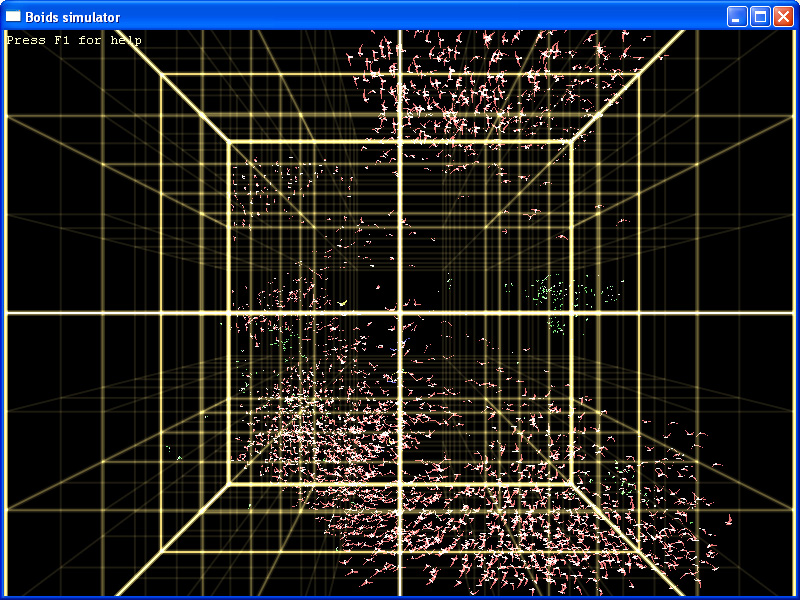
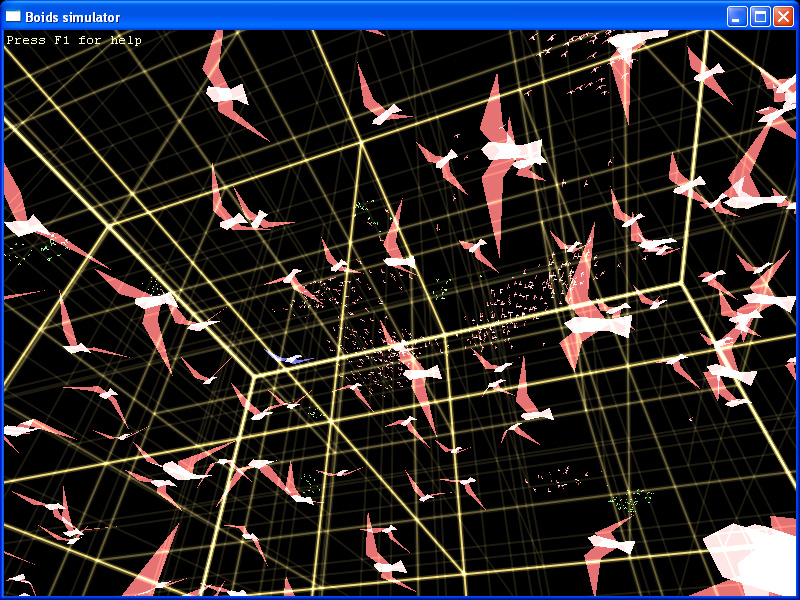
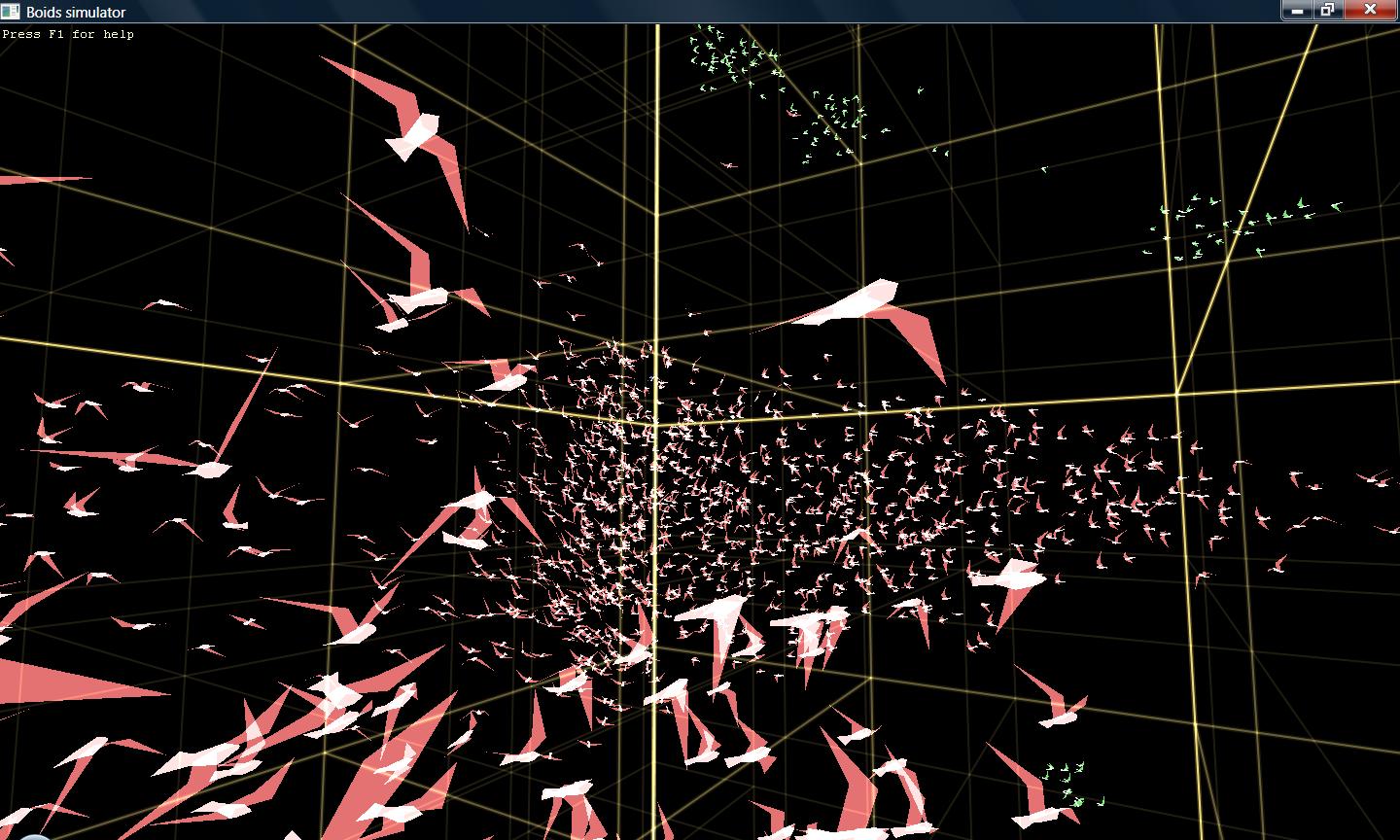
Boids are bird-like virtual robots capable of flying together in flocks. Inspired by the paper “Flocks, Herds, and Schools: A Distributed Behavioral Model” by Craig Reynolds, I implemented a fast boid simulator in 2006, simulating and rendering more than a thousand boids at real-time frame rates.


Boid interaction
Each boid's behaviour is governed by simple local rules. These are local in the sense that they control the speed and direction of each boid solely based on other boids in their local vicinity, without the help of some central leader or control system. The rules basically work together to get the boid to mimic the velocity and direction of nearby boids, while flying away from boids or other blocking objects that are too close by. In this implementation, each rule simply adds its own 3D acceleration vector as its desire to steer towards to or away from an influence. The following accelerations are calculated and summed for a number of closeby boids:

acc_avoid_boid = -direction_towards_boid / boid_distance
acc_prefer_boid_distance = direction_towards_boid * (1 – preferred_distance / boid_distance)
acc_match_boid_velocity = (other_boid_velocity – own_velocity) / sqrt(boid_distance)

A weighed average of these three acceleration is used to update the current velocity of each boid per frame. Varying the weights and the preferred_distance results in different tradeoffs between conflicting desires and thus different behaviour. Also note that weights for vertical components of any acceleration can be tweaked differently from their horizontal components to describe a preference for more horizontal or vertical flock.

These accelerations somewhat differ from the usual boid implementation. For example, acc_avoid_boidand acc_prefer_boid_distance both prefer to fly away from other boids that are too close. However, acc_avoid_boid is meant and tweaked to prevent accidental collisions, while the less weightyacc_prefer_boid_distance moves the boid to an ideal distance from other boids in a slower, more gentle way.

Furthermore, the acc_match_boid_velocity acceleration also contains an unusual relation to distance. This relation helps to prevent the closest boids to steer into each other, decreasing the chances accidental collisions will happen. Less obvious is the fact that it also helps to prevent recurrent oscillations in flock density and size. This is the result of the formula’s non-linearity and asymmetry, causing any oscillatory spring-like energy to dissipate quickly.

In a typical boid implementation, the rules (and their resulting accelerations) are applied for the N closest boids, N being a small fixed number typically between 3 and 10. In contrast, this simulation applies them for the closest and second closest boid, and for the closest boid farther away than the distance of the (first) closest boid times x, x being a tweakable parameter typically between 2.0 and 10.0. By considering the behaviour of this relatively distant third boid, seperate flocks are more likely to merge, creating larger and more stable flocks.

Other influences
In addition to the boid - boid interactions, Other influences
other influences are easily incorporated as additional accelerations:

acc_avoid_object = -direction_towards_object / object_distance
acc_avoid_predator = -direction_towards_predator / predator_distance
acc_prefer_horizontal_flight = -vertical_velocity
acc_prefer_height = [0 1 0] * (preferred_height - current_height)

Again, these accelerations can be weighed and added to the final acceleration.

Updating positions
The final acceleration is split into the three local axes: forward, sideward and upward. Each component is then clamped to its own specific range, which can be different in each of the three direction as can be expected for any non-omnidirectionally configured creature.

The clamped acceleration is integrated using simple forward Euler integration into the velocity vector. To support fast turning of the boids but prevent too sudden changes in speed, the new speed is smoothed by mixing in the speed from the previous frame, without affecting the new direction. Furthermore, the new velocity is scaled depending on its vertical component, simulating the approximate effect of gravity. Consequently, a boid will simply accelerate when doing down, and decelerate when going up. Lastly, the new velocity is clamped to a predefined range. The clamped velocity is then integrated into the new position.

Simulator details
The boid animation is driven by the current turning speed and vertical velocity, influencing the flapping frequency and tail direction. Updating the boid position and velocity, progressing the animation, and rendering the models is done every frame. But for efficiency reasons, each boid is only allowed to update its AI accelerations 10 times per second. This amortizes the cost of the boid AI over multiple frames while rendering smoothly animated models at higher rates.

To add variety to the flocks, three different types of boids are available in the simulator: sparrow-like boids (in green), gull-like boids (in red), and predator-like boids (in yellow). The sparrows manoeuvre quickly and prefer to stay very close to each other. The gulls fly more elegantly and more synchronized. The predators stalk nearby sparrows and gulls, dispersing their flocks. Together, the variety between species and their interactions result in mesmerizing flocks of ever changing sizes and formations. For further details, see the freely available source code for Windows, distributed under the GPL license.

Downloads
Boids application for Windows.
GPL-licensed C++ Boids source code for Windows

miércoles, 9 de enero de 2013

Berenice Abbott’s Minimalist Black-and-White Science Imagery, 1958-1960

ORIGINAL: Brain Pickings

The abstract beauty of science, made dramatically visible.


Photographer Berenice Abbott(1898-1991) might be best-remembered for her striking black-and-white prints of New York’s changing face in the 1930s, but she was also intensely interested in science and in making the abstract elegance and beauty of science visible and concrete. In 1939, she began experimenting with scientific imagery and capturing the whimsy of physics, mathematics and chemistry in her minimalist yet dramatic black-and-white photos. Documenting Science (public library) collects the best of that work, which culminated with the Physical Science Study Project at MIT in 1958.

A Bouncing Ball in Diminishing Arcs (1958)
Behavior of Waves (1962)
Beams of Light Through Glass (1960)
Multiple Exposure of a Swinging Ball (1958)
Magnetism & Electricity (1958)
Collision of Two Balls (1960)
Magnetism with Key (1958)
Parabolic Mirror (1958)
Interference Pattern (1958)
The Pendulum (1960)
Documenting Science is part Mathematical Impressions, part Bee, part something entirely and timelessly original. The MIT Museum is currently showing an exhibition of Abbot’s scientific imagery, running through the end of the year.