Mostrando entradas con la etiqueta Robots. Mostrar todas las entradas

miércoles, 16 de mayo de 2018

This Hard-to-Destroy Drone Goes From Rigid to Flexible When It Crashes

Image: EPFL Don't worry, the drone is fine!
Anyone who’s ever flown a drone of any sort will tell you that sooner or later, you’re going to crash it. The question is how exactly you will go about doing this, and how much of the drone will be functional after it’s happened. Most flying animals somewhat frustratingly don’t have this problem: Birds and insects run into things occasionally (or all the time, for small bugs), and just shrug it off and keep on going, thanks to their biological design, which includes both stiffness and flexibility. Now roboticists at the EPFL, in Lausanne, Switzerland, are relying on these same qualities to design a highly resilient quadrotor that’s impressively difficult to destroy.

There are three primary strategies for designing drones with impact resistance.
  1. The first is to just protect the propellers by surrounding them with the frame of the drone or with individual propeller guards. Most commercial drones have something like this. With this level of protection, you’re less likely to injure people, but since the prop protection is rigid, you’re more likely to injure the drone itself if (I mean, when) you crash it. The EPFL quadrotor uses a flexible frame that locks in place with magnets. When a collision occurs, the frame breaks away from the magnets, and once the energy is dissipated, elastic bands pull the frame back together and you’re good to go.
  2. The second level of impact protection is to design your drone in a way that it can absorb energy from the crash without breaking into pieces. One way of doing that is to decouple the frame of the drone by, say, using flexible, elastic couplers. This gives you a “squishy” drone, which is very effective at handling impacts, but it’s also squishy in-flight, which causes all kinds of structural and stability problems. 
  3. The most impressive level of impact protection that we’ve seen in drones is the brute force approach of just surrounding the entire thing with a flexible, rotating cage. Flyability has made a compelling business case for using drones with protective cages, and for some applications, it’s fantastic. You do, however, pay a penalty, since the cage can increase the overall size of the drone by upwards of 60 percent, meaning that it’s safer to run into things, but you’re also much more likely to run into things. The cage adds mass as well, leading to a drone that can’t lift as much or fly as far.

EPFL’s idea is a compromise of sorts: They’ve managed to create a drone with a frame that’s rigid right up until it smashes into something, at which point it turns flexible:

The inspiration for this design came from insect wings. To fly, insects need wings with high stiffness, but flexibility is critical for absorbing shock, and wasps do it with a special joint that allows the entire wing to “reversibly crumple” during a collision, as the EPFL researchers explain:

Wasp wings display dual stiffness, that is the ability to reversibly transition between rigid and soft states, which provides mechanical resilience without impairing flight performances. The wings of wasps contain a flexible resilin joint... This design allows the wing tip to slightly flex during flight (rigid state), but reversibly crumple… during collisions (soft state). If the dual-stiffness behavior is impaired... the rigid wings undergo severe tear during collision. Therefore, this design provides crash resilience by effectively preventing wing overload during collisions without compromising flight capabilities.
Image: EPFL The quadcopter has two main parts: the external frame and a central case. They are held together by magnetic joints, each with two magnets and a spring (inset).
The quadrotor that the researchers came up with uses a flexible frame that locks in place around the core of the quadrotor with magnets. When a collision occurs, the frame breaks away from the magnets, absorbing the energy of the collision. Once the energy is dissipated, elastic bands pull the frame back into its original configuration, and the magnets snap together again, and you’re good to go.

The uniqueness of the proposed design lies in the fact that the frame is rigid during flight, but softens during collisions. This allows combination of the advantages of both rigid and soft systems: stability and rapid response to user commands during flight, leading to flight performance equivalent to a drone equipped with a standard rigid frame, and crash resilience like a soft system. The experiments showed a satisfying survivability of the frame of the drone, that withstood roughly 50 collisions with no permanent damage.

The researchers, who are members of EPFL’s Laboratory of Intelligent Systems, suggest that an approach like this could be useful for all kinds of robots, not just drones. Most robots are rigid for various performance reasons (like precision), but the ability to be flexible when necessary without using intrinsically soft materials could could come in handy for grasping, locomotion, or simply as an added safety measure for human-robot interaction tasks.

S. Mintchev, Member, IEEE, S. de Rivaz and D. Floreano, Senior Member, IEEE
“Insect-Inspired Mechanical Resilience for Multicopters,” by S. Mintchev, S. de Rivas, and D. Floreano from EPFL was published in the 25 January 2017 issue of IEEE Robotics and Automation Letters.

[ EPFL ]

ORIGINAL: IEEE Spectrum
By Evan Ackerman
Posted 9 Mar 2017

martes, 27 de septiembre de 2016

Soft Robot With Microfluidic Logic Circuit


Perhaps our future overlords won’t be made up of electrical circuits after all but will instead be soft-bodied like ourselves. However, their design will have its origins in electrical analogues, as with the Octobot.

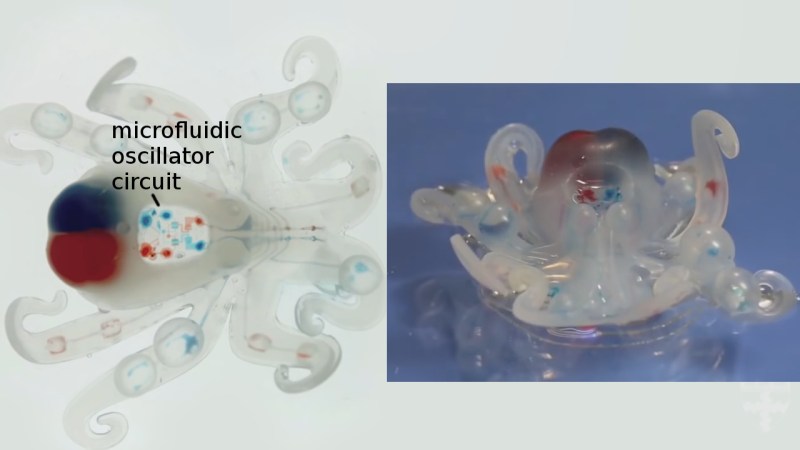
The Octobot is the brainchild a team of Harvard University researchers who recently published an article about it in Nature. Its body is modeled on the octopus and is composed of all soft body parts that were made using a combination of 3D printing, molding and soft lithography. Two sets of arms on either side of the Octobot move, taking turns under the control of a soft oscillator circuit. You can see it in action in the video below.
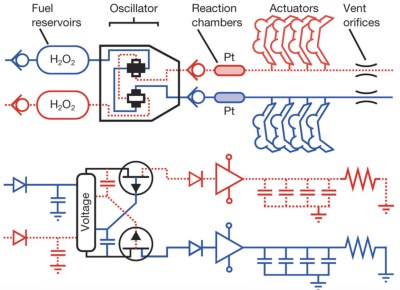
Octobot mechanical and electrical analogue circuits (credit: Michael Wehner at al./Nature)

As shown in the diagram, the fuel is a liquid hydrogen peroxide (H2O2) which the oscillator gets from one of two fuel reservoirs and feeds into one of two reaction chambers. In the oscillator, pinch valves act like JFETs. When fuel from one reservoir is flowing into one reaction chamber, one of the pinch valves pinches off the flow of fuel to the other reaction chamber. It’s not clear how but somehow or other that fuel flow is then pinched off by another pinch valve as fuel then flows from the other reservoir to the other reaction chamber.

The reaction chamber contains a small amount of platinum as a catalyst which reacts with the hydrogen peroxide to release a much larger volume of oxygen gas into actuators in the arms. Those actuators expand like balloons causing the arms to move. The reaction chambers are the analogues of amplifiers. Other analogues are check valves for diodes, vent orifices for resistors as well as other chambers which appear to be capacitors.

This is a proof of concept and as yet the Octobot doesn’t walk but the team hopes to make one that can crawl, swim and interact with its environment. When it does we look forward to it joining this other soft-bodied bot modeled after a stingray. It looks like our overlords might all come from the sea.


Here’s you can see the Octobot in action.


And here’s another video from Harvard demonstrating the chemical reaction between hydrogen peroxide and platinum that produces oxygen. ("Powering the Octobot: A chemical reaction")


viernes, 25 de diciembre de 2015

Robots are learning from YouTube tutorials

Do it yourself, robot. (Reuters/Kim Kyung-Hoon)
For better or worse, we’ve taught robots to mimic human behavior in countless ways. They can perform tasks as rudimentary as picking up objects, or as creative as dreaming their own dreams. They can identify bullying, and even play jazz. Now, we’ve taught robots the most human task of all: how to teach themselves to make Jell-O shots from watching YouTube videos.

Ever go to YouTube and type in something like, “How to make pancakes,” or, “How to mount a TV”? Sure you have. While many such tutorials are awful—and some are just deliberately misleading—the sheer number of instructional videos offers strong odds of finding one that’s genuinely helpful. And when all those videos are aggregated and analyzed simultaneously, it’s not hard for a robot to figure out what the correct steps are.

Researchers at Cornell University have taught robots to do just that with a system called RoboWatch. By watching and scanning multiple videos of the same “how-to” activity (with subtitles enabled), bots can 

  • identify common steps, 
  • put them in order, and 
  • learn how to do whatever the tutorials are teaching.
Robot learning is not new, but what’s unusual here is that these robots can learn without human supervision, as Phys.Org points out.

Similar research usually requires human overseers to introduce and explain words, or captions, for the robots to parse. RoboWatch, however, needs no human help, save that someone ensure all the videos analyzed fall into a single category (pdf). The idea is that a human could one day tell a robot to perform a task and then the robot would independently research and learn how to carry out that task.


So next time you getting frustrated watching a video on how to change a tire, don’t fret. Soon, a robot will do all that for you. We just have to make sure it doesn’t watch any videos about “how to take over the world.”

ORIGINAL: QZ
December 22, 2015

viernes, 23 de octubre de 2015

Robot With Tummy Full of Microbes Can Swim in Dirty Water Forever


Image: University of BristolRow-bot with mouth open (inset shows mouth closed).
Robots are better than animals in almost every way. Well, they’re better in some ways, I guess. I mean, robots are occasionally okay at some things. A few things. None of those things are energetic autonomy: the ability to operate continuously and indefinitely without dependence on humans for refueling. There certainly are robots that operate autonomously for long durations, and they’re either feeding off of radioactivity, or they’re relying on solar panels that don’t work half the time. A better option (at least in some situations) might be robots that forage for food like animals do, taking care of their own energy needs all by themselves.

This is only a slightly crazy idea (although at one point it was briefly the craziest idea ever), and fuel cells that are full of living microbes are a real thing. At the Bristol Robotics Laboratory, in the United Kingdom, they’ve been developing a robot called Row-bot that can swim around, harvesting energy directly from the water using a microbial fuel cell as an artificial stomach.

According to the researchers, Microbial Fuel Cells (MFCs) generate electricity by “electrons mobilised by the redox reaction that takes place in electrogenic bacterial anabolism.” More specifically, in the case of their device, they explain that “raw organic biomass is used as both an inoculant for the bacterial culture and the anolyte that fuels the reaction resulting in an environmentally biocompatible means of electricity generation.” In other words (simpler ones), microbes eat stuff in the water and poop out electrons, and as long as you’ve got enough water with stuff in it to keep the microbes fat and happy, they’ll keep giving you electrons that you can use to make your robot do things. MFCs work in all kinds of water, including fresh water in rivers and lakes, seawater, and even waste water, and they actually clean the water as they go, which is nice.

Microbes are kind of tiny, and each one doesn’t produce a lot of energy, so to do anything useful, you either need a whole bunch of them (multiple fuel cells) or a very efficient robot. Row-bot is very efficient, modeled on a water beetle. It has two side paddles to move, little floaty feeties to keep it from drowning, and a microbial fuel cell in its tummy:


It has a mouth, too, that it can open to ingest water for the fuel cell, and also a fuel outflow port on its posterior end that we’d call its butt if we were immature, which we’re not. Each time the robot opens its mouth, it swims forward, ingests fresh water into its MFC tummy, digests for 3 minutes, and then expels the water out the back as it swims forward again, making room for a fresh gulp. Row-bot stores the energy generated by the MFC in a capacitor, and over one cycle (opening its mouth, swimming 10 strokes forward at just under 1 stroke per second and then closing its mouth), it only uses 1.8 joules. That’s 20 centimeters of motion with about 1 joule of energy leftover that could potentially be used to power sensors or laser turrets or something. 

As long as Row-bot has water to swim through, the MFC makes it more or less energetically autonomous, although the current design is mostly a testbed for integration of the MFC with actuators to see how well it works. There’s a lot more optimization that needs to happen, like reducing body drag and finding the most efficient combination of materials to use for the paddles, as well as altering the “stride” of the robot to better mimic actual water beetles. Also, multiple MFCs could be configured in series if you need more power for those aforementioned laser turrets.

Eventually, the researchers suggest that Row-bot could be developed for applications such as remote sensing and environmental monitoring and clean-up, although space exploration isn’t out of the question either.

Also, it’s called “Row-bot.” Get it? Row-bot the robot. Heh.

“Row-bot: An Energetically Autonomous Artificial Water Boatman,” by Hemma Philamore, Jonathan Rossiter, Andrew Stinchcombe, and Ioannis Ieropoulos from the University of Bristol and University of the West of England, was presented at IROS 2015 in Hamburg, Germany.

Learn More fuel cell iros iros 201

ORIGINAL: IEEE Spectrum
By Evan Ackerman
Posted 22 Oct 2015

miércoles, 29 de abril de 2015

'Highly creative' professionals won't lose their jobs to robots, study finds


A University of Oxford study finds that there are some things that a robot won’t be able to do. Unfortunately, these gigs don’t pay all that well.

Many people are in “robot overlord denial,” according to a recent online poll run by jobs board Monster.com. They think computers could not replace them at work. Sadly, most are probably wrong.

University of Oxford researchers Carl Benedikt Frey and Michael Osborne estimated in 2013 that 47% of total U.S. jobs could be automated by 2033. The combination of robotics, automation, artificial intelligence, and machine learning is so powerful that some white collar workers are already being replaced — and we’re talking journalists, lawyers, doctors, and financial analysts, not the person who used to file all the incoming faxes.

But there’s hope, at least for some. According to an advanced copy of a new report that U.K. non-profit Nesta sent to Fortune, 21% of US employment requires people to be “highly creative.” Of them, 86% (18% of the total workforce) are at low or no risk from automation. In the U.K., 87% of those in creative fields


“Artists, musicians, computer programmers, architects, advertising specialists … there’s a very wide range of creative occupations,” said report co-author Hasan Bakhshi, director of creative economy at Nesta, to Fortune. Some other types would be financial managers, judges, management consultants, and IT managers. “Those jobs have a very high degree of resistance to automation.”

The study is based on the work of Frey and Osborne, who are also co-authors of this new report. The three researchers fed 120 job descriptions from the US Department of Labor into a computer and analyzed them to see which were most likely to require extensive creativity, or the use of imagination or ideas to make something new.

Creativity is one of the three classic bottlenecks to automating work, according to Bakhshi. “Tasks which involve a high degree of human manipulation and human perception — subtle tasks — other things being equal will be more difficult to automate,” he said. For instance, although goods can be manufactured in a robotic factory, real craft work still “requires the human touch.”

So will jobs that need social intelligence, such as your therapist or life insurance agent.


Of course, the degree of creativity matters. Financial journalists who rewrite financial statements are already beginning to be supplanted by software. The more repetitive and dependent on data the work is, the more easily a human can be pushed aside.

In addition, just because certain types of creative occupations can’t easily be replaced doesn’t mean that their industries won’t see disruption. Packing and shipping crafts can be automated, as can could some aspects of the film industry that aren’t such things as directing, acting, and design. “These industries are going to be disrupted and are vulnerable,” Bakhshi said.

Also, not all these will necessarily provide a financial windfall. The study found an “inverse U-shape” relationship between the probability of an occupation being highly creative and the average income it might deliver. Musicians, actors, dancers, and artists might make relatively little, while people in technical, financial, and legal creative occupations can do quite well. So keeping that creative job may not seem much of a financial blessing in many cases.

Are you in a “creative” role that will be safe from automation? You can find out what these Oxford researchers think by taking their online quiz.

ORIGINAL Fortune
APRIL 22, 2015

lunes, 14 de abril de 2014

The Global Search for Education: Education and Jobs


"The Future of Employment study makes clear that what matters most today is what you can do with what you know, rather than how much you know."
- Dr. Tony Wagner

What does today's technology mean for tomorrow's jobs and how can we better structure our education system to ensure that the future working population can prosper in the labor market?
A large range of 20th century jobs are endangered by the machine age. A recent Oxford Martin School study by Dr. Carl Benedikt Frey (Oxford Martin School) and Dr. Michael A. Osborne (Department of Engineering Science, University of Oxford) found that 47% of current US jobs are at risk of automation within the next twenty years. Further, despite recent job growth in the service industry sector, occupations within this industry are highly susceptible. Frey and Osborne assessed the degree to which 702 specific jobs are vulnerable to computerization, distinguishing these occupations into categories of high, medium and low risk.
Job Automation May Threaten Half of U.S. Workforce (Bloomberg)
Mobile robots and ‘smart’ computers — that learn on the job — make it likely that occupations employing about half of today's U.S. workers could be possible to automate in the next decade or two, according to an Oxford University study that estimated the probability of computerization of more than 700 occupations. Published March 12, 2014


Sources: University of Oxford, Carl Benedikt Frey and Michael A. Osborne
GRAPHIC: AKI ITO / BLOOMBERG NEWS & DAVE MERRILL / BLOOMBERG VISUAL DATA

One of the main ways governments have helped people during previous waves of technological progress is through education system reform. What should government be doing now to make the changes that are necessary?

To discuss these issues further, I am joined today in The Global Search for Education by Dr. Carl Frey and Dr. Michael Osborne, authors of The Future of Employment: How Susceptible are Jobs to Computerization, and Dr. Tony Wagner, Expert in Residence at Harvard University's Innovation Lab. Tony will be leading a presentation on Education for Innovation at last week's OPPI Festival in Helsinki, Finland.


"I can only recommend that young people continue to gain the kind of cognitive and creative skills that give them a competitive edge over machines." Dr. Michael A. Osborne

Gentlemen, could you please summarize what you believe were your most important findings in your study?

Michael: We found that a substantial fraction (47%) of current US employment is at risk of automation within the next twenty years. While some of these occupations are in categories previously thought unthreatened by automation, such as logistics and services, we expect automation to continue to predominately threaten low-skilled workers. In fact, we found a strong negative relationship between the average degree of education within an occupation and its susceptibility to computerization. In a similar way, this was true for the average wage: the better-paid jobs, featuring largely better-educated workers, are unlikely to be automated in the near future. Quantitatively, we found that if only a quarter of people within an occupation have a bachelor's degree or better, the occupation would likely have a fifty-fifty chance of being automatable within the foreseeable future. If half of workers within an occupation have at least a bachelor's degree, its probability of automation is close to zero. It seems clear that education is a crucial issue in considering future jobs.

Can you speak a little about the range of 20th century jobs that are endangered by the machine age?  

Michael: We firstly expect that existing trends of automation in production will continue: robots, with ever improving sensors and manipulators, will continue to replace factory workers. We further predict that  
many sales jobs are vulnerable: online shopping and self-checkouts will only continue to become more popular at the expense of human salespeople and cashiers. In fact,  
telemarketers were rated as one of the most computerizable occupations; to the dismay, no doubt, of anyone who is sick of speaking to robots on the phone. Perhaps more surprisingly,
we expect transportation and clerical jobs to be at risk from new technologies. Autonomous vehicles threaten many logistics occupations, such as drivers of forklifts or mine vehicles, while
big data analytics place occupations reliant on storing or accessing information at risk, such as tax preparers.
As evidence for the latter: we're already seeing paralegal jobs replaced by algorithms, so this is not an unreasonable prediction.
We finally suspect that many jobs in the service sector will be increasingly at risk, with the growth of service robotics and sophisticated algorithms.
As examples, court reporters may have their jobs threatened by transcription software, and
electronics repair jobs are already being affected by the declining costs of increasingly complex electronic items. This is particularly alarming given the recently high fraction of workers undertaking service work.
Nonetheless, many other service sector jobs are likely to remain unautomatable; as an example, human housekeepers are still much better at their jobs than robots.

Carl: To expand a bit on that, what we are saying is that service occupations that do not require much creative and social intelligence are likely to be automated. Some personal service jobs, however, do require especially some social intelligence. These, we think, will not be automated.


"In the short run, the government could support employment by stimulating the demand for personal services. In the long run, I do not believe there is much of a substitute for training workers to work with computers." - Dr. Carl Benedikt Frey

Please discuss some of the characteristics of occupations not at risk of computerization. 

Michael: These jobs involve tasks at which machines are relatively poor: tasks involving creativity or social intelligence. As examples, I think
  • recreational therapists, 
  • mental health counselors and 
  • primary school teachers are relatively safe for the foreseeable future. 
  • Many people may also be surprised to learn that occupations requiring work in very cluttered environments are also relatively safe. For example, the perceptual capacity of a human housekeeper, able to distinguish unwanted dirt from a pot plant, is unlikely to be matched by a robot cleaner for many decades.
Tony, why does this evolutionary phase require more revolutionary changes in education versus the gradual changes we have seen in previous generations?

The Future of Employment study makes clear that what matters most today is what you can do with what you know, rather than how much you know. Many recent college graduates find themselves unemployed or underemployed because they lack the skills needed in an increasingly innovation-driven economy. With academic content knowledge having become a commodity that's available on every internet-connected device, the ability to 
  • initiate, 
  • discern, 
  • persevere, 
  • collaborate, and 
  • to solve problems creatively 
are the qualities most in demand today and will be increasingly important in the future. The problem is that our education system was designed, primarily, to teach the three R's and to transmit content knowledge. We need to create schools that coach students for skill and will, in addition to teaching content. If we don't make this transition quickly, a growing number of our youth will be unemployable at the same time that employers complain that they cannot find new hires that have the skills they need.

"We need to create schools that coach students for skill and will, in addition to teaching content. If we don't make this transition quickly, a growing number of our youth will be unemployable at the same time that employers complain that they cannot find new hires who have the skills they need." - Dr. Tony Wagner

What recommendations would you make to governments about retraining workers who are now or will be unemployed as a result of this evolution? 

Tony: I wish I had an intelligent answer to this important question, but I'm a "recovering" high school English teacher, not an economist. My hunch is that it will take a generation to better prepare young people for the new economy. Meanwhile, perhaps we'll need to put people to work repairing our crumbling infrastructure, helping out in preschools and assisted living homes, and so on. There is a lot to be done to make our country a better and more humane place to live. The question is: are we willing to pay people to do this work?

Carl: In the short run, the government could support employment by stimulating the demand for personal services. In the long run, I do not believe there is much of a substitute for training workers to work with computers.

If you were speaking to a group of high school students today, what fields and disciplines would you encourage them to explore to ensure success in the job market?

 Tony: First, I would encourage them to pursue their real interests. Curiosity and intrinsic interest trump mere academic achievement today. Secondly, I'd suggest they consider designing an interdisciplinary major in college around a problem of interest to them. Innovation increasingly happens at the intersections of academic disciplines, not within them.

Michael: One thing that came out very clearly from our analysis was the continuing importance of education. In particular, we found a strong negative trend between an occupation's average level of education and its probability of computerization. As such, I can only recommend that young people continue to gain the kind of cognitive and creative skills that give them a competitive edge over machines. In particular, and I may be biased, but occupations revolving around creative uses of data are likely to be resistant to automation for some time. Further, people skills: the ability to negotiate, or persuade, are likely to become increasingly important for human work, due to their resistance to automation. Finally, manual work in unstructured environments is probably a fairly safe bet: gardeners are unlikely to have to worry about their jobs for a good long while.


C. M. Rubin, Dr. Tony Wagner, Dr. Carl Benedikt Frey, Dr. Michael A. Osborne
Photos are courtesy of the Oxford Martin School and Tony Wagner.

For more information on the Oxford Martin School Study:
http://www.futuretech.ox.ac.uk/sites/futuretech.ox.ac.uk/files/The_Future_of_Employment_OMS_Working_Paper_1.pdf

For more information on Education for Innovation at the OPPI Festival: http://oppifestival.com/

In The Global Search for Education, join me and globally renowned thought leaders including Sir Michael Barber (UK), Dr. Michael Block (U.S.), Dr. Leon Botstein (U.S.), Professor Clay Christensen (U.S.), Dr. Linda Darling-Hammond (U.S.), Dr. Madhav Chavan (India), Professor Michael Fullan (Canada), Professor Howard Gardner (U.S.), Professor Andy Hargreaves (U.S.), Professor Yvonne Hellman (The Netherlands), Professor Kristin Helstad (Norway), Jean Hendrickson (U.S.), Professor Rose Hipkins (New Zealand), Professor Cornelia Hoogland (Canada), Honourable Jeff Johnson (Canada), Mme. Chantal Kaufmann (Belgium), Dr. Eija Kauppinen (Finland), State Secretary Tapio Kosunen (Finland), Professor Dominique Lafontaine (Belgium), Professor Hugh Lauder (UK), Professor Ben Levin (Canada), Lord Ken Macdonald (UK), Professor Barry McGaw (Australia), Shiv Nadar (India), Professor R. Natarajan (India), Dr. Pak Tee Ng (Singapore), Dr. Denise Pope (US), Sridhar Rajagopalan (India), Dr. Diane Ravitch (U.S.), Richard Wilson Riley (U.S.), Sir Ken Robinson (UK), Professor Pasi Sahlberg (Finland), Professor Manabu Sato (Japan), Andreas Schleicher (PISA, OECD), Dr. Anthony Seldon (UK), Dr. David Shaffer (U.S.), Dr. Kirsten Sivesind (Norway), Chancellor Stephen Spahn (U.S.), Yves Theze (Lycee Francais U.S.), Professor Charles Ungerleider (Canada), Professor Tony Wagner (U.S.), Sir David Watson (UK), Professor Dylan Wiliam (UK), Dr. Mark Wormald (UK), Professor Theo Wubbels (The Netherlands), Professor Michael Young (UK), and Professor Minxuan Zhang (China) as they explore the big picture education questions that all nations face today.

The Global Search for Education Community Page

C. M. Rubin is the author of two widely read online series for which she received a 2011 Upton Sinclair award, "The Global Search for Education" and "How Will We Read?" She is also the author of three bestselling books, including The Real Alice in Wonderland, and is the publisher of CMRubinWorld.

Follow C. M. Rubin on Twitter: www.twitter.com/@cmrubinworld

TAGS: Education Technology Future of Employment Carl Benedikt Frey Michael A. Osborne Automation of Production Tony Wagner The Global Search for Education Computerizable Occupations Job Automation Oxford Martin School 20th Century Job Market C. M. Rubin Education for Innovation OPPI Festival Education Reform Occupation Computerization

jueves, 13 de febrero de 2014

Robotic construction crew needs no foreman

Harvard graduate student Kirstin Petersen (left) and staff scientist Justin Werfel (right) traveled to Namibia to study termite mounds—the inspiration for the TERMES robots that can autonomously build towers, castles, and pyramids out of foam bricks. Credit: Harvard's Wyss Institute

Cambridge, Mass. — On the plains of Namibia, millions of tiny termites are building a mound of soil—an 8-foot-tall "lung" for their underground nest. During a year of construction, many termites will live and die, wind and rain will erode the structure, and yet the colony's life-sustaining project will continue.

Inspired by the termites' resilience and collective intelligence, a team of computer scientists and engineers at the Harvard School of Engineering and Applied Sciences (SEAS) and the Wyss Institute for Biologically Inspired Engineering at Harvard University has created an autonomous robotic construction crew. The system needs no supervisor, no eye in the sky, and no communication: just simple robots—any number of robots—that cooperate by modifying their environment.

Harvard's TERMES system demonstrates that collective systems of robots can build complex, three-dimensional structures without the need for any central command or prescribed roles. The results of the four-year project were presented this week at the AAAS 2014 Annual Meeting and published in the February 14 issue of Science.

The TERMES robots can build towers, castles, and pyramids out of foam bricks, autonomously building themselves staircases to reach the higher levels and adding bricks wherever they are needed. In the future, similar robots could lay sandbags in advance of a flood, or perform simple construction tasks on Mars.

"The key inspiration we took from termites is the idea that you can do something really complicated as a group, without a supervisor, and secondly that you can do it without everybody discussing explicitly what's going on, but just by modifying the environment," says principal investigator Radhika Nagpal, Fred Kavli Professor of Computer Science at Harvard SEAS. She is also a core faculty member at the Wyss Institute, where she co-leads the Bioinspired Robotics platform.

The TERMES robots can carry bricks, build staircases, and climb them to add bricks to a structure, following low-level rules to independently complete a construction project. Credit: Eliza Grinnell, Harvard SEAS

"We try to draw inspiration from the elegant ways in which Nature self organizes and self regulates," said Wyss Institute Founding Director Don Ingber, Ph.D., M.D., "and this latest feat by our robotics team is clear evidence of the tremendous potential of bioinspired engineering, and its ability to spawn truly game-changing technologies."

Most human construction projects today are performed by trained workers in a hierarchical organization, explains lead author Justin Werfel, a staff scientist in bioinspired robotics at the Wyss Institute and a former SEAS postdoctoral fellow.

"Normally, at the beginning, you have a blueprint and a detailed plan of how to execute it, and the foreman goes out and directs his crew, supervising them as they do it," he says. "In insect colonies, it's not as if the queen is giving them all individual instructions. Each termite doesn't know what the others are doing or what the current overall state of the mound is."

Instead, termites rely on a concept known as stigmergy, a kind of implicit communication: they observe each others' changes to the environment and act accordingly. That is what Nagpal's team has designed the robots to do, with impressive results. Supplementary videos published with the Science paper show the robots cooperating to build several kinds of structures and even recovering from unexpected changes to the structures during construction.

The TERMES robots, developed at Harvard, act independently but collectively. Credit: Eliza Grinnell, Harvard SEAS.

Each robot executes its building process in parallel with others, but without knowing who else is working at the same time. If one robot breaks, or has to leave, it does not affect the others. This also means that the same instructions can be executed by five robots or five hundred. The TERMES system is an important proof of concept for scalable, distributed artificial intelligence.

Nagpal's Self-Organizing Systems Research Group specializes in distributed algorithms that allow very large groups of robots to act as a colony. Close connections between Harvard's computer scientists, electrical engineers, and biologists are key to her team's success. They created a swarm of friendly Kilobots a few years ago and are contributing artificial intelligence expertise to the ongoing RoboBees project, in collaboration with Harvard faculty members Robert J. Wood and Gu-Yeon Wei.

"When many agents get together—whether they're termites, bees, or robots—often some interesting, higher-level behavior emerges that you wouldn't predict from looking at the components by themselves," says Werfel. "Broadly speaking, we're interested in connecting what happens at the low level, with individual agent rules, to these emergent outcomes."

Coauthor Kirstin Petersen, a graduate student at Harvard SEAS with a fellowship from the Wyss Institute, spearheaded the design and construction of the TERMES robots and bricks. These robots can perform all the necessary tasks—carrying blocks, climbing the structure, attaching the blocks, and so on—with only four simple types of sensors and three actuators.


Watch a video of the robots in action.


"We co-designed robots and bricks in an effort to make the system as minimalist and reliable as possible," Petersen says. "Not only does this help to make the system more robust; it also greatly simplifies the amount of computing required of the onboard processor. The idea is not just to reduce the number of small-scale errors, but more so to detect and correct them before they propagate into errors that can be fatal to the entire system."

In contrast to the TERMES system, it is currently more common for robotic systems to depend on a central controller. These systems typically rely on an "eye in the sky" that can see the whole process or on all of the robots being able to talk to each other frequently. These approaches can improve group efficiency and help the system recover from problems quickly, but as the numbers of robots and the size of their territory increase, these systems become harder to operate. In dangerous or remote environments, a central controller presents a single failure point that could bring down the whole system.

"It may be that in the end you want something in between the centralized and the decentralized system—but we've proven the extreme end of the scale: that it could be just like the termites," says Nagpal. "And from the termites' point of view, it's working out great."

This research was supported by the Wyss Institute for Biologically Inspired Engineering at Harvard University.

What can a TERMES robot do?
- Move forward, backward, and turn in place
- Climb up or down a step the height of one brick
- Pick up a brick, carry it, and deposit it directly in front of itself
- Detect other bricks and robots in immediate vicinity
- Keep track of its own location with respect to a "seed" brick

What instructions do the TERMES robots follow?
- Obey predetermined traffic rules
- Circle the growing structure to find the first, "seed" brick (for orientation)
- Climb onto the structure
- Obtain a brick
- Attach the brick at any vacant point that satisfies local geometric requirements
- Climb off the structure
- Repeat

ORIGINAL: Wyss Institute for Biologically Inspired Engineering 
Date: Feb 13, 2014

jueves, 23 de enero de 2014

“Soft” (and miniaturized) robots. Micro-robots will move like biological organisms

Simulation of euglenid movement. (Credit: SISSA)


Increasingly small robots can carry out their functions even inside the human body. No, this isn't a sci-fi dream. The technology is almost ready. However there is still one condition they must meet to be effective: these devices need to have the same "softness" and flexibility as biological tissues. Share This:

4 This is the opinion of scientists like Antonio De Simone, from SISSA (the International School for Advanced Studies of Trieste) and Marino Arroyo from the Polytechnic University of Catalonia, who have just published a paper in the Journal of the Mechanics and Physics of Solids. Taking inspiration from unicellular water micro-organisms, they studied the locomotion mechanisms of "soft robots." Forget cogwheels, pistons and levers: miniaturized robots of the future will be "soft."

"If I think of the robots of tomorrow, what comes to mind are the tentacles of an octopus or the trunk of an elephant rather than the mechanical arm of a crane or the inner workings of a watch. And if I think of micro-robots then I think of unicellular organisms moving in water. The robots of the future will be increasingly like biological organisms" explains Antonio De Simone. De Simone and his team at SISSA have been studying the movement of euglenids, unicellular aquatic animals, for several years. One of the aims of De Simone's research -- which has recently been awarded a European Research Council Advanced Grant of 1,300,000 euro -- is to transfer the knowledge acquired in euglenids to micro-robotics, a field that represents a promising challenge for the future.

Micro-robots may in fact carry out a number of important functions, for example for human health, by delivering drugs directly to where they are needed, re-opening occluded blood vessels, or helping to close wounds, to name just a few. To do this, these tiny robots will have to be able to move around efficiently.

"Imagine trying to miniaturize a device made up of levers and cogwheels: you can't go below a certain minimal size. Instead, by mimicking biological systems we can go all the way down to cell size, and this is exactly the direction research is taking. We, in particular, are working on movement and studying how certain unicellular organisms with highly efficient locomotion move." In their study, De Simone and Arroyo simulated euglenid species with different shapes and locomotion methods, based chiefly on cell body deformation and swelling, to describe in detail the mechanics and characteristics of the movement obtained. "Our work not only helps to understand the movement mechanism of these unicellular organisms, but it provides a knowledge base to plan the locomotion system of future micro-robots." De Simone and Arroyo's paper has been selected to appear in the special issue of the J. Mech. Phys. Solids. Sources


SISSA


ORIGINAL: Zeit News
December 12, 2013

martes, 21 de agosto de 2012

Tiny Factory Could Make Solar Panels Anywhere

ORIGINAL: Live Science
NewsDaily Staff
21 August 2012

Inventors Shawn Frayne (right) and Alex Hornstein (left) stand next to their Solar Pocket Factory.
CREDIT: Shawn Frayne | Alex Hornstein 
Making clean energy fit into a person's pocket would be a neat trick, and two inventors have begun working on the solution. They envision tiny automated factories that make solar panels as small as a person's fingers.

The table-size Solar Pocket Factory could churn out a solar panel every 15 seconds, giving full-size factories in China a run for their money, say Shawn Frayne and Alex Hornstein, who are hoping to raise $50,000 on the crowd-funding website Kickstarter to finish their prototype and prepare for a product launch in 2013.

The two inventors have already tested microsolar panels for charging mobile phones, powering energy-charging stations at the High Line park in Manhattan, and even replacing the batteries in a daughter's toys.
Today's small solar panels cost about twice as much as big solar panels and typically fail within two to five years. Frayne and Hornstein say they have figured out how to shave 30 percent off the cost and make "microsolar" panels that would last five times longer.

The solution comes from building an automated factory that can churn out solar panels of a consistent quality based on higher-quality materials. Such automation not only would sidestep the costs of human labor required to glue and assemble every part of the tiny panels by hand, it would cut down on the costs of dealing with flawed panels that get thrown out and wasted, the two inventors say.

Rewards for people who donate to the Kickstarter project include kits for assembling solar panels that can power a person's own smartphones or household gadgets.

Success for the Solar Pocket Factory could signal yet another step toward robotic factories that would change the world — in terms of both spreading clean-energy technologies and disrupting the human work force. The Pentagon has started its own project to createrobotic sewing machines capable of outcompeting human workers in Asian factories.

This story was provided by InnovationNewsDaily, a sister site to LiveScience. Follow InnovationNewsDaily on Twitter @News_Innovation, or on Facebook.

viernes, 27 de julio de 2012

Theo’s organisms

ORIGINAL: Chemoton
6 July, 2012

Video – Animaris Gubernare (AG), is one of the most recent Theo Jansen’s Strandbeest‘s (strandbeest.com) machine animals. Born in October 2010, AG died out in October 2011. It had two external (rolling) wind stomachs which serve as an anchor against strong winds.

Since 1990, only by using plastic tubes, lemonade bottles and air pistons as logic gates, powered by wind, Theo Jansen has produced some quite incredible machine animals. His creatures are designed to move – and even survive – on their own. In some cases he have recurred to Evolutionary Computation(more) as a mean to optimize their shape in order to longer survive hard storms and salt water. He briefly explains:

“(…) Since 1990 I have been occupied creating new forms of life. Not pollen or seeds but plastic yellow tubes are used as the basic material of this new nature. I make skeletons that are able to walk on the wind, so they don’t have to eat. Over time, these skeletons have become increasingly better at surviving the elements such as storm and water and eventually I want to put these animals out in herds on the beaches, so they will live their own lives (…)”, Theo Jansen, in Strandbeest(strandbeest.com).

But he goes a step further. Not he only develop sensors (for water sensing) as well as a full Brain, a binary step counter made of plastic tubes, which could change his pattern of zeroes, overtime, and adapts. Have a look (minute 6, second 33) … :


Video – Jansen‘s Lecture at TED talks, March 2007 (Monterey, California). Theo Jansen creates kinetic sculptures that walk using wind power (featured in a few previous short sifts), here he explains how he makes them work. Incredibly, he has devised a way to optimize the shape of the machine’s parts and gait using a genetic algorithm running on a PC and has actually made logic gates out of the air pistons making up the machines. His work attests to a truly jaw-dropping intelligence.