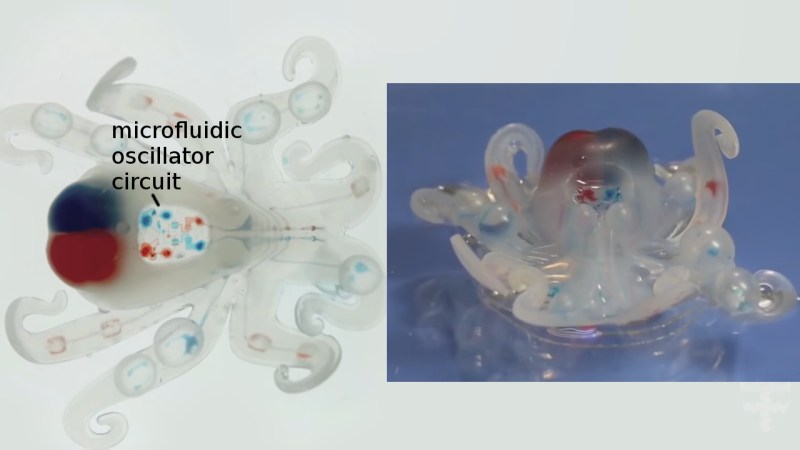
Perhaps our future overlords won’t be made up of electrical circuits after all but will instead be soft-bodied like ourselves. However, their design will have its origins in electrical analogues, as with the Octobot.
The Octobot is the brainchild a team of Harvard University researchers who recently published an article about it in Nature. Its body is modeled on the octopus and is composed of all soft body parts that were made using a combination of 3D printing, molding and soft lithography. Two sets of arms on either side of the Octobot move, taking turns under the control of a soft oscillator circuit. You can see it in action in the video below.
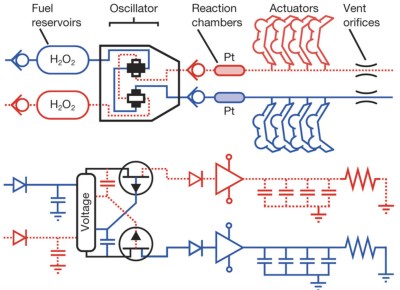
Octobot mechanical and electrical analogue circuits (credit: Michael Wehner at al./Nature)
As shown in the diagram, the fuel is a liquid hydrogen peroxide (H2O2) which the oscillator gets from one of two fuel reservoirs and feeds into one of two reaction chambers. In the oscillator, pinch valves act like JFETs. When fuel from one reservoir is flowing into one reaction chamber, one of the pinch valves pinches off the flow of fuel to the other reaction chamber. It’s not clear how but somehow or other that fuel flow is then pinched off by another pinch valve as fuel then flows from the other reservoir to the other reaction chamber.
The reaction chamber contains a small amount of platinum as a catalyst which reacts with the hydrogen peroxide to release a much larger volume of oxygen gas into actuators in the arms. Those actuators expand like balloons causing the arms to move. The reaction chambers are the analogues of amplifiers. Other analogues are check valves for diodes, vent orifices for resistors as well as other chambers which appear to be capacitors.
This is a proof of concept and as yet the Octobot doesn’t walk but the team hopes to make one that can crawl, swim and interact with its environment. When it does we look forward to it joining this other soft-bodied bot modeled after a stingray. It looks like our overlords might all come from the sea.
Here’s you can see the Octobot in action.
And here’s another video from Harvard demonstrating the chemical reaction between hydrogen peroxide and platinum that produces oxygen. ("Powering the Octobot: A chemical reaction")
Bioengineers invent a way to harvest energy from water evaporating at room temperature. It's an engine with living parts.
Joe Turner Lin
It might not look like much, but this plastic box is a fully functioning engine—and one that does something no other engine has ever done before. Pulling energy seemingly out of thin air, it harvests power from the ambient evaporation of room-temperature water. No kidding.
A team of bioengineers led by Ozgur Sahin at Columbia University have just created the world's first evaporation-driven engine, which they report today in the journal Nature Communications. Using nothing more than a puddle of resting water, the engine, which measures less than four inches on each side, can power LED lights and even drive a miniature car. Better yet, Sahin says, the engine costs less than $5 to build.
"This is a very, very impressive breakthrough," says Peter Fratzl, a biomaterial researcher at the Max-Planck Institute of Colloids and Interfaces in Potsdam, Germany who was not involved in the research. "The engine is essentially harvesting useful amounts of energy from the infinitely small and naturally occurring gradients [in temperature] near the surface of water. These tiny temperature gradients exist everywhere, even in some of the most remote places on Earth."
An engine with living parts
To understand how the engine works, it helps to understand unique material behind it.
The key to Sahin's astonishing new invention is a new material that Sahin calls HYDRAs (short for hygroscopy-driven artificial muscles). HYDRAs are essentially thin, muscle-like plastic bands that contract and expand with tiny changes in humidity. A pinky finger-length HYDRA band can cycle through contraction and expansion more than a million times with only a slight, and almost negligible, degradation of the material. "And HYDRAs change shape in really quite a dramatic way: they can almost quadruple in length," Sahin says.
The idea for the HYDRA material came to Sahin more than half a decade ago, when he came across an unusual find in nature. While studying the physical properties of micro-organisms with advanced imaging techniques, he discovered that the spore of the very common grass bacillus bacteria responds in a strange way to tiny amounts of moisture. Although the dormant spore has almost no metabolic activity and does no physical work, its outer shell can soak up and exude ambient levels of evaporated water—expanding and shrinking while doing so.
"The spores stay very rigid as they expand and contract in response to humidity," Sahin says. "That rigidity means their movements come with a whole lot of energy."
Add caption
After many experiments, Sahin found a way he could mimic the spore's unique response. To make HYDRAs, he actually paints the spores onto plastic strips using a laboratory glue. By painting dormant spores in altering patches on both sides of a single strip, the pulsating spores cause the plastic to flex and release in a single direction in response to moisture—just like a spring expanding and contracting.
While a material made of living creatures may sound like it should have a short lifespan, Fratzl says that, in fact, HYDRAs are "likely to last for a very, very long time," he says. "In nature, it's absolutely critical that these spores survive from decades to even hundreds of years in dormancy, all while responding to outside humidity in this dramatic way without breaking down."
The inner workings
How do you go from spores on strips to a working engine?
The engine is placed over a puddle of room-temperature water, creating a small enclosure. As the water on the surface naturally evaporates, the inside of the engine becomes slightly more humid. This triggers strips of HYDRAs to expand as they soak up some of the new-found humidity. Collectively, these HYDRAs pull on a cord which is attached to a small electromagnetic generator, transforming the cord's movement into energy. The HYDRAs also pull open a set of four shutters on top of the engine, releasing the humid air. With the shutters open, humidity inside the engine drops. This causes the HYDRAs to shed their water-vapor and contract, which pulls the shutters back closed. And the process repeats, just like an engine's cycle.
Sahin has found that the engine works at room temperature (around 70 degrees Fahrenheit) with water that's at a wide range of temperatures—from 60 to 90 degrees F. Because water naturally evaporates faster at higher temperatures, hotter water works best.
With 60-degree (15.5°C) water, the engine will open and close its shutters once every 40 seconds.
At 70 degrees (21.1°C), it does so every 20 seconds.
At 90 degrees (32.2°C), it's every 10.
Sahin also created a second engine with his HYDRAs—this one a turbine-style creation that uses the motion of bending HYDRAs to spin a wheel. Placed on top of a miniature car, the entire device slowly ekes forward—again, powered by nothing but evaporating water.
More than a toy On average, each pull of the engine creates roughly 50 microwatts. That's a tiny amount of energy, but it's enough to generate light with an LED by harvesting the energy of a puddle of water that's doing nothing but existing at room temperature. Sahin also says that the materials used to make the engine are extremely cheap. Even including the HYRDAs, he says it should cost less than $5 to put together.
There is plenty of room for improvement, too. For one thing, he says, each HYDRA band uses just 1 percent of energy potential of the bacteria spores. A HYDRA-like material that could make better use of the spores would radically increase usefulness of the device. In fact, Sahin says he already developed another material that could tap into one-third of the spores' energy potential, but it proved an absolute nightmare to finagle that material into a long-lasting engine.
For now, the evaporation engine is just a proof of concept meant to show that this unique type of energy generation really can be accomplished. Whether future devices will ever be able to compete with other renewable energy sources, such as wind or solar energy collection, may be a question that won't even be answerable for decades. But the promise is there, he says. Just consider the way the planet works: "The power in wind on a global scale primarily comes from evaporation," he says, "so there's more power to be had here than there is in the wind."