Mostrando entradas con la etiqueta Harvard U. Mostrar todas las entradas

martes, 27 de septiembre de 2016

Soft Robot With Microfluidic Logic Circuit


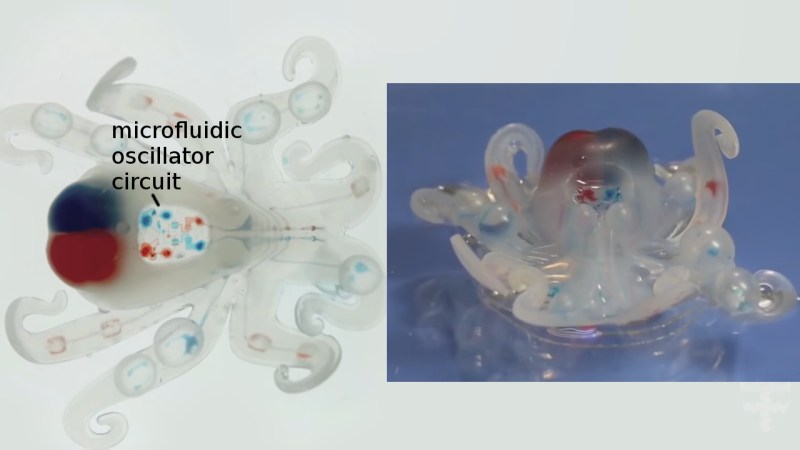
Perhaps our future overlords won’t be made up of electrical circuits after all but will instead be soft-bodied like ourselves. However, their design will have its origins in electrical analogues, as with the Octobot.

The Octobot is the brainchild a team of Harvard University researchers who recently published an article about it in Nature. Its body is modeled on the octopus and is composed of all soft body parts that were made using a combination of 3D printing, molding and soft lithography. Two sets of arms on either side of the Octobot move, taking turns under the control of a soft oscillator circuit. You can see it in action in the video below.
Octobot mechanical and electrical analogue circuits (credit: Michael Wehner at al./Nature)

As shown in the diagram, the fuel is a liquid hydrogen peroxide (H2O2) which the oscillator gets from one of two fuel reservoirs and feeds into one of two reaction chambers. In the oscillator, pinch valves act like JFETs. When fuel from one reservoir is flowing into one reaction chamber, one of the pinch valves pinches off the flow of fuel to the other reaction chamber. It’s not clear how but somehow or other that fuel flow is then pinched off by another pinch valve as fuel then flows from the other reservoir to the other reaction chamber.

The reaction chamber contains a small amount of platinum as a catalyst which reacts with the hydrogen peroxide to release a much larger volume of oxygen gas into actuators in the arms. Those actuators expand like balloons causing the arms to move. The reaction chambers are the analogues of amplifiers. Other analogues are check valves for diodes, vent orifices for resistors as well as other chambers which appear to be capacitors.

This is a proof of concept and as yet the Octobot doesn’t walk but the team hopes to make one that can crawl, swim and interact with its environment. When it does we look forward to it joining this other soft-bodied bot modeled after a stingray. It looks like our overlords might all come from the sea.


Here’s you can see the Octobot in action.


And here’s another video from Harvard demonstrating the chemical reaction between hydrogen peroxide and platinum that produces oxygen. ("Powering the Octobot: A chemical reaction")


domingo, 11 de septiembre de 2016

The Extraordinary Link Between Deep Neural Networks and the Nature of the Universe

Nobody understands why deep neural networks are so good at solving complex problems. Now physicists say the secret is buried in the laws of physics.

In the last couple of years, deep learning techniques have transformed the world of artificial intelligence. One by one, the abilities and techniques that humans once imagined were uniquely our own have begun to fall to the onslaught of ever more powerful machines. Deep neural networks are now better than humans at tasks such as face recognition and object recognition. They’ve mastered the ancient game of Go and thrashed the best human players.

But there is a problem. There is no mathematical reason why networks arranged in layers should be so good at these challenges. Mathematicians are flummoxed. Despite the huge success of deep neural networks, nobody is quite sure how they achieve their success.

Today that changes thanks to the work of Henry Lin at Harvard University and Max Tegmark at MIT. These guys say the reason why mathematicians have been so embarrassed is that the answer depends on the nature of the universe. In other words, the answer lies in the regime of physics rather than mathematics.

First, let’s set up the problem using the example of classifying a megabit grayscale image to determine whether it shows a cat or a dog.

Such an image consists of a million pixels that can each take one of 256 grayscale values. So in theory, there can be 2561000000 possible images, and for each one it is necessary to compute whether it shows a cat or dog. And yet neural networks, with merely thousands or millions of parameters, somehow manage this classification task with ease.

In the language of mathematics, neural networks work by approximating complex mathematical functions with simpler ones. When it comes to classifying images of cats and dogs, the neural network must implement a function that takes as an input a million grayscale pixels and outputs the probability distribution of what it might represent.


The problem is that there are orders of magnitude more mathematical functions than possible networks to approximate them. And yet deep neural networks somehow get the right answer.

Now Lin and Tegmark say they’ve worked out why. The answer is that the universe is governed by a tiny subset of all possible functions. In other words, when the laws of physics are written down mathematically, they can all be described by functions that have a remarkable set of simple properties.

So deep neural networks don’t have to approximate any possible mathematical function, only a tiny subset of them.

To put this in perspective, consider the order of a polynomial function, which is the size of its highest exponent. So a quadratic equation like y=x2 has order 2, the equation y=x24 has order 24, and so on.

Obviously, the number of orders is infinite and yet only a tiny subset of polynomials appear in the laws of physics. “For reasons that are still not fully understood, our universe can be accurately described by polynomial Hamiltonians of low order,” say Lin and Tegmark. Typically, the polynomials that describe laws of physics have orders ranging from 2 to 4.

The laws of physics have other important properties. For example, they are usually symmetrical when it comes to rotation and translation. Rotate a cat or dog through 360 degrees and it looks the same; translate it by 10 meters or 100 meters or a kilometer and it will look the same. That also simplifies the task of approximating the process of cat or dog recognition.

These properties mean that neural networks do not need to approximate an infinitude of possible mathematical functions but only a tiny subset of the simplest ones.

There is another property of the universe that neural networks exploit. This is the hierarchy of its structure. “Elementary particles form atoms which in turn form molecules, cells, organisms, planets, solar systems, galaxies, etc.,” say Lin and Tegmark. And complex structures are often formed through a sequence of simpler steps.

This is why the structure of neural networks is important too: the layers in these networks can approximate each step in the causal sequence.

Lin and Tegmark give the example of the cosmic microwave background radiation, the echo of the Big Bang that permeates the universe. In recent years, various spacecraft have mapped this radiation in ever higher resolution. And of course, physicists have puzzled over why these maps take the form they do.

Tegmark and Lin point out that whatever the reason, it is undoubtedly the result of a causal hierarchy.A set of cosmological parameters (the density of dark matter, etc.) determines the power spectrum of density fluctuations in our universe, which in turn determines the pattern of cosmic microwave background radiation reaching us from our early universe, which gets combined with foreground radio noise from our galaxy to produce the frequency-dependent sky maps that are recorded by a satellite-based telescope,” they say.

Each of these causal layers contains progressively more data. There are only a handful of cosmological parameters but the maps and the noise they contain are made up of billions of numbers. The goal of physics is to analyze the big numbers in a way that reveals the smaller ones.

And when phenomena have this hierarchical structure, neural networks make the process of analyzing it significantly easier.

We have shown that the success of deep and cheap learning depends not only on mathematics but also on physics, which favors certain classes of exceptionally simple probability distributions that deep learning is uniquely suited to model,” conclude Lin and Tegmark.

That’s interesting and important work with significant implications. Artificial neural networks are famously based on biological ones. So not only do Lin and Tegmark’s ideas explain why deep learning machines work so well, they also explain why human brains can make sense of the universe. Evolution has somehow settled on a brain structure that is ideally suited to teasing apart the complexity of the universe.

This work opens the way for significant progress in artificial intelligence. Now that we finally understand why deep neural networks work so well, mathematicians can get to work exploring the specific mathematical properties that allow them to perform so well. “Strengthening the analytic understanding of deep learning may suggest ways of improving it,” say Lin and Tegmark.

Deep learning has taken giant strides in recent years. With this improved understanding, the rate of advancement is bound to accelerate.

Ref: arxiv.org/abs/1608.08225: Why Does Deep and Cheap Learning Work So Well?


ORIGINAL: TechnologyReview
September 9, 2016

miércoles, 16 de diciembre de 2015

Leading Harvard physicist has a radical new theory for why humans exist

Stephanie Mitchell/Harvard Staff Photographer Lisa Randall.
Where do we come from? There are many right answers to this question, and the one you get often depends on who you ask.

For example, 
  • an astrophysicist might say that the chemical components of our bodies were first forged in the nuclear fires of stars.
  • On the other hand, an evolutionary biologist might look at the similarities between our DNA and that of other primates' and conclude we evolved from apes.
  • Lisa Randall, a theoretical physicist at Harvard University, has a different, and novel answer, which she describes in her latest book, "Dark Matter and the Dinosaurs."
Randall has written other popular science books, including the New York Times bestseller "Warped Passages: Unraveling the Mysteries of the Universe's Hidden Dimensions." Her studies at Harvard explore theoretical particle physics and cosmology.

In her latest book, she posits that the extinction of the dinosaurs — necessary for the emergence of humans — is linked to dark matter. Dark matter is the mysterious, invisible matter that astronomers estimate makes up 85% of all matter in our universe.

One species' extinction is another's head start

Thomson Reuters
Paleontologists largely agree that about 66 million years ago a giant, 9-mile-long celestial body — likely a comet — struck Earth. The impact wiped out 75% of species across the planet, including most of the dinosaurs.

Among the survivors were small primates. Over the next 66 million years these primates diversified, grew larger, learned to walk on two legs, and developed large brains, which they eventually used to invent pizza delivery.

So what caused that giant space rock to collide with our planet in the first place and give primates a chance to thrive?

It could just be chance — or luck, depending on your perspective — but Randall would disagree with both of these ideas.

Business Insider
In her book, Randall describes a dark, pancake-shaped patty of densely packed dark matter within our galaxy that could be responsible for our emergence as a species.

Dark matter has never been directly detected. However, there is enough evidence for its immense gravitational influence on our universe that the vast majority of the scientific community agrees that dark matter is a form of mysterious matter that we can neither see or touch, but that nevertheless must permeate the cosmos.

Generally, dark matter tends to be concentrated in large halos around galaxies like giant bubbles. But Randall thinks that there could also be a so-called dark disc amid the stars, planets, and gas clouds in our galaxy.

Beware the dark disc
If there is dark matter in Randall's hypothetical disc, then it stands to reason that the disc has a powerful gravitational influence on the objects around it — including our solar system.

But our solar system is not always near the disc, which is the crux of Randall's theory.

As the solar system revolves around the center of the Milky Way — the same way Earth revolves around the sun — it moves up and down, or oscillates, through the plane of our galaxy. And the rate of this oscillation is very intriguing.

Below is an illustration of our solar system's oscillation, where the orange dot in the lower left rectangle is our sun and the black line at the center is the dark disc:

APS/Alan Stonebraker
A team of astronomers made a rough estimate of this oscillation rate near the turn of this century, calculating that our solar system passes through the plane of the Milky Way about once every 32 million years, which means if there's a dark disc, we pass through that at the same rate.

Interestingly, there's evidence to suggest that mass extinctions in Earth's past happened within this time frame, or about once every 25 to 35 million years.

It's this similarity between the mass-extinction rate and the rate of our solar system's oscillation through the galaxy that made Randall and her Harvard colleague Matthew Reece first suggest the link in a scientific paper published in the journal Physical Review Letters last year, and that Randall explores more in her book.

Randall hypothesizes that when we're passing through the dark disc, the gravity from the dark matter within influences the outer region of our solar system, called the Oort cloud.

The Oort cloud, illustrated below just right of center, sits between roughly 1,000 to 100,000 Astronomical Units (90 billion to 9 trillion miles) from the sun and is thought to contain billions of icy objects at least 12 miles wide.

Uploaded by WolfmanSF to Wikipedia
If something 12 miles wide hit Earth today, it would mean the end of life as we know it. And Randall thinks that's exactly what happened to the dinosaurs 66 million years ago that opened the door for widespread primate evolution.

Prove it

NASA Goddard Spaceflight Center Dark matter is illustrated here as the fog between galaxies.
While it's impossible to wind back the clock, proving the existence of the dark disc would greatly advance Randall's theory.

She's tried to do so by looking at the speed and direction of stars in our galaxy. If stars moved in ways that couldn't be explained by the amount of ordinary, visible matter around them, then it could suggest the presence of the dark disc.

But that's a very tall order. There are about 100 billion stars in the Milky Way, and hunting dark matter is notoriously tricky.

We have a dozen or so functioning detectors underground, on Earth's surface, and in space — and none of them has yet managed to sniff out a dark-matter particle. If they do, it would be a significant step toward supporting Randall's hypothesis.

In her concluding remarks, Randall writes:
"In some global sense, we are all descendants of Chicxulub [the town where the dinosaur-killing meteor impacted]. It's a part of our history that we should want to understand. If true, the additional wrinkle presented in this book would mean that not only was dark matter responsible for irrevocably changing our world, but also that some of it played a crucial role in allowing our existence." 

ORIGINAL: Business Insider 
14.11.2015

miércoles, 25 de marzo de 2015

Scientists Successfully Insert Woolly Mammoth DNA Into Elephant Genome


Photo credit: AuntSpray/ Shutterstock
In true "Jurassic Park" style, scientists at Harvard University have successfully managed to insert genes from the woolly mammoth into the genome of an elephant. While this may represent significant progress in the field, lead researcher George Church has reportedly played down claims that the work brings us closer to recreating these iconic animals.

Woolly mammoths (Mammuthus primignius) may have appeared more than 400,000 years ago during the middle Pleistocene, but they actually didn’t die out all that long ago. Alongside most other large mammal species residing in the Northern Hemisphere, they disappeared from most of their range across mainland Eurasia and North America about 10,000 years ago, but a small population of some 500-1,000 individuals survived on Wrangel Island in the Arctic Ocean for a further 6,000 years.