Mostrando entradas con la etiqueta Peces. Mostrar todas las entradas

viernes, 21 de marzo de 2014

Casanare: sequía mata a miles de animales

Para la gobernación, la deforestación que hay en Boyacá reduce el agua disponible, pero esa no sería toda la verdad.

La sequía ha matado a peces, ganado, venados, entre otros animales. La mayor mortandad ha sido de chigüiros. Foto: SEMANA

La fuerte ola de sequía que atraviesa Casanare ha causado desde hace cuatro meses la muerte por deshidratación de aproximadamente 20.000 animales, principalmente chigüiros, venados, zorros, peces, tortugas, reptiles y ganado vacuno.

El impacto ha sido tan fuerte que la Gobernación de ese departamento está estudiando este viernes si declara emergencia ambiental, especialmente en el municipio de Paz de Ariporo, el tercero más importante de Casanare. Pero para ello necesitan argumentos jurídicos que están recopilando.

De hacerlo, significaría que se harían obras de mediano plazo como perforación de pozos profundos con equipos de bombeo para abastecer de agua.

Pero el problema no es de falta de pozos sino de una reserva forestal suficiente, como lo explicó para Semana.com Adriana Soto, ex viceministra de Ambiente y experta en adaptación al cambio climático.

Habrá más sequías y más lluvias extremas. Las regiones que tengan en mejor estado sus coberturas naturales (como bosques, selvas, entre otros) podrán resistir mejor estos impactos porque ayudan a regular el agua y los suelos”, indicó.

Soto especificó que si no hay árboles y una zona forestal bien mantenida, el agua lluvia no se acumula en los pozos y se generan sequías cada vez más fuertes.

Estamos apostándole mal a la cosa porque la ganadería extensiva y las actividades agrícolas piensan en un terreno limpio de árboles como lo productivo pero este país se tiene que dar cuenta que la deforestación va contra su misma productividad”, aseguró.

En la Gobernación de Casanare están de acuerdo con este planteamiento pero le tiran la pelota a su vecino, Boyacá. “En Casanare hay poco pie de monte. La deforestación está en municipios boyacenses como Paya, Isba o Aquitania y nuestro departamento se debe a Boyacá por turismo, por vías y por aguas. Cuatro ríos que vierten a Casanare nacen en la Laguna de Tota”, aseguró Luis Eduardo Castro, secretario de planeación de Casanare.

Los animales tienen que caminar kilómetros con su manada para conseguir un pozo de agua.

En sus largos trayectos, los animales mueren atrapados por el lodo o de sed.

El tiempo de intensas temperaturas, que van entre 40° y 45° centígrados, comenzó desde diciembre del 2013 y no ha cesado. Muchas voces indignadas en las redes sociales han manifestado que la Gobernación y el Estado no han hecho nada durante estos cuatro meses y pretenden arreglar la situación en un día.

Castro dijo que en la sabana siempre hay mortalidad de animales por el clima pero esta situación se agudizó con la prolongación del verano, que no esperaban. “Es un fenómeno natural que se nos sale de las manos”, precisó.

Según él, no es el primer acto de la Gobernación para afrontar la sequía. El intento de Casanare es trabajar en el manejo de cuencas de la mano con Boyacá y que esto sea aprobado como política pública nacional.

Castro argumenta que la Autoridad Nacional de Licencias Ambientales (ANLA) otorga permisos a las grandes empresas sin estudiar demasiado si afecta o no el territorio y la Gobernación no puede interferir en ello. “La ANLA expide la licencia pero no hace seguimiento, no hace un balance de la compensación del daño y no revisa constantemente si las empresas cumplen o no con la conservación de microcuencas”, detalló.

Si bien de Boyacá provienen importantes recursos hídricos para Casanare, no se puede obviar una responsabilidad de este departamento en los impactos del medio ambiente. Así piensa Manuel Rodríguez, el primer ministro de Medio Ambiente que tuvo el país, quien dice que “Casanare no puede olvidar que ha tratado a los humedales de una manera absolutamente irresponsable y eso es local”. Según Rodríguez, en ese departamento se han drenado humedales para otorgarle mayor terreno a la agricultura.

Algunas voces culpan a las petroleras por secar los pozos hídricos. El secretario de planeación dice que no tiene el dato técnico de si esas empresas interfieren o no en esta última temporada de sequía. Rodríguez opina que la afectación de las aguas en la explotación petrolera es evidente pero que de fondo el tema no es cómo regularla sino si se acaba o no la extracción de dicho mineral.

Adriana Soto, por su parte, considera que hay que mirar la situación específica de Casanare con lupa para asegurar eso y analizar la sequía con más ciencia y menos política. Su posición es clara: la única solución para las largas y fuertes sequías o las inundaciones que aquejan al país es la reforestación y el cuidado de bosques y selvas.

De otra manera, por más pozos que se construyan, será una tarea casi imposible afrontar el drástico cambio del clima pues no habrá reservas hídricas suficientes en tiempos de calor ni coberturas naturales que guarden el agua durante tiempos de lluvia. Así, seguirán muriendo 20.000 animales silvestres y miles más.

Peces muertos por deshidratación.

Alrededor de 250.000 hectáreas estarían afectadas.

ORIGINAL: Semana
21 marzo 2014

martes, 20 de agosto de 2013

What’s This Mysterious Circle on the Seafloor?

ORIGINAL: NatGeo
by Mary Bates in Weird & Wild
August 15, 2013

What creates mysterious circles on the seafloor? No, it’s not aliens of the deep—it’s actually pufferfish hoping to snag a mate, a new study says.

Divers first noticed the 6.5-foot-wide (2-meter-wide) circular structures near Japan‘s Amami-Oshima Island about 20 years ago. But no one knew how these so-called mystery circles were constructed—or what was creating them—until now.
A male pufferfish (center) made this nest to lure females in Japan in 2012. Photograph courtesy Kimiaki Ito
The circles, scientists say, are actually nests created by male pufferfish, which spend about ten days carefully constructing and decorating the structures to woo females. What’s more, this industrious pufferfish is thought to be a new species in the Torquigener genus, according to the study, published July 1 in the journal Scientific Reports.

Nesting Instinct
The male fish, which measures less than 5 inches (13 centimeters) long, first uses his body to create peaks and valleys in the sandy bottom around a central circle of smooth sand. He accomplishes this feat by swimming in toward the center of the circle in a straight line and then back around the center in a circular motion. (Watch a pufferfish video.)

Before the female fish arrive to inspect his handiwork, the male forms irregular patterns in the fine sand particles of the central circle. He also decorates the peaks of the outer portion with shell and coral fragments.

When a potential female partner arrives on the scene, the male stirs up the fine sand in the nest’s inner circle. If she deems the nest, and the male who built it, satisfactory, she lays her eggs in the center of the nest and leaves.
A male pufferfish uses his body to create peaks and valleys in the sand. Photograph courtesy Kimiaki Ito

The scientists aren’t sure exactly what the females are looking for when they judge a male’s nest. It could be the central patterns made of fine sand, the decorations on the outside, or the nest’s size or symmetry. (Also see Help Name This Mystery Fish.”)

But they do know that because the nest-making process is so time-consuming, a larger nest could indicate a stronger or more fit male—both desirable traits to females.

Dad Duties
Once the female splits, though, it’s the male who does the parental chores: He remains in the nest until the eggs hatch six days later.

Afterward, the male looks for a nearby spot to start the nest-making process all over again, which is a mystery of its own: Why spend all that time and energy building a brand-new nest? The scientists think it has something to do with the fine sand particles that make up the smooth center of the circles. (Read “Africa’s Mysterious ‘Fairy Circles’ Explained.”)

The males use up all the fine sand within the radius of their nest during a single spawning cycle. To construct another nest, they have to look elsewhere for a site with more fine sand particles.

Now that’s what you call a labor of love.

miércoles, 27 de marzo de 2013

Ocean Array Could Clean 7,250,000 Tons of Plastic

ORIGINAL: Mashable
Tracy Staedter for Discovery News 

WHAT'S THIS?
Image via Christopher Furlong/Getty Images
Millions of tons of tiny bits of plastic float in giant patches — or gyres — in oceans around the world. There are five large patches of plastic. One of them, the North Pacific Gyre, is roughly twice the size of the United States. All of them are a problem.

These bits of plastic look like food to fish and birds and once consumed, end up killing these animals. But the plastic bits also contain chemicals, such as DDTs and PCBs, that once consumed by small sea creatures then enter the food chain to be consumed eventually by people.


And because plastic doesn’t break down and dissolve, these gyres are going to be around forhundreds, if not thousands of years, even if we stopped polluting tomorrow.

What to do?
Young entrepreneur Boyan Slat wants to develop an array of floating devices designed to clean up the more than 7 million tons of plastic bits suspended in the top layer of the gyres — that’s the weight of 1,000 Eiffel Towers.

The array would be made of manta-ray-shaped platforms connected in a zig-zagging pattern and affixed to the seabed. Ocean currents would drive plastic debris toward the platforms, which would be powered by the sun and wave action. Long, floating booms — not nets — would be used to sift plastics from the water with very little bycatch. Slat found that zooplankton, microscopic animals important to the bottom of the food chain, can be removed safely from the water using a centrifuge.


In a TED talk for TEDxDelft 2012, Slat detailed his plan. Not only would his plan clean up the ocean, save the lives of aquatic animals and reduce the amount of pollutants from entering the food chain but it would also save industry millions per year. Marine vessels are damaged every year from the garbage floating in the ocean, countries lose money when tourists no longer want to visit their polluted beaches. And Slat also thinks that he can make millions of dollars from the plastic he collects, by recycling it.

lunes, 18 de febrero de 2013

How I fell in love with a fish - Dan Barber

ORIGINAL: TED

Chef Dan Barber squares off with a dilemma facing many chefs today: how to keep fish on the menu. With impeccable research and deadpan humor, he chronicles his pursuit of a sustainable fish he could love and the foodie's honeymoon he's enjoyed since discovering an outrageously delicious fish raised using a revolutionary farming method in Spain.

domingo, 18 de noviembre de 2012

Home Aquaponics Kit: Self-Cleaning Fish Tank That Grows Food

ORIGINAL: Kickstarter
by Nikhil & Alejandro


The Aquaponics Garden: an elegant table-top fish tank that cleans itself & grows fresh food at the same time. A closed-loop ecosystem!

Launched: Nov 15, 2012
Funding ends: Dec 15, 2012

Check out this recent article from GOOD Magazine on this campaign!

Grow fresh produce right in the comfort of your own home - beans, basil, thyme, baby greens, oregano, mint, parsley, spinach and so many other delicious foods!

Follow our Kickstarter journey on Facebook and Twitter!

Perfect for the classroom!
A Beautifully Simple & Closed-Loop Ecosystem Right on Your Table
An elegant table-top experience
Fun for families!
Great for classrooms and science projects

So What's Happening Inside?
Aquaponics Garden

So what's happening? The fish, they poo and they pee, and all that waste-water gets broken down by beneficial bacteria into nutrients

The waste-water from the fish is then pumped up & upcycled as an awesome organic fertilizer for the plants. The plants take up the nutrients and, at the same time, clean the water which then falls back down for the fish.

There is no soil - the plants are growing just on rocks - all the nutrients coming from the fish (no need for any artificial fertilizers - it's all organic!!)

There is no need to clean the water because of the plants - it's a self-cleaning fish tank!

What Can I Grow?

Choose from a variety of fresh produce, including spinach, baby greens, oregano, beans, basil, mint, parsley & thyme.

Harvesting Basil_Aquaponics Garden
All You Have to Do is Feed Your Fish

You can pick from a ton of different types of fish that will work great in the system - including our favorite, the Betta fish we have pictured in our system!
Feeding Fish_Aquaponics Garden
What Comes With My Aquaponics Garden?

Each Aquaponics Garden comes with the entire system - ready to go & no assembly required!

Includes:
  • The tank & garden top - food and pet safe!
  • Air pump to bring your nutrients up and oxygenate the water
  • 5 pots with pebbles (from which the plants will grow)
  • Organic seeds (mixture of various herbs)
  • Fish food and water conditioners to get started right away
Just add water & fish and watch your system take off! Our goal was to make this incredibly intuitive and easy to setup!

Who We Are
2 Recent College Grads On a Mission to Help People Grow Their Own Food at Home

Help Bring This to Life - Pledge Today
Add caption
Add caption
Add caption
FAQ

  1. How many fish can I keep? The industry standard is 1" of fish for 1 gallon of water. This is a 3 gallon tank, so you can have 1 larger 3" fish, or a few smaller 1" fish. If you'd like to host other types of fish, the system will allow it, but you should transfer them out to a larger tank when they grow in size.
  2. What kind of fish can I put in my tank? Many types will work well, but we highly recommend some ornamental fish like Bettas, cloud fish, danios, or small goldfish. These are some of the easiest fish to keep, but depending on your expertise, you can keep others!
  3. How big is the unit? It's roughly 10" wide, by 11" high, by 6" deep - smaller than your average toaster oven! The tank itself holds 3 gallons of water. When empty, it's super-light, just a few pounds!
  4. What is it made out of? We are finalizing the exact materials, but are exploring various combinations of recycled plastics, acrylic, and glass.
  5. Can I grow flowers in my system? Absolutely!!
  6. How many different types of plants can I grow? There are 5 "pots" to plant in, and you pick and choose what combo of plants to grow in them as you please! Five of the same, or one of each. You can get creative!
  7. Does it need sunlight - I thought fish don't like sun? We recommend putting the tank right next your window, with the back up against a wall. That way there's no direct light coming into your tank, but at the same time, enough ambient sunlight to help the plants grow. If you'd like to place the kit right against a window, we suggest just placing a backer against the back clear panel to prevent direct sunlight from hitting the tank (which can cause algae growth!) We're working on finding the best tint for the back right now.
  8. 8) Can I grow year-round? Yes! If it's too cold though for the fish you choose or you don't have proper light in the winter, we suggest investing in some inexpensive water-heaters and grow-lights to guarantee consistent growth! We'll have our favorite suggestions on our site, and links to buy them, when we are reading to ship in late February.
  9. 9) Can I use my own seeds? Absolutely! We don't believe in the pricey subscription model when it comes to food! You don't need to buy any special replacement pre-seeded pods from us - use your own seeds!

RISKS AND CHALLENGES

Some of the challenges that we are currently working to solve and create the best possible solutions for are below. We will constantly be updating our Kickstarter community as we learn more and make decisions on the below areas.

Some manufacturing challenges:
  1. Keeping costs down on the accessory inputs: Manage costs by getting many of the additional inputs donated for free. We are looking to partner with various suppliers of fish food and water conditioners to offer starter kits for free with our Aquaponics Garden. By keeping their brand on these starter packs, it'll expose their brand to many more customers and make up for the donation of the starter packs. These relationships are still being finalized, and there is a risk of added costs if we cannot make these happen.
  2. Manufacturing of the Pot: We are still determining how the actual pot will be manufactured - will it be one injected molded pot, or 3 different parts sonic welded together (a U shaped piece) with a clear front and back panel. Although the separate pieces will look cleaner and offer more precise angles, it is more expensive. We are working with our manufacturer to understand the capability of their equipment to create the product in one pot-shaped unit and hopefully maintain quality and keep price down.
  3. Sustainability - we are looking into the best options to use entirely recycled plastic or glass. This is still being finalized and maintaing a low cost will be a challenge for these two solutions. We'll be constantly updating the KS community as we work on this!
  4. Time-line: We are confident here as we have a partner locally that has already committed to being able to manufacture this - which would reduce the months of time wasted in shipping by using foreign manufacturers.
  5. Colored Kits - we are still finalizing the exact way the colored/tinted back panel will be applied to the clear back - through an adhesive or a hook-mechanism. The problem with the adhesive has been being able to easily remove it if a customer wants to change the color. The hanging method adds more parts/tooling and drives the cost up.
  6. Etching - the exact font size of how big the names will be (for the LIFETIME LEGACY reward) is being finalized - there is a challenge/balance of having names be small enough to fit more names/make it accessible to more and big enough where it can be etched and readable. We will keep you informed!!

Leave a comment with any other questions!

Thanks!

Alejandro and Nikhil


FAQ


Have a question? If the info above doesn't help, you can ask the project creator directly.Ask a question
Report this project to Kickstarter

592backers
$34,868pledged of $100,000 goal

26days to go
Back This Project$1 minimum pledge


This project will only be funded if at least $100,000 is pledged by Saturday Dec 15, 2:59am EST.

Project by
Nikhil & Alejandro

Oakland, CAContact me

First created · 2 backed
Nikhil Arora (1120 friends)
Website: http://backtotheroots.com

See full bio

Pledge $1 or more
18 backers


***BEHIND THE SCENES ACCESS*** Get access to private Kickstarter updates & fun(ny) pics from the journey!
Estimated delivery: Dec 2012


Pledge $10 or more
40 backers


***PHOTO MURAL*** Your picture will go up on the photo mural we're creating at our farm featuring all of our supporters. Your name will also be added to our website's product page so everyone knows who helped bring this to life!
Estimated delivery: Dec 2012


Pledge $25 or more
25 backers


***T-SHIRT*** Everyone will know about your love for the Aquaponics Garden when you wear your limited edition Sustainably Delicious t-shirt! (Int'l delivery not guaranteed by Dec 2012)
Estimated delivery: Dec 2012
Add $15 to ship outside the US


Pledge $40 or more
150 backers Sold out


***BE THE FIRST*** Save on an Aquaponics Garden pre-order by being one of the first 150 people in the world to own the kit.
Estimated delivery: Feb 2013
Add $50 to ship outside the US

Pledge $50 or more
273 backers


***AQUAPONICS GARDEN PRE-ORDER*** Whether you're buying one for your home or kid's classroom, you'll save 33% from the planned retail price and enjoy free shipping in the US by pre-ordering today!
Estimated delivery: Feb 2013
Add $50 to ship outside the US


Pledge $100 or more
45 backers


***CUSTOM COLORED AQUAPONICS GARDEN*** Add a bit more pop to your experience by tinting the back panel to the color of your choice! Includes: t-shirt. (Estimated delivery date of t-shirt: Dec 21 2012; Estimated delivery of kit: late Feb 2013; Items will ship together in late Feb 2013 for international backers)
Estimated delivery: Dec 2012
Add $50 to ship outside the US


Pledge $500 or more
13 backers Limited (137 of 150 left)


***LIFETIME LEGACY*** Your name will be permanently engraved on the bottom of every single kit we sell. As we scale, thousands of customers worldwide will always remember who helped make this possible! Includes: t-shirt & custom colored kit. (Estimated delivery date of t-shirt: Dec 21 2012; Estimated delivery of kit: late Feb 2013; Items will ship together in late Feb for international backers)
Estimated delivery: Dec 2012
Add $50 to ship outside the US


Pledge $2,000 or more
0 backers Limited (20 of 20 left)


***JOIN THE FAMILY*** In order to have the honor of hosting you at our annual company retreat, we will fly you out to San Francisco and put you up for 3 nights in early Jan 2013. Meet the Back to the Roots Family and experience our fun, fun(ny), and fun(ky) culture. Help us strategize and think through how to grow this movement of making food personal again! Includes: t-shirt, custom colored kit & liftetime legacy engraving. (Estimated delivery of t-shirt: Dec 21, 2012; Estimated delivery of kit: late Feb 2013; Estimated time of trip: Early January 2013; US domestic flights only)
Estimated delivery: Dec 2012
Add $50 to ship outside the US


Pledge $10,000 or more
0 backers Limited (10 of 10 left)


***INSPIRE YOUR COMMUNITY*** Alejandro and Nikhil will fly out to you and host an educational seminar for your community. We’ll be leading a discussion to inspire people towards a more sustainable future by growing your own food and eating local. We will cook a delicious, locally-sourced meal for all in attendance. Includes: t-shirt, custom colored kit & liftetime legacy engraving. (Estimated delivery of t-shirt: Dec 21, 2012; Estimated delivery for kit: Late Feb 2013; All details for event will be finalized directly with you)
Estimated delivery:

viernes, 31 de agosto de 2012

Autoridades evalúan causas del desastre ecológico en Mallorquín

ORIGINAL: El Heraldo
Por Marly Obredor Salazar

Una comisión de la Gerencia de la Contraloría General de la República recorrió la ciénaga.
Establecer con claridad las causas de la alteración del equilibrio del ecosistema de la ciénaga de Mallorquín, que desencadenó en la mortandad de peces reportada ayer, es la prioridad de las autoridades ambientales de Barranquilla.

De acuerdo a lo expresado por el jefe de Control y Vigilancia del Damab, Ángel Romo Padilla, un equipo técnico de la entidad ambiental diseñó un programa de muestreo para establecer la calidad del agua de la ciénaga y la que llega del arroyo León.

Así mismo, programó un recorrido para analizar los vertimientos de agua que realizan diferentes empresas a esa cuenca. “Debemos identificar cuáles empresas realizan vertimientos en la ciénaga, para luego establecer las características físico-química de los mismos”, expresó el funcionario.

Romo indicó que de acuerdo a las características que se notaron en el agua (color verdoso, proliferación de algas), esto podría darse por el aporte de nutrientes como fósforo y nitrógeno.No me gustaría especular, pero estos elementos podrían estar presentes en el agua que salen de la Edar (Estación Depuradora de Aguas Residuales del Distrito de Barranquilla), ubicada en el barrio El Pueblo”.

El ingeniero ambiental dijo que los análisis de laboratorio deberán comprobar o descartar esta hipótesis. Indicó que precisamente el Damab financió un proyecto de optimización de la Edar.

Esta teoría coincide con la denuncia realizada por Luz Helena de Sarmiento, líder de la veeduría ciudadana conformada por las comunidades de Puerto Colombia, quien cuestionó si la laguna de oxidación del Pueblito tiene la capacidad requerida para tratar las aguas residuales provenientes de las empresas instaladas en el sector de Juan Mina.

El ingeniero Ramón Hemer, gerente de Operaciones de la empresa Triple A, que tiene a su cargo la Estación de Aguas Residuales, descartó de plano que el agua que sale de la Edar esté ocasionando el daño ecológico.

El funcionario dijo que el agua que es tratada en la Edar es de uso doméstico y no industrial, “nuestro comportamiento ha sido el mismo durante los 12 años de funcionamiento de la estación, en cuanto al agua de entrada y al agua de salida. Mucho más ahora que el Damab adelanta el proyecto de optimización para eliminar nitrógeno y fósforo”, insistió.

El representante de la Triple A, empresa que apoyó la recolección de los peces muertos de la Ciénaga, dijo que se inclina más hacia la teoría que indica que las aguas se encontraban estancadas a la altura del puente sobre la 51B y que al correr, ocasionaron la mortandad.

También pidió que se revisen los canales que intercomunican las aguas de la ciénaga con el Río Magdalena, pues tiene conocimiento que los mismo se encuentran taponados, lo que también podría afectar el equilibrio natural de ese cuerpo.

Ayer, una comisión de la Gerencia de la Contraloría General de la República, liderada por Manuel Díaz Jimeno, se hizo presente en la zona y realizó un recorrido por la ciénaga, al tiempo que escuchó las inquietudes de los pescadores.

sábado, 25 de agosto de 2012

Fish Are Warmer, Faster, Stronger: Unexpected Benefits of Living in a Changing Climate, Biologists Find

ORIGINAL: Science Daily

Zebrafish embryos, taken 28 hours after fertilization (a little over a third of the way through embryonic development). (Credit: Ian Johnston)
ScienceDaily (Aug. 14, 2012) — New research by McMaster University biologist Graham Scott suggests that growing up at warmer temperatures helps some aquatic animals cope with climate change, raising questions about the limits of adaptation.

Working with Ian Johnston at the University of St Andrews in Scotland, Scott has found that raising zebrafish at warmer temperatures as embryos actually improves their ability to adjust to both higher and lower temperatures as adults.

Their research shows the fish are hardier after being raised in a warm-water nursery, and raises the question of how far the temperature can rise before the advantage becomes a liability, as inevitably it will, Scott says.

"What limits are there to their coping abilities? That's what we're really trying to understand," says Scott, a specialist in animals' adaptation to challenging environments. "If we want to appreciate how the natural world is affected by climate change, that's what we need to know."

The research appears in the Proceedings of the National Academy of Sciences.

Zebrafish are native to freshwater habitats of Southern Asia, and over their lives can experience a range of temperatures from almost 40°C to nearly freezing. The fish under study were raised across the range of temperatures they would normally experience in their natural breeding season (22°C to 32°C).

The biology of zebrafish -- especially their short gestation period -- makes them ideal research subjects.

Scott and Johnston found that when embryos raised in warm water experienced temperature variation as adults, they could swim faster, their muscle was better suited for aerobic exercise, and they expressed at higher levels many of the genes that contribute to exercise performance.

The improvements were true for the adult fish in warmer and colder water alike -- a finding that surprised the researchers.

"We thought that they might do better under warmer conditions because they grew up in warmer conditions. We didn't think they'd also do better under colder conditions, but they did."

miércoles, 4 de julio de 2012

THE END OF THE LINE - UN MUNDO SIN PECES


Sinopsis:
¿Qué está pasado con los peces de todo el mundo? ¿De dónde viene el atún que comes? ¿Y cómo fue capturado? ¿Es el mar una fuente inagotable de recursos? La fundación MarViva y Greenpeace presentan "THE END OF THE LINE - UN MUNDO SIN PECES" , el primer documental riguroso sobre la desaparición de las especies marinas y la seguridad alimentaria.

"The End of the Line - Un mundo sin peces" se basa en un libro del periodista de investigación Charles Clover, y cuenta con el apoyo, además de MarViva, de las fundaciones Waitt Family y Channel 4 Britdoc.

La película ha sido producida por Arcane Pictures, Calm Productions y Darmouth Films
La versión original de "THE END OF THE LINE - UN MUNDO SIN PECES" narrada por el actor Ted Danson (Cheers, Damages) — se presentó en el Festival de Cine Sundance 2009. Su promoción ha sido apoyada por cientos de organizaciones medioambientales, oceanográficas y de conservación marina , incluidos el Consejo para la Defensa de los Recursos Naturales (NRDC), National Geographic, Greenpeace y WWF.
La versión doblada al castellano y que veremos en Argentina, está a cargo de Miguel Bosé.

Si bien esta película no se estrenará comercialmente (la idea no es lucrar con el film), estamos haciendo a través de la Fundación de MarViva, España, con el apoyo local de Greenpeace, una campaña de concientización sobre la extinción de peces a mediano plazo. Posiblemente haya funciones gratuitas que avisaremos luego.

Pero es por esta causa que necesitamos la mayor colaboración posible de los comunicadores.
No nos interesa hacer una crítica de espectáculos hacia film sino tratar de difundir en la más amplia forma posible las ideas, conclusiones y reflexiones que se muestran en esta película.

Ficha Técnica:
Dirección: Rupert Murray
Productores Ejecutivos:
Christopher Hird y Jess Search, Ted Waitt y Erica Knie (MarViva)
Productores: Claire Lewis y George Duffield
Montaje: Claire Ferguson
Narración: Miguel Bosé (castellano)

Datos Técnicos:  82 min.

País: UK 


Documental que denuncia, a través de impactantes imágenes, el daño que la sobrepesca está haciendo a los océanos y las consecuencias globales que puede tener en la biodiversidad marina y en nuestra propia vida.

Filmado durante más de dos años siguiendo las investigaciones de Charles Clover, periodista del Daily Telegraph, el documental examina la inminente extinción del atún rojo, fundamentalmente producida por el aumento de la demanda occidental de sushi, y revela que si el sector de la pesca no se regula, en el año 2048 podrían haber desaparecido de nuestros mares todos los peces comestibles, lo que provocaría una hambruna que afectaría a millones de personas y dejaría en paro a todo el sector pesquero mundial.

lunes, 2 de julio de 2012

Battle for the Xingu


Cultures of Resistance is excited to present our short film "Battle for the Xingu" online. The film is about indigenous Kayapó opposition to the Brazilian government’s proposed Belo Monte Dam on the Xingu River in the Amazon. The dam would have a disastrous impact on the Kayapó homeland. The film features footage from the 2008 Altamira summit, a key moment of the burgeoning Kayapó movement, when 1,000 Indians joined national and international supporters in the city of Altamira, Para to protest the Belo Monte Dam project plans. It was the largest indigenous gathering in the Brazilian Amazon in nearly twenty years.

In her article at the Huffington Post, Iara Lee discusses the local, national, and international resistance to the Belo Monte project, and the flawed thinking behind the many mega-dams around the world. She also published an updated version of the article on the Video for Change blog at WITNESS , an organization that was formed to harness the power of video for human rights advocacy.

If you are interested in hosting your own screening of "Battle for the Xingu," please get in touch here  or email us at info@culturesofresistance.org.


Belo Monte's Many Flaws

Many specialists from across Brazil and abroad—including economists, engineers, and environmental scientists—have made it clear that Belo Monte is an ill-conceived dam. While the government estimates the project’s total price tag at US$8.7 billion, independent assessments have put the number around $17 billion, while numerous private corporations have lost interest in investing. Indeed, state-owned, taxpayer-financed companies account for approximately 75% of the recently signed concession.

The dam’s technical viability has also been called into question. Coronado Antunes, ex-President of the state-owned water and sanitation utility Sabesp, was quoted in the July issue of the Journal of the Brazilian Engineering Institute , calling the dam "the worst engineering project in the history of hydroelectric dams in Brazil, and perhaps of any engineering project in the world." According to independent evaluations, during the seasons and years when the river’s flow is below its peak, the dam will generate far less than what government and industry proponents have touted to the public. Quoting Antunes again, "in years of low instream flow, Belo Monte will be disastrous."

Besides the economic and technical issues, and the thousands who would be forced from their homes due to flooding, less-obvious impacts abound. Fresh water would be significantly less available; fish species would be decimated; water-borne diseases like Malaria would skyrocket.

According to a World Wildlife Fund study , through investments in energy efficiency Brazil could cut its projected demand by 40% by the year 2020—the equivalent to 14 dams the size of Belo Monte. On the other hand, approximately 30% of the dam’s generated power will go to heavy industry like mining companies, which themselves are some of the world’s worst polluters.

The Campaign to Stop the Dam
We at Cultures of Resistance think International Rivers is one of the best groups working to protect rivers and the people who depend on them, particularly the Xingu. Founded in 1985, the group has worked to encourage more efficient ways of meeting the world’s water and energy needs. The International Rivers network includes environmentalists, human rights activists, ecological and industry experts, as well as individuals who are directly affected by the building of large dams. In their review of the Belo Monte Dam project, International Rivers experts reported that “although it would have an official installed capacity of 11,233 MW, the dam would be highly inefficient, generating as little as 1000 MW during the 3-4 month low water season." They concluded that the irreversible, harmful impact of the dam would greatly outweigh the economic value of the energy it would produce. Those inspired by the activism in the short film should consider getting involved with International Rivers.

How You Can Get Involved
Indigenous leaders continue to demand that the Brazilian government terminate the dam project, andInternational Rivers reports that the Kayapó have interpreted the continuation of construction plans as a threat of war. To join the fight to preserve the Xingu River, International Rivers recommends:
  • Hosting your own screening and discussion of "The Battle for the Xingu." Cultures of Resistance can help you arrange a screening of the film.
  • Writing to President Rousseff and other Brazilian government officials to say that the international community will not tolerate the destruction of the Amazon region’s ecological and cultural diversity.
  • Donating directly to International Rivers’ Xingu River campaign.
  • Joining the International Rivers mailing lists to receive updated information regarding developing issues, current campaigns, and future events.
  • Volunteering with International Rivers. The group needs volunteers in all areas of administration, and well as research, education, and advocacy. Volunteer opportunities are available to individuals of all ages and in many different regions of the world.


lunes, 18 de junio de 2012

The vanishing North

ORIGINAL: The Economist

There are benefits in the melting of the Arctic, but the risks are much greater

Jun 16th 2012


NOW that summer is here, the Arctic is crowded with life. Phytoplankton are blooming in its chilly seas. Fish, birds and whales are gorging on them. Millions of migratory geese are in their northern breeding grounds. And the area is teeming with scientists, performing a new Arctic ritual.

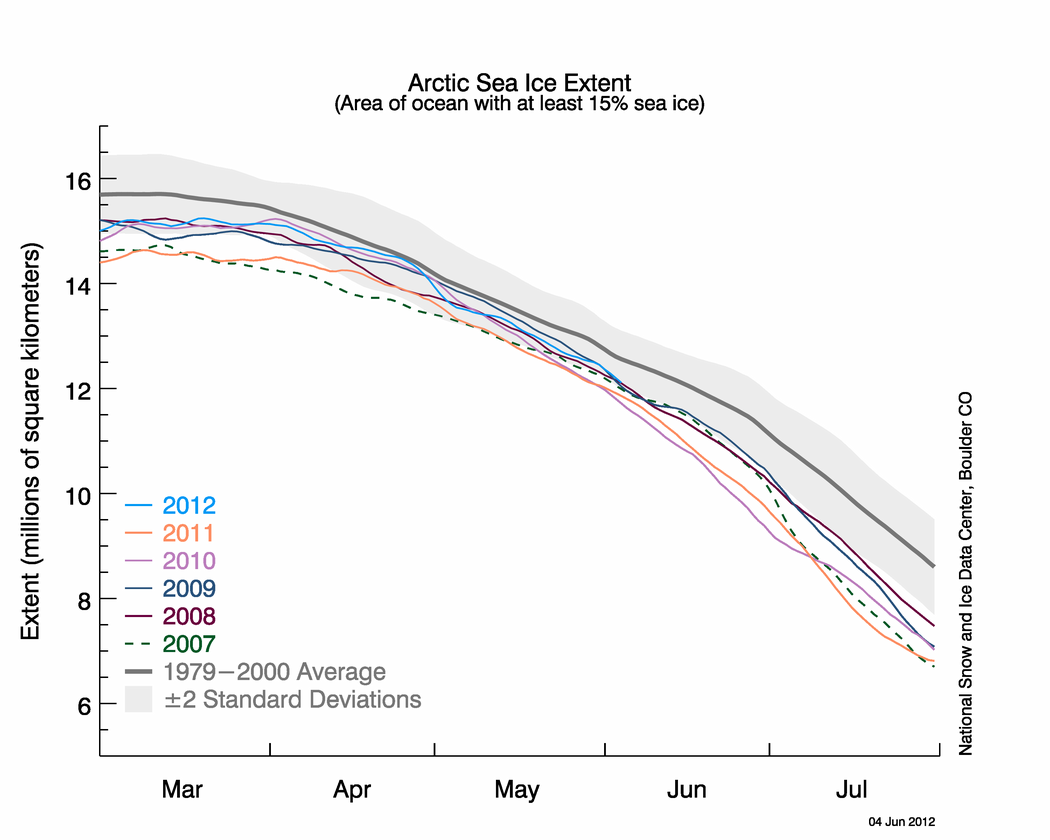
Between now and early September, when the polar pack ice shrivels to its summer minimum, they will pore over the daily sea ice reports of America’s National Snow and Ice Data Centre (NSIDC). Its satellite data will show that the ice has shrunk far below the long-term average. This is no anomaly: since the 1970s the sea ice has retreated by around 12% each decade. Last year the summer minimum was 4.33m square km (1.67m square miles)—almost half the average for the 1960s.
Graph: NSIDC
The Arctic’s glaciers, including those of Greenland’s vast ice cap, are retreating. The land is thawing: the area covered by snow in June is roughly a fifth less than in the 1960s. The permafrost is shrinking. Alien plants, birds, fish and animals are creeping north: Atlantic mackerel, haddock and cod are coming up in Arctic nets. Some Arctic species will probably die out.

Perhaps not since the 19th-century clearance of America’s forests has the world seen such a spectacular environmental change. It is a stunning illustration of global warming, the cause of the melt. It also contains grave warnings of its dangers. The world would be mad to ignore them.

As our special report shows in detail, the Arctic is warming roughly twice as fast as the rest of the planet. Since the 1950s the lower atmosphere has warmed by a global average of 0.7 degrees Celsius; Greenland’s air has warmed by 1.5 degrees. The main reason appears to be a catalytic warming effect, triggered by global warming. When snow or ice melt, they are replaced by darker melt-water pools, land or sea. As a result, the Arctic surface absorbs more solar heat. This causes local warming, therefore more melting, which causes more warming, and so on. This positive feedback shows how even a small change to the Earth’s systems can trigger much greater ones.

Photo: NSIDC

lunes, 11 de junio de 2012

The 2012 Bio-Art Winners (detailed)

ORIGINAL: FASEB

This images are so stunning that deserved another post

Frank Moutos and Farshid Guilak*
Duke University Medical Center, Durham, NC

Due to a lack of blood vessels and other characteristics, cartilage heals very slowly. One way to accelerate natural cartilage repair and growth is to use tissue engineering, or the artificially-stimulated production of functional replacement tissue. The image shows a three-dimensionally woven biomaterial scaffold. The scaffold consists of multiple layers of resorbable fiber bundles that have been woven into a porous structure. The scaffold is then seeded with cells that grow to become new tissue as the fibers are resorbed. The fibers provide stiffness and strength in a manner that mimics native collagenous tissues such as cartilage. This work to use tissue engineering to generate replacement cartilage is supported by NIH funding from the National Institute of Arthritis and Musculoskeletal and Skin Diseases.

*Biomedical Engineering Society

Douglas B. Cowan†*

Harvard Medical School, Boston, MA

This micrograph shows cells called myoblasts attached to spherical microcarriers, which allow the growth of adult stem cells that have been isolated from skeletal muscle. The stem cells are shown in green. By combining these cells in a bioreactor, the muscle stem cells can be greatly increased in number and then separated from the myoblast “feeder” cells. The image was produced in the course of studies aimed at creating artificial “stem cell factories” and was supported by NIH funding from the National Heart, Lung and Blood Institute.

†American Physiological Society
*Biomedical Engineering Society

Matthew E. Arnegard1, Derrick J. Zwickl2, Ying Lu3, and Harold H. Zakon3
1Fred Hutchinson Cancer Research Center, Seattle, WA
2University of Kansas, Lawrence, KS
3University of Texas, Austin, TX

Closely related electric fish species from the Okano River of Gabon, collected in the vicinity of the abandoned Fang village, “Na.” Each species is shown along with a recording of its electric organ discharge, which these fish use to communicate with one another and electro-locate prey, much like bats use echolocation. Electric fish recognize other members of their own species using the species-specific waveforms of these heartbeat-like discharges. NIH funding from the National Institute of General Medical Sciences allows Arnegard and colleagues to investigate how this electrical variability is caused by some of the same genetic mutations that, in humans, lead to congenital heart defects and childhood epilepsy.

Ivica Grgic1,2, Craig R. Brooks1, Andreas F. Hofmeister1,2, Vanesa Bijol1, Joseph V. Bonventre1,3,4†‡, and Benjamin D. Humphreys1,4

1Harvard Medical School, Boston, MA
2Philipps-University, Marburg, Germany
3Harvard University-Massachusetts Institute of Technology, Cambridge, MA
4Harvard University, Cambridge, MA

Visualizing the smallest biological structures has traditionally required the use of highly specialized electron microscopy equipment. Using a combination of genetic-based labeling and a variety of fluorescent proteins, researchers have developed a way to push the limits of the light microscope to view the smallest of biological structures. The image shows foot processes of genetically labeled cells (red) covering walls of capillaries (green) in a kidney of a mouse. This work is supported by the NIH National Institute of Diabetes and Digestive and Kidney Diseases.

†American Physiological Society
‡American Society for Clinical Investigation

Submission by The American Association of Immunologists on behalf of Mohammed Khan1, Theodore S. Steiner2, Ho Pan Sham1, Kirk S. Bergstrom1, Jingtian T. Huang1, Kiran Assi2, Bill Salh2†, Isabella T. Tai2, Xiaoxia Li3**††, and Bruce A. Vallance1†††
1British Columbia Children's Hospital, Vancouver, Canada
2University of British Columbia, Vancouver, Canada
3Cleveland Clinic Foundation, Cleveland, OH

The control of inflammatory responses in the intestinal lining is critical to the prevention of unwanted immune reactions to the “good bacteria” in the gut. Expressed on the surface of the cells of the intestine, the single IgG IL-1-related receptor (Sigirr) is a key regulator of this process. Tissue from a colon biopsy stained for Sigirr and other cellular components is shown. Therapeutic targeting of Sigirr could be useful in the treatment of inflammatory bowel disease or other inflammatory disorders of the gastrointestinal tract.

†American Physiological Society
**American Society for Biochemistry & Molecular Biology
††The American Association of Immunologists


Alejandra Bosco and Monica L. Vetter§
University of Utah, Salt Lake City, UT

The image features nerve fibers (blue) and their attendant microglia (green), the cells responsible for immune defense in the central nervous system, as the fibers converge to form the optic nerve in a mouse retina. In glaucoma, the retina and optic nerve experience neurodegeneration that causes blindness. Researchers have discovered that mouse retinal microglia undergo changes preceding irreversible neuronal decline and death. Similar changes may take place in humans. By detecting and tracking the activity of microglia, researchers aim to identify and target early pathways underlying the onset of glaucoma. This research to further the development of more effective treatments to diagnose and slow glaucoma is supported by NIH funding from the National Eye Institute.

§Society for Developmental Biology


A. Kelsey Lewis1, Yong Wan1, Mary Colasanto1, Mark van Langeveld1, Ronen Schweitzer2§, Charles D. Hansen1, and Gabrielle Kardon1§

1University of Utah, Salt Lake City, UT
2Shriners Hospital, Portland, OR

Upper panel:
This is a limb from a transgenic, embryonic mouse, showing well established musculoskeletal and nervous systems. The limb is stained with a variety of techniques to differentiate muscle, tendon, bone, and nerve, and rendered into a three-dimensional image using FluoRender, a publicly available rendering program developed at the University of Utah.

Lower panel:
This is a model, derived from the upper panel image, showing muscles, tendons, bones, and nerves. This model is part of a collaborative effort between geneticists and computer scientists to develop a 3-dimensional interactive atlas of limb development. NIH funding from the Eunice Kennedy Shriver National Institute of Child Health and Human Development supports this effort.

§Society for Developmental Biology

Li-Hsien Lin†
University of Iowa

Both glutamate and nitric oxide play an important role in transmitting cardiovascular and respiratory signals between the brain, heart, and lung. This butterfly shaped figure is an image of a rat spinal cord showing the distribution of three types of glutamate and nitric oxide synthesizing enzymes. Understanding the action and interaction of glutamate and nitric oxide in the nervous system could lead to better treatments for cardiovascular diseases such as hypertension and heart failure. This work is supported by NIH funding from the National Heart, Lung and Blood Institute.

†American Physiological Society

Grigori Enikolopov and Ann-Shyn Chiang

1Cold Spring Harbor Laboratory, Cold Spring Harbor, NY
2National Tsing Hua University, Taiwan

New neurons are produced from neural stem cells in several areas of the adult brain. One such area is in the hippocampus, a brain structure crucial for cognitive function. The number of neural stem cells in the hippocampus decreases over time, possibly contributing to the cognitive impairment associated with aging. When activated by extrinsic stimuli, stem cells divide and generate progenitor cells, which eventually mature into neurons and migrate into the layers above, whereas stem cells themselves undergo additional rounds of rapid divisions and convert into astrocytes, thus leaving the stem cell pool. The image depicts stem cells (green) and neuronal nuclei (red). This research to understand how the brain produces new neurons is supported by NIH through the National Institute of Mental Health and the National Institute of Aging.

Rakesh Karmacharya1, Stuart L. Schreiber2**, and Stephen J. Haggarty1
1Harvard Medical School, Boston, MA
2Harvard University, Cambridge, MA

The study of induced pluripotent stem (iPS) cell-derived neurons is a promising new approach to understanding the molecular and cellular underpinnings of schizophrenia, bipolar disorder, and other psychiatric diseases. Researchers are investigating the disease biology of psychiatric disorders by reprogramming patient skin cells to iPS cells and then generating live neuronal cells with the patients' genetic makeup. This image shows a culture of differentiated neuronal cells (green) and neural progenitor cells (red), with the nuclei of the cells in blue. This research is supported by NIH through the National Institute of Mental Health.

**American Society for Biochemistry & Molecular Biology