Mostrando entradas con la etiqueta Alimentación. Mostrar todas las entradas

sábado, 1 de noviembre de 2014

16-Year-Old Irish Girls Win Google Science Fair 2014 With World-Changing Crop Yield Breakthrough


Irish teenagers Ciara Judge, Émer Hickey and Sophie Healy-Thow, all 16, have won the Google Science Fair 2014. Their project, Combating the Global Food Crisis, aims to provide a solution to low crop yields by pairing a nitrogen-fixing bacteria that naturally occurs in the soil with cereal crops it does not normally associate with, such as barley and oats. The results were incredible: the girls found their test crops germinated in half the time and had a drymass yield up to 74 percent greater than usual.


All three girls love gardening. In 2011, at school, they were also studying the food crisis in the Horn of Africa and were thinking about ways they could help. One day Hickey pulled up some pea plants from her garden and brought them in to discuss strange nodules on the roots with the girls’ science teacher. Peas, like other leguminous plants, have a symbiotic relationship with diazatrophic rhizobia bacteria found in soil. This relationship leads to nitrogen fixing in the soil, which can reduce the need for added chemical fertilizers.


The girls decided to experiment with the effects of rhizobia on non-leguminous plants. After trialing over 10,000 barley and oat seeds, the results were astonishing. Two types of rhizobia in particular showed great potential for agricultural use. In their submission to the Fair the girls stated: “These results have significant potential for increasing yields of food crops and reducing losses due to adverse weather conditions. They also offer opportunities for reducing the environmental footprint of agriculture by reducing fertilizer usage. As demand for cereals increases with population growth, this discovery could act as a partial solution to the impending food poverty crisis. There is potential for future work in this area and we plan to investigate the biochemical mechanism involved and carry out more extensive field trials.

The trio are not newcomers to scientific achievement. In 2013, they were awarded first place in a national science competition from a field of 2,000 entries. They then represented Ireland in the European Contest for Young Scientists in September 2013, where they also won first place. As the Grand Prize winners of the Google Science Fair 2014, Ciara, Émer and Sophie each receive a 10-day trip to the Galapagos Islands provided by National Geographic, a $50,000 scholarship from Google, a personalized LEGO prize provided by LEGO Education and the chance to participate in astronaut training at the Virgin Galactic Spaceport in the Mojave desert. You can sign up here to be notified when entries open for the Google Science Fair 2015.

ORIGINAL: Inhabitat
09/25/14

miércoles, 24 de septiembre de 2014

Hacked photosynthesis could boost crop yields

Algal enzyme can speed up rate at which plants make food.

chain45154/Moment/Getty

Rice is one of the crops that could increase their yields by converting solar energy more efficiently.

It is difficult to find fault with a process that can create food from sunlight, water and air, but for many plants, there is room for improvement. Researchers have taken an important step towards enhancing photosynthesis by engineering plants with enzymes from blue-green algae that speed up the process of converting carbon dioxide into sugars.

The results, published today in Nature1, surmount a daunting hurdle on the path to boosting plant yields — a goal that is taking on increasing importance as the world’s population grows.

With the limited ability to increase land use for agriculture, there’s a huge interest in trying to improve yield across all the major crops,” says Steven Gutteridge, a research fellow at chemical firm DuPont’s crop-protection division in Newark, Delaware.

Researchers have long wanted to increase yields by targeting Rubisco, the enzyme responsible for converting carbon dioxide into sugar. Rubisco is possibly the most abundant protein on Earth, and can account for up to half of all the soluble protein found in a leaf.

But one reason for its abundance is its inefficiency: plants produce so much Rubisco in part to compensate for its slow catalysis. Some have estimated that tinkering with Rubisco and ways to boost the concentration of carbon dioxide around it could generate up to a 60% increase2 in the yields of crops such as rice and wheat.

Light speed
Plant geneticist Maureen Hanson of Cornell University in Ithaca, New York, and her colleagues decided to borrow a faster Rubisco from the cyanobacterium Synechococcus elongatus.

Related stories
Solar energy: Springtime for the artificial leaf
Experiment aims to steep rainforest in carbon dioxide
Life found deep under the sea

More related stories

A team including Hanson and plant physiologist Martin Parry of Rothamsted Research in Harpenden, UK, shuttled bacterial Rubisco genes into the genome of the chloroplast — the cellular organelle where photosynthesis takes place — in the tobacco plant (Nicotiana tabacum), a common model organism for genetic-engineering research. In some of the plants the researchers also added a bacterial protein that is thought to help Rubisco to fold properly. In others, they added a bacterial protein that structurally supports Rubisco.

Both lines of tobacco were able to use the bacterial Rubisco for photosynthesis, and both converted CO2 to sugar faster than normal tobacco1.

The work provides an important foundation for testing the hypothesis that a faster Rubisco can yield a more productive plant, says Donald Ort, a plant biologist at the University of Illinois at Urbana–Champaign. But Hanson is quick to note that her team will need to do more before that hypothesis has been proven.

Although the bacterial Rubisco works faster than the tobacco enzyme, it is also more prone to wasting energy by reacting with oxygen rather than CO2. Photosynthetic bacteria overcome this problem by creating specialized structures called carboxysomes, which enclose the enzyme and create a CO2-rich environment, discouraging wasteful reactions.

Without carboxysomes, Hanson’s engineered plants — which also express much less Rubisco than normal plants — must be grown in chambers that can maintain artificially high CO2 concentrations.

There is hope, however, that they may soon be weaned off this requirement. In June, Hanson’s team reported3 the creation of tobacco that could generate structures resembling bacterial carboxysomes. The next step, says Hanson, will be to try this experiment in plants that express the turbocharged bacterial Rubisco.

Ort says that it may be possible to generate tobacco plants with functional carboxysomes in the next five years. Naturedoi:10.1038/nature.2014.15949
Read the related Editorial and News & Views.

References

Lin, M. T., Occhialini, A., Andralojc, P. J., Parry, M. A. J. & Hanson, M. R. Nature http://dx.doi.org/10.1038/nature13776 (2014).
PubMed Show context

McGrath, J. M. & Long, S. P. Plant Physiol. 164, 2247–2261 (2014).
Article
PubMed
ISI
ChemPort Show context

Lin, M. T. et al. Plant J. 79, 1–12 (2014).
Article
PubMed
ISI
ChemPort Show context


ORIGINAL: Nature
By Heidi Ledford
17 September 2014

lunes, 5 de mayo de 2014

Hand-Held Spectroscopy Tool Lets You Examine the Molecular Composition of Your Food


Up on Mars, the Curiosity Rover uses its spectrometers to examine the chemical composition of the rocks and dirt on the red planet. Now the Israeli startup Consumer Physics has developed a tool that lets you conduct similar experiments in your own backyard or at your dinner table.

The company launched a Kickstarter campaign today with the goal of raising US $200 000 to fund the first production run of its hand-held spectrometer, which is about the size of a flash drive.

Using near-infrared spectroscopy, the device, called SCiO, shines light on a sample and measures the light absorption patterns of the molecules therein. It then identifies the object by its optical signature, and gives the user information about the object's molecular composition. It uses bluetooth to link to the user's smartphone, where an app manages the data.


Add caption
In a product demo for IEEE Spectrum last week, company CEO Dror Shalon held up a prototype SCiO to a block of Gouda he had just bought at Walgreens. After a brief flash of light and a few seconds of analysis, Shalon's smartphone reported that the item was: cheese. While that might not seem like the most useful announcement for a functional human being with eyes, the SCiO can provide more info. After following a prompt to enter the portion size (which was on the cheese's packaging), the app displayed that cheese's calories per serving, as well as fats, carbohydrates, and proteins. Of course, all that info was also on the cheese's packaging. But Shalon says the SCiO's abilities will shine forth at restaurants and anywhere people are grabbing food on the go. 

Shalon thinks that consumer spectroscopy is an idea who's time has come. Today's quantified self gadgets let us track our bodies with unprecedented recision—we can count our steps taken, calories burned, and much more. But people who want that kind of information about the materials around them have been out of luck so far. "When we came up with this vision, I went to Amazon to search, because I was sure that it must exist already," says Shalon. When his search came up empty, he and his team started working.

Kickstarter backers who donate $149 will get the SCiO in December, along with free downloads of all the SCiO-specific apps that Consumer Physics will develop over the next two years. The company has already developed apps for identifying and authenticating pharmaceuticals, for checking the hydration of plants, and for measuring the sugar content of fruit. Shalon is hoping that third-party developers will find many other things to do with SCiO. "That's the major reason we’re doing the Kickstarter campaign, to get the device into the hands of the early adopters," he says.

ORIGINAL: IEEE Spectrum
By Eliza Strickland
30 Apr 2014 | 13:00 GMT

sábado, 15 de marzo de 2014

Health Food for Foodies

Chefs and doctors are teaming up to create healthy dishes you might actually crave

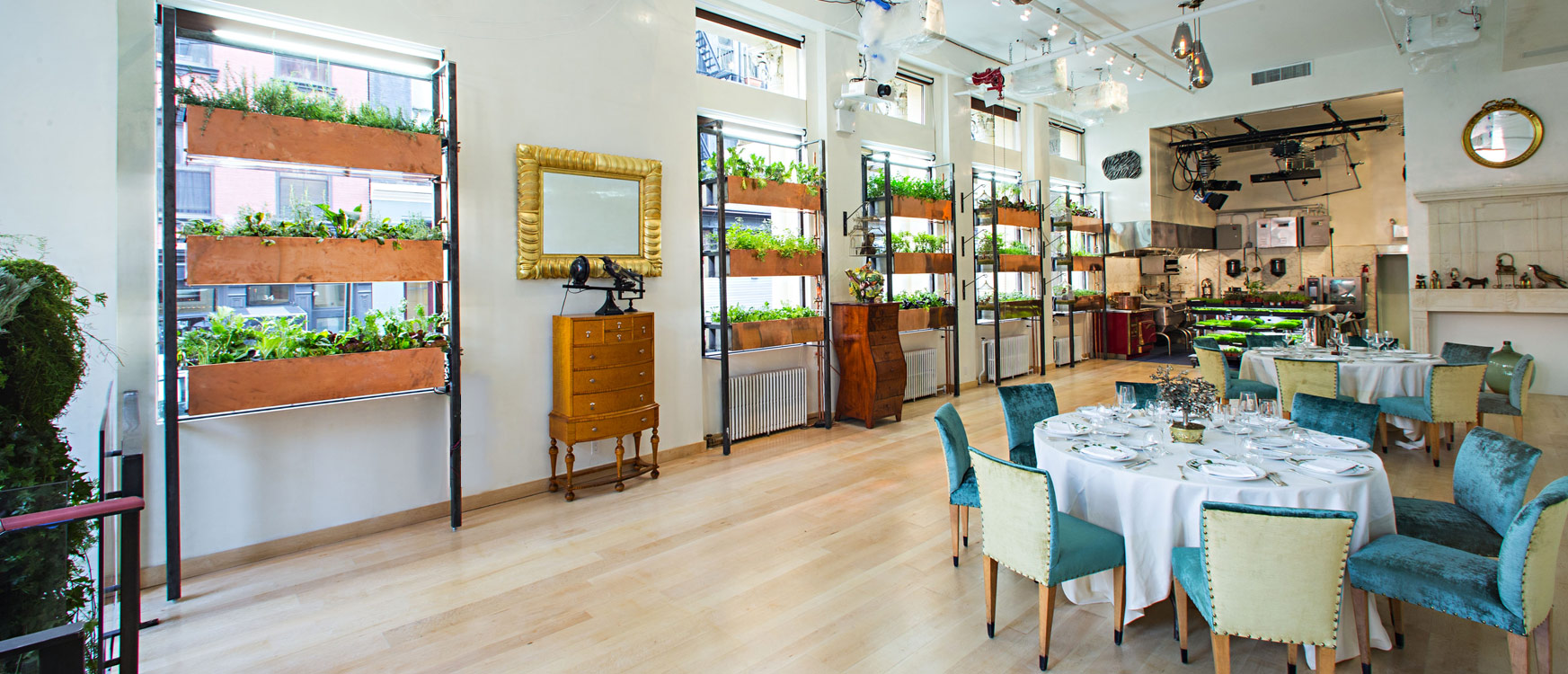
Chef and restaurateur David Bouley harnesses his French culinary background combined with the wisdom of naturopathy and medicine to create dishes infused with nutrient-rich plants grown at his restaurant Bouley Botanical.

THIS WEEKEND, David Eisenberg, a physician, will talk shop with some 450 colleagues, from ophthalmologists to endocrinologists. Instead of wearing a white coat in a medical lab at the Harvard School of Public Health, however, he'll don a white apron in a teaching kitchen at the Culinary Institute of America (CIA) in Napa Valley, Calif.

A Delicious Prescription F. Martin Ramin/The Wall Street Journal, Styling by Anne Cardenas

They're coming together for the 10th meeting of the Healthy Kitchens/Healthy Lives conference. It's a joint project of the CIA, Harvard School of Public Health and Samueli Institute, a non-profit dedicated to investigating healing practices. The conference brings doctors, registered dietitians and nutritionists, educators, sustainability experts and healthcare professionals together with chefs, such as Mollie Katzen and Michelin-starred Suvir Saran.

Dr. Eisenberg co-founded the program as "a place where nutrition scientists could teach medical providers what they need to know about which foods we should eat more of, or less of, and why," he said. "And, based on scientific evidence, chefs [translate] that into demonstrations on how to prepare healthy, delicious, affordable, easy-to-make dishes." For him, the continuity between food and medicine is obvious and practical. "It is not my view that the right question is 'How do we replace drugs with foods?' The premise of this conference is 'How do we help people move in the direction of a healthier lifestyle and diet, to prevent illness or manage illness that's already occurred?'"

Though connecting food and health has a long history, this collaboration between doctors and chefs represents a newer approach—studying and sharing how certain foods can prevent diseases or help manage them. In May, the Goldring Center for Culinary Medicine at Tulane University will debut the nation's first teaching kitchen affiliated with a medical school. Located in New Orleans, it will be a place for students, doctors, chefs and the local community to investigate the role food can play in managing obesity and related diseases.

Interactive: Culinary Rx

F. Martin Ramin/ The Wall Street Journal, Styling by Anne Cardenas

View Graphics

The Goldring Center's Executive Director and Assistant Dean for Clinical Services, Timothy Harlan, is both a chef and a doctor, having owned restaurants before attending medical school. He said the program's goal is to school doctors-in-training in "some very simple techniques they can use to change the dialogue with their patients, change the way their patients think about food and nutrition." Classes integrate nutrition with biochemistry, physiology and anatomy. The program also encompasses a food-research branch and has licensed its curriculum to two other medical schools. Dr. Harlan added, "Make no mistake, I am an allopathic physician. I do not believe in anything other than evidence-based medicine. As an internist, I prescribe statins and beta-blockers and ACE inhibitors and aspirin. I believe in them and they have a role. Diet alone is very good. Medication alone is very good. But diet plus medication is synergistic. It's another tool in the box that physicians should have available to them."


Danny Kim for The Wall Street Journal

Culinary Rx

Both the Harvard/CIA partnership and the Goldring Center's programming rely heavily on the principles of the Mediterranean diet, which emphasizes fruits and vegetables, whole grains, legumes, healthy fats, certain fish and a minimal quantity of good-quality meat and cultured dairy. The results of a recent study by the Harvard School of Public Health and Cambridge Health Alliance link the diet with lower risk of heart disease. A previous study, published by the Journal of the American College of Cardiology, shows that the Mediterranean diet is linked with lower risk of obesity, diabetes and cancer.

The chefs involved are eager to demonstrate that eating for wellness needn't mean dull "health food." David Bouley, for one, grew up in a French family "where the pantry and medicine cabinet always seemed to overlap," he said. He recently opened Bouley Botanical, an event space and "living pantry" growing 400 plant species to provision Mr. Bouley's Manhattan restaurants.

Plants growing by the window at Bouley Botanical Danny Kim for The Wall Street Journal

A continuing interest in the healing properties of food had caused Mr. Bouley to seek the advice of nutritionists in the past. "All they ever told me was what not to put in food," Mr. Bouley said. "They never told me what I should cook." It wasn't until he began to collaborate with a medical doctor, Mark Hyman, that the chef found what he was looking for.

During last fall's New York City Wine & Food Festival, Dr. Hyman, author of "The Blood Sugar Solution" (Little, Brown), teamed up with Mr. Bouley for a dinner called "The Chef and the Doctor." Over the meal, the two discussed the healing properties of ingredients such as mushrooms (full of polysaccharides, said to battle tumors) and sardines (omega-3s, believed to protect against heart disease and stroke). Some dishes they collaborated on

  • a creamy almond soup sharpened by glazed scallions; 
  • wild mushrooms with white truffle, sweet garlic, grilled toro and 
  • coconut foam—are now staples on the menu at Bouley restaurant.
“'All they ever told me was what not to put in food. They never told me what I should cook.'

Another high-profile New York chef, Seamus Mullen, has been working in an idiom he calls "Hero Food," in a cookbook of the same name and at his acclaimed restaurant Tertulia. Mr. Mullen has seen for himself what diet can do: According to his doctor, Frank Lipman, he has reversed the effects of rheumatoid arthritis by eating the right foods. Mr. Mullen's pain was debilitating; he endured multiple hospitalizations. "I knew there was a direct correlation between food and my body's ability to deal with inflammation," he said. "But I wasn't sure how to put that into practice." It took months, but when Mr. Mullen woke up one morning last May without chronic pain, his life changed. He started cycling again (he was once semi-pro). Last October, he said, for the first time his blood-test results showed no sign of rheumatoid arthritis.

Mr. Mullen believes eliminating gluten was a major factor, in addition to sticking to "hero foods" like leafy greens, grass-fed meat and eggs. (For more on the benefits associated with these foods, see "Culinary Rx.") "The fundamental part of the equation is that it needs to be delicious, that the ingredients are well sourced," he said. "I take it one step further by increasing the good fats and cutting back on some of the carbohydrates and sugar." Take a recipe from Mr. Mullen's book, tosta matrimonio: grilled flatbread topped with tomatoes and anchovies, their briny tang tempered by fresh ricotta and a drizzle of saba, a naturally sweet grape-juice reduction. The dish packs a big dose of heart-disease-fighting omega-3s from the fish; cancer-battling folate and sulfur from garlic; and anti-inflammatory olive oil. Mr. Mullen hopes to collaborate further with Dr. Lipman on a restaurant concept.

GREEN SPACE | Planters at Bouley Botanical supply produce to chef David Bouley's Manhattan restaurants. Danny Kim for The Wall Street Journal

Beyond the rise in, and growing concern about, rates of heart disease, obesity and diabetes, the conversation around the Affordable Care Act is shaping thinking about food as prevention. "It's pretty clear that if we can reduce the burden of disease, we can reduce the burden of the cost of disease," said Dr. Harlan of the Goldring Center. "Farm before pharm" is the mantra of a number of programs designed to provide assistance to children at risk of developing diet-related diseases. In this vein, Wholesome Wave, a non-profit whose mission is to make locally grown produce available to people at all income levels, launched its Fruit and Vegetable Prescription Program (FVRx) in 2010.

Now available in six states, FVRx prescriptions are dispensed by primary care providers and redeemed at farmers' markets. According to a 2012 study by the program's healthcare partners, 37.8% of participants decreased their BMI (body mass index, a weight-to-height calculation used to predict health problems) over one year. Wholesome Wave President and CEO Michel Nischan—a chef, restaurateur and cookbook author—points to affordable local food access as a platform for policy change. "If large employers could see an investment in providing minimum-wage employees a connection with a company doctor and an opportunity to increase fruit and vegetable consumption, their premiums are going to go down pretty significantly on the back end," he said.

It is the goal of Mr. Nischan and other chefs collaborating with doctors and farmers to advocate for the role that nutrition can play in overall wellness by gathering and offering up data that supports their claims. Encouraging people to eat more of these foods—by showing how delicious they can be—is the first step.

By KATHLEEN SQUIRES
March 14, 2014

viernes, 7 de marzo de 2014

This Is What New York Would Look Like If The Whole City Was A Giant Urban Farm


The Big Apple would be a lot greener if it needed to grow its own food.

For the past six years, the urban research nonprofit Terreform has carefully considered exactly what New York City would look like if everything New Yorkers ate was grown inside city limits.


At some level, it’s absurd,” says Michael Sorkin, who leads Terreform.


We discovered that with intense use of vertical agriculture and a change in diet, we could in fact physically provide the facilities to grow 2500 decent calories for every resident in New York."

"But the energy estimates were so enormous we estimated that 25 nuclear power plants would be required.

 
Still, even if cities don’t necessarily become giant farms, the research can help point urban areas toward more sustainable choices.

 
The researchers also looked at options for growing all food within 100 miles of the city, or growing everything within the state.

We looked at 100% autonomy-- what effort that would take, what forms, what living arrangements-- and we then look for some more reasonable response,” Sorkin says.

The research is part of a larger project called New York City (Steady) State, which will eventually detail how the city can be entirely self-sufficient, from energy to waste.


It’s intended as a counterpoint to things like ecological footprints, which generically measure environmental impact.

Here, the researchers are looking at specific and direct impacts in a confined area.

"It’s a matter of taking responsibility for one’s effects on the planet," Sorkin says.


"New York is a good place to start because New Yorkers, as Americans, are enormous consumers."

The design includes everything from a skyscraper devoted to meat production (though Sorkin notes that it would be a lot easier, sustainability-wise, if everyone in the city became vegan), to rooftop "neighborhood food hubs" and streets that are turned into gardens.

"We’re looking at all sorts of resources that we think are misused in New York, like streets," he explains.


"This is the largest area of space in the public realm. Imagine if we took half of the street out of the automobile realm and put it in the pedestrian realm: There could be farms, there could be daycare centers, there could be all sorts of public amenities."

They found a few limits for food production; coffee, for example, is hard to grow in a vertical farm. Even in that case, they tried to find a local connection.

After learning that Haiti grows enough coffee to supply half of New York's needs, they've proposed an agreement between the two locations.


Haitians could be given education at schools like Columbia in exchange for selling New Yorkers coffee.

 
After Terreform completes research on other aspects of self-sufficiency, like energy, it will be putting together a resource for cities to use in planning.

"We're compiling an encyclopedia of the technologies and morphologies that could be used for cities around the world that are interested in moving in the direction of autonomy," Sorkin says.

And they continue to push the boundaries of what self-sufficiency can mean.

"We're always asking a question about the nature of the membrane around the city," Sorkin says.


"What would it be permeable to, what protections would have to be given to local production. It's an armature for speculation."


The Big Apple would be a lot greener if it needed to grow its own food.

The New York City (Steady) State is considering what it would mean if the city's 8 million residents were entirely self-sufficient, from the food they eat to the fuel they burn.
 
For the past six years, the urban research nonprofit Terreform has carefully considered exactly what New York City would look like if everything New Yorkers ate was grown inside city limits.

At some level, it’s absurd,” says Michael Sorkin, who leads Terreform. “We discovered that with intense use of vertical agriculture and a change in diet, we could in fact physically provide the facilities to grow 2,500 decent calories for every resident in New York. But the energy estimates were so enormous we estimated that 25 nuclear power plants would be required.

Amsterdam Ave.

Still, even if cities don’t necessarily become giant farms, the research can help point urban areas toward more sustainable choices. The researchers also looked at options for growing all food within 100 miles of the city, or growing everything within the state. “We looked at 100% autonomy--what effort that would take, what forms, what living arrangements--and we then look for some more reasonable response,” Sorkin says.

The research is part of a larger project called New York City (Steady) State, which will eventually detail how the city can be entirely self-sufficient, from energy to waste. It’s intended as a counterpoint to things like ecological footprints, which generically measure environmental impact.

Here, the researchers are looking at specific and direct impacts in a confined area.

"It’s a matter of taking responsibility for one’s effects on the planet," Sorkin says. "New York is a good place to start because New Yorkers, as Americans, are enormous consumers."

Why look at consumption on the level of the city? "Nation-states seem to be incompetent, and multi-nationals seem to be badly motivated," he says. "As an urbanist, I wanted to know what a city could actually accomplish if it decided to truly take responsibility."

Sunnyside, Queens site

The design includes everything from a skyscraper devoted to meat production (though Sorkin notes that it would be a lot easier, sustainability-wise, if everyone in the city became vegan), to rooftop "neighborhood food hubs" and streets that are turned into gardens.

"We’re looking at all sorts of resources that we think are misused in New York, like streets," he explains. "This is the largest area of space in the public realm. Imagine if we took half of the street out of the automobile realm and put it in the pedestrian realm: There could be farms, there could be daycare centers, there could be all sorts of public amenities."

They found a few limits for food production; coffee, for example, is hard to grow in a vertical farm. Even in that case, they tried to find a local connection. After learning that Haiti grows enough coffee to supply half of New York's needs, they've proposed an agreement between the two locations: Haitians could be given education at schools like Columbia in exchange for selling New Yorkers coffee. 

After Terreform completes research on other aspects of self-sufficiency, like energy, it will be putting together a resource for cities to use in planning. "We're compiling an encyclopedia of the technologies and morphologies that could be used for cities around the world that are interested in moving in the direction of autonomy," Sorkin says.

And they continue to push the boundaries of what self-sufficiency can mean. "We're always asking a question about the nature of the membrane around the city," Sorkin says. "What would it be permeable to, what protections would have to be given to local production. It's an armature for speculation."

ORIGINAL: Fast Company

sábado, 1 de marzo de 2014

Can lab-grown meat solve China’s food safety and shortage problems?

This might be cleaner in a lab. Reuters/Kim Kyung-Hoon

China’s problems with food safety—as well as worries about the food supply meeting its population’s needs—have prompted a number of solutions, including 
  • creating a new regulatory body and 
  • investing millions in biotechnology
  • Another, more novel approach is on the horizon: synthetically made meat.
Earlier this month, Asia’s wealthiest man, Li Ka-Shing, announced that he had led at $23 million investment round in a Silicon Valley startup that makes plant-based egg substitutes and eggless mayonnaise. The company, Hampton Creek, is getting ready to expand into Asia. “Everyone wants a clean and sustainable world,Li said at the time.

As we’ve pointed out, worry about the world’s meat consumption is one reason why research and business ventures related to synthetic food, like last year’s first lab-grown burger made with cow cells, and meat substitutes have started to take off. In China, where meat consumption is already double that of America’s and still growing even as available arable land shrinks, synthetically made food could be even more relevant. According to Hampton Creek CEO Josh Tetrick, China already consumes 30% of the world’s eggs.

Food safety is another reason why synthetic food could benefit China. The country’s agriculture and food supply chains are difficult to regulate, stretching across 200 million small farms and almost half a million food processing companies, with few financial resources to maintain safety standards. Lab-cultivated meat and eggs like Hampton Creek’s could also help protect against viruses like avian flu that have cropped up because of close human contact with live poultry in cities. China’s on-and-off food scandals have eroded consumer trust and hit firms hoping to cater to them, like Yum Brands, whose KFC chain is still struggling to win back Chinese eaters after reports of excessive antibiotics.

The UK and the Chinese government have launched synthetic biology research exchanges and Chinese biotech firm BGI now runs the world’s largest pig cloning center. It may not be that long before we see Chinese lab-grown pork.


ORIGINAL: Quarz
By Lily Kuo @lilkuo 
February 26, 2014

sábado, 8 de febrero de 2014

La tragedia de las Semillas Transgénicas, Dra. Vandana S

Magnífica y sencilla exposición de esta mujer sabia y luchadora, reflexiones sobre todo el entramado detrás de las semillas transgénicas.

Apr 5, 2011

viernes, 24 de enero de 2014

Hay Festival: Hay Verde. Enero 29, 30 y 31 / Parque Explora, Medellín.


Del 29 al 31 de enero, en Explora, conversaciones en torno a temas de sostenibilidad (ambientales y sociales) con importantes líderes de opinión invitados a la segunda versión del Hay Verde - Medellín , encuentro adjunto al Hay Festival festival internacional de literatura y artes que ocurrirá en Cartagena. Wade Davis, premio Samuel Johnson por su último libro Into the Silence, en conversación con Brigitte LG Baptiste; Pere Estupinyà, periodista científico en el Instituto Tecnológico de Massachusetts (MIT); David Rieff, prestigioso periodista y politólogo en conversación con Héctor Abad Faciolince; Rosie Boycott, periodista y escritora británica, asesora del alcalde de Londres en materia de alimentación; Mark Cocker, autor naturalista, columnista en The Guardian; y Tom Hart Dyke, horticultor y recolector de plantas británico, diseñó y construyó el "World Garden of Plants" un espacio que ya tiene más de 8.000 especies de plantas.

Fecha: Enero 29, 30 y 31 / Lugar: Parque Explora / Entrada libre
Consulte todo sobre el Hay Festival Cartagena de Indias 2014 en su página oficialwww.hayfestival.com/cartagena
S=EX2, la ciencia del sexo | Pere Estupinya
Químico y bioquímico, escritor y divulgador científico. Español residente en Nueva York, ha trabajado como periodista científico en el Instituto Tecnológico de Massachusetts (MIT) en Boston, en Institutos Nacionales de la Salud de Estados Unidos y como editor en el programa Redes de TVE. Es autor de "El ladrón de cerebros" (2010), "Rascar donde no pica" (2012), "S=EX2. La ciencia del sexo" (2013) y en la actualidad realiza el blog "Apuntes científicos desde el MIT" para el diario El País.

Conoce el blog de ciencia "Apuntes científicos desde el MIT" que el autor realiza para "El País"

Conferencia: S=EX2, la ciencia del sexo | Invitado:Pere Estupinya
Fecha: Miércoles 29 de enero de 2013 | Hora: 5 pm |Lugar: Auditorio Parque Explora


Contra la memoria | David Rieff en conversación con Héctor Abad Faciolince
David Rieff es un prestigioso periodista y politólogo que ha publicado destacados trabajos en revistas como The New Republic y World Policy Journal; Rieff es autor de "Un mar de muerte. Recuerdos de un hijo", donde narra la enfermedad y muerte de su madre, Susan Sontag. Fundador y director del proyecto "Crímenes de Guerra" en la Universidad Americana de Washington DC, ha conocido de primera mano los efectos de los crímenes de guerra en países como Ruanda, Kosovo, Israel, Palestina, Irak y Bosnia. Su último libro, "Contra la memoria", narra precisamente su experiencia en Bosnia. Estará en conversación con el escritor y periodista colombiano Héctor Abad Faciolince.


Conversación: Contra la memoria. | Invitados: David Rieff y Héctor Abad Faciolince
Fecha: Miércoles 29 de enero de 2013 | Hora: 6:30 pm | Lugar: Auditorio Parque Explora


Cómo alimentar una ciudad | Rosie Boycott
Periodista y escritora británica. A comienzos de los años setenta co-fundó las revistas Spare Rib y Virago Press. Ha trabajado para el Daily Mail, The Sunday Telegraph, Harpers & Queen y Esquire, pero es más conocida como editora de The Independent on Sunday,The Independent y Daily Express. Es autora de varios libros, entre ellos una autobiografía, "A Nice Girl Like Me: A Story of the Seventies"; la novela "All for Love" y el libro "Spotted Pigs & Green Tomatoes: A Year in the Life of Our Farm". Actualmente es asesora de Boris Johnson, alcalde de Londres, en materiade alimentación. Nos ofrecerá una conferencia sobre el reto que supone el alimentaruna ciudad.


Conferencia: Cómo alimentar una ciudad | Invitada: Rosie Boycott
Fecha: Jueves 30 de enero de 2013 | Hora: 5 pm | Lugar: Auditorio Parque Explora


Aves y personas | Mark Cocker

Birds and People (aves y personas) es un novedoso proyecto emprendido por el autor Mark Cocker y el fotógrafo David Tipling que explora la relación ancestral entre los seres humanos y las aves. Parte historia natural, parte historia cultural, describe y documenta nuestro vínculo con las aves, explorando esto a través de la historia, la literatura, el arte, la cocina, el lenguaje, la política y el medioambiente. Documentado en un libro, nos enseña tanto sobre las aves como sobre nosotros mismos. Mark Cocker nos hablará sobre el proyecto.

Visita el sitio oficial de Mark Cocker
Visita el sitio oficial del proyecto "Birds and People"
Conoce algunos artículos publicados por Mark Cocker en el periódico The Guardian
Vea un avance del libro Birders: Tales of a Tribe
Síguelo en Twitter @MarkCocker2

Conferencia: Aves y personas | Invitado: Mark Cocker
Fecha: Jueves 30 de enero de 2013 | Hora: 6:30 pm | Lugar:Auditorio Parque Explora


Desde el jardín | Tom Hart Dyke y Rosie Boycott
Horticultor y recolector de plantas británico. En el año 2.000 fue secuestrado por la guerrilla mientras recolectaba orquídeas junto con un compañero en la región del Darién y pasó nueve meses en cautiverio. Desde entonces, ha viajado recolectando plantas para el "World Garden of Plants" un jardín que él mismo diseñó y en el que ya alberga más de 8.000 especies. Su iniciativa está localizada en las afueras de su propiedad familiar en Kent. Ha realizado una serie para la BBC2 en la que muestra el jardín y ha publicado libros como An Englishman's Home y The Cloud Garden.


Conferencia: Aves y personas | Invitados: Tom Hart Dyke y Rosie Boycott
Fecha: Jueves 30 de enero de 2013 | Hora: 8 pm | Lugar:Auditorio Parque Explora


El río | Wade Davis y Brigitte LG Baptiste

Wade Davis es antropólogo, etnobotánico, autor y fotógrafo. Su trabajo se ha enfocado en las culturas nativas e indígenas de diferentes partes del mundo, especialmente del continente americano. Ha publicado artículos en revistas como Outside, National Geographic (para la cual es explorador residente),Fortune, Men'sJournal y Condé Nast Traveler. Nueve de sus libros han sido traducidos al español, uno de ellos con mucho éxito en Colombia: El río. Exploraciones y descubrimientos en la selva amazónica. Su último libro Into the Silence ganó en el 2012 el Samuel Johnson Prize de no-ficción. Estará en conversación con Brigitte Baptiste, bióloga, docente, magíster en estudios latinoamericanos, especialista en ecología del paisaje, en análisis de procesos de transformación del territorio y doctoranda en ciencias ambientales y directora del Instituto de Investigaciones Biológicas Alexander von Humboldt.


Conferencia: El río | Invitados: Wade Davis y Brigitte LG Baptiste
Fecha: Viernes 31 de enero de 2013 | Hora: 5 pm | Lugar: Auditorio Parque Explora


Proyección del documental "Apaporis" de José Antonio Dorado


*Cada conferencia del Hay Verde Medellín tendrá un cupo limitado en auditorio para 300 personas y se realizará retransmisión en la Sala 3D. 100 de los cupos del auditorio se asignarán de manera virtual en este mismo enlace, la inscripción se habilitará a las 9 am del mismo día de la conferencia, los 200 cupos restantes se asignarán por orden de llegada hasta agortar el aforo. Recuerde que el ingreso después de cada conferencia el auditorio será evacuado para adecuar la siguiente lo que siginifica que la asistencia a la primera no garantiza el cupo para las siguientes.

ORIGINAL: Parque Explora


14 de Enero de 2014