Mostrando entradas con la etiqueta Noruega. Mostrar todas las entradas

lunes, 25 de marzo de 2013

What Makes a Biophilic City?

ORIGINAL: LandArchs
Jan 11, 2013


The second in a series of articles on biophilic design in landscape architecture, Joseph Clancy looks at what makes a city biophilic.

In my last article, I discussed the empirical evidence and case studies proving the social, health and economic benefits of biophilic design. But to what degree must a city engage in biophilia to be classed as a “biophilic city”? Timothy Beatley describes a biophilic city as being “partly defined by the qualities and biodiversity present and designed into urban life, but also the many activities and lifestyle choices and patterns, the many opportunities residents have to learn about and be engaged directly in nature, and the local institutions and commitments expressed, for instance, in local government budgets and policies”.

So how do we classify a city as a biophilic city?
Hanging Garden in CBD, Singapore
According to the works of Timothy Beatley, Biophilic Cities can be indicated by the following qualities:

Biophilic cities have abundant nature in close proximity to large numbers of urbanites
Green infrastructure programs, parklets & a high percentage land cover of green space would be steps towards fulfilling this aspect of a biophilic city. New York City qualifies as a biophilic city in this regard by PlaNYC’s goal of a public green space within a 10 minute walk of every resident by 2030, while Seattle P-Patch program aims for one community garden per 2,500 city inhabitants! 
The Highline, New York City
In biophilic cities, residents feel a deep affinity with the unique flora, fauna and fungi found there
Incentive, education and encouragement from city authorities are necessary to catalyze this goal. It measures not just the environmental values of inhabitants, but their knowledge of local and native species. In New Zealand, the city of Wellington also has over sixty community conservation groups! In the last two years alone, volunteer environmental groups have performed 28,000 hours of service on Wellington’s 4,000 hectares of nature reserves. While in Oslo, Norway, over 81% of inhabitants had visited the city’s surrounding forests in the last year, proving residents appreciation of the natural landscape.
Vitoria-Gasteiz, Salburua Restored Wetland
Wellington, New Zealand
Biophilic cities are cities that provide abundant opportunities to be outside and to enjoy nature
Urbanization causes severe fragmentation of habitats and nature, with land value at a premium, resulting in little room for green space. Well connected green spaces and green corridors can counter this problem, easing accessibility for urban inhabitants. Singapore has an extensive park system, integrated by 200-kilometers of Park Connectors, in the form of elevated walkways. Oslo, Norway is perhaps the leader in this category however, with an estimated 94% of the city’s residents living within 300 meters of a park! Anchorage, Alaska has 1 mile (1.6Km) of natural walking trails per 1,000 residents. The trails are multi use and seasonal, offering everything from hiking to skiing.
Canopy Walk, Singapore
Biophilic cities are rich multisensory environments, where the sounds of nature are as appreciated as much as the visual or ocular experience
The integration of natural spaces and ecological corridors into the urban fabric can create the conditions necessary for multisensory, nature rich environments. Implementing a Noise Reduction Plan or reducing levels of vehicular transport, would create “quiet zones”, with noise levels below 50 decibels (dB). Oslo, Norway is attempting an initiative of daylighting all eight of the city’s rivers. This will form part of the Akersleva, a combined green and blue infrastructure corridor, connecting the city centre inhabitants with nature in the very heart of the city, with 14 quiet zones planned within the corridor.
Oslo, Norway
Biophilic cities place importance on education about nature and biodiversity, and on providing many and varied opportunities to learn about and directly experience nature
Education can result in reinforcing positive feelings about nature and encouraging sustainable living among the general population. In Limerick City, Ireland, several environmental groups are working with the support of the city council to educate the city’s population on biodiversity and native wildlife species. Urban Tree Project and Limerick City Biodiversity Networkhave engaged the local population with nature, while providing guided walks, lectures and online resources to educate the city’s inhabitants on the importance of biodiversity.
Limerick City Biodiversity Network, Credit: Anthony Furlong
Biophilic cities invest in the social and physical infrastructure that helps to bring urbanites in closer connection and understanding of nature
Investment in biophilic projects is an excellent indicator of a biophilic city. Timothy Beatley identifies 5% of a cities budget dedicated to biodiversity and at least 1 current biophilic project in operation as indicative of governance in a biophilic city. Portland, Oregon, exceeds this and has invested heavily in social & green infrastructure, with Portland having the highest parks per-capita acreage in America. While Singapore’s N’Parkshave an incentive program, entitled Skyrise Greenery, for green roofs & living walls, offering up to 75% of the cost.
Tanner Springs, Portland, Oregon
Biophilic cities take steps to actively support the conservation of global nature
With cities being the epicentre of governance, innovation, employment and population, they have a necessary role in the conservation of nature on a regional, national and international scale, given their ecological footprint and negative impacts upon the environment. Such measures include; set aside of land, designation for protected sites, the creation of a biodiversity action plan and focus on compact development. In the city of Nagoya, Japan, 10% of urban land cover is set aside to be left in an unmanaged wild state as nature preserves.

While Phoenix, Arizona has taken this a step further by purchasing over 17,000 acres of natural desert for nature conservation, to help mitigate the negative effects of Phoenix’s urban sprawl. Then there is Vitoria-Gasteiz, in Basque country, encircled by a green belt to restrict encroaching development and to protect the internationally important restored wetland, the Salburua. However, the city still intends to create the Anilla Verde Interior—“the interior green belt”!
Park Olarizu, Vitoria-Gasteiz
These indicators focus on the protection, enhancement and introduction of nature into our cities, while encouraging interaction with nature by the city’s inhabitants through the process of environmental education and habitat restoration. With more than half of the world’s population living in urban centres devoid of nature, biophilic cities are no longer a choice. The benefits & criteria have been discussed, in my next article I will countdown the Top Ten Biophilic Cities.

Article written by Joseph Clancy

sábado, 23 de febrero de 2013

Doomsday bunker: largest seed bank in the world

ORIGINAL: Science Dump
by Michiel
02/22/2013 - 12:20

The world's agricultural hard drive, the Svalbard Global Seed Vault, turns five years old next week thursday. The Svalbard Global Seed Vault is located on Spitsbergen and funded by the Norwegian Government and also by Bill Gates. The modern day Noah's Ark is designed to provide seeds for crops after an apocalyptic disaster. The bunker is located 120 meters deep in a mountain, 130 meters above sea level.


jueves, 23 de agosto de 2012

Tackling climate change: Carbon capture and storage

ORIGINAL: The Economist

CCS is a proven technology that could help mitigate climate change, but at a steep cost. A new test facility in Norway is working to make it financially viable


lunes, 18 de junio de 2012

The vanishing North

ORIGINAL: The Economist

There are benefits in the melting of the Arctic, but the risks are much greater

Jun 16th 2012


NOW that summer is here, the Arctic is crowded with life. Phytoplankton are blooming in its chilly seas. Fish, birds and whales are gorging on them. Millions of migratory geese are in their northern breeding grounds. And the area is teeming with scientists, performing a new Arctic ritual.

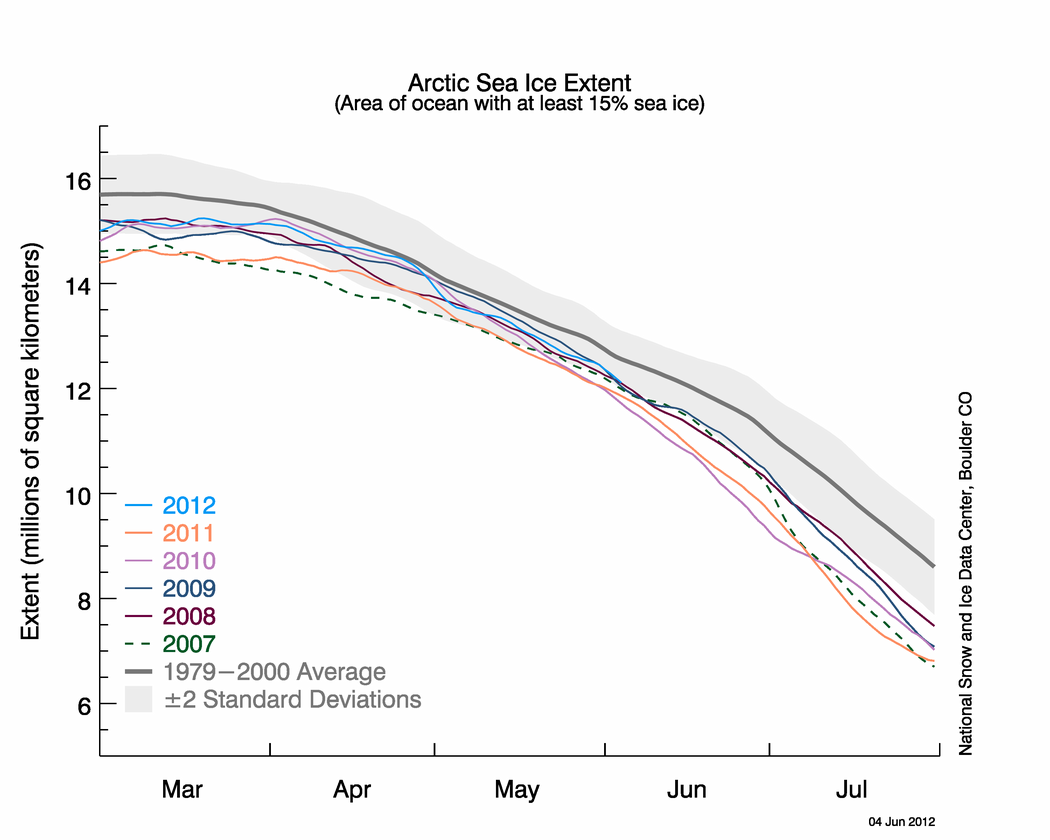
Between now and early September, when the polar pack ice shrivels to its summer minimum, they will pore over the daily sea ice reports of America’s National Snow and Ice Data Centre (NSIDC). Its satellite data will show that the ice has shrunk far below the long-term average. This is no anomaly: since the 1970s the sea ice has retreated by around 12% each decade. Last year the summer minimum was 4.33m square km (1.67m square miles)—almost half the average for the 1960s.
Graph: NSIDC
The Arctic’s glaciers, including those of Greenland’s vast ice cap, are retreating. The land is thawing: the area covered by snow in June is roughly a fifth less than in the 1960s. The permafrost is shrinking. Alien plants, birds, fish and animals are creeping north: Atlantic mackerel, haddock and cod are coming up in Arctic nets. Some Arctic species will probably die out.

Perhaps not since the 19th-century clearance of America’s forests has the world seen such a spectacular environmental change. It is a stunning illustration of global warming, the cause of the melt. It also contains grave warnings of its dangers. The world would be mad to ignore them.

As our special report shows in detail, the Arctic is warming roughly twice as fast as the rest of the planet. Since the 1950s the lower atmosphere has warmed by a global average of 0.7 degrees Celsius; Greenland’s air has warmed by 1.5 degrees. The main reason appears to be a catalytic warming effect, triggered by global warming. When snow or ice melt, they are replaced by darker melt-water pools, land or sea. As a result, the Arctic surface absorbs more solar heat. This causes local warming, therefore more melting, which causes more warming, and so on. This positive feedback shows how even a small change to the Earth’s systems can trigger much greater ones.

Photo: NSIDC

domingo, 29 de abril de 2012

El antepasado más antiguo de los humanos encontrado en lodo de lago en Noruega

ORIGINAL: Discovery
28 de abril 2012
AFP

Un devorador de algas microscópicas que vive en un lago en Noruega puede ser uno de los organismos más antiguos del mundo.

El Collodictyon vive en el fango de un pequeño lago en Noruega. UIO / MERG
El GIST
  • Un devorador de algas que vive en un lago de Noruega se declara como uno de los organismos vivos más antiguos de la Tierra.
  • La criatura unicelular evolucionó hace unos mil millones de años y sería más remota relación humana.

Después de dos décadas de examinar una microscópica devoradora de algas que vive en un lago en Noruega, los científicos han declarado que es uno de los organismos más antiguos del mundo de vida y la más remota relación humana.

El escurridizo animal, unicelular evolucionó hace unos mil millones de años y no encajan en ninguna de las categorías conocidas de los organismos vivos - que no era un animal, planta, parásito, hongo o alga, dicen.

"Hemos encontrado una rama desconocida del árbol de la vida que vive en este lago. Es único", dice el investigador de la Universidad de Oslo, el Dr. Kamran Shalchian-Tabrizi.


"Hasta ahora no sabemos de ningún otro grupo de organismos que desciende desde más cerca de las raíces del árbol de la vida de esta especie", que se ha declarado un nuevo género llamado Collodictyon.

Los científicos creen que el descubrimiento puede dar una idea de lo que la vida se parecía en la Tierra cientos de millones de años atrás.

El Collodictyon vive en el fango de un pequeño lago llamado Ås , 30 kilómetros al sur de Oslo.


Cuenta con cuatro flagelos - cola como hélices que utiliza para moverse, y sólo puede ser visto con un microscopio. Es de 30 a 50 micrómetros de largo.

Al igual que las plantas, hongos, algas y animales, incluyendo seres humanos, Collodictyon son miembros de la familia eucariota que poseen núcleos de las células encerrados por membranas, a diferencia de las bacterias.

Las criaturas no sociales
Mediante las características de Collodictyon, los científicos pueden inferir cómo lucían los eucariotas prehistóricos, dice Tabrizi - probablemente un organismo unicelular con estructuras como  dedo que se utilizan para atrapar a sus presas microscópicas.


"No son criaturas sociables", dice el co-investigador el profesor Klaveness Dag, que ha cultivado millones de los pequeños organismos para estudio.

"Se desarrollan mejor solos. Una vez que se han comido el alimento, el canibalismo está a la orden del día."

No se han encontrado más que en el lago.

"Es fascinante que todavía podemos encontrar este tipo de organismos después de tantos años", dice Tabrizi.

"Ha estado fuera de nuestras salas de estar durante millones de años y no hemos visto."

El Collodictyon se encontró por primera vez en el lago hace unos 20 años por la Universidad de Oslo, los científicos que reconocieron que era inusual, pero "no sabían lo importante que era", añade.

miércoles, 25 de enero de 2012

Imágenes de la Tormenta Solar en el Norte de Noruega


¡El Sol está despierto!
El sábado pasado (21 de enero de 2012) fue el día del regreso-del-sol aquí en Tromsø, cuando el Sol se podía ver sobre el horizonte por primera vez desde noviembre del año pasado. Debido a las montañas que bloquean la vista no he visto el Sol real todavía, pero su luz reflejada se podía ver en las laderas de montaña y pronto llegará aún más alto.

El Sol, sin embargo, hizo mucho más que "sólo" volver este fin de semana - que también envió una eyección de masa llamada coronal (CME), que alcanzó el campo magnético de la Tierra y ha producido algunas luces del norte muy intensas en todo el círculo polar ártico.

Así se veía el cielo parecía, visto desde fuera Kvaløya Tromsø. Las imágenes son del 21 de enero, 22 y 23.
Auroras y el planeta Júpiter en la paso de Ersfjorden, Noruega
Las Pléyades y Júpiter enmarcados por las auroras y las montañas de Kvaløya
Corona de Luz Nórdica en verde y rojo
Auroras rojas

Vista desde el exterior de Kvaløya el 22 de enero


Tormenta Solar en el Norte de Noruega por Fredrik Broms en Vimeo.
Secuencia de imágenes a intervalos de tiempo de la tormenta solar que está impactando la atmósfera de la Tierra los días 21-23 de enero de 2012. La secuencia completa fue capturad dentro de este período de tiempo en varios lugares en Kvaløya fuera de Tromsø en el norte de Noruega
 Copyright Notice:
All rights reserved to Fredrik Broms - Northern Lights Photography - www.northernlightsphotography.no

Actualización - Desarrollo de la Tormenta Solar (24 de enero de 2012)
Durante los últimos tres días, las luces del norte se han visto muy intensas en todo el círculo polar ártico.

Como se predijo, una fuerte eyección de masa coronal (CME) alcanzó el campo magnética de la Tierra hace apenas una hora aproximadamente a las 1500 UT, según lo informado por mi colega Stamnes Rob en el Centro de Polar de Luz en Lofoten, Noruega.

Esto significa que es muy probable que haya auroras vistosas en las próximas horas, así que si tiene el cielo despajeado, sál a echar un vistazo al cielo nocturno!

A continuación se muestra una secuencia de video que hice de la tormenta solar de 21-23 Enero 2012 - las de esta noche podrían ser aún mejores!