Mostrando entradas con la etiqueta Marina. Mostrar todas las entradas

viernes, 12 de septiembre de 2014

Scientists find mysterious species that defy all classifications of life


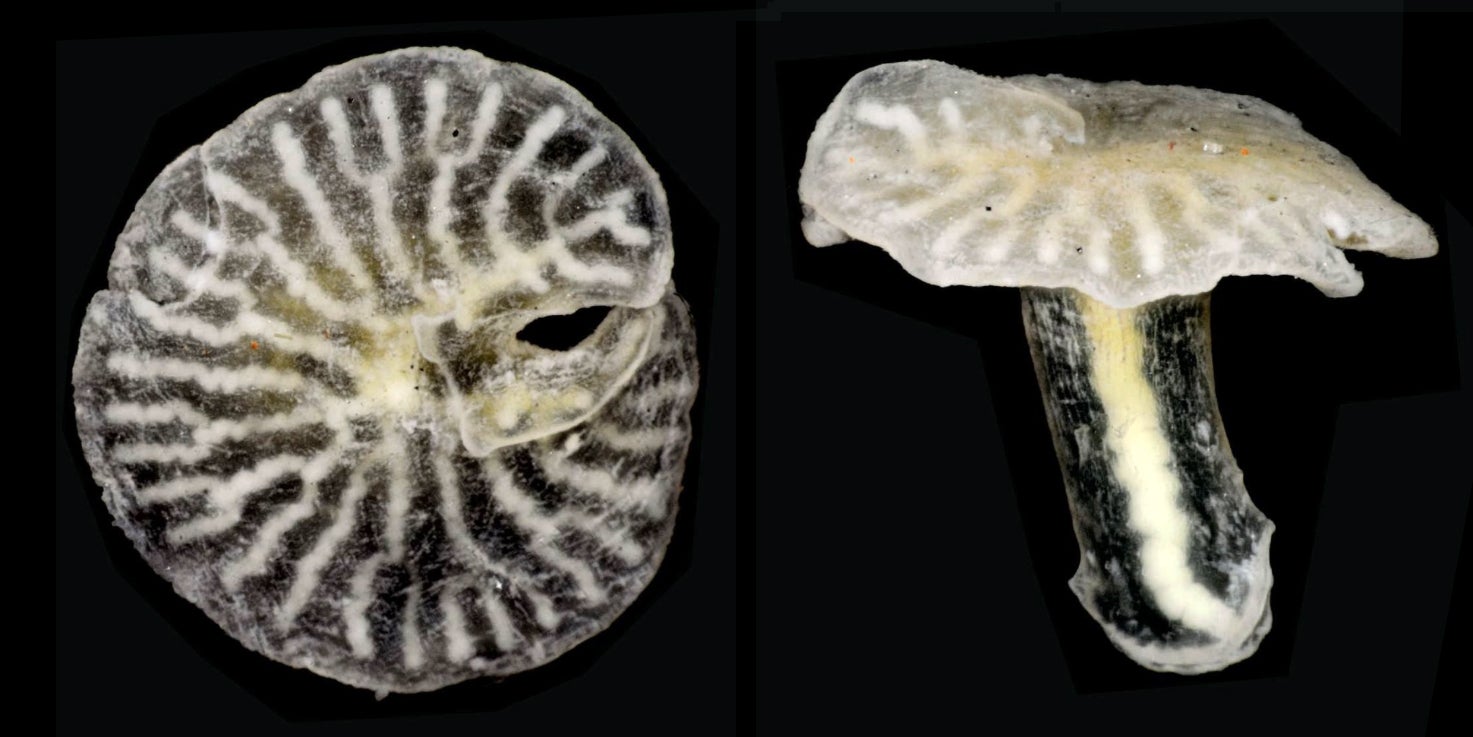
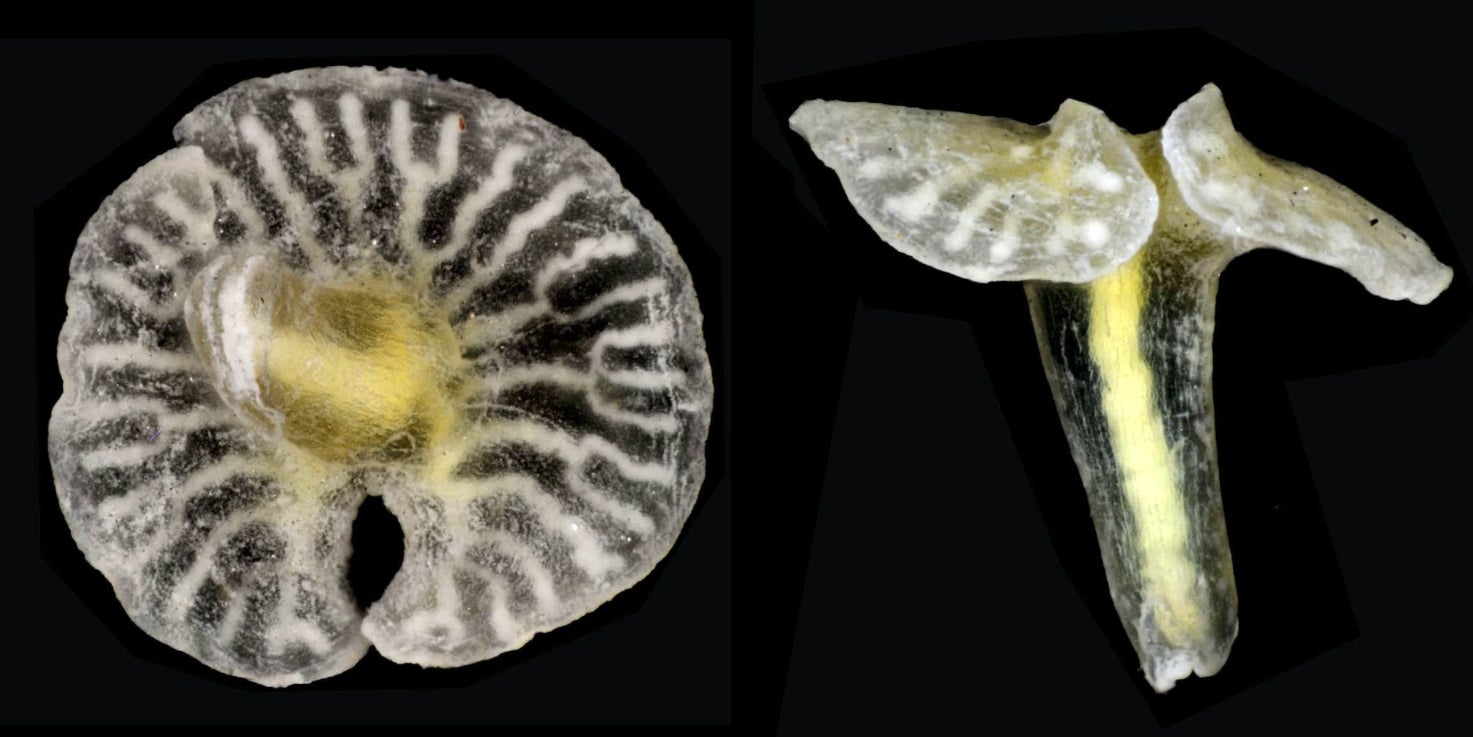
Marine biologists from the University of Copenhagen have discovered two new species that "defy all existing classifications of life." They are rather cute and pretty—like some monsters from a Mario Bros. game.

Found in the sea southeast of Australia, the research paper published in PLOS ONE describes two asymmetrical mushroom shaped beings found at a depth of 400 to 1000 meters:

A new genus, Dendrogramma, with two new species of 
  • multicellular, 
  • non-bilaterian, 
  • mesogleal 
  • animals with 
  • some bilateral aspects, 
D. enigmatica and D. discoides, are described from the south-east Australian bathyal (400 and 1000 metres depth). A new family, Dendrogrammatidae, is established forDendrogramma.


The enigmatic beings have scientists puzzled because they don't fit in the current classification of life. The paper's abstract says that their relation to other species is a "question still under debate," so they have left their classification as incertae sedis. The scientists who made the discovery say that new specimens should be recover to make molecular analysis to find the relation with other existing species—if any.

The other question still under debate is this: Can I eat them, perhaps deep fried with a light batter?

ORIGINAL: Sploid
By Jesus Diaz
Sept 10, 2014

miércoles, 6 de febrero de 2013

Oil additive polymer PIB may be responsible for seabird deaths

ORIGINAL: The Guardian
The Guardian, Wednesday 6 February 2013


Pollution expert says polyisobutene is the sticky substance found on hundreds of seabirds after examining washed-up guillemot
A sticky substance is washed off a guillemot at RSPCA West Hatch Animal Centre & Wildlife centre near Taunton. Photograph: Ben Birchall/PA

A sticky substance that has killed hundreds of seabirds could be a polymer often used to improve the performance of lubricating oil, it has emerged.

Professor Steve Rowland, an expert in pollution from Plymouth University, examined the substance found on one of the guillemots washed up on the south coast of the UK. He concluded that it is PIB – polyisobutene – which is used in products ranging from adhesives to sealants and chewing gum. The makeup of the samples he and his team have analysed suggests it was most likely used as an additive in lubricating oil.

Rowland, who is funded by the European Research Council to study oil pollution, said: "PIB is used as an additive to lubricants. It looks and feels a little like wallpaper adhesive. When it is caught up in the birds' feathers, it just glues them together."

About 300 birds have washed up alive coated in the substance. Scores more have been found dead and naturalists are worried that hundreds could have died and been blown out to sea. The Royal Society for Protection of Birds has also heard reports of birds washing up on the coast of Belgium.

Rowland has passed his findings to the Maritime and Coastguard Agency, which is leading the government's response to the incident. Environment Agency scientists have also been working to establish what the substance is.

Rowland said he had heard of a similar incident almost 20 years ago when a ship's crew flushed out tanks that had been carrying the substance. He said it could be very difficult to trace the source of this latest incident.

sábado, 17 de noviembre de 2012

Most Ocean Species Remain Undiscovered

Tia Ghose, Staff Writer
Nov 15, 2012

Stalked Medusa Haliclystus californiensis
CREDIT: WoRMS Photo Gallery / Collins, Allen G., 2012

Up to a million species live in the seas, and two-thirds of those ocean-dwellers may still be undiscovered, according to a new study that also cataloged all of the known species that dwell beneath the waves.

The findings, published today (Nov. 15) in the journal Current Biology, suggest that the oceans remain a vast, uncharted territory. The new registry could help guide marine conservation efforts by giving scientists a universal way to describe the underwater creatures.

"If you want to understand life on Earth, then of course you need to know what life there is on Earth," said the study's lead author, Ward Appeltans, a member of the Intergovernmental Oceanographic Commission of the United Nations Educational, Scientific and Cultural Organization (UNESCO). "If you want to protect the ocean you need to know what you want to protect."

Appeltans began assembling a European list of sea life in 1999. In 2007, his team decided to expand the effort to encompass all of the world's marine species. [Images: Catalog of Strange Sea Creatures]

It was a massive undertaking. Appeltans and colleagues contacted more than 250 world experts on marine life to catalog all known species.

"When there's a child that's born you need to go to city hall and register the name of the baby, but when you create a new species the only thing you need to do is publish a paper in an official journal," Appeltans told OurAmazingPlanet.

As a result, many species names were duplicated.

"For every five species that were described, two were described before," he said.

So far, the team has cataloged 226,000 species, excluding marine bacteria. Another 65,000 are waiting to be described in museums and collections. By using a computer simulation, Appeltans and his team concluded that between 700,000 and 1 million species live in the sea.

Anywhere from one-third to two-thirds of sea life has not been discovered yet, by their estimate. Most of those hidden sea creatures are probably crustaceans, mollusks, worms and sea sponges, they said.

The new database, called the World Register of Marine Species (WoRMS), fulfills deep human curiosity, Appeltans said.

"It's in our nature that we want to know what exists on Earth," Appeltans said. "We want to know what's out there in our oceans."

But beyond human curiosity, an orderly system for categorizing marine life may also help scientists conserve endangered species or keep track of medicinal chemicals derived from ocean dwellers, he said.

Follow OurAmazingPlanet on Twitter @OAPlanet. We're also on Facebook and Google+.

viernes, 28 de septiembre de 2012

La expedición que descubre un millón de especies marinas

ORIGINAL: BBC


La nave científica Tara ha completado recientemente su viaje de 112.000 kilómetros alrededor del mundo, durante el que ha recogido datos sobre la diversidad del plancton.

El equipo internacional de científicos a bordo del Tara descubrió más de un millón de especies en su viaje y volvió con información detallada de distintos tipos de este organismo de los océanos.

Un camarógrafo marino tomó imágenes usando una cámara de alta definición con una lente macro, la primera vez que se utiliza esta tecnología para capturar instantáneas de estos organismos microscópicos.

El equipo del Tara, cuya misión era estudiar el impacto del cambio climático en ecosistemas marinos, señaló que el 90% de las especies que detectaron no se conocían previamente.

Vea este video de BBC Mundo sobre los secretos mejor guardados en las profundidades marinas.

sábado, 25 de agosto de 2012

Fish Are Warmer, Faster, Stronger: Unexpected Benefits of Living in a Changing Climate, Biologists Find

ORIGINAL: Science Daily

Zebrafish embryos, taken 28 hours after fertilization (a little over a third of the way through embryonic development). (Credit: Ian Johnston)
ScienceDaily (Aug. 14, 2012) — New research by McMaster University biologist Graham Scott suggests that growing up at warmer temperatures helps some aquatic animals cope with climate change, raising questions about the limits of adaptation.

Working with Ian Johnston at the University of St Andrews in Scotland, Scott has found that raising zebrafish at warmer temperatures as embryos actually improves their ability to adjust to both higher and lower temperatures as adults.

Their research shows the fish are hardier after being raised in a warm-water nursery, and raises the question of how far the temperature can rise before the advantage becomes a liability, as inevitably it will, Scott says.

"What limits are there to their coping abilities? That's what we're really trying to understand," says Scott, a specialist in animals' adaptation to challenging environments. "If we want to appreciate how the natural world is affected by climate change, that's what we need to know."

The research appears in the Proceedings of the National Academy of Sciences.

Zebrafish are native to freshwater habitats of Southern Asia, and over their lives can experience a range of temperatures from almost 40°C to nearly freezing. The fish under study were raised across the range of temperatures they would normally experience in their natural breeding season (22°C to 32°C).

The biology of zebrafish -- especially their short gestation period -- makes them ideal research subjects.

Scott and Johnston found that when embryos raised in warm water experienced temperature variation as adults, they could swim faster, their muscle was better suited for aerobic exercise, and they expressed at higher levels many of the genes that contribute to exercise performance.

The improvements were true for the adult fish in warmer and colder water alike -- a finding that surprised the researchers.

"We thought that they might do better under warmer conditions because they grew up in warmer conditions. We didn't think they'd also do better under colder conditions, but they did."

domingo, 8 de julio de 2012

Navy to deafen 15,900 whales and dolphins and kill 1,800 more

By Lyndia Storey (Contact)

To be delivered to: U.S. Navy EIS Comments
Stop the killing of 1,800 whales and dolphins and the deafening of 15,900 more by ceasing the operation of the Navy's underwater sound system in the Hawaiian Islands, the California and Atlantic Coasts, and the Gulf of Mexico.

The Navy is required to include comments on their Environmental Impact Statement (EIS) re: the use of high frequency underwater sound for testing in Hawaii, the California and Atlantic Coasts, and the Gulf of Mexico. According to their estimates it will deafen more than 15,900 whales and dolphins and kill 1,800 more over the next 5 years. Whales and dolphins depend on sound to navigate and live. Your signature and comment will have to be included in the EIS and could stop this Naval program, potentially saving the lives of these ocean creatures. The comments must be in by July 10, 2012.


NEW goal - We need 375,000 signatures
There are currently 373,920 signatures

lunes, 18 de junio de 2012

The vanishing North

ORIGINAL: The Economist

There are benefits in the melting of the Arctic, but the risks are much greater

Jun 16th 2012


NOW that summer is here, the Arctic is crowded with life. Phytoplankton are blooming in its chilly seas. Fish, birds and whales are gorging on them. Millions of migratory geese are in their northern breeding grounds. And the area is teeming with scientists, performing a new Arctic ritual.

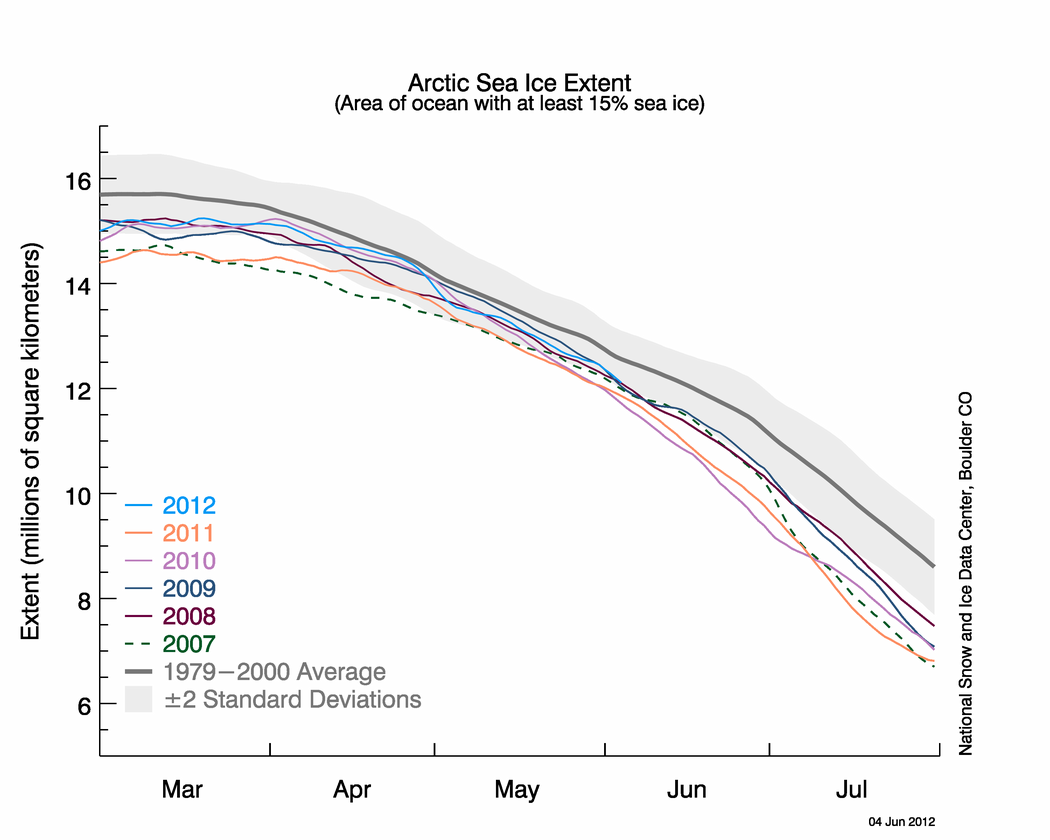
Between now and early September, when the polar pack ice shrivels to its summer minimum, they will pore over the daily sea ice reports of America’s National Snow and Ice Data Centre (NSIDC). Its satellite data will show that the ice has shrunk far below the long-term average. This is no anomaly: since the 1970s the sea ice has retreated by around 12% each decade. Last year the summer minimum was 4.33m square km (1.67m square miles)—almost half the average for the 1960s.
Graph: NSIDC
The Arctic’s glaciers, including those of Greenland’s vast ice cap, are retreating. The land is thawing: the area covered by snow in June is roughly a fifth less than in the 1960s. The permafrost is shrinking. Alien plants, birds, fish and animals are creeping north: Atlantic mackerel, haddock and cod are coming up in Arctic nets. Some Arctic species will probably die out.

Perhaps not since the 19th-century clearance of America’s forests has the world seen such a spectacular environmental change. It is a stunning illustration of global warming, the cause of the melt. It also contains grave warnings of its dangers. The world would be mad to ignore them.

As our special report shows in detail, the Arctic is warming roughly twice as fast as the rest of the planet. Since the 1950s the lower atmosphere has warmed by a global average of 0.7 degrees Celsius; Greenland’s air has warmed by 1.5 degrees. The main reason appears to be a catalytic warming effect, triggered by global warming. When snow or ice melt, they are replaced by darker melt-water pools, land or sea. As a result, the Arctic surface absorbs more solar heat. This causes local warming, therefore more melting, which causes more warming, and so on. This positive feedback shows how even a small change to the Earth’s systems can trigger much greater ones.

Photo: NSIDC

martes, 22 de mayo de 2012

22 de mayo 2011, día internacional de la diversidad biológica: Biodiversidad marina

ORIGINAL: CBD


Varias actividades de la Ola Verde va a suceder el 22 de mayo ya que es un día especial para toda la vida en la Tierra. Cada año, personas de todo el mundo celebran la diversidad biológica en lo que se llama el "Día Internacional de la Diversidad Biológica" o el DIDB, para abreviar. El objetivo principal del día es para crear conciencia y comprensión de las cuestiones de diversidad biológica.

Para ayudar a los países, las escuelas y otras personas a planificar sus celebraciones del  DIDB , la Secretaría del Convenio sobre la Diversidad Biológica (CDB) elige un tema diferente para cada año. Algunos de los temas anteriores incluyen: la biodiversidad y el cambio climático, la biodiversidad en las tierras secas, la reducción de la biodiversidad y la pobreza y el seguro de vida en nuestro mundo cambiante.
La Diversidad Biológica Marina es el tema este año del Día Internacional de la Diversidad Biológica (IDB). La designación del IDB de 2012 sobre el tema de los ecosistemas marinos proporciona a las Partes en el Convenio sobre la Diversidad Biológica (CDB) y cualquier persona interesada en la vida marina, la oportunidad de crear conciencia sobre el problema y aumentar la acción práctica.


Entre los años 2000 y 2010, una colaboración sin precedentes entre científicos de todo el mundo se propuso intentar determinar cuánta vida hay en los mares.

Esta iniciativa se denominó el 'Censo de la vida marina' y en ella colaboraron 2.700 científicos de más de 80 países, que participaron en 540 expediciones alrededor del planeta. Estudiaron la superficie de las aguas marinas y sondearon las aguas más profundas y las profundidades más oscuras de los mares, navegaron por los mares tropicales y exploraron las aguas con hielos a la deriva de los océanos ártico y antártico.

Cuando finalizó el censo, se habían añadido 1.200 especies a la lista conocida de seres vivos marinos. Los científicos todavía están trabajando con 5.000 especímenes para determinar si también se trata de especies recientemente descubiertas. La cantidad de especies marinas conocidas (las especies que se han identificado y aquellas sobre las que se cuenta con documentación pero carecen de clasificación) creció como resultado directo de los esfuerzos del censo. Hoy, son aproximadamente 250.000. (Esta cifra no incluye algunas formas de vida microbiana, como los virus marinos.) En su informe final, el equipo que realizó el censo sugirió que podría haber al menos un millón. Algunos piensan que esta cifra podría duplicarse.


En 2012, la biodiversidad marina es el tema. La designación del DIDB de 2012, sobre el tema de los ecosistemas marinos ofrece a todos los interesados en la vida marina, la oportunidad de dar a conocer el problema y aumentar la acción práctica. Para obtener más información, mantener un ojo en la página web del BID.

domingo, 25 de marzo de 2012

Deepest Solo Dive Makes History! (Updated)

ORIGINAL: Deepsea ChallengePaul Allen
MARCH 25, 2012

The explorer-filmmaker emerges from his sub after returning from Challenger Deep.
Photograph by Mark Thiessen, National Geographic


Foto: PaulGAllen Paul Allen. #Deepseachallenge surfacing
Foto PaulGAllen Paul Allen. #DeepSeaChallenge sub comes out of the water picture  


At noon, local time (10 p.m. ET), James Cameron's "vertical torpedo" sub broke the surface of the western Pacific, carrying the National Geographic explorer and filmmaker back from the Mariana Trench's Challenger Deep—Earth's deepest, and perhaps most alien, realm.

The first human to reach the 6.8-mile-deep (11-kilometer-deep) undersea valley solo, Cameron arrived at the bottom with the tech to collect scientific data, specimens, and visions unthinkable in 1960, when the only other manned Challenger Deep dive took place, according to members of the National Geographic expedition.


National Geographic and Rolex congratulate James Cameron and the DEEPSEA CHALLENGE team on a successful and historic expedition to the Challenger Deep in the Mariana Trench.


With this achievement, Cameron becomes the first person to make a solo dive to the deepest place on Earth. The endeavor was one of scientific discovery in a new age of exploration, and its success will give us a better understanding of this least explored environment and the secrets and lessons it holds.

Breaking: James Cameron Completes Record-Breaking Mariana Trench Dive

Ker Than


Published 10:02 p.m. ET, March 25, 2012

After a faster-than-expected 70-minute ascent, James Cameron's "vertical torpedo" sub exploded up through the surface of the western Pacific minutes ago, carrying the National Geographic explorer and filmmaker back from the Mariana Trench's Challenger Deep—Earth's deepest, and perhaps most alien, realm.

The first human to reach the 6.8-mile-deep (11-kilometer-deep) undersea valley solo, Cameron arrived at the bottom with the tech to collect scientific data, specimens, and visions unthinkable in 1960, when the only other manned Challenger Deep dive took place, according to members of the National Geographic expedition.

Before surfacing about 300 miles (500 kilometers) southwest of Guam—where an expedition ship's crane plucked his sub from the sea—Cameron spent hours hovering over Challenger Deep's desert-like seafloor and gliding along its cliff walls, the whole time collecting samples and video.

Among the 2.5-story-tall DEEPSEA CHALLENGER sub's tools are a sediment sampler, a robotic claw, a "slurp gun" for sucking up small sea creatures for study at the surface, and temperature, salinity, and pressure gauges. (See pictures of Cameron's sub.)

Cameron—best known for creating fictional worlds on film (Avatar, Titanic, The Abyss)—is expected to announce his initial findings later today. After analysis, full results are to be published in a future edition of National Geographic magazine.


Science in Three Dimensions

Throughout the Mariana Trench dive, 3-D video cameras were kept whirring, and not just for the benefit of future audiences of planned documentaries.

"There is scientific value in getting stereo images because ... you can determine the scale and distance of objects from stereo pairs that you can't from 2-D images," Cameron told National Geographic News before the dive.

But "it's not just the video. The sub's lighting of deepwater scenes—mainly by an 8-foot (2.5-meter) tower of LEDs—is "so, so beautiful," said Doug Bartlett, a marine biologist at the Scripps Institution of Oceanography in San Diego, California.

"It's unlike anything that you'll have seen from other subs or other remotely operated vehicles," said Bartlett, chief scientist for the DEEPSEA CHALLENGE project, a partnership with the National Geographic Society and Rolex. (The Society owns National Geographic News.)


Medical, Psychological Rigors

As the 57-year-old explorer emerged from the sub's coffin—tight 43-inch-wide (109-centimeter-wide) cockpit, a medical team stood at the ready.

But if recent test dives—including one to more than five miles (eight kilometers meters) down—are any indication, Cameron should be physically fine, despite having been unable to extend his arms and legs for hours, expedition physician Joe MacInnis told National Geographic News before the dive.

"Jim is going to be a little bit stiff and sore from the cramped position, but he's in really good shape for his age, so I don't expect any problems at all," said MacInnis, a long-time Cameron friend.

In addition, the sub's "pilot sphere" has a handlebar, which Cameron could use to pull himself occasionally up during the dive. "Usually, shifting position is all that's required to buy yourself another few hours," he said.


Because Cameron had prepared extensively for the dive, he should be psychologically fine as well, said Walter Sipes, an aeronautics psychologist at NASA's Johnson Space Center.

"He's got prior experience doing this, not just in the simulator but also training dives ... and he's an adventurer, so I really don't think they'll have any issues to worry about," said Sipes, who is not part of the expedition.

Still, if Cameron plans to conduct more dives—which the team has indicated he will—Sipes recommends he get plenty of rest in-between or risk mental fatigue.

"When you start to get fatigued, you start making mistakes," he added. "And since he's down there solo, he can't afford that. He's a [potential] single-point failure."

It should be at least a few weeks before any further DEEPSEA CHALLENGE dives, as the director's next breakneck mission will take him from the middle of the Pacific to London, where he's due at a premiere of his Titanic 3-D Wednesday.


"A Turning Point"

By returning humans to the so-called hadal zone—the ocean's deepest level, below 20,000 feet (6,000 meters)—the Challenger Deep expedition may represent a renaissance in deep-sea exploration.

While remotely operated vehicles, or ROVs, are much less expensive than manned subs, "the critical thing is to be able to take the human mind down into that environment," expedition member Patricia Fryer said, "to be able to turn your head and look around to see what the relationships are between organisms in a community and to see how they're behaving—to turn off all the lights and just sit there and watch and not frighten the animals, so that they behave normally.

"That is almost impossible to do with an ROV," said Fryer, a marine geologist at the Hawai'i Institute of Geophysics & Planetology.

Andy Bowen, project manager and principal developer of the Nereus, an ROV that explored Challenger Deep in 2009, said a manned mission also has the potential to inspire public imagination in a way a robot can't.

"It's difficult to anthropomorphize machines in a way that engages everyone's imagination—not in the same way that having boots on the ground, so to speak, can do," said Bowen, who's not an expedition member.

Biological oceanographer Lisa Levin, also at Scripps, said that the DEEPSEA CHALLENGE program's potential for generating public interest in deep-ocean science is as important as any new species Cameron might have discovered.

"I consider Cameron to be doing for the trenches what Jacques Cousteau did for the ocean many decades ago," said Levin, who's part of the team but did not participate in the seagoing expedition.

At a time of fast-shrinking funds for undersea research, "what scientists need is the public support to be able to continue exploration and research of the deep ocean," Levin said.


For his part, Cameron seems sure that the DEEPSEA CHALLENGER will be exploring the depths for a long time to come. In fact, he's so confident in his star vehicle, he started mulling sequels even before today's trench dive.

Phase two might include adding a thin fiber-optic tether to the ship, which "would allow science observers at the surface to see the images in real time," said Cameron, a National Geographic Society explorer-in-residence.

"And phase three might be taking this vehicle and creating a second-generation vehicle."


DEEPSEA CHALLENGE, then, may be anything but a one-hit wonder. To expedition chief scientistBartlett, the Mariana Trench dive could "represent a turning point in how we approach ocean science.

"I absolutely think that what you're seeing is the start of a program, not just one grand expedition."


Rachael Jackson of National Geographic Channels International contributed reporting to this story.

.@JimCameron has surfaced! Congrats to him on his historic solo dive to the ocean's deepest point #deepseachallenge


.@JimCameron has surfaced! Congrats to him on his historic solo dive to the ocean's deepest point#deepseachallenge

#deepseachallenge sub started return to the surface after a successfull dive welcome back to sea level soon!

ORIGINAL: @PaulGAllen
(Paul Allen, was original founder of MS, it's involved in the DeepSea Challenge Project)


#deepseachallenge sub started return to the surface after a successfull dive welcome back to sea level soon! (Exploration time was about 3 hours)

#DeepseaChallenge Pressure at bottom is 16,285 Pounds per square inch at that depth. Design pressure was 16,500 ...Yikes/Amazing!


EXPEDITION RISKS AND DANGERS 


Worry is a good thing when you’re an explorer. It’s when you’re cavalier, when you take risk for granted, that’s when you’re gonna get bit.” —James Cameron

Exploration is inherently dangerous. The DEEPSEA CHALLENGE team is cognizant of the risk of traveling to the ocean’s deepest point and does everything possible to mitigate the many hazards. Under the leadership of James Cameron and Ron Allum, each and every member of the team is encouraged, even required, to be explicit about the risks that are simply part of their work. The expedition philosophy follows the thinking that the only way to protect against risk is by anticipating, understanding, and addressing it outright. There is a great deal to be gained if DEEPSEA CHALLENGE is successful, but all members of the expedition acknowledge that lives are at stake and that, as Cameron himself has written, “there are a lot of ways to die.”

Cameron outlines some of these ways, in his own words, below.

IMPLOSION
The obvious one. You’ve miscalculated the design of your sphere. As you approach the bottom, with barely a warning groan, the sphere buckles suddenly. Faster than you can scream, you’re smashed into jam.

PENETRATOR FAILURE
There’s a dead short someplace and one of the pins in your electrical penetrator—the device that feeds power and control signals through the sphere wall—melts, causing the penetrator to fail. The water jet erodes the interior of the penetrator, allowing seawater to blast inside, at 16,000 psi.

FREEZING
If you get stuck on the bottom your weights don’t drop, and it’s a race between your life support running out and freezing to death. But you’ve got 60 hours of scrubber and O2, so freezing wins. Because the water outside is just above 0°C … icewater.

FIRE
Electrical fires can break out among all of the sub’s gadgets, and with O2 pumping into the pilot sphere, fires can grow quickly. Although a fire extinguisher is stored in the sphere, it may not be enough to extinguish a sizable fire.

VIEWPORT FAILURE
You’re looking out the viewport when suddenly you see cracks developing. The cracks quickly web throughout the thick volume of the acrylic, and it starts to give way. Then BANG! The cork pops and the sea hammers in like a supersonic piston.

ADRIFT
Only one ascent weight drops instead of both. So you ascend close to the surface but not all the way. Over the next ten hours a two-knot midwater current takes you 20 miles away, and the surface crew has no idea where you are, because you’re not at the surface.

Three Unexpected Dangers of Deep-Ocean Exploration

The “behind the scenes” information posted on the DEEPSEA CHALLENGE website provides incredible insight into the types of challenges—and logistics—that go into planning and executing an expedition of this size and scope. There are surprises everywhere—things one might never have thought to consider on their own and the planning for which there are few, if any, precedents. The work of the DEEPSEA CHALLENGE is an exercise for mystery- and puzzle-loving minds. Three expedition risks that the DEEPSEA CHALLENGE team has anticipated and addressed that might take nondivers by surprise are listed below.

HYDROTHERMAL VENT-INDUCED MELTDOWN
As first reported in expedition blogger Dr. Joe MacInnis’s March 18 entry, several of the expedition’s members, including the legendary Captain Don Walsh, one of two people ever to have been to the Challenger Deep prior to this expedition, discussed the risks of “flying a research sub too close to a hydrothermal vent,” where they “casually mention[ed]” that the water temperature approached 700 degrees and would melt a sub’s viewport.

SEAFLOOR COMMUNICATIONS CABLE ENTANGLEMENT
Submarine communications cables are cables that traverse the seafloor between land-based stations to extend telecommunication signals across stretches of ocean. Were the sub to become entangled in these cables, it might prevent it from returning to the surface.

HYPOTHERMIA AND HYPERTHERMIA
The DEEPSEA CHALLENGER submersible is a state-of-the-art vehicle—but it is not equipped with a thermostat that can adjust internal temperatures for comfort. The temperature range for a dive borders on the extreme. As the National Geographic expedition website reports, “the temperature will drop from sauna-like at the surface to meat-locker cold at the bottom.” Cameron will dive wearing many layers but the risk of overheating or freezing is significant. In a personal communication to his team, Cameron described a recent experience with heatstroke-like symptoms as he waited inside the sub’s unventilated pilot sphere to be launched into the ocean:

Hyperthermia early in the dive (and throughout shallow test dives) is a hazard in this vehicle, at least as much as hypothermia late in a deep dive. I found my mental performance slipping after two hours at 102 degrees/100% humidity [while piloting the sub for a test dive]. It doesn’t sound that hot but with zero evaporative cooling available in such a tiny airspace, I’m sure my core temp was going up to match air temp. I got sub internal temp back down to 97 degrees. But by then I was trashed, and had lost several pounds in water.

@JimCameron is the first person in history to solo dive to the deepest place on Earth, a record 35,756ft/10,898m #deepseachallenge (Updated)

ORIGINAL: DeepSea Challenge


. is the first person in history to solo dive to the deepest place on Earth, a record 35,756ft/10,898m 

ORIGINAL: DeepSeaChallenge
As of 5:52 p.m. ET (7:52 a.m. on Monday, local time), James Cameron has arrived at the Mariana Trench‘s Challenger Deep, members of the National Geographic expedition have confirmed.

His depth on arrival: 35,756 feet (10,898 meters)—a figure unattainable anywhere else in the ocean.

Reaching bottom, the National Geographic explorer and filmmaker typed out welcome words for the cheering support crew waiting at the surface: All systems OK.”

James Cameron has started his descent to the ocean's deepest point (Updated)

ORIGINAL: DeepSeaChallenge

.@JimCameron is the first person in history to solo dive to the deepest place on Earth, a record 35,756ft/10,898m#deepseachallenge


"RELEASE, RELEASE, RELEASE!@JimCameron's last words before starting the descent to the Mariana Trench
(Updated 3:23pm).@JimCameron just passed the #Titanic depth at around 4,305 meters #deepseachallenge
@JimCameron has started his descent to the ocean's deepest point. Stay tuned for updates from the deep.#deepseachallenge


sábado, 24 de marzo de 2012

To boldly go under: Director James Cameron embarks on his record-breaking descent SEVEN miles to the bottom of Pacific's Mariana trench

ORIGINAL: Daily Mail
UPDATED: 16:00 GMT, 22 March 2012
  • Aims to be first human to visit bottom since January 1960
  • Solo submersible so cramped he can't move his arms
  • First of several competing missions to deepest point on Earth
  • Mariana Trench is deeper than Everest is high
  • The descent takes about 90 minutes
  • Cameron will film the journey for a feature-length documentary
Avatar director James Cameron's attempt to be the first human being in 50 years to visit the deepest point on Earth - the bottom of the Mariana Trench, seven miles down in the Pacific - is under way.

The director aims to become the first of at least four teams racing to the ocean floor, an icy, alien environment with pressures 1,000 times higher than the surface.

Many liken the journey to man's steps into space. 'The deep trenches are the last unexplored frontier on our planet," says Cameron.
James Cameron emerging from the hatch of Deepsea Challenger - the tiny submarine the director will use to travel to the bottom of the Pacific's Mariana trench
James Cameron's team prepare Deepsea Challenger for its first test in the ocean at Jervis Bay, south of Sydney, Australia. In the coming weeks the submersible will travel to the bottom of the Mariana Trench
James Cameron (far right) and Don Walsh (far left), who was aboard the only other successful manned descent to the Mariana Trench in 1960 
Jacques Piccard and Don Walsh emerge from the bathyscaphe Trieste following their successful manned descent to the bottom of the Mariana Trench in January 1960. In the coming weeks, 52 years later, explorer and filmmaker James Cameron aims to repeat the feat

Deepsea Challenger, the submersible designed by explorer and filmmaker James Cameron and his engineering team to travel to the bottom of the Mariana Trench, is lowered into the water for testing

The only people who have ever reached the bottom of the Mariana Trench were Jacques Piccard and Don Walsh, who used the huge, blimp-shaped submersible Trieste in January 1960.

The director recently completed a test dive of five miles in Papua New Guinea, using his solo submersible Deep Sea Challenger.

Cameron had to build his own vehicle for the attempt - a craft capable of withstanding 1,000 atmospheres of pressure.


Cameron is inside a pilot sphere - the shape most able to resist pressure - so cramped he will not be able to extend his arms.

He will be the sole occupant in a complex, 24-foot-long craft made primarily of highly specialised glass foam.

The descent will take around 90 minutes and he will spend around six hours at the bottom, filming the attempt for a 3D documentary.

More...
Protection: Cameron will command the sub from a spherical cockpit - the best shape for withstanding pressure

Rolex sent a watch down with the Trieste in 1960 and produced another timepiece for Cameron's odyssey.

It's a complete one-off and not for sale - and is capable of withstanding the extreme pressures of the Mariana Trench - and more - right down to 12,000m.

Cameron looks set to beat rival teams to the bottom - Sir Richard Branson's Deep Flight Challenger, and DOER Marine, backed by Google's Eric Schmidt.

A Florida company, Triton submarines, are working on a submarine that will take people to the bottom for $250,000 a ticket.
A unique Rolex watch will also be journeying to the bottom with Cameron. Time for deep exploration: A one-off Rolex capable ofwithstanding pressure down to 12,000mis attached to the side of the sub
'I've always dreamed of diving to the deepest place in the oceans,' says Cameron. 'For me it went from a boyhood fantasy to a real quest, like climbing Everest.'

'There is currently no commercial submersible on Earth capable of diving to the ‘full ocean depth’ of 36,000 feet. The only way to make my dream a reality was to build a new vehicle unlike any in current existence,' says Cameron.

In-water testing of the submersible that explorer and filmmaker James Cameron will pilot to the bottom of the Mariana Trench

Swinging above the docks in Guam's Apra Harbor is the Trieste, the submersible that took Don Walsh and Jacques Piccard on the first and only successful manned dive to the bottom of the Mariana Trench

Deep-water testing of tthe submersible that explorer and filmmaker James Cameron will pilot to the bottom of the Mariana Trench
Deepsea Challenger undergoes deep-water testing in preparation for Cameron's dive
The measurement - using echosound - of Challenger Deep, the deepest point of the Marianas trench may be the most accurate yet
The Mariana trench: The last visitors to the bottom went there in January 1960

A 'hydrographic' ship from the U.S. Navy recently mapped the Marianas trench from north to south using a 'multibeam echosounder', a standard device for mapping the ocean floor.

The ship, associated with CCOM, the Centre for Coastal and Ocean Mapping at the University of New Hampshire, mapped the whole of the Marianas Trench to a 100m resolution - including an accurate 'map' of the deepest place on earth, Challenger Deep

Cameron is an avid explorer with 72 submersible dives to his credit—51 of which were in Russian Mir submersibles to depths of up to 16,000 feet, including 33 to Titanic.