Mostrando entradas con la etiqueta Kickstarter. Mostrar todas las entradas

viernes, 28 de noviembre de 2014

Intricacies: A Book of Collaborative Drawings Inspired by Nature (Kickstarter)


Intricacies is a forthcoming book of collaborative illustrations between artists Christina Mrozik and Zoe Keller. The black and white drawings of birds, intertwined anatomical studies, and other bits of wildlife stitched with hints of narrative were inspired in part by the rural landscape surrounding their small art studio in Michigan. Each illustration represents 30-50 hours of combined drawing time, with some pieces passed back and forth multiple times between Keller and Mrozik before the piece was finished. The 64-page hardcover book is currently funding over on Kickstarter with just 3 days left. (via Juxtapoz)

ORIGINAL: This Is Colossal
November 28, 2014

martes, 25 de noviembre de 2014

Open qPCR: DNA Diagnostics for Everyone

Turning DNA into data just became affordable, and biohacking will never be the same. Meet our open source Real-Time PCR Thermocycler.


Real-Time PCR is a powerful technology. It can detect foodborne contaminants like E. Coli and Listeria, as well identify fraudulently labeled food products. It's used to diagnose infections such as HIV and Malaria, and we've created a reward level to donate an Open qPCR to Ebola clinics in Western Africa.

Real-Time PCR can also identify genetic mutations that increase our likelihood of cancers, such as those within BRCA1. It's a fundamental tool of biological research, and has literally thousands of other applications too long to list here.

However with machines costing $20,000 and up, Real-Time PCR (also known as qPCR) is simply unaffordable where it is needed most. We aim to change that with Open qPCR, a system available at a fraction of their typical cost.

Four years ago we Kickstarted and successfully delivered OpenPCR, the world's first open source thermocycler. Now we're taking it to the next level with a machine that not only copies the DNA but converts it into data.

Open qPCR is disrupting DNA diagnostics.
Our reason for starting this project is simple: we want to make this essential technology available to everyone, including doctors in developing countries, students in high school and university labs, companies in the food supply chain, and biohackers who are developing some of the most innovative synthetic biology applications.


Over the past two years, we've designed and prototyped an open-source instrument that can perform the above mentioned tests, but costs less than a tenth the cost of other commercially available systems. Now, we're ready to share it with the world and see what others can do with it.

DNA Diagnostics on your Desktop
To create a truly cost-effective diagnostic system, we realized users would also need affordable access to the necessary reagents. That's why we created our own low-cost Real-Time PCR MasterMix incorporating our open source fluorescent dye.

We also focused on making the software as user-friendly as possible. While there's powerful functionality available for scientists, the machine also interprets the data and presents clear positive/negative results to end users.


Open qPCR web UI showing detection interpretation. Results are labeled indeterminate if replicates vary or control reactions fail.
What Open qPCR Can Do
The Hardware
Open qPCR's heatblock holds 16 reaction wells capable of holding either 100 or 200 uL tubes/strips. The heat block ramps between 0 and 100 degrees C at 5 C/s, allowing many PCR protocols to be completed in as little as 30 minutes.


Open qPCR's well block supports 16 samples

Fluorescence detection is performed with a solid-state LED excitation (470-490 nm) and photodiode detection system, utilizing a set of optical filters to create sharp cutoffs.

Open qPCR is available in both single-channel and dual-channel versions. Both versions can detect many green fluorophores like FAM in the 510-545 nm range. The dual-channel version can additionally detect HEX/VIC/JOE fluorophores in the 560-610 nm region.
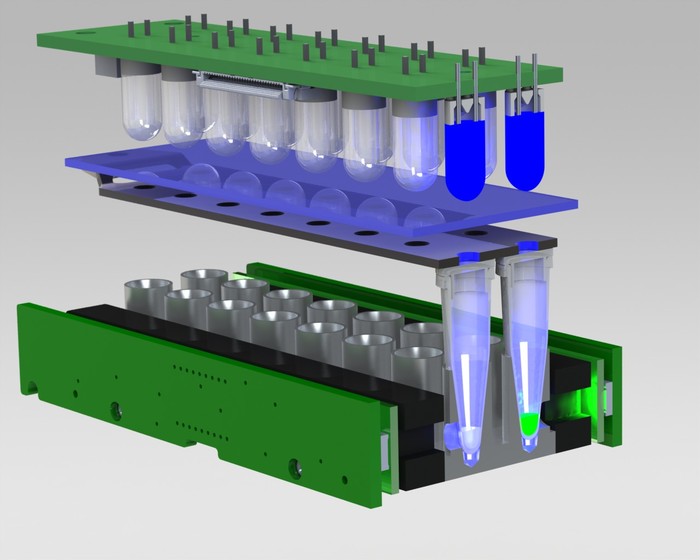

The optical system detects the DNA in the right tube, but the left tube without DNA fails to fluoresce. The single-channel detection system is shown in this image.

An 800x480 pixel capacitive touchscreen allows easy control of the machine, while USB, ethernet, and wifi interfaces let the user control the machine via a web browser or other networked systems. The machine is controlled by an embedded BeagleBone Black microcomputer, running embedded Linux at 1 GHz and sporting 4 GB of flash.


Open qPCR uses ethernet, wifi, and USB to communicate with the outside world

Open qPCR is compatible with power systems around the world (110 - 240 V, 47-63 Hz), and complies with all CE and FCC requirements. In normal cycling operation the machine requires 250 W, but in a special low-power mode, isothermal DNA detection can be performed with as little as 45 W, allowing field use with solar/battery power.

The hardware design, including BOM, SolidWorks files, and Eagle CAD will all be released as open source when the machine ships, and are available sooner as an early access reward.

Tech Specs

The Software
We've developed an open and intuitive user interface using modern web technologies such as HTML5 and JavaScript. Open qPCR runs an embedded web server, which lets the machine be operated in a platform-independent way from nearby computers connected via ethernet or wifi. A USB connectivity mode is also supported for non-networked environments.

Open qPCR provides a powerful protocol editor, which supports basic cycle and step editing, as well as advanced features such as controlled ramp rates and auto-delta/touchdown steps. Data collection may be triggered on each step and/or ramp, and a final hold temperature is supported.

A visual plate layout editor allows the assignment of samples, targets, standards, and controls to each well, as well as viewing fluorescence curves on a per-well basis.

The software supports amplification curve Ct thresholds, presence/absence detection, melt curve analysis, and relative quantification. Software support for absolute quantification may be ready by the shipping date, or will otherwise be made available shortly thereafter as a free downloadable update. It's a bit tricky to do absolute quantification with a 16 well block, but we've got some ideas. Data may also be exported in RDML format, allowing for more advanced analysis in other software.

All software including real-time control, web user interface, and scientific analysis code will be released as open source when the machine ships.

Real-Time PCR Reagents and Starter Packs
Real-Time PCR reagents have a reputation for being expensive, which is why we're creating our own to coincide with the low cost Open qPCR. We've created our own low-cost PCR MasterMix, and are currently synthesizing Chai Green, an IP-free fluorescent intercalating dye. The composition of these reagents and structure of Chai Green will be released as open source.

We'll be including starter packs of these reagents with all Open qPCR machine rewards so you can evaluate these low-cost reagents yourselves. The starter packs will include enough reagents for 50 PCR reactions.


Of course you may also use existing dyes or probes with fluorophores like FAM with your Open qPCR.

Our Story
Four years ago, in 2010, Josh Perfetto and Tito Jankowski started a Kickstarter campaign for OpenPCR, the world's first open source PCR thermocycler. Josh and Tito successfully fulfilled the Kickstarter, and today approximately 800 OpenPCRs are used around the globe.

Though revolutionary at the time, OpenPCR, like all endpoint PCR thermocyclers, was a relatively basic machine. It simply heats and cools a piece of metal in a precise manner. This thermal cycling facilitates the PCR reaction which selectively amplifies DNA, enabling the many applications of PCR described on this page. However turning this amplified DNA into useful information requires downstream laboratory processes which are too laborious, costly, and error-prone for most diagnostic uses.

This provided the impetus to create Open qPCR, a machine that directly turns DNA into actionable information. In 2012 Josh assembled a team of electrical, mechanical, optical, and software engineers to couple the thermal cycling accuracy of OpenPCR with an optical detection system, powerful modern processor, and modern ethernet, wifi, web, and touch screen interfaces. And unlike OpenPCR, which was a build-it-yourself DIY kit, Open qPCR is a professionally assembled ready-to-use system, though it stays true to its DIYbio roots.

It was a long haul, but we're excited to bring it to you.

The Biohacker Kit
To perform tests with Open qPCR, beyond the machine and provided reagents, you'll need a set of PCR Primers specific for your application and control DNA to have confidence in your results. We will be creating an open source database of PCR assays (the primers, probes, protocols, and controls needed to perform PCR) in 2015, and early beta access to that is available as a KickStarter reward.

However as a first step towards that vision, we're offering a Biohacker Kit available separately or as an add-on to an Open qPCR reward. The Biohacker Kit ships internationally and contains:

  • PCR primer and control library for 5 tests: one pertaining to fraudulently labeled food, another to a gene associated with athletic ability (ACTN3), and three other tests which will be decided on by backers
  • Reagents for 50 DNA extractions
  • Real-Time PCR reagents for 100 reactions
  • A laboratory pipette
  • Two boxes of pipette tips
  • PCR strips
  • Sterile cotton swabs for collecting DNA
With our machine and this kit, you'll have everything you need to perform these tests right out of the box.
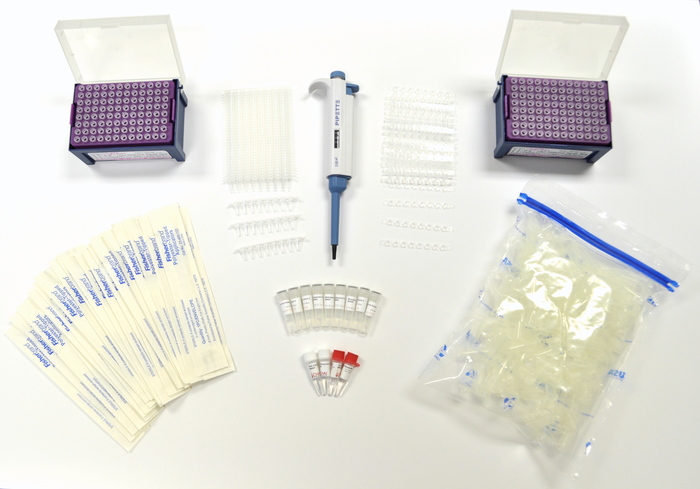
What's in the Biohacker Kit
Production Schedule
Over the past two years we've built and tested countless prototypes. We now have a working system, and have suppliers and manufacturers lined up to build our machine. We're ready to get Open qPCR into production, but need your help to finance the first manufacturing run.

We plan to have the first batch of units to fulfill the Kickstarter rewards in March 2015, and the second batch ready in April. The expected delivery date for your batch is shown in the reward section when you pledge.

We are continuing to refine the software, and are on-track for basic informatics (amplification curves with Ct values, melt curves, and presence/absence detection) to be fully implemented by our shipping date as well as relative quantification. Support for absolute quantification is on our development roadmap, but may or may not be ready by the shipping date (it's somewhat tricky with our 16 well block). If it is not ready in time, it will be available as a free downloadable software update shortly thereafter.

Progression of Open qPCR's circuit board

Open qPCR has not yet been submitted to nor cleared by the US FDA for medical uses. Thus within the US and EU it is sold for research, educational, and recreational uses only. We will ship Open qPCR globally but you are responsible for ensuring your intended uses are compatible with the regulations of your country.

Add Ons
The T-Shirt, Coffee Mug, and BioHacker Kit rewards may all be added to the higher reward levels by adding the cost of these rewards to your total pledge. If you are shipping outside the US, please add a $15 shipping fee for T-Shirt or Coffee Mug add-ons, and a $60 shipping fee for BioHacker Kit add-ons. You will be able to specify the add-ons you are requesting in a post-campaign survey.

A reagent-only version of the Biohacker kit is also available for $150, plus $40 for shipping outside the US. This kit includes the DNA extraction buffer, Real-Time PCR MasterMix, primer library, and control DNA of the Biohacker kit, but does not include the pipette, tips, cotton swabs, PCR tubes, or eppendorf tubes.

About Us
Chai Biotechnologies is a biotech startup focussed on making biotechnology more broadly accessible. Chai is based in Santa Clara, California, and was founded by Josh Perfetto, a former co-creator of the OpenPCR open-source thermocycler project KickStarted in 2010. Chai is a team of 8 including experts in molecular biology, mechanical and electrical engineering, software development, and user interface design.


We have worked to remove as much risk as possible before launching this campaign. We have created a working prototype, sourced all key components from suppliers, and identified a local manufacturer for our initial batch, which will help us resolve manufacturing issues quickly. Additionally we have successfully delivered on an earlier Kickstarter project OpenPCR, which was a simpler predecessor to this machine.

While we're happy with our preparations to date, there is always the risk of unforeseen challenges when manufacturing physical products. We will keep you advised of our progress and any unexpected challenges, and will work our hardest to meet the delivery schedule.

ORIGINAL: Kickstarter

sábado, 1 de noviembre de 2014

OpenTrons: Open-Source Rapid Prototyping for Biology


PLAY
Accelerating research with open, affordable, & easy-to-use lab robots. We empower people to innovate with biotech.
OT.One

This is the OT.One liquid handling robot, the core of OpenTrons' rapid-prototyping platform for biotech. Shown below with a standard single channel micropipette:


's video poster

This video shows some of the upgrades available to the OT.One -- the OT.MagWash station for magnetic micro-bead washes, a multi-channel micropipette, and on-board camera (see below for details on the Starter Kit and Pro Upgrade).


's video poster
 PLAY
Accelerate your research! 

Biologists today spend too much time moving around tiny amounts of liquid by hand. Micropipetting is a repetitive, error-prone, time consuming task, and it is slowing down research.


Pipetting got you down?

The OT.One does pipetting for you so you can focus on moving your project forward. Lower your error rate, free up your time, accelerate your research.


Let OpenTrons take care of the pipetting for you!

Testimonial from a cancer researcher.


's video poster
 PLAY

Synbio Starter Kit! 

Not a scientist? No problem! Our Synbio Starter Kit can get you up and running with synthetic biology!


's video poster
 PLAY


Together with Synbiota, we put together a kit that lets you run the "hello world" of synthetic biology -- assemble a DNA design from modular genetic blocks, and boot it up in a bacteria to make it glow red under a blacklight!

The Synbiota kit includes four Genomikon DNA Blocks
  • an Anchor, 
  • a Linker,
  •  a red florescent protein gene copied from pink choral, and 
  • a Cap that completes the plasmid. 
The kit also includes a standard p200 micropipette, and the OT.MagWash DNA assembly station (video above). You can assemble the DNA either by hand or with an OT.One!


OT.One Backer Options
OT.One backers have three options, the Standard Kit, the Getting Started Kit (add +$100 to the backer level), and the Pro Upgrade (add +$500 to the backer level). 

Standard Kit


Robotics:
  • Raspberry Pi on board with wifi, BLE. 
  • OpenTrons open-source NodeJS software bundle. 
  • Industrial grade aluminum chassis. 
  • Measures 2ft x 2ft x 2ft, approx. 60lbs. 
  • 100 micron XYZ accuracy with the Smoothieboard Open Hardware 5x stepper motor controller. 
Workbench:
  • 15 SPE well-plate capacity. 
  • 100% aluminum for easy sterilization. 
  • Quick-snap mounting system. 
Liquid Handling:
  • Single motor mount for standard hand micropipette, single- or multi- channel. 
  • Microliter accuracy, every time.
Getting Started Kit - add $100 to an OT.One


Synbiota "Hello World" 
  • Run the "hello world" of synthetic biology -- assemble a DNA design, and boot it up into a bacteria to see it glow!
  • Four-part Genomikon block DNA kit, Anchor, Linker, red flouecient protein gene copied from a pink choral, and a cap to complete the plasmid. 
  • Lab-safe, non-toxic strain of e. coli, to transform and make glow!
  • All the reagents and labware you need for the protocol. 

Standard p200 Micropipette
  • Pre-fitted with OpenTrons hardware for easy and precise mounting to the OT.One.
OT.MagWash Station
  • Automate magnetic micro-bead wash steps for Genomikon DNA assembly. 
Pro Upgrade - add $500 to an OT.One


Dual Pipette Mount:
  • Attach a second standard micropipette, single- or multi- channel. 
  • Run protocols requiring two different micropipettes in the same job. 
8-Channel Micropipette
  • Eight transfers at a time for high-throughput and multiplexed protocols. 
  • Pre-fitted with OpenTrons anchor hardware for easy and precise mounting to the OT.One. 
On-Board Camera
  • Open for your development! 
  • Future applications include job monitoring, auto positioning, colony picking, process confirmation, etc. 
Mix.Bio
  • Mix.Bio is the first ever community for the peer-to-peer development of open-source automated biology protocols.


Design, share, and run protocols on Mix.Bio!


This is a video tour of Mix.Bio.


's video poster
Mix.Bio lets you easily design protocols in the browser. Drag and drop tools, commands, and locations to put together OpenTrons jobs, then share them with your peers. Or, search through protocols others made and download one to run yourself! 
OpenTrons is full Open-Source! 
We stand on the shoulders of giants -- thanks especially to the Smoothieware team for such an awesome motor controller!


Full Open-Source -- Hardware, Software, Science

Friends and Partners


Risks and challenges

Manufacturing is always a challenge, but it is one we are prepared for. We spent the summer in Shenzhen, China, where we solidified a network of suppliers and manufacturers that we know will deliver quality, affordable robots starting in April 2015.

We also avoided parts in the OT.One that require difficult, time-intensive custom tools and molds to make. That makes manufacturing much less complicated, and is one of the main reasons we are so confident we can start shipping to early-bird backers in April.

Also, we are part of Haxlr8r, a hardware accelerator in Shenzhen, and are working with Seeed Studio, the open-hardware facilitator, for manufacturing. Both Hax and Seeed have tons of experience delivering on Kickstarter campaigns, and we are excited to be a part of their awesome network!

Manufacturing is never easy, but we are as prepared as possible to deliver quality robots starting in April!


ORIGINAL: KickStarter

viernes, 13 de junio de 2014

Good News: Education Is Evolving. The Proof Is In the Play

Quick, can you name three modern medical achievements that you never imagined would happen in your lifetime? If you can, maybe you thought of things like: growing organs in a laboratory, face transplants, and even a skull created by a 3D printer. Yet, if we ask a person to name three modern advancements in education, I think you will find fewer people who can give you a decent answer, let alone three. If you by any chance thought of that documentary about schools in Finland, I think that’s a great answer though it depresses me very much since I don’t live in Finland.

To be sure, many parents including myself are full of frustration and want more done to improve education. However, it would be wise to note that awesome educational developments are taking place right now, here in the U.S. These marvels come to us in the form of toys and games but with a twist – as both offer children the chance to practice a skill called computational thinking.

Thanks to two experts in tech education, Dr. Wendy Martin and Francisco Cervantes at the EDC Center for Children and Technology, I was able to learn what this was. According to Martin and Cervantes, computational thinking is practiced when you learn how to code. It’s the process of creating a program, letting it run, encountering problems, dissecting and examining the problem, and finding a solution so you can create something. Two products offering this to children as young as preschool-age are making news this month.


Motivation is the Key to Learning
I love KIBO. It is one of those toys that ranks up there alongside brainy toy greats such as the Etch-A-Sketch, Froebel Gifts, and LEGO. These are examples of very intuitive toys. You just pick up and play and when you’re done, you have undoubtedly gained something. KIBO is a perfect demonstration of how kids are learning through play all while needing little to no instructions.

With a toy like KIBO, kids are able to take a robot, scan bar codes on a sequence of connectable wooden blocks, each of which have a designated action. This creates a string of orders telling the robot what to do. Actions like “Begin – Shake – Light Up – Turn Right – End” are terrific for young learners but the command sequences can also become more complex. Kids can even use “If-Then” clauses. KIBO is kind of like constructing a sequence of actions, similar to the way kids do pretend play and create stories.

The great news this month is that the makers of KIBO, KinderLab Robotics, has launched a campaign on Kickstarter. Thus, anyone has the opportunity to become part of the first round of investors in this major advancement in education.

I asked Dr. Marina Umaschi Bers, the director of the DevTech research group at Tufts and chief scientist at KinderLab Robotics about any prerequisite knowledge needed to play with KIBO. It was a relief to hear that there was a lot of success across the board among children despite the varied backgrounds in family income and even neurological differences such as children with executive functioning impairments. In my experience as a tester of hundreds of toys, that trait is a genuine marker of a well-designed toy because there is something in it for everyone. Additionally, as a fan of Friedrich Froebel, the inventor of the original kindergarten that began in the 1800s, it was very obvious that KIBO really had those special qualities of toys that intrinsically support creativity and inquiry. “Our company name and our product, KIBO, are certainly influenced by the works of Friedrich Froebel,” said Umaschi Bers. “Exploring programming through play and developmentally-appropriate learning manipulatives are core to the philosophy behind KIBO.

Lisa Moellman, an education consultant and former Associate Director of the Harvard Achievement Support Initiative in Boston is also a parent of a child who had KIBO as part of his school curriculum for the past three years since kindergarten. (Yes, it’s aligned with the Common Core Standards too!) Moellman was very impressed and said that as the tools, the visuals, the programming was so hands-on and intuitive, her son and his classmates were able to easily access the robot’s functions and move forward. “That just kept his motivation really high.” Motivation is key. Little humans have little tolerance for glitches.

Computational Thinking Does Not Require Computers? Not Even Electricity or Reading?

The board game industry also recognizes the value in teaching kids how to code. It was no surprise to me that industry pioneer, ThinkFun became the new publisher of Robot Turtles, a game whose claim to fame is that it’s the most backed board game in Kickstarter history. This game for preschoolers had everyone waiting for its release this month including developmental psychologist and play consultant Dr. Jennie Ito of The Play Kitchen who had also pre-ordered the game because she believes that learning programming is important. “It teaches children that they can be creators,” she says. “That they can not only have an idea, they can actually turn their idea into something.

With Robot Turtles, kids are essentially solving problems as they help their turtles to reach their destinations by making a series of decisions. The fun part is that they are in the driver’s seat and the grown-up play partner is the “Turtle Mover” who must do whatever the child “Turtle Master” says by performing fun computer-noises like “BEEP” and “DOT” which has everyone holding their stomachs with laughter.


The red code cards here instruct the red turtle what do. ie. turn left, move forward.


It’s not that easy to get to your destination, there are ice walls, stone walls and crates to block your turtle’s path. Think! Make a good decision!


What is really great about Robot Turtles and programming in general is that similar to block play, you can start off simple and end up doing something rather complicated but only when you’re ready. I am really impressed with ThinkFun’s commitment to helping young kids grasp coding through game play. Not only have they added additional adventures to take things to a higher level but they’ve even created a dedicated website allowing kids to create and share their adventures with others and thus, learn from each other. Not surprisingly, such an activity is actually a very integral part of the culture of programmers and again, we are talking about preschoolers here.

You may ask yourself why is it important for kids to make robots or turtles shake, rattle, beep, bloop, etc. Why do we need them to make up these sequences? I had this same question but I look at it like this: Have you ever given directions or advice to a colleague and they mistakenly did something completely different? It has happened to all of us and it is because the language of people can have infinite meanings and possibilities. If you believe that then you can believe that we need to show kids the benefits of being clear, purposeful, and feeling fulfilled. To be truthful, I don’t believe you can actually teach this to children. However, with the right tools like KIBO and Robot Turtles, you are more apt to be successful in establishing a setting where these essential growth experiences can be accessed and owned by all children. To me, that is an awesome advancement in the science of education.

Note: Every product is usually personally tested by Toys Are Tools’ testers but all available KIBOs are currently doing their jobs as tools in schools. However, I am very grateful to have had a personal and lengthy live video demo by the founders of KinderLab Robotics. Robot Turtles was submitted to facilitate a review. Reviews are never promised.

More best toy tips from Jenn at Toys Are Tools.

ORIGINAL: Forbes
By Jenn Choi

lunes, 5 de mayo de 2014

Hand-Held Spectroscopy Tool Lets You Examine the Molecular Composition of Your Food


Up on Mars, the Curiosity Rover uses its spectrometers to examine the chemical composition of the rocks and dirt on the red planet. Now the Israeli startup Consumer Physics has developed a tool that lets you conduct similar experiments in your own backyard or at your dinner table.

The company launched a Kickstarter campaign today with the goal of raising US $200 000 to fund the first production run of its hand-held spectrometer, which is about the size of a flash drive.

Using near-infrared spectroscopy, the device, called SCiO, shines light on a sample and measures the light absorption patterns of the molecules therein. It then identifies the object by its optical signature, and gives the user information about the object's molecular composition. It uses bluetooth to link to the user's smartphone, where an app manages the data.


Add caption
In a product demo for IEEE Spectrum last week, company CEO Dror Shalon held up a prototype SCiO to a block of Gouda he had just bought at Walgreens. After a brief flash of light and a few seconds of analysis, Shalon's smartphone reported that the item was: cheese. While that might not seem like the most useful announcement for a functional human being with eyes, the SCiO can provide more info. After following a prompt to enter the portion size (which was on the cheese's packaging), the app displayed that cheese's calories per serving, as well as fats, carbohydrates, and proteins. Of course, all that info was also on the cheese's packaging. But Shalon says the SCiO's abilities will shine forth at restaurants and anywhere people are grabbing food on the go. 

Shalon thinks that consumer spectroscopy is an idea who's time has come. Today's quantified self gadgets let us track our bodies with unprecedented recision—we can count our steps taken, calories burned, and much more. But people who want that kind of information about the materials around them have been out of luck so far. "When we came up with this vision, I went to Amazon to search, because I was sure that it must exist already," says Shalon. When his search came up empty, he and his team started working.

Kickstarter backers who donate $149 will get the SCiO in December, along with free downloads of all the SCiO-specific apps that Consumer Physics will develop over the next two years. The company has already developed apps for identifying and authenticating pharmaceuticals, for checking the hydration of plants, and for measuring the sugar content of fruit. Shalon is hoping that third-party developers will find many other things to do with SCiO. "That's the major reason we’re doing the Kickstarter campaign, to get the device into the hands of the early adopters," he says.

ORIGINAL: IEEE Spectrum
By Eliza Strickland
30 Apr 2014 | 13:00 GMT

martes, 8 de abril de 2014

$299 3D printer achieves Kickstarter goal in minutes

The 'cheap' M3D printer may be the first one to appeal to a mass market

An ultra-cheap 3D printer has hit its Kickstarter goal in just 11 minutes, with some lauding it as the first mass market version of the technology.

Makers M3D have currently raised over $1m (£597,000) well ahead of their $400,000 target with 28 days to go.

Early backers will get the machine for just $199 and other backers can pledge as little as $299.

Dubbed Micro, it comes with easy-to-use software that allows users to search, drag and drop objects to print.


Kickstarter is a crowd-funding website that has breathed life into a range of technology projects, including the virtual reality headset Oculus Rift, which was subsequently bought by Facebook for $2bn.

'Exciting thing'
At just 7.3in (18.5cm) square and weighing 1kg (2.2lbs), the device will be easy to move around. It can be used with Windows, Mac or Linux.

Users can choose a design to make.
It comes with software that allows users to search and browse objects online. Once they have picked something they would like to print they drag it into the printer and hit print.

"It's our goal to make the Micro accessible to everyday users," reads the pitch on Kickstarter.

The tagline on its Kickstarter page calls it "the first truly consumer 3D printer".

Some believe that it could be a game changer.

"Along with the market entry of New Kinpo I think it's one of the most interesting things to happen in desktop 3D printing," said expert Joris Peels.

"New price points and lower pricing will be key in getting people to buy a 3D printer. Not many people can afford to pay $2,000 for a printer but many more can try one for $500 or $300," he added.

The team hope to be able to start shipping the machines in August.

While those supporting the device on Kickstarter will get it for $299 or below, a retail price has not yet been set although it is expected to be "within the same price bracket" according to a company spokeswoman.


ORIGINAL: BBC
8 April 2014 

sábado, 8 de febrero de 2014

How to Make (Assemble) a Computer (in 107 Seconds)


Kano is the first computer kit for everybody.
Make, play, code, and level yourself up.
Coming to Kickstarter on November 19th. (USD119)

Sign up: http://kano.me


What's inside?

  1. Kano Books, illustrated and intuitive
  2. Kano OS and Levels – 8GB SD card
  3. DIY Speaker
  4. Raspberry Pi Model B
  5. Kano Keyboard
  6. Custom case
  7. Card mods and stencils
  8. Stickers!
  9. Cables: HDMI, Mini-USB
  10. Worldwide power plug
  11. WiFi powerup 

miércoles, 22 de enero de 2014

Polish 3D Printer Zortrax Sells 5,000 Units To Dell


It may seem like small potatoes, but Polish 3D printer manufacturer Zortrax has chalked a 5,000 unit order from Dell. This is the first I’ve heard of a mass order of home 3D-printing equipment and it means a real boon for the budding Olsztyn-based company.

Dell kept in touch with us when we were still in the middle of our Kickstarter campaign. We weren’t in a position to make them a reasonable business offer at that time, since our production volume was very limited,” said Rafał Tomasiak, Zortrax CEO. “At that point in time the production was very tedious, every single printer was quality checked and tested by us. Business negotiations with Dell were stalled at some point and we focused on shipping the printers to our Kickstarter backers. Now the situation is much different, we are prepared for large quantity orders.

Zortrax launched last May and is now shipping to happy Kickstarter backers. I’ve used the printer multiple times and was very impressed by the print quality and build. The company is poised to be a major player in the European market and, with this investment by Dell, potentially globally. The company said the the printers are headed toward Dell’s central and east Asia offices.

Frankly speaking, we were surprised that any company, even a company like Dell, wants to place such an order! But after a while we realized how many printers we use in our own office… For a designer who prints a large number of prototypes it is much more useful to use 10 smaller printers on one desk, which operate simultaneously, rather than one with a larger build volume,” said Tomasiak.


lunes, 3 de junio de 2013

ARKYD: A Space Telescope for Everyone

ORIGINAL: Kickstarter


The first publicly accessible space telescope! Take amazing photos of space or have your photo displayed above the Earth.


06-02-2013 – Let’s spread the word!
Big Thank YOU to everyone who has pledged their support to make a publicly-accessible ARKYD space telescope a reality! Many of you have asked how you can help support ARKYD. We've put together a supporter's resource to help reach more people. You'll find translations of the various materials prepared by our community and learn how you can connect with other supporters.


Since the formation of Planetary Resources, our primary goal has been to build technology enabling us to prospect and mine asteroids. We've spent the last year making great leaps in the development of these technologies. These advancements have presented us with the opportunity to engage in another passion of our team:

to make space exploration accessible to everyone.

Space has always been something that most people only dream about. Very few ever get the chance to experience space — to feel that overwhelming sense of awe described by astronauts. Our challenge and vision is this: how can we make
that a reality?

Introducing: The ARKYD — [ahrk-kid]

The ARKYD is a technologically advanced, orbiting space telescope that will be controlled by YOU, the crowd, through your pledges and community involvement! You can even direct your telescope time to non-profit science centers and universities for use in your communities!

Just think about the true impact of this endeavor for a moment. Together we can provide access to technology that costs tens of millions of dollars into the hands of students, scientists and a new generation of explorers, who will use it in ways we can’t even fathom yet!

At Planetary Resources, our primary focus is mining asteroids, and we’re pushing the boundaries of what is possible by vertically integrating and applying innovations from consumer-based industries. It’s our goal to reduce the cost of space observatories many times over, allowing anyone to access them for their own use. We want to empower the crowd to solve the big problems of our time — and this is the first step to making that a reality.


The first publicly accessible space telescope! Take amazing photos of space or have your photo displayed above the Earth.

Our primary mission is to develop low-cost robotic spacecraft to explore and mine resource-rich asteroids within our reach. The first step to making this possible is the launching a fleet of ARKYD spacecraft to identify asteroids that are ripe for further exploration. This same capability has numerous other potential applications in education and research. The goals that we want to achieve with this Kickstarter mission are four-fold:

To give students access to space capabilities — Whether studying planets in a 5th grade class or writing a graduate thesis, students of all ages will have the ability to direct the telescope and explore what interests them! We’re planning some exciting new educational opportunities just for K-12 educational programs.

To support important research and discovery — There are thousands of institutions and researchers in need for greater access to in-orbit space observatories. The ARKYD will provide a new, low-cost resource to help observe distant galaxies, search for alien planets, and monitor the skies for potentially dangerous asteroids. Researchers at MIT, the University of Washington, and across the globe have shown interest in using the ARKYD to further their important research.

To build excitement about space and all of its potential — The ARKYD is designed to be a fun and interactive experience that is accessible to anyone. This kind of direct access to a satellite is unprecedented. Our backers will be the first people in history to control a public space telescope!

To give YOU a say — What makes this mission unique is that we’re putting control of the telescope in YOUR hands. You’ll get the opportunity to help decide which science centers and museums are the beneficiaries of ARKYD telescope time, what photos to take, and more. We’re putting YOU in control! By pledging toward this mission, you’ll receive access to our website and mobile apps allowing you to follow along with the progress of the satellite, sneak peaks at photos and videos, and get voting access to make your voice heard in the future direction of the satellite!


The engineering and development of the telescope itself is being covered by Planetary Resources, and we're investing millions of dollars in research and development to develop the ARKYD with advanced capabilities like photographing deep space and searching for asteroids. However, a publicly accessible satellite is very different from those that we intend to launch for the purposes of locating asteroids. The engineering and technological needs for doing each of those jobs are quite different.

Here's where we need YOUR help: The proceeds from this campaign will go to several different areas:
  1. To actually launch the satellite into space. 
  2. To support the spacecraft over its lifetime — including manpower to facilitate the photos, "selfies", monitoring the spacecraft and training the staff at the chosen science center that will take over control. 
  3. To create an easy-to-use Control Interface that will allow ANYONE to access and control the satellite. 
  4. To fund the creation of an incredible, interactive educational experience that can be used by schools anywhere, to enable students to experience space in a way that's never been possible.