Mostrando entradas con la etiqueta Groenlandia. Mostrar todas las entradas

lunes, 30 de julio de 2012

NASA: Strange and sudden ice melt in Greenland

ORIGINAL: First Coast News


WASHINGTON -- Nearly all of Greenland's massive ice sheet suddenly started melting a bit this month, a freak event that surprised scientists.

Even Greenland's coldest and highest place, Summit station, showed melting. Ice core records show that last happened in 1889 and occurs about once every 150 years.

Meltwater flooding the Watson River in Greenland. Photo taken on July 12, 2012.
CREDIT: NASA Earth Observatory 
Three satellites show what NASA calls unprecedented melting of the ice sheet that blankets the island, starting on July 8 and lasting four days. Most of the thick ice remains. While some ice usually melts during the summer, what was unusual was that the melting happened in a flash and over a widespread area.

"You literally had this wave of warm air wash over the Greenland ice sheet and melt it," NASA ice scientist Tom Wagner said Tuesday.

The ice melt area went from 40 percent of the ice sheet to 97 percent in four days, according to NASA. Until now, the most extensive melt seen by satellites in the past three decades was about 55 percent.

Wagner said researchers don't know how much of Greenland's ice melted, but it seems to be freezing again.

"When we see melt in places that we haven't seen before, at least in a long period of time, it makes you sit up and ask what's happening?" NASA chief scientist Waleed Abdalati said. It's a big signal, the meaning of which we're going to sort out for years to come."

About the same time, a giant iceberg broke off from the Petermann Glacier in northern Greenland. And the National Snow and Ice Data Center on Tuesday announced that the area filled with Arctic sea ice continues near a record low.

Wagner and other scientists said because this Greenland-wide melting has happened before they can't yet determine if this is a natural rare event or one triggered by man-made global warming. But they do know that the edges of Greenland's ice sheets have already been thinning because of climate change.

Summer in Greenland has been freakishly warm so far. That's because of frequent high-pressure systems that have parked over the island, bringing warm, clear weather that melts ice and snow, explained University of Georgia climatologist Thomas Mote.

He and others say it's similar to the high-pressure systems that have parked over the American Midwest bringing record-breaking warmth and drought.

Ohio State University ice scientist Jason Box, who returned Tuesday from a three-week visit, said he ditched his cold weather gear for the cotton pants that he normally dons in Nevada.

"It was sunny and warm and all the locals were talking about how sunny it was," Box said after getting off a plane. "Beyond T-shirt weather."

Associated Press

martes, 24 de julio de 2012

46 Square Miles Of Iceberg Break Off In Greenland (Video)

ORIGINAL: Care2
July 23, 2012 


A huge iceberg that’s about twice the size of Manhattan has torn off the Petermann Glacier in Greenland, illustrating another dramatic change to the warming island.

For several years, scientists had been watching a long crack near the tip of the northerly Petermann Glacier. 
On Monday, July 16, NASA satellites showed it had broken completely, freeing an iceberg measuring 46 square miles.

About four-fifths of Greenland is covered by a massive ice sheet; Petermann Glacier is mostly on land, but a segment sticks out over water, and that’s where the break occurred.

From NPR:


“It’s dramatic. It’s disturbing,” said University of Delaware professor Andreas Muenchow, who was one of the first researchers to notice the break. “We have data for 150 years and we see changes that we have not seen before.”


“It’s one of the manifestations that Greenland is changing very fast,” he said.


Researchers suspect global warming is to blame, but can’t prove it conclusively yet. Glaciers do calve icebergs naturally, but what’s happened in the last three years to Petermann is unprecedented, Muenchow and other scientists say.


“This is not part of natural variations anymore,” said NASA glaciologist Eric Rignot, who camped on Petermann 10 years ago.


Many of Greenland’s southern glaciers have been melting at an unusually rapid pace.


It was 15 years ago that my nephew set out on a trek across Greenland, sponsored by Britain’s Royal Geographical Society (RGS). The RGS had supplied him with a topographical map dating back to the 60s, but so much snow and ice had melted since then that the map was of little use in terms of altitude.


According to Ted Scambos, lead scientist at the National Snow and Ice Data Center in Boulder, Colorado, the Petermann break brings large ice loss much farther north than in the past. If it continues, and more of the Petermann is lost, the melting would push up sea levels.


It’s more than glaciers in Greenland that are melting. Scientists also reported this week that the Arctic had the largest sea ice loss on record for June.


The Artic Sea Ice Blog has posted video taken in June 2011 of some of that iceberg’s chunks.

sábado, 30 de junio de 2012

Discovery: Earth's Oldest Crater Is Largest Too

ORIGINAL: Space
Douglas Main, OurAmazingPlanet Staff Writer
Date: 29 June 2012 Time: 04:42 PM ET

An artistic interpretation of how a large meteorite impact might have looked. The crater formed in modern-day Greenland may be the oldest and largest yet discovered on Earth. CREDIT: Carsten Egestal Thuesen, GEUS 
A study of Greenland's rocks may have turned up something unexpected: the oldest and largest meteorite crater ever found on Earth.

Researchers think the crater was formed 3 billion years ago, making it the oldest ever found, said Danish researcher Adam Garde. The impact crater currently measures about 62 miles (100 kilometers) from one side to another. But before it eroded, it was likely more than 310 miles (500 km) wide, which would make it the biggest on Earth, Garde told OurAmazingPlanet.

The team has calculated it was caused by a meteorite 19 miles (30 km) wide, which, if it hit Earth today, would wipe out all higher life.

Mystery feature

In the 3 billion years since impact, the land has been eroded down to about 16 miles (25 km) below the original surface. But the effects of the intense shock wave and heat penetrated deep into the Earth, and remain visible today, said Garde, a researcher at the Geological Survey of Denmark and Greenland. [ Meteor Mania: How Well Do You Know 'Shooting Stars'? ]

Garde had been conducting research on Greenland's geology and noticed several strange features that didn't make sense. One day in September 2009, he came up with the extreme explanation of an impact from a meteorite. His team collected samples over the years and published the results in the July issue of the journal Earth and Planetary Science Letters. He's now "100 percent positive" it's a crater, for several reasons, he said.

For one, he found widespread crushed rocks in a circular shape that seemed to be caused by the shock waves of a massive impact.
Second, there are deposits of a melted mineral called K-feldspar (or potassium-feldspar) that could have been liquefied only at extremely high heat, like that caused by an meteorite's crash-landing .
There's also widespread evidence of weathering by hot water, which he thinks was caused by the ocean rushing into the crater after it struck the area. The area may have been covered by a shallow ocean at the time, but even if it wasn't, it doesn't matter, Garde said. "The crater from a meteorite that big would have caused the sea to rush in," he said.

Mining for minerals

The black circle on map shows the location of the meteorite impact near the town of Maniitsoq in Greenland. CREDIT: Geological Survey of Denmark and Greenland
John Spray, a meteorite expert at the University of New Brunswick, who wasn't involved in the research, said he thinks it's probably a meteor crater, but points out that it hasn't been proved, and may not be for some time. "It's very interesting and it's good science," he said. "But we don't really know how to recognize very old impact craters, because they are typically so highly modified."

That's because Earth is alive and constantly changing due processes such as erosion, precipitation and plate tectonics. At one time Earth likely had as many craters as the moon, which is essentially geologically dead. But these have mostly been wiped away, destroyed by erosion and the like.

Only around 180 impact craters have ever been discovered on Earth, and nearly one-third of them contain significant minerals deposits such as precious metals. The Canadian mining company, North American Nickel, is exploring the region where the potentially newfound crater is for nickel and other mineral deposits, company geologist John Roozendaal said. They are conducting airborne surveys and will soon do more mapping, small-scale sampling and drilling to see if they can find an area that could be economical to mine.

These impacts are of interest to mining companies not because of the large meteorites themselves — they typically vaporize — but because of the effect upon the Earth's surface. The impact heats rocks so much that metals can melt and then collect toward the bottom of the crater. Craters can also be important sources of oil and gas; the crushed, permeable rocks can act like a sponge, absorbing hydrocarbons.

Before this discovery, the oldest crater was thought to be the Vredefort crater in South Africa, estimated to be 2 billion years old. At 186 miles (300 km) wide, it's also the largest crater that remains visible. Scientists expect that there were many more craters formed around 3-4 billion years ago when Earth lacked a protective atmosphere.

Garde said the most interesting thing about the experience was finding an alternate explanation for something outside of his training. "I had a problem I couldn't solve in a region I knew very well," he said. "A meteor impact was the idea that made everything fall into place — It's not something I was looking for."

This article was provided by OurAmazingPlanet , a sister site of SPACE.com. Reach Douglas Main at dmain@techmedianetwork.com . Follow him on Twitter @Douglas_Main . Follow OurAmazingPlanet on Twitter @OAPlanet . We're also on Facebook and Google+ .


lunes, 18 de junio de 2012

The vanishing North

ORIGINAL: The Economist

There are benefits in the melting of the Arctic, but the risks are much greater

Jun 16th 2012


NOW that summer is here, the Arctic is crowded with life. Phytoplankton are blooming in its chilly seas. Fish, birds and whales are gorging on them. Millions of migratory geese are in their northern breeding grounds. And the area is teeming with scientists, performing a new Arctic ritual.

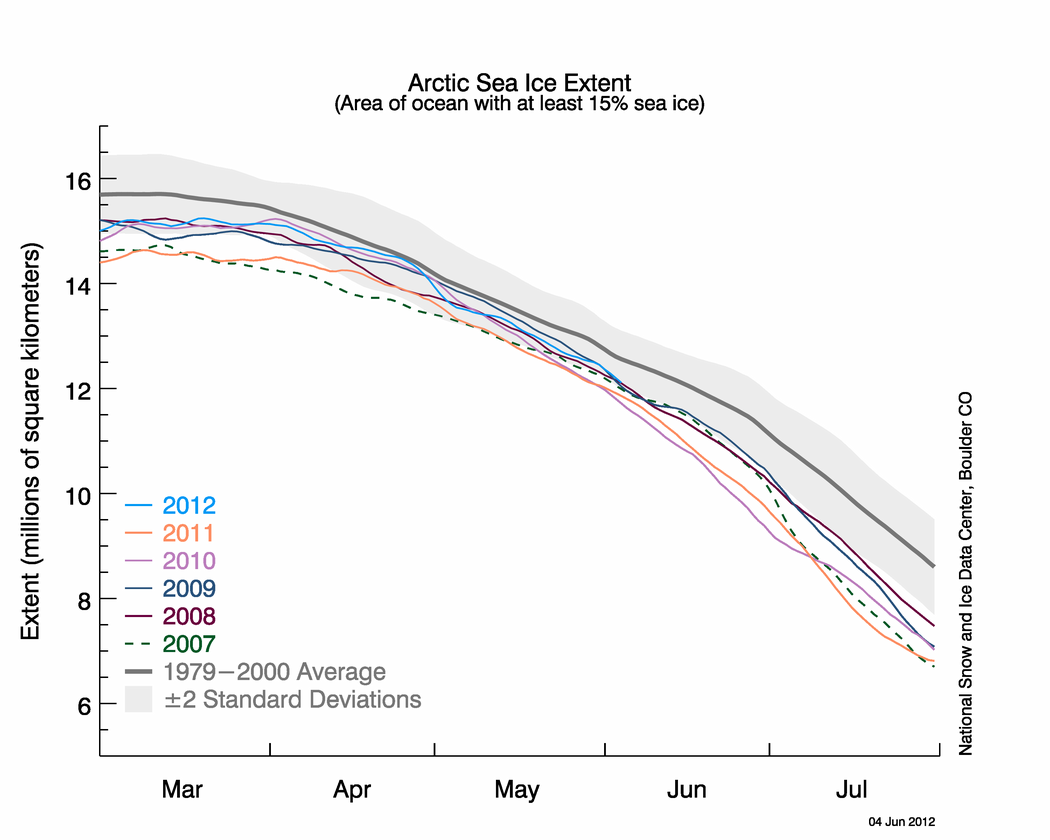
Between now and early September, when the polar pack ice shrivels to its summer minimum, they will pore over the daily sea ice reports of America’s National Snow and Ice Data Centre (NSIDC). Its satellite data will show that the ice has shrunk far below the long-term average. This is no anomaly: since the 1970s the sea ice has retreated by around 12% each decade. Last year the summer minimum was 4.33m square km (1.67m square miles)—almost half the average for the 1960s.
Graph: NSIDC
The Arctic’s glaciers, including those of Greenland’s vast ice cap, are retreating. The land is thawing: the area covered by snow in June is roughly a fifth less than in the 1960s. The permafrost is shrinking. Alien plants, birds, fish and animals are creeping north: Atlantic mackerel, haddock and cod are coming up in Arctic nets. Some Arctic species will probably die out.

Perhaps not since the 19th-century clearance of America’s forests has the world seen such a spectacular environmental change. It is a stunning illustration of global warming, the cause of the melt. It also contains grave warnings of its dangers. The world would be mad to ignore them.

As our special report shows in detail, the Arctic is warming roughly twice as fast as the rest of the planet. Since the 1950s the lower atmosphere has warmed by a global average of 0.7 degrees Celsius; Greenland’s air has warmed by 1.5 degrees. The main reason appears to be a catalytic warming effect, triggered by global warming. When snow or ice melt, they are replaced by darker melt-water pools, land or sea. As a result, the Arctic surface absorbs more solar heat. This causes local warming, therefore more melting, which causes more warming, and so on. This positive feedback shows how even a small change to the Earth’s systems can trigger much greater ones.

Photo: NSIDC

viernes, 11 de mayo de 2012

Greenland losing ice faster than before

05/11/2012

© 1999 WikiCommons/Michael Haferkamp cc by sa 3.0 
A recent story on NPR claimed to have “reassuring” news about melting ice in Greenland. Right after it was published, climate deniers jumped on the story. According to them, we don’t have to worry about Greenland’s melting glaciers anymore.

I’d love for this to be true — but it isn’t. In fact, Greenland is losing ice faster than it used to 10 years ago. And that’s bad news for all of us.

Here’s a quick refresher. As the climate warms, glaciers are melting all over the world, including in Greenland. The more ice that melts, the more global sea levels rise.

© 2005 WikiCommons/Mila Zinkova cc by sa 3.0 
What a recent study found is that worst-case scenarios about Greenland’s melting ice are looking less likely. It turns out the hundreds of glaciers surrounding the main ice sheet are melting at different rates. For example, some glaciers have accelerated in fits and starts. Others accelerated for a while, but now are holding steady.

As the lead scientist of the study points out, however, “there is no ‘good-case’ scenario when it comes to sea level rise.” As we learn later in the article, overall, Greenland is losing ice 30% faster now than it was 10 years ago, meaning at least three feet of sea level rise is still likely by 2100.

If sea levels rise another 3 feet, I somehow doubt folks in New York City, Bangladesh and Kiribati will say, “Well, that wasn’t so bad.”