Mostrando entradas con la etiqueta Insectos. Mostrar todas las entradas

lunes, 23 de diciembre de 2013

Can Bees Be Trained to Sniff Out Cancer?

Credit: Susana Soares

Some insects, such as bees, have a sense of smell so acutely sensitive that they can locate the faintest of odors in a room, even if it consists of only a few molecules. But scientists are particularly intrigued by the fact that these bugs can even be taught to detect various chemicals, from methamphetamines to ingredients in explosives. They’ve even been shown to effectively diagnose diseases like tuberculosis and diabetes.

U.K.-based product designer Susana Soares has created a simple, elegant way of harnessing bees to screen for a number of diseases, including cancers, like tumors of the lung and ovaries. Her glass apparatus, called “Bee’s,” features a large chamber and a smaller connected chamber housed within it. After training the bees to associate a specific chemical odor with a food reward, such as sugar, the insects are released into the diagnostic device through an opening. Patients would simply blow into the smaller compartment and wait to see if a swarm gathers toward something alarming in the person’s breath.

The project, part of her master’s thesis at London’s Royal College of Art, began in 2007 when Soares came across research on bees and their phenomenal olfactory abilities. After talking to researchers in the field, she learned that certain diseases, such as lung cancer, noticeably alter the composition of bodily fluids, producing odorous compounds that show up in urine and sometimes blood. Some investigators have even been experimenting with various sensory methods to home in on these “biomarkers.” In Philadelphia, for instance, scientists have trained mice to identify the scent of lung cancer. Trained dogs have also been used to sniff out ovarian cancer. Others have focused on replicating these animal abilities in electronic nose devices that are calibrated to pick up these biomarkers undetectable to human noses.

Insects offer key advantages over mammals and electronics, however, because of their antennae. For example, electronic nose devices have trouble detecting an odor amid more complicated conditions, like when there’s a greater mixture of gases, as is found in human breath. And studies have revealed that sniffer dogs identify odors correctly only about 71 percent of the time, while also requiring at least three months’ training. Bees, in contrast, have achieved an accuracy rate of 98 percent and can be trained in about 10 minutes.

In developing “Bee’s,” the Portuguese native needed something that enabled the user to easily transport bees into the instrument and safely suck them back out using a vacuum. The source material also had to be malleable enough to shape into a system with well-defined pathways that don’t impede their movement. She eventually settled on glass as the material because of its flexibility and transparency. “To know the results of a breath test, you’d have to see the behavior of the insects,” she says. “Everything is about their behavior.”

Prototypes have undergone field testing, and although it didn’t find any instances of cancer, it did turn up a case of diabetes that was later confirmed. It’s unlikely, though, that the concept will amount to anything beyond being an exhibition curiosity. While there was a brief period in which she felt ambitious enough to reach out to potential collaborators, the process proved so time consuming and unfruitful that she ultimately gave up. The only organizations that seemed even remotely interested in her idea were a handful of charities. So for now, “Bee’s” exists as one of those purely academic exercises to show, as she puts it, the “symbiotic relationship” humans have with nature and how “technology and science can better foster these relationships.”

“I think there’s only four labs in the world doing research into insects for disease screening, which shows you that this approach doesn’t go over well in the western world,” says Soares. “Medical and health technologies are a big business, and the bottom line is they just don’t see how something like this can be profitable.”

Glen C. Rains, an agricultural professor at the University of Georgia, largely concurs, though he adds that there are more complex issues besides economics. The entomologist, as well as licensed beekeeper, has dealt with numerous challenges while developing a similar device called the Wasp Hound, which uses a batch of five wasps to detect the presence of bedbugs. Rains’ system is a bit more elaborate in that it uses a camera to record the wasps’ behavior. The data is then fed into software that analyzes these movements to determine if the bugs actually did indeed detect these unwanted guests. After over a decade of development, Rains has forged a partnership with Bennett Aerospace, an engineering firm, to refine the technology for large-scale real applications.

“The whole notion is definitely something people find fascinating,” he says. “But once you get into how it would work or how they make money, there’s no model for how it would be done.”

While there’s a tried-and-true market for electronic technologies, Rains points out that disease screening systems based on insects requires a separate infrastructure that the industry players haven’t bothered to think through. Facilities, for instance, would need a way to efficiently obtain odor samples for training and, obviously, a beekeeper on site who can manage and train the insects. After a few positive results, the insects’ willingness to buzz towards the chemical starts to diminish significantly, as they start to catch on to the fact that a sugary reward no longer await them at the other end. Thus, in a lab setting, bugs would need constant retraining throughout the day. But what’s encouraging, he adds, is that the enlisting of bugs for clinical purposes isn’t unprecedented, with the use of maggots and leaches to clean wounds being a well-accepted medical practice.

Despite these challenges, Soares has left at least the back door open to such a possibility, if someone with the right resources is willing to take a risk. “It has the potential to save so many lives,” she says. “It can even be an open-source concept, so for anyone who is interested, I’d be happy to talk.”
ORIGINAL: Smithsonian
December 13, 2013


01-intro

02-a-diagnostic-tool
03-a-precise-object

02-robert-hooke

Bee´s / Project
Bee's explores how we might co-habit with natural biological systems and use their potential to increase our perceptive abilities.

The objects facilitate bees' odour detection abilities in human breath. Bees can be trained within 10 minutes using Pavlov’s reflex to target a wide range of natural and man-made chemicals and odours, including the biomarkers associated with certain diseases.

The aim of the project is to develop upon current technological research by using design to translate the outcome into systems and objects that people can understand and use, engendering significant adjustments in their lives and mind set.

How it works

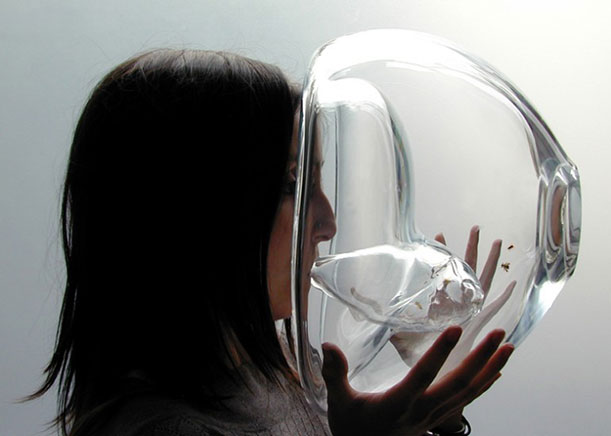
The glass objects have two enclosures: a smaller chamber that serves as the diagnosis space and a bigger chamber where previously trained bees are kept for the short period of time necessary for them to detect general health. People exhale into the smaller chamber and the bees rush into it if they detect on the breath the odour that they where trained to target.


01 & 02 Person preparing to exhale into the small chamber
03 Negative diagnostic: bees did not detect traces of odour they were trained to target
04 Positive diagnostic: bees rushed to the small chamber were they detect the targeted odour


What can bees detect?

Scientific research demonstrated that bees can diagnose accurately at an early stage a vast variety of diseases, such as: tuberculosis, lung and skin cancer, and diabetes.

Diagnostic tool 2: person exhaling into the diagnostic chamber, 26*15 cm, prototype 2007; borosilicate; Vilabo, Portugal


Precise object

The outer curved tube helps bees avoid from flying accidentally into the interior diagnosis chamber, making for a more precise result. The tubes connected to the small chamber create condensation, so that exhalation is visible.

Precise object, 22*12 cm, prototype 2007; borosilicate; Vilabo, Portugal


Detecting chemicals in the axilla
Apocrine glands are known to contain pheromones that retain information about a person's health that bees antennae can identify.

Diagnostic tool 4 (25*16 cm) prototype 2008; borosilicate; Vilabo, Portugal

The bee clinic

These diagnostic tools would be part of system that uses bees as a biosensor.

The systems implies:
  • A BEE CENTRE: a structure that facilitates the technologic potential of bees. Within the centre is a BEEFARM, a TRAINING CENTRE, a RESEARCH lab and a HEALTHCARE CENTRE.
  • TRAINING CENTER: courses can be taken on beetraining where bees are collected and trained by beetrainers. These are specialists that learn beetraining techniques to be used in a large scope of applications, including diagnosing diseases.
  • BEE clinic: bees are used at the clinic for screening tests. These insects are very accurate in early medical diagnosis through detection on a person's breath. Bees are a sustainable and valuable resource. After performing the diagnose in the clinic they are released, returning to their beehive. 
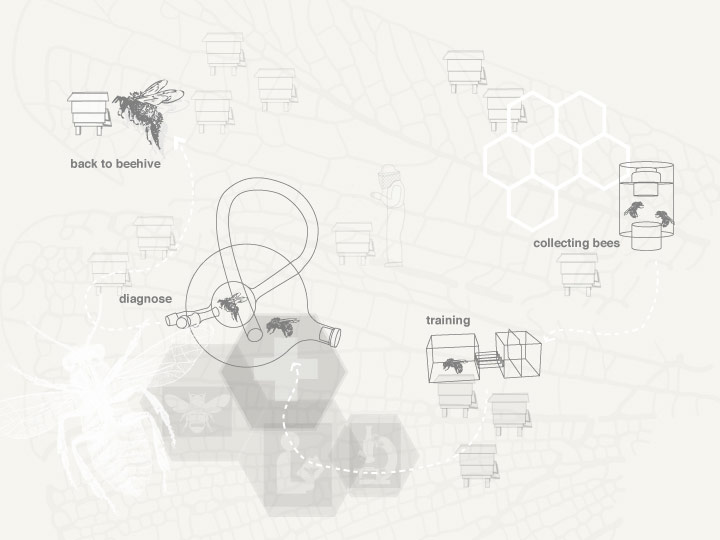
Bee Graphic - Complete Cycle


What if people started to be screened by bees for cancer?
Which one would we trust more, a machine or a biosensor?
Could bee training become a profession?

Bee training
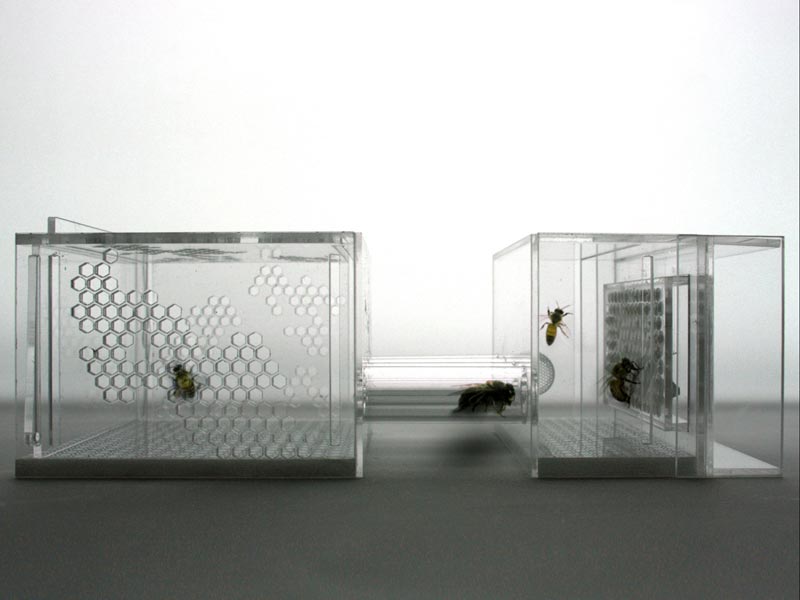
Bees can be easily trained using Pavlov’s reflex to target a wide range of natural and man-made chemicals odours including the biomarkers associated with certain diseases. The training consists in baffling the bees with a specific odour and feeding them with a solution of water and sugar, therefore they associate that odour with a food reward.
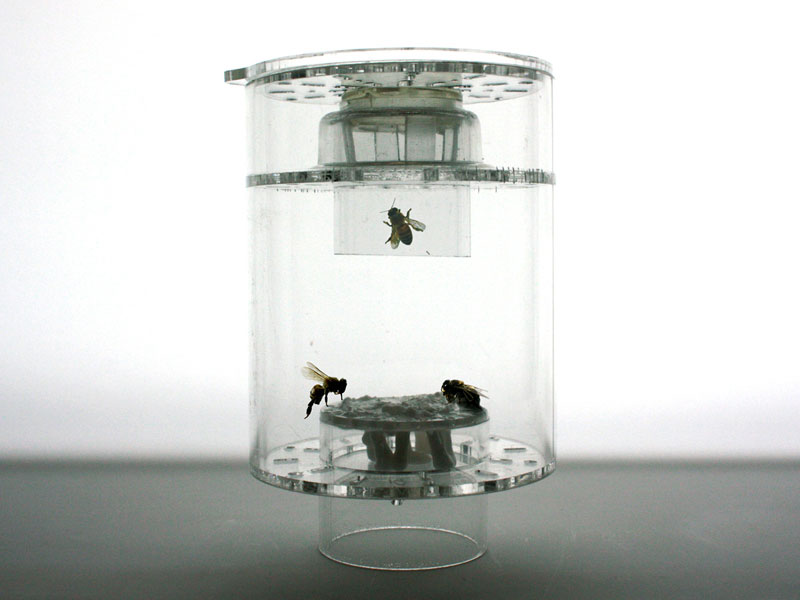
05 Bee catcher: this object is use to collect bees for training, a sugary solution is used to attract them inside - 15*9 cm, prototype 2009; acrylic.


06 Bee training object - 20*7*9 cm, prototype 2009; clear acrylic & hip.

Acknowledgements:
  • Calouste Gulbenkian Foundation
  • Royal College of Art, Design Interactions Department: Professor Anthony Dunne and Ms. Fiona Raby
  • Crisform: Designer Sónia Durães and Glass Master Mateus
  • Vilabo: Mr. João Gomes
  • London Beekeeper Association: Mr. David Perkins
  • Inscentinel, Bee research team at Rothamsted Research, UK: Dr. Mathilde Briens
Credits:
Susana Soares

Models:
Bernardete Fernandes
Clarie Ducruet
Margarida Martins

martes, 26 de noviembre de 2013

La comida de insectos se industrializa y tiene mucho futuro por delante


El aviso de los organismos internacionales de alimentación queda claro: aunque existan más de mil millones de personas con exceso de peso y sobrealimentadas en el planeta, también existen otros mil millones que cada día se acuestan con hambre. Los alimentos en la actualidad están desequilibradamente repartidos, pero es que si la tendencia continúa así, según los estudios oficiales, la población planetaria no contará con viandas suficientes cuando alcancemos la cifra de 9.000 millones de personas, prevista para el 2050. Se buscan con urgencia soluciones para garantizar al mundo que todos tendremos acceso a una alimentación suficiente, segura y nutritiva.

Un equipo de estudiantes canadienses (Montreal) llamado Food Group Aspire, procedente de la universidad McGill, ha recibido el suculento premio Hult 2013 para poner en marcha su idea, cuyo fin es evitar esas previsibles hambrunas a las que ya se empieza a temer. Su objetivo: crear una industria global centrada en la elaboración de alimentos a partir de insectos, desde harina hasta bichos pasados a la parrilla. ¿Será este el destino de la cocina humana?

Add caption


“Cuando nos presentamos al concurso vimos que el objetivo era ‘hacer frente a la inseguridad alimentaria’, cuenta Mohammed Ashour, líder y director del equipo. “Lo cierto es que después de hacer una lluvia de ideas solo llegábamos a soluciones aburridas y algo inútiles, así que decidimos buscar ideas locas, y un amigo nos habló de la posibilidad de comer insectos. Con un poco de investigación nos dimos cuenta de que muchas personas consumen insectos estacionalmente y que son nutritivos”.

En concreto, son más de 2.000 especies de insectos las que se comen en el planeta y son parte de la alimentación de dos millones y medio de personas, según Naciones Unidas (NU). El pasado enero un grupo de NU para la Agricultura y la Alimentación (FAO) formado por 60 expertos internacionales -en biología, nutrición y entomofagia- postularon que “comer insectos es bueno” porque son “son nutritivos, variados, económicos y hasta deliciosos”; y segundo, porque son una “vía para luchar contra el hambre” en este planeta de demografía en vertiginoso aumento.

Por ser los primeros en idear una industria formal con intención de desarrollar esa oportunidad, Food Group Aspire (compuesto por Ashour, Shobhita Soor, Zev Thompson, Jesse Pearlstein y Gabe Mott, un equipo multidisiplinar) fue el elegido en los Hult entre los 10.000 proyectos presentados.

Add caption


“Con el cultivo, procesamiento y venta de insectos comestibles ofreceremos a las comunidades urbanas humildes un mejor acceso a una fuente eficiente y sostenible de proteínas y nutrientes”, cuenta el líder del grupo. “¿Suena loco? Lo es y no lo es”.

“Nuestra intención es formalizar los mercados informales existentes y promover prácticas innovadoras de cultivo de insectos”, especifica Thompson, otro de los miembros. Su sistema consiste en enseñar a los habitantes de los países con mayor escasez alimentaria a procesar a gran escala la producción de insectos para crear harina, derivados de insectos, insectos asados y también sembrar la semilla que haga de esto un producto introducido formalmente en el mercado.

Para dar con el sistema perfecto, los universitarios visitaron países consumidores de bichos como México, Tailandia o Kenia, elaboraron diferentes técnicas de trabajo e incluso corrigieron errores de base. Inicialmente “queríamos que la elaboración de los productos de insectos se hiciera en los reductos urbanos marginales”, explica un miembro del conjunto, “pero después de nuestra investigación encontramos que la mayoría de la gente en los barrios pobres urbanos no quieren cultivar insectos porque tienen un espacio muy limitado y ensucian sus casas, así que nuestro modelo de negocio actual está destinado a agricultores semiurbanos y rurales que más tarde deberán distribuir sus productos en las ciudades”.


El alimento principal de Aspire es una harina fortificada, una mezcla de polvo de saltamontes (chapulines) con yuca, maíz o harina de trigo que tiene un sabor muy similar a la harina pura. Otros de sus productos son aperitivos o suplementos alimenticios. Y además sus avances también son útiles como pienso animal.

“Los insectos son atrapados, lavados y escurridos”, explican el proceso. Después “se hornean y muelen”, así que son consumibles y totalmente higiénicos. Para dar el primer paso en este modelo de negocio y probar su eficacia, Aspire comenzará trabajando en Oaxaca (México) con las 10.000 toneladas de langostas que han podido adquirir gracias al premio. Una vez convertidas en harina, el producto se podrá emplear para hacer “pan, pasteles, sopas, guisos, salsas…”. También están analizando la posibilidad de desarrollar este proyecto piloto en Ghana a la vez que se realiza en México, donde el trabajo ya ha comenzado.

- ¿Cuánto dinero se ahorra al hacer una tonelada de harina de insectos en comparación con una tonelada de harina normal?

- No podemos responder con precisión ya que no hemos hecho harina a escala industrial todavía. Probablemente sea algo más cara.

-¿Y cuáles son las ventajas y desventajas de la primera en comparación con la segunda?

- No hay desventajas nutricionales para la harina fortificada (de insectos). Ventajas sí: un mayor contenido de minerales, particularmente el zinc , hierro, calcio, magnesio y mayor contenido de proteína.

-¿Creen que la gente de los países occidentales está dispuesta a comer insectos?

No tenemos ninguna ambición de vender cualquier cosa que no quieran en los países más desarrollados. Sin embargo, vale la pena señalar que cuando las personas de estos sitios comen grillos enteros asados, les suelen gustar mucho. ¿Por qué no iban a consumir la harina?

- En cuanto a la cantidad de materia prima, ¿cuántos kilos de harina se pueden obtener de las 10 toneladas de insectos?

-Hablamos de una proporción de 30 a 70 , lo que significa que 10 toneladas de insectos darían aproximadamente 33 toneladas de harina fortificada.

- Y en cuanto a sus beneficios como generador de empleo, ¿qué aporta vuestro proyecto?

- Esto depende en gran medida del insecto, pero en México prevemos que cada agricultor puede producir aproximadamente 2 kg de insectos en una sola bandeja cada mes. Un agricultor típico podría tener veinte contenedores, 40 kg por mes. Esto significa que 25 agricultores pueden producir hasta una tonelada de insectos.

- Oí que tuvieron algún problema de patentes con otro estudiante llamado Jakub Dzamba…

-Como este tema se está resolviendo aún, preferimos no comentar demasiado hasta que se acabe el proceso. Solo diremos que, igual que con Dzamba, consultamos con muchas personas para asesorarnos mientras trabajamos en el proyecto. Estamos agradecidos por sus asesoramientos y apoyos, y estaremos felices de poner el crédito de colaboraciones como la de Dzamba [este estudiante participó con unas ilustraciones que ya han sido retiradas del trabajo final], pero según lo confirmado por la organización del Premio Hult, las ilustraciones y el trabajo de diseño gráfico prestados por Jakub no eran pertinentes para los criterios de evaluación utilizados en la competencia, y por lo tanto, no era importantes en nuestra victoria. Le deseamos suerte, aunque a diferencia de él, para nosotros esto no es una cosa de firmar patentes, sino de resolver un problema mayor a nivel mundial.

- Parece que la industria alimentaria de los insectos a gran escala ya ha escuchado el pistoletazo de salida con el proyecto mexicano. ¿Próximas metas?

-Vemos una gran oportunidad de mercado en África Occidental en general, y además es el continente con mayor déficit alimentario de todos.

- Al final vuestra idea “loca” de aquella tormenta de ideas resultó no ser tan loca.

- Supongo que, para mí, los insectos comestibles hoy son como los vehículos eléctricos eran hace 10 años: cuando yo estaba empezando un negocio de bicicletas eléctricas con un amigo mío –responde Thompson -parecía muy experimental y vanguardista en su momento, pero ahora, diez años después, veo las bicicletas eléctricas en todas partes. Este proyecto de alimentación con insectos es nuestra oportunidad para potenciar la próxima generación y resolver algunos de los problemas más acuciantes del mundo. Esperamos que un día podamos mirar atrás y decir: estábamos en la vanguardia de los insectos comestibles en 2013.

Relacionado: ¿Acabaremos comiendo insectos para sobrevivir?


ORIGINAL: Yoroboku
by Jaled Abdelrahim(@jaledaa)
November 26, 2013

miércoles, 8 de mayo de 2013

Insect-Eye Digital Camera Sees What You Just Did

ORIGINAL: NatGeo
by Ed Yong


Almost all of our cameras form images by using a single lens to focus light onto a light-sensitive sheet. That’s how our own eyes actually work, but there are many other ways of seeing the world. Arthropods—insects, spiders and their kin—have compound eyes, which consist of hundreds or thousands of individual units or ommatidia. Each one has its own lens and light detectors. They form separate images, which are then united in the brain. And since arthropods greatly outnumber all other animals, the vast majority of eyes are compound ones. 

Now, John Rogers from the University of Illinois at Urbana-Champaign has developed a camera that mimics compound eyes. It might not have the same resolution as a state-of-the-art digital camera, but it compensates with many advantages that make it ideal for surveillance. Perhaps in the future, we’ll be watched by man-made flies on the walls. 

Rogers chose to mimic apposition eyes—a type of compound eye where each ommatidium sees a narrow part of the insect’s visual field, effectively capturing just one pixel of a full image. 

First, his team makes a grid of tiny light-sensitive diodes out of silicon. They’re connected by flexible S-shaped wires that allow the grid to flex without breaking. On top of that, they lay a sheet of silicone (PDMS) that’s moulded into small bubble-shaped lenses, one sitting over each diode. The two layers are fused together and deformed into a dome. Each diode-and-lens combo acts as an ommatidium and the full camera has 180 of them, each pointing in a slightly different direction. 


The camera builds on decades of Rogers’ work on flexible electronics—devices that are largely made of brittle, rigid materials like silicon, but can flex and curve like living tissues. He has created “electronic-skin” that can be applied like tattoos and used to measure muscle and nerve activity, sensors that can mould to the shape of the brain or heart, and even electronics that dissolve over time. 

Rogers’ inventions include a flexible camera that’s based on our own eyes. Like other cameras, this one has a lens and a sheet of light detectors that acts as a retina. But while modern cameras have flat ‘retinas’, Rogers’ machine has a curved one, just like our actual eyes. This makes it more compact. Much of the weight of modern cameras comes from bulky secondary lenses that correct the incoming light so it can project onto a flat surface without distortions. With a curved retina, you don’t need these lenses, and the camera can shrink. 

With one eyeball camera in the works, it might seem strange that the team decided to build a compound one too. After all, compound eyes—especially apposition ones—aren’t that sensitive to light and have fairly low resolution. Dan-E. Nilsson, who studies insect vision at Lund University, says, “The type of compound eye they have mimicked has long been known to be a poor solution to vision. And to have one private lens for every pixel in the image is the most inefficient use possible of the space available for an eye.” 

But, wait! Compound eyes have some advantages. Since their ommatidia point in all directions, they give their owners a panoramic 180-degree view of the world that’s clear over the entire field of view. By contrast, our eyes can only see a narrow angle ahead of us, and the images they form are only sharp at the very centre of our visual field. 

Compound eyes also have an almost infinite depth of field—that is, objects stay in focus regardless of how far they are from the eye. So, flies can clearly see something far and near objects at the same time, without having to adjust any lenses. And compound eyes are also exquisitely sensitive to movement, since their owners can compare the passage of shapes across different ommatidia. 

Wide angles. Sharp focus at all distances. Sensitivity to movement. If you were building a surveillance camera, these are exactly the properties you’d want. Indeed, Rogers thinks that surveillance is an obvious application for his fly-eye design. 

In a related editorial, Alexander Borst and Johannes Plett from the Max-Planck-Institute of Neurobiology suggest that the cameras might be useful for controlling tiny drones. At the moment, these use normal cameras with fish-eye lenses to give them a wide field of view. An insect-eye camera could do the same, while possibly making the robot more sensitive to movements. 

“It’s great work, and a nice example of biomimetics,” says Nicholas Roberts from the University of Bristol, who studies animal eyes. Although it doesn’t tell us anything that “crosses back to biology”, the camera’s huge depth of field is a “nice benefit over single lens designs”. 

And though Rogers admits that while the fly-eye camera will never match the resolution of a normal one, he thinks that’s not a deal-breaker. “If you can combine multiple images over time, you can effectively get a high resolution,” he says. “Surveillance cameras use this trick to spot speeding cars – the resolution from a single frame can’t identify the letters on a licence plate.” 

There’s obviously room for improvement but with 180 ommatidia, the digital camera is already more sophisticated than the eyes of some insects—some worker ants, for example, only have 100 in each eye. But it’s a long way off from the best insect eyes, like those of the green darner dragonfly (28,000 ommatidia) or the praying mantis (15,000). For the moment, nature still wins. 

Reference: Song, Xie, Malyarchuk, Xiao, Jung, Choi, Liu, Park, Lu, Kim, Crozier, Huang & Rogers. 2013. Digital cameras with designs inspired by the arthropod eye. Nature http://dx.doi.org/10.1038/nature12083

sábado, 20 de octubre de 2012

Scientists unlock the secrets behind growing giant bugs

ORIGINAL: IO9
BY LAUREN DAVIS
NOV 1, 2010


In an effort to understand the makeup of Earth's prehistoric atmosphere, a group of researchers has been trying to grow insects as large as their giant ancestors. It's all fun and games until they start overrunning the countryside.

Ancient Earth saw dragonflies with wingspans up to 28 inches, and their size is thought to be linked to higher levels of oxygen in the prehistoric atmosphere. Now John VandenBrooks of Arizona State University has tested that hypothesis by growing himself some big bugs.

VanderBrooks raised groups of dragonflies, cockroaches, grasshoppers, meal worms, beetles, and other insects in atmospheres with different levels of oxygen. As predicted, the dragonflies and many of the other insects raised in higher oxygen matured more quickly and became larger adults; when these same species of insects were raised in atmospheres with oxygen levels lower than modern Earth's they grew to be smaller than those reared in modern atmosphere.

There was, however, a significant exception. Ancient cockroaches were no larger than modern ones, and in VanderBrooks' experiment, the cockroaches grew no larger in higher levels of oxygen. In fact, the cockroaches raised in hyperoxia stayed in their larval stage longer, as if waiting for less oppressive levels of oxygen. So at least this particular bout of mad science won't end with giant roaches raiding your pantry.


domingo, 9 de septiembre de 2012

10 of the largest insects in the world

Photo: Gunnar Ries Amphibol/Wiki Commons/CC License 
Big bugs
The largest insects that ever lived were dragonfly-like bugs of the order Protodonata, sometimes referred to as griffinflies. They had wingspans of nearly two and a half feet across and huge dentate mandibles, making them formidable predators.

Thankfully, they went extinct a long time ago at the end of the Paleozoic Era. Although insects can't grow quite that large in today's world, there are a few that are nevertheless large enough to give even seasoned entomologists a good fright.

Here's our list of 10 of the largest insects alive today. (Text: Bryan Nelson)


Titan beetle
Photo: via greenpacks.org 
The Amazon rain forest is home to many large beetles, but none of them compares in length to the titan beetle, Titanus giganteus.

This gargantuan insect has mandibles that can easily snap a pencil in half, and reportedly they can rip into human flesh, too.

Believe it or not, this beetle is actually a draw for adventurous tourists, and many ecotourism agencies in South America advertise pictures of them in their pamphlets. Like many beetles, the titan beetle can emit a loud hissing sound when it is threatened.

Giant stick insects

Photo: mirrorimage-NL/iStockPhoto
The longest insects on the planet are stick insects, which have evolved a bizarre shape to hide themselves from predators among branches, twigs and foliage.

The giant walking stick from Southeast Asia is the longest variety, growing to as long as about 2 feet in length. Some species can produce a pungent-smelling defensive spray, but these bugs are mostly harmless and are often kept as pets.

Giant weta
Photo: Mike Locke/Flickr
Endemic to New Zealand, giant wetas are enormous bugs that are related to crickets. The largest giant wetas can weigh in excess of 70 grams (about 2.5 ounces), making them among the heaviest insects in the world. (They can weigh more than a sparrow.)

They are long too, with bodies measuring as long as about 4 inches not including the legs and antennae.

Because these giants are only found on islands, they are an excellent example of island gigantism.


Goliath beetle
Photo: Museum de Toulouse/Flickr

Based on weight and bulk, goliath beetles are strong contenders for the title of largest insects on Earth.

Native to Africa, males of these species can grow to over 4 inches, and can weigh as much as 100 grams (3.5 ounces) in their larval stage.

Though they are believed to be primarily vegetarian in the wild, they have shown a voracious appetite for protein in captivity, and captive beetles are often fed dog and cat food.


Atlas moth

Photo: internets_dairy/Flickr
Common across the Malay archipelago, these bird-sized insects are considered the largest moths in the world. They are so big that their cocoons are occasionally used as purses in Taiwan.

The total area of their wings can measure 60 square inches and their wingspans can measure at least 1 foot in length. Atlas caterpillars can be over an inch thick!

Tarantula hawk
Photo: Lokibaho/iStockphoto

These enormous wasps are so large and ferocious that they are capable of hunting and feeding on tarantulas.

Their legs have hooks on the ends which they use to latch onto their victims, and their stinger (which can be as long as a third of an inch) is rated as among the most painful in the world.

Luckily, they are mostly docile unless harassed, but this is one mean bug you wouldn't want to encounter!


Giant burrowing cockroach
Photo: Mark Pellegrini/Wiki Commons/CC License
Also called the rhinoceros cockroach, this insect is the heaviest cockroach in the world. It may take a generous dose of Raid to take one of these big bugs down!

Actually, this is one roach you may want to keep around; Unlike other cockroaches, the rhinoceros cockroach doesn't have wings, isn't considered to be a pest and even plays an important role in its ecosystem by breaking down dead leaves. Some people have found that they make good pets.

Found in Australia, these bugs can live for as long as 10 years and can grow to over 3 inches in length.

Queen Alexandra's birdwing

Photo: Mark Pellegrini/Wiki Commons/CC License
The largest butterfly in the world, Queen Alexandra's birdwing lives up to its name with a wingspan of over 1 foot.

Found only in remote regions of Papua New Guinea, the first specimen ever found was taken down using a shotgun. Though it was only discovered in the West in 1906, this gentle giant is already considered endangered by the IUCN, primarily because of encroaching development in its native habitats, mostly from palm oil plantations.


Giant water bug
Photo: avlxyz/Flickr
These enormous insects, also known as toe-biters and alligator ticks, can reach lengths rivaling some of the largest beetles in the world.

Known as voracious predators in the streams and ponds where they live, giant water bugs can deliver a painful bite (thus the nickname "toe-biters").

Nonetheless, in Thailand they are considered good eating, and are often attracted, harvested and collected using black lights which draws in the insects.


Acteon beetle

Photo: avlxyz/Flickr
Megasoma acteon, another of the giant beetle species in the Amazon rain forest of South America, can reach lengths of more than 5 inches long and can grow as thick as 1.6 inches.

It has a formidable armor like most beetles. (Let's just say it's not something you could squash with your shoe.) In fact, due primarily to its massive size, adult acteon beetles have almost no natural predators.

martes, 4 de septiembre de 2012

¿Las efímeras viven solo 24 horas, dedicadas exclusivamente al sexo?


Los efemerópteros (Ephemeroptera) son un orden de insectos pterigotos, conocidos vulgarmente como efímeras, efémeras o cachipollas (sí, cachipollas, no es broma). Es el orden de insectos alados más antiguos que existe en la actualidad. Su vida en la fase adulta es muy corta, de donde deriva el nombre del grupo (en griego ephemeros = que vive un día). Sin embargo, a pesar de lo que suele pensarse, no viven un día (dedicando la mayor parte de ese tiempo a copular).

En función de la especie, incluso puede vivir menos de un día, o más. Pero eso sólo es la etapa final de la vida: las efímeras pasan la mayor parte de su existencia como ninfas acuáticas, un período que puede durar entre varios meses y cuatro años.

Hay 2.500 especies de efímeras, vuelan todo el verano y no son moscas. Las moscas pertenecen al orden Diptera (“dos alas” en griego). Las efímeras son mucho más antiguas que las moscas: hay fósiles de efímeras de 300 millones de años de antigüedad.

Lo que sí es verdad es lo del sexo, tal y como explica John Lloyd en El nuevo pequeño gran libro de la ignorancia:
Las efímeras adultas no comen nunca: solo les interesa el sexo. Enormes enjambres de machos invaden el aire simultáneamente, y las hembras vuelan entre ellos, deseosas de aparearse. El apareamiento sucede en pleno vuelo y en cuanto finaliza, el macho cae al agua, muerto. La hembra pone huevos inmediatamente en el agua y, entonces, cae muerta. Una especie, la Dolania americana, muere a los cinco minutos de la última muda de piel. En ese pequeñísimo espacio de tiempo, tiene que secarse las alas nuevas, volar, escoger una pareja, aparearse y, si es hembra, poner huevos. Un día es una jornada intensísima en la vida de una efímera.

lunes, 20 de agosto de 2012

Photosynthesis-like process found in insects

ORIGINAL: Nature

Aphids may have a rudimentary sunlight-harvesting system.

Pigments that can harvest the Sun's energy have a role in the metabolism of pea aphids.   SIMON FRASER/SCIENCE PHOTO LIBRARY
The biology of aphids is bizarre: they can be born pregnant and males sometimes lack mouths, causing them to die not long after mating. In an addition to their list of anomalies, work published this week indicates that they may also capture sunlight and use the energy for metabolic purposes.

Aphids are unique among animals in their ability to synthesize pigments called carotenoids. Many creatures rely on these pigments for a variety of functions, such as maintaining a healthy immune system and making certain vitamins, but all other animals must obtain them through their diet. Entomologist Alain Robichon at the SophiaAgrobiotech Institute in Sophia Antipolis, France,and his colleagues suggest that, in aphids, these pigments can absorb energy from the Sun and transfer it to the cellular machinery involved in energy production1.

Although unprecedented in animals, this capability is common in other kingdoms. Plants and algae, as well as certain fungi and bacteria, also synthesize carotenoids, and in all of these organisms the pigments form part of the photosynthetic machinery.

Home-made harvesters
Taking their cue from the 2010 finding2 that the high levels of carotenoids found in aphids are homegrown, Robichon and his team set out to investigate why the insects make such metabolically expensive chemicals.

Carotenoids are responsible for aphid pigmentation, and an aphid's colour determines the kind of predators that can see it. The body colour of Robichon's lab aphids is affected by environmental conditions, with the cold favouring green aphids, optimal conditions resulting in orange ones and white ones appearing when the population is large and faced with limited resources.

When the researchers measured the aphids’ levels of ATP — the ‘currency’ of energy transfer in all living things — the results were striking. Green aphids, which contain high levels of carotenoids, make significantly more ATP than do white ones, which are almost devoid of these pigments. Moreover, ATP production rose when the orange insects — which contain an intermediate amount of carotenoids — were placed in the light, and fell when they were moved into the dark.

The researchers went on to crush the orange aphids and purify their carotenoids, demonstrating that it was these extracts that could absorb light and pass this energy on.

One of the authors, Maria Capovilla, another entomologist at the Sophia Institute, insists that much more work is needed before scientists can be sure that aphids truly photosynthesize, but the findings certainly throw up that possibility.

The way that carotene molecules are arranged in the animals adds weight to that hypothesis. The pigments form a layer between 0–40 micrometres deep under the insect's cuticle, putting them in the perfect position to capture the Sun's light.

Nancy Moran, an insect geneticist at Yale University in West Haven, Connecticut, who was responsible for the original discovery that aphids have the genes for carotenoid production, points out that there are many unanswered questions. “Energy production seems to be the least of an aphid's problems — their diet is loaded with excessive sugar, most of which they cannot use,” she says.

And that begs the question of why aphids would need to photosynthesize. But Capovilla speculates that a battery-like back-up might help them in times of environmental stress, such as when they are migrating to a new host plant.Nature doi:10.1038/nature.2012.11214

Corrected:
The original headline of the piece incorrectly implied that the researchers had discovered evidence of photosynthesis in aphids. In fact, photosynthesis requires carbon dioxide to be 'fixed' and turned into organic compounds.

Valmalette, J. C. et al. Sci. Rep. http://dx.doi.org/10.1038/srep00579 (2012).Hide context
… Entomologist Alain Robichon at the Sophia Agrobiotech Institute in Sophia Antipolis, France, and his colleagues suggest that, in aphids, these pigments can absorb energy from the Sun and transfer it to the cellular machinery involved in energy production1… in article


Moran, N. A. & Jarvik, T. Science, 328, 624–627 (2010)
Taking their cue from the 2010 finding2 that the high levels of carotenoids found in aphids are homegrown, Robichon and his team set out to investigate why the insects make such metabolically expensive chemicals… in article

martes, 14 de agosto de 2012

Japón: Exposición a radiación pudo generar mutaciones en mariposas

ORIGINAL: Más Verde


Un equipo de científicos japoneses vinculó mutaciones en mariposas con la exposición a la radiación de la central nuclear de Fukushima Daichii.

Cambios en las antenas, patas y forma de las alas fueron observados por investigadores de la Universidad de Ryukyus, Okinawa, en esos insectos tras el desastre nuclear en esa región, sacudida por un fuerte sismo del 11 de marzo del 2011.


Transcurridos dos meses del accidente nuclear en la planta de energía, los científicos recogieron 144 ejemplares de la especie Zizeeria maha en 10 lugares de Japón, que incluía la región de Fukushima.

Mediante la comparación de las mutaciones encontradas en las mariposas seleccionadas en los diferentes sitios, el equipo halló que las áreas con mayores cantidades de radiación eran el hogar de las mariposas con alas mucho más pequeñas y los ojos irregularmente desarrollados.

“Se ha creído que los insectos son muy resistentes a la radiación, en ese sentido nuestros resultados fueron inesperados”, indicó el autor principal del estudio, Joji Otaki. Su equipo realizó un experimento en laboratorio con ejemplares que vivían a mil 750 kilómetros de donde ocurrió el accidente.


Fue por la cría de estas mariposas que se comenzó a notar una serie de anomalías que no se habían visto en la anterior generación recogida de Fukushima tales como antenas con malformaciones.

Investigadores que no participaron en el estudio opinaron que estos resultados son importantes para las personas y las comunidades biológicas que viven en Fukushima y sus alrededores.

Fuente: Prensa Latina, Agencias

jueves, 5 de julio de 2012

Los impresionantes membrácidos

ORIGINAL: INBIO Costa Rica
Por eocampo

Fotografía: http://www.flagstaffotos.com.au/ Jason R. Cryan Ph.D. - New York State Museum
Si existiera un premio para el grupo más inusual de animales, los membrácidos (la familia de insectos Membracidae) seguramente serían los ganadores. Muchos de estos pequeños insectos consumidores de plantas tienen formas excepcionalmente elaboradas e increíbles, únicas en el mundo animal, que siempre estimulan nuestra imaginación. Mientras que las vidas de la mayoría de estos insectos pasan desapercibidas para casi todas las personas y no parecen afectar la actividad humana, algunas especies se consideran plagas de poca importancia en la agricultura o la horticultura. Sin embargo, los membrácidos y los grupos relacionados con ellos son una parte importante de la fauna animal herbívora en casi todos los ecosistemas terrestres.

Aunque los membrácidos habitan en todo el mundo (excepto en el Ártico y el Antártico), su mayor diversidad se encuentra en el Neotrópico. Es probable que este grupo de insectos se diversificara en las zonas tropicales del Nuevo Mundo, donde ciertos linajes de los membrácidos se dispersaron y colonizaron otras áreas del globo.

“La naturaleza debe haber estado de muy buen humor cuando creó los membrácidos, puesto que estas pequeñas criaturas tienen un aspecto de lo más cómicamente grotesco”.
John Henry Comstock, A Manual for the Study of Insects, 1897

Muchos investigadores están interesados en estudiar a los membrácidos por una variedad notable de razones biológicas. El conocimiento de la historia evolutiva de sus estructuras anatómicas a menudo extrañas es ciertamente una de ellas; nadie sabe realmente qué propósito tienen estas estructuras fantásticas, aunque en muchas especies el camuflaje es una fuerte posibilidad. Otras investigaciones sobre los membrácidos incluyen el uso de este grupo como indicadores de la biodiversidad, estudios ecológicos sobre la comunicación mediante vibraciones del sustrato y el uso de algunas especies (del género Enchenopa) como organismos modelo para estudiar mecanismos de la especiación simpátrica.
El conocimiento de la historia evolutiva de sus estructuras anatómicas a menudo extrañas es ciertamente una de ellas; nadie sabe realmente qué propósito tienen estas estructuras fantásticas, aunque en muchas especies el camuflaje es una fuerte posibilidad. Ilustración: Edwin Wilson Cambridge


Actualmente se reconocen tres familias de membrácidos (Membracidae, Aetalionidae y Melizoderidae), de las cuales Membracidae es la más conocida y numerosa, con 3.000 especies descritas. Los membrácidos están dentro de un grupo más grande de insectos, los llamados Cicadomorpha, que también incluye a las cigarras, los saltahojas y los salivazos o baba de culebra.

La familia Membracidae es un grupo natural, aunque ciertas evidencias sugieren que los membrácidos surgieron dentro de las chicharritas, específicamente en un grupo de chicharritas arbóreas. Cualquiera sea su origen evolutivo, los membrácidos comparten la característica diagnóstica de tener un pronoto agrandado (como un escudo, la sección del exoesqueleto cubre el dorso del primer segmento torácico), que en algunos casos se expande hasta cubrir el cuerpo entero, y presenta estructuras extrañas en muchas especies.
Foto: Vijay Cavale
Los membrácidos se alimentan del floema y muchas especies forman agrupaciones de ninfas o de ninfas y adultos. Se piensa que su comportamiento a juntarse en manadas pudo haberse desarrollado como mecanismo para evitar la depredación, y muchas veces está acompañado de asociaciones simbiótica con hormigas, abejas o avispas. Estos himenópteros protegen a los membrácidos de depredadores y parásitos; a cambio, estos producen una sustancia azucarada (llamada melaza) que es utilizada como alimento por los himenópteros. Sin embargo, al menos un grupo de membrácidos ha desarrollado sus propios medios de protección y por lo tanto no depende de los organismos simbiontes para su defensa: los adultos de la tribu Hoplophorionini tienen una adaptación anatómica que les permite dar patadas laterales que utilizan para frustrar los intentos de los depredadores y parásitos de atacar su descendencia.

Muchas especies han desarrollado un grado relativamente alto de comportamiento subsocial. Por ejemplo, algunas madres, después de depositar sus huevos fertilizados, los protegen de los depredadores y parásitos hasta que eclosionan, y algunas incluso siguen cuidando su descendencia hasta que alcanza la madurez.

Le invitamos a conocer más sobre los impresionantes membrácidos en esta guía de campo que Editorial INBio pone a su disposición.