|
| Credit: Susana Soares |
Some insects, such as bees, have a sense of smell so acutely sensitive that they can locate the faintest of odors in a room, even if it consists of only a few molecules. But scientists are particularly intrigued by the fact that
these bugs can even be taught to detect various chemicals, from methamphetamines to ingredients in explosives. They’ve even been shown to effectively diagnose diseases like tuberculosis and diabetes.
U.K.-based product designer
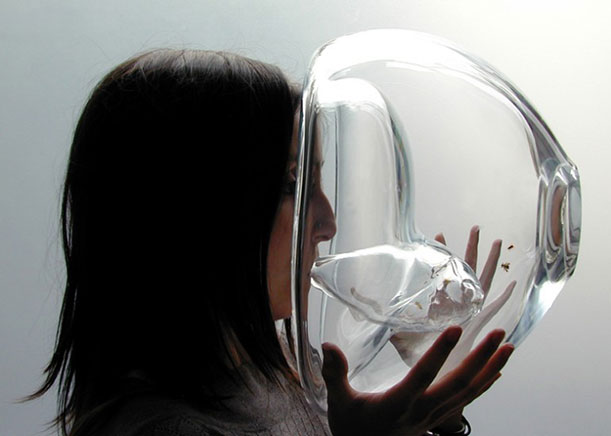
Susana Soares has created a simple, elegant way of harnessing bees to screen for a number of diseases, including cancers, like tumors of the lung and ovaries. Her glass apparatus, called “
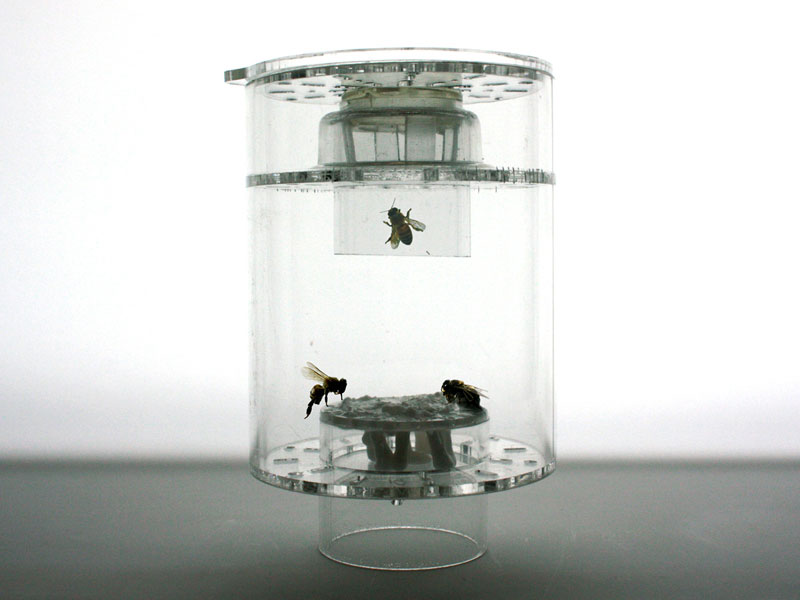
Bee’s,” features a large chamber and a smaller connected chamber housed within it. After training the bees to associate a specific chemical odor with a food reward, such as sugar, the insects are released into the diagnostic device through an opening.
Patients would simply blow into the smaller compartment and wait to see if a swarm gathers toward something alarming in the person’s breath.
The project, part of her master’s thesis at
London’s Royal College of Art, began in 2007 when Soares came across research on bees and their phenomenal olfactory abilities. After talking to researchers in the field, she learned that
certain diseases, such as lung cancer, noticeably alter the composition of bodily fluids, producing odorous compounds that show up in urine and sometimes blood. Some investigators have even been experimenting with various sensory methods to home in on these “
biomarkers.” In Philadelphia, for instance,
scientists have trained mice to identify the scent of lung cancer. Trained dogs have also been used to
sniff out ovarian cancer. Others have focused on replicating these animal abilities in
electronic nose devices that are calibrated to pick up these biomarkers undetectable to human noses.
Insects offer key advantages over mammals and electronics, however, because of their antennae. For example, electronic nose devices have trouble detecting an odor amid more complicated conditions, like when there’s a greater mixture of gases, as is found in human breath. And studies have revealed that
sniffer dogs identify odors correctly only about 71 percent of the time, while also requiring at least three months’ training.
Bees, in contrast, have achieved an accuracy rate of 98 percent and can be trained in about 10 minutes.
In developing “
Bee’s,” the Portuguese native needed something that enabled the user to easily transport bees into the instrument and safely suck them back out using a vacuum. The source material also had to be malleable enough to shape into a system with well-defined pathways that don’t impede their movement. She eventually settled on glass as the material because of its flexibility and transparency. “
To know the results of a breath test, you’d have to see the behavior of the insects,” she says. “
Everything is about their behavior.”
Prototypes have undergone field testing, and although it didn’t find any instances of cancer, it did turn up a case of diabetes that was later confirmed. It’s unlikely, though, that t
he concept will amount to anything beyond being an exhibition curiosity. While there was a brief period in which she felt ambitious enough to reach out to potential collaborators, the process proved so time consuming and unfruitful that she ultimately gave up. The only organizations that seemed even remotely interested in her idea were a handful of charities. So for now,
“Bee’s” exists as one of those purely academic exercises to show, as she puts it, the “symbiotic relationship” humans have with nature and how “technology and science can better foster these relationships.”
“
I think there’s only four labs in the world doing research into insects for disease screening, which shows you that this approach doesn’t go over well in the western world,” says Soares. “
Medical and health technologies are a big business, and the bottom line is they just don’t see how something like this can be profitable.”
Glen C. Rains, an agricultural professor at the
University of Georgia, largely concurs, though he adds that there are more complex issues besides economics. The entomologist, as well as licensed beekeeper, has
dealt with numerous challenges while developing a similar device called the
Wasp Hound, which
uses a batch of five wasps to detect the presence of bedbugs. Rains’ system is a bit more elaborate in that it uses a camera to record the wasps’ behavior. The data is then fed into software that analyzes these movements to determine if the bugs actually did indeed detect these unwanted guests. After over a decade of development, Rains has forged a partnership with
Bennett Aerospace, an engineering firm, to refine the technology for large-scale real applications.
“
The whole notion is definitely something people find fascinating,” he says. “But once you get into how it would work or how they make money, there’s no model for how it would be done.”
While there’s a tried-and-true market for electronic technologies, Rains points out that disease screening systems based on insects requires a separate infrastructure that the industry players haven’t bothered to think through. Facilities, for instance, would need a way to efficiently obtain odor samples for training and, obviously, a beekeeper on site who can manage and train the insects. After a few positive results, the insects’ willingness to buzz towards the chemical starts to diminish significantly, as they start to catch on to the fact that a sugary reward no longer await them at the other end. Thus, in a lab setting, bugs would need constant retraining throughout the day. But what’s encouraging, he adds, is that the enlisting of bugs for clinical purposes isn’t unprecedented, with the use of maggots and leaches to clean wounds being a well-accepted medical practice.
Despite these challenges, Soares has left at least the back door open to such a possibility, if someone with the right resources is willing to take a risk. “It has the potential to save so many lives,” she says. “It can even be an open-source concept, so for anyone who is interested, I’d be happy to talk.”
 |
| 01-intro |
 |
| 02-a-diagnostic-tool |
 |
| 03-a-precise-object |
 |
| 02-robert-hooke |
Bee´s / Project
Bee's explores how we might co-habit with natural biological systems and use their potential to increase our perceptive abilities.
The objects facilitate bees' odour detection abilities in human breath. Bees can be trained within 10 minutes using Pavlov’s reflex to target a wide range of natural and man-made chemicals and odours, including the biomarkers associated with certain diseases.
The aim of the project is to develop upon current technological research by using design to translate the outcome into systems and objects that people can understand and use, engendering significant adjustments in their lives and mind set.
How it works
The glass objects have two enclosures: a smaller chamber that serves as the diagnosis space and a bigger chamber where previously trained bees are kept for the short period of time necessary for them to detect general health. People exhale into the smaller chamber and the bees rush into it if they detect on the breath the odour that they where trained to target.
01 & 02 Person preparing to exhale into the small chamber
03 Negative diagnostic: bees did not detect traces of odour they were trained to target
04 Positive diagnostic: bees rushed to the small chamber were they detect the targeted odour
What can bees detect?
Scientific research demonstrated that bees can diagnose accurately at an early stage a vast variety of diseases, such as: tuberculosis, lung and skin cancer, and diabetes.
Diagnostic tool 2: person exhaling into the diagnostic chamber, 26*15 cm, prototype 2007; borosilicate; Vilabo, Portugal
Precise object
The outer curved tube helps bees avoid from flying accidentally into the interior diagnosis chamber, making for a more precise result. The tubes connected to the small chamber create condensation, so that exhalation is visible.
Precise object, 22*12 cm, prototype 2007; borosilicate; Vilabo, Portugal
Detecting chemicals in the axilla
Apocrine glands are known to contain pheromones that retain information about a person's health that bees antennae can identify.
Diagnostic tool 4 (25*16 cm) prototype 2008; borosilicate; Vilabo, Portugal
The bee clinic
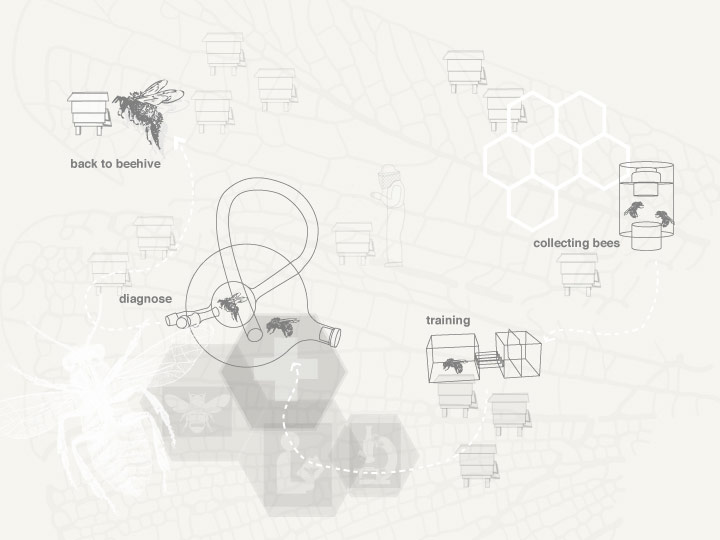
These diagnostic tools would be part of system that uses bees as a biosensor.
The systems implies:
- A BEE CENTRE: a structure that facilitates the technologic potential of bees. Within the centre is a BEEFARM, a TRAINING CENTRE, a RESEARCH lab and a HEALTHCARE CENTRE.
- TRAINING CENTER: courses can be taken on beetraining where bees are collected and trained by beetrainers. These are specialists that learn beetraining techniques to be used in a large scope of applications, including diagnosing diseases.
- BEE clinic: bees are used at the clinic for screening tests. These insects are very accurate in early medical diagnosis through detection on a person's breath. Bees are a sustainable and valuable resource. After performing the diagnose in the clinic they are released, returning to their beehive.
 |
| Bee Graphic - Complete Cycle |
What if people started to be screened by bees for cancer?
Which one would we trust more, a machine or a biosensor?
Could bee training become a profession?
Bee training
Bees can be easily trained using Pavlov’s reflex to target a wide range of natural and man-made chemicals odours including the biomarkers associated with certain diseases. The training consists in baffling the bees with a specific odour and feeding them with a solution of water and sugar, therefore they associate that odour with a food reward.
 |
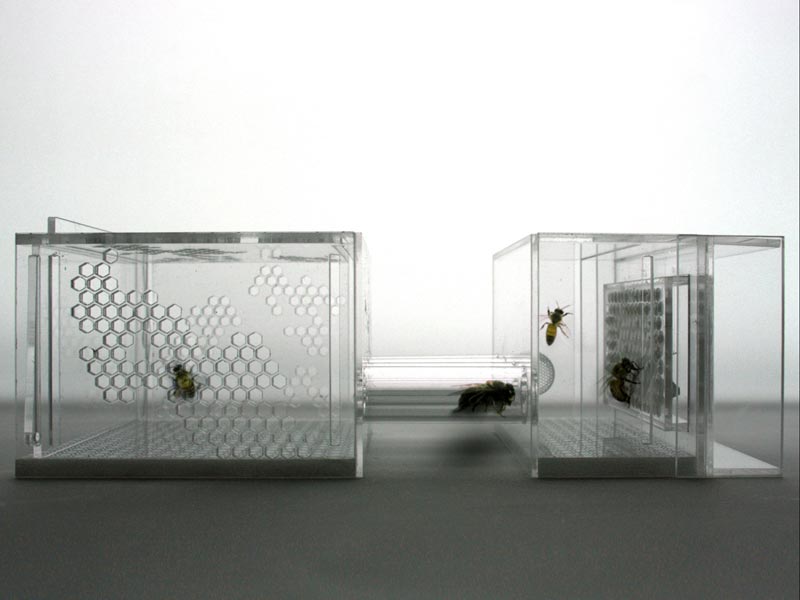
| 05 Bee catcher: this object is use to collect bees for training, a
sugary solution is used to attract them inside - 15*9 cm, prototype
2009; acrylic. |
 |
06 Bee training object - 20*7*9 cm, prototype 2009; clear acrylic & hip. |
Acknowledgements:
- Calouste Gulbenkian Foundation
- Royal College of Art, Design Interactions Department: Professor Anthony Dunne and Ms. Fiona Raby
- Crisform: Designer Sónia Durães and Glass Master Mateus
- Vilabo: Mr. João Gomes
- London Beekeeper Association: Mr. David Perkins
- Inscentinel, Bee research team at Rothamsted Research, UK: Dr. Mathilde Briens
Credits:
Susana Soares
Models:
Bernardete Fernandes
Clarie Ducruet
Margarida Martins

 Research from Greg Jefferis’s group in the LMB’s Neurobiology Division has uncovered a biological switch that determines which part of the fruit fly’s brain responds to pheromones, depending on whether the fruit fly is male or female. Previous studies have identified differences in brain structure between the sexes but this study, published in Cell, is the first description in any animal of a specific change in nerve cell wiring that reroutes information between male and female brains.