Mostrando entradas con la etiqueta visión. Mostrar todas las entradas

sábado, 13 de diciembre de 2014

Biodiversidad, la apuesta científica de Colombia

Colciencias busca poner al país entre los tres más innovadores de América Latina.

 Yaneth Giha, directora de Colciencias. Foto: Carlos Ortega / EL TIEMPO
Tener 3.000 nuevos doctores, lograr una tasa de patentes anual de 1.000, trabajar con 11.000 empresas y realizar la primera Expedición BIO son algunos desafíos de Colciencias, el Departamento Administrativo de Ciencia, Tecnología e Innovación, para hacer de Colombia el país estrella en innovación en América Latina para el 2025.

La biodiversidad será el eje transversal de esta ambiciosa política, en cabeza de Yaneth Giha, directora de la entidad, quien sueña con un gran instituto en el país que trabaje en enfermedades transmitidas por vectores y 12 museos interactivos para acercarnos a la ciencia.

Sabe que su tarea es compleja, pero asegura que los científicos, la academia, los empresarios y el Gobierno están sintonizados en este propósito. En entrevista con EL TIEMPO, Giha habló de cómo trabajará para sacar a Colombia del séptimo lugar en la región en producción científica, para ponerlo entre los tres primeros.

¿Por qué la biodiversidad como eje de su política?
Es lo que hace a Colombia un gran laboratorio para transformar el conocimiento mundial. Hay una frase del científico estadounidense de Harvard E. O. Wilson, que dice que “la biodiversidad es para Colombia lo que el petróleo es para Arabia Saudí”. Es el recurso, además renovable, más importante que puede tener un país. Es donde se encuentran posibilidades de hacer cosas para muchos sectores: para salud, cosméticos, energía, agro. Tenemos que aprovechar que somos el país más biodiverso por metro cuadrado.

Uno de sus retos es hacer la primera Expedición BIO, ¿de qué se trata?
Lo que intenta es que dejemos de hablar de que Colombia es el país más biodiverso y empecemos a usar esa biodiversidad como corresponde. Vamos a tener seis nodos en el país a donde enviaremos grupos interdisciplinarios para que hagan un inventario de la biodiversidad y empiecen a definir en qué se puede usar. Esos nodos van a estar en los 
  • los Llanos, 
  • el Amazonas, 
  • el Chocó, 
  • el Eje Cafetero, 
  • el Tayrona y 
  • Nariño.
¿Cómo está el país frente a la región en temas de ciencia, tecnología e innovación?
La gran visión que tenemos es que Colombia debe ser uno de los países más innovadores de América Latina en el 2025; por lo menos estar entre los tres primeros. Hoy, en producción científica estamos séptimos en la región. Debemos empezar a producir mucho más conocimiento de alto impacto, pero también debe haber más empresas innovadoras que saquen productos de manera permanente.

¿Seguimos viendo la ciencia como un tema lejano para nuestra realidad?
Con los resultados que vayamos teniendo a lo largo de los años este tema se irá poniendo cada vez más en primer nivel de importancia. Creo que ya lo es, pero falta que como sociedad le demos ese nivel para que de ahí en adelante sea como la típica bola de nieve con la que todo empieza a pasar.

¿Por dónde empezar?
En el país tenemos tres grandes actores en esta materia: 
  • Por un lado están las universidades, de donde sale el 80 por ciento de la investigación del país. 
  • El segundo son los centros de investigación y de desarrollo tecnológico, que son de alguna manera el vínculo entre las universidades y 
  • el tercer actor, las empresas. 
Necesitamos de manera permanente fortalecer las tres instancias.

¿Cómo acercar a las empresas?
Hoy, las empresas colombianas no innovan, menos del 1 por ciento no lo hacen de manera permanente. Vamos a trabajar con 8.000 empresas en los próximos años; pasaremos de 800 en los años anteriores. Que incorporen en su ADN empresarial la innovación, pero además les vamos a enseñar cómo hacerlo. La segunda estrategia es aceleración de la innovación. Vamos a trabajar con 2.000 empresas -en el pasado lo hemos hecho con 100- que tienen proyectos que los pueden llevar a otro nivel. Les ponemos una empresa para que los ayude a llegar a ese nivel. Y si se revisa la tasa de patentes, también se requiere un incremento muy importante: 213 patentes en el 2012. Corea es un ejemplo que está lejano: en el 2012 pidió 150.000 patentes. Nuestra meta es lograr una tasa anual de 1.000.

¿Contempla estrategias para vincular a las empresas con la academia?
El año pasado armamos las Oficinas de Transferencia Tecnológica. Lo que estas hacen es coger el conocimiento que se tiene en un lugar, que en su mayoría es con los científicos, y lo transfiere a una empresa, que es la que lo puede usar. También estamos en la idea de sacar ‘Spin offs’, que resultan cuando una universidad y una empresa se juntan, generan nuevo conocimiento y se arma una empresa a raíz de esto. Vamos por 50 nuevas empresas de base tecnológica muy grande.

¿Cómo estamos en formación de nuestros científicos?
Necesitamos empezar a tener una base humana de alguna manera de más alto nivel y en disciplinas claves para que la producción científica se incremente. Más del 70 por ciento de la gente se está enfocando en estudios muy altos en ciencias sociales, eso se seguirá trabajando, pero trataremos de equilibrarlo con las disciplinas de STEM (por su sigla en inglés, ciencias, tecnología, ingeniería y matemáticas).

¿Qué falta para acercar más a los jóvenes a la ciencia?
Falta dar un poco más esa educación con contexto para que la gente entienda para qué es la ciencia, cómo hacer que los niños entiendan toda la gama increíble del conocimiento que hay allí. Esperamos tener una nueva generación en 10 años para que esté enganchada con la ciencia. También queremos crear 12 museos interactivos, es una manera más práctica de entender el valor de la ciencia y que se entiendan todos sus usos.

¿Y ese trabajo irá a las regiones?
Todo esto tiene que pasar allá. Colombia debe tener una estrategia en la que a nivel de país definimos cuáles son las regiones que tienen cosas listas que pueden llevarlas a otro nivel. Si bien hay tres o cuatro muy avanzadas, hay otras que están en un nivel medio que necesitan crear capacidades y estamos en el plan de generárselas. Y otras que están en niveles básicos, donde no hay grupos de investigación. En Antioquia, Atlántico, Valle del Cauca y Santander ya podemos empezar a trabajar, son lugares donde pueden pasar cosas increíbles muy pronto.

Para abrirnos campo entre los mejores tenemos que difundir lo que hacemos, ¿los científicos ven esto importante?
Se los dije, tengo que sacarles los secretos. Necesitamos que ellos sientan que los suyo es importante, que entiendan que el conocimiento que generan tiene una utilidad para la sociedad más allá de sus propios artículos. Colciencias será el gran articulador para visibilizar lo que pasa en el país en ciencia e innovación.

¿Se trabaja de cerca con los investigadores que están afuera en grandes proyectos?
Tenemos una base de datos de nuestros investigadores en el exterior, pero no solo se trata de eso sino de juntarlos. El año entrante vamos a hacer seis encuentros de temas importantes para el país, atrayendo a quienes están afuera y adentro.

Expertos señalan que la mejor política científica es crear oportunidades en abundancia, ¿lo estamos haciendo acá?
Creo que en el país las hay y las universidades son el espacio que las está ofreciendo. Sin embargo, hay que fomentar espacios en las empresas para que ese conocimiento también llegue a ese lado de la cadena, que se puede convertir en el gran detonador de cambios en el país a nivel de competitividad. Además, hay que convocar a los investigadores en torno a temas estratégicos que marquen al país.

En esa orden, plantea macroproyectos para vincularlos más a ello, ¿cuáles serían?
Sueño con tener un gran instituto en Colombia que trabaje en enfermedades transmitidas por vectores, porque tenemos unos desarrollos impresionantes en malaria, dengue, tuberculosis. Sueño con un gran proyecto de biorefinería y que Colombia se convierta en un país con centros especializados en temas agrícolas para que las cadenas sean mucho más productivas y eficientes. Las tres cosas en las que Colombia puede llegar a ser líder son las que el mundo pide: 
  • salud, 
  • energía y 
  • alimentos.

¿Podremos asumir el costo de esta política tan ambiciosa?
Estamos haciendo unas revisiones profundas de cuánto nos cuesta cada una de las metas. Por ejemplo, tener el programa de doctorados, vamos a trabajar en 3.000 becas en los próximos años, lo que nos cuesta unos 100.000 millones de pesos anuales y vamos a hacer el esfuerzo para que Colombia tenga esto porque es la base humana que hace la investigación. Estamos revisando cuánto nos cuesta tener ese gran centro de investigaciones en enfermedades transmitidas por vectores. Así estamos haciendo con todas las estrategias que vamos a desarrollar.

VIDA


ORIGINAL: El Tiempo
Por: VIDA
12 de diciembre de 2014

martes, 15 de abril de 2014

Google’s Microcamera Contact Lens Is Coming to an Eyeball Near You


Forget those glasses. The tech giant has filed a patent application for a lens with a built-in micro-camera which could be controlled by blinking and would process data to help blind people "see" and link to smartphones

After Google Glass, the next “moon shot” Google product might very well be a contact lens with a built-in micro-camera.

The tech giant has filed a patent application on a smart lens with sensors that could detect light, pattern of colors, objects and faces.

Those wearing the contacts would command the device through a sophisticated system of unique blinking patterns, as explained by the blog Patent Bold.

Google’s latest breakthrough could help blind people see certain moving objects around them, according to Patent Bolt.

“For example, a blind person wearing Google’s contact lens with a built-in camera may be walking on a sidewalk and approaching an intersection. The analysis component of the contact lens can process the raw image data of the camera to determine … that there is a car approaching the intersection.”

The lens would also have wireless capabilities to be hooked up to smartphones.

In January, Google revealed a prototypes of contact lenses that will make it easier for diabetes patients to monitor their blood sugar levels and stay healthy.

ORIGINAL: Time
April 15, 2014

martes, 11 de marzo de 2014

What Is the Resolution of the Human Eye?

The new iPhone camera is 8-megapixels. Meanwhile, Canon is reportedly testing a new DSLR with 75-megapixels. But how many megapixels is the human eye? That is, how many megapixels would an image the size of your field of vision need to be to look normal?

Well, as Vsauce explains in its latest video, the better question is actually:
What is the resolution of the human eye? 


It's a complicated question, one that must take into account the peculiar anatomy of the eye which is different than the less peculiar engineering of a digital camera. As such, it's worth watching all ten minutes of the video, explaining not only how we see but also how well. Spoiler: the human eye is 576 megapixels—but really only about 7 megapixels matter. [YouTube]

ORIGINAL: Gizmodo
By Adam Clark Estes

lunes, 20 de enero de 2014

How EnChroma’s smart sunglasses can help solve color blindness

ABC 7. The EnChroma glasses

 Wearable technology is proving to be hugely beneficial to people with a variety of disabilities and health conditions.

In Berkeley, a group of engineers is developing smart sunglasses that can help color-blind people identify and better discriminate between colors. The startup, called EnChroma, initially received funding for its research from the National Institutes of Health (NIH).

It’s a huge potential market. According to the website We Are Colorblind, around 8 percent of the male population of the planet is color blind.

For some color-blind people, driving is challenging, as it can be difficult to discern between a red and green traffic light. Former New York Times writer David Pogue is color blind and gave the glasses a try. Pogue doesn’t have any trouble driving, but doesn’t see deep greens and reds.
EnChroma

The Explorer Glasses will set you back $600

“Yards full of leafy trees and plants suddenly had different shades of green. Everywhere I looked, desaturated or barely discernible red things were popping,” wrote Pogue. “There was a weird sensation of seeing red and green areas in the periphery of my vision.”


According to a company spokesperson, color-blind wearers of Enchroma’s smart “Cx Explorer” glasses experience up to a 30 percent improvement in ability to identify colors and a 70 percent improvement in color discrimination.

The sunglasses are designed to be worn outdoors in bright light — not artificial light. The company wouldn’t advise wearing them at work, to read, or watch videos on a computer screen.

In an email interview, cofounders Don McPherson and Tony Dykes detailed how EnChroma’s technology rivals other products. According to the founders, most products on the market will use strongly tinted red and magenta lenses.

“A side effect is that these aids distort your overall perception of color, completely eliminating some colors and flattening out your depth perception,” the company wrote to me. “They also look rather silly.”

Meanwhile, EnChroma uses a mathematical formula to directly communicate with the brain’s visual system. This system is calculated to help a color-blind person observe the correct ratios the brain needs for normal color vision. The company uses over 100 reflective coatings at different opacities rather than a single tinted lens.
McPherson, a material sciences expert, initially had the idea for the technology when making very expensive glass laser-protective eyewear. These glasses would sell to hospitals for $1,600 a pop. McPherson consistently received reorders, as the glasses would be stolen by the surgeons to wear as normal sunglasses. He began wearing them too and noticed at a frisbee game that he could see orange cones for the first time.

After noticing he was color blind, McPherson began working on a prototype for others like him. EnChroma’s Explorer glasses are available for a more affordable (but still heart-skipping) $600.

EnChroma has raised $1.3 million from angel investors and the NIH to date. The company plans to raise about $2 to $4 million in February from venture capitalists. The goal is to use the same technology to benefit people with a variety of vision problems.

To see the glasses in action, check out the video from ABC’s San Francisco affiliate. You can also order a pair to try — there’s a 30 day money-back guarantee.


ORIGINAL: Venture Beat
January 20, 2014

lunes, 16 de diciembre de 2013

Think Google Glass is cool? These specs can see through your skin

We’ve all been there: Sitting awkwardly on a doctor’s table, as a nurse stabs you repeatedly, trying to find a vein to draw some blood. It’s painful – and it could soon become a thing of the past, thanks to a nifty pair of x-ray glasses from Silicon Valley-based imaging firm Evena Medical.

Evena’s Eyes-On Glasses enable nurses (or any other user) to clearly see the veins beneath your skin, and choose the “best” vein for whatever reason a nurse might need to stick you with a needle. Eyes-On is similar to other medical devices made by Evena – but those are big, and need to be carted from room to room. Eyes-On can be worn like a pair of Google Glass, presumably making the process all that much easier.

“Studies have shown that up to 40 percent of IV starts require multiple attempts to locate and access a vein, which not only wastes valuable nursing time but also delays therapy and causes patient discomfort and dissatisfaction,” said Frank Ball, Evena Medical President and CEO, in a statement. “With Evena’s Eyes-On Glasses, nurses can quickly and easily locate and access the best veins for each patient – even in challenging clinical environments such as pediatric or neonatal units.”

The tech that gives Eyes-On Glasses their x-ray superpowers comes from Epson (yes, the same Epson that makes printers). The company’s Moverio smartglasses technology gives users a taste of augmented reality thanks to its transparent display that “projects overlays of digital content onto the real-world in the center of the wearer’s field of view … enabling a seamless blend of the physical and digital worlds,” according to Evena.

The Eyes-On Glasses also packs on-board storage for saving images of patients’ vein patters, and “telemedicine” capabilities (probably Wi-Fi) that let nurses easily share the images with doctors straight from the device.

Evena expects to start shipping Eyes-On Glasses in the first quarter of 2014, so don’t be surprised when your nurses walk in looking like they just came off the set of an 80s sci-fi movie.

Check out a (slightly disturbing) video of Eyes-On in action below:


Evena Eyes-On™ Glasses The newest addition to the Evena family of products is the one-of-a-kind point-of-care wearable Eyes-On™ Glasses system. Evena Eyes-On Glasses provide all the same imaging technology advantages as other Evena products, but in a cost-effective, cart-free, wearable form. The Evena Glasses system is appropriate for pre-hospital, physician offices, clinics or hospitals. The Glasses unit is battery powered and offers the ultimate in portability and ease of use.
Unique Eyes-on Glasses features include:
  • Multi-Spectral Imaging - a breakthrough patented technology developed by Evena for the deepest penetration with the most detailed and sharpest image is effective for almost all physiologies.
  • Real-time anatomically accurate images – no other system provides such exceptionally clear, accurate images.
  • EMR/PACS interface enables automated, improved and more precise documentation of appropriate care, including verification of vein patency.
  • Hands-free, cart-free, wearable technology allows medical staff to maneuver anywhere anytime with the complete vasculature image right before their eyes.
  • See-through, Eyes-On technology allows the user to have full situational awareness, to keep eye contact with the patient plus a clear view of the patient’s area of interest, enabling quick and easy location and access to the best vein.
Evena Sparrow is not available in the U.S., EU and many other developed nations
ORIGINAL: Digital Trends; Evena
November 20, 2013

jueves, 25 de julio de 2013

Scientists transplant photoreceptors from retina grown ‘in a dish’

ORIGINAL: UCL
21 July 2013
Professor Robin Ali, UCL Institute of Ophthalmology (Credit: UCL)
UCL scientists have carried out the first successful transplant of light-sensitive photoreceptor cells extracted from a synthetic retina, grown ‘in a dish’ from embryonic stem cells.
When transplanted into night-blind mice these cells appeared to develop normally, integrating into the existing retina and forming the nerve connections needed to transmit visual information to the brain.

The study, funded by the Medical Research Council (MRC) and published today in Nature Biotechnology, suggests that embryonic stem cells could in future provide a potentially unlimited supply of healthy photoreceptors for retinal cell transplantations to treat blindness in humans.

The loss of photoreceptors – light sensitive nerve cells that line the back of the eye – is a leading cause of sight loss in degenerative eye diseases such as age-related macular degeneration, retinitis pigmentosa and diabetes-related blindness.

There are two types of photoreceptor in the eye – rods and cones. Rod cells are especially important for seeing in the dark as they are extremely sensitive to even low levels of light.

The new 3D technique more closely mimics normal development, which means we are able to pick out and purify the cells at precisely the right stage to ensure successful transplantation. The next step will be to refine this technique using human cells to enable us to start clinical trials.

Professor Robin Ali, UCL Institute of Ophthalmology
Previous work by Professor Robin Ali and his team at the UCL Institute of Ophthalmology and Moorfields Eye Hospital has shown that transplanting immature rod cells from the retinas of healthy mice into blind mice can restore their sight. However, in humans this type of therapy would not be practical for the thousands of patients in need of treatment.

Using a new laboratory technique involving 3D culture and differentiation of mouse embryonic stem cells, which was developed recently in Japan, Prof Ali’s team were able to grow retinas containing all the different nerve cells needed for sight.

Professor Ali, UCL Institute of Ophthalmology and Moorfields Eye Hospital, who led the research, said: “Over recent years scientists have become pretty good at working with stem cells and coaxing them to develop into different types of adult cells and tissues. But until recently the complex structure of the retina has proved difficult to reproduce in the lab. This is probably because the type of cell culture we were using was not able to recreate the developmental process that would happen in a normal embryo.

“The new 3D technique more closely mimics normal development, which means we are able to pick out and purify the cells at precisely the right stage to ensure successful transplantation. The next step will be to refine this technique using human cells to enable us to start clinical trials.”

The researchers grew retinal precursor cells using the new 3D culture method and compared them closely with cells developed normally, looking for different markers at different stages of development. They also carried out tests to look at the genes being expressed by the two types of cells to make sure they were biologically equivalent.

They then transplanted around 200,000 of the artificially grown cells by injecting them into the retina of night blind mice. Three weeks after transplantation the cells had moved and integrated into the recipient mouse retina and were beginning to look like normal mature rod cells. These cells were still present six weeks after transplantation. The researchers also saw nerve connections (synapses), suggesting that the transplanted cells were able to connect with the existing retinal circuitry.

Dr Rob Buckle, Head of Regenerative Medicine at the MRC, said: “Regenerative medicine holds a great deal of promise for treating degenerative diseases and the eye is one area in particular where scientists are making very rapid progress. This study is an important milestone on the road to developing a widely available cell therapy for blindness as it proves unequivocally that embryonic stem cells can provide a renewable source of photoreceptors that could be used in treatments.”

-Ends-

Media contact: David Weston


Links:
Full paper in Nature Biotechnology (£)
Related images on the UCL Flickr stream
A nascent retina, generated from a 3D embryonic stem cell culture
A nascent retina, generated from a 3D embryonic stem cell culture, containing photoreceptor precursors expressing normal photoreceptor proteins, including the visual pigment, Rhodopsin (green) and the transcription factor, Crx (red). The precursors from such retinae can be isolated and transplanted into adult mice.
Image by Anai Gonzalez-Cordero. Read the press release at: bit.ly/1dPdfrp

domingo, 14 de julio de 2013

What is Artificial Intelligence?


Add caption
The term Artificial Intelligence (AI) was coined by John McCarthy in 1956. According to him AI is defined as "the science and engineering of making intelligent machines."

The Merriam Webster's Collegiate Dictionary gives us the following two meanings:

1 : the capability of a machine to imitate intelligent human behavior
2 : a branch of computer science dealing with the simulation of intelligent behavior in computers


As we can see, today the primary meaning of the term is to denote any non-human or non-biological and hence "artificial" entity capable of imitating "intelligent" human behavior. What we may need to add is that while the original meaning pertained exclusively to mechanistic entities such as robots and computers, today the term can be used to denote electronic, digital, virtual or other non-biological and/or disembodied entities which exhibit the function of intelligence.


miércoles, 8 de mayo de 2013

Insect-Eye Digital Camera Sees What You Just Did

ORIGINAL: NatGeo
by Ed Yong


Almost all of our cameras form images by using a single lens to focus light onto a light-sensitive sheet. That’s how our own eyes actually work, but there are many other ways of seeing the world. Arthropods—insects, spiders and their kin—have compound eyes, which consist of hundreds or thousands of individual units or ommatidia. Each one has its own lens and light detectors. They form separate images, which are then united in the brain. And since arthropods greatly outnumber all other animals, the vast majority of eyes are compound ones. 

Now, John Rogers from the University of Illinois at Urbana-Champaign has developed a camera that mimics compound eyes. It might not have the same resolution as a state-of-the-art digital camera, but it compensates with many advantages that make it ideal for surveillance. Perhaps in the future, we’ll be watched by man-made flies on the walls. 

Rogers chose to mimic apposition eyes—a type of compound eye where each ommatidium sees a narrow part of the insect’s visual field, effectively capturing just one pixel of a full image. 

First, his team makes a grid of tiny light-sensitive diodes out of silicon. They’re connected by flexible S-shaped wires that allow the grid to flex without breaking. On top of that, they lay a sheet of silicone (PDMS) that’s moulded into small bubble-shaped lenses, one sitting over each diode. The two layers are fused together and deformed into a dome. Each diode-and-lens combo acts as an ommatidium and the full camera has 180 of them, each pointing in a slightly different direction. 


The camera builds on decades of Rogers’ work on flexible electronics—devices that are largely made of brittle, rigid materials like silicon, but can flex and curve like living tissues. He has created “electronic-skin” that can be applied like tattoos and used to measure muscle and nerve activity, sensors that can mould to the shape of the brain or heart, and even electronics that dissolve over time. 

Rogers’ inventions include a flexible camera that’s based on our own eyes. Like other cameras, this one has a lens and a sheet of light detectors that acts as a retina. But while modern cameras have flat ‘retinas’, Rogers’ machine has a curved one, just like our actual eyes. This makes it more compact. Much of the weight of modern cameras comes from bulky secondary lenses that correct the incoming light so it can project onto a flat surface without distortions. With a curved retina, you don’t need these lenses, and the camera can shrink. 

With one eyeball camera in the works, it might seem strange that the team decided to build a compound one too. After all, compound eyes—especially apposition ones—aren’t that sensitive to light and have fairly low resolution. Dan-E. Nilsson, who studies insect vision at Lund University, says, “The type of compound eye they have mimicked has long been known to be a poor solution to vision. And to have one private lens for every pixel in the image is the most inefficient use possible of the space available for an eye.” 

But, wait! Compound eyes have some advantages. Since their ommatidia point in all directions, they give their owners a panoramic 180-degree view of the world that’s clear over the entire field of view. By contrast, our eyes can only see a narrow angle ahead of us, and the images they form are only sharp at the very centre of our visual field. 

Compound eyes also have an almost infinite depth of field—that is, objects stay in focus regardless of how far they are from the eye. So, flies can clearly see something far and near objects at the same time, without having to adjust any lenses. And compound eyes are also exquisitely sensitive to movement, since their owners can compare the passage of shapes across different ommatidia. 

Wide angles. Sharp focus at all distances. Sensitivity to movement. If you were building a surveillance camera, these are exactly the properties you’d want. Indeed, Rogers thinks that surveillance is an obvious application for his fly-eye design. 

In a related editorial, Alexander Borst and Johannes Plett from the Max-Planck-Institute of Neurobiology suggest that the cameras might be useful for controlling tiny drones. At the moment, these use normal cameras with fish-eye lenses to give them a wide field of view. An insect-eye camera could do the same, while possibly making the robot more sensitive to movements. 

“It’s great work, and a nice example of biomimetics,” says Nicholas Roberts from the University of Bristol, who studies animal eyes. Although it doesn’t tell us anything that “crosses back to biology”, the camera’s huge depth of field is a “nice benefit over single lens designs”. 

And though Rogers admits that while the fly-eye camera will never match the resolution of a normal one, he thinks that’s not a deal-breaker. “If you can combine multiple images over time, you can effectively get a high resolution,” he says. “Surveillance cameras use this trick to spot speeding cars – the resolution from a single frame can’t identify the letters on a licence plate.” 

There’s obviously room for improvement but with 180 ommatidia, the digital camera is already more sophisticated than the eyes of some insects—some worker ants, for example, only have 100 in each eye. But it’s a long way off from the best insect eyes, like those of the green darner dragonfly (28,000 ommatidia) or the praying mantis (15,000). For the moment, nature still wins. 

Reference: Song, Xie, Malyarchuk, Xiao, Jung, Choi, Liu, Park, Lu, Kim, Crozier, Huang & Rogers. 2013. Digital cameras with designs inspired by the arthropod eye. Nature http://dx.doi.org/10.1038/nature12083

domingo, 21 de abril de 2013

Why Mantis Shrimp is my new favorite animal

ORIGINAL: Oatmeal


Additional notes from the author
This comic was inspired by this wonderful podcast about color from RadioLab. If you've never listened to RadioLab, today should be the day you start.
If anyone knows of an aquarium that houses a mantis shrimp, please let me know. I'd love to visit.

Lastly, a big thank you to Jane C. Daugherty for proofreading this comic for me. If you want to learn things from the most awesome librarian this side of the North American tectonic plate, follow her on Twitter.

miércoles, 13 de febrero de 2013

Night-vision rat becomes first animal with sixth sense

ORIGINAL: New Scientist
Douglas Heaven, reporter
13 February 2013


The latest bionic superhero is a rat: its brain hooked up to an infrared detector, it's become the first animal to be given a sixth sense.

Developed by Miguel Nicolelis and colleagues at Duke University in Durham, North Carolina, the system connects a head-mounted sensor to a brain region that normally processes touch sensations from whiskers. As shown in this video, the rat's brain is tricked when infrared light is detected, giving it a new sense organ. "Instead of seeing, the rats learned how to touch the light," says Nicolelis.

Even though the touch-processing brain area acquires a new role, the team found that it continues to process touch sensations from whiskers, somehow dividing its time between both types of signal. "The adult brain is a lot more plastic than we thought," says Nicolelis.

The finding could lead to new brain prostheses that restore sight in humans with a damaged visual cortex. By bypassing the damaged part of the brain altogether, it might be possible to wire up a video camera to a part of the brain that processes touch, letting people "touch" what the camera sees.

According to Nicolelis, it could also lead to superhero powers for humans. "It could be X-rays, radio waves, anything," he says. "Superman probably had a prosthetic device that nobody knew of."

lunes, 7 de enero de 2013

Totally blind mice get sight back

ORIGINAL: BBC
By James Gallagher Health and science reporter, BBC News

Totally blind mice have had their sight restored by injections of light-sensing cells into the eye, UK researchers report.

The team in Oxford said their studies closely resemble the treatments that would be needed in people with degenerative eye disease.

Similar results have already been achieved with night-blind mice.

Experts said the field was advancing rapidly, but there were still questions about the quality of vision restored.

Patients with retinitis pigmentosa gradually lose light-sensing cells from the retina and can become blind.

“It's the first proof that you can take a completely blind mouse, put the cells in and reconstruct the entire light-sensitive layer” Prof Robert MacLaren University of Oxford

The research team, at the University of Oxford, used mice with a complete lack of light-sensing photoreceptor cells in their retinas. The mice were unable to tell the difference between light and dark.

Reconstruction

They injected "precursor" cells which will develop into the building blocks of a retina once inside the eye. Two weeks after the injections a retina had formed, according to the findings presented in the Proceedings of the National Academy of Sciences journal.

Prof Robert MacLaren said: "We have recreated the whole structure, basically it's the first proof that you can take a completely blind mouse, put the cells in and reconstruct the entire light-sensitive layer."

Previous studies have achieved similar results with mice that had a partially degenerated retina. Prof MacLaren said this was like "restoring a whole computer screen rather than repairing individual pixels".

The mice were tested to see if they fled being in a bright area, if their pupils constricted in response to light and had their brain scanned to see if visual information was being processed by the mind.

Vision
Prof Pete Coffee, from the Institute of Ophthalmology at University College London, said the findings were important as they looked at the "most clinically relevant and severe case" of blindness.

"This is probably what you would need to do to restore sight in a patient that has lost their vision," he said.

However, he said this and similar studies needed to show how good the recovered vision was as brain scans and tests of light sensitivity were not enough.

He said: "Can they tell the difference between a nasty animal and something to eat?"

Prof Robin Ali published research in the journal Nature showing that transplanting cells could restore vision in night-blind mice and then showed the same technique worked in a range of mice with degenerated retinas.

He said: "These papers demonstrate that it is possible to transplant photoreceptor cells into a range of mice even with a severe level of degeneration.

"I think it's great that another group is showing the utility of photoreceptor transplantation."

Researchers are already trialling human embryonic stem cells, at Moorfields Eye Hospital, in patients with Stargardt's disease. Early results suggest the technique is safe but reliable results will take several years.

Retinal chips or bionic eyes are also being trialled in patients with retinitis pigmentosa.

miércoles, 18 de julio de 2012

Bio-Retina Implant Could Give Laser-Powered Sight to the Blind

ORIGINAL: PopSci
By Arnie Cooper
2012/07/16

Instant Eye Kevin Hand
A new bionic eye implant could allow blind people to recognize faces, watch TV and even read. Nano Retina’s Bio-Retina is one of two recent attempts to help patients with age-related macular degeneration, which affects 1.5 million people in the U.S. Although a similar implant, Second Sight’s Argus II, has been on the market in Europe since last year, it requires a four-hour operation under full anesthesia because it includes an antenna to receive power and images from an external apparatus. The Bio-Retina implant is smaller because it doesn’t have an antenna. Instead, the implant captures images directly in the eye, and a laser powers the implant remotely. Because of Bio-Retina’s compact size, an ophthalmologist can insert it through a small incision in the eye in 30 minutes—potentially more appropriate for seniors. The Bio-Retina will generate a 576-pixel grayscale image. And clinical trials could begin as soon as next year.

1. DON GLASSES
Ordinary-looking glasses contain a battery, a power-delivering laser apparatus and working lenses (to help with vision problems such as nearsightedness and astigmatism).

2. SHINE LASER POWER
The near-infrared laser beam, gentle enough to shine harmlessly through the eye onto the implant, provides up to three milliwatts of power to a photovoltaic cell on the eye implant. The light is invisible, so it won’t interfere with sight.

3. CAPTURE IMAGE
Photoreceptors pass light information to an image processor that translates each image pixel into a series of electrical pulses that represent a particular shade of gray.

4. TRIGGER NEURONS
(Inset) Six hundred needle electrodes (wrapped in biocompatible silicon and sapphire to prevent the formation of scar tissue) penetrate the retina. Each electrode represents one pixel, sending pulses of electricity to stimulate the eye’s neurons, which transmit the image to the brain.

domingo, 3 de junio de 2012

Slow Motion Raptor Strikes

ORIGINAL: Smarter Every Day

Andrew is a student worker at the SRC's Education unit. He is also the 2011-2012 President of Auburn University's Society for Conservation Biology.

The Southeastern Raptor Center (SRC) is a facility dedicated to the care and conservation of birds of prey, with the mission statement being "Education, Conservation, Rehabilitation". Part of the Auburn College of Veterinary Medicine, the SRC is comprised of a rehabilitation and education unit. The rehabilitation unit takes in hundreds of ill, injured, and orphaned raptors every year, while the education unit gives presentations to over 30,000 people annually. For more information on the Southeastern Raptor Center check out their website:
Look at their website at the Southeastern Raptor Center to learn more. 
THEY'LL BRING THE EAGLES TO YOU!

www.auburn.edu/raptor

viernes, 25 de mayo de 2012

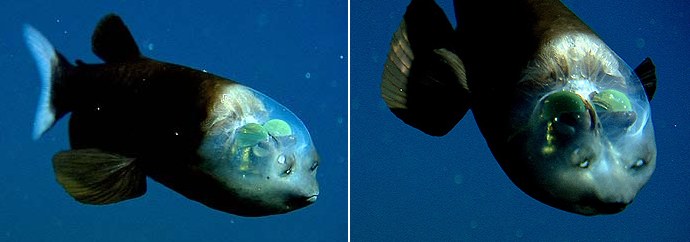
Resuelven el misterio del pez de cabeza transparente

ORIGINAL: Fogonazos
24 febrero 2009
Imágenes: Acuario de Monterrey
Investigadores del Acuario de la Bahía de Monterey acaban de resolver uno de los enigmas que intrigaba desde hacía años a los biólogos marinos: la utilidad de la cabeza transparente del pez Macropinna microstoma y sus ojos tubulares. Después de estudiar concienzudamente su comportamiento en aguas profundas de California, los investigadores han llegado a la conclusión de que este mecanismo le permite aumentar su ángulo de visión y detectar mejor a sus presas. En otras palabras: el pez ve a través de su propia cabeza.


Las imágenes de esta criatura pueden resultar engañosas, puesto que sus ojos no son los dos puntos oscuros que veis en la parte frontal de la cabeza, sino esas dos estructuras verdes que flotan en su interior. Ambos ojos pueden rotar literalmente dentro del cráneo y permiten al pez observar lo que sucede por encima de él, de frente y a ambos lados. Los dos puntos oscuros de la parte delantera son en realidad dos órganos olfatorios.