Mostrando entradas con la etiqueta Fukushima. Mostrar todas las entradas

martes, 11 de marzo de 2014

Meet the Robots of Fukushima Daiichi

A cleanup crew of automatons will go where humans fear to tread

http://spectrum.ieee.org/ns/slideshows/03SS_FukushimaRobo5a/fullscreen/03w.slides_ackbot.jpg
1 / 14 Photo: TEPCO 
Entering the Danger Zone: In March 2011, a series of meltdowns and explosions turned the Fukushima Daiichi nuclear power station into a radioactive ruin. The damaged reactor buildings are far too radioactive for humans to safely work in, so robots are surveying radiation levels and starting the cleanup. The PackBot, an inspection bot from iRobot of Bedford, Mass., was one of the first bots to arrive at the site.

http://spectrum.ieee.org/ns/slideshows/03SS_FukushimaRobo5a/fullscreen/03w.slides_quince.jpg
2 / 14
Photo: The Yomiuri Shimbun/AP Photo
Homegrown: Despite Japan’s thriving robotics industry, there were few domestically produced robots capable of working in a rubble-strewn disaster site. This Quince, built by researchers at the Chiba Institute of Technology, near Tokyo, was one of the few that was ready to go.

3 / 14
Photo: TEPCO

A Bot’s-Eye View: After hundreds of tests, plant owner TEPCO cleared the Quince robots to enter the Fukushima Daiichi reactor buildings. The bots send back video and radiation readings to TEPCO workers who are planning the cleanup and decommissioning efforts. The Quince’s tanklike treads allow it to climb up and down the steep stairs inside the buildings.


4 / 14

Photo: Kyodo/AP Photo

Bigger and Tougher: The next-generation robot from the Chiba Institute researchers, Sakura, can roll over rubble or through shallow pools of water. It can also carry heavy equipment, like a camera capable of detecting dangerous gamma radiation.

http://spectrum.ieee.org/ns/slideshows/03SS_FukushimaRobo5a/fullscreen/03w.slides_cosora.jpg

5 / 14

Photo: Kyodo/AP Photo

Has Arms, Will Travel: After the accident, the Japanese government gave grants to leading industrial companies to help them develop robots that can assist with cleanup efforts. Hitachi built the ASTACO-SoRa, whose two arms can be fitted with pinchers, cutting blades, or drills.

http://spectrum.ieee.org/ns/slideshows/03SS_FukushimaRobo5a/fullscreen/256_03w.slides_cosora.jpg
6 / 14

Photo: TEPCO

One Piece at a Time: The ASTACO-SoRa has already begun work inside the Fukushima Daiichi reactor buildings. Each of its arms can reach 2.5 meters and lift 150 kilograms. The bot can clear a path through the debris for other decontamination robots and, eventually, for humans.

http://spectrum.ieee.org/ns/slideshows/03SS_FukushimaRobo5a/fullscreen/03w.slides_trapod.jpg

7 / 14

Photo: Yoshikazu Tsuno/AFP/Getty Images

Walking Tall: Toshiba developed this four-legged robot that can walk on uneven surfaces, avoid obstacles, and climb stairs. So far it's equipped with cameras and dosimeters, as well as a small camera-topped companion bot, which can be inserted into tight spaces. The company wants to add arms so the tetrapod can install shielding, patch leaks, and remove debris.

http://spectrum.ieee.org/ns/slideshows/03SS_FukushimaRobo5a/fullscreen/03w.slides_dryice.jpg
8 / 14

Photo: Yoshikazu Tsuno/AFP/Getty Images

A Big Blaster: To bring down radiation levels inside the reactor buildings, robots must scrub surfaces clean and suck up the resulting muck. Toshiba’s new decontamination robot will use high-pressure jets of dry ice to scour away radioactive materials, along with top layers of paint or concrete.

http://spectrum.ieee.org/ns/slideshows/03SS_FukushimaRobo5a/fullscreen/03w.slides_racoon.jpg
9 / 14

Photo: TEPCO

For the Floor: The Raccoon, from Atox, has been scrubbing floors inside reactor buildings. Radiation levels must be brought down so human workers can go inside to plan the next stages of the decommissioning process: stopping up leaks and removing the melted fuel from the damaged reactors.

http://spectrum.ieee.org/ns/slideshows/03SS_FukushimaRobo5a/fullscreen/03w.slides_eister.jpg

10 / 14

Photo: Kyodo/AP Photo

Armed for Duty: Mitsubishi Heavy Industries contributed this two-armed bot, the MHI-MEISTeR. Its arms can be fitted with a variety of tools, including one drill that can take a core sample from concrete walls and floors. Each arm has seven degrees of freedom, making the bot a versatile and flexible worker.

http://spectrum.ieee.org/ns/slideshows/03SS_FukushimaRobo5a/fullscreen/03w.slides_yrobot.jpg


11 / 14

Photo: Honda

Looking Up: This long-necked survey bot, built by Honda and Japan’s National Institute of Advanced Industrial Science and Technology, can inspect high and inaccessible areas. The robot’s mast can extend 7 meters, and the flexible arm on top can peek around obstacles. The robot uses movement systems developed for ASIMO, Honda’s famous humanoid robot.

http://spectrum.ieee.org/ns/slideshows/03SS_FukushimaRobo5a/fullscreen/03w.slides_iraffe.jpg

12 / 14

Photo: Kiyoshi Ota/Bloomberg/Getty Images

Lofty Ambition: The Super Giraffe from Mitsubishi is another tall bot, unfolding and extending to reach 8 meters high. An arm atop the telescoping ladder is equipped with a tool to open and close valves, and Mitsubishi is developing other tools for applications such as welding and drilling. This bot can operate for 5 hours thanks to a lithium-ion battery adapted from Mitsubishi’s electric vehicles.
http://spectrum.ieee.org/ns/slideshows/03SS_FukushimaRobo5a/fullscreen/03w.slides_velink.jpg 
13 / 14
Photo: Activelink

An Exoskeleton Assist: While TEPCO hasn’t yet expressed interest in exoskeleton technology for its Fukushima Daiichi workers, that hasn’t stopped roboticists from building systems and suggesting them for use in the power plant. This Powerloader from Activelink, a subsidiary of Panasonic, could help workers bear the weight of heavy radiation suits and allow them to manipulate heavy objects.


14 / 14

Photo: Yoshikazu Tsuno/AFP/Getty Images

Robotic Muscle: Cyberdyne has upgraded its exoskeleton technology to be suitable for Fukushima Daiichi. Its current offering, which includes radiation shielding and biomedical sensors, allows workers to lift heavy loads.


ORIGINAL: IEEE Spectrum
By Eliza Strickland
28 Feb 2014

domingo, 17 de noviembre de 2013

The Fukushima Radiation Leak Is Equal To 76 Million Bananas (per hour)


There’s much screaming and shouting from the usual suspects about the new radiation leak discovered at Fukushima, the stricken nuclear power plants in Japan. What they’re not telling you is that the radiation leakage is around the same as 76 million bananas. A fact which should help to put it all into some perspective. Here’s Greenpeace:

Environmental group Greenpeace said Tepco had “anxiously hid the leaks” and urged Japan to seek international expertise.

“Greenpeace calls for the Japanese authorities to do all in their power to solve this situation, and that includes increased transparancy…and getting international expertise in to help find solutions,” Dr Rianne Teule of Greenpeace International said in an e-mailed statement.

Not that Greenpeace is ever going to say anything other than that nuclear power is the work of the very devil of course. And the headlines do indeed seem alarming:

Radioactive Fukushima groundwater rises above barrier – Up to 40 trillion becquerels released into Pacific ocean so far – Storage for radioactive water running out.

Or:

Tepco admitted on Friday that a cumulative 20 trillion to 40 trillion becquerels of radioactive tritium may have leaked into the sea since the disaster.

Most of us haven’t a clue what that means of course. We don’t instinctively understand what a becquerel is in the same way that we do pound, pint or gallons, and certainly trillions of anything sounds hideous. But don’t forget that trillions of picogrammes of dihydrogen monoxide is also the major ingredient in a glass of beer. So what we really want to know is whether 20 trillion becquerels of radiation is actually an important number. To which the answer is no, it isn’t. This is actually around and about (perhaps a little over) the amount of radiation the plant was allowed to dump into the environment before the disaster. Now there are indeed those who insist that any amount of radiation kills us all stone dead while we sleep in our beds but I’m afraid that this is incorrect. We’re all exposed to radiation all the time and we all seem to survive long enough to be killed by something else so radiation isn’t as dangerous as all that.

At which point we can offer a comparison. Something to try and give us a sense of perspective about whether 20 trillion nasties of radiation is something to get all concerned about or not. That comparison being that the radiation leakage from Fukushima appears to be about the same as that from 76 million bananas. Which is a lot of bananas I agree, but again we can put that into some sort of perspective.

Let’s start from the beginning with the banana equivalent dose, the BED. Bananas contain potassium, some portion of potassium is always radioactive, thus bananas contain some radioactivity. This gets into the human body as we digest the lovely fruit (OK, bananas are an herb but still…):

Since a typical banana contains about half a gram of potassium, it will have an activity of roughly 15 Bq.

Excellent, we now have a unit that we can grasp, one that the human mind can use to give a sense of proportion to these claims about radioactivity. We know that bananas are good for us on balance, thus this amount of radioactivity isn’t all that much of a burden on us.

We also have that claim of 20 trillion becquerels of radiation having been dumped into the Pacific Ocean in the past couple of years. 20 trillion divided by two years by 365 days by 24 hours gives us an hourly rate of 1,141,552,511 becquerels per hour. Divide that by our 15 Bq per banana and we can see that the radiation spillage from Fukushima is running at 76 million bananas per hour.

Which is, as I say above, a lot of bananas. But it’s not actually that many bananas. World production of them is some 145 million tonnes a year. There’s a thousand kilos in a tonne, say a banana is 100 grammes (sounds about right, four bananas to the pound, ten to the kilo) or 1.45 trillion bananas a year eaten around the world. Divide again by 365 and 24 to get the hourly consumption rate and we get 165 million bananas consumed per hour.

We can do this slightly differently and say that the 1.45 trillion bananas consumed each year have those 15 Bq giving us around 22 trillion Bq each year. The Fukushima leak is 20 trillion Bq over two years: thus our two calculations agree. The current leak is just under half that exposure that we all get from the global consumption of bananas.

Except even that’s overstating it. For the banana consumption does indeed get into our bodies: the Fukushima leak is getting into the Pacific Ocean where it’s obviously far less dangerous. And don’t forget that all that radiation in the bananas ends up in the oceans as well, given that we do in fact urinate it out and no, it’s not something that the sewage treatment plants particularly keep out of the rivers.

There are some who are viewing this radiation leak very differently:


Arnold Gundersen, Fairewinds Associates: [...] we are contaminating the Pacific Ocean which is extraordinarily serious.

Evgeny Sukhoi: Is there anything that can be done with that, I mean with the ocean?

Gundersen: Frankly, I don’t believe so. I think we will continue to release radioactive material into the ocean for 20 or 30 years at least. They have to pump the water out of the areas surrounding the nuclear reactor. But frankly, this water is the most radioactive water I’ve ever experienced.

I have to admit that I simply don’t agree. I’m not actually arguing that radiation is good for us but I really don’t think that half the radiation of the world’s banana crop being diluted into the Pacific Ocean is all that much to worry about.

And why we really shouldn’t worry about it all that much. The radiation that fossil fuel plants spew into the environment each year is around 0.1 EBq. That’s ExaBecquerel, or 10 to the power of 18. Fukushima is pumping out 10 trillion becquerels a year at present. Or 10 TBq, or 10 of 10 to the power of 12. Or, if you prefer, one ten thousandth of the amount that the world’s coal plants are doing. Or even, given that there are only about 2,500 coal plants in the world, Fukushima is, in this disaster, pumping out around one quarter of the radiation that a coal plant does in normal operation.

You can worry about it if you want but it’s not something that’s likely to have any real measurable effect on anyone or anything.

ORIGINAL: Forbes
By Tim Worstall, Contributor
8/10/2013

lunes, 23 de septiembre de 2013

JAEA finally tracks contamination in immediate vicinity of Fukushima plant

ORIGINAL: Asahi
By HISASHI HATTORI/ Senior Staff Writer
September 24, 2013

The Asahi Shimbun
Imagen: The Asahi Shimbun

The Japan Atomic Energy Agency used an unmanned helicopter to crack a missing piece of the puzzle regarding radiation contamination close to the wrecked Fukushima No. 1 nuclear power plant.

It has finally come up with the first detailed study of radiation levels within a 3-kilometer radius of the center of the plant. The zone has been inaccessible to scientists because of the three reactor meltdowns triggered by the 2011 earthquake and tsunami disaster.

The JAEA measured radiation levels within 3 km of the stricken plant between August and October last year, and detected readings of more than 19 microsieverts per hour south and west of the nuclear plant.

The government-affiliated research body said radiation levels remained relatively high northwest of the facility as well.

It also investigated radiation levels above ground within an 80-km radius of the plant, and found that the extent of contamination has fallen 36 percent from a previous survey.

The agency regularly complied contamination maps inside an 80-km radius of the plant based on cumulative doses at 10,000 locations.

As of last December, cumulative doses in the area had declined by 36 percent from June 2011. This was largely due to a sharp decrease in levels of cesium-134, which has a half-life of two years, according to the JAEA.

The research institute said 29 percentage points of the observed 36-percent fall in cumulative doses was due to the decrease in cesium-134 levels, while cumulative doses declined a further 8 points because rain washed away radioactive substances on the ground and helped them seep into the soil.

However, annual radiation levels of 1 millisievert or more were detected in 60 percent of the area.

Cumulative doses on streets among houses and other buildings decreased to 35 percent of the previous measurement, although cumulative doses on roads in forest areas fell to 44 percent of the previous survey. That is apparently because decontamination work has been more intensively carried out in residential areas than in woodland regions.

By HISASHI HATTORI/ Senior Staff Writer

lunes, 2 de septiembre de 2013

Fukushima radiation levels '18 times higher' than thought

ORIGINAL: BBC 
1 September 2013
Japanese Economy Minister Toshimitsu Motegi inspected the site on Monday

Related Stories At the source of Fukushima's water Watch
Fukushima 'much worse' than reported
Q&A: Fukushima leak problems

Radiation levels around Japan's Fukushima nuclear plant are 18 times higher than previously thought, Japanese authorities have warned.

Last week the plant's operator reported radioactive water had leaked from a storage tank into the ground.

It now says readings taken near the leaking tank on Saturday showed radiation was high enough to prove lethal within four hours of exposure.

The plant was crippled by the 2011 earthquake and tsunami.

The Tokyo Electric Power Company (Tepco) had originally said the radiation emitted by the leaking water was around 100 millisieverts an hour.

However, the company said the equipment used to make that recording could only read measurements of up to 100 millisieverts.

The new recording, using a more sensitive device, showed a level of 1,800 millisieverts an hour.

The new reading will have direct implications for radiation doses received by workers who spent several days trying to stop the leak last week, the BBC's Rupert Wingfield-Hayes reports from Tokyo.

In addition, Tepco says it has discovered a leak on another pipe emitting radiation levels of 230 millisieverts an hour.

The plant has seen a series of water leaks and power failures.

The 2011 tsunami knocked out cooling systems to the reactors, three of which melted down.

The damage from the tsunami has necessitated the constant pumping of water to cool the reactors.

This is believed to be the fourth major leak from storage tanks at Fukushima since 2011 and the worst so far in terms of volume.

After the latest leak, Japan's nuclear-energy watchdog raised the incident level from one to three on the international scale measuring the severity of atomic accidents, which has a maximum of seven.

Experts have said the scale of water leakage may be worse than officials have admitted.


domingo, 7 de abril de 2013

Fukushima Seeks Revival in Farming With No Soil

ORIGINAL: Bloomberg

March 11 (Bloomberg) -- Kawauchi village in Fukushima, Japan, wondered how it would carry on farming following the nation's worst atomic disaster in 25 years and the radiation that followed. Now, it has figured out that farming can be done without soil. Bloomberg’s Yuriy Humber reports. (Source: Bloomberg)
"... 1% of the water, 25% of the fertilizer, 50 times more yield..."

sábado, 12 de enero de 2013

Graphene oxide causes radioactive material to "clump" out of water

ORIGINAL: Gizmodo
January 12, 201
Scientists have discovered that graphene oxide flakes are very effective at removing radioactive contaminants from water (Image: Shutterstock)Image Gallery (2 images)
Removing radioactive material from contaminated water, such as that in Japan’s Fukushima nuclear power plants, could be getting a little easier. Scientists from Houston’s Rice University and Lomonosov Moscow State University have discovered that when flakes of graphene oxide are added to such water, it causes the radionuclides to condense into clumps. Those clumps can then be separated and disposed of.

Presently, bentonite clays and activated carbon are used to remove radioactive contaminants from water. The graphene oxide flakes are reportedly much more effective, however. Their large surface area allows each flake to adsorb a large amount of toxins, and the clumping action occurs within minutes. The clumped material is still radioactive, and must be handled and disposed of accordingly.

In a test of the technique, the one-atom-thick microscopic flakes were added to water containing uranium and plutonium, along with substances like calcium and sodium, that have been shown to negatively affect their adsorption. The graphene oxide was nonetheless able to “clump” the worst toxins quickly, regardless of the water’s pH value.
A vial holding graphene oxide flakes in solution (left), and one in which those flakes have caused simulated nuclear waste to form into clumps (right)
“Where you have huge pools of radioactive material, like at Fukushima, you add graphene oxide and get back a solid material from what were just ions in a solution,” said Rice chemist James Tour, who led the research along with Moscow’s Stepan Kalmykov. “Then you can skim it off and burn it. Graphene oxide burns very rapidly and leaves a cake of radioactive material you can then reuse.”

Along with its use in disaster scenarios, Tour also believes the technique could be used to remove naturally-occurring radioactive material encountered in hydraulic fracturing (or “fracking”) operations, and in the mining of rare earth metals.

About the Author
An experienced freelance writer, videographer and television producer, Ben's interest in all forms of innovation is particularly fanatical when it comes to human-powered transportation, film-making gear, environmentally-friendly technologies and anything that's designed to go underwater. He lives in Edmonton, Alberta, where he spends a lot of time going over the handlebars of his mountain bike, hanging out in off-leash parks, and wishing the Pacific Ocean wasn't so far away. All articles by Ben Coxworth

lunes, 24 de septiembre de 2012

Naoto y los animales de Fukushima

ORIGINAL: Aguas de Cauris
NAOTO MATSUMURA EL HÉROE QUE CUIDA DE LOS ANIMALES DE FUKUSHIMA

Luego del tsunami pensó en abandonar la zona. Primero evacuó a su mujer y a sus dos hijos, y se quedó para poner a salvo sus propiedades, pero al observar como sus vecinos se iban abandonando a su suerte a sus mascotas, pensó que no podía abandonarles, y ahora dedica su día a ir de casa en casa, cuidando perros, gatos, patos, cerdos, ...hasta un avestruz que vive en el patio de una escuela de primaria. Ahora Naoto Matsumura se niega a abandonar a pesar de las órdenes del gobierno. Dice que ha pensado en la posibilidad de contraer cáncer (en 3 o 4 años), pero prefiere quedarse con un perro flaco llamado Aki su compañero constante.

Él está preocupado de que los cientos de animales que ha estado alimentando a unos 400 – vacas, cerdos, aves de corral 60 30 10, perros, gatos de más de 100, y un avestruz, no sobrevivirán para ver una nueva primavera.
“Ellos necesitan la ayuda de los seres humanos”, dijo en una entrevista en un campo de arroz cerca de 25 millas al oeste de la crisis en curso en la planta de energía nuclear.

Matsumura es una anomalía en un país donde el desafío del gobierno es el conteo de consenso y social por encima de todo. Sin embargo, la desobediencia civil tranquila de Matsumura habla en voz alta del dilema que enfrentan los más de 100.000 los refugiados en silencio “nucleares” que fueron desplazados por los desastres del 11 de marzo.

Tokio se apresuró a establecer zonas de evacuación alrededor de la planta, pero ha sido lento para resolver los refugiados. Una orden del gobierno les prohíbe regresar a sus hogares en medio de una docena de ciudades alrededor de Fukushima Dai-ichi que fueron declarados fuera de los límites después de la central nuclear afectada por el tsunami comenzó a arrojar radiactividad.

“Ya estamos quedando en el olvido”, dijo Matsumura, un hombre curtido, pero limpio de corte con la construcción robusta de un granjero. ”El resto del país ha cambiado. No quiere pensar en nosotros.”

La ciudad de Tomioka está sellada detrás de las barreras de la policía, que ocultan el corazón de la central nuclear de zona de exclusión, un área que es oficialmente demasiado peligroso para la vida humana.
Él es un héroe en un desierto tóxico, perseguido por un enemigo invisible llamado “radiactividad” y otro “gobierno” devorando seres vivos ahora y en el futuro.

martes, 14 de agosto de 2012

Japón: Exposición a radiación pudo generar mutaciones en mariposas

ORIGINAL: Más Verde


Un equipo de científicos japoneses vinculó mutaciones en mariposas con la exposición a la radiación de la central nuclear de Fukushima Daichii.

Cambios en las antenas, patas y forma de las alas fueron observados por investigadores de la Universidad de Ryukyus, Okinawa, en esos insectos tras el desastre nuclear en esa región, sacudida por un fuerte sismo del 11 de marzo del 2011.


Transcurridos dos meses del accidente nuclear en la planta de energía, los científicos recogieron 144 ejemplares de la especie Zizeeria maha en 10 lugares de Japón, que incluía la región de Fukushima.

Mediante la comparación de las mutaciones encontradas en las mariposas seleccionadas en los diferentes sitios, el equipo halló que las áreas con mayores cantidades de radiación eran el hogar de las mariposas con alas mucho más pequeñas y los ojos irregularmente desarrollados.

“Se ha creído que los insectos son muy resistentes a la radiación, en ese sentido nuestros resultados fueron inesperados”, indicó el autor principal del estudio, Joji Otaki. Su equipo realizó un experimento en laboratorio con ejemplares que vivían a mil 750 kilómetros de donde ocurrió el accidente.


Fue por la cría de estas mariposas que se comenzó a notar una serie de anomalías que no se habían visto en la anterior generación recogida de Fukushima tales como antenas con malformaciones.

Investigadores que no participaron en el estudio opinaron que estos resultados son importantes para las personas y las comunidades biológicas que viven en Fukushima y sus alrededores.

Fuente: Prensa Latina, Agencias

martes, 17 de julio de 2012

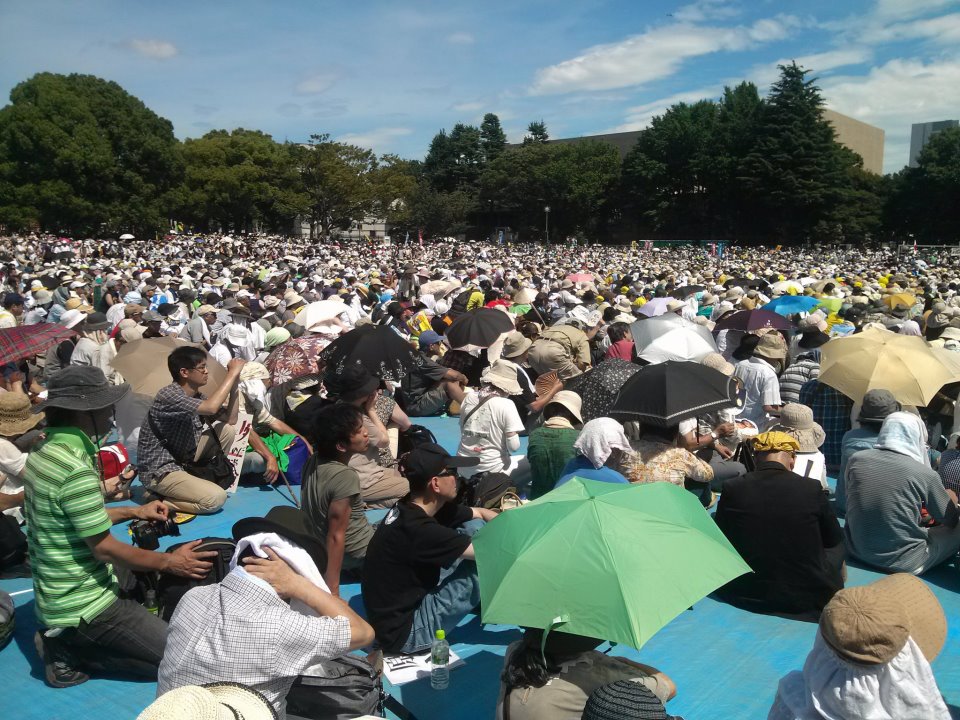
Antinuclear rally draws 170,000 people at central Tokyo park

ORIGINAL: Mainichi


TOKYO (Kyodo) -- An anti-nuclear power plant rally called for by a group led by Nobel literature laureate Kenzaburo Oe and other celebrities drew a crowd of around 170,000 people Monday at Tokyo's Yoyogi Park, according to organizers.

At the assembly held under a scorching sun, dubbed "100,000 People's Assembly to say Goodbye to Nuclear Power Plants," journalist Satoshi Kamata said at the opening event, "We want to bring an end to nuclear power plants immediately."

Oe criticized the government's stance of trying to restart nuclear reactors when the Fukushima nuclear crisis has not yet fully been resolved. "I feel we're being insulted by the government" due to the recent rebooting of a reactor, a move he described as "a plot by the government."

The rally, which also featured live musical performances by Japanese singers, was part of the ongoing antinuclear campaign "10 Million People's Action to say Goodbye to Nuclear Power Plants" that has been conducted following the 2011 crisis at the Fukushima Daiichi Nuclear Power Plant.

The organizing group consists of the Japan Congress Against A- and H-Bombs, commonly known as Gensuikin, and other bodies.

According to the organizers, the event drew not only activists from civic groups but also numerous private citizens concerned about their future. The number of participants in the rally at Yoyogi Park was unparalleled for an event there, they said.
Anti-nuclear energy protesters march on a street in Tokyo Monday, July 16, 2012. Tens of thousands of people gathered at a Tokyo park, demanding “Sayonara,” or goodbye, to nuclear power as Japan prepares to restart yet another reactor, and expressed outrage over a report that blamed culture on the Fukushima disaster. (AP Photo/Koji Sasahara)
Kumiko Kobayashi, 59, from Tokyo's Meguro Ward brought her children and granddaughter in participating at an antinuclear protest for the first time. "The first priority is to halt nuclear power plants. I want the government and the general public to have a normal way of thinking and realize that," she said.

A 90-year-old novelist and Buddhist nun, Jakusho Setouchi, said she is skeptical about whether the government will listen to the people's wish to do away with nuclear power. "We nonetheless need to assemble. We're taxpayers. We can and should express our opinions," she said.

Economic commentator Katsuto Uchihashi and journalist Takashi Hirose were among others who spoke at the rally.

The participants took to the streets after the rally, marching about 3 kilometers near the park and chanting such slogans as "We don't need nuclear power plants," and "The government, stop deciding without public consent."

Oe and others have also been collecting signatures from 10 million people as part of the action. As of July 8, around 7.85 million people had offered their signatures and some have already been presented to Chief Cabinet Secretary Osamu Fujimura.

A weekly antinuclear rally has been held every Friday for months in front of the prime minister's residence in Tokyo and has been drawing an increasing number of people. Civic groups staging the event say a June 29 meet drew 200,000 people but the Metropolitan Police Department put the total count at around 17,000.

martes, 29 de mayo de 2012

Radioactive bluefin tuna from Japan found in U.S. waters

ORIGINAL: Raw Story
By David Ferguson
Monday, May 28, 2012 17:28 EDT 


For the first time, scientists have discovered that tuna contaminated by last year’s radiation leak from the crippled Fukushima nuclear plant have crossed the Pacific Ocean into U.S. waters, according to the Associated Press. Scientists have been started to discover the radioactive fish some 6,000 miles from their place of origin, the first time that large, migrating fish have been shown to carry contaminants over such a great distance.

Normally, radiation and other contaminants are found in smaller fish and plankton, and only in waters close to the source of contamination. However, levels of radioactive cesium have been found at ten times the normal levels in fish off of the coast of California. The current levels, say officials, are still below the levels considered unsafe by the U.S. and Japanese governments.

In March of 2011, a massive earthquake and devastating tsunami struck northeastern Japan, killing thousands and reducing entire towns to mud and rubble. The Fukushima nuclear plant was caught unprepared for the disaster, and subsequently multiple reactors at the plant melted down, spewing radioactive materials into the air and water and triggering mass evacuations. Bluefin tuna are large, fast-swimming fish, growing up to ten feet in length and weighing up to half a ton. The fish swim at “breakneck” speeds and cross the oceans to feed and mate.

Scientists tested tuna from other regions to discover if the cesium-134 and cesium-137 found in the fish might have come from somewhere else, or if the fish had ingested plankton from water affected by the radiation leak.

Ken Woeller of the Woods Hole National Oceanographic Institute is an outside researcher who consulted by the investigation. He said the results “are unequivocal. Fukushima was the source.”

(image via WikiMedia Commons)


domingo, 27 de mayo de 2012

Germany sets new solar power record, institute says

ORIGINAL: Reuters
BERLIN | Sat May 26, 2012 2:02pm EDT

The solar power plant in Alt Daber near Wittstock (Germany) was commissioned at the end of 2011. With 67.8 MWp photovoltaic power it stands for one of the biggest solar power plants BELECTRIC has constructed. From Clean Technica
(Reuters) - German solar power plants produced a world record 22 gigawatts of electricity per hour - equal to 20 nuclear power stations at full capacity - through the midday hours on Friday and Saturday, the head of a renewable energy think tank said. 

The German government decided to abandon nuclear power after the Fukushima nuclear disaster last year, closing eight plants immediately and shutting down the remaining nine by 2022.

They will be replaced by renewable energy sources such as wind, solar and bio-mass.

Norbert Allnoch, director of the Institute of the Renewable Energy Industry (IWR) in Muenster, said the 22 gigawatts of solar power per hour fed into the national grid on Saturday met nearly 50 percent of the nation's midday electricity needs.

"Never before anywhere has a country produced as much photovoltaic electricity," Allnoch told Reuters. "Germany came close to the 20 gigawatt (GW) mark a few times in recent weeks. But this was the first time we made it over."

The record-breaking amount of solar power shows one of the world's leading industrial nations was able to meet a third of its electricity needs on a work day, Friday, and nearly half on Saturday when factories and offices were closed.

Government-mandated support for renewables has helped Germany became a world leader in renewable energy and the country gets about 20 percent of its overall annual electricity from those sources.

Germany has nearly as much installed solar power generation capacity as the rest of the world combined and gets about four percent of its overall annual electricity needs from the sun alone. It aims to cut its greenhouse gas emissions by 40 percent from 1990 levels by 2020.

SUNSHINE
Some critics say renewable energy is not reliable enough nor is there enough capacity to power major industrial nations. But Chancellor Angela Merkel has said Germany is eager to demonstrate that is indeed possible.

The jump above the 20 GW level was due to increased capacity this year and bright sunshine nationwide.

The 22 GW per hour figure is up from about 14 GW per hour a year ago. Germany added 7.5 GW of installed power generation capacity in 2012 and 1.8 GW more in the first quarter for a total of 26 GW capacity.

"This shows Germany is capable of meeting a large share of its electricity needs with solar power," Allnoch said. "It also shows Germany can do with fewer coal-burning power plants, gas-burning plants and nuclear plants."

Allnoch said the data is based on information from the European Energy Exchange (EEX), a bourse based in Leipzig.

The incentives through the state-mandated "feed-in-tariff" (FIT) are not without controversy, however. The FIT is the lifeblood for the industry until photovoltaic prices fall further to levels similar for conventional power production.

Utilities and consumer groups have complained the FIT for solar power adds about 2 cents per kilowatt/hour on top of electricity prices in Germany that are already among the highest in the world with consumers paying about 23 cents per kw/h.

German consumers pay about 4 billion euros ($5 billion) per year on top of their electricity bills for solar power, according to a 2012 report by the Environment Ministry.

Critics also complain growing levels of solar power make the national grid more less stable due to fluctuations in output.

Merkel's centre-right government has tried to accelerate cuts in the FIT, which has fallen by between 15 and 30 percent per year, to nearly 40 percent this year to levels below 20 cents per kw/h. But the upper house of parliament, the Bundesrat, has blocked it.

($1 = 0.7992 euros)

martes, 17 de abril de 2012

Japan to be without nuclear power after May 5

ORIGINAL: AsahiAJW
April 17, 2012
REUTERS
Oi nuclear power plant (The Asahi Shimbun)
Japan will within weeks have no nuclear power for the first time in more than 40 years, after the trade minister said two reactors idled after the Fukushima disaster would not be back online before the last one currently operating is shut down.

Trade Minister Yukio Edano signaled it would take at least several weeks before the government, keen to avoid a power crunch, can give a final go-ahead to restarts, meaning Japan is set on May 6 to mark its first nuclear power-free day since 1970.

"If we thoroughly go through the procedure, it would be (on or) after May 6 even if we could restart them," Edano told a news conference, adding that whether they can actually be brought back online is still up to ongoing discussions.

The crisis at the Fukushima No. 1 nuclear power plant, where a huge earthquake and tsunami in March 2011 triggered radiation leaks, has hammered public faith in nuclear power and prevented the restart of reactors shut down for regular maintenance checks, with all but one of 54 reactors now offline.

Nuclear power accounted for about 30 percent of Japan's electricity demand before the Fukushima crisis.

In discussing restarts of the No.3 and No.4 reactors at Kansai Electric's Oi nuclear power plant, in western Japan, the first to clear the government's technical review on resilience against a severe event, Tokyo has said it wants local backing even though it is not legally required.

The hosts of the Oi plant -- the governor of Fukui prefecture and mayor of Oi town, some 360 km (225 miles) southwest of Tokyo -- told Edano on April 14 that some conditions should be met before they can make a decision.

These included a safety review by an expert panel formed by the prefecture and backing from areas neighboring Fukui that are becoming increasingly vocal about possible radiation damage in the event of an accident at any of the 13 reactors in Fukui.

Exactly when Fukui Governor Issei Nishikawa and Oi Mayor Shinobu Tokioka will make decisions is unclear.

Members of the expert panel will be visiting the Oi plant on April 18 and are likely to meet several more times before they reach a conclusion, while the Fukui assembly may meet as early as next week to discuss whether they can back the restarts, Masao Sato, a member of the assembly, told Reuters.

Oi town told Reuters in March that it conditionally backed the restart. Fukui governor Nishikawa told Edano on April 14 that, while the government has addressed some of Fukui's concerns, more discussions were needed on safety. While a looming summertime power crunch is a headache throughout Japan, Kansai Electric's service region, including Japan's second biggest metropolitan area of Osaka, is particularly vulnerable as nuclear power met more than 40 percent of power needs prior to the Fukushima crisis.

Electricity generated by the Oi No.3 and 4 reactors accounted for around 1.8 percent of the total amount of electricity generated in Japan in the business year 2009/10, data from the trade ministry and the Federation of Electric Power Companies in Japan showed.

Edano said that the government may have to protectively come up with plans for rolling blackouts.

"We absolutely cannot let power go out suddenly," he said.

The governors of Shiga and Kyoto prefectures, bordering Fukui, on April 17 outlined recommendations for the central government on restarting reactors, including publicizing views from independent organizations on reactor safety.

The last time Japan saw a nuclear power-free period was the five days ended on May 4, 1970, when the two reactors then existing were both shut for maintenance, according to the Federation of Electric Power Companies of Japan.