Mostrando entradas con la etiqueta Telepresencia. Mostrar todas las entradas

domingo, 31 de agosto de 2014

5 Robots Booking It to a Classroom Near You

IMAGE: ANDY BAKER/GETTY IMAGES

Robots are the new kids in school.

The technological creations are taking on serious roles in the classroom. With the accelerating rate of robotic technology, school administrators all over the world are plotting how to implement them in education, from elementary through high school.

In South Korea, robots are replacing English teachers entirely, entrusted with leading and teaching entire classrooms. In Alaska, some robots are replacing the need for teachers to physically be present at all.


Robotics 101 is now in session. Here are five ways robots are being introduced into schools.

1. Nao Robot as math teacher

IMAGE: WIKIPEDIA

In Harlem school PS 76, a Nao robot created in France, nicknamed Projo helps students improve their math skills. It's small, about the size of a stuffed animal, and sits by a computer to assist students working on math and science problems online.

Sandra Okita, a teacher at the school, told The Wall Street Journal the robot gauges how students interact with non-human teachers. The students have taken to the humanoid robotic peer, who can speak and react, saying it's helpful and gives the right amount of hints to help them get their work done.

2. Aiding children with autism


The Nao Robot also helps improve social interaction and communication for children with autism. The robots were introduced in a classroom in Birmingham, England in 2012, to play with children in elementary school. Though the children were intimidated at first, they've taken to the robotic friend, according to The Telegraph.

3. VGo robot for ill children


Sick students will never have to miss class again if the VGo robot catches on. Created by VGo Communications, the rolling robot has a webcam and can be controlled and operated remotely via computer. About 30 students with special needs nationwide have been using the $6,000 robot to attend classes.

For example, a 12-year-old Texas student with leukemia kept up with classmates by using a VGo robot. With a price tag of about $6,000, the robots aren't easily accessible, but they're a promising sign of what's to come.

4. Robots over teachers


In the South Korean town of Masan, robots are starting to replace teachers entirely. The government started using the robots to teach students English in 2010. The robots operate under supervision, but the plan is to have them lead a room exclusively in a few years, as robot technology develops.

5. Virtual teachers


IMAGE: FLICKR, SEAN MACENTEE
South Korea isn't the only place getting virtual teachers. A school in Kodiak, Alaska has started using telepresence robots to beam teachers into the classroom. The tall, rolling robots have iPads attached to the top, which teachers will use to video chat with students.

The Kodiak Island Borough School District's superintendent, Stewart McDonald, told The Washington Times he was inspired to do this because of the show The Big Bang Theory, which stars a similar robot. Each robot costs about $2,000; the school bought 12 total in early 2014.


domingo, 16 de febrero de 2014

Sci-Fi Device Lets Men And Women Swap Bodies


Using virtual reality and neuroscience, this machine lets you see, hear, and even feel what it's like in another person's body. 

Happy Presidents Day! We're celebrating by revisiting some of our most popular stories of the year. Enjoy.

Talk about going on a gender bender.

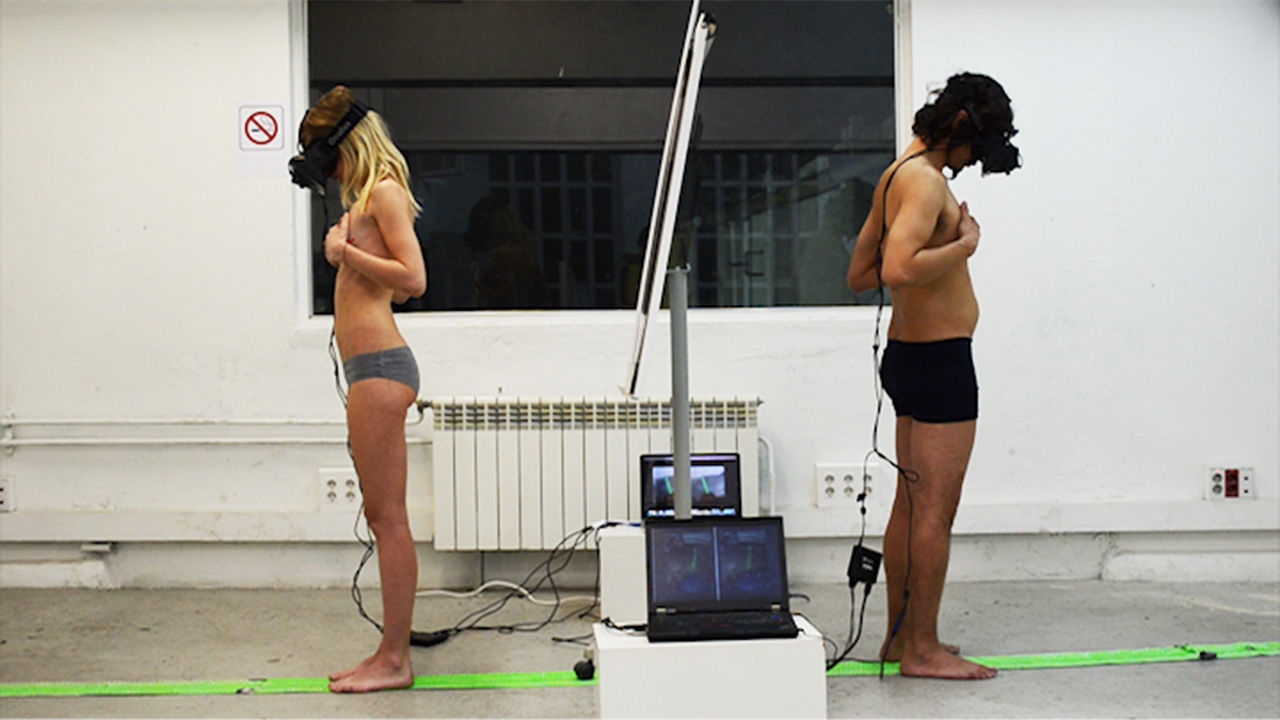
A new machine created by a Spanish design collective combines virtual reality with advanced neuroscientific techniques to let men and women swap bodies with each other. Called The Machine To Be Another, it's all done in the hopes that body transference will help scientists explore and quantify concepts like sexism, gender identity, and bias.

Based in Barcelona, Be Another Lab is made up of Philippe Bertrand, Daniel Gonzalez Franco, Christian Cherene, and Arthur Pointea, a collection of interdisciplinary artists whose fields range from programming and electronic engineering to interactive system design and neuro-rehabilitation. Together, the goal of Be Another Lab is to explore the concepts of empathy through technology, science, and art.


In most neuroscience experiments that examine issues of empathy and bias, participants "trade places" with others using digital avatars. If a study wants to explore empathy for the handicapped, for example, scientists might sit subjects down in front of a computer and make them play a video game in which they are confined to a wheelchair, then ask them a series of questions about how the experience made them feel. But none of it is real.

Be Another Lab takes a different, more visceral approach to exploring empathy. Instead of using digital avatars, the group uses performers to copy the movements of a subject: for example, racial bias is studied by having a subject's actions mirrored by a performer of color.


"We believe this allows for a deeper experience for a user, knowing that their point of view is that of an actual human being, and not a virtual avatar," says Bertrand. "In the last year, we’ve observed that subjects tend to demonstrate empathetic feelings towards the performers they didn't have before. They say that the experience has raised their awareness about the performers' social conditions, that they were able to go 'deep into this other person's life.'" They say that the experience has raised their awareness.

With The Machine To Be Another, Bertrand and company have taken this approach to the next level by leveraging the tech of a paid Oculus Rift virtual reality headset. In the project, two participants stand in front of one another, and put on their headsets which allow them to effectively see out of one another's eyes. When they look at each other, they see themselves. When they speak, they hear the other person's voice in their ears.


But this isn't where the simulation ends. Working together, the two participants are encouraged to sync their movements, touching objects in the room, looking at things, and exploring their 'own' bodies simultaneously.

"The brain integrates different senses to create your experience of the world," explains Bertrand. "In turn, the information from each of these senses influences how the other senses are processed. We use these techniques from neuroscience to actually affect the psychophysical sensation of being in your body."


In other words, in combination with being fed video and sound from their partner's headset, by moving and touching things at the same time, the Machine To Be Another can actually convince people that they are in someone else's body as long as the two partners remain in sync.

It's a radical idea that Be Another Lab is only beginning to explore. Right now, their experiments have mostly focused on gender swapping, which the team hopes will also explore issues in regards to transgender and queer bias. The group is currently looking to partner with organizations, experts and activists to help them further perfect their techniques.

They say to truly understand someone, you have to walk a mile in their shoes. Thanks to the Machine To Be Another, you won't just walk that mile, you'll feel the blisters on the other person's feet.

ORIGINAL: FastCo Exist