Mostrando entradas con la etiqueta Psicología. Mostrar todas las entradas

domingo, 16 de febrero de 2014

Sci-Fi Device Lets Men And Women Swap Bodies


Using virtual reality and neuroscience, this machine lets you see, hear, and even feel what it's like in another person's body. 

Happy Presidents Day! We're celebrating by revisiting some of our most popular stories of the year. Enjoy.

Talk about going on a gender bender.

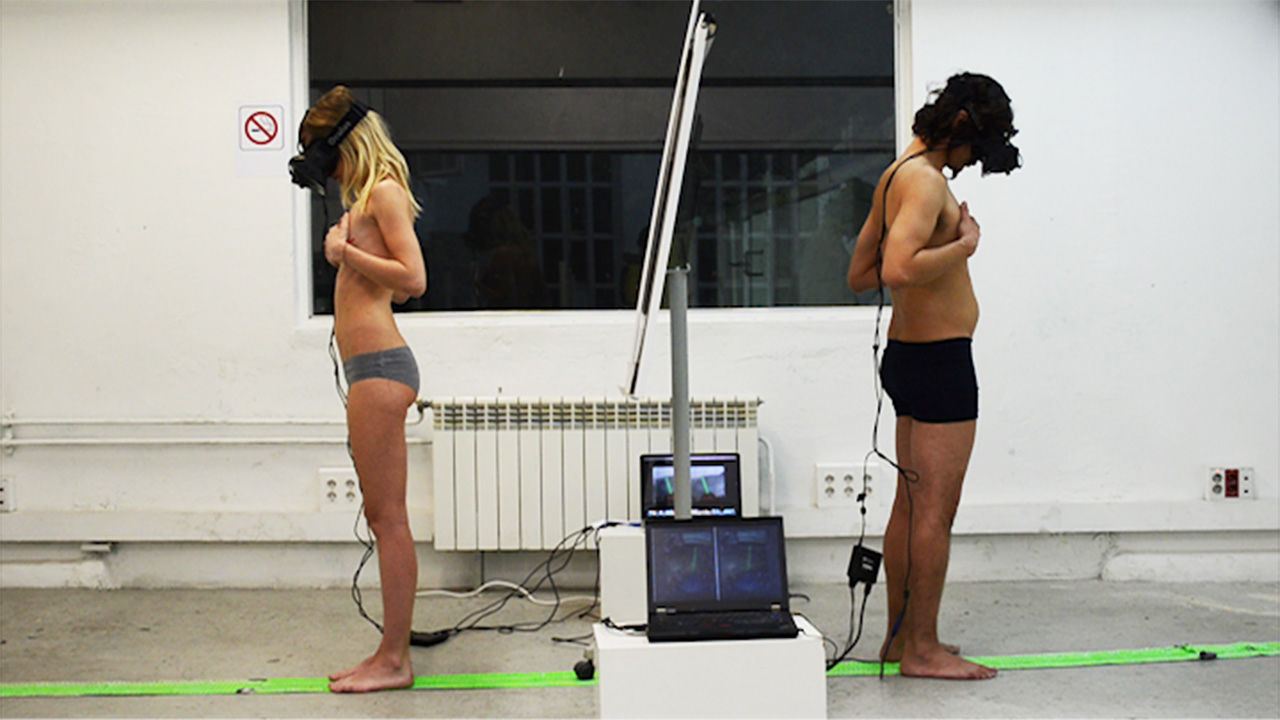
A new machine created by a Spanish design collective combines virtual reality with advanced neuroscientific techniques to let men and women swap bodies with each other. Called The Machine To Be Another, it's all done in the hopes that body transference will help scientists explore and quantify concepts like sexism, gender identity, and bias.

Based in Barcelona, Be Another Lab is made up of Philippe Bertrand, Daniel Gonzalez Franco, Christian Cherene, and Arthur Pointea, a collection of interdisciplinary artists whose fields range from programming and electronic engineering to interactive system design and neuro-rehabilitation. Together, the goal of Be Another Lab is to explore the concepts of empathy through technology, science, and art.


In most neuroscience experiments that examine issues of empathy and bias, participants "trade places" with others using digital avatars. If a study wants to explore empathy for the handicapped, for example, scientists might sit subjects down in front of a computer and make them play a video game in which they are confined to a wheelchair, then ask them a series of questions about how the experience made them feel. But none of it is real.

Be Another Lab takes a different, more visceral approach to exploring empathy. Instead of using digital avatars, the group uses performers to copy the movements of a subject: for example, racial bias is studied by having a subject's actions mirrored by a performer of color.


"We believe this allows for a deeper experience for a user, knowing that their point of view is that of an actual human being, and not a virtual avatar," says Bertrand. "In the last year, we’ve observed that subjects tend to demonstrate empathetic feelings towards the performers they didn't have before. They say that the experience has raised their awareness about the performers' social conditions, that they were able to go 'deep into this other person's life.'" They say that the experience has raised their awareness.

With The Machine To Be Another, Bertrand and company have taken this approach to the next level by leveraging the tech of a paid Oculus Rift virtual reality headset. In the project, two participants stand in front of one another, and put on their headsets which allow them to effectively see out of one another's eyes. When they look at each other, they see themselves. When they speak, they hear the other person's voice in their ears.


But this isn't where the simulation ends. Working together, the two participants are encouraged to sync their movements, touching objects in the room, looking at things, and exploring their 'own' bodies simultaneously.

"The brain integrates different senses to create your experience of the world," explains Bertrand. "In turn, the information from each of these senses influences how the other senses are processed. We use these techniques from neuroscience to actually affect the psychophysical sensation of being in your body."


In other words, in combination with being fed video and sound from their partner's headset, by moving and touching things at the same time, the Machine To Be Another can actually convince people that they are in someone else's body as long as the two partners remain in sync.

It's a radical idea that Be Another Lab is only beginning to explore. Right now, their experiments have mostly focused on gender swapping, which the team hopes will also explore issues in regards to transgender and queer bias. The group is currently looking to partner with organizations, experts and activists to help them further perfect their techniques.

They say to truly understand someone, you have to walk a mile in their shoes. Thanks to the Machine To Be Another, you won't just walk that mile, you'll feel the blisters on the other person's feet.

ORIGINAL: FastCo Exist

viernes, 3 de enero de 2014

Homo-Empathicus: How We Belong to Each Other. ~ Kathryn Ashworth {video}

heartconnection

This video is evidence that the most civilized thing a person can do is be empathetic, and that current forms of technology are serving to bridge our natural inclination to connect across culture. It may change the way you see social networking platforms, your iPhone, etc.. It may even change the way you see yourself:
“We are actually soft-wired for sociability, affection, companionship, and the first drive is to…belong.”


“Empathy is the opposite of Utopia. There is no empathy in heaven, I can tell you before you get there. There isn’t any empathy in heaven because there’s no mortality. There’s no empathy in utopia because there’s no suffering. Empathy is grounded in the acknowledgement of death and the celebration of life and rooting for each other to flourish and be. It’s based on our frailty and imperfections. So when we are talking about building an empathetic civilization we are not talking about utopia, we are talking about the ability of humanity to show solidarity not only with each other but with our fellow creatures who have a one and only life on this planet. We are homo-empathicus.”

No matter the heights of the individual and the empire we desire to construct out of ourselves alone, the inner drive to connect, beyond walls of separation, will always overcome.

It’s the basic mechanics and biology of humanity.

ORIGINAL: Elephant Journal
Via Kathryn Ashworth
Dec 17, 2013

miércoles, 28 de agosto de 2013

App Captures the Boston Bombing’s Psychological Effects

ORIGINAL: IEEE Spectrum
By Eliza Strickland
27 Aug 2013


Could psychological-monitoring apps become as common as fitness and activity gadgets?

Image: Cogito A Mind Minder: Cogito's mood-monitoring app can detect signals of psychological distress
In April, the software company Cogito was halfway through a clinical trial to see if it could detect symptoms of depression and post-traumatic stress disorder (PTSD) through a smartphone app. All of the 100 participants in the study lived around Boston. Then, on 15 April, two bombs went off near the finish line of the Boston Marathon, killing three people and injuring hundreds. Suddenly, Cogito’s clinical trial was a lot more relevant.

The trial was funded by the Defense Advanced Research Projects Agency (DARPA) under its Detection and Computational Analysis of Psychological Signals program. To address the troubling number of psychological problems and suicides among active-duty military personnel and veterans, the U.S. Department of Defense is seeking technologies that can identify at-risk individuals so professionals can help them.

Cogito, a Boston-based MIT spin-off, developed an app that keeps track of a person’s social behavior and vocal characteristics. The app monitors the phone’s location and time of use and also logs phone calls and text messages. (It doesn’t look at the content of those calls and texts.) Finally, there’s an active component: Participants can choose to fill out questionnaires about their mood and can record audio diaries. Cogito’s expertise is in automated speech analysis, which it applies to those audio diaries; future iterations could mine phone conversations for information as well.

Put all the data together and you’re able to tell a lot about a person, says Cogito CEO Joshua Feast. Sometimes you even find signs of distress that people don’t want to admit to or haven’t recognized themselves. “We’re able to look at sleep, mood, social isolation, and physical isolation,” says Feast, all of which can serve as “honest signals” of psychological trouble. In the Boston trial, Cogito was only testing the sophisticated algorithms it developed to aggregate the data. If the trial works out, future versions of the software could provide these summaries to clinicians to allow them to intervene and could also give the information to the subjects themselves.

All of this can seem rather creepy—apps that get inside your head and reveal your emotional secrets. But Feast says that’s why his company places so much emphasis on privacy and trust. If Cogito’s system becomes a commercial product, there will be legal guarantees that a user will always own and control his or her own data. For example, a user could choose whether or not to share the data with a clinician. Feast says he doesn’t think users would have it any other way. “Morally it’s the right thing to do, and also for adoption it’s the right thing to do,” he says.

The participants in the Boston trial included veterans, civilians with histories of trauma or depression, and some healthy civilians. While the bulk of the data from the study is still being analyzed, Feast says the impact of the April bombing is already clear. The algorithms picked up more markers of stress in the participants, including decreased use of the app’s interactive components. “Fewer survey questions were being answered, and fewer audio diaries were being recorded,” he says.

Further study of the data will answer other important questions about the nature of depression and PTSD, says Feast: “What is resilience? What kind of people fared better after the bombing? What happens to people with vulnerability when things like this happen?” The company is still formulating its research questions, he says.

The Durkheim Project, another initiative funded by this DARPA program, focuses more narrowly on identifying veterans at risk of suicide. Chris Poulin, director of the project, explains that his system predicts suicide risk by analyzing veterans’ text messages and their posting on social-networking sites like Facebook and Twitter. Poulin says he’s impressed with the scope of Cogito’s data collection and its incorporation of voice monitoring. “There are other people out there collecting mobile data and looking at activity metrics, but very few people have integrated voice data,” he says.

Cogito’s voice-analysis software, Cogito Dialog, monitors vocal characteristics such as level of excitement and fluidity of speech. Feast explains that it’s tricky to get clear data in this area because there’s so much natural variation in people’s speech habits. However, the system can detect changes to an individual’s speech patterns over time and can also be useful in telemedicine. For example, if a clinician calls veterans and asks them all the same series of questions, a monitoring system can flag people with unusual responses. “Speech analysis is well suited for looking at population norms and deviation from the norms,” says Feast.

Feast believes that the company’s experience with the Boston bombing provides a preview of a possible future where psychological monitoring apps are as common as the fitness and activity gadgets that proliferate today. “When there’s an earthquake or terrorist attack or traumatic event that hits a population center, this technology could support a rapid response team for psychological distress,” he says. “It would be like the CDC [Centers for Disease Control] responding to a flu outbreak.”

domingo, 18 de agosto de 2013

The Magnifying Glass Ceiling: The Plight of Women in Science

ORIGINAL: PLoS
By Jane Hu
August 16, 2013


Scientists frequently reference a quote attributed to Einstein: “You do not truly understand something unless you can explain it to your grandma.” Whether or not these words were actually Einstein’s, they’ve been used again and again to encourage students to explain highly technical details in a simple way so that even your grandma could understand it. The assumption is that your dear old grandma is a feeble-minded lady who doesn’t know anything about phishing or bitcoin or Bayesian statistics.

What’s interesting here is that it’s always your grandma you’re asked to explain things to, not your grandpa. This subtle difference seems innocuous, but it reflects the age-old stereotype that men are more competent than women in math and science. Luckily, we’ve moved forward from the days when women in science like Rosalind Franklin, Cecilia Payne-Gaposchkin, and Lise Meitner had their ideas overlooked or even blatantly stolen, but the undercurrent of sexism has not disappeared – it has just become subtler. 

Cecilia Payne-Gaposchkin
Cecilia Payne-Gaposchkin discovered that the sun is made of mostly hydrogen. Fellow astronomer Henry Norris Russell rejected her work…but then published a paper making the same claim four years later. Even though he cited Payne-Gaposchkin’s work, he is still commonly credited with her discovery.

It is true that women are underrepresented in these spheres, but not because women aren’t interested in it or can’t handle the work (for instance, see some grandmas who probably know more than you). Even when women are highly competent in their field of study, their career accomplishments take a backseat to what’s stereotypically a woman’s duty: raising a family.

Take, for instance, the late Yvonne Brill, a rocket scientist (certainly the type of grandma you wouldn’t talk down to). Her obituary in the New York Times began:

She made a mean beef stroganoff, followed her husband from job to job and took eight years off from work to raise three children. “The world’s best mom,” her son Matthew said.

But Yvonne Brill, who died on Wednesday at 88 in Princeton, N.J., was also a brilliant rocket scientist, who in the early 1970s invented a propulsion system to help keep communications satellites from slipping out of their orbits.

The New York Times has since changed the obituary to lead with a mention of Brill’s career, but the original introduction reflects this trend of subtle sexism. The “but” that begins the second paragraph seems to imply that being a good wife or mom is somehow directly contradictory with being a “brilliant rocket scientist”.

Scientists, too, fall prey to gender stereotypes. In a 1999 study, University of Wisconsin-Milwaukee researcher Rhea Steinpreis and her colleagues sent faculty members a CV for a fake applicant’s tenure-track faculty position, and randomized whether the applicant had a male or female name. With the same application, the male applicant was more likely to be hired than the female applicant. More than a decade later, nothing has changed; last year, Yale researcher Corinne Moss-Racusin and her colleagues ran a similar study, asking faculty to rate application materials for a lab manager position. Like in Steinpreis et al.’s study, the male applicant was also rated more highly than the female applicant, and was given a higher average starting salary.

Even if women get that coveted lab manager position or tenure-track faculty position, their research may be less likely to be seen by a wider audience. Last year, the popular journal Nature assessed their own inclusion of female perspectives. They found that women made up only 14% of their reviewers, 18% of their profiled scientists in 2011 and 2012, and 19% of Nature‘s Comment and World View articles. Though there tend to be fewer women in STEM fields to review, write, and profile, Nature acknowledges that doesn’t fully explain the lack of female viewpoints included in their publication. In their own words: “There is work to do.”
This lack of visibility and opportunity can be frustrating, and, according to a 2008 Harvard Business School study, it also contributes to women’s decision to leave STEM fields. Recent research from Berkeley faculty Mary Ann Mason, Nicholas Wolfinger, and Marc Goulden found that STEM fields fail to retain women at every stage of their careers, from undergraduate science courses to professorial tenure review. Data collected by the National Science Foundation found that in many fields, like engineering and biology, women make up more than half of undergraduate students, but this number drops off at each transition point, so that at the tenured professor level, women make up only 20-25% of the total. The most women drop out in the transition between receiving a PhD to landing a faculty position.

Why are women leaving in such numbers? We’ve all heard an urban legend about that one old, misogynistic professor in the department who has explicitly stated his belief that women don’t belong in science, but as the majority of male scientists will attest, there are few men who sit in their ivory towers, intentionally barring women from being hired or published. The story is far more complicated. For one, having more women on review boards does not increase the likelihood that more women will be hired or published. In Steinpreis et al. and Moss-Racusin et al.’s studies, women were just as likely as men to rate the male applicant more highly than the female applicant. This underscores the pervasiveness of gender stereotypes; women, too, can believe that men are more competent. And even worse: they take those stereotypes to heart while on the job.

Social psychologists call this phenomenon “stereotype threat.” This occurs when an individual who is a member of a group fears they will confirm a negative stereotype about their group. A classic stereotype threat study by Spencer, Steele, & Claude (1999) found that women performed worse on a math test if told the test was supposed to reflect gender differences than if they were told it did not reflect gender differences. This works with pretty much any negative stereotype; Yeung & von Hippel (2008) found that women who were primed with the stereotype that women are bad at driving were more than twice as likely to hit jaywalkers in a virtual driving game.
Stereotype threat can affect female scientists’ behavior when interacting with their male colleagues.
More recent research suggests stereotype threat has an effect on women’s perception of daily interactions with fellow scientists. University of British Columbia research Toni Schmader and University of Arizona researcher Matthias Mehl had women in science wear microphones that recorded random snippets of their daily conversations. In rating how “competent” women sounded in talking about their own work, the study found that women sounded less competent when speaking with male colleagues than female colleagues. Presumably, this behavior is a result of stereotype threat: women fear confirming the stereotype of “women are bad at science,” and they falter.

In the face of all this, what’s a woman in science to do?
The STEM blogosphere has been abuzz with recommendations. 
  • Require universities to adopt family-friendly policies to retain women who are dropping out for family reasons. 
  • Provide childcare. 
  • Make the tenure process more flexible. 
  • Do more scientific outreach for young girls. 
  • Create support groups for women to foster stronger mentor/mentee relationships. 
  • These are all good ideas, and fit an underlying theme: we need to keep current female scientists in their fields, and we need them to recruit more women to join in the future. 
  • Subvert the harmful stereotypes about women and STEM fields that girls hear from a young age: make sure Mattel never makes another “Math class is tough” Barbie, or that children’s clothing stores never make another girls’ t-shirt like this. 
  • Be the grandma who does the explaining, not the one who needs to be explained to.

Jane is a PhD candidate in the psychology department at University of California, Berkeley. Her research focuses on social cognition and learning in preschoolers. She is also an editor of the Berkeley Science Review. 
Follow her on Twitter @jane_c_hu, or check out her science blog: metacogs.tumblr.com

martes, 16 de julio de 2013

Computer as Smart as a 4-Year-Old? Researchers IQ Test New Artificial Intelligence System

ORIGINAL: ScienceDaily

Artificial and natural knowledge researchers IQ-tested one of the best available artificial intelligence systems and learned that it's about as smart as the average 4-year-old. (Credit: © Spofi / Fotolia)

July 15, 2013 — Artificial and natural knowledge researchers at the University of Illinois at Chicago have IQ-tested one of the best available artificial intelligence systems to see how intelligent it really is.

Turns out it's about as smart as the average 4-year-old, they will report July 17 at the U.S. Artificial Intelligence Conference in Bellevue, Wash.

The UIC team put ConceptNet 4 (Currently ConceptNet5.1), an artificial intelligence system developed at M.I.T., through the verbal portions of the Weschsler Preschool and Primary Scale of Intelligence Test, a standard IQ assessment for young children.

They found ConceptNet 4 has the average IQ of a young child. But unlike most children, the machine's scores were very uneven across different portions of the test.

"If a child had scores that varied this much, it might be a symptom that something was wrong," said Robert Sloan, professor and head of computer science at UIC, and lead author on the study.

Sloan said ConceptNet 4 did very well on a test of vocabulary and on a test of its ability to recognize similarities.

"But ConceptNet 4 did dramatically worse than average on comprehension­the 'why' questions," he said.

One of the hardest problems in building an artificial intelligence, Sloan said, is devising a computer program that can make sound and prudent judgment based on a simple perception of the situation or facts-the dictionary definition of commonsense.

Commonsense has eluded AI engineers because it requires both a very large collection of facts and what Sloan calls implicit facts-things so obvious that we don't know we know them. A computer may know the temperature at which water freezes, but we know that ice is cold.

"All of us know a huge number of things," said Sloan. "As babies, we crawled around and yanked on things and learned that things fall. We yanked on other things and learned that dogs and cats don't appreciate having their tails pulled." Life is a rich learning environment.

"We're still very far from programs with commonsense-AI that can answer comprehension questions with the skill of a child of 8," said Sloan. He and his colleagues hope the study will help to focus attention on the "hard spots" in AI research.

Study coauthors are UIC professors Stellan Ohlsson of psychology and Gyorgy Turan of mathematics, statistics and computer science; and UIC mathematical computer science undergraduate student Aaron Urasky.

The study was supported by award N00014-09-1-0125 from the Office of Naval Research and grant CCF-0916708 from the National Science Foundation.