Mostrando entradas con la etiqueta Empatía. Mostrar todas las entradas

domingo, 16 de febrero de 2014

Sci-Fi Device Lets Men And Women Swap Bodies


Using virtual reality and neuroscience, this machine lets you see, hear, and even feel what it's like in another person's body. 

Happy Presidents Day! We're celebrating by revisiting some of our most popular stories of the year. Enjoy.

Talk about going on a gender bender.

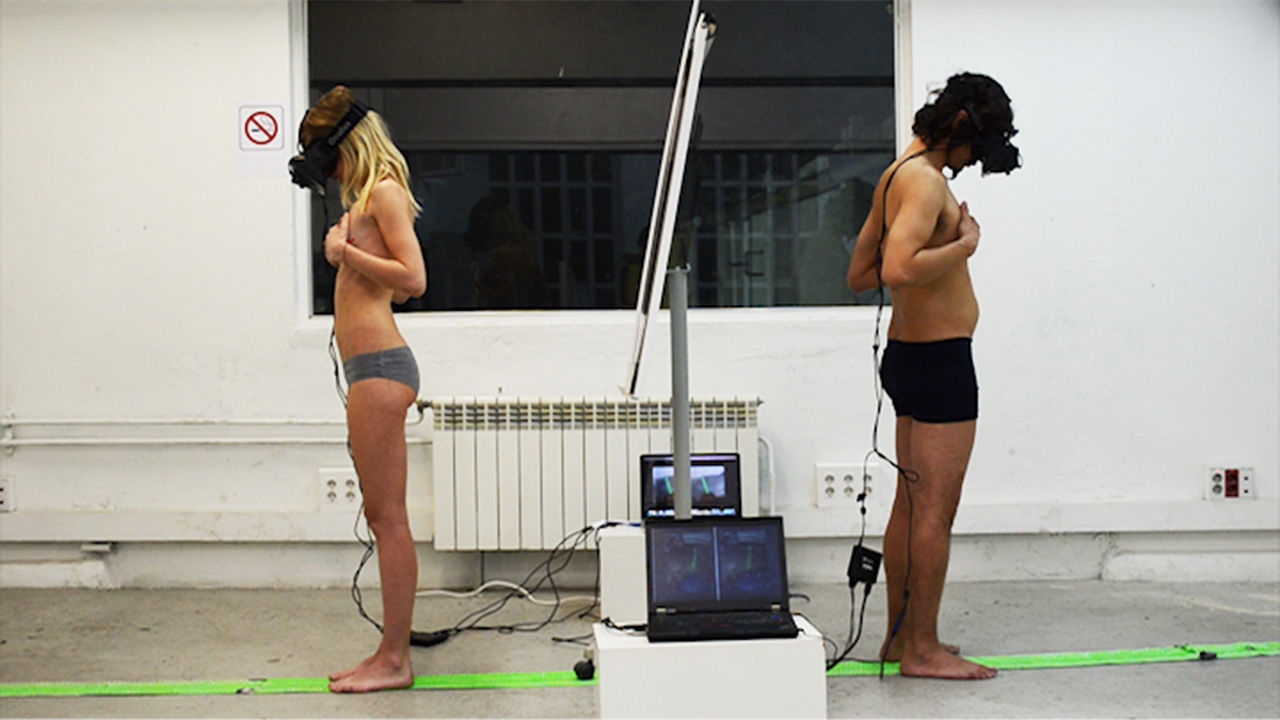
A new machine created by a Spanish design collective combines virtual reality with advanced neuroscientific techniques to let men and women swap bodies with each other. Called The Machine To Be Another, it's all done in the hopes that body transference will help scientists explore and quantify concepts like sexism, gender identity, and bias.

Based in Barcelona, Be Another Lab is made up of Philippe Bertrand, Daniel Gonzalez Franco, Christian Cherene, and Arthur Pointea, a collection of interdisciplinary artists whose fields range from programming and electronic engineering to interactive system design and neuro-rehabilitation. Together, the goal of Be Another Lab is to explore the concepts of empathy through technology, science, and art.


In most neuroscience experiments that examine issues of empathy and bias, participants "trade places" with others using digital avatars. If a study wants to explore empathy for the handicapped, for example, scientists might sit subjects down in front of a computer and make them play a video game in which they are confined to a wheelchair, then ask them a series of questions about how the experience made them feel. But none of it is real.

Be Another Lab takes a different, more visceral approach to exploring empathy. Instead of using digital avatars, the group uses performers to copy the movements of a subject: for example, racial bias is studied by having a subject's actions mirrored by a performer of color.


"We believe this allows for a deeper experience for a user, knowing that their point of view is that of an actual human being, and not a virtual avatar," says Bertrand. "In the last year, we’ve observed that subjects tend to demonstrate empathetic feelings towards the performers they didn't have before. They say that the experience has raised their awareness about the performers' social conditions, that they were able to go 'deep into this other person's life.'" They say that the experience has raised their awareness.

With The Machine To Be Another, Bertrand and company have taken this approach to the next level by leveraging the tech of a paid Oculus Rift virtual reality headset. In the project, two participants stand in front of one another, and put on their headsets which allow them to effectively see out of one another's eyes. When they look at each other, they see themselves. When they speak, they hear the other person's voice in their ears.


But this isn't where the simulation ends. Working together, the two participants are encouraged to sync their movements, touching objects in the room, looking at things, and exploring their 'own' bodies simultaneously.

"The brain integrates different senses to create your experience of the world," explains Bertrand. "In turn, the information from each of these senses influences how the other senses are processed. We use these techniques from neuroscience to actually affect the psychophysical sensation of being in your body."


In other words, in combination with being fed video and sound from their partner's headset, by moving and touching things at the same time, the Machine To Be Another can actually convince people that they are in someone else's body as long as the two partners remain in sync.

It's a radical idea that Be Another Lab is only beginning to explore. Right now, their experiments have mostly focused on gender swapping, which the team hopes will also explore issues in regards to transgender and queer bias. The group is currently looking to partner with organizations, experts and activists to help them further perfect their techniques.

They say to truly understand someone, you have to walk a mile in their shoes. Thanks to the Machine To Be Another, you won't just walk that mile, you'll feel the blisters on the other person's feet.

ORIGINAL: FastCo Exist

viernes, 3 de enero de 2014

Homo-Empathicus: How We Belong to Each Other. ~ Kathryn Ashworth {video}

heartconnection

This video is evidence that the most civilized thing a person can do is be empathetic, and that current forms of technology are serving to bridge our natural inclination to connect across culture. It may change the way you see social networking platforms, your iPhone, etc.. It may even change the way you see yourself:
“We are actually soft-wired for sociability, affection, companionship, and the first drive is to…belong.”


“Empathy is the opposite of Utopia. There is no empathy in heaven, I can tell you before you get there. There isn’t any empathy in heaven because there’s no mortality. There’s no empathy in utopia because there’s no suffering. Empathy is grounded in the acknowledgement of death and the celebration of life and rooting for each other to flourish and be. It’s based on our frailty and imperfections. So when we are talking about building an empathetic civilization we are not talking about utopia, we are talking about the ability of humanity to show solidarity not only with each other but with our fellow creatures who have a one and only life on this planet. We are homo-empathicus.”

No matter the heights of the individual and the empire we desire to construct out of ourselves alone, the inner drive to connect, beyond walls of separation, will always overcome.

It’s the basic mechanics and biology of humanity.

ORIGINAL: Elephant Journal
Via Kathryn Ashworth
Dec 17, 2013

jueves, 11 de octubre de 2012

Estudio muestra que los perros sienten el dolor de las personas y buscan aliviarlo

ORIGINAL: PijamaSurf
Autor: pijamasurf
Publicación: 10/06/2012 2:28 pm

El altruismo emocional de los perros: estudio sugiere que los perros son capaces de detectar el sufrimiento de las personas y reaccionan ante este brindando comfort.


La intuición que tienen las personas que conviven con perros de que estos animales son sensibles a sus sentimientos parece confirmarse por un reciente estudio. Los perros reaccionan al dolor humano de una manera sumisa que se ajusta a proveer alivio –comio si el verdadero entrenamiento biológico de esta especie fuera la empatía.

Un experimento realizado por psicólogos de la Universidad de Goldmisths en Londres probó a 18 perros en distintas situaciones, con sus dueños y extraños, en las que los voluntarios aparentaron llorar, susurrar o tararear y hablar. Los perros reiteradamente reaccionaron a los simulacros de llanto, acercándose a estas personas y buscando iniciar contacto físico.

“El tarareo fue diseñado paar ser un comportamiento relativamente nuevo, que podría provocar la curiosidad de los perros. El hecho de que los perros diferenciaron entre el llanto y el tarareo indica que su respuesta no fue meramente motivada por la curiosidad”, dijo la Dra Deborah Custance.

Los perros respondieron al llanto de una persona no obstante que no fuera su dueño, lo que parece mostrar que su respuesta fue genuinamente empática y o el resultado de la búsqueda de una recompensa o de sus propias necesidades. El hecho de que los perros reaccionen a una emoción fingida no significa que no sepan percibir nuestras emociones, ya que nuestro mismo cerebro no hace distinción entre si una emoción es simulada o la experimentamos espontáneamente, de la misma forma que no distingue del todo si vemos algo o imaginamos eso mismo.

Hace algunas semanas reportamos sobre una interesante investigación que sugería que las ratas son capaces de sentir y actuar dirigidas por la empatía (y que ésta podría ser la emoción universal). Por otro lado el biólogo de la Universidad de Cambridge, Rupert Sheldrake, ha realizado numerosos experimentos que parecen mostrar que las mascotas tienen una capacidad telepática para saber cuándo sus dueños van a regresar a casa. No hay duda que los animales domésticos, y especialmente los perros, cumplen una admirable función servicial, como si estuvieran entre nosotros para expiar nuestras penas.