Mostrando entradas con la etiqueta Animal. Mostrar todas las entradas

martes, 7 de abril de 2015

This chameleon is actually an amazing bodypainting


Yep. Believe it or not, this is not a stunning picture of a chameleon. It is the latest bodypaintng piece by the Italian artist Johannes Stötter. I had to wait until the end of the video to realize there were actually two women.


Almost a year ago, another of his bodypaintings hit the Internet. It was this beautiful picture of a frog consisting in five women. Check it out:


ORIGINAL:
Gizmodo

sábado, 25 de enero de 2014

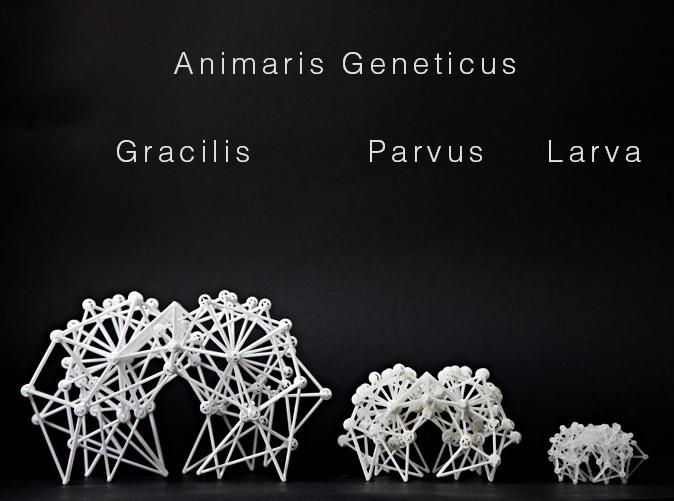
StrandBeests: 3D Print Crazy Live Animals… Well Almost

While browsing Shapeways this afternoon I stumbled upon something that caught my eye. No, it’s not another life saving device that has been 3D printed, or even something that you can get any real use out of, but I still could not look away. What are these 3D Printed objects you may ask? They’re Strandbeests, and they have been created by an extremely talented fellow by the name of Theo Jansen.

Theo is a 65 year old Dutch artist with quite the imagination, who gained fame for his work with PVC piping in the 1990′s to create what were also known back then as StrandBeests. They were basically large structures that could move on their own, many resembling animals or insects. Because of the fact that they have several leg-like extremities, they also usually have the ability to move on sand better than wheels can. Unlike a wheel, only small portions of the “Animals” need to touch the ground. Many Strandbeests can move on their own with the help of a wind driven propeller. The work was quite an engineering as well as artistic feat.

Theo has recently decided to take those same skills and apply them to 3D modelling and printing, bringing his creations to Shapeways so that anyone around the world can buy his famous StrandBeests. He has produced the following video, somewhat humorous, showing off his new 3D printed Beests, comparing them to wild animals:


Currently he is offering four different Strandbeests on Shpaeways, they include the following:
  • Animaris Geneticus Gracilis
  • Animaris Geneticus Larva
  • Animaris Geneticus Ondularis
  • Animaris Geneticus Parvus
Prices for his little works of art range anywhere from $39 to $110, and make amazing coffee table toys. You can discuss these little creatures in the 3DPrintBoard Forum here: http://3dprintboard.com/showthread.php?1518-Introducing-Theo-Jansen-s-StrandBeests


ORIGINAL: 3DPrint
by Randall Desmond
January 24, 2014

sábado, 21 de diciembre de 2013

Newly Discovered Pygmy Tapir is the Largest Terrestrial Mammal Found Since 1992


This week, the biggest animal discovery of the 21st century was announced. Meet kabomani, the “little black tapir.” He’s a shy and elusive fellow, living below the radar in the grasslands and forests of Brazil and Colombia. He’s also the largest terrestrial mammal found since 1992, when the saola of Southeast Asia raised his bovine head. How does a quarter-ton animal slip past the prying eyes of science for so long? Easy – just ignore what local people have been trying to tell you!


One of the continent’s largest and last megafauna, tapirs are surprisingly easy to overlook. Mostly active at night, they move slowly and cryptically, and they spend much of their time in and under the water. Still, this little guy has been rooting around right under our noses for more than a hundred years. In fact, the first known specimen was collected by none other than Theodore Roosevelt. Teddy’s field notes remark that this specimen, taken by another member of his party, “was a bull, full grown but very much smaller than the animal I had killed (a Brazilian tapir, Tapirus terrestris). The hunters said that this was a distinct kind.’’ The Karitiana tribe who live in the area regularly hunt kabomani, and of course they knew all along that the little fellow was a different animal altogether. The Karitianans can take some satisfaction in at least getting the naming rights. The new tapir is Tapirus kabomani, meaning “tapir” in the local Paumari language.

The kabomani is the first tapir discovered since 1865, and the first Perissodactyl (the order that includes tapirs, rhinos, and horses) found in over one hundred years. The last one was Przwalski’s Horse, way back in 1882. This new species looks much like a Brazilian tapir, but at only 250 pounds, he’s much smaller than his 700 pound cousin.

Mario Cozzuol, lead author and paleontologist on the Journal of Mammology paper announcing the discovery, first suspected the presence of the new species a decade ago while looking at some unusual skulls. His team then collected genetic material and specimens from local hunters and the Karitiana Indians. An extensive investigation of the tapir’s appearance and genetics proved this was indeed a new species of megafauna. Fabrício R. Santos, the paper’s co-author, says indigenous people were critical to the discovery, because they had known about its existence for decades, if not centuries, and can precisely identify their skulls.

For scientists and conservationists, this discovery is especially important. Only five species of tapir remain alive, dwindling relics of a once diverse group that spread from South America across the Bering Straits into Asia, Africa, and Europe. These include the Brazilian tapir, mountain tapir, Baird’s tapir, and the new Kabomani, all living in Central or South America, and one species in Asia (the Malayan tapir). All are threatened with extinction from hunting and loss of habitat, and the kabomani is no different. The region plans to build two large dams in the area, as well as many roads, and faces alarming rates of deforestation. How long will our tiny new addition remain in the family? We can certainly hope he will stay with us for the foreseeable future. Welcome, little kabomani!

Via Mongabay, Journal of Mammalogy

ORIGINAL: Inhabitat
12/21/13

lunes, 4 de noviembre de 2013

Why Should We Care About Animals? | Brian May | Oxford Union

Dr Brian May answers an audience members question during Q & A session after his speech "Save The Badgers" (full speech video at the end) - Oxford Union Society


Brian May says that there is no balance in nature only change in nature. He highlights his view is that every ONE animal matters, not just looking at it from a species wide point of view. Any creature that has feeling is worthy of respect and care.
 

ABOUT BRIAN MAY:
Brian May, musician and astrophysicist, is most widely known as the guitarist, songwriter and occasional singer of the rock band Queen.

He was appointed a CBE in 2005 for services to the music industry and for his charity work. He earned a PhD in astrophysics from Imperial College in 2007 and is currently serving as the 4th Chancellor of Liverpool John Moores University.  

Planet Rock voted May the 7th greatest guitarist of all time, and he was ranked at No. 26 on Rolling Stone magazine's list of the 100 Greatest Guitarists of All Time. In 2012, May was ranked the 2nd greatest guitarist of all time by a Guitar World magazine readers poll.

ABOUT THE OXFORD UNION SOCIETY:

The Union is the world's most prestigious debating society, with an unparalleled reputation for bringing international guests and speakers to Oxford. It has been established for 189 years, aiming to promote debate and discussion not just in Oxford University, but across the globe.


SUBSCRIBE for more speakers ► http://is.gd/OxfordUnion
Sign the Petition to SAVE THE BADGERS @ http://www.save-me.org.uk/
Oxford Union Website @ http://www.oxford-union.org/

viernes, 29 de marzo de 2013

Frans de Waal: Comportamiento moral en los animales

ORIGINAL: TED


Frans de Waal
Frans de Waal studies primate social behavior -- how they fight and reconcile, share and cooperate.

Why you should listen to him:

Dr. Frans B. M. de Waal is a biologist and primatologist known for his work on the behavior and social intelligence of primates. His first book, Chimpanzee Politics (1982), compared the schmoozing and scheming of chimpanzees involved in power struggles with that of human politicians. Ever since, de Waal has drawn parallels between primate and human behavior, from peacemaking and morality to culture. His scientific work has been published in hundreds of technical articles in journals such as Science, Nature, Scientific American, and outlets specialized in animal behavior. His popular books – translated into fifteen languages – have made him one of the world’s most visible primatologists. His latest books are Our Inner Ape (2005, Riverhead) and The Age of Empathy (2009, Harmony).

De Waal is C. H. Candler Professor in the Psychology Department of Emory University and Director of the Living Links Center at the Yerkes National Primate Center, in Atlanta. He has been elected to the National Academy of Sciences (US), the American Academy of Arts and Sciences, and the Royal Dutch Academy of Sciences. In 2007, he was selected by Time as one of The Worlds’ 100 Most Influential People Today, and in 2011 by Discover as among 47 (all time) Great Minds of Science.

Quotes by Frans de Waal 
“If you ask anyone, what is morality based on? These are the two factors that always come out: One is reciprocity, … a sense of fairness, and the other one is empathy and compassion.”

“Humanity is actually much more cooperative and empathic than [it's] given credit for.”

“There's actually a lot of evidence in primates and other animals that they return favors.”

lunes, 18 de febrero de 2013

¡Gran victoria! La UE prohíbe definitivamente la experimentación en animales con fines cosméticos

ORIGINAL: Anima Naturalis
30 de enero del 2013.

Esta revolucionaria victoria significa que del 11 de marzo en adelante, cualquier persona que desee vender nuevos productos e ingredientes cosméticos en la UE no debe probarlos en animales en ninguna parte del mundo. La prohibición afecta a todos los cosméticos, incluyendo artículos de aseo y productos de belleza desde jabón a pasta de dientes.

¡Gran victoria! La UE prohíbe definitivamente la experimentación en animales con fines cosméticos
Europa Press | AnimaNaturalis
The Body Shop es una de las pocas marcas de belleza que no se verá afectada por la prohibición, ya que siempre ha estado en contra de la experimentación en animales con fines cosméticos.

La prohibición propuesta supone un fuerte mensaje para todo el mundo en apoyo de la belleza sin crueldad y en particular para países como China, que aún exigen pruebas animales para los cosméticos, con el fin de que se prohíban también. 

La consejera delegada de Cruelty Free International, Michelle Thew, dijo: "Este es un acontecimiento verdaderamente histórico y la culminación de más de 20 años decampaña. Ahora aplicaremos nuestra determinación y visión a una escala global para asegurar que el resto del mundo sigue este camino".

Paul McGreevy, Director de Valores International en The Body Shop rindió tributo a los clientes que han apoyado la campaña de la compañía en contra de la experimentación en animales con fines cosméticos durante muchos años, y dijo: "Este gran logro en Europa es solo el cierre de un capítulo. El futuro de la belleza debe estar libre de crueldad".

En 1991, BUAV (fundador de Cruelty Free International) estableció una coalición europea de organizaciones de protección animal líderes en Europa (ECEAE) con el objetivo de terminar con el uso de las pruebas animales para cosméticos. Esto fue el inicio de una campaña pública y política de alto perfil en Europa que abarca más de 20 años.

En 1993, The Body Shop, la primera compañía de belleza en tomar medidas en contra de la experimentación en animales con fines cosméticos, secundó la campaña reclutando el apoyo de sus clientes en Europa. Tres años más tarde, en 1996, la Dama Anita Roddick, fundadora de The Body Shop, se unió a miembros de la ECEAE y MPE para presentar una petición con 4 millones de firmas a la Comisión Europea.

En 2012, la BUAV fundó Cruelty Free International, la primera organización global dedicada a terminar con la experimentación en animales con fines cosméticos en todo el mundo. The Body Shop junto con Cruelty Free International lanzó una nueva campaña internacional a la que se unió AnimaNaturalis, que hasta ahora ha conseguido que clientes de 55 países firmen una petición global que respalda el fin definitivo de la experimentación en animales con fines cosméticos.


martes, 28 de agosto de 2012

A Sixth Sense


ancient Egyptians used carrier pigeons, the domesticated descendants of wild rock doves, to carry urgent messages to distant lands. They proved to be cheaper, faster and more efficient than human messengers and their use spread throughout the Mediterranean, central and northern Europe, and then throughout the world. Yet it wasn’t until the mid-1800s that scientists began to ask how they do it. To this day, how animals accurately navigate on long migrations is still one of biology’s great mysteries. 

A modern day rock dove.
Photo by Ingrid Taylar at Wikimedia.
That’s not to say science hasn’t made a lot of headway on this investigation. Scientists have found that some animals learn landmarks when they travel in one direction, and use those landmarks to find their way back. Some animals follow odor cues. But one of the more intriguing theories is that animals have an internal map and compass but not a literal map and compass. The “map” is how the brain knows where things are in relation to each other and the “compass” is how the animal knows what direction it is facing with respect to where it wants to be.

How might such a compass work? One internal compass is a sun compass, in which an animal can use the position of the sun and the time of day to determine what direction it is facing. Some of the most convincing evidence supporting the existence of such a compass is that pigeons that are kept in a room with a time-shifted light cycle will fly in a predictably wrong direction on a sunny day. They will fly this wrong direction for long distances and even when they can see known landmarks. So pigeons clearly rely on the sun to achieve their great navigational feats… But what do they do on cloudy days… or at night? 

A cartoon of the Earth's magnetic field by Zureks at Wikimedia. In reality, the directions of magnetic pull are not this straight and uniform, but you get the idea.

Maybe pigeons have another compass based on the Earth’s magnetic field. Over 30 years ago, researchers found that racing pigeons (the new profession of decedents of carrier pigeons after mailmen in trucks and airplanes took their previous jobs) arrive at their destinations a little bit later when there have been recent magnetic storms due to sunspots. Pigeons also get disoriented in places with magnetic anomalies, such as areas with lots of iron ore. But experiments in which researchers have placed magnets or magnetic coils on the backs, wings, necks, heads or legs of pigeons have not had consistent effects, particularly on sunny days (when the sun compass likely comes into play).

Enter Cordula Mora and Michael Walker from the University of Aukland, New Zealand. Cordula and Michael reasoned that because the magnetic field gets weaker with distance and because we think that magnetoreception (the ability to perceive magnetic fields) occurs in or around the head, maybe these previous studies had inconsistent results because the magnets used were too far away and/or too weak to affect the receptors in a consistent way. So they did their own study with smaller, stronger magnets applied to pigeon beaks. 

Cordula and Michael glued magnets to the cere of pigeons. The diagram on the left shows how they did it and the photo on the right is a pigeon showing off his new nosepiece. (Check out the rock dove image above to see what a naked cere looks like). Diagram and image from Mora and Walker 2012 Animal Behaviour paper.
Cordula and Michael glued either a magnet or a brass weight (as a control) to the cere (the fleshy upper-part of the beak that contains the nostrils) of experienced racing pigeons right before a flight. In one experiment, researchers released the pigeons 11 consecutive times from the same place (called Gernsheim), and alternated whether they had a magnet or a brass weight glued to their cere. In a second experiment, the researchers released every bird once from each of 25 different places, each time with either a magnet or a brass weight glued to their cere. The birds were always flying to the same place (their loft), but the direction and distance they needed to fly was different for each of the release sites. Thus, the first experiment provides the birds with an opportunity to learn and compensate for any effect of the magnet, while the second experiment does not. All of the flights were done on sunny days. 


The places the researchers released the pigeons from were all different directions and distances from their home loft (at the center). Diagram from Mora and Walker 2012 Animal Behaviour paper.
For each flight, the researchers watched the bird through binoculars until it vanished from view, at which point they recorded the vanishing bearing (the direction the pigeon was flying before it vanished from view). They also timed how long it took the bird to return to the loft and recorded any instances in which the bird did not return to the loft.

The pigeons with magnets consistently flew just a little to the right of pigeons with brass weights. The effect was very small (ranging from 11° to 22°), but it almost always happened, regardless of the bird or the release site. The effect was also consistent over consecutive years, even in birds tested repeatedly from the same release site. However, although the vanishing bearing of birds with magnets was regularly to the right of the birds with brass weights, the magnets did not prevent the pigeons from finding their loft and did not even cause them to take longer to get home. This shows that some time after the vanishing distance, the pigeons with magnets compensated for their originally slightly-off bearing.

The fact that the pigeons with magnets almost always started off flying too-far right suggests that they do have and use a magnetic compass, or perhaps even a magnetic map. But the fact that they always got back to the loft just as fast as their brass weight carrying counterparts shows that they also rely on other mechanisms, like a sun compass and landmarks. Perhaps magnetoreception is only important to determine take-off direction. Or alternatively, maybe the birds learn to ignore the confusing signals of the magnets after awhile.

We still have a lot to learn about how animals use magnetic fields. And how does magnetoreception even work? How animals navigate over long distances is still a great mystery, but scientists are on the case.

Want to know more? Check these out:

1. Mora, C.V., & Walker, M.M. (2012). Consistent effect of an attached magnet on the initial orientation of homing pigeons, Columbia livia. Animal Behaviour, 84, 377-383 DOI: 10.1016/j.anbehav.2012.05.005

2. Wiltschko, R., & Wiltschko, W. (2003). Avian navigation: from historical to modern concepts. Animal Behaviour, 65, 257-272 DOI: 10.1006/anbe.2003.2054

3. Bingman, V. P., & Cheng, K. (2005). Mechanisms of animal global navigation: comparative perspectives and enduring challenges. Ethology Ecology & Evolution, 17, 295-318 DOI: 10.1080/08927014.2005.9522584

4. Winged Migration, a fantastic movie by Jacques Perrin


domingo, 10 de junio de 2012

Caballo con Prótesis

ORIGINAL: El Campito Refugio

¡Ejercitando la esperanza! ¡Apostando por la vida! Claro que se puede...¡Se puede y se debe!
(nuestra felicitacion a quienes llevaron adelante la recuperacion de este caballito, le dieron una oportunidad, cuando muchos optan por la eutanasia, aclaramos que no está en El Campito)

Foto: Autor Desconocido

lunes, 28 de mayo de 2012

Por qué algunos animales matan a sus crías

ORIGINAL: BBC
Redacción BBC
27.05.12


Parece lo más cruel del mundo, pero en el reino animal, el infanticidio es una herramienta poderosa para garantizar la supervivencia de las especies, señala un número cada vez mayor de investigadores.

Por esta razón, para muchos animales cachorros, la principal amenaza proviene de sus mismos pares.


Según le explicó a BBC Nature el experto en leones Craig Packer, cuando los animales matan a sus crías, lo hace de una forma que puede llegar a ser terrible.

"Ocurre de una manera violenta. Les muerden la espalda, la cabeza, el cuello y les aplastan el abdomen", dice.
Los peligros de no cometer infanticidio

Entre los suricatos, son las hembras las que cometen infanticidio.

El infanticidio está presente en una serie de especies, entre las que se incluyen mamíferos -como los roedores y los primates-, peces, insectos y anfibios.

Por lo general el que lo lleva a cabo es un macho adulto. Si bien estos suelen ser los encargados de proteger a los más pequeños, cuando aparecen nuevos machos en escena, la situación puede cambiar radicalmente.

Los recién llegados intentarán desplazar a los padres. Si logran usurpar su liderazgo -atacándolos, persiguiéndolos o incluso matando a los dominantes- los hijos de los machos del lugar corren peligro.

Esto se debe a que los intrusos tienen un objetivo: tener su propia cría con las hembras del grupo.

Entre los leones, por ejemplo, si los que llegaron matan a los leones bebés, sus madres se vuelven fértiles rápidamente, y así pueden producir nuevas crías.

Además, si los intrusos no eliminan a los cachorros que no son suyos, corren el riesgo de que éstos crezcan y puedan volverse sus enemigos.

Patas sin sangre

INFANTICIDIO EN EL REINO ANIMAL


  • Leones: los machos intrusos pueden matar a los cachorros en el grupo para asegurarse que tendrán descendencia 
  • Delfín nariz de botella: el infanticidio es raro en los cetáceos, pero se han registrado varios casos en esta especie 
  • Arao común (ave): recurren al infanticidio cuando hay escasez de comida 
  • Chimpancés: el infanticidio es relativamente común entre los chimpancés salvajes. Lo practican tano los machos como las hembras. 
Sin embargo, no solo son los padres los que matan a los más pequeños. Las hembras también lo hacen, explica Tim Clutton-Brock, profesor de la Universidad de Cambridge, en Reino Unido.

Las ratas hembra se comen a las crías de otras hembras y luego usan sus nidos para sus propios hijos. También pueden eliminar a su propia descendencia si nace con deformaciones o muestran heridas para destinar sus recursos a los otros hijos.

De acuerdo a un estudio publicado en el Journal of Theoretical Biology, más de 40 especies de primates cometen infanticidio. Pero, en muchas especies, las hembras emplean una estrategia para reducir el riesgo.

Algunas recurren a la confusión en torno a quién es el padre: las hembras se aparean con múltiples machos así ninguno sabe cuál es su hijo.

"En un grupo con muchos machos, si dos se aparean con la misma hembra y ninguno sabe que es el padre, se reducen las probabilidades de infanticidio", comenta Clutton-Brock.

En el caso de los suricatos, se sabe que las hembras dominantes pueden matar la cría de una subordinada, pero los machos no se manchan sus patas con sangre.

"Los suricatos machos nunca practican el infanticidio, porque apenas las hembras tienen cría, están listas para aparearse otra vez. Por eso, matar a los bebés, no beneficia en nada a los machos", explica el experto.

La situación es completamente diferente entre los leones ya que las hembras, después de tener cría, pasan 18 meses amamantándola y por ende no están listas para volver a reproducirse.

sábado, 26 de mayo de 2012

Elegidas las 10 especies más llamativas de 2012

ORIGINAL: El Colombiano
Ramiro Velásquez
23 de mayo de 2012

El Instituto Internacional para la Exploración de las Especies en Arizona State University y un comité de científicos de varios países escogieron la lista de las 10 especies del año 2012 entre las halladas en 2011, el quinto año en el cual se realiza la escogencia, revelada en el aniversario del nacimiento de Carlos Lineo, el botánico sueco responsable del sistema moderno de clasificación de plantas y animales.

1. Mono estornudador: Rhinopithecus strykeri, el segundo simio de nariz hundida hallado en Myanmar, que se cree en peligro crítico de extinción. FOTO CORTESÍA.
Entre las 10 especies elegidas figuran un mono estornudador, una bella pero venenosa medusa, un gusano de tierra y un hongo. También una orquídea que abre de noche, un cactus caminador y una pequeñísima avispa, así como una tarántula azul y un milípedo gigante.

El top 10 busca llamar la atención sobre la crisis de la diversidad y animar a exploradores y museos a continuar con la tradición de 250 años de descubrir y describir los millones de plantas, animales y microbios con los que compartimos este planeta”, dijo Quenton Wheeler, entomólogo que dirige el Instituto.

Los miembros del comité internacional que hizo la selección entre más de 200 nominaciones miraron especies que “capturaran nuestra atención porque son inusuales o porque tienen rasgos extraños”, explicó Mary Liz Jameson, de Wichita State University, quien dirige el comité.

En el planeta existen entre 8 y 100 millones de especies según diversos científicos. Al momento se han descubierto cerca de 2 millones.


2. Medusa de Bonaire: una bella medusa que parece una caja, con coloridas y largas colas, Tamoya ohboya. Se encontró en Bonaire . FOTO CORTESÍA

3. Gusano del diablo: Halicephalobus mephisto, mide 0,5 milímetros. Estos nemátodos son los organismos multicelulares que más profundo viven, a 1.300 metros de profundidad en Sudáfrica. No ha estado con contacto con la atmósfera terrestre durante 6.000 años. FOTO CORTESÍA

4. Orquídea nocturna: Bulbophyllum nocturnum es de Papúa Nueva Guinea y sus flores abren alrededor de las 10 de la noche y se cierran en la mañana. FOTO CORTESÍA

5. Avispa parásita: cruza el piso de Madrid, España, a 1 centímetro de altura sobre el suelo en busca de su cuna predilecta: hormigas. En ellas, a una velocidad de 1/20 de segundo deposita sus huevos. Su nombre: Kollasmosoma sentum. FOTO CORTESÍA

6. Hongo Bob Esponja: Spongiforma squarepantsii, que semeja más una esponja que un hongo típico. Si se comprime, luego recobra su forma original, tal como la esponja. FOTO CORTESÍA

7. Poppy nepalesa de otoño: Meconopsis autumnalis, una plantita amarilla que vive en la alta montaña de Nepal, que florece en otoño. FOTO CORTESÍA

8. Milpiés gigante: Curifarcimen vagans, que mide hasta 16 centímetros se halla en las montañas Arc en Tanzania. Tiene un diámetro de 1,5 centímetros con unos 56 anillos más o menos o segmentos corporales, cada uno con un par de patas. FOTO CORTESÍA

9. Cactus caminador: es un fósil de hace 520 millones de años, que se parece más a un cacto caminador que a un animal, pero Diania cactiformis vivió en lo que hoy es China y no se conocía. Puede ser ancestro de artrópodos como arañas e insectos. FOTO CORTESÍA

10. Tarántula de Sazima: un hermoso ejemplar de un azul iridiscente, la primera especie de Brasil elegida en el top 10 de las especies. Pterinopelma sazimai vive en ecosistemas aislados en lo alto de las montañas. FOTO CORTESÍA

viernes, 25 de mayo de 2012

Petitions about Free Access to Tax Funded Research; Animal Abuse, Shut down Nuclear Reactors

Require free access over the Internet to scientific journal articles arising from taxpayer-funded research


We believe in the power of the Internet to foster innovation, research, and education. Requiring the published results of taxpayer-funded research to be posted on the Internet in human and machine readable form would provide access to patients and caregivers, students and their teachers, researchers, entrepreneurs, and other taxpayers who paid for the research. Expanding access would speed the research process and increase the return on our investment in scientific research.

The highly successful Public Access Policy of the National Institutes of Health proves that this can be done without disrupting the research process, and we urge President Obama to act now to implement open access policies for all federal agencies that fund scientific research.


Make all animal abuse a felony for every convicted case of abuse in all states.


The petition asks that animal cruelty laws be made stronger. We want all convicted cases to be felonies in every state in this country. We are their voice and every living being deserves to be treated humanely. I believe with this done it will also help with people who abuse children and women. No abuse is right and therefore should be prosecuted to the fullest.
Created: May 17, 2012


shut down ALL nuclear reactors 1 at a time, safety as the reason. Must be made to withstand Earthquakes / Tsunamis.


Recently, (May 5 2012) Japan has announced the SHUT DOWN of its final nuclear power plant.

The entire country is now operating free from nuclear power.

Here is the MSM news story confirmation released May 5, 2012:


This petition of redress to the Whitehouse, specifically to President Obama, is aimed to mimic the reduction, and eventual ELIMINATION of all nuclear power plants within the Continental United States of America.

The shutdown process: Close each nuclear plant when it comes up for safety review. The reason for shutdown will be for the plant to assure it is 100% earthquake / tsunami proof.

If the plant is not deemed 100% Earthquake / Tsunami proof, then it will be permanently closed

jueves, 17 de mayo de 2012

Nuevo lagarto acorazado es el primero en ser identificado por una imagen con escáner

ORIGINAL: New Scientist
Caroline Morley, investigadora de fotos en línea
17 de mayo 2012

(Foto: AMNH / E. Stanley)

Durante los años de combate cuerpo a cuerpo, los seres humanos se han protegido con todo, desde pieles de animales y la corteza de los árboles hasta Kevlar. Esta tomografía computarizada (TC) muestra cómo algunos lagartos han desarrollado armaduras de su propia cuenta. Como los reptiles, que ya tienen escamas duras, en algunas especies, como ésta, las escamas están reforzadas para formar una armadura dura unidas por pequeños huesos llamados osteodermos.

El análisis confirmó datos genéticos y otros análisis para demostrar que el lagarto es una especie previamente identificados, marunguensis Cordylus, de la meseta Marungu en la República Democrática del Congo. En particular, el análisis mostró que esta especie tiene un menor número de osteodermos en el vientre de su pariente más cercano genética.

Edward Stanley, del Museo Americano de Historia Natural de Nueva York llevó a cabo las pruebas genéticas y tomografías computarizadas. Dijo: "Los datos de CT se ha incluido en las descripciones de una serie de peces vivos y especies de invertebrados, así como muchas especies extintas, pero hasta donde sabemos, esta es la primera vez que se ha utilizado durante un lagarto existente."

lunes, 7 de mayo de 2012

Solar-Powered Sea Slugs

ORIGINAL: U Maine | Nature
Imagine being able to turn on solar-powered cells whenever food became limiting in your environment to exploit the sun’s energy to produce chemical energy. Further imagine the advantage of being mobile and camouflaged with a green, rippling leaf appearance in a sea filled with predators in search of soft-bodied creatures. The sacoglossan mollusc Elysia chlorotica (Gould) possesses all of these traits. It is a shell-less, green “walking leaf” that will feed on algae when they are available, stealing the chloroplasts, and using them for solar-power when food is scarce.


ORIGINAL: Nature
The slug pictured to the right, Elysia chlorotica, is a symbiont thief.


Elysia chlorotica eats the alga Vaucheria litorea but does not digest it. The slug cuts open algal filaments and sucks out the contents, transferring the living chloroplasts to its own tissue. Chloroplasts are organisms that have lived symbiotically within plant cells for many millions of years. They harness energy from the sun, which they give to the plant or alga cell they live within. Most animals digest the chloroplasts entirely when they eat plants, but not Elysia. By keeping the chloroplasts intact and transferring them to its own tissue, Elysia allows them to continue photosynthesizing, producing energy for the slug. The slug can then live for months without eating as long as sunlight is available, and can maintain the same chloroplasts for its entire adult life. This is an extremely unique relationship between an animal and plant symbionts.

Many other animals form associations with photosynthetic organisms. Corals such as the one depicted below have a symbiosis with multiple single-celled organisms called zooxanthellae. This is a multiple-level symbiosis because corals house the entire chloroplast-containing zooxanthellae cells within their tissue. This is different from Elysia chlorotica, who has cut out the middleman — instead of incorporating entire cells, it only retains the chloroplasts.
The photograph of Elysia chowing down was taken by Nicholas E. Curtis and Ray Martinez. The second photograph of Elysia is courtesy of Mary S. Tyler, and was the cover of PNAS when this paper was published. The lower picture is the coral Porites as photographed by Casey Dunn.

You can watch two amazing videos of the slugs in action, here and here, both of which were included in the PNAS paper.
--Freya Goetz


These sea slugs feed by slicing or puncturing siphonaceous algal cells and sucking out the cell contents. All of the contents, including the algal nucleus, are discarded except the chloroplasts which are engulfed phagocytotically into the digestive cells. (The figure to the right shows the "stolen" chloroplasts, or kleptoplasts, within the cells of the slug's digestive tract.)

By distributing the “photosynthetic factories“ throughout their extensively branched digestive system just one cell layer beneath the epidermis, the sea slugs not only blend into the green algal bed (the figure to the right shows the sea slug on strands of the alga Vaucheria litorea ), they also capture light energy to fuel photoautotrophic CO2 fixation. In some cases, the resulting carbon products can totally sustain the sea slugs for several months in the absence of an algal food source and serve as precursors for synthesis of chemical defense compounds and the copious mucus which bathes and protects the sea slugs.


Symbiosis
Symbiotic associations between organisms, even of different kingdoms, is not that unusual. However, in almost all cases they represent an association between two intact, free-living organisms, both of which have retained their complete cellular genetic make-up. Such associations are typically intercellular and, if intracellular, the symbiont is frequently isolated from the host’s cytosol by sequestration in a vacuole or host-provided membrane. What makes the sea slug/algal chloroplast symbiosis so remarkable is that the symbiont is a “naked,” foreign organelle sustained intracellularly in direct contact with the host sea slug cytosol and the symbiont remains functional for several months despite the absence of any algal nucleo-cytosolic influence.

There is some disagreement on whether an association between an organism and an isolated organelle such as a chloroplast constitutes symbiosis since the symbiont (chloroplast) is not a free-living organism. The term symbiosis was first defined as, “unlike organisms” living together. “Unlike organisms” came to mean different species and symbiosis changed to reflect, “prolonged physical associations without respect to outcome.” In the early 1900's, the Russian scientist K.S. Mereschkovsky proposed that chloroplasts originated from blue-green algae (cyanobacteria), a process he named symbiogenesis or “the origin of evolutionary novelty via symbiosis.”

In 1975, Robert Trench defined intracellular symbiosis as, “the coexistence of at least two genomes of divergent evolutionary origins occupying the same cytoplasmic environment.

In her book on “Symbiotic Interactions,” Angela Douglas (1994) emphasizes that symbiosis is not dependent on mutual benefit to the partners, rather that at least one of the partners acquires a new metabolic property. Considering both Trench’s and Douglas’ definitions, we conclude that the intracellular association of algal chloroplasts with molluscan cells can be considered a unique symbiotic association. The chloroplast represents a symbiont genome and the host mollusc acquires a new metabolic capability, photosynthesis. Still, others prefer to use the term kleptoplasty or “something borrowed” to describe the chloroplast symbiosis. Regardless of definition or term used, today it is universally recognized that great biological novelty and diversity come from symbiotic associations and symbiosis is a widespread biological phenomenon.

PRIMARY, SECONDARY AND TERTIARY ENDOSYMBIOSIS
The endosymbiotic events leading to a solar-powered sea slug.

The endosymbiont theory traces the origin of the chloroplast to a free-living cyanobacterium that was engulfed by a eukaryote giving rise to the primary lineages of glaucophytes, red algae (rhodophytes), and the green plants and algae (the viridiplantae or streptophytes and chlorophytes, respectively).

Subsequently, secondary endosymbiosis, the uptake of a eukaryotic alga (green or red lineage) by another heterotrophic eukaryotic host, gave rise to a diverse group of secondary or complex algae, including the heterokont Vaucheria litorea.
Tertiary symbiosis is most commonly associated with dinoflagellates and the replacement of their endosymbiont with a new secondary endosymbiont. Here, we propose that the engulfment of secondary chloroplasts by a sea slug also represents a tertiary endosymbiotic association.

Kleptoplasty by Elysia chlorotica.
History
The first reports of "green bodies" within molluscs were made in 1904 by Brüel. However, it was not until the mid 1960's that these "green bodies" were studied and seen to be functional chloroplasts. From this time on, there has been much interest in the phenomenon by which sea slugs find, acquire, and maintain chloroplasts as an essential component of their life-cycle.

Kleptoplasty (“stealing” of chloroplasts) by Elysia chlorotica is remarkable for at least three reasons.
  1. First, the “symbiont” in this case is not another autonomous organism with an intact genome, but rather a “naked,” foreign organelle (chloroplast).
  2. Second, the symbiont is housed intracellularly and not sequestered between cells or within a vacuolar membrane.
  3. Third, and perhaps most remarkable, the semi-autonomous kleptoplasts remain functional for as long as ten months within the foreign host cytosol despite the absence of any of its own algal nucleo-cytosolic components.
This type of long-term activity by isolated plastids is unprecedented and astounding considering that chloroplasts are derived from once free-living cyanobacteria and have lost the majority of their genes. Hence, they are dependent on their own nucleo-cytosol for protein synthesis, targeting, and regulation of just about every function of the organelle. In turn, chloroplasts are fragile organelles and very sensitive to physical and chemical changes in their environment, including osmotic stress. Evidently, the advantages of photoautotrophy have provided a strong selective pressure for the evolution of this association.
Whether the establishment of this symbiotic association is fueled by photoautotrophy pressure to sustain energy production for the sea slug when food is scarce or the need for camouflage protection when facing life without a protective shell in a predatory environment, or both, the association has not progressed to a hereditary one where the plastids are passed from one generation of slugs to the next. Instead, the association must be established anew each year and is required for the slug to develop into a mature adult sea slug, at least in laboratory experiments.

Establishment of the Kleptoplastic Association
We have now succeeded in culturing Elysia chlorotica in the laboratory including establishing the symbiotic or kleptoplastic association with Vaucheria litorea chloroplasts. Adult E. chloroticaproduce eggs, devoid of plastids, typically in late spring and planktonic veligers hatch within 4 to 5 d and then spend about 5 d feeding on unicellular algae (Rhodomonas or Isochrysis in the lab). When subsequently provided with filaments of V. litorea, metamorphosis of the veligers into juvenile sea slugs occurs within 1 to 2 d.
The endosymbiosis is established when young juvenile sea slugs grasp and then puncture the siphonaceous algal cells and suck out the cell contents. All of the algal contents are “discarded” except the chloroplasts, which are engulfed phagocytotically into the digestive cells. The captured chloroplasts fill the growing, extensively branched digestive tubules that lie just one cell layer beneath the epidermis.

Over the next several months the sea slugs may continue to feed onVaucheria if it is available and/or sustain themselves by photoautotrophic CO2 fixation using their newly acquired chloroplasts.


In laboratory culture, the sea slugs are kept apart from the algae, thus sustaining themselves totally by photosynthesis for up to ten months. Interestingly, death of the adults occurs almost synchronously late each spring in the lab and field (Pierce et al. 1999 Biol. Bulletin on virus).

The alga vaucheria
Vaucheria: Synonyms = water felt
Reproduction = asexual by fragmentation of filaments or zoospores and sexual by oogamy.

Vaucheria is a salt-water, yellow-green alga (Xanthophyte), in the Heterokont Kingdom.
Xanthophytes (yellow-green algae): >600 species, PS, fresh and marine waters, Chl a and c1 and c2 and NO fucoxanthin or Chl b. Cell wall, but not of cellulose or chitin. Food reserve = oil or fat, not starch typically. Haploid nucleus with outer membrane continuous with ctER. Sessile or free-living; motile flatellated unicells to colonies to siphonaceous (coenocytic) multinucleated filaments, to multicellular filaments.


Heterokont (=stramenopile = chromista)
description: Members of the Kingdom Chromista or Heterokontae exhibit the following characteristics: tubular mitochondria, motile cell with two different flagella. They vary from unicellular flagellates to large, siphonaceous filaments. They include diatoms, raphidiophytes, chrysophytes (golden algae), oomycota (water molds), phaeophytes (brown algae and kelps), haptophytes, silicoflagellata, and the xanthophyta (yellow-green algae including Vaucheria).
Vaucheria exhibits a siphonaceous morphology with a large vacuole and a thin layer of multinucleate cytoplasm containing numerous chloroplasts.

Chloroplasts
The chloroplasts ofVaucheria litorea have the standard four membranes surrounding them when seen within the algal cytoplasm. When isolated, they have only the standard double envelope.

Vaucheria litorea.
Taxonomy:

Kingdom Chromista (=Heterokontae)

Division (Phylum): Ochrophyta
Class: Xanthophyceae
Order: Vaucheriales
Family: Vaucheriaceae
Genus: Vaucheria (De Candolle, 1801)
Species: Vaucheria litorea Hofman ex C. Agardh, 1823

Culturing the alga vaucheria
The heterokont alga (= chromophytes [chl a and c], autotrophic stramenopiles), Vaucheria litorea, is maintained in culture in enriched quarter-strength (tolerates ¼ to full-strength sea water) Instant Ocean and a modified f/2 medium with natural lighting and daily manual swirling.

about elysia chlorotica
Found in saltwater marshes along the east coast of the US as far north as Nova Scotia to NC in the south and some times down to FL; waters of widely varying salinity, but usually brackish salt marshes. Our specimens are routinely collected from an intertidal marsh on Martha’s Vineyard Island, MA.

Synonyms = “leaves that crawl,” “solar-powered sea slugs,” “walking leaf,” “eastern emerald elysia,”
Reproduction = hermaphroditic, but self-fertilization is not common, shed fertilized eggs
Size = 2 to 3 cm common; some up to 6cm