Mostrando entradas con la etiqueta Women. Mostrar todas las entradas

miércoles, 25 de mayo de 2016

The Incredible Story of NASA’s Forgotten ‘Rocket Girls’

Tracking lunar missions with the troublesome IBM 704 in 1959 -- the punch cards were for programming.
CREDIT: COURTESY NASA/JPL-CALTECH)

Looking back, the technology that put man on the moon seems incredibly basic. In the early days of space exploration, when electronic computers weren’t reliable and cutting-edge calculators could barely do basic functions, nearly all of the math was done by hand. Women — underpaid, overworked, and ultimately forgotten by even the institution they served — did most of it.

Nathalia Holt, a science writer and microbiologist, stumbled upon their stories almost by fate.

Five years ago, like any good 21st century parent, she googled a prospective baby name — Eleanor Frances — and stumbled upon a picture of a woman named Eleanor Frances Helin accepting an award at NASA in the 1960s.

I just remember just staring at this picture completely stunned. I have a PhD in Microbiology, and I consider myself very well-versed in the contributions of women scientists, but I had never heard of women working in NASA at this era, much less as scientists, and I really wanted to learn more,” Holt told ThinkProgress over the phone.
The Computers, 1953-
CREDIT: COURTESY NASA/JPL-CALTECH)
 Holt’s research led her to an entire group of women who worked as human computers throughout the history of space exploration. Although her first inkling came through a fortuitous internet search, finding the whole story took painstaking digging. Even NASA’s archives had forgotten them. Using old photo captions that identified just one or two names in big groups of women, Holt cold called scores of women until she connected with the right ones. I had never heard of women working in NASA at this era, much less as scientists, and I really wanted to learn more.

The stories these women told her formed the basis of her new book, Rise of the Rocket Girls.

In it, Holt chronicles women’s central role in what we now think of as the key accomplishments in space exploration, and their lives as computers in NASA’s Jet Propulsion Laboratory (JPL).

These women took math classes for fun though it was considered impractical for a woman. They competed against each other in speed-calculation contests. They hid their pregnancies and hoarded their vacation time so they could come back to work after having children. They worked alongside famous figures like Carl Sagan, Wernher von Braun, and Richard Feynman, and they were ultimately essential to the discoveries that made those men household names.

Yet when NASA celebrated the 50th anniversary of the first American satellite, the agency forgot to invite the women — living mere miles away — who were in the room when it happened.


Rise of the Rocket Girls unveils this forgotten history with nuance and insight, weaving in personal details about friendships, marriage, and motherhood with the technical problems these women solved, such as exactly how much fuel a rocket needed and how much would make it explode. And as the share of women graduating with technical degrees continues to plateau — and, in some cases, plummet — Holt’s book is an important reminder of how women’s work has been essential to advances in science and technology all along.

ThinkProgress spoke to Holt about the stories in her book, how JPL built and maintained such a strong group of female scientists, and the role of women in science and tech.

One thing that struck me is that in between all the details about JPL and all the science details, you really weave in a lot of detail about their personal lives. Is there a particular reason you felt like that was important?
In the beginning, I didn’t want to talk about their personal lives at all. I felt it would take away from what they did professionally, and from the contributions scientifically, and I worried if I talked too much about their personal lives it would undermine the contributions they had made.

Ultimately, I decided I wouldn’t be honoring their legacy if I didn’t tell the full story. Luckily, because this is a book, I had the space to tell both their scientific contributions and their personal lives. The reason I felt it was really important is because they were able to accomplish these incredibly long careers at a time when women with children did not typically work outside the home — so what they accomplished was really unique. They were able to do it because of very specific institutional dynamics and very specific ways that they were able to manage their personal lives as well, and I do think it’s a very powerful message for women today to hear.
The computers at work, 1955. Helen Ling is sitting at the second desk, left side. Barbara Lewis (Paulson) is on the phone at the back, and Macie Roberts is standing on the right side near the window.
CREDIT: COURTESY NASA/JPL-CALTECH
And you know, even the title is something that I gave a lot of thought about as well. I worried about putting “girls” in the title. Ultimately, I decided that it was a fitting title because this is what they called themselves. They actually called themselves the girls, Helen’s girls. The name that they didn’t like was computresses. That was the name that was really despised among the group.

That’s so funny, because isn’t that what they were? They were computers?
Yes they were, they were officially computers. And that name was fine. Computresses was the name they didn’t like. But yes, talking about their personal lives was not something that I did lightly, it’s something that I gave a lot of thought to.

Some parts of your book to me seemed like a very strong articulation for the importance of paid family leave, or just family leave at all. I was really struck by when — I believe it was Barbara Paulson — applied for a closer parking lot because she was pregnant and the administrators said, “Oh, you’re pregnant, you can’t work here anymore!” At that point she was an important manager, and they lost an important part of their team.

Barbara (Lewis) Paulson receiving her ten-year pin 
from Bill Pickering in 1959
CREDIT: COURTESY NASA/JPL-CALTECH
Yes, that was very upsetting. I mean this would happen quite often, that the women would hide their pregnancies as long as they could because, well, while the men and women they worked with didn’t care that they were pregnant, it was the administrators that would say no, this is an insurance liability and would immediately fire you that day, you had to leave the lab.

And when you were fired there was no maternity leave, so your job wasn’t waiting for you when you came back. That scene with Barbara, it was just so heartbreaking to hear her describe what that was like, and how hurtful that was for her. Luckily she was able to come back after having kids and had a very long career at the lab.

Why did you choose to focus specifically on the women at JPL, and how did JPL end up with such a strong female cohort, when other teams — NASA for example — doesn’t seem to have retained that diversity?
I chose the women at JPL because it was such a unique group. It started out with a married couple who were the first computers who worked at JPL, and then eventually — at that point there were still men and women who were working as computers — a woman was promoted to supervisor of the computers in 1942.

Her name was Macie Roberts, and she decided that she wanted to make the team all female. Her reasons for this were that she wanted it to be a cohesive group, she wanted it to feel like a family, and she worried that if she hired a man he simply wouldn’t listen to her. So she hired all women, and even her successor hired women as well. The strength they had in that group is really quite remarkable. They were really able to create their own culture at JPL

This wasn’t the same at other NASA centers. Of course, there were other computers that worked at other NASA centers and many of them were women, especially the ones that were hired during WWII when there was a shortage of men. But what I found that was quite sad at the other NASA centers was that once IBMs (electronic computers) came in, the women who worked as computers lost their jobs.

And so, I really loved the stories of the women at JPL because that didn’t happen to them. Instead they are the ones who became the first computer programmers. They became the engineers in the lab and just had these remarkable careers because of it.

At one point, you said it became the official rule that everybody who was hired had to have an engineering degree. At that time, they had all these women working there that — some of them didn’t even have bachelor’s degrees. As this was in the 70s and engineering programs weren’t yet letting in women, in a way it just set the diversity back.
Yes, this was a really critical time. I feel like that was happening not just at JPL but in labs all over the world, because you had this critical moment where degrees were becoming vital to have a job. But, so many of these engineering programs didn’t admit women yet. But at JPL, the women — even though many of them didn’t even have bachelor’s degrees, some of them did, some of them even had master’s degrees — but they were grandfathered in as engineers.

Helen Ling working on Mariner 2, 1962-
CREDIT: COURTESY NASA/JPL-CALTECH
One story I really love is Helen Ling, who was a very long-time supervisor of the computing section. She took over after Macie Roberts retired. She specifically sought out women who had bachelor’s degrees in math and computer science, and then she would hire them and encourage them to go to night school in engineering. Because of her you have all these women who came in and were able to rise up the ranks, and you have these great stories of women, — such as Sylvia Miller — who went on to have this long career and become the director of the Mars program office. And it’s really just because of Helen Ling that they were able to do this.

I should probably note here, the sad case of Susan Finley — she is Nasa’s longest serving female employee, and she’s been in the lab since 1958, so she’s had this incredible long career. She was hired by Macie Roberts and was there since the beginning of NASA.

Then in 2004, NASA decided to change the rules and decided that you can’t be an engineer if you don’t have a bachelors’ degree. They essentially took away that grandfathering that happened in the 1970s. This didn’t affect most of the women because many of them retired in the mid to late 1990’s, but it affected Sue.

They took away her engineering position and they put her on an hourly salary. It’s just really a terrible tragedy that I’m hoping that my book can change. That is one thing that i would most like to change with my book.

Is there anything else you’re hoping that the book will change?
In general I felt like we deserved to have recognition of these women, and not just because they deserve it, but because of the situation of women in technology today.

There has been such a drop in the number of women who are receiving bachelor’s degrees in computer science. I talk about it in the book a little bit, and I mention that really disheartening statistic — that 37 percent of bachelor’s degrees in computer science were awarded to women in 1984, that’s dropped down to 18 percent today. My hope is that the book will inspire women to go into technology today as well.

One of the main theories is that a lot of women don’t think of themselves as engineers because they don’t see representative examples. And yet, here we have this really strong example of all these really amazing women, who helped put rockets into space, and yet they’ve been completely forgotten.

I think it’s sad that so many of our female scientists have stories that were forgotten. It’s important that we go back and we find their stories and we recognize their contributions.

Could you talk a little bit about Janez Lawson?
Tracking spacecraft position in the control room during the Venus flyby, 1962
CREDIT: COURTESY NASA/JPL-CALTECH
She just has an amazing story. She was the first African American hired in a technical position at the Jet Propulsion Laboratory. She had a degree in chemical engineering from UCLA — so today she would have been hired as an engineer — but back then she was hired as a computer. There was a lot of discussion about hiring her — they wondered if this was going to create turmoil at the lab. It was really Macie Roberts who stood up for her and said no, we need to hire her, and helped promote Janez Lawson’s career.

She was one of the first people sent to the IBM training school, and she did incredibly well there. She had an amazing career and she did eventually become a chemical engineer. So i just think her story is so inspiring. I wish i could have interviewed her directly (she had passed away), but luckily i was able to speak with her friends and her family and get her story that way.

Your book also serves as a pretty good primer in the early history — or rather the complete history — of the space program. Is there a particular milestone that was your favorite when you were researching this?
Oh that’s such a hard question! There’s really quite a few; there are so many stories that I found surprising. One of my favorite things about researching this book was that I spoke with so many primary sources, and I did a lot of archival research as well. I was able to come across stories about these missions that really hadn’t been published before. Especially some of the early moon missions, I was just really fascinated with how many failures there were.I was shocked to learn that we could have put a satellite up a year before Sputnik

Hard decision, but I think maybe my favorite one is Jupiter C. This was the forerunner to Explorer One, the first American satellite. I was shocked to learn that we could have put a satellite up a year before Sputnik.

So, on September 20th, 1956, Jupiter C was launched — and this rocket was just incredible. It had a new altitude record — it went up to 3335 miles into the air — and it was just amazing for everyone watching it. But at its apex, it was loaded down with sandbags. Whereas if it had just had a satellite at the top we could have launched a satellite a year before Sputnik.

Analog computer equipment in 
the old Space Flight Operations control center, 1960
CREDIT: COURTESY NASA/JPL-CALTECH)
It’s just an amazing story. It’s really incredible how sneaky the group at JPL and their army collaborators, including Wernher von Braun, were at going around the Eisenhower Administration to make the first American satellite happen. I loved hearing about how they had this sort of design satellite that they had to keep locked away in cabinets, so that they had to make sure NASA administrators — or those who would become NASA administrators — wouldn’t see it.

It’s kind of funny too because I feel like that spirit really kept on. With the Voyagers, there’s sort of a similar story of sneakiness. Even in missions today, i think it’s kind of a mischievous lab. They like to push the limits.

This interview has been edited for clarity and brevity.

ORIGINAL: Think Progress
MAY 19, 2016

miércoles, 16 de diciembre de 2015

Evelyn Witkin and the Road to DNA Enlightenment


Evelyn M. Witkin with her cat Jenny at home in Princeton, N.J. CreditLaura Pedrick for The New York Times
For decades Evelyn M. Witkin, professor emerita at Rutgers University, has been a towering figure in genetics. Recently she was awarded the Lasker Basic Medical Research Award for groundbreaking work into how DNA responds to damage, a process essential to all living organisms.

At 94, Dr. Witkin’s own DNA appears to be in excellent condition. We met at her townhouse not far from Princeton University. A condensed and edited version of that interview and a subsequent telephone conversation follows.

Q. When you were growing up in 1930s New York, what did you think you’d be doing with your life?
A. I thought I might become a biologist. Genetics wasn’t a separate field of study yet.

As an N.Y.U. undergraduate, I majored in biology; however, in my senior year, which was 1940, I joined a civil-rights protest. That changed the direction of my life.

Though N.Y.U. had blacks on sports teams, when the school went up against some universities in the South, they kept them home. Seven student leaders, myself included, circulated a petition protesting N.Y.U.’s acceptance of Southern racism. N.Y.U. responded by suspending us for three months. I could not graduate with my class. I lost the graduate assistantship they’d offered me for the following year.

DNA’s Defenses
Evelyn M. Witkin and Stephen J. Elledge received a Lasker award for insights into how cells respond to damaged DNA. 

So I went up to Columbia, walked into Theodosius Dobzhansky’s office and asked if I might study with him. He’d never had a female graduate student before and thought that would be pretty good, and he said, “Sure.

Why did you go to Dobzhansky, a founder of evolutionary genetics?
To be frank, it was because Professor Dobzhansky was Russian. I was interested in testing the theories of Trofim Lysenko, who asserted that genes didn’t exist. I thought Dobzhansky could read Lysenko in the original. Now, once I took Dobzhansky’s genetics class, I saw that Lysenko was a fraud or an ignoramus, or both.

One day in 1943, Professor Dobzhansky gave me an article by Salvador Luria and Max Delbruck proving for the first time that bacteria had genes. Reporting on it for Dobzhansky’s class, I jumped up and down with excitement. At the time, one of the big questions involved how genetic mutations occurred. Thanks to Luria and Delbruck, I now saw how we could use bacteria models to answer that.

So in the summer of 1944, Dobzhansky sent me to Cold Spring Harbor Laboratories, where he had connections and where they were pioneering bacterial genetics. I ended up staying until 1955.

Legend has it that on your first day there you made a significant discovery. True?
Yes. On my first day, my supervisor handed me a culture of E. coli bacteria, pointed to an ultraviolet lamp and said, “Go induce mutations.”

I took a million bacteria, placed them on petri dishes, and put them under ultraviolet lamps. When I came back the next morning, there was almost nothing left alive. The UV light doses apparently had been too strong. However, one petri dish had four colonies on it, which meant that four bacteria had survived what had killed everybody else.

At this point, I asked, “Why did they survive? Maybe a mutation made them resistant.

I next cultured and tested them. Sure enough, they could withstand 100 times more radiation than the parent strain. That created something of a splash among scientists at Cold Spring Harbor. It became the focus of my Ph.D. research and led to work that I and others did later on how DNA repairs itself.

What did you discover?
That DNA damage generates a signal that turns on a whole lot of other genes that are not active in the healthy cell. They don’t do anything unless the cell generates this S.O.S. signal. And when they are turned on, they make products that help cells survive. They repair damage.

Now, my co-winner of the Lasker Prize, Stephen Elledge, later picked up on what I found and applied it to higher organisms, including humans. It’s one connected story that couldn’t have been understood unless it had been worked out in bacteria first.

Your career began in a time when there were tremendous barriers against women entering the sciences. How were you able to do it?
I think it, in part, was because I had a lot of support from men.

My late husband, Herman Witkin, an experimental psychologist, was a real feminist. He believed my career was as important as his. For 10 years, he commuted four hours every day to his work in Brooklyn so that I could keep mine at Cold Spring Harbor. When our second child was an infant, he had a sabbatical. He wrote a book with the baby in his lap most of the time.

He loved being home with the children that year. He said he got so close to those kids and that it was the best thing ever.

Some time in the 1950s, Vannevar Bush, who’d headed the Carnegie Institution of Washington — Cold Spring Harbor’s laboratory was its department of genetics — sent his college-age granddaughter to talk to me about family and career. “The secret,” I told her, “is to have a husband like Herman Witkin and boss like Vannevar Bush.

How exactly was Bush helpful?
When I was pregnant with my first child, he came to my lab and said it was important to make scientific careers possible for women. What did I need? I told him, maternity leave and to return only part time. He said, “Done, and we’re not going to cut your salary because I know you’re going to do a full-time job.” That act alone made it possible for me to stay with my research.

Bush also was very supportive of Barbara McClintock. Before coming to Cold Spring Harbor, she’d had all the classical “women in science” experiences. She’d been a member of a graduate team at Cornell of three men. They got top-notch jobs as soon as they got their Ph.D.s. Barbara couldn’t.

She won the Nobel Prize for the work she did there. Were you friends?
Yes. She taught me to really get to know my bacteria. She had this belief that you had to have a feeling for the organism. I knew what she meant. You needed to get deep down with these bugs, get to know what goes on with them so that you could spot something unusual.

Why, in 1955, did you leave the research paradise that was Cold Spring Harbor?
Because it was bad for our family to have Herman commuting four hours daily. I moved my work to Downstate Medical Center in Brooklyn. Very early, I made a decision that if there was conflict between my work and family, the family came first.

In 1960 we both had sabbaticals to Paris. When François Jacob heard, he asked me to come work with him at the Pasteur. I turned him down because you don’t work with Jacob unless you use every cylinder you’ve got. My children were 8 and 11. They were going to be in a strange country, in a strange school. I couldn’t do it.

When the Nobel Prize in Chemistry was awarded this year, it went to researchers who had worked on DNA repair. Were you disappointed not to be included?
That’s an awkward question. I can imagine that readers who do not know me will not believe me, but I couldn’t have been disappointed because it never occurred to me that I would get a Lasker Award, let alone a Nobel.

ORIGINAL: NYTimes
By Claudia Dreifus
DEC. 14, 2015

miércoles, 16 de septiembre de 2015

El juego de cartas “Mujeres de Ciencia”


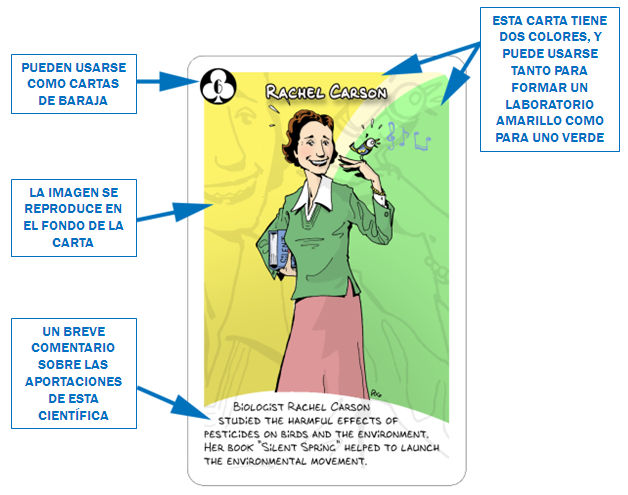
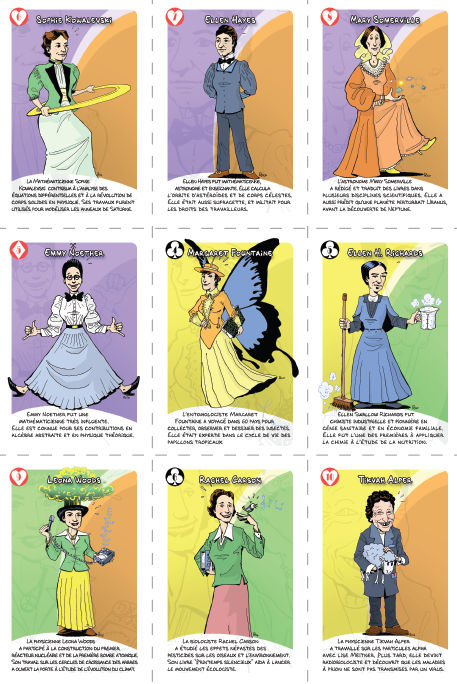
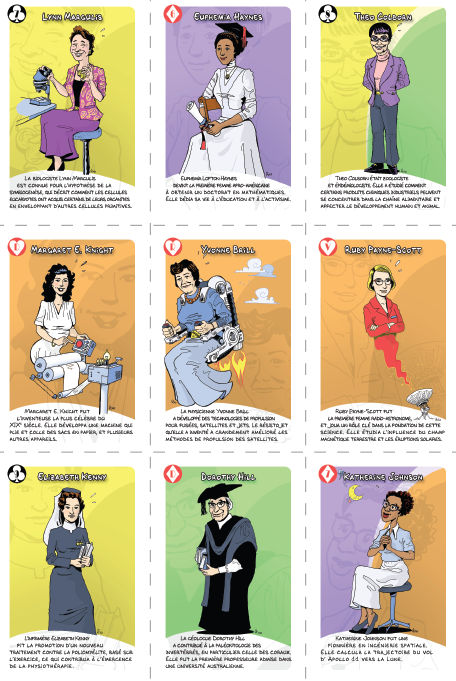
El juego de cartas Women in science presenta a 44 científicas de disciplinas variadas. La baraja –una idea de Anouk Charles y Benoît Fries– está compuesta por 52 cartas dibujadas por el artista Francis Collie.

Jugando con esta singular baraja, se puede aprender sobre las aportaciones de estas mujeres, algunas de ellas muy poco conocidas.

Además, este juego pretende ofrecer modelos tanto a chicas como a chicos, para que se animen a estudiar carreras de ciencias.

Reglas del juego
El objetivo del juego es reunir cuatro cartas del mismo color para formar un laboratorio. La primera persona que forma tres laboratorios, gana la partida. Cada jugador o jugadora recibe seis cartas. Se coloca el mazo (boca abajo) en el centro de la mesa y una primera carta boca arriba.

En cada turno, el jugador o jugadora decide coger la primera carta del mazo o la situada boca arriba, y se desprende de una carta, dejándola boca arriba en el montón de descarte.

Algunas cartas tienen dos colores y pueden usarse para construir laboratorios de cualquiera de los dos colores. La carta reclutamiento permite a un jugador o jugadora coger cualquier personaje del montón de descarte. La carta prestigio permite robar dos personajes de un laboratorio adversario (se destruye el laboratorio y los personajes restantes se reenvian a la mano de su propietario). La cartaclon permite a un jugador o jugadora hacer una copia de un personaje que posee; se sitúa junto a la carta con el personaje calcado cuando se forma un laboratorio, y no pueden separarse hasta el final de la partida.

Al final de cada turno, cada jugador o jugadora sólo puede tener seis cartas en la mano, dejando las sobrantes en el montón de descarte.

Cuando se terminan las cartas del mazo en el turno de una persona, queda eliminada de la partida; sus cartas y sus laboratorios se barajan junto a las cartas del montón de descarte para formar un nuevo mazo, y el proceso vuelve a comenzar.
Imagen creada por Marta Macho Stadler a partir de ésta.

Además, las cartas pueden utilizarse para cualquier otro juego de baraja francesa (corazones, diamantes, tréboles y picas).

Los colores que permiten formar los laboratorios son cinco y representan a diferentes disciplinas de la ciencia –los laboratorios se forman con científicas que pueden colaborar entre ellas–: amarillo (enfermería, medicina, salud), fucsia (educación, psiquiatría, psicología), lila (informática, matemáticas), naranja (física, inventos) y verde (biología, geología, química).

Las científicas representadas –junto al color y el número y palo de la baraja que la identifica– son:


Corazones
1. Chien-Shiung Wu(naranja)
2. Cecilia Payne (naranja)
3. Lise Meitner (naranja)
4. Maria Telkes (verde-naranja)
5. Lillian Gilbreth (naranja-fucsia)
6. Sofia Kovalevskaya (lila-naranja)
7. Ellen Hayes (lila-naranja)
8. Mary Somerville (lila-naranja)
9. Leona Woods (verde-naranja)
10. Tikvah Alper (amarillo-naranja)
V. Ruby Payne-Scott(naranja)
D. Margaret E. Knight(naranja)
R. Yvonne Brill (naranja)

Diamantes
1. Rose Dieng-Kuntz (lila)
2. Grace Hopper (lila)
3. Dian Fossey (verde-lila)
5. Emmy Noether (lila)
6. Euphemia Haynes (lila)
7. Katherine Johnson (lila-naranja)
8. Sophie Germain (lila)
9. Ada Lovelace (lila)
10. Irène Joliot-Curie (naranja)
V. Hedy Lamarr (naranja)
D. Dorothy Hill (verde)
R. Margaret Mead (fucsia)

Tréboles
1. Tewhida Ben Sheikh(amarillo)
2. Françoise Dolto(amarillo-fucsia)
3. Rosalind Franklin(amarillo)
4. Margaret Fountaine(amarillo)
5. Ellen H. Richards(amarillo-verde)
6. Rachel Carson (amarillo-verde)
7. Lynn Margulis (amarillo-verde)
8. Theo Colborn (amarillo-verde)
9. Elizabeth Kenny(amarillo)
10. Dorothy Hodgkin(amarillo)
V. Marie Tharp (verde)
D. Inge Lehmann (verde)
R. Wangari Maathai(verde)

Picas
1 y 2. Carta ‘reclutamiento’ (Albert Einstein)
3 y 4. Carta ‘prestigio’
5, 6, 7 y 8. Carta ‘clon’
9. Karen Horney (fucsia)
10. Alice Miller (fucsia)
V. Melanie Klein (fucsia)
D. Maria Montessori (amarillo-fucsia)
R. Nettie Stevens (amarillo)

Esta baraja se puede adquirir en inglés –Women in science– y en francés –Femmes de science–.

Además, en este enlace (cartas en francés) o este enlace (cartas en inglés) se puede solicitar el envío –gratuito– de un fichero pdf para imprimir la baraja completa.


Sobre la autora
Marta Macho Stadler es doctora en matemáticas, profesora del Departamento de Matemáticas de la UPV/EHU y colaboradora en ::ZTFNews y la Cátedra de Cultura Científica de la UPV/EHU.


ORIGINAL: MujeresEnCiencia
9 septiembre, 2015

jueves, 11 de junio de 2015

16 on-point responses from female scientists to Nobel winner's sexist comments

Image: Twitter Amelia Cervera / Danielle Spitzer

LONDON — How do you respond to sexist comments if you're a female scientist who has been told that you should be in a single-sex lab because male scientists might fall in love with you? You mock them on Twitter, of course.

Female scientists have been tweeting photos of themselves (and some historical figures) with the hashtag #distractinglysexy in response to Sir Tim Hunt's comments on Tuesday. He told a conference in South Korea that the "trouble with girls" is they fall in love with you, you fall in love with them and that then when they're criticised, they cry.

See also: Nobel-winning scientist resigns after sexist comments about women in labs

British biochemist Hunt, who was awarded a Nobel Prize in Physiology or Medicine in 2001, resigned from his role at University College London following the controversy.

After news of his comments spread, they sparked outrage in the science community in Britain and beyond.

Here are 16 of the best #distractinglysexy tweets:
I'm really glad that Curie managed to take a break from crying to discover radium and polonium #distractinglysexypic.twitter.com/txYVHoidK5 — Amy Remeikis (@AmyRemeikis) June 11, 2015

It's just really hard working in a coed lab because I'm too distracting to the male scientists #distractinglysexypic.twitter.com/9cZMUpy6TL— Danielle Spitzer (@dspitzzz) June 11, 2015 

Nothing like a sample tube full of cheetah poop to make you #distractinglysexypic.twitter.com/tdBTLRos4p — Sarah Durant (@SarahMDurant) J
 
Still #distractinglysexy after a full day of cell culture. Didn't even cry this time, so proud! #HeyaTimHuntpic.twitter.com/RdAxxLJ1fY— Lucie de Beauchamp (@lu_debeauchamp) June 11, 2015 

Tears, laughter, romance, dirty dirty flotation: #archaeology makes me so hot right now  #distractinglysexypic.twitter.com/Ke2KtDAXZi— Lorna Richardson (@lornarichardson) June 11, 2015

Planting this giant field experiment in the snow was probably the most #distractinglysexy week of my career so far. pic.twitter.com/bowL2vFdKg— Maggie R Wagner (@GolfXrayEcho) June 11, 2015

Filter mask protects me from hazardous chemicals and muffles my woman cries. Double win! #DistractinglySexypic.twitter.com/5kYlm6SNud— Amelia Cervera (@ameliacervera) June 11, 2015

My lenses bring all the profs to the yard. #distractinglysexypic.twitter.com/tgDNzg28gJ — Nermeen Youssef (@Cleo2atra) June 11, 2015
 
Oh don't mind me. I'm just pipetting while being #distractinglysexy #TimHunt #WomenInSTEM #womeninscience pic.twitter.com/95ywMimBno— Meg Massa (@MegMassa) June 11, 2015
 
Hearts in the palm of our hands #distractinglysexy #TimHunt @VagendaMagazine pic.twitter.com/KA1askiwCD— ash (@ashcl0ud) June 11, 2015
 
I made it through these brain dissections without falling in love or crying. Phew! #distractinglysexy  #TimHunt pic.twitter.com/q5PVkM9zCx— Sonja Vernes (@Sonja_Vernes) June 11, 2015

Guess I can't save the lives of my geological counterparts - I'm too #distractinglysexy to the team. As if! #TimHunt pic.twitter.com/QwXSYPhLQr— Lisa P to the O (@xLiserx) June 11, 2015

I had 3 marriage proposals after this talk. Shame I cried too much to accept #distractinglysexy #captioncompetition pic.twitter.com/Bv8yYmKhMK— Sammie Buzzard (@TreacherousBuzz) June 11, 2015

To save you all time, I have designed an easy to print off sign for your lab. You are welcome. #distractinglysexy pic.twitter.com/3LAPboJhb4— Steve Diggle (@stevediggle) June 11, 2015

Ha! Best #distractinglysexy signage ever! pic.twitter.com/dgx097F0x4 — Cindy Renate (@CindyRenate) June 11, 2015
You might think we're covered up for bug and sun protection, but it's really just because we're #distractinglysexy pic.twitter.com/O5fQH0bJgQ Rachel Penczykowski (@RachelPenczy) June 11, 2015

Have something to add to this story? Share it in the comments.


ORIGINAL: Mashable
4 hours ago

lunes, 27 de abril de 2015

Meet the Women Scientists of TIME 100


Joanne Liu. Bryan Schutmaat for TIME

These five most influential women are pioneers in the field of science and medicine

It will surprise no one to learn that women are vastly underrepresented in the field of science. But in this year’s TIME 100, five outstanding women who are making huge strides in the fields of medicine, genetics, and infectious disease, made the list.

Read more about these five influential scientists.

Liu and her team at MSF were the first to respond to the Ebola outbreak in Guinea. Liu has become a leader in the outbreak, and has fiercely and publicly criticized the international community for its slow response to the outbreak.

2- 3. Emmanuelle Charpentier & Jennifer Doudna, Creators of gene-editing technology
Charpentier and Doudna developed a groundbreaking gene-editing technique called CRISPR-Cas9, which allows scientists to add or remove genetic material as they please. The process has major implications for a variety of health problems from HIV to sickle cell anemia to cancer. In theory, CRISPR-Cas9 could be used to edit any human gene.

Dr. Pardis Sabeti, Geneticist who sequenced the Ebola genome from the most recent outbreak
Sabeti and her team are responsible for quickly sequencing the genome of the Ebola virus that has ravaged Guinea, Sierra Leone and Liberia. The task was important, since it determined that the disease was indeed spreading from person to person. Many of her collaborators and fellow researchers died during the outbreak. When she’s out of the lab, Sabeti sings in a rock band.

Elizabeth Holmes, Health technology entrepreneur
Holmes is the CEO of Theranos, a blood testing company that has challenged the traditional lab testing model. She studied chemistry before dropping out of Stanford University her sophomore year to start her company, and at age 31 she made Forbes’ Billionaires List as the youngest self-made woman billionaire.


ORIGINAL: Time

lunes, 6 de abril de 2015

We Need to Stop Ignoring Women Scientists

Sawdust

You have never heard of Hertha Ayrton. She was a brilliant British engineer, physicist, and inventor at the turn of the 20th century, and if you knew who she was you would thank her for steadying the flicker then prevalent in movie projection systems (why they're still called flicks). But in her lifetime, Ayrton was also a prominent suffragist and an outspoken advocate for the acceptance of women in scientific fields. Ayrton wanted to make sure due recognition went to another brilliant physicist: her friend Marie Curie.

See? It worked. And now, 92 years after Ayrton's death and 81 years after Curie's, we can see the real problem with Ayrton's success. Because today if you ask someone to name a woman scientist, the first and only name they'll offer is Marie Curie. It's one of the biggest obstacles to better representation of women in science and technology, and it's time to cut it out. Stop talking about Marie Curie; she wouldn't have wanted things this way.

When Silvia Tomášková, director of the Women in Science program at the University of North Carolina at Chapel Hill, brings up famous female scientists with her students—and this has been happening since she started teaching 20 years ago—she gets the same reaction: “Marie Curie.” Tomášková always tries to move them on. “Let's not even start there. Who else?” What about Vera Rubin, who confirmed the existence of dark matter? The experimental physicist Chien-Shiung Wu? Hedy Lamarr, the Hollywood starlet who invented a communications technology that paved the way for Wi-Fi, GPS, and Bluetooth? 
Felix Petruska

But no. Rarely are they included on the “famous scientist” educational posters. (It's men and Curie.) You haven't heard their names any more than you have heard Ayrton's. Curie has a monopoly. 
 Don't get me wrong. Curie was a remarkable scientist. She was the first woman to win a Nobel Prize—and the only one to win it twice. From her discovery of radioactive elements polonium and radium whole new areas of research on radioactivity bloomed. Her work changed the world. But you already know this, of course. Curie occupies a well-worn card in our mental file system. She's our default setting, relied upon whenever a woman in science is needed. Yes, her work was groundbreaking, and yes, her life was fascinating, but name-checking her—and only her—is more than lazy. It's standing in the way of women pursuing STEM fields.

Although girls take the same number of math and science credits in high school that boys do—even earning slightly higher grades—only 21.5 percent of US women entering university plan on majoring in science, technology, engineering, or mathematics. In computer science, women's share of the workforce has declined since the 1980s. Something happens in high school to convince girls that as young women they'd be out of place in science or math and should aim for less technical fields and lighter professions. To them Curie isn't a role model. She's a glaring, unattainable exception.

Our ability to make decisions extends only as far and wide as our knowledge base. When girls consider chemistry or archaeology, let's say, and find fields packed with men, it's hard for them to imagine that there's a stool for them at the lab bench too. According to both government reports and personal accounts, girls pursuing STEM careers benefit from role models. And they exist. They're just hidden behind everyone's favorite female scientist.

Related Stories

If we really want to get more women into STEM fields, we need to enact a moratorium on Marie Curie. It's all well and good to have that obligatory female nerd in the lab on every procedural mystery TV show, to include some lab-coated ladies in a Lego set, or to add a computer engineer Barbie to Mattel's latest line (though that one didn't go so well). But clearly it's not enough. Every single one of us needs to scrub that you-know-who reflex from our brain and replace it with a diverse set of important female innovators. When we do, girls will gain Grace Hopper, who was one of the most important—and colorful—computer scientists in history; Marie Tharp, who mapped the ocean floor and saw evidence of continental drift years before her partner or others in the scientific community accepted the idea; Virginia Apgar, whose scoring system for newborns has saved countless babies' lives; and Inge Lehmann, who discovered Earth's inner core.

Hopper loved to remind people that “we've always done it this way” is a lousy excuse that stands in the way of progress. By challenging ourselves to talk about a wider variety of accomplished women in STEM fields, we're guaranteeing a future with an even greater selection of brilliant thinkers to champion.

Rachel Swaby (@rachelswaby) is the author of Headstrong: 52 Women Who Changed Science—and the World, out April 7.

ORIGINAL: Wired
Rachel Swaby Magazine
04.01.15

viernes, 28 de junio de 2013

Meet Vera Rubin, Proved the existance of Dark Matter - Rejected From Princeton for Being a Woman

Nicole
Friday 28 June 2013.


Vera Rubin graduated from Vassar College with a BA, wasn’t allowed into Princeton to do her PhD because “women weren’t allowed” into their astronomy department so went to Cornell University instead. While doing her PhD she discovered “clumping” of galaxies in the universe – i.e. that galaxies might be rotating around centres, and not as the Big Bang Theory, suggests just moving outwards. However, it took two decades before anyone took this seriously and today it is generally accepted as fact.

Years later, she became the first woman hired at the Carnegie Institute DTM and worked with Kent Ford. Based on the ideas of Fritz Zwicky they found that all the galaxies in the universe - at the centre and at the edge - were moving at the same speed so realised there must be something there contributing to the gravitational pull of the universe, or else the universe should’ve been flying apart. In other words, the first evidence for dark matter – the invisible substance holding the universe together.

If you really have something you want to do — and it surely doesn’t have to be astronomy — and you really think that it’s worth doing, you should go ahead and do it." - Vera Rubin


Sources: DiscoveryAmerican Museum of Natural HistoryComaNiddyVassar


viernes, 21 de junio de 2013

JARA-BRAIN Women Scientists are "Excellent"

ORIGINAL: JARA

Excellent science will be intensively supported at RWTH Aachen University. (Foto: Shutterstock).


In the second phase of the Excellence Initiative, RWTH Aachen University is providing a wide range of funding opportunities for scientists. Applications from no less than three JARA-BRAIN women scientists were successful in an internal university selection procedure. Univ.-Prof. Dr. Ute Habel, head of the teaching and research area of Neuropsychological Gender Studies, was awarded the title of RWTH Fellow and will receive € 50,000 for her research project "Predictors of Successful Scientific Careers for Women and Men".

The aim of the study is to identify neural factors and behaviours that are beneficial for the scientific careers of men and women. To this end, women and men in leading scientific positions and also a corresponding number of persons at a preliminary stage of their scientific careers, such as postdocs, will be examined with respect to their sensitivity to stress in their behaviour and their cerebral activation patterns, and compared with each other.

"Train your Brain" – EEG-Neurofeedback Training for Depression

The JARA-BRAIN junior professor Dr. Birgit Derntl made a positive impression on the reviewers in the RWTH Start-Up Programme. Her application "Train your Brain – localized EEG neurofeedback as a new opportunity for intervention in depression" will receive funding of € 20,000. EEG neurofeedback training aims to influence the brain activity of people suffering from depression in such a way that their perception, attention and behaviour will be positively affected. In order to monitor the changes in the brain brought about by EEG neurofeedback training, fMRI images will be used for the first time before and after training.

Innovative e-learning video project on the topic of psychiatric diseases PD Dr. Irene Neuner, who works as a senior physician at University Hospital Aachen's Department of Psychiatry, Psychotherapy and Psychosomatics, and also conducts research at Forschungszentrum Jülich, was awarded the title RWTH Lecturer for her innovative teaching and research activities. The projects she has initiated include an e-learning video project on the topic of psychiatric diseases and a study course on psychiatry introduced as part of the Aachen model course for medical students. Irene Neuner is also jointly responsible for the hospital's mentoring programme for interns. The title of RWTH Lecturer also includes funding of € 15,000 for future project