Mostrando entradas con la etiqueta Sequencing. Mostrar todas las entradas

viernes, 3 de junio de 2016

Just a SmidgION: Oxford Nanopore announce iPhone-powered sequencing

CTO Clive Brown announces new Oxford Nanopore sequencing and library prep devices during his keynote address to the company’s user group conference

Stop the presses! Not something we call on a regular bases at FLG towers because, well, our work is largely digital. But when the latest news from Oxford Nanopore landed on our desks this afternoon, this old print journalism adage felt rather apt.

Clive Brown, CTO of Oxford Nanopore, talks at the London Calling Conference, via Oxford Nanopore
Yesterday, in his keynote address to the company’s user group conference in London, CTO Clive Brown announced the development of a new smartphone-powered nanopore sequencer, whimsically (and very Britishly) named ‘SmidgION’.

“Even I can’t believe they let me get away with that name,” chuckled Clive during his presentation.
Tiny SmidgION is currently in early-stage development

With 256 channels per flow cell, SmidgION will be smaller than the company’s existing MinION device, and is expected to come to market in 2017. 

MinION has established itself as a versatile field device, and is set to make history later this year as the first device used to sequence DNA in space. With SmidgION Oxford Nanopore are continuing to appeal to the field researcher, with potential applications in monitoring disease outbreaks, and real-time species identification in the fight against wildlife crime. 

Brown also revealed Project Zumbador, also in early development, a combined sample and library prep device that would deliver DNA captured on beads directly into the flow cell. Event attendee and one of our favourite genomics bloggers Keith Robison (Omics! Omics!) shared some images of the early prototype during his twitter coverage.

Zumbador prototype in hand #nanoporeconf pic.twitter.com/oOfzx97lGZ

— Keith Robison (@OmicsOmicsBlog) May 26, 2016

Note – Keith has now written his own coverage of the Oxford Nanopore announcements, including a photo diary in which he takes his personalised MinION device on a bike ride around London.

Interestingly, Brown also announced that Oxford Nanopore are no longer selling devices that contain the R7 nanopore. R7 has given way to R9, the company’s name for a membrane protein derived from Escherichia coli. This development may help the company to side-step a recent legal challenge from Illumina, which claimed that the R7 pore infringed a patent license. Oxford Nanopore licensed the new pore from VIB in Belgium and University College London in March 2016.

Liz Harley
27 MAY 16

martes, 5 de abril de 2016

A programming language for living cells

MIT biological engineers have devised a programming language that can be used to give new functions to E. coli bacteria.
Image: Janet Iwasa
New language lets researchers design novel biological circuits.
MIT biological engineers have created a programming language that allows them to rapidly design complex, DNA-encoded circuits that give new functions to living cells.

Using this language, anyone can write a program for the function they want, such as detecting and responding to certain environmental conditions. They can then generate a DNA sequence that will achieve it.

“It is literally a programming language for bacteria,” says Christopher Voigt, an MIT professor of biological engineering. “You use a text-based language, just like you’re programming a computer. Then you take that text and you compile it and it turns it into a DNA sequence that you put into the cell, and the circuit runs inside the cell.”

Voigt and colleagues at Boston University and the National Institute of Standards and Technology have used this language, which they describe in the April 1 issue of Science, to build circuits that can detect up to three inputs and respond in different ways. Future applications for this kind of programming include designing bacterial cells that can produce a cancer drug when they detect a tumor, or creating yeast cells that can halt their own fermentation process if too many toxic byproducts build up.

The researchers plan to make the user design interface available on the Web.

No experience needed
Over the past 15 years, biologists and engineers have designed many genetic parts, such as sensors, memory switches, and biological clocks, that can be combined to modify existing cell functions and add new ones.

However, designing each circuit is a laborious process that requires great expertise and often a lot of trial and error. “You have to have this really intimate knowledge of how those pieces are going to work and how they’re going to come together,” Voigt says.

Users of the new programming language, however, need no special knowledge of genetic engineering.

“You could be completely naive as to how any of it works. That’s what’s really different about this,” Voigt says. “You could be a student in high school and go onto the Web-based server and type out the program you want, and it spits back the DNA sequence.”

The language is based on Verilog, which is commonly used to program computer chips. To create a version of the language that would work for cells, the researchers designed computing elements such as logic gates and sensors that can be encoded in a bacterial cell’s DNA. The sensors can detect different compounds, such as oxygen or glucose, as well as light, temperature, acidity, and other environmental conditions. Users can also add their own sensors. “It’s very customizable,” Voigt says.

The biggest challenge, he says, was designing the 14 logic gates used in the circuits so that they wouldn’t interfere with each other once placed in the complex environment of a living cell.

In the current version of the programming language, these genetic parts are optimized for E. coli, but the researchers are working on expanding the language for other strains of bacteria, including Bacteroides, commonly found in the human gut, and Pseudomonas, which often lives in plant roots, as well as the yeast Saccharomyces cerevisiae. This would allow users to write a single program and then compile it for different organisms to get the right DNA sequence for each one.

Biological circuits
Using this language, the researchers programmed 60 circuits with different functions, and 45 of them worked correctly the first time they were tested. Many of the circuits were designed to measure one or more environmental conditions, such as oxygen level or glucose concentration, and respond accordingly. Another circuit was designed to rank three different inputs and then respond based on the priority of each one.

One of the new circuits is the largest biological circuit ever built, containing seven logic gates and about 12,000 base pairs of DNA.

Another advantage of this technique is its speed. Until now, “it would take years to build these types of circuits. Now you just hit the button and immediately get a DNA sequence to test,” Voigt says.

His team plans to work on several different applications using this approach: bacteria that can be swallowed to aid in digestion of lactose; bacteria that can live on plant roots and produce insecticide if they sense the plant is under attack; and yeast that can be engineered to shut off when they are producing too many toxic byproducts in a fermentation reactor.

The lead author of the Science paper is MIT graduate student Alec Nielsen. Other authors are former MIT postdoc Bryan Der, MIT postdoc Jonghyeon Shin, Boston University graduate student Prashant Vaidyanathan, Boston University associate professor Douglas Densmore, and National Institute of Standards and Technology researchers Vanya Paralanov, Elizabeth Strychalski, and David Ross.

ORIGINAL: MIT
Anne Trafton | MIT News Office 
March 31, 2016

lunes, 27 de abril de 2015

Meet the Women Scientists of TIME 100


Joanne Liu. Bryan Schutmaat for TIME

These five most influential women are pioneers in the field of science and medicine

It will surprise no one to learn that women are vastly underrepresented in the field of science. But in this year’s TIME 100, five outstanding women who are making huge strides in the fields of medicine, genetics, and infectious disease, made the list.

Read more about these five influential scientists.

Liu and her team at MSF were the first to respond to the Ebola outbreak in Guinea. Liu has become a leader in the outbreak, and has fiercely and publicly criticized the international community for its slow response to the outbreak.

2- 3. Emmanuelle Charpentier & Jennifer Doudna, Creators of gene-editing technology
Charpentier and Doudna developed a groundbreaking gene-editing technique called CRISPR-Cas9, which allows scientists to add or remove genetic material as they please. The process has major implications for a variety of health problems from HIV to sickle cell anemia to cancer. In theory, CRISPR-Cas9 could be used to edit any human gene.

Dr. Pardis Sabeti, Geneticist who sequenced the Ebola genome from the most recent outbreak
Sabeti and her team are responsible for quickly sequencing the genome of the Ebola virus that has ravaged Guinea, Sierra Leone and Liberia. The task was important, since it determined that the disease was indeed spreading from person to person. Many of her collaborators and fellow researchers died during the outbreak. When she’s out of the lab, Sabeti sings in a rock band.

Elizabeth Holmes, Health technology entrepreneur
Holmes is the CEO of Theranos, a blood testing company that has challenged the traditional lab testing model. She studied chemistry before dropping out of Stanford University her sophomore year to start her company, and at age 31 she made Forbes’ Billionaires List as the youngest self-made woman billionaire.


ORIGINAL: Time

viernes, 27 de marzo de 2015

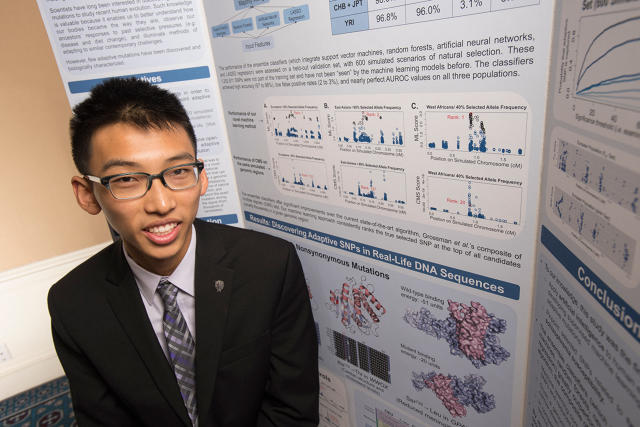
This 17-Year-Old Has Discovered DNA Mutations That Could Combat HIV And Meningitis

photo: Gio.tto via Shutterstock]

High schooler Andrew Jin is answering previously unasked questions in biology.


Like plenty of science-oriented high school kids, Andrew Jin is interested in human evolution. But Jin, one of three $150,000 first-place winners in this year's Intel Science Talent Search, took that interest further than most. For his project, the high school senior came up with machine learning algorithms that detect mutations in the human genome—mutations that could one day be used to develop drugs to combat diseases like HIV and schizophrenia.


Initially, Jin wanted to investigate how humans have evolved over the past 10,000 years. "I was doing it out of curiosity," he says. "I started thinking about natural selection and evolution, and that we understand so much about its theory, but we know nothing about reality. I was curious about what mutations help us be sophisticated human beings."

Jin decided to examine 179 human DNA sequences from different parts of the world. Each sequence consisted of 3 million base pairs of DNA—far too much to look at without help from an algorithm. So he set up a machine learning algorithm and found 130 potentially adaptive mutations, related to things like immune response and metabolism, that played a role in human evolution.

Working from a summer program at MIT, Jin refined his research and came up with a handful of mutations, including ones involved in resistance to meningitis and decreased susceptibility to viruses like influenza and HIV, that could potentially be used by pharmaceutical companies in new drug development.

There have been other natural-selection studies in the past looking for adaptive mutations, but Jin says that many of his findings are new. There's still a long way to go before he starts chatting up Big Pharma, however. "There's very, very strong evidence for these mutations playing a role in disease resistance, but in order to confirm, I would have to do biological experiments to study their protective mechanisms. That’s what I’m interested in doing now," says Jin.

Once he gets to college (he's not yet sure where that will be), Jin plans to pursue computer science or biology. But that's not all he's good at: The teen is a talented pianist who has played at Carnegie Hall. "I'm also an avid Boy Scout," he says.

lunes, 15 de diciembre de 2014

New Genome Sequences Reveal the Bird Tree of Life

A global, four-year project involving hundreds of scientists shows how avian lineages diverged after the dinosaurs’ extinction.


ERIC JARVIS DESCRIBES HOW THE MASSIVE AVIAN GENOME PROJECT REVEALED KEY RELATIONSHIPS AND EVENTS WITHIN BIRD EVOLUTION. | AAAS/ CARLA SCHAFFER

An international team of researchers has sequenced the genomes of 45 avian species and created the most reliable tree of life for birds to date. Their new avian family tree helps to clarify how modern birds — the most species-rich class of four-limbed vertebrates on the planet — emerged rapidly from a mass extinction event that wiped out the dinosaurs about 66 million years ago.

It also reveals how some of the earliest branches on the bird tree of life diverged, answering many long-standing questions about the common ancestor of birds, crocodilians, and dinosaurs. The findings shed new light on the evolution of avian sex chromosomes, vocal learning in both birds and humans, and the process that led to birds losing their teeth.

The massive comparative genomics project took more than four years to complete and involved hundreds of scientists from about 80 institutions in 20 different countries. The collaboration culminated in multiple studies, eight of which are published in the 12 December issue of Science. Others are published in journals such as Genome Biology and GigaScience.

The research was led by

  • Guojie Zhang from BGI in Shenzhen, China, and the University of Copenhagen in Denmark; 
  • Erich Jarvis from the Howard Hughes Medical Institute and Duke University in Durham, North Carolina; and 
  • Thomas Gilbert from the Natural History Museum of Denmark and Curtin University in Australia. 
With the expertise of colleagues from around the world, they were able to sequence at least one genome from every major modern bird lineage.

Zhang and his colleagues described their analysis of 48 avian genomes, including the 45 new sequences that they contributed (crow, duck, pigeon, falcon, woodpecker, eagle, ostrich, and many more) along with three genomes that were already available (chicken, turkey, and zebra finch). Their findings help to explain why bird genomes, in general, are about 70% smaller than those of mammals.

BIRD SPECIMENS FROM THE NATIONAL MUSEUM OF NATURAL HISTORY IN WASHINGTON, D.C. ILLUSTRATE SOME OF THE DIVERSE AVIAN SPECIES WHOSE GENOMES WERE SEQUENCED FOR THE PROJECT. | AAAS/ CARLA SCHAFFER
"One major reason that bird genomes are so small is because they don't have much repetitive DNA," explained Zhang during a webcast teleconference. "Another reason is that bird genomes have experienced massive gene loss in their ancestral stages. At least 1,600 genes have been lost in all bird genomes. Many of these genes actually have essential functions in humans, including some related to reproduction, skeleton formation, and lung systems."

"The loss of these key genes may have a significant effect on the evolution of many distinct phenotypes of birds," he continued. "Like their loss of teeth and dysfunction of one of their ovaries."

The analysis also revealed that the earliest common ancestor of land birds, which include parrots and songbirds as well as hawks and eagles, was a predator at the top of its food chain.

In a separate report, Jarvis and colleagues showed that protein-coding genes are not enough to get accurate phylogenetic trees. They suggested that researchers must include non-coding sequences of DNA as well as regions between the genes to provide a more accurate picture.

"In the past, people have been using one, two — up to 10 or 20 genes — to try to infer [bird] species relationships over the last 100 million years or so," said Jarvis. "Our theory has been: If you take the whole genome, you would have a more accurate species tree than just one or two genes [could provide] alone."

Their approach required more than 300 years of CPU time on several supercomputers, but they suggest that it could enable other groups of researchers to reconstruct similar, high-quality species trees for other challenging datasets in the future.

Ed Green from the University of California in Santa Cruz, California, and colleagues described the first sequencing of three crocodilian genomes — the American alligator, the saltwater crocodile, and the Indian gharial — which represent birds' closest living relatives. They revealed that the genomes of such crocodilians are evolving at an exceptionally slow pace.

THE INDIAN GHARIAL IS ONE OF THE CLOSEST LIVING RELATIVES OF BIRDS. | CHRISTOPHER BROCHU
"The molecular evolution of birds is much faster than it is in crocs, turtles, and other reptilian lineages," said Green. "So this avian lineage seems to be faster than other reptiles, but not faster than mammals."

Some of the other Science reports explore long-standing mysteries of bird biology. Qi Zhou from the University of California in Berkeley, California, and colleagues, for example, used the new avian genome sequences to explain how sex chromosomes have evolved in birds. Unlike the human Y chromosome, the avian W chromosome still has many active genes, and sex chromosomes of various bird species are currently at different stages of evolution, they write.

READ MORE ABOUT
THE NEW BIRD FAMILY TREE


Andreas Pfenning from Duke University with support from the Howard Hughes Medical Institute, along with his colleagues, exploited the sequences to study the molecular specializations between brain circuits that are important for singing in vocal-learning birds and speech in humans. Osceola Whitney, also from Duke University, and his colleagues determined that a whopping 10% of a bird's genome is regulated by singing, with highly diverse patterns across singing brain regions mediated by differences in gene expression.

Robert Meredith from Montclair State University in Montclair, New Jersey, and colleagues suggests that the mutations that eliminated enamel and dentin from the teeth of modern birds, an event which eventually led to toothless beaks-began about 116 million years ago.

Taken together, these reports support the theory of a "big bang" for bird evolution, with many species emerging rapidly during the 10 to 15 million years that followed the dinosaurs' extinction at the Cretaceous-Paleogene Boundary. They're poised to provide a model for other comparative genomics projects for the foreseeable future.

ORIGINAL: AAAS
Brandon Bryn
11 December 2014