Mostrando entradas con la etiqueta PCR. Mostrar todas las entradas

martes, 19 de enero de 2016

Traveling Salesman Applied To DNA Synthesis

One of the fun things about being a programmer is that algorithms that you know can often be applied in unexpected ways in areas that are the domain of other specialists. A good example is the traveling salesman problem being applied to DNA synthesis.

If you want to create a custom strand of DNA, it is fairly automatic these days. You specify the sequence of base pairs you need and a machine can create the DNA for you. Automatic DNA or gene synthesis works by using the standard Polymerase Chain Reaction (PCR) that is used in genetic "fingerprinting". In this process smaller sections of DNA are joined together and reproduced until a usable quantity has been created. This works well, but if the desired DNA contains repeated sections then it fails because there are multiple ways that the DNA fragments can be assembled. 

This seems to be a fundamental problem with the method, but if you are only interested in the protein that the DNA fragment codes for then you have some extra degrees of freedom. The protein that the DNA codes for is a sequence of amino acids and every three letters of the DNA, a codon, specifies a single amino acid, but there are 61 codons producing only 20 amino acids. What this means is that you can change the DNA sequence by substituting equivalent codons and still use it to generate the same protein. 

The redundancy in the codons is the key to solving the repeated sequence problem. All we have to do is change the codons to remove the repeats in the DNA while preserving the repeats in the protein produced. This is what scientists from Duke University have done using an analogy with the traveling salesman problem. The task is to find the least repetitive sequence that still produces the same protein.

Ashutosh Chilkoti, the Theo Pilkington Professor of Biomedical Engineering explains:

"I always thought there was a potential solution, that there must be a way of mathematically figuring it out. I had offered this problem to graduate students before, but nobody wanted to tackle it because it requires a particular combination of high-level math, computer science and molecular biology. But Nicholas Tang was the right guy."

The solution is a version of the "traveling salesman" problem. The classic question is, given a map with a set of cities to visit, what is the shortest route possible that hits every city exactly once before returning to the original city? Once recognized as the traveling salesman problem an exact solution using De Bruijn graphs and a modern mixed integer linear programme solver was found.

After swapping pieces of genetic code in repeating protein recipes, researchers were able to scramble them enough to be commercially synthesized. The dark bands are indicators of 18 repeating polypeptides successfully being fabricated. 

To prove that he had a solution, Tang made non-repetitive DNA for 19 highly repetitive polypeptides and sent the specifications off to a commercial lab. They returned working samples of the DNA with no problems. This would have been impossible using the original DNA specifications. 

Chilkoti and Tang are now working to make the new computer program available online for anybody to use through a simple web form, opening a new area of synthetic biology for all to explore.


ORIGINAL: .I-Programmer
by MIke James 
13 January 2016

viernes, 28 de noviembre de 2014

miniPCR: A DNA Discovery System for Everyone


 miniPCR: A DNA Discovery System for Everyone's video poster
DNA curious? Open up the world of DNA science and exploration with a portable, powerful, and affordable PCR-based DNA Discovery System

We live in a DNA world. DNA technology helps us diagnose disease, understand our ancestry and origins, establish guilt or innocence in our justice system, and test the water and food we consume every day. Yet DNA technology is still a black box for most of us.

We've created miniPCR to open the world of DNA science to everyone, everywhere.
This is the miniPCR DNA Discovery System:

Together we've reached our first Goal! Here are our Stretch Goals:

To prepare, amplify (copy), and visualize your DNA: With the DNA Family Tree kit, extract your own DNA and make so many million copies of it (in miniPCR) that you’ll see it shine before your eyes (with miniPCR visualizer).

Real-world biotech applications: Learn how DNA can be used to identify people, to detect bacteria in our food, to clone pieces of DNA from one organism into another, and more.

Learn more about the world around you: Engage in citizen science projects such as DNA barcoding, sushi-gate, detect food mislabeling, and (as you get more advanced) use PCR to characterize and discover new animals, plants, and fungi.

How DNA replication works (in our cells and in test tubes): PCR and our software will teach you how the chemistry of DNA allows our cells (and our miniPCR machines) to propagate genetic information.

The polymerase chain reaction (PCR) is at the heart of DNA analysis. PCR is a Nobel-winning technology that lets us make billions of copies of a specific piece of DNA that can be used for genetic analysis.


DNA testing and analysis kits everyone can use.

Get miniPCR for yourself, but don't forget to give one to a school.
More schools have asked for miniPCR, and we've added them!

Schools can now access a case full of DNA technology:

With the miniPCR DNA Discovery System:

  • YOU can take DNA science into your own hands, and share it with your kids.
  • OUR SCHOOLS can teach essential biotechnology and discovery.
  • EVERY LAB in the globe can have access to fundamental DNA analysis tools.

In the past few months, we have made and sold more than one hundred miniPCR machines that have been in use by scientists and students in four continents. See what miniPCR users are saying through these testimonials, and read:


You choice of:

  • The complete miniPCR DNA Discovery System (including a miniPCR Machine)
  • Or just the miniPCR machine (if you already own Pipetting Tools, Gel Electrophoresis, and Visualizer). PLUS you'll get the opportunity to donate cutting-edge DNA science to schools. 

Don't forget to add-on one or more DNA Testing Kits which contain all necessary reagents to do the labs!

The Amplyus team is led by Ezequiel (Zeke) Alvarez Saavedra and Sebastian Kraves. We met >15 years ago in college, where we shared the dream of becoming DNA scientists. Lacking access to lab tools, we learned DNA science mostly from lectures and textbooks. It wasn't ideal, but we fell in love with modern biology. After getting our PhDs at Harvard and MIT, we realized that we could create tools to give everyone access to the world of DNA science and discovery.

Amplyus is currently at the MassChallenge accelerator amidst other like-minded startups that strive to have a positive impact in our world.

Zeke Alvarez Saavedra, PhD, is a geneticist trained at MIT. His work has been cited thousands of times and profiled in The New York Times, National Public Radio and the BBC. Zeke is a patented and licensed inventor of gene-detection technologies.

Sebastian Kraves, PhD, is a molecular neurobiologist trained at Harvard. He has spent more than six years with the Boston Consulting Group addressing high-impact problems in healthcare, such as access to diagnostic technologies in Sub-Saharan Africa. Sebastian has also published on neural circuits, optogenetics, and the genetic regulation of behavior.


miniPCR comes out of the box and into the palm of your hand!

miniPCR will give you access to the full power and quality of a professional grade DNA lab instrument. If you're an experienced PCR user, you'll love its simplicity and convenience. If you're new to DNA analysis, miniPCR and its software will make it incredibly easy to learn.

  • Powerful. miniPCR delivers the same powerful genetic analysis as 10-times larger, $3,000-$10,000 instruments used by biomedical professionals. 
  • Portable. 2 x 5 x 4 inches, so you can take your science with you, or conveniently put miniPCR away when not in use.
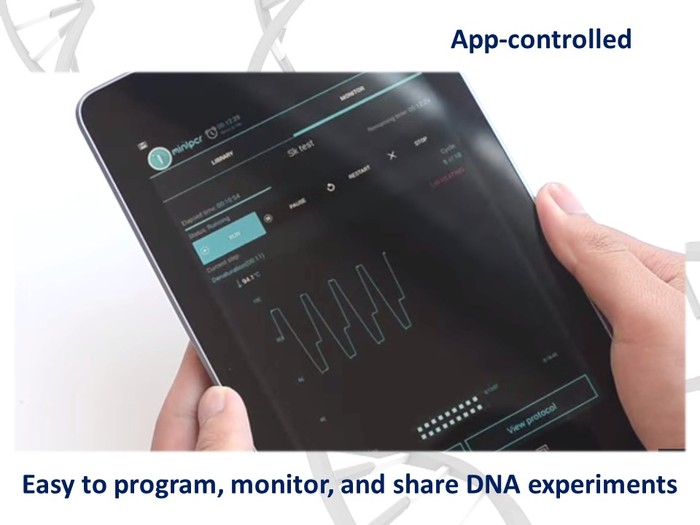
  • Simple. Easy to control directly from your Android device or Mac/Windows computer through the miniPCR app.
  • Ready to use. Requires no assembly. Simply plug into your computer, smartphone, or tablet. Or just flick it ON (miniPCR will store its program in memory).
  • Engaging. Through the app, visualize experiments and understand DNA science in real time. Through the clear case, see and understand how miniPCR works.
  • Affordable. At one-tenth the cost of commercial PCR machines, miniPCR is within the reach of homes, schools, and every lab budget.

The miniPCR software makes DNA science more intuitive. It's easy to program and monitor PCR conditions in real time, and export and share data for verification and analysis. It works on Android, MacOS, and Windows, and it's free with miniPCR.

Newcomers more easily grasp the underlying science 

Professional users enjoy the convenience of programming, storing, and monitoring experiments on their own phone or computer

To help you get up and running, we've created these DNA testing kits:

  • DNA Food Safety Lab
  • Forensic DNA Crime Lab
  • DNA Family Tree (see the schematic below)

miniPCR kits come with detailed instructions and have already been used by dozens of teachers and hundreds of students from middle school to college.

If the campaign meets our stretch goal, we will create a GMO detection lab to test whether your food has been genetically engineered.

It's 2014. More than 60 years since Watson and Crick's double helix, and more thanten since we've sequenced the human genome. Yet it's still hard to teach DNA science in our schools. Science is best learned by doing it, but biotech equipment available today is complex, expensive, and hardly education-friendly.

We're out to change that. We won't stop until every kid has access to the exciting world of biotech experimentation and the opportunities it creates.Download this brief document, and share it with your teacher, parent-teacher association, or principal to garner support to bring miniPCR to your classroom

Your pledge will help transform the landscape of science education through our technology, lesson plans, and teacher support.

Why? Just listen to Howard Goldsweig, MD, Biology teacher at The Codman Academy Public Charter School, a Boston inner city school:

PLAY


In PCR, small DNA sequences called primers search the millions or billions of letters in the genome for the target gene (or DNA region), in the same way that Google searches for a specific set of words in the World Wide Web. During PCR, that target DNA of interest is amplified or copied billions of times, in the same way that a small snippet of text can be broadcast widely using Twitter. To learn how PCR works watch the brief primer below.

PLAY

Our DNA Discovery System includes everything you'll need for steps 1, 2, and 3. We'll guide and support you if you've never done it before.

miniPCR will allow you to learn, discover, and explore in new ways:
Contribute to citizen science projects: DNA barcoding, sampling biodiversity, detecting food mislabeling, and more...

Make a billion copies of any gene from any organism

Understand more about yourself and the world around us

WHAT ELSE CAN SCIENTISTS DO WITH PCR? The range of DNA detection and modification experiments that doctors and scientists can do with PCR is virtually limitless. Copying DNA has countless applications; this wiki cites a few. PCR can be used to read genes, to detect infections (Ebola, HIV, malaria, many more), and to solve crimes. It can also just bring joy into the lives of biology nerds like us.

DISCLAIMER: We make miniPCR available to homes and schools for research and educational purposes only, and we offer it only with that intent. We believe that as more of us better understand DNA technology, society will be better equipped to make collective and individual decisions related to DNA analysis. We do not make/market/endorse miniPCR for use as a diagnostic or medical tool by laypersons, as we believe that people seeking to make medical decisions should be appropriately supported by medical professionals.

We are serious about science and education -- we love to experiment, but the last thing we’d do is experiment with you. miniPCR has gone through 10 prototypes, 3 beta versions, and one full year of validation of the final design in research labs and classrooms.
We've designed miniPCR from the ground up to make DNA science more accessible

Out of MIT, Zeke worked with a team at Templeman Automation. The team that undertook development and built the first prototype was formed by Zeke, Chris Templeman, Sean Jeffries, Cameron Dube, Dave Thomas, Randy Creasi, and Michael White. We open sourced the design. Early on the team received input from Josh Perfetto and Mac Cowell, who shared ideas and expertise. Thanks to you all!

Sebastian and Zeke decided to found Amplyus to further develop and validate the technology and bring it into manufacturing scale, making miniPCR machines available to everyone, everywhere.

We are now ready to bring miniPCR into full-scale production. Your pledge will help usset up our manufacturing operations locally in Massachusetts, creating jobs and helping lower production cost. It will also help us finalize development of our gel electrophoresis and visualization system.

The primary risk this campaign faces is the timely and efficient procurement of parts, components, and tools needed to manufacture at a larger scale. Luckily, we've spent the last year working with the same supply chain partners, getting to know them, and ensuring their quality and commitment meets ours. We are proud to be working with many local machine shops and suppliers that meet stringent specifications. That said, sourcing components can be a source of delays.

The second risk we'll face is the transition from small-batch production in our own hands to full-scale manufacturing. We've done a number of things to ensure a smooth hand-off. We have identified a local factory right here, in Massachusetts. This will allow us to work closely with our partners to get production rolling (while creating jobs!). Together, we have established standard processes, a quality control and testing plan, and we will soon run a production pilot.

The final challenge will be in working closely with our supporters to keep translating advanced concepts in DNA science into experiences accessible to a broad audience. This is the reason we started this company, and a challenge that we readily embrace.

Some may ask whether there are collateral risks with putting DNA technology into the hands of more people. Can miniPCR fall into the wrong hands and give birth to synthetic species that will colonize earth overnight? Extremely unlikely (sorry to disappoint). First off, it takes years of blood, sweat, and tears by entire teams of highly overtrained biologists to deliver any meaningful genetic transformation. Secondly, any evildoers lurking in the biosphere have access to laboratory tools already capable of doing the same genetic tricks as miniPCR (they are just much more expensive). All this said, we encourage everyone to explore biotechnology with the same spirit of exploration and curiosity that every scientist embodies. With great genetic power comes great responsibility. We believe that the greater risk lies in misinformation and ignorance, not in the dissemination of knowledge.

FAQ

ORIGINAL: Kickstarter

martes, 10 de diciembre de 2013

Opinion: Science Counterculture. On taking DIYbio to the next level

FLICKR, ADONOFRIO
Open-source software paved the way for a new, community-driven development model by providing a product that was free to use and modify. This in turn fostered a business culture that was driven by support-services. That open-source principles could also herald a new era in biology was demonstrated by the successful completion of the publicly funded Human Genome Project more than a decade ago. Today, that same open, community-driven mindset continues to drive much research in the life sciences.

Soon after the human genome sequence was published, biohackers and do-it-yourself biology (DIYbio) groups came onto the scene. Among the first to demonstrate the feasibility of garage biology was Meredith Patterson, who created glow-in-the-dark yogurt by transfecting green fluorescent protein DNA into Lactobacillus. Rob Carlson, who in 2005 was among the first to spot this new development and start his own garage lab, opined in The Scientist in 2011 that garage innovation would be as important for technological advancements in biology as it was in IT. Since then, some biohackers have organized themselves into low-cost, community-based labs providing both lab space and training. However, unleashing their true technological potential will call for greater networking between these groups and borrowing concepts from business incubator models and the open-source hardware movement.

DIYbio groups—such as BioCurious, CounterCulture Labs, Genspace, Bioartlab, and Biogarage—have sprung up in many cities across North America, Europe, Asia, and Oceania. While many have demonstrated that simple experiments like isolating DNA or creating recombinant microbes are easily replicated outside the traditional lab, more promising, low-cost, open-source tools are also being developed. These include Biocurious’s bioprinter, OpenFuge, and the Kickstarter-backed OpenPCR. Of these, the latter two are already available, and at a fraction of the cost of the cheapest commercial models.

To grow, the DIYbio community must have access to inexpensive lab equipment and consumables. A number of companies, which include Open Biotechnology, IORodeo, and Chai Biotechnologies, are offering open-source products ranging from mammalian cell lines, electrophoresis kits, and power packs to thermal cyclers for PCR. While this list is by no means exhaustive, partnering with these and other similar startups could satisfy DIYbio’s thirst for machines and reagents, and help create innovative technologies.

And then there are the open-source hardware companies, such as SparkFun, Adafruit Industries, and MakerBot, as well as initiatives like RepRap, which are well positioned to serve the DIYbio community. SparkFun and Adafruit manufacture hardware components for DIY projects, such as Arduino microcontroller boards, printed circuit boards, and other accessories. MakerBot produces the Replicator 2 series of 3-D printers and RepRap is a community-based initiative for building self-replicating 3-D printers. Writing in Science, Michigan Technological University’s Joshua Pearce noted that Arduino-controlled research equipment fabricated on 3-D printers could soon become a reality. Members of Joseph DeRisi’s lab at the University of California, San Francisco, have already taken the first steps by 3-D printing lab consumables and equipment such gel electrophoresis combs, gel trays, and rotors for bench-top centrifuges.

While the ability of DIYbio to drive technological innovation is fairly obvious, its ability to spur basic research innovation is less clear. For this to happen, equipment and operating costs must be brought down. Technological innovation may well fuel research advances in the long run, but for now, DIYbio groups could focus on community outreach programs and targeting high school and university participation. Community labs that are up and running could invite students to volunteer. They could expand community outreach online by posting videos or providing links to educational sites. Networking among DIYbio groups to develop shared goals and invest in shared equipment could be one way out of the resource crunch. Another would be to borrow from the business incubator model by asking for a small percentage of equity in exchange for assistance in developing a successful product and bringing it to market.

Countercultural movements are evidence of a society’s diversity and vitality. Many of the biggest advances in science have come from people outside or on the fringes of the science establishment. The emerging DIYbio community could become the incubator that nurtures the next generation’s technologies and public scientists. For this to happen, DIY biologists will need to band together to gain the critical mass necessary to support the open-source development of biological techniques, equipment, and experimental methods.

ORIGINAL: The Scientist
By Usha Nair
December 9, 2013 

Usha Nair is a research associate in the department of biology at the University of Saskatchewan, where her research focuses on the structure determination of proteins associated with bacterial virulence.

domingo, 12 de mayo de 2013

Synthetic circuits integrating logic and memory in living cells

ORIGINAL: Nature
10 February 2013

Nature Biotechnology 31, 448–452 (2013) doi:10.1038/nbt.2510 Received 25 October 2012 Accepted 17 January 2013 Published online 10 February 2013 

Logic and memory are essential functions of circuits that generate complex, state-dependent responses. Here we describe a strategy for efficiently assembling synthetic genetic circuits that use recombinases to implement Boolean logic functions with stable DNA-encoded memory of events. Application of this strategy allowed us to create all 16 two-input Boolean logic functions in living Escherichia coli cells without requiring cascades comprising multiple logic gates. We demonstrate long-term maintenance of memory for at least 90 cell generations and the ability to interrogate the states of these synthetic devices with fluorescent reporters and PCR. Using this approach we created two-bit digital-to-analog converters, which should be useful in biotechnology applications for encoding multiple stable gene expression outputs using transient inputs of inducers. We envision that this integrated logic and memory system will enable the implementation of complex cellular state machines, behaviors and pathways for therapeutic, diagnostic and basic science applications.

Figure 1: Integrated logic and memory devices. A simple rule is used to translate desired computational functions into [promoter(s)]-[terminator(s)]-[output] designs, which can be constructed with straightforward Gibson assembly. In all of the E. coli cells used in this work,
Figure 2: Recombinase-based logic gates can implement a complete set of two-input–one-output Boolean logic gates without needing to cascade multiple universal gates together. 


Figure 3: Stable memory maintenance over multiple cell generations and after cell death. 
(a) Percentage of cells maintaining GFP expression, assayed by flow cytometry after gating by forward and side scatter, in cells containing an AND gate induced to the ON state after day 0 and continuously diluted and grown without input…

Figure 4: Recombinase-based logic and memory can implement digital-to-analog converters. 
Cells were exposed to no inputs, AHL only, aTc only, or AHL and aTc simultaneously. (a–c) Various digital combinations of the input inducers result in multiple levels of analog gene expression outputs on the basis of the varying strengt…