Mostrando entradas con la etiqueta Camera. Mostrar todas las entradas

martes, 5 de enero de 2016

NVIDIA DRIVE PX 2. NVIDIA Accelerates Race to Autonomous Driving at CES 2016

NVIDIA today shifted its autonomous-driving leadership into high gear.

At a press event kicking off CES 2016, we unveiled artificial-intelligence technology that will let cars sense the world around them and pilot a safe route forward.

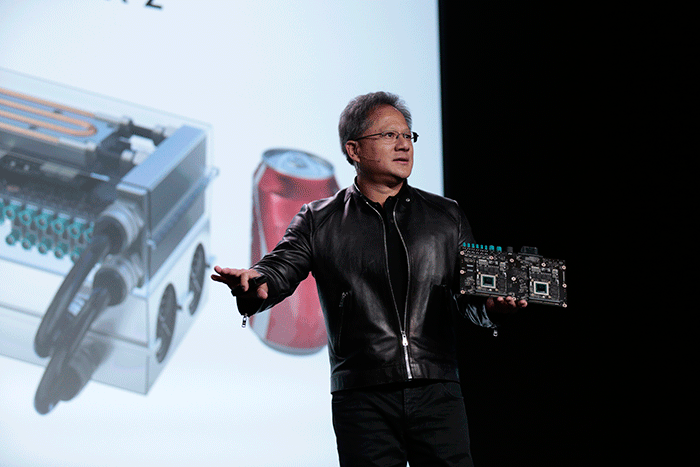
Dressed in his trademark black leather jacket, speaking to a crowd of some 400 automakers, media and analysts, NVIDIA CEO Jen-Hsun Huang revealed DRIVE PX 2, an automotive supercomputing platform that processes 24 trillion deep learning operations a second. That’s 10 times the performance of the first-generation DRIVE PX, now being used by more than 50 companies in the automotive world.

The new DRIVE PX 2 delivers 8 teraflops of processing power. It has the processing power of 150 MacBook Pros. And it’s the size of a lunchbox in contrast to earlier autonomous-driving technology being used today, which takes up the entire trunk of a mid-sized sedan. 

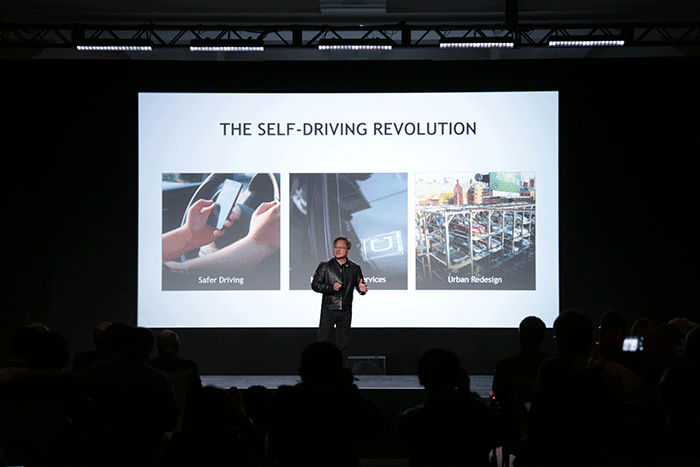
Self-driving cars will revolutionize society,” Huang said at the beginning of his talk. “And NVIDIA’s vision is to enable them.

Volvo to Deploy DRIVE PX in Self-Driving SUVs
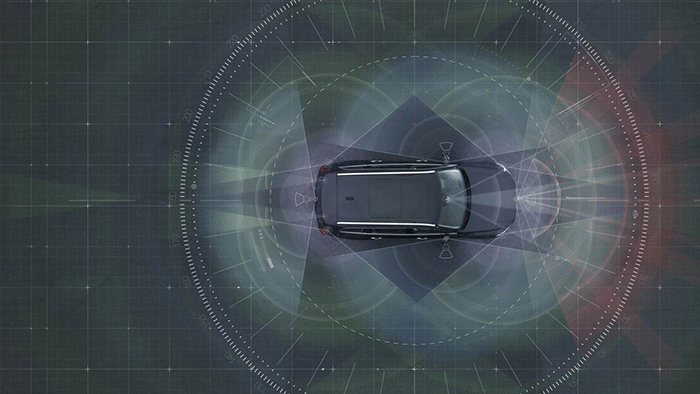
As part of its quest to eliminate traffic fatalities, Volvo will be the first automaker to deploy DRIVE PX 2.
Huang announced that Volvo – known worldwide for safety and reliability – will be the first automaker to deploy DRIVE PX 2.

In the world’s first public trial of autonomous driving, the Swedish automaker next year will lease 100 XC90 luxury SUVs outfitted with DRIVE PX 2 technology. The technology will help the vehicles drive autonomously around Volvo’s hometown of Gothenburg, and semi-autonomously elsewhere.

DRIVE PX 2 has the power to harness a host of sensors to get a 360 degree view of the environment around the car.

The rear-view mirror is history,” Jen-Hsun said.

Drive Safely, by Not Driving at All
Not so long ago, pundits had questioned the safety of technology in cars. Now, with Volvo incorporating autonomous vehicles into its plan to end traffic fatalities, that script has been flipped. Autonomous cars may be vastly safer than human-piloted vehicles.

Car crashes – an estimated 93 percent of them caused by human error kill 1.3 million drivers each year. More American teenagers die from texting while driving than any other cause, including drunk driving.

There’s also a productivity issue. Americans waste some 5.5 billion hours of time each year in traffic, costing the U.S. about $121 billion, according to an Urban Mobility Report from Texas A&M. And inefficient use of roads by cars wastes even vaster sums spent on infrastructure.

Deep Learning Hits the Road
Self-driving solutions based on computer vision can provide some answers. But tackling the infinite permutations that a driver needs to react to – stray pets, swerving cars, slashing rain, steady road construction crews – is far too complex a programming challenge.

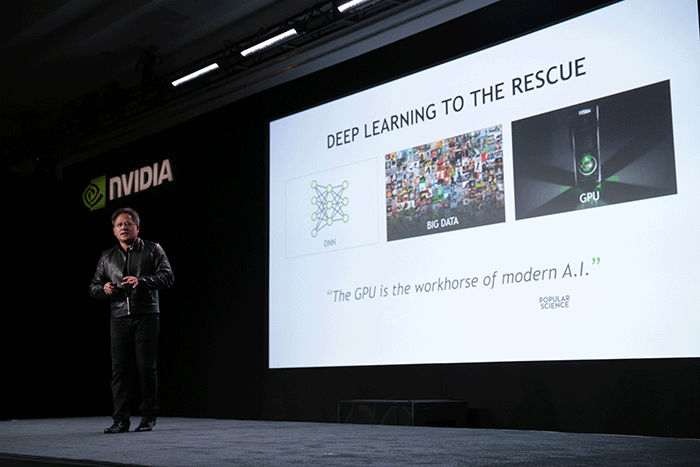
Deep learning enabled by NVIDIA technology can address these challenges. A highly trained deep neural network – residing on supercomputers in the cloud – captures the experience of many tens of thousands of hours of road time.

Huang noted that a number of automotive companies are already using NVIDIA’s deep learning technology to power their efforts, getting speedup of 30-40X in training their networks compared with other technology. BMW, Daimler and Ford are among them, along with innovative Japanese startups like Preferred Networks and ZMP. And Audi said it was able in four hours to do training that took it two years with a competing solution.
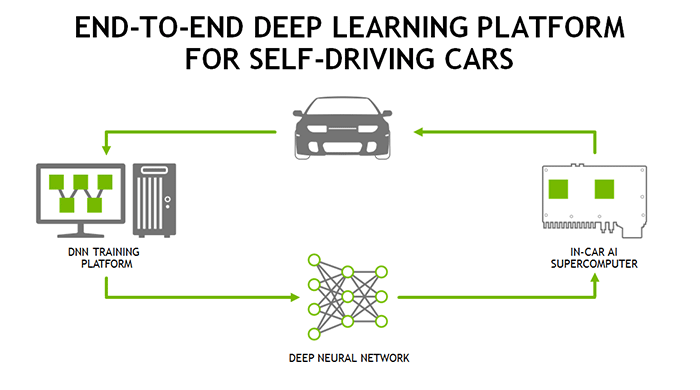
  NVIDIA DRIVE PX 2 is part of an end-to-end platform that brings deep learning to the road.

NVIDIA’s end-to-end solution for deep learning starts with NVIDIA DIGITS, a supercomputer that can be used to train digital neural networks by exposing them to data collected during that time on the road. On the other end is DRIVE PX 2, which draws on this training to make inferences to enable the car to progress safely down the road. In the middle is NVIDIA DriveWorks, a suite of software tools, libraries and modules that accelerates development and testing of autonomous vehicles.

DriveWorks enables sensor calibration, acquisition of surround data, synchronization, recording and then processing streams of sensor data through a complex pipeline of algorithms running on all of the DRIVE PX 2’s specialized and general-purpose processors.

During the event, Huang reminded the audience that machines are already beating humans at tasks once considered impossible for computers, such as image recognition. Systems trained with deep learning can now correctly classify images more than 96 percent of the time, exceeding what humans can do on similar tasks.

He used the event to show what deep learning can do for autonomous vehicles.

A series of demos drove this home, showing in three steps how DRIVE PX 2 harnesses a host of sensors – lidar, radar and cameras and ultrasonic – to understand the world around it, in real time, and plan a safe and efficient path forward.

The World’s Biggest Infotainment System
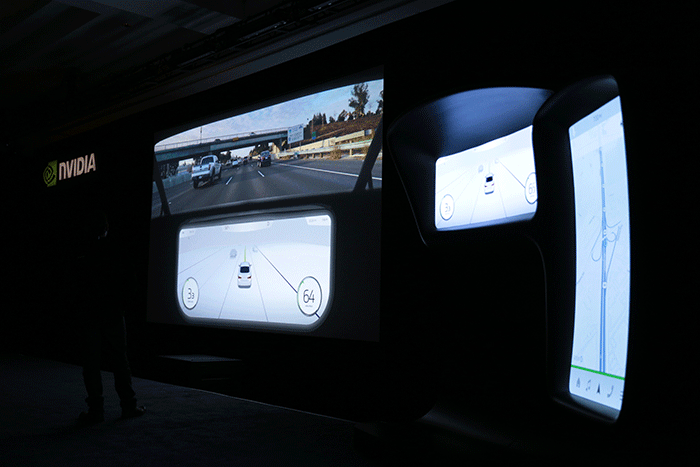

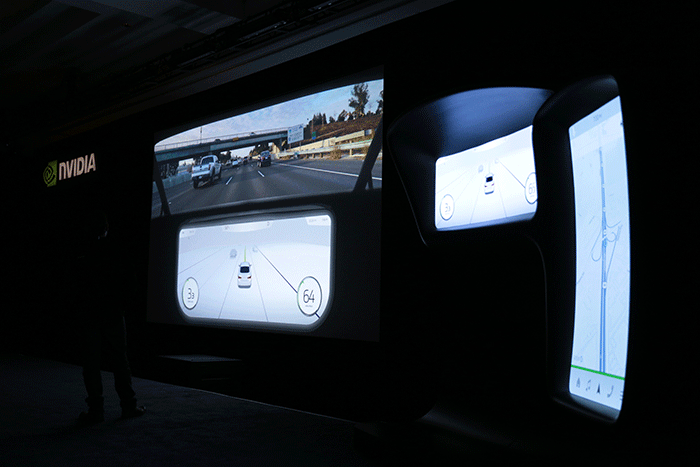
The highlight of the demos was what Huang called the world’s largest car infotainment system — an elegant block the size of a medium-sized bedroom wall mounted with a long horizontal screen and a long vertical one.

While a third larger screen showed the scene that a driver would take in, the wide demo screen showed how the car — using deep learning and sensor fusion — “viewed” the very same scene in real-time, stitched together from its array of sensors. On its right, the huge portrait-oriented screen shows a highly precise map that marked the car’s progress.

It’s a demo that will leave an impression on an audience that’s going to be hear a lot about the future of driving in the week ahead.

Photos from Our CES 2016 Press Event

NVIDIA Drive PX-2

ORIGINAL: Nvidia
By Bob Sherbin on January 3, 2016

domingo, 17 de mayo de 2015

Silicon Chips That See Are Going to Make Your Smartphone Brilliant

Many gadgets will be able to understand images and video thanks to chips designed to run powerful artificial-intelligence algorithms.

WHY IT MATTERS
Many applications for mobile computers could be more powerful with advanced image recognition.

Many of the devices around us may soon acquire powerful new abilities to understand images and video, thanks to hardware designed for the machine-learning technique called deep learning.

Companies like Google have made breakthroughs in image and face recognition through deep learning, using giant data sets and powerful computers (see “10 Breakthrough Technologies 2013: Deep Learning”). Now two leading chip companies and the Chinese search giant Baidu say hardware is coming that will bring the technique to phones, cars, and more.

Chip manufacturers don’t typically disclose their new features in advance. But at a conference on computer vision Tuesday, Synopsys, a company that licenses software and intellectual property to the biggest names in chip making, showed off a new image-processor core tailored for deep learning. It is expected to be added to chips that power smartphones, cameras, and cars. The core would occupy about one square millimeter of space on a chip made with one of the most commonly used manufacturing technologies.

Pierre Paulin, a director of R&D at Synopsys, told MIT Technology Review that the new processor design will be made available to his company’s customers this summer. Many have expressed strong interest in getting hold of hardware to help deploy deep learning, he said.

Synopsys showed a demo in which the new design recognized speed-limit signs in footage from a car. Paulin also presented results from using the chip to run a deep-learning network trained to recognize faces. It didn’t hit the accuracy levels of the best research results, which have been achieved on powerful computers, but it came pretty close, he said. “For applications like video surveillance it performs very well,” he said. The specialized core uses significantly less power than a conventional chip would need to do the same task.

The new core could add a degree of visual intelligence to many kinds of devices, from phones to cheap security cameras. It wouldn’t allow devices to recognize tens of thousands of objects on their own, but Paulin said they might be able to recognize dozens.

That might lead to novel kinds of camera or photo apps. Paulin said the technology could also enhance car, traffic, and surveillance cameras. For example, a home security camera could start sending data over the Internet only when a human entered the frame. “You can do fancier things like detecting if someone has fallen on the subway,” he said.

Jeff Gehlhaar, vice president of technology at Qualcomm Research, spoke at the event about his company’s work on getting deep learning running on apps for existing phone hardware. He declined to discuss whether the company is planning to build support for deep learning into its chips. But speaking about the industry in general, he said that such chips are surely coming. Being able to use deep learning on mobile chips will be vital to helping robots navigate and interact with the world, he said, and to efforts to develop autonomous cars.

I think you will see custom hardware emerge to solve these problems,” he said. “Our traditional approaches to silicon are going to run out of gas, and we’ll have to roll up our sleeves and do things differently.” Gehlhaar didn’t indicate how soon that might be. Qualcomm has said that its coming generation of mobile chips will include software designed to bring deep learning to camera and other apps (see “Smartphones Will Soon Learn to Recognize Faces and More”).

Ren Wu, a researcher at Chinese search company Baidu, also said chips that support deep learning are needed for powerful research computers in daily use. “You need to deploy that intelligence everywhere, at any place or any time,” he said.

Being able to do things like analyze images on a device without connecting to the Internet can make apps faster and more energy-efficient because it isn’t necessary to send data to and fro, said Wu. He and Qualcomm’s Gehlhaar both said that making mobile devices more intelligent could temper the privacy implications of some apps by reducing the volume of personal data such as photos transmitted off a device.

You want the intelligence to filter out the raw data and only send the important information, the metadata, to the cloud,” said Wu.


ORIGINAL: Tech Review
May 14, 2015

lunes, 1 de diciembre de 2014

DIY Exoplanet Detector Using a DSLR


Your DSLR can do much more than just take a few nice portraits or the occasional vacation photos – with some DIY magic you can actually turn it into a device which can detect planets outside our solar system – something that 20 years ago was impossible even with the most sophisticated telescopes.

So how can you achieve this? David Schneider who you can see in the video above was able to use his Canon EOS Rebel XS (a.k.a Canon 1000D) camera. With old manual-focus 300mm Nikon telephoto lens he got from eBay for under a $100 with a $17 adapter

After he had his camera setup Schneider needed a way to track stars in a very precise way. There are of course very expensive options that you can buy, However as a DIY enthusiast he decided to create something on his own based on a device called a barn door tracker (a relatively simple device that will allow you to shoot longer exposures and track the stars to compensate for the Earth’s rotation).

Looking online you can find many different designs for creating a barn door tracker (see for example here and here) – some are very basic and manual and some are more advanced and use a computer – which is exactly what Schneider decided to do (using arduino) – costing him another few dollars (including an inexpensive power adapter that can run his camera for hours).

Buying and building the hardware you see in the video was actually the easy part. The hard part was finding a way to look for a target star, track it and be able to measure the brightness of the star changing as a planet passes by it. Now it is important to realize at this point that the star chosen for this task – called simply HD 189733 (about 63 light-years away from us in the constellation of Vulpecula) is known to have an exoplanet orbiting it since 2005 – so Schneider did not actually discover a planet outside our solar system but was “only” able to confirm its existence. However given the very basic and inexpensive equipment he used – this is still a pretty impressive achievement. Finding a new expoplanet this way will probably require a lot more patience but it might not be impossible if you have the right information from other observations of the same region of space.

All this makes us wonder if NASA can actually do something that will significantly improve our ability to detect expoplanets and cost a fraction of any existing observatory. By funding a competition between companies and entrepreneurs to create a low cost but functional hardware that will be sold at a relatively low price to the consumer (say below $300 or so) and use any DSLR with a telephoto lens and a simple distributed computing software along the lines of SETI@home or Orbit@home that will coordinate worldwide efforts to locate, track and confirm the existence and orbits of exoplanets – it can drastically improve the rate in which we discover and confirm planets outside our solar system (and help raise a new generation interested in Astronomy).

Astrophotography is nothing new of course and we have covered the topic in the past including How To Photograph The Milky Way (or Die Trying) and PBS: The Beauty of Space Photography.

VIA: IEEE spectrum (where you can read Schneider’s full report).

ORIGINAL: Lens Vid
NOV30